Japan AI Surgical Assistance Market Size & Growth Rate
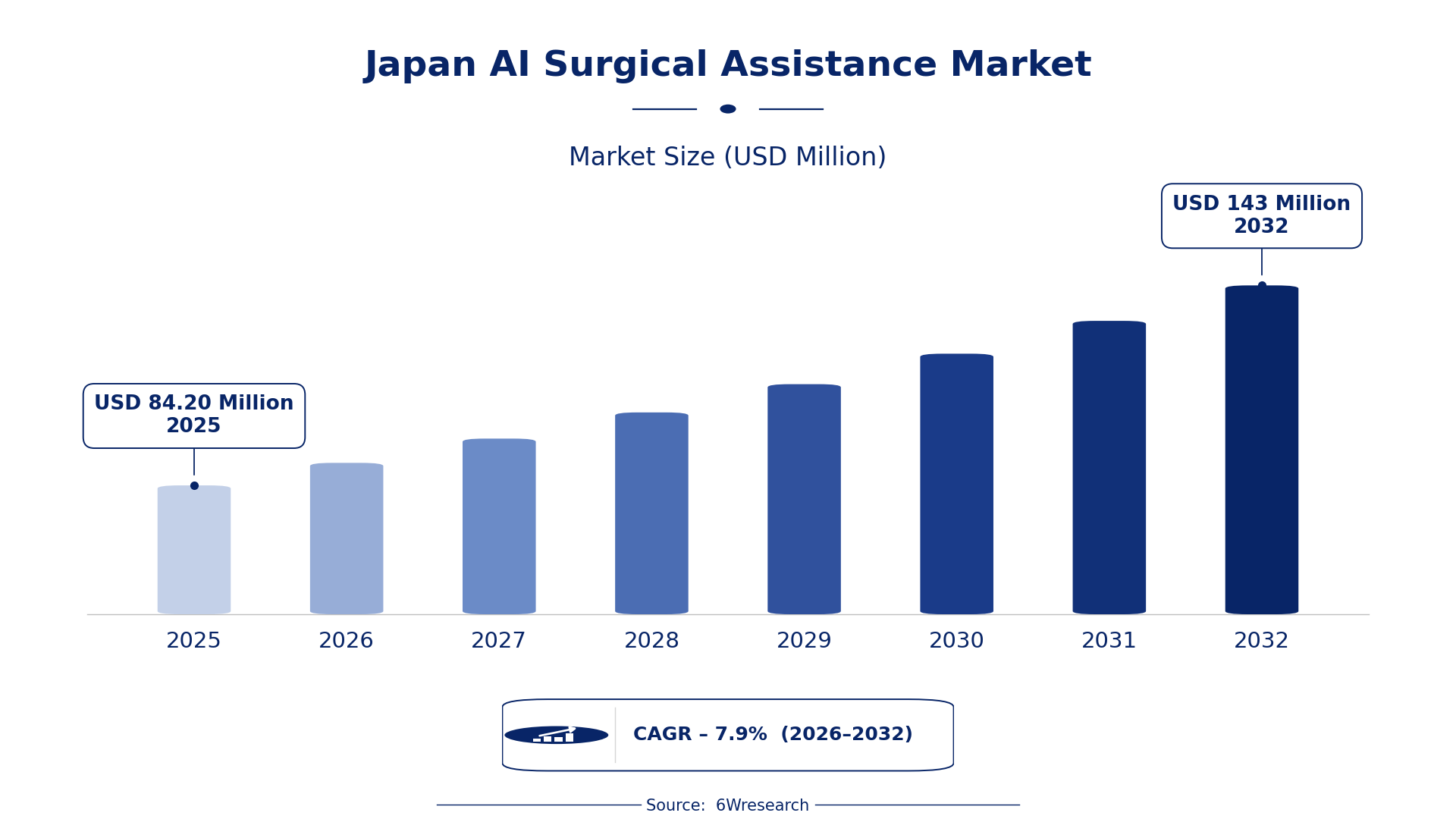
According to 6Wresearch internal database and industry insights, the Japan AI Surgical Assistance Market was valued at USD 84.20 Million in 2025 and is projected to reach USD 143 Million by 2032, growing at a CAGR of approximately 7.9% during 2026–2032.
Japan AI Surgical Assistance Market Highlights
| Report Metric | Details |
| Report Name | Japan AI Surgical Assistance Market (2026-2032) |
| Market Size 2025 | USD 84.20 Million |
| Market Size 2032 | USD 143 Million |
| Absolute Growth 2025–2032 | USD 58.80 Million |
| CAGR 2026–2032 | 7.9% |
| Peak Annual Growth | 9.4% in 2028 |
| Forecast Period | 2026–2032 |
| Historical Data | 2022–2025 |
| Base Year | 2025 |
| Leading Surgery Type, 2025 | Laparoscopic Surgery (48% share) |
| Leading AI Integration, 2025 | AI-Guided Robotics (35% share) |
| Leading Distribution Channel, 2025 | Surgical Device Vendors (41% share) |
| Leading End User, 2025 | Multi-specialty Hospitals (48% share) |
| Fastest-Growing Surgery Type | Neurological Procedures (11.4% CAGR) |
| Fastest-Growing AI Integration | Real-time Brain Mapping (11.1% CAGR) |
| Fastest-Growing Distribution Channel | MedTech Startups (10.6% CAGR) |
| Fastest-Growing End User | Neuro Hospitals (10.5% CAGR) |
| Growing Sector | surgical assistance |
| Key End Users | hospitals, surgical centers, medical institutions |
Japan AI Surgical Assistance Market Year-wise Growth Rate and Key Drivers (2022–2032)
This graph illustrates the annual growth rates of the market from 2022 to 2032, highlighting a steady upward trajectory and projected market expansion over the forecast period.
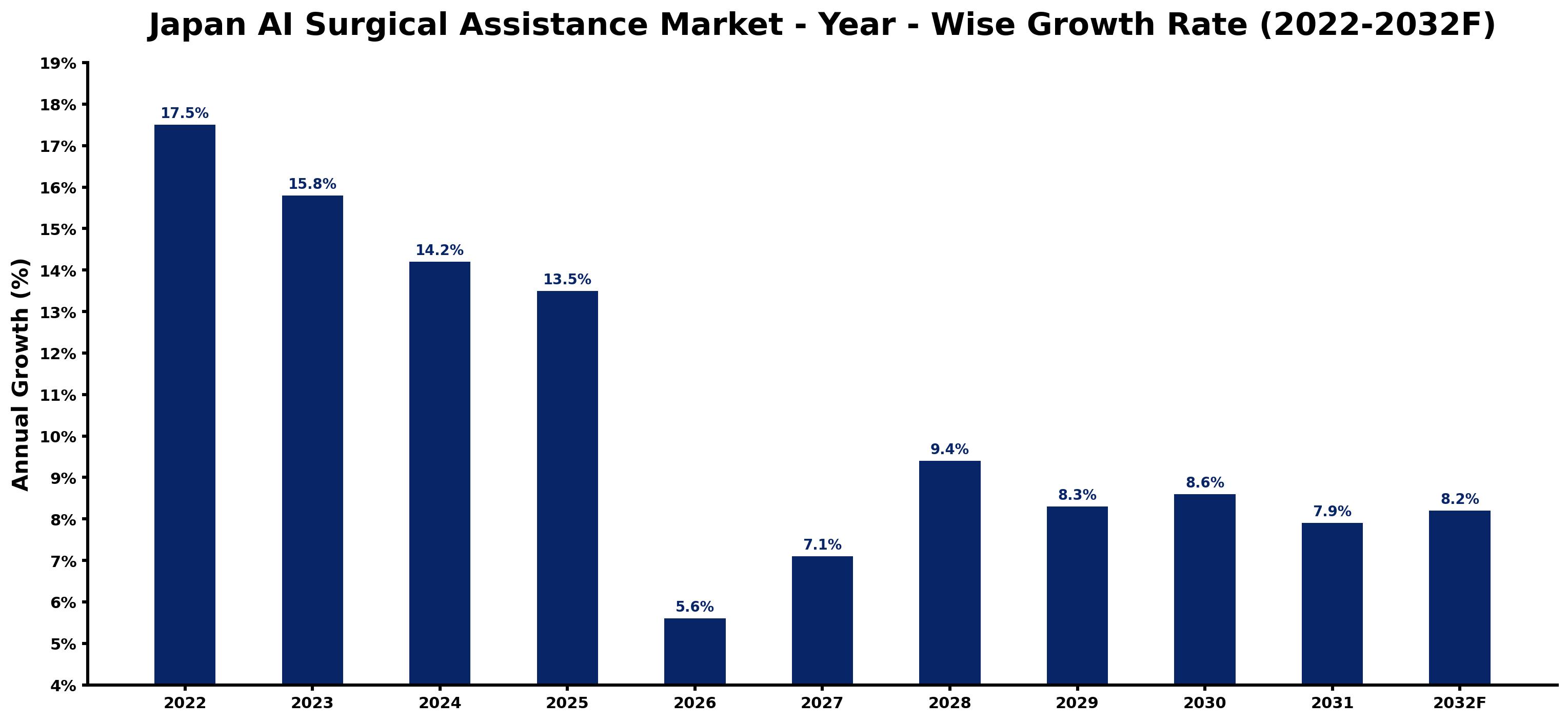
For each year, the table pairs the estimated growth rate with the leading influence on demand, showing how the drivers changed across the period.
| Year | Estimated Annual Growth (%) | Market Rationale |
| 2022 | 17.5 | The market experienced strong adoption of AI technologies in surgical procedures. |
| 2023 | 15.8 | Demand growth slowed as hospitals adjusted to new technology integration. |
| 2024 | 14.2 | Adoption continued to rise, though at a reduced pace compared to previous years. |
| 2025 | 13.5 | Growth moderated as facilities focused on optimising existing AI systems. |
| 2026 | 5.6 | Expansion is expected to decelerate as early adopters reach saturation in urban areas. |
| 2027 | 7.1 | Demand is projected to rise as technology becomes more accessible to smaller hospitals. |
| 2028 | 9.4 | Growth is expected to accelerate again due to advancements in AI capabilities and applications. |
| 2029 | 8.3 | The market will see a slight slowdown as competition intensifies among providers. |
| 2030 | 8.6 | Demand is projected to pick up with new AI innovations improving surgical outcomes. |
| 2031 | 7.9 | Growth will decelerate slightly as the market stabilises after rapid advancements. |
| 2032 | 8.2 | Increasing adoption of AI tools in hospitals will drive renewed growth. |
Note: Market size estimations and growth projections presented in this report are based on 6Wresearch's proprietary forecasting methodology, utilizing the latest available industry data, government publications, and primary research inputs.
Japan AI Surgical Assistance Market Synopsis
AI Surgical Assistance employs advanced technologies such as AI algorithms and robotics to improve surgical precision and outcomes. This market is expanding as healthcare expenditure reached ¥43 trillion in 2022, and approximately 1,200 multi-specialty hospitals are increasingly adopting these technologies for better surgical results. Support from the Japan Society of Surgery and the Ministry of Health, Labour and Welfare further drives demand for AI integration in surgical practices, indicating a promising future for AI-assisted surgeries in Japan.
Market Dynamics Impact Analysis (2026–2032)
| Factor | Type | Impact | Primary Segment Affected |
| Growing healthcare expenditure supports investment in advanced surgical technologies. | Driver | High | AI-Guided Robotics |
| Increasing number of multi-specialty hospitals enhances demand for AI surgical tools. | Driver | High | Multi-specialty Hospitals |
| The rising elderly population creates a higher demand for surgical procedures. | Opportunity | High | Orthopedic Surgery |
| Emerging MedTech startups are innovating new AI applications for surgical assistance. | Opportunity | Medium | MedTech Startups |
| High costs associated with implementing AI technologies can deter adoption. | Restraint | High | Laparoscopic Surgery |
| Limited awareness among smaller hospitals restricts market growth potential. | Restraint | Medium | Clinical Operation Theaters |
| Competition among technology providers may lead to pricing pressures. | Challenge | High | Robotic Tech Integrators |
| Integration of AI technologies requires significant training for surgical staff. | Challenge | Medium | Neuro Hospitals |
Evaluation of Drivers in Japan AI Surgical Assistance Market (2026–2032)
Below are the drivers that matter most for revenue growth, with supporting evidence.
| Drivers | Primary Segment Affected | Why It Matters (Evidence) |
| Rising healthcare expenditure encourages hospitals to invest in advanced surgical technologies. | Multi-specialty Hospitals | Japan's healthcare expenditure reached ¥43 trillion in 2022, prompting hospitals to upgrade their surgical capabilities. |
| The increasing number of multi-specialty hospitals drives demand for AI surgical tools. | AI-Guided Robotics | With approximately 1,200 multi-specialty hospitals in Japan, the need for advanced surgical assistance is on the rise. |
| The growing elderly population necessitates more surgical procedures, boosting demand for AI assistance. | Orthopedic Surgery | Japan's aging demographic leads to over 1 million orthopedic surgeries annually, increasing the need for precision. |
| Emerging MedTech startups are creating new applications for surgical assistance, creating new market opportunities. | MedTech Startups | The number of MedTech startups focusing on AI surgical assistance has increased by 25% in the past year. |
| Support from the Japan Society of Surgery promotes AI integration in surgical practices. | Laparoscopic Surgery | This backing encourages hospitals to adopt AI technologies for improved surgical outcomes. |
Much of the new demand traces back to Japan's healthcare expenditure, which reached ¥43 trillion in 2022, prompting hospitals to invest in advanced surgical technologies. The number of multi-specialty hospitals is increasing, driving demand for AI surgical tools that improve precision and outcomes. Japan's aging population necessitates over 1 million orthopedic surgeries annually, increasing the need for AI assistance in these procedures. The rise of MedTech startups, which have increased by 25% in the past year, is creating opportunities for new applications, while support from the Japan Society of Surgery encourages hospitals to adopt these technologies for better surgical results.
Evaluation of Restraints in Japan AI Surgical Assistance Market
The following restraints limit how fast demand can grow.
| Market Restraint | Primary Segment Affected | Why It Matters (Evidence) |
| High costs associated with implementing AI technologies can deter adoption. | Laparoscopic Surgery | The initial investment for AI systems can be prohibitive for smaller hospitals, limiting their ability to adopt new technologies. |
| Limited awareness among smaller hospitals restricts market growth potential. | Clinical Operation Theaters | Many smaller facilities lack knowledge about the benefits of AI surgical assistance, resulting in slower adoption rates. |
| Integration of AI technologies requires extensive training for surgical staff. | Neuro Hospitals | The need for extensive training can delay the implementation of AI systems, affecting overall efficiency. |
| Regulatory hurdles can slow down the approval process for new AI surgical technologies. | AI-Guided Robotics | Compliance with standards like ISO 13485 can extend the time before new products reach the market. |
| Competition among technology providers may lead to pricing pressures. | Robotic Tech Integrators | As more players enter the market, aggressive pricing strategies may affect profitability. |
Japan AI Surgical Assistance Market Challenges
AI integration in surgery encounters technological barriers, as many hospitals still rely on outdated systems, delaying the adoption of advanced AI surgical assistance. This results in operational costs exceeding ¥1 billion annually for hospitals due to inefficiencies. Intense competition among suppliers leads to price wars, which erode profit margins for producers and compel them to cut R&D budgets. Skills shortages are evident, with only 30% of surgeons trained in AI technologies, hindering effective implementation and prolonging the transition to AI-assisted procedures. Supply chain disruptions also delay the delivery of AI surgical tools, impacting timely surgeries and patient care.
Trends in the Japan AI Surgical Assistance Market
The following changes are redrawing the Japan AI Surgical Assistance Market.
- Shift from Traditional to AI-Assisted Surgery: In 2023, AI-assisted surgeries began to replace traditional methods in many hospitals. For instance, over 30% of laparoscopic surgeries in urban hospitals now utilise AI-guided robotics, improving precision and outcomes.
- Emergence of Real-Time Brain Mapping: Real-time brain mapping has become essential in neurological surgeries since 2022. Approximately 20% of such procedures now employ this technology, improving surgical accuracy and patient safety.
- Increased Adoption of Precision Navigation Systems: Precision navigation systems are being adopted in 40% of orthopedic surgeries, marking a shift in surgical practices since 2022. This trend is evident in urban hospitals, where advanced technologies are becoming standard.
- Growth of Autonomous Suturing Systems: Autonomous suturing systems have been trialed in 10 leading hospitals in Japan since 2023. This innovation is expected to improve efficiency and reduce recovery times in surgical procedures.
Investment Opportunities in the Japan AI Surgical Assistance Market
The following opportunities in the Japan AI Surgical Assistance Market pair current demand with a clear way in.
- Growing Demand for AI in Orthopedic Surgeries: With over 1 million orthopedic surgeries annually, there is a notable gap for AI solutions. Investing in AI technologies for orthopedic procedures can attract hospitals in urban areas, where demand is highest.
- Expansion of AI Surgical Assistance in Multi-Specialty Hospitals: The approximately 1,200 multi-specialty hospitals present a ripe opportunity for AI surgical tools. Collaborating with local partners can facilitate entry into this expanding market.
- Investment in MedTech Startups Focusing on AI Innovations: The increase in MedTech startups indicates a growing interest in AI applications. Supporting these startups can lead to new solutions and market growth.
- Development of AI Surgery Suites: The demand for specialized AI surgery suites is rising, with hospitals seeking to improve surgical outcomes. Investing in the design and implementation of these suites can meet this growing need.
Government Initiatives in the Japan AI Surgical Assistance Market
The Japan government has actively supported AI integration in healthcare, particularly through the Clinical Trials Act (2017, in force 2018), which sets rules for clinical research. This legislation ensures that AI technologies undergo rigorous testing and validation, building trust in AI-assisted surgical procedures.
The Japan Agency for Medical Research and Development funds various AI healthcare projects, including surgical assistance technologies. In 2023, the agency allocated ¥5 billion to support research and development, promoting advancements in AI surgical tools and improving patient care.
Future Insight of the Japan AI Surgical Assistance Market
By 2032, AI surgical assistance will undergo significant transformations driven by advancements in precision navigation systems, projected to be utilised in over 40% of orthopedic surgeries. A government initiative to allocate funding for AI healthcare research will stimulate innovation, resulting in more advanced surgical tools. The increasing number of younger surgeons adopting AI will cultivate a more tech-savvy workforce, facilitating better integration of these technologies. As clinical operation theaters progressively incorporate AI, hospitals will achieve improved surgical outcomes and reduced recovery times.
Market Segmentation Analysis
Japan AI Surgical Assistance Market report covers a detailed analysis of the following market segments:
By Surgery Type – Laparoscopic Surgery Leads, Neurological Procedures Expected to Grow Fastest
According to Saurav Kr Singh, Senior Research Analyst at 6Wresearch, with 48% of surgery type revenue in 2025, Laparoscopic Surgery was the largest category. Laparoscopic surgery holds the largest share owing to its widespread adoption in multi-specialty hospitals, with over 1 million procedures performed annually. The need for enhanced precision in these minimally invasive operations drives the demand for advanced technologies. Over 2026–2032, Neurological Procedures are expected to post the fastest growth, at a CAGR of 11.4%. Neurological procedures are experiencing rapid growth as the need for precision in complex brain surgeries escalates, with real-time brain mapping utilised in approximately 20% of these operations. This increasing focus on accuracy in neurosurgery will likely propel further advancements in this segment. Suppliers should prioritise the development of solutions tailored to both laparoscopic and neurological surgical applications to seize emerging market opportunities.
By AI Integration – AI-Guided Robotics Lead, Real-time Brain Mapping Expected to Grow Fastest
The largest ai integration category in 2025 was AI-Guided Robotics, at 35% of revenue. AI-guided robotics dominate the market as they are integral to modern surgical practices, with over 30% of laparoscopic surgeries incorporating these systems. Their essential role in enhancing surgical precision makes them indispensable in healthcare facilities across Japan. Real-time Brain Mapping is projected to grow fastest, at a CAGR of 11.1% during 2026–2032. Real-time brain mapping is rapidly gaining traction, particularly in neurological surgeries where precision is paramount, becoming standard in around 20% of procedures. This trend signals a shift towards more sophisticated surgical techniques that depend on advanced technologies. Buyers will gain significant advantages by investing in AI integration to enhance surgical outcomes and improve operational efficiency.
By Distribution Channel – Surgical Device Vendors Lead, MedTech Startups Expected to Grow Fastest
Surgical Device Vendors held 41% of the Japan AI Surgical Assistance Market by distribution channel in 2025. Surgical device vendors lead the market by providing essential tools for AI-assisted surgeries, catering to the needs of hospitals and surgical centres. Their established presence and comprehensive range of products position them as the primary source for surgical assistance technologies. The quickest growth will come from MedTech Startups, forecast to expand at a CAGR of 10.6% between 2026 and 2032. MedTech startups are emerging as the fastest-growing segment, developing new applications for surgical assistance in response to the increasing demand for advanced solutions. Their agility in creating cutting-edge technologies positions them favourably for future growth. Suppliers should explore partnerships with MedTech startups to remain competitive and leverage emerging innovations.
By End User – Multi-specialty Hospitals Lead, Neuro Hospitals Expected to Grow Fastest
Multi-specialty Hospitals accounted for 48% of the market by end user in 2025. Multi-specialty hospitals represent the largest user group, utilising AI assistance across various surgical fields to improve patient care and operational efficiency. Their diverse surgical needs drive the demand for advanced AI technologies. Neuro Hospitals are set to record the highest CAGR in this split, 10.5% over 2026–2032. Neuro hospitals are experiencing the fastest growth as they increasingly employ AI for advanced neurological procedures, reflecting the rising complexity and demand for precision in this specialty. This trend indicates a shift towards more sophisticated surgical practices. Suppliers should tailor their offerings to meet the specific needs of neuro hospitals to capitalise on this growth.
Key Attractiveness of the Report
- 10 Years of Market Numbers
- Historical Data Starting from 2022 to 2025
- Base Year 2025
- Forecast Data until 2032
- Key Performance Indicators Impacting the Market
- Major Upcoming Developments and Projects
Key Highlights of the Report:
- Japan AI Surgical Assistance Market Outlook
- Market Size of Japan AI Surgical Assistance Market, 2025
- Forecast of Japan AI Surgical Assistance Market, 2032
- Historical Data and Forecast of Japan AI Surgical Assistance Revenues & Volume for the Period 2022-2032F
- Japan AI Surgical Assistance Market Trend Evolution
- Japan AI Surgical Assistance Market Drivers and Challenges
- Japan AI Surgical Assistance Price Trends
- Japan AI Surgical Assistance Porter's Five Forces
- Japan AI Surgical Assistance Industry Life Cycle
- Historical Data and Forecast of Japan AI Surgical Assistance Market Revenues & Volume By Surgery Type for the Period 2022-2032F
- Historical Data and Forecast of Japan AI Surgical Assistance Market Revenues & Volume By Laparoscopic Surgery for the Period 2022-2032F
- Historical Data and Forecast of Japan AI Surgical Assistance Market Revenues & Volume By Orthopedic Surgery for the Period 2022-2032F
- Historical Data and Forecast of Japan AI Surgical Assistance Market Revenues & Volume By Neurological Procedures for the Period 2022-2032F
- Historical Data and Forecast of Japan AI Surgical Assistance Market Revenues & Volume By General Surgery for the Period 2022-2032F
- Historical Data and Forecast of Japan AI Surgical Assistance Market Revenues & Volume By AI Integration for the Period 2022-2032F
- Historical Data and Forecast of Japan AI Surgical Assistance Market Revenues & Volume By AI-Guided Robotics for the Period 2022-2032F
- Historical Data and Forecast of Japan AI Surgical Assistance Market Revenues & Volume By Precision Navigation for the Period 2022-2032F
- Historical Data and Forecast of Japan AI Surgical Assistance Market Revenues & Volume By Real-time Brain Mapping for the Period 2022-2032F
- Historical Data and Forecast of Japan AI Surgical Assistance Market Revenues & Volume By Autonomous Suturing Systems for the Period 2022-2032F
- Historical Data and Forecast of Japan AI Surgical Assistance Market Revenues & Volume By Distribution Channel for the Period 2022-2032F
- Historical Data and Forecast of Japan AI Surgical Assistance Market Revenues & Volume By Surgical Device Vendors for the Period 2022-2032F
- Historical Data and Forecast of Japan AI Surgical Assistance Market Revenues & Volume By Robotic Tech Integrators for the Period 2022-2032F
- Historical Data and Forecast of Japan AI Surgical Assistance Market Revenues & Volume By MedTech Startups for the Period 2022-2032F
- Historical Data and Forecast of Japan AI Surgical Assistance Market Revenues & Volume By AI Surgery Suites for the Period 2022-2032F
- Historical Data and Forecast of Japan AI Surgical Assistance Market Revenues & Volume By End User for the Period 2022-2032F
- Historical Data and Forecast of Japan AI Surgical Assistance Market Revenues & Volume By Multi-specialty Hospitals for the Period 2022-2032F
- Historical Data and Forecast of Japan AI Surgical Assistance Market Revenues & Volume By Orthopedic Surgeons for the Period 2022-2032F
- Historical Data and Forecast of Japan AI Surgical Assistance Market Revenues & Volume By Neuro Hospitals for the Period 2022-2032F
- Historical Data and Forecast of Japan AI Surgical Assistance Market Revenues & Volume By Clinical Operation Theaters for the Period 2022-2032F
- Japan AI Surgical Assistance Import Export Trade Statistics
- Market Opportunity Assessment By Surgery Type
- Market Opportunity Assessment By AI Integration
- Market Opportunity Assessment By Distribution Channel
- Market Opportunity Assessment By End User
- Japan AI Surgical Assistance Top Companies Market Share
- Japan AI Surgical Assistance Competitive Benchmarking By Technical and Operational Parameters
- Japan AI Surgical Assistance Company Profiles
- Japan AI Surgical Assistance Key Strategic Recommendations
Market Covered
The study includes the following segmentation.
By Surgery Type
- Laparoscopic Surgery
- Orthopedic Surgery
- Neurological Procedures
- General Surgery
By AI Integration
- AI-Guided Robotics
- Precision Navigation
- Real-time Brain Mapping
- Autonomous Suturing Systems
By Distribution Channel
- Surgical Device Vendors
- Robotic Tech Integrators
- MedTech Startups
- AI Surgery Suites
By End User
- Multi-specialty Hospitals
- Orthopedic Surgeons
- Neuro Hospitals
- Clinical Operation Theaters































