Japan AI Threat Detection Market Size & Growth Rate
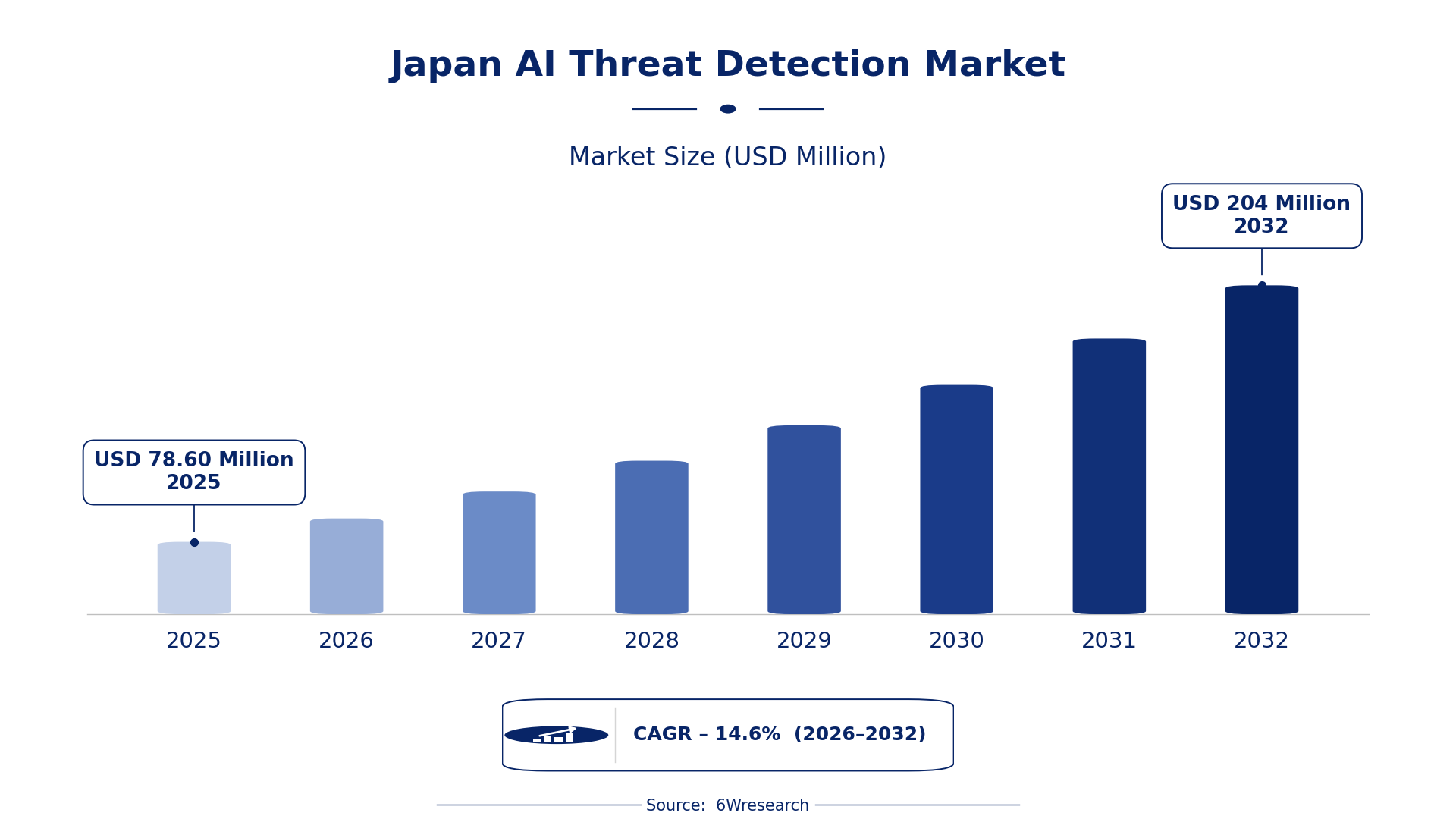
According to 6Wresearch internal database and industry insights, the Japan AI Threat Detection Market was valued at USD 78.60 Million in 2025 and is projected to reach USD 204 Million by 2032, growing at a CAGR of approximately 14.6% during 2026–2032.
Japan AI Threat Detection Market Highlights
| Report Metric | Details |
| Report Name | Japan AI Threat Detection Market (2026-2032) |
| Market Size 2025 | USD 78.60 Million |
| Market Size 2032 | USD 204 Million |
| Absolute Growth 2025–2032 | USD 125.40 Million |
| CAGR 2026–2032 | 14.6% |
| Peak Annual Growth | 20.0% in 2027 |
| Forecast Period | 2026–2032 |
| Historical Data | 2022–2025 |
| Base Year | 2025 |
| Leading Threat Type, 2025 | Network Intrusions (46% share) |
| Leading AI Detection Feature, 2025 | Anomaly Detection (41% share) |
| Leading Distribution Channel, 2025 | Cybersecurity Platforms (42% share) |
| Leading End User, 2025 | Banks & Payment Gateways (44% share) |
| Fastest-Growing Threat Type | Insider Threat Monitoring (19.9% CAGR) |
| Fastest-Growing AI Detection Feature | Behavior Analytics (18.1% CAGR) |
| Fastest-Growing Distribution Channel | Security SaaS Providers (18.5% CAGR) |
| Fastest-Growing End User | IT Security Teams (18.2% CAGR) |
| Growing Sector | Cybersecurity |
| Key End Users | Banks, IT Security Teams, Corporations, Enterprises |
Japan AI Threat Detection Market Year-wise Growth Rate and Key Drivers (2022–2032)
This graph illustrates the annual growth rates of the market from 2022 to 2032, highlighting a steady upward trajectory and projected market expansion over the forecast period.
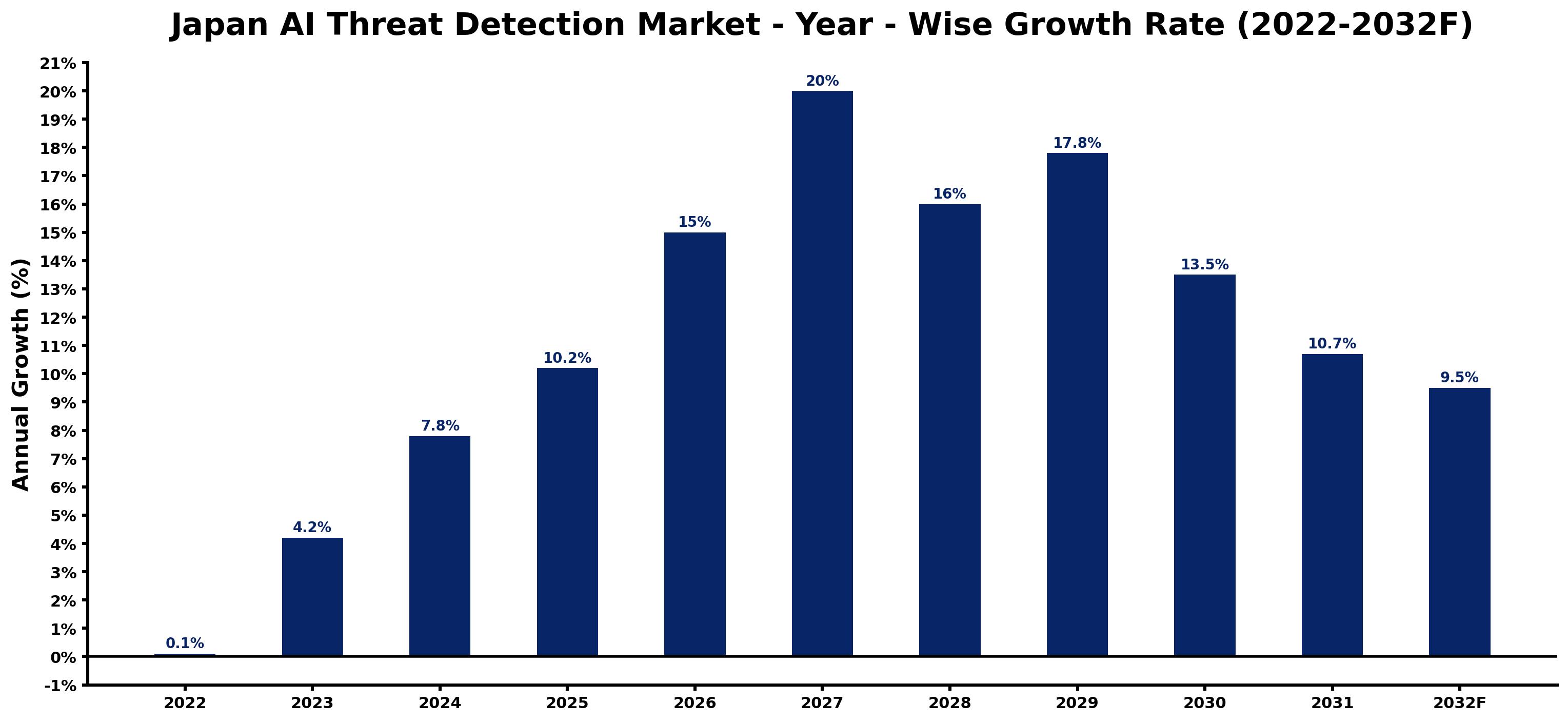
The following figures match every annual growth estimate with the main market development of that year, giving the reasoning behind each rise or slowdown.
| Year | Estimated Annual Growth (%) | Market Rationale |
| 2022 | 0.1 | The market exhibited minimal growth, reflecting initial adoption phases among users. |
| 2023 | 4.2 | Growth accelerated as cybersecurity awareness increased among financial institutions. |
| 2024 | 7.8 | Demand rose further due to rising cyber threats and regulatory pressures. |
| 2025 | 10.2 | The market reached a historical peak as businesses invested heavily in security solutions. |
| 2026 | 15.0 | Growth continued as companies upgraded their cybersecurity infrastructure in response to threats. |
| 2027 | 20.0 | Demand peaked with substantial investments in advanced AI technologies for threat detection. |
| 2028 | 16.0 | Growth slowed slightly as market saturation began to affect new investments. |
| 2029 | 17.8 | A renewed focus on emerging threats spurred faster growth again in the market. |
| 2030 | 13.5 | Growth decelerated as companies reassessed their cybersecurity strategies and budgets. |
| 2031 | 10.7 | The market continued to grow but at a slower pace due to increased competition. |
| 2032 | 9.5 | Growth further slowed as the market stabilised and matured. |
Note: Market size estimations and growth projections presented in this report are based on 6Wresearch's proprietary forecasting methodology, utilizing the latest available industry data, government publications, and primary research inputs.
Japan AI Threat Detection Market Synopsis
AI Threat Detection employs advanced algorithms and machine learning to identify security threats in real-time, protecting networks from intrusions and detecting fraudulent transactions. The Japan AI Threat Detection Market is experiencing growth driven by heightened awareness, particularly in the finance and IT sectors. In 2023, Japan's cybersecurity market was valued at approximately 1 trillion yen, with over 10 million reported cyber incidents, indicating a pressing need for effective security solutions. The Tokyo region stands out as a hub for innovation and investment in cybersecurity technologies.
Market Dynamics Impact Analysis (2026–2032)
| Factor | Type | Impact | Primary Segment Affected |
| Increasing cyber incidents drive demand for real-time threat detection solutions. | Driver | High | Network Intrusions |
| Growing investment in cybersecurity technologies enhances protection against threats. | Driver | High | Fraudulent Transactions |
| The rise in cyber threats presents opportunities for new AI detection solutions. | Opportunity | High | Malware & Ransomware |
| Investment in cybersecurity startups is expanding the market for innovative solutions. | Opportunity | High | Insider Threat Monitoring |
| Shortage of skilled cybersecurity professionals limits the market's growth potential. | Restraint | High | Network Intrusions |
| High costs associated with implementing advanced AI systems can deter investment. | Restraint | Medium | Fraudulent Transactions |
| Rapid technological changes can lead to obsolescence of existing solutions. | Challenge | High | Malware & Ransomware |
| Intense competition among cybersecurity firms can drive down profit margins. | Challenge | Medium | Insider Threat Monitoring |
Evaluation of Drivers in Japan AI Threat Detection Market (2026–2032)
The table below links each growth driver to the segment it affects and the evidence for it.
| Drivers | Primary Segment Affected | Why It Matters (Evidence) |
| Increased cyber incidents are prompting businesses to invest in AI threat detection systems. | Network Intrusions | In 2023, Japan reported over 10 million cyber incidents, highlighting the urgent need for effective security. |
| Growing awareness of cybersecurity risks among financial institutions is driving demand. | Fraudulent Transactions | The financial sector is investing in AI solutions to protect against fraud, given the rising number of incidents. |
| Regulatory requirements are pushing companies to adopt advanced cybersecurity measures. | Malware & Ransomware | The Cybersecurity Strategy of 2021 mandates stricter compliance for businesses, leading to increased investments. |
| The expansion of cybersecurity startups is driving innovation in threat detection solutions. | Insider Threat Monitoring | Government initiatives support cybersecurity startups, enhancing the local market. |
| Investment in IT infrastructure is rising, leading to greater demand for cybersecurity solutions. | Anomaly Detection | With Japan's cybersecurity market valued at approximately 1 trillion yen in 2023, companies are prioritising security investments. |
Buyers are adding capacity as the Tokyo region emerges as a hub for cybersecurity innovation. In 2023, Japan experienced over 10 million reported cyber incidents, prompting businesses to invest in AI threat detection systems. The financial sector is increasingly prioritising advanced security measures, with the cybersecurity market valued at approximately 1 trillion yen. Compliance requirements compel companies to adopt effective solutions, while support for cybersecurity startups enhances innovation, driving demand for effective threat detection technologies.
Evaluation of Restraints in Japan AI Threat Detection Market
The key brakes on demand, and where they bite hardest, are shown below.
| Market Restraint | Primary Segment Affected | Why It Matters (Evidence) |
| The shortage of skilled cybersecurity professionals limits the effectiveness of threat detection systems. | Network Intrusions | With an estimated 300,000 cybersecurity professionals by 2025, demand still outpaces supply, affecting implementation. |
| High costs of advanced AI systems deter smaller firms from investing in cybersecurity. | Fraudulent Transactions | Many SMEs struggle to allocate budgets for sophisticated threat detection solutions, limiting market reach. |
| Rapid technological advancements can render existing solutions obsolete quickly. | Malware & Ransomware | As technology evolves, companies face challenges in keeping their systems updated and effective. |
| Intense competition among cybersecurity firms can lead to price wars, affecting profitability. | Insider Threat Monitoring | With numerous players in the market, firms may lower prices to attract clients, impacting margins. |
| Complex regulatory compliance requirements can slow down the adoption of new technologies. | Anomaly Detection | Companies must navigate stringent regulations, which can delay implementation of advanced security measures. |
Japan AI Threat Detection Market Challenges
Regulatory requirements from the Financial Services Agency impose rigorous compliance processes, causing delays of up to six months for financial institutions seeking AI threat detection solutions. Intense competition in the Tokyo region drives many cybersecurity firms to lower prices, which can reduce profit margins for producers and limit their ability to invest in advanced technologies. Technology gaps persist as numerous suppliers lack essential machine learning expertise, resulting in inadequate threat detection that fails to meet buyer expectations. High development costs for AI algorithms burden smaller firms, restricting their product offerings and reducing choices for buyers.
Trends in the Japan AI Threat Detection Market
These developments are changing demand patterns in the Japan AI Threat Detection Market.
- Shift from Traditional Security to AI-Driven Solutions: Since 2021, financial institutions have increasingly adopted AI-driven solutions for threat detection, with 44% of banks investing in such technologies. This shift improves their ability to respond to emerging threats.
- Transition from Reactive to Proactive Threat Management: In 2022, IT security teams began implementing measures to identify threats before they materialise. This approach is exemplified by the adoption of predictive models, which are becoming standard in many organisations.
- Emergence of Cybersecurity Startups in Tokyo: In 2023, the Tokyo Metropolitan Government's initiatives to support cybersecurity startups led to a surge in new firms entering the market, contributing to innovation and competition in the sector.
- Growing Importance of Compliance with Cybersecurity Standards: Since the implementation of ISO/IEC 27001, companies have increasingly prioritised compliance, with a substantial rise in certifications among financial institutions, reflecting a commitment to effective security practices.
Investment Opportunities in the Japan AI Threat Detection Market
The following areas offer the clearest openings for investors and suppliers in the Japan AI Threat Detection Market.
- Partnerships with Cybersecurity Startups: With over 10 million cyber incidents reported in 2023, there is a pressing need for effective solutions. Collaborating with cybersecurity startups in Tokyo can provide access to advanced technologies.
- Investment in AI Threat Detection Technologies: As Japan's cybersecurity market approaches 1 trillion yen, investing in AI threat detection solutions presents a valuable opportunity for firms looking to improve security measures.
- Expansion into the Financial Services Sector: Given the substantial demand from banks and payment gateways, companies can focus on developing tailored solutions for this sector to capture a larger market share.
- Utilising Government Support for Cybersecurity Initiatives: The Tokyo Metropolitan Government's initiatives to support startups provide an opportunity for firms to enter the market through partnerships or joint ventures.
Government Initiatives in the Japan AI Threat Detection Market
The Digital Agency, established in September 2021, enhances the framework for cybersecurity by leading government digital transformation and setting common system standards. This initiative complements the Industrial Standardization Act, which governs product and test standards, ensuring that AI threat detection solutions meet rigorous safety and security requirements. The focus on standardisation is critical for building trust among users and fostering wider adoption across sectors.
The Information-Technology Promotion Agency provides resources and guidelines for cybersecurity practices, approving various initiatives aimed at strengthening the cybersecurity infrastructure. In 2023, it funded over 100 projects to enhance cybersecurity measures within SMEs, reflecting a commitment to improving national security and supporting the growth of the AI threat detection market.
Future Insight of the Japan AI Threat Detection Market
Advanced machine learning techniques will reshape demand for AI threat detection by 2032, enabling faster and more accurate threat identification. The programme initiated by the Ministry of Economy, Trade and Industry in 2022 will drive cybersecurity improvements in SMEs, expanding the market potential. By 2025, the anticipated workforce of over 300,000 cybersecurity professionals will support ongoing innovation and development. Adoption of ISO/IEC 27001 will standardise practices, ensuring buyers receive reliable and effective cybersecurity solutions.
Market Segmentation Analysis
Japan AI Threat Detection Market report covers a detailed analysis of the following market segments:
By Threat Type – Network Intrusions Lead, Insider Threat Monitoring Expected to Grow Fastest
According to Saurav Kr Singh, Senior Research Analyst at 6Wresearch, Network Intrusions took 46% of threat type revenue in 2025, more than any other category. Network intrusions are a critical concern for protecting digital infrastructure, particularly in the finance sector where sensitive data is at risk. The high frequency of attacks necessitates advanced solutions to safeguard operations and maintain trust. Over 2026–2032, Insider Threat Monitoring is expected to post the fastest growth, at a CAGR of 19.9%. Insider threat monitoring is gaining traction as organisations recognise the importance of addressing internal risks, especially in environments handling sensitive information. The alarming figure of over 10 million cyber incidents in 2023 has heightened the focus on enhancing internal security protocols. Suppliers should develop comprehensive solutions that address both external and internal threats to align with market demands.
By AI Detection Feature – Anomaly Detection Leads, Behavior Analytics Expected to Grow Fastest
In 2025, Anomaly Detection led the ai detection feature split with a 41% share. Anomaly detection is essential for identifying unusual patterns in data, making it a vital component of threat detection strategies. Its widespread adoption across various sectors underscores its importance in maintaining effective security measures. Behavior Analytics is projected to grow fastest, at a CAGR of 18.1% during 2026–2032. Behaviour analytics is rapidly gaining traction as organisations aim to understand user actions to proactively identify potential threats. This method is particularly beneficial in sectors managing sensitive data, contributing to its swift implementation. Buyers need to prioritise advanced analytics capabilities to strengthen their security frameworks and effectively mitigate risks.
By Distribution Channel – Cybersecurity Platforms Lead, Security SaaS Providers Expected to Grow Fastest
The largest distribution channel category in 2025 was Cybersecurity Platforms, at 42% of revenue. Cybersecurity platforms serve as the primary delivery method for threat detection solutions, offering essential protection for users. Their established presence in the market makes them the preferred choice for organisations seeking reliable security measures. The quickest growth will come from Security SaaS Providers, forecast to expand at a CAGR of 18.5% between 2026 and 2032. Security SaaS providers are experiencing rapid growth as businesses increasingly prefer cloud-based solutions for their flexibility and scalability. This trend is particularly notable among small and medium enterprises seeking cost-effective security options. Suppliers should concentrate on developing cloud-based offerings to meet the rising demand from diverse business sizes.
By End User – Banks & Payment Gateways Lead, IT Security Teams Expected to Grow Fastest
With 44% of end user revenue in 2025, Banks & Payment Gateways was the largest category. Banks and payment gateways are significant end-users of cybersecurity solutions due to their management of sensitive financial data. Their substantial investments in security reflect the critical need to protect customer information and maintain trust within the industry. IT Security Teams are set to record the highest CAGR in this split, 18.2% over 2026–2032. IT security teams are increasingly adopting advanced threat detection technologies to combat the rising sophistication of cyber threats. Their proactive approach is essential for ensuring organisational security in an ever-evolving threat landscape. Suppliers must customise their solutions to address the specific requirements of financial institutions and IT security teams to seize market opportunities.
Key Attractiveness of the Report
- 10 Years of Market Numbers
- Historical Data Starting from 2022 to 2025
- Base Year 2025
- Forecast Data until 2032
- Key Performance Indicators Impacting the Market
- Major Upcoming Developments and Projects
Key Highlights of the Report:
- Japan AI Threat Detection Market Outlook
- Market Size of Japan AI Threat Detection Market, 2025
- Forecast of Japan AI Threat Detection Market, 2032
- Historical Data and Forecast of Japan AI Threat Detection Revenues & Volume for the Period 2022-2032F
- Japan AI Threat Detection Market Trend Evolution
- Japan AI Threat Detection Market Drivers and Challenges
- Japan AI Threat Detection Price Trends
- Japan AI Threat Detection Porter's Five Forces
- Japan AI Threat Detection Industry Life Cycle
- Historical Data and Forecast of Japan AI Threat Detection Market Revenues & Volume By Threat Type for the Period 2022-2032F
- Historical Data and Forecast of Japan AI Threat Detection Market Revenues & Volume By Network Intrusions for the Period 2022-2032F
- Historical Data and Forecast of Japan AI Threat Detection Market Revenues & Volume By Fraudulent Transactions for the Period 2022-2032F
- Historical Data and Forecast of Japan AI Threat Detection Market Revenues & Volume By Malware & Ransomware for the Period 2022-2032F
- Historical Data and Forecast of Japan AI Threat Detection Market Revenues & Volume By Insider Threat Monitoring for the Period 2022-2032F
- Historical Data and Forecast of Japan AI Threat Detection Market Revenues & Volume By AI Detection Feature for the Period 2022-2032F
- Historical Data and Forecast of Japan AI Threat Detection Market Revenues & Volume By Anomaly Detection for the Period 2022-2032F
- Historical Data and Forecast of Japan AI Threat Detection Market Revenues & Volume By Predictive Models for the Period 2022-2032F
- Historical Data and Forecast of Japan AI Threat Detection Market Revenues & Volume By Pattern Recognition for the Period 2022-2032F
- Historical Data and Forecast of Japan AI Threat Detection Market Revenues & Volume By Behavior Analytics for the Period 2022-2032F
- Historical Data and Forecast of Japan AI Threat Detection Market Revenues & Volume By Distribution Channel for the Period 2022-2032F
- Historical Data and Forecast of Japan AI Threat Detection Market Revenues & Volume By Cybersecurity Platforms for the Period 2022-2032F
- Historical Data and Forecast of Japan AI Threat Detection Market Revenues & Volume By Fintech Solutions for the Period 2022-2032F
- Historical Data and Forecast of Japan AI Threat Detection Market Revenues & Volume By Antivirus Suites for the Period 2022-2032F
- Historical Data and Forecast of Japan AI Threat Detection Market Revenues & Volume By Security SaaS Providers for the Period 2022-2032F
- Historical Data and Forecast of Japan AI Threat Detection Market Revenues & Volume By End User for the Period 2022-2032F
- Historical Data and Forecast of Japan AI Threat Detection Market Revenues & Volume By IT Security Teams for the Period 2022-2032F
- Historical Data and Forecast of Japan AI Threat Detection Market Revenues & Volume By Banks & Payment Gateways for the Period 2022-2032F
- Historical Data and Forecast of Japan AI Threat Detection Market Revenues & Volume By Enterprises for the Period 2022-2032F
- Historical Data and Forecast of Japan AI Threat Detection Market Revenues & Volume By Corporations for the Period 2022-2032F
- Japan AI Threat Detection Import Export Trade Statistics
- Market Opportunity Assessment By Threat Type
- Market Opportunity Assessment By AI Detection Feature
- Market Opportunity Assessment By Distribution Channel
- Market Opportunity Assessment By End User
- Japan AI Threat Detection Top Companies Market Share
- Japan AI Threat Detection Competitive Benchmarking By Technical and Operational Parameters
- Japan AI Threat Detection Company Profiles
- Japan AI Threat Detection Key Strategic Recommendations
Market Covered
The report covers the following segments.
By Threat Type
- Network Intrusions
- Fraudulent Transactions
- Malware & Ransomware
- Insider Threat Monitoring
By AI Detection Feature
- Anomaly Detection
- Predictive Models
- Pattern Recognition
- Behavior Analytics
By Distribution Channel
- Cybersecurity Platforms
- Fintech Solutions
- Antivirus Suites
- Security SaaS Providers
By End User
- IT Security Teams
- Banks & Payment Gateways
- Enterprises
- Corporations































