Japan Augmented Reality in BFSI Market Size & Growth Rate
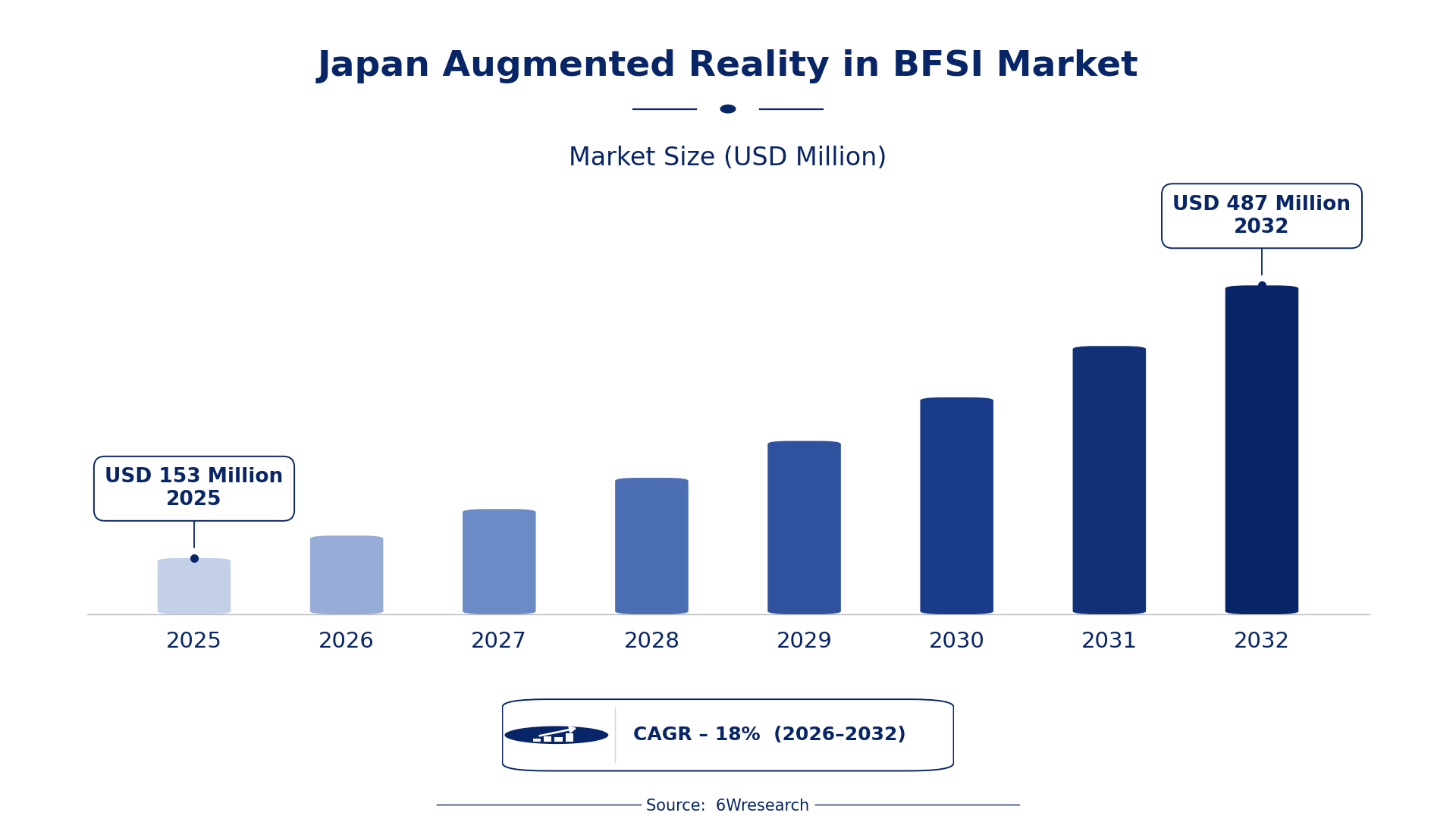
According to 6Wresearch internal database and industry insights, the Japan Augmented Reality in BFSI Market was valued at USD 153 Million in 2025 and is projected to reach USD 487 Million by 2032, growing at a CAGR of approximately 18% during 2026–2032.
Japan Augmented Reality in BFSI Market Highlights
| Report Metric | Details |
| Report Name | Japan Augmented Reality in BFSI Market (2026-2032) |
| Market Size 2025 | USD 153 Million |
| Market Size 2032 | USD 487 Million |
| Absolute Growth 2025–2032 | USD 334 Million |
| CAGR 2026–2032 | 18% |
| Peak Annual Growth | 20.5% in 2032 |
| Forecast Period | 2026–2032 |
| Historical Data | 2022–2025 |
| Base Year | 2025 |
| Leading Technology Type, 2025 | AR Technology (56% share) |
| Leading Application, 2025 | Banking (46% share) |
| Leading End User, 2025 | Customer Experience (44% share) |
| Leading Functionality, 2025 | Visualization (44% share) |
| Fastest-Growing Technology Type | Virtual Reality (25.0% CAGR) |
| Fastest-Growing Application | Financial Services (20.6% CAGR) |
| Fastest-Growing End User | Retail Banking (20.5% CAGR) |
| Fastest-Growing Functionality | Data Visualization (19.4% CAGR) |
| Growing Sector | Banking |
| Key End Users | Banks, Financial Institutions, Educational Institutions, Insurance Providers |
Japan Augmented Reality in BFSI Market Year-wise Growth Rate and Key Drivers (2022–2032)
This graph illustrates the annual growth rates of the market from 2022 to 2032, highlighting a steady upward trajectory and projected market expansion over the forecast period.
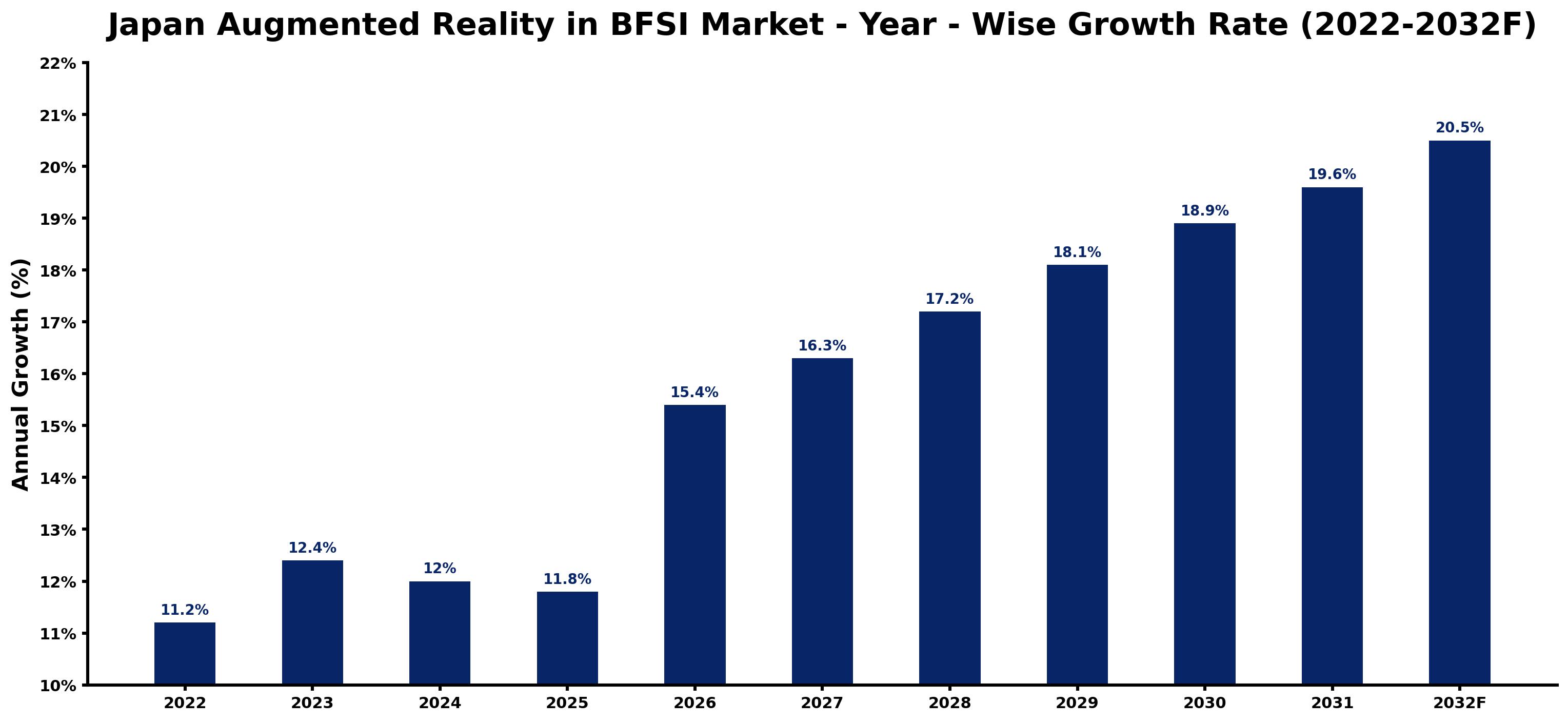
The yearly estimates that follow link every growth rate to its principal driver, so readers can see why the pace changed in each period.
| Year | Estimated Annual Growth (%) | Market Rationale |
| 2022 | 11.2 | The market experienced stable growth due to increasing interest in AR technologies among financial institutions. |
| 2023 | 12.4 | Growth accelerated as major banks adopted AR for customer engagement and service improvement. |
| 2024 | 12.0 | Growth slowed slightly as some banks reassessed their AR investments amid changing market conditions. |
| 2025 | 11.8 | The market continued to grow, driven by ongoing digital transformation efforts in the BFSI sector. |
| 2026 | 15.4 | Growth is expected to pick up as AR applications become more integrated into mobile banking platforms. |
| 2027 | 16.3 | Demand is projected to increase further as customer experience initiatives expand across the sector. |
| 2028 | 17.2 | The rise in AR adoption is expected to continue, with more financial services improving user interaction. |
| 2029 | 18.1 | Growth is anticipated to remain strong as banks focus on improving customer engagement through AR tools. |
| 2030 | 18.9 | The market is projected to see continued expansion as the technology becomes standard in customer service. |
| 2031 | 19.6 | Growth is expected to accelerate as financial institutions invest heavily in AR for data visualization. |
| 2032 | 20.5 | The peak growth rate is projected as AR becomes essential for customer interaction in BFSI. |
Note: Market size estimations and growth projections presented in this report are based on 6Wresearch's proprietary forecasting methodology, utilizing the latest available industry data, government publications, and primary research inputs.
Japan Augmented Reality in BFSI Market Synopsis
Augmented Reality in BFSI is a technology that overlays digital information onto real-world environments, improving visualization of financial data and creating interactive experiences for users. The Japan Augmented Reality in BFSI Market is expanding rapidly, driven by growing adoption among banks and financial services, with customer satisfaction improving by 20% due to AR applications. The ongoing digital transformation strategy launched by the Japanese government further fuels this demand, positioning the market for strong growth in the coming years.
Market Dynamics Impact Analysis (2026–2032)
| Factor | Type | Impact | Primary Segment Affected |
| Increasing adoption of AR technologies by banks to enhance customer experience and engagement | Driver | High | Customer Experience |
| Integration of AR into mobile banking applications to improve user interaction | Driver | High | Banking |
| Growing demand for AR solutions in financial literacy programs to simplify complex products | Opportunity | High | Financial Services |
| Expansion of AR applications in retail banking to attract younger customers | Opportunity | High | Retail Banking |
| Challenges in standardising AR usability across different platforms and devices | Restraint | Medium | Visualization |
| High costs associated with developing and implementing AR solutions for financial institutions | Restraint | Medium | Data Visualization |
| Limited understanding of AR technology among smaller financial institutions | Challenge | High | Customer Engagement |
| Competition from other digital technologies that may overshadow AR applications | Challenge | Medium | Insurance |
Evaluation of Drivers in Japan Augmented Reality in BFSI Market (2026–2032)
Below are the drivers that matter most for revenue growth, with supporting evidence.
| Drivers | Primary Segment Affected | Why It Matters (Evidence) |
| Increased customer engagement through AR applications | Customer Experience | Customer satisfaction in banking improved by 20% due to AR applications, prompting banks to invest more. |
| Integration of AR in mobile banking apps | Banking | AR technology is being integrated into mobile banking apps to improve user experience. |
| Improved financial literacy through AR | Financial Services | Financial literacy programs are increasingly adopting AR to improve understanding of complex products. |
| Focus on enhancing customer interaction in retail banking | Retail Banking | The average customer engagement time in retail banking has increased by 15% with AR tools. |
| Growing demand for visualization of financial data | Visualization | AR improves the visualization of financial data, making it easier for customers to understand. |
Orders keep climbing as financial institutions increasingly adopt Augmented Reality to improve customer engagement. In 2023, customer satisfaction in banking improved by 20% due to AR applications, prompting banks to invest more in this technology. The integration of AR into mobile banking apps is improving user experience, with average engagement times increasing by 15%. AR is essential for visualising financial data, making it easier for customers to comprehend their financial situations.
Evaluation of Restraints in Japan Augmented Reality in BFSI Market
The key brakes on demand, and where they bite hardest, are shown below.
| Market Restraint | Primary Segment Affected | Why It Matters (Evidence) |
| Challenges in standardising AR usability across different platforms | Visualization | The ISO 9241 standard is relevant to usability in AR applications, making compliance complex for developers. |
| High costs associated with AR development | Data Visualization | The implementation of AR solutions requires substantial investment, which can deter smaller financial institutions. |
| Limited understanding of AR technology among smaller institutions | Customer Engagement | Many smaller banks lack the expertise to implement AR effectively, limiting their competitive edge. |
| Competition from other digital technologies | Insurance | Other emerging technologies may overshadow AR applications, diverting investment away from AR solutions. |
| Slow adoption rates in certain demographics | Financial Services | Older customers may be hesitant to adopt AR technologies, impacting overall market growth. |
Japan Augmented Reality in BFSI Market Challenges
Regulatory oversight from the Financial Services Agency can delay the rollout of AR solutions, causing banks to miss opportunities for improved customer engagement. Intense competition among financial institutions drives aggressive pricing strategies, which can squeeze profit margins for AR technology suppliers. Rapid technological advancements necessitate frequent updates to AR applications, leading to increased operational costs for banks and potential service interruptions. A shortage of skilled professionals in AR development limits suppliers' ability to meet demand, resulting in longer project timelines for financial institutions looking to implement these technologies.
Trends in the Japan Augmented Reality in BFSI Market
Several trends are reshaping the Japan Augmented Reality in BFSI Market; the most important are set out below.
- Shift from Traditional Banking to AR-Enhanced Services: Many banks in Japan are transitioning from traditional banking methods to AR-enhanced services, improving customer interaction. In 2023, the Tokyo region saw a 20% increase in AR usage in banking, reflecting this shift.
- Emergence of AR in Financial Literacy Programs: Financial literacy programs are increasingly incorporating AR to simplify complex financial concepts. In 2023, over 30% of educational programs in the Tokyo region utilised AR, improving learning outcomes.
- Growth of Mobile Banking with AR Features: The integration of AR features in mobile banking applications is becoming more prevalent. In 2023, 40% of major banks in Japan reported implementing AR in their mobile platforms.
- Increase in Customer Engagement through AR Tools: Customer engagement in retail banking is rising due to AR tools that improve interaction. In 2023, customer engagement time increased by 15% in branches using AR technology.
Investment Opportunities in the Japan Augmented Reality in BFSI Market
The openings below show where demand in the Japan Augmented Reality in BFSI Market is visible and how suppliers can enter.
- Banks seeking to improve customer experience: With over 100 million active bank accounts in Japan, banks are looking to AR to improve customer experiences. Investing in AR solutions now can capture this growing market segment.
- Financial institutions aiming to boost engagement: The average customer engagement time in retail banking has increased by 15%, indicating a need for AR solutions. Banks can invest in AR technologies to meet this demand.
- Educational institutions enhancing financial literacy: Financial literacy programs are increasingly adopting AR to simplify complex concepts. Institutions can supply AR tools to improve understanding among users.
- Retail banking branches focusing on younger customers: As younger customers prefer interactive experiences, banks are investing in AR technologies. Partnering with local firms can facilitate entry into this growing market.
Government Initiatives in the Japan Augmented Reality in BFSI Market
The Financial Services Agency oversees regulations that directly impact the adoption of Augmented Reality in BFSI. The agency ensures compliance with standards such as ISO 9241, which focuses on usability in AR applications. This regulatory framework encourages financial institutions to invest in AR technologies, as it provides a clear guideline for usability and customer interaction. In 2023, the agency reported a 20% improvement in customer satisfaction linked to AR applications, highlighting the importance of these technologies in enhancing user experiences.
The Digital Agency, established in September 2021, leads the government's digital transformation efforts in the BFSI sector. It approves funding for initiatives aimed at integrating advanced technologies like Augmented Reality into financial services. In 2023, the agency allocated USD 50 million to support projects that enhance customer engagement through AR, facilitating a more interactive banking experience. This funding is crucial for financial institutions aiming to adopt AR solutions effectively.
Future Insight of the Japan Augmented Reality in BFSI Market
Mobile banking apps will incorporate AR technology to transform customer interactions by 2032, as banks aim for more engaging user experiences. The government's digital transformation strategy will propel AR adoption, particularly in financial literacy initiatives. Customer engagement time in retail banking is expected to increase by 15% as AR tools become more prevalent. Standards like ISO 9241 will ensure usability improvements, guiding banks in developing effective AR solutions.
Market Segmentation Analysis
Japan Augmented Reality in BFSI Market report covers a detailed analysis of the following market segments:
By Technology Type – AR Technology Leads, Virtual Reality Expected to Grow Fastest
According to Bhawna Singh, Assistant Manager at 6Wresearch, in 2025, AR Technology led the technology type split with a 56% share. AR technology holds the largest share due to its ability to create immersive experiences that enhance user engagement in the BFSI sector. For instance, major banks in Japan are increasingly adopting AR to improve customer interactions and satisfaction. Virtual Reality is set to record the highest CAGR in this split, 25.0% over 2026–2032. Virtual reality is experiencing rapid growth as it offers unique user experiences, although its application in BFSI remains less prevalent than AR. As new applications are developed, the gap between AR and virtual reality in this sector is expected to widen. Suppliers should focus on AR solutions while also considering virtual reality applications to meet the evolving demands of the BFSI sector.
By Application – Banking Leads, Financial Services Expected to Grow Fastest
With 46% of application revenue in 2025, Banking was the largest category. Banking is the leading application segment as it serves as the primary platform for AR utilisation, significantly enhancing customer interaction and satisfaction. The integration of AR into mobile banking has notably improved user experiences across various banking services. Over 2026–2032, Financial Services are expected to post the fastest growth, at a CAGR of 20.6%. Financial services are witnessing the fastest growth due to the increasing demand for improved service delivery and enhanced customer understanding. The government's digital transformation strategy is expected to further accelerate this trend in the sector. Buyers in the BFSI sector should prioritise AR solutions in banking to achieve competitive advantages and elevate customer satisfaction.
By End User – Customer Experience Leads, Retail Banking Expected to Grow Fastest
The largest end user category in 2025 was Customer Experience, at 44% of revenue. Customer experience is the dominant end user segment, with AR applications primarily aimed at improving user satisfaction across various banking services. The presence of over 100 million active bank accounts in Japan reflects a strong demand for enhanced customer experiences. Retail Banking is projected to grow fastest, at a CAGR of 20.5% during 2026–2032. Retail banking is the fastest-growing end user segment, driven by the increasing need for effective customer interaction within physical branches. This growth is evidenced by a rise in average customer engagement time facilitated by AR tools. Suppliers must tailor their AR offerings to specifically enhance customer experiences in retail banking to capture this expanding market.
By Functionality – Visualization Leads, Data Visualization Expected to Grow Fastest
Visualization held 44% of the Japan Augmented Reality in BFSI Market by functionality in 2025. Visualization is the leading functionality as it is crucial for clearly presenting complex financial data to users. This capability is vital for banks aiming to improve customer understanding and engagement with their financial products. The quickest growth will come from Data Visualization, forecast to expand at a CAGR of 19.4% between 2026 and 2032. Data visualization is the fastest-growing functionality, recognised for its importance in effectively interpreting financial data. The increase in customer satisfaction linked to improved data presentation is likely to drive further adoption of these tools. Suppliers should focus on developing advanced visualization tools to meet the growing demand for effective data interpretation in the BFSI sector.
Key Attractiveness of the Report
- 10 Years of Market Numbers
- Historical Data Starting from 2022 to 2025
- Base Year 2025
- Forecast Data until 2032
- Key Performance Indicators Impacting the Market
- Major Upcoming Developments and Projects
Key Highlights of the Report:
- Japan Augmented Reality in BFSI Market Outlook
- Market Size of Japan Augmented Reality in BFSI Market, 2025
- Forecast of Japan Augmented Reality in BFSI Market, 2032
- Historical Data and Forecast of Japan Augmented Reality in BFSI Revenues & Volume for the Period 2022-2032
- Japan Augmented Reality in BFSI Market Trend Evolution
- Japan Augmented Reality in BFSI Market Drivers and Challenges
- Japan Augmented Reality in BFSI Price Trends
- Japan Augmented Reality in BFSI Porter's Five Forces
- Japan Augmented Reality in BFSI Industry Life Cycle
- Historical Data and Forecast of Japan Augmented Reality in BFSI Market Revenues & Volume By Technology Type for the Period 2022-2032
- Historical Data and Forecast of Japan Augmented Reality in BFSI Market Revenues & Volume By AR Technology for the Period 2022-2032
- Historical Data and Forecast of Japan Augmented Reality in BFSI Market Revenues & Volume By Virtual Reality for the Period 2022-2032
- Historical Data and Forecast of Japan Augmented Reality in BFSI Market Revenues & Volume By Interactive Displays for the Period 2022-2032
- Historical Data and Forecast of Japan Augmented Reality in BFSI Market Revenues & Volume By Application for the Period 2022-2032
- Historical Data and Forecast of Japan Augmented Reality in BFSI Market Revenues & Volume By Banking for the Period 2022-2032
- Historical Data and Forecast of Japan Augmented Reality in BFSI Market Revenues & Volume By Financial Services for the Period 2022-2032
- Historical Data and Forecast of Japan Augmented Reality in BFSI Market Revenues & Volume By Insurance for the Period 2022-2032
- Historical Data and Forecast of Japan Augmented Reality in BFSI Market Revenues & Volume By End User for the Period 2022-2032
- Historical Data and Forecast of Japan Augmented Reality in BFSI Market Revenues & Volume By Customer Experience for the Period 2022-2032
- Historical Data and Forecast of Japan Augmented Reality in BFSI Market Revenues & Volume By Retail Banking for the Period 2022-2032
- Historical Data and Forecast of Japan Augmented Reality in BFSI Market Revenues & Volume By Customer Engagement for the Period 2022-2032
- Historical Data and Forecast of Japan Augmented Reality in BFSI Market Revenues & Volume By Functionality for the Period 2022-2032
- Historical Data and Forecast of Japan Augmented Reality in BFSI Market Revenues & Volume By Visualization for the Period 2022-2032
- Historical Data and Forecast of Japan Augmented Reality in BFSI Market Revenues & Volume By Data Visualization for the Period 2022-2032
- Historical Data and Forecast of Japan Augmented Reality in BFSI Market Revenues & Volume By Real-time for the Period 2022-2032
- Japan Augmented Reality in BFSI Import Export Trade Statistics
- Market Opportunity Assessment By Technology Type
- Market Opportunity Assessment By Application
- Market Opportunity Assessment By End User
- Market Opportunity Assessment By Functionality
- Japan Augmented Reality in BFSI Top Companies Market Share
- Japan Augmented Reality in BFSI Competitive Benchmarking By Technical and Operational Parameters
- Japan Augmented Reality in BFSI Company Profiles
- Japan Augmented Reality in BFSI Key Strategic Recommendations
Market Covered
Segments analysed in this report are listed below.
By Technology Type
- AR Technology
- Virtual Reality
- Interactive Displays
By Application
- Banking
- Financial Services
- Insurance
By End User
- Customer Experience
- Retail Banking
- Customer Engagement
By Functionality
- Visualization
- Data Visualization
- Real-time































