Japan Augmented Reality Mixed Reality Market Size & Growth Rate
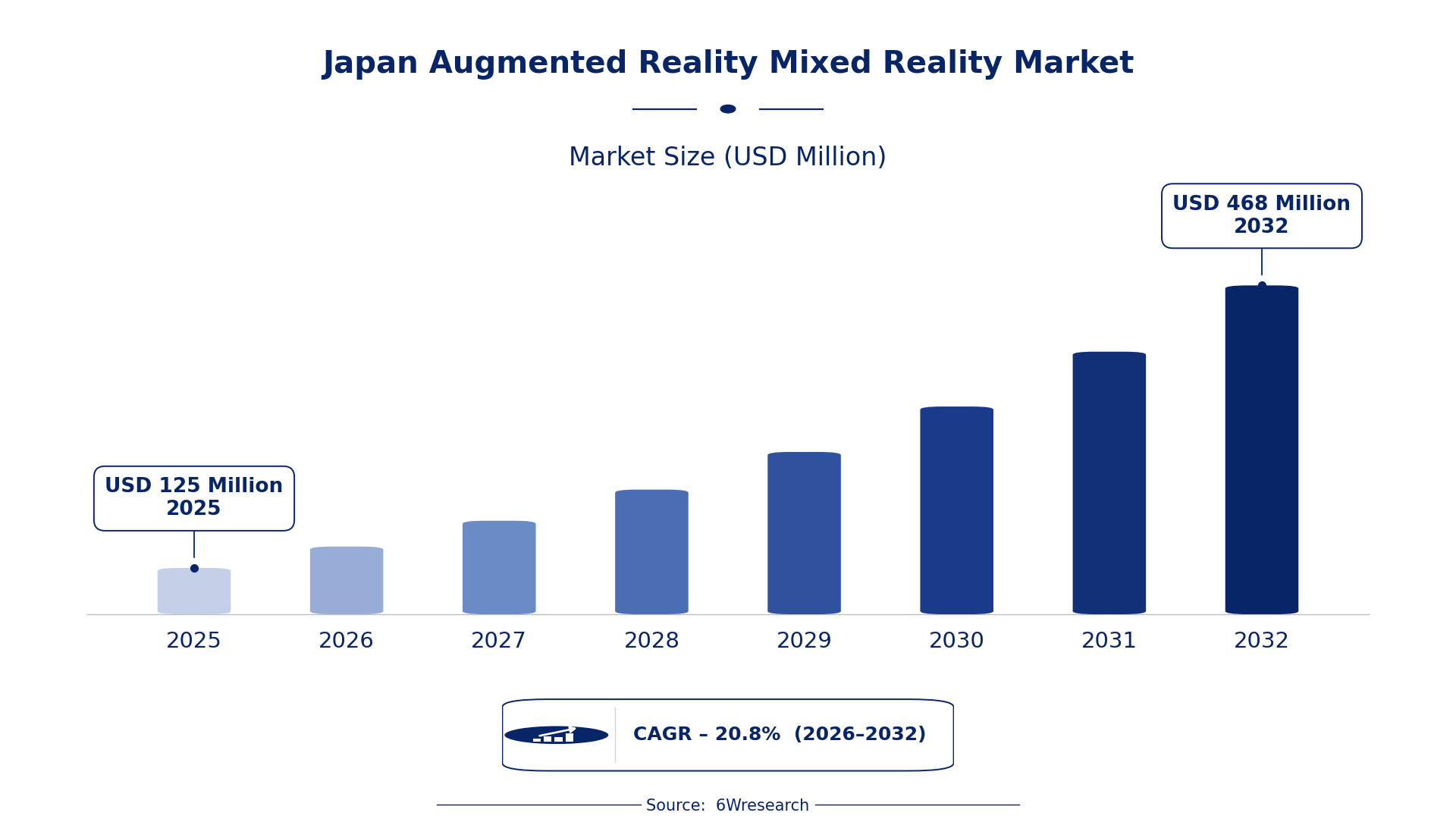
According to 6Wresearch internal database and industry insights, the Japan Augmented Reality Mixed Reality Market was valued at USD 125 Million in 2025 and is projected to reach USD 468 Million by 2032, growing at a CAGR of approximately 20.8% during 2026–2032.
Japan Augmented Reality Mixed Reality Market Highlights
| Report Metric | Details |
| Report Name | Japan Augmented Reality Mixed Reality Market (2026-2032) |
| Market Size 2025 | USD 125 Million |
| Market Size 2032 | USD 468 Million |
| Absolute Growth 2025–2032 | USD 343 Million |
| CAGR 2026–2032 | 20.8% |
| Peak Annual Growth | 23.1% in 2032 |
| Forecast Period | 2026–2032 |
| Historical Data | 2022–2025 |
| Base Year | 2025 |
| Leading Technology Type, 2025 | AR (60% share) |
| Leading Application, 2025 | Education (40% share) |
| Leading End User, 2025 | Learning Tools (48% share) |
| Leading Functionality, 2025 | Interactive (50% share) |
| Fastest-Growing Application | Healthcare (22.1% CAGR) |
| Fastest-Growing End User | Medical Training (26.3% CAGR) |
| Fastest-Growing Functionality | Simulation (22.5% CAGR) |
| Growing Sector | Education |
| Key End Users | Educational institutions, healthcare providers, gaming developers |
Japan Augmented Reality Mixed Reality Market Year-wise Growth Rate and Key Drivers (2022–2032)
This graph illustrates the annual growth rates of the market from 2022 to 2032, highlighting a steady upward trajectory and projected market expansion over the forecast period.
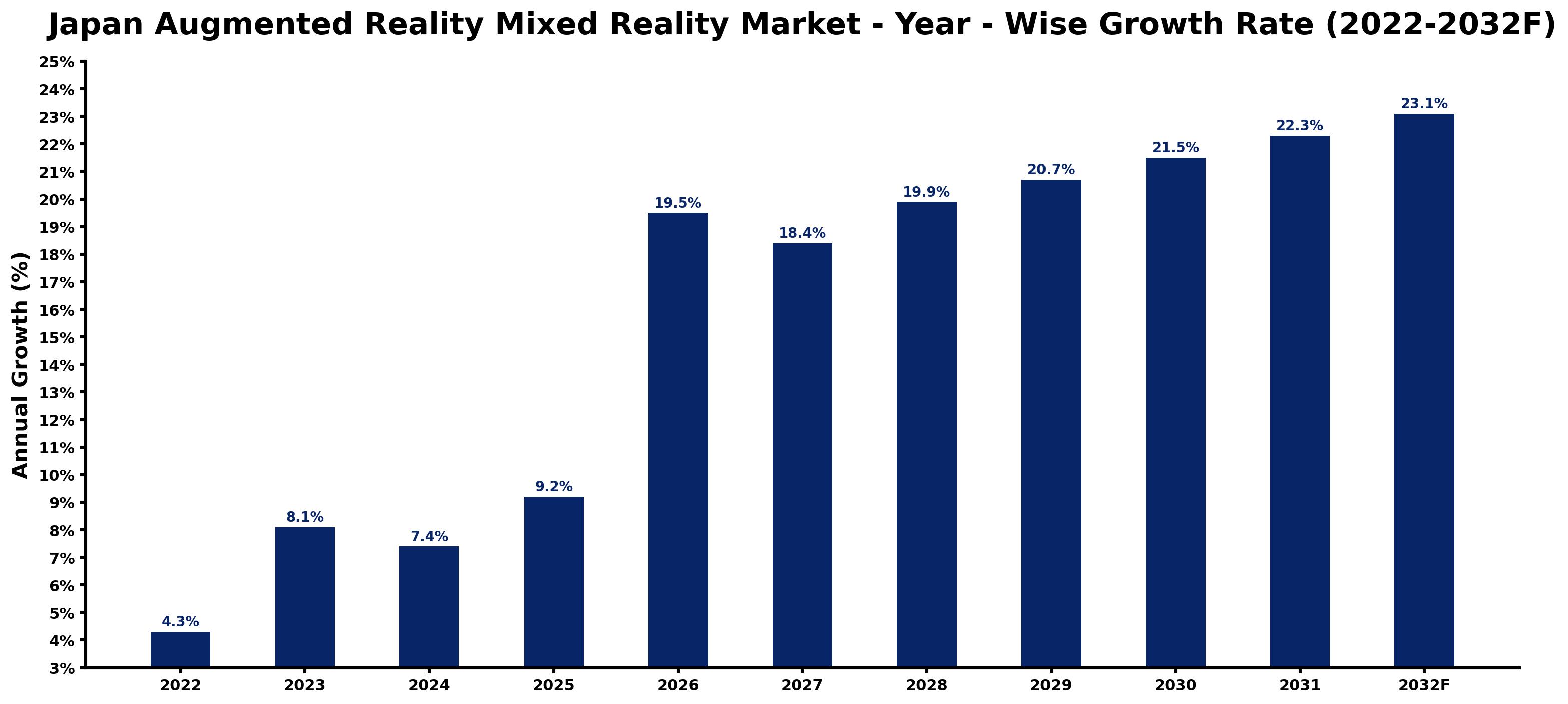
The yearly estimates that follow link every growth rate to its principal driver, so readers can see why the pace changed in each period.
| Year | Estimated Annual Growth (%) | Market Rationale |
| 2022 | 4.3 | The market experienced steady growth, driven by initial adoption in educational institutions. |
| 2023 | 8.1 | Growth accelerated as more educational institutions began integrating AR technologies into their curricula. |
| 2024 | 7.4 | A slowdown occurred as the market adjusted to earlier rapid expansions in technology usage. |
| 2025 | 9.2 | Increased investment in educational tools led to a faster growth rate compared to the previous year. |
| 2026 | 19.5 | The market surged as healthcare institutions adopted AR for medical training and simulations. |
| 2027 | 18.4 | A slight slowdown was observed as the market stabilised after rapid growth in healthcare applications. |
| 2028 | 19.9 | Growth picked up again, driven by new applications in both education and gaming sectors. |
| 2029 | 20.7 | The market continued to grow, supported by rising consumer engagement in AR gaming. |
| 2030 | 21.5 | Demand increased further as educational institutions expanded AR-enhanced learning programs. |
| 2031 | 22.3 | The market maintained strong growth, driven by ongoing investments in AR technologies. |
| 2032 | 23.1 | The peak growth rate was reached as AR applications became mainstream in education and healthcare. |
Note: Market size estimations and growth projections presented in this report are based on 6Wresearch's proprietary forecasting methodology, utilizing the latest available industry data, government publications, and primary research inputs.
Japan Augmented Reality Mixed Reality Market Synopsis
Augmented Reality Mixed Reality technologies overlay digital information onto the real world, enhancing experiences in education, gaming, and healthcare. In Japan, over 1,000 educational institutions are utilising AR/MR technologies, driven by initiatives such as the 'Future Classroom'. The healthcare sector is increasingly adopting AR for medical training, with a government investment of ¥2 billion aimed at advancing educational applications by 2025, highlighting a growing demand for immersive training solutions.
Market Dynamics Impact Analysis (2026–2032)
| Factor | Type | Impact | Primary Segment Affected |
| Growing adoption of AR in educational institutions | Driver | High | Education |
| Increasing integration of AR in healthcare training | Driver | High | Healthcare |
| Expansion of AR gaming market | Opportunity | High | Gaming |
| Emergence of new AR applications in various sectors | Opportunity | Medium | Immersive Experiences |
| High costs of AR technology implementation | Restraint | High | Healthcare |
| Limited interoperability standards for AR technologies | Restraint | Medium | Education |
| Compliance with evolving regulations in healthcare training | Challenge | High | Medical Training |
| Capacity constraints in AR content development | Challenge | Medium | Learning Tools |
Evaluation of Drivers in Japan Augmented Reality Mixed Reality Market (2026–2032)
Key forces behind demand, with the segment each one moves most, are listed below.
| Drivers | Primary Segment Affected | Why It Matters (Evidence) |
| Increased investment in AR technologies by educational institutions | Education | In 2023, over 500,000 students engaged in AR learning programs, boosting demand for AR tools. |
| Healthcare institutions adopting AR for training purposes | Healthcare | The focus on surgical simulations has led to a growing market for AR applications in medical training, with a projected increase of 30%. |
| Rising consumer interest in AR gaming experiences | Gaming | AR gaming revenue reached ¥150 billion in 2023, reflecting strong engagement and purchase behaviour among consumers. |
| Government initiatives promoting AR in classrooms | Education | The 'Future Classroom' initiative encourages the use of AR technologies in learning, impacting over 1,000 schools. |
| Development of AR standards to ensure quality and interoperability | Healthcare | ISO/IEC 30170 standard enhances the reliability of AR technologies in medical training environments, benefiting numerous healthcare institutions. |
A wider customer base explains much of the growth, as educational institutions increasingly adopt AR technologies for immersive learning experiences. The healthcare sector is integrating AR for medical training, focusing on surgical simulations, which has significantly increased the market size. Consumer interest in AR gaming is rising, with revenue reaching ¥150 billion in 2023, reflecting strong engagement and interest in interactive experiences. This shift indicates a growing trend towards immersive applications in education and healthcare.
Evaluation of Restraints in Japan Augmented Reality Mixed Reality Market
The main factors holding the market back are set out below.
| Market Restraint | Primary Segment Affected | Why It Matters (Evidence) |
| High costs associated with implementing AR technologies in healthcare training | Healthcare | Healthcare institutions face financial barriers, limiting the adoption of AR for medical training, with costs exceeding ¥50 million annually. |
| Limited interoperability standards for AR technologies | Education | The lack of established standards hampers the integration of AR tools across different educational platforms, affecting over 1,000 institutions. |
| Compliance with strict regulations in medical training | Medical Training | Healthcare providers must navigate complex regulations, delaying the adoption of AR technologies, impacting training timelines by up to six months. |
| Capacity constraints in AR content development | Learning Tools | A shortage of skilled developers limits the availability of quality AR content for educational applications, affecting over 500,000 students. |
| Market fragmentation due to diverse AR applications | Immersive Experiences | The variety of AR applications complicates the market, making it challenging for suppliers to target specific segments effectively. |
Japan Augmented Reality Mixed Reality Market Challenges
A shortage of skilled professionals in AR/MR development leads to project delays, costing technology startups up to ¥100 million annually. Educational buyers face escalating costs due to a lack of sufficient AR content, which can inflate per-student expenses by 30%. Regulatory challenges surrounding AR standards, like ISO/IEC 30170, can extend product approval timelines, causing healthcare institutions to miss critical training deadlines. Supply chain disruptions for AR hardware components can result in project delays, forcing producers to push back delivery schedules by an average of three months, which disrupts educational and medical training programs.
Trends in the Japan Augmented Reality Mixed Reality Market
Several trends are reshaping the Japan Augmented Reality Mixed Reality Market; the most important are set out below.
- Healthcare Innovation Strategy Focusing on AR: The Japanese government's focus on integrating AR into medical training is expected to improve training for healthcare professionals. This initiative is projected to increase the adoption of AR technologies across hospitals, with a planned investment of ¥2 billion.
- Shift in Educational Tools Towards AR: Educational institutions are increasingly adopting AR technologies for interactive learning, as evidenced by the 'Future Classroom' initiative. Over 1,000 schools are now utilising AR, improving student engagement and learning outcomes.
- Growing Popularity of AR Gaming: Consumer interest in AR gaming is rising, with revenue reaching ¥150 billion in 2023. This trend indicates a shift towards more immersive and engaging gaming experiences, attracting a broader audience.
- Emergence of AR Standards for Quality Assurance: The establishment of ISO/IEC 30170 is improving the quality and interoperability of AR technologies. This standard is important for ensuring effective integration in both educational and healthcare applications.
Investment Opportunities in the Japan Augmented Reality Mixed Reality Market
Investors looking at the Japan Augmented Reality Mixed Reality Market should consider the following areas.
- Tokyo as a Hub for AR Development: Tokyo is a major hub for AR/MR development, with numerous startups driving innovation. The city's vibrant tech scene presents opportunities for investment in AR applications, particularly in education and healthcare, with a projected market growth of 20%.
- Timing for Investment in Educational AR Tools: With over 1,000 educational institutions adopting AR technologies, now is an ideal time to invest in educational AR tools. This demand offers opportunities for suppliers in the education sector, with a potential market growth of ¥2 billion by 2025.
- Gap in AR Content Development: There is a growing need for high-quality AR content in education, with a projected increase in AR learning programs. Suppliers can address this gap by partnering with educational institutions to develop tailored solutions, targeting over 500,000 students.
- Healthcare Training Demand for AR Solutions: The increasing adoption of AR in medical training presents an opportunity, with healthcare institutions seeking effective training solutions. Suppliers can enter this market by collaborating with hospitals and training centres, with a projected investment of ¥2 billion.
Government Initiatives in the Japan Augmented Reality Mixed Reality Market
The Long-Term Care Insurance Act, established in 1997 and enforced since 2000, provides funding for nursing care and support services for older individuals. This law has facilitated the integration of AR technologies in training for healthcare professionals, ensuring they are equipped to meet the needs of an aging population. Additionally, the Medical Care Act of 1948 sets standards for hospitals and clinics, influencing the adoption of AR in medical training environments, impacting numerous healthcare institutions.
In 2023, the Japanese government allocated ¥2 billion for the development of AR technology in education through the 'Digital Agency'. This agency is responsible for integrating AR into public services and education, ensuring that educational institutions have access to the latest technologies for improved learning experiences.
Future Insight of the Japan Augmented Reality Mixed Reality Market
By 2032, the Japanese government's focus on integrating AR into public services and education will drive suppliers to create more interactive tools. The planned ¥2 billion investment in AR technology will enhance resources for over 500,000 students involved in these initiatives. Healthcare institutions will increasingly adopt AR for surgical simulations, improving training outcomes. The establishment of the Japan Augmented Reality Association will set standards that ensure quality and interoperability across diverse applications.
Market Segmentation Analysis
Japan Augmented Reality Mixed Reality Market report covers a detailed analysis of the following market segments:
By Technology Type – AR Leads and Records the Fastest Growth
According to Bhawna Singh, Assistant Manager at 6Wresearch, AR held 60% of the Japan Augmented Reality Mixed Reality Market by technology type in 2025. Augmented Reality holds the largest share in Japan, largely due to its extensive use in over 1,000 educational institutions that leverage this technology for interactive learning. The Ministry of Education's promotion of AR in classrooms further solidifies its dominant position in the market. Its lead should widen, with a projected CAGR of 22.6% during 2026–2032, the highest in this split. The growth of Augmented Reality is expected to accelerate as educational institutions increasingly integrate AR into their curricula, evidenced by over 500,000 students participating in AR-enhanced learning programs. This trend indicates that its lead will continue to widen as more schools adopt these educational tools. Suppliers should focus on creating AR solutions tailored for educational purposes to capitalise on the expanding market.
By Application – Education Leads, Healthcare Expected to Grow Fastest
In 2025, Education led the application split with a 40% share. Education leads the market due to its widespread adoption for enhancing learning through interactive tools, significantly bolstered by initiatives from the Ministry of Education. The 'Future Classroom' initiative exemplifies the commitment to integrating AR technologies in educational environments. Healthcare is projected to grow fastest, at a CAGR of 22.1% during 2026–2032. Healthcare is rapidly growing as medical institutions increasingly implement AR for training, particularly in surgical simulations. The 'Healthcare Innovation Strategy' aims to incorporate AR into medical training by 2025, driving this sector's expansion. Buyers in the healthcare sector should invest in AR solutions to improve training outcomes and operational efficiency.
By End User – Learning Tools Lead, Medical Training Expected to Grow Fastest
Learning Tools accounted for 48% of the market by end user in 2025. Learning Tools dominate the market as they are vital for educational applications, enabling interactive learning experiences across numerous institutions. The engagement of over 500,000 students in AR-enhanced programs reflects the strong demand for these educational tools. The quickest growth will come from Medical Training, forecast to expand at a CAGR of 26.3% between 2026 and 2032. Medical Training is experiencing the fastest growth as healthcare professionals increasingly utilise AR for realistic training scenarios, enhancing their skills through simulations. This trend is supported by the rising adoption of AR in medical training across various institutions. Suppliers should prioritise developing AR solutions specifically for medical training to meet the growing demand.
By Functionality – Interactive Leads, Simulation Expected to Grow Fastest
With 50% of functionality revenue in 2025, Interactive was the largest category. Interactive functionality is the leading segment as it is essential for user engagement in educational and training contexts, making learning experiences more immersive. The focus on interactive tools in over 1,000 educational institutions underscores the importance of this functionality. Simulation is set to record the highest CAGR in this split, 22.5% over 2026–2032. Simulation functionality is growing rapidly due to its critical role in providing realistic training scenarios in healthcare, which is key for effective learning. The increasing reliance on AR for medical training suggests that this segment will continue to expand. Buyers should seek AR solutions that feature advanced simulation capabilities to enhance training effectiveness.
Key Attractiveness of the Report
- 10 Years of Market Numbers
- Historical Data Starting from 2022 to 2025
- Base Year 2025
- Forecast Data until 2032
- Key Performance Indicators Impacting the Market
- Major Upcoming Developments and Projects
Key Highlights of the Report:
- Japan Augmented Reality Mixed Reality Market Outlook
- Market Size of Japan Augmented Reality Mixed Reality Market, 2025
- Forecast of Japan Augmented Reality Mixed Reality Market, 2032
- Historical Data and Forecast of Japan Augmented Reality Mixed Reality Revenues & Volume for the Period 2022-2032
- Japan Augmented Reality Mixed Reality Market Trend Evolution
- Japan Augmented Reality Mixed Reality Market Drivers and Challenges
- Japan Augmented Reality Mixed Reality Price Trends
- Japan Augmented Reality Mixed Reality Porter's Five Forces
- Japan Augmented Reality Mixed Reality Industry Life Cycle
- Historical Data and Forecast of Japan Augmented Reality Mixed Reality Market Revenues & Volume By Technology Type for the Period 2022-2032
- Historical Data and Forecast of Japan Augmented Reality Mixed Reality Market Revenues & Volume By AR for the Period 2022-2032
- Historical Data and Forecast of Japan Augmented Reality Mixed Reality Market Revenues & Volume By MR for the Period 2022-2032
- Historical Data and Forecast of Japan Augmented Reality Mixed Reality Market Revenues & Volume By MR for the Period 2022-2032
- Historical Data and Forecast of Japan Augmented Reality Mixed Reality Market Revenues & Volume By Application for the Period 2022-2032
- Historical Data and Forecast of Japan Augmented Reality Mixed Reality Market Revenues & Volume By Education for the Period 2022-2032
- Historical Data and Forecast of Japan Augmented Reality Mixed Reality Market Revenues & Volume By Gaming for the Period 2022-2032
- Historical Data and Forecast of Japan Augmented Reality Mixed Reality Market Revenues & Volume By Healthcare for the Period 2022-2032
- Historical Data and Forecast of Japan Augmented Reality Mixed Reality Market Revenues & Volume By End User for the Period 2022-2032
- Historical Data and Forecast of Japan Augmented Reality Mixed Reality Market Revenues & Volume By Learning Tools for the Period 2022-2032
- Historical Data and Forecast of Japan Augmented Reality Mixed Reality Market Revenues & Volume By Immersive Experiences for the Period 2022-2032
- Historical Data and Forecast of Japan Augmented Reality Mixed Reality Market Revenues & Volume By Medical Training for the Period 2022-2032
- Historical Data and Forecast of Japan Augmented Reality Mixed Reality Market Revenues & Volume By Functionality for the Period 2022-2032
- Historical Data and Forecast of Japan Augmented Reality Mixed Reality Market Revenues & Volume By Interactive for the Period 2022-2032
- Historical Data and Forecast of Japan Augmented Reality Mixed Reality Market Revenues & Volume By Simulation for the Period 2022-2032
- Historical Data and Forecast of Japan Augmented Reality Mixed Reality Market Revenues & Volume By 3D Modeling for the Period 2022-2032
- Japan Augmented Reality Mixed Reality Import Export Trade Statistics
- Market Opportunity Assessment By Technology Type
- Market Opportunity Assessment By Application
- Market Opportunity Assessment By End User
- Market Opportunity Assessment By Functionality
- Japan Augmented Reality Mixed Reality Top Companies Market Share
- Japan Augmented Reality Mixed Reality Competitive Benchmarking By Technical and Operational Parameters
- Japan Augmented Reality Mixed Reality Company Profiles
- Japan Augmented Reality Mixed Reality Key Strategic Recommendations
Market Covered
The following segment groups are covered in the report.
By Technology Type
- AR
- MR
By Application
- Education
- Gaming
- Healthcare
By End User
- Learning Tools
- Immersive Experiences
- Medical Training
By Functionality
- Interactive
- Simulation
- 3D Modeling































