Japan Augmented Reality Virtual Reality Aviation Market Size & Growth Rate
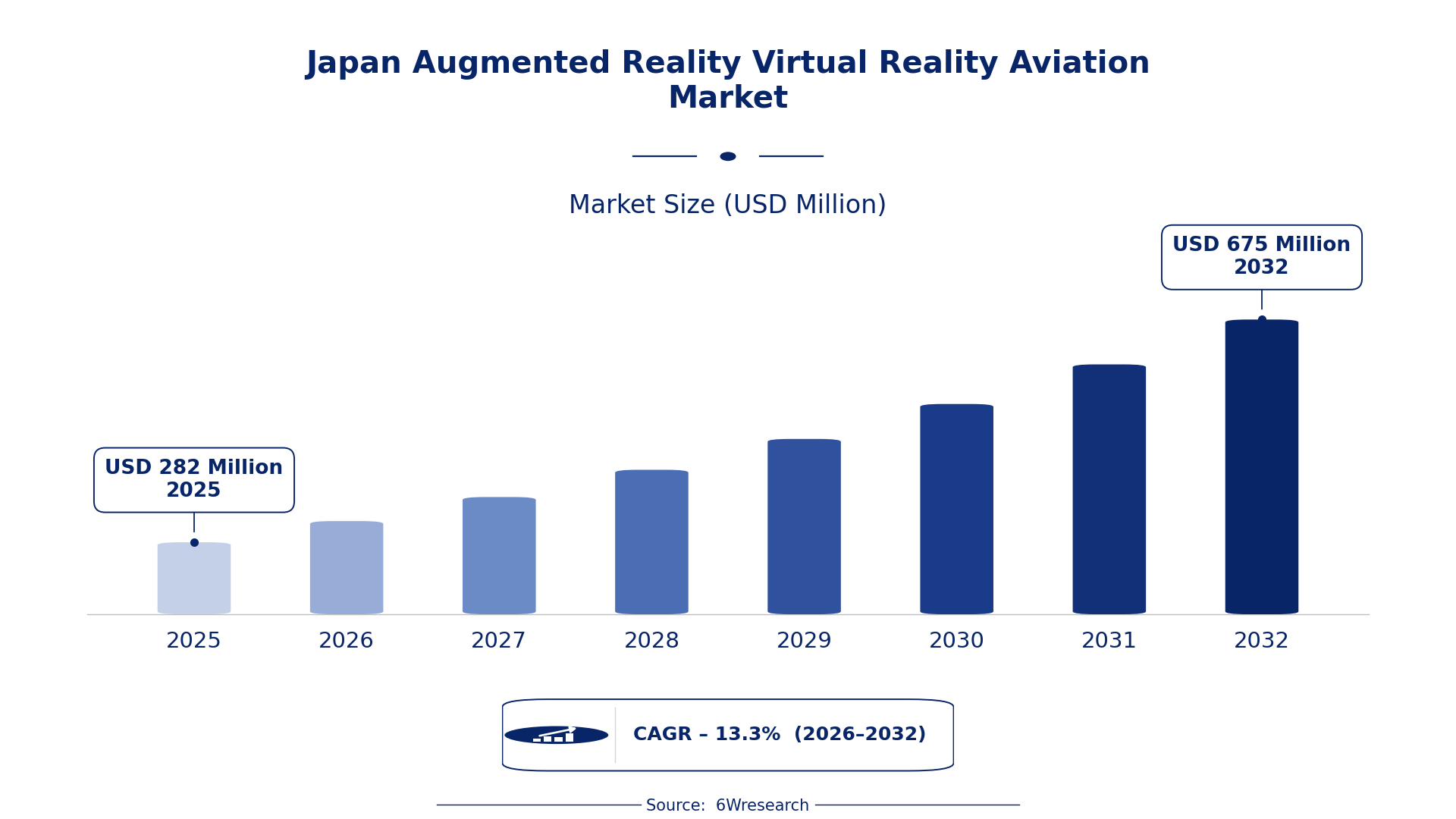
According to 6Wresearch internal database and industry insights, the Japan Augmented Reality Virtual Reality Aviation Market was valued at USD 282 Million in 2025 and is projected to reach USD 675 Million by 2032, growing at a CAGR of approximately 13.3% during 2026–2032.
Japan Augmented Reality Virtual Reality Aviation Market Highlights
| Report Metric | Details |
| Report Name | Japan Augmented Reality Virtual Reality Aviation Market (2026-2032) |
| Market Size 2025 | USD 282 Million |
| Market Size 2032 | USD 675 Million |
| Absolute Growth 2025–2032 | USD 393 Million |
| CAGR 2026–2032 | 13.3% |
| Peak Annual Growth | 16.0% in 2032 |
| Forecast Period | 2026–2032 |
| Historical Data | 2022–2025 |
| Base Year | 2025 |
| Leading Technology Type, 2025 | VR (54% share) |
| Leading End User, 2025 | Aviation (49% share) |
| Leading Application, 2025 | Pilot Training (48% share) |
| Leading Functionality, 2025 | Flight Simulation (51% share) |
| Fastest-Growing Technology Type | AR (18.5% CAGR) |
| Fastest-Growing End User | Military (17.0% CAGR) |
| Fastest-Growing Application | Aviation Simulation (17.7% CAGR) |
| Fastest-Growing Functionality | Virtual Training (17.2% CAGR) |
| Growing Sector | Aviation |
| Key End Users | Aviation training facilities, military training units, aerospace developers |
Japan Augmented Reality Virtual Reality Aviation Market Year-wise Growth Rate and Key Drivers (2022–2032)
This graph illustrates the annual growth rates of the market from 2022 to 2032, highlighting a steady upward trajectory and projected market expansion over the forecast period.
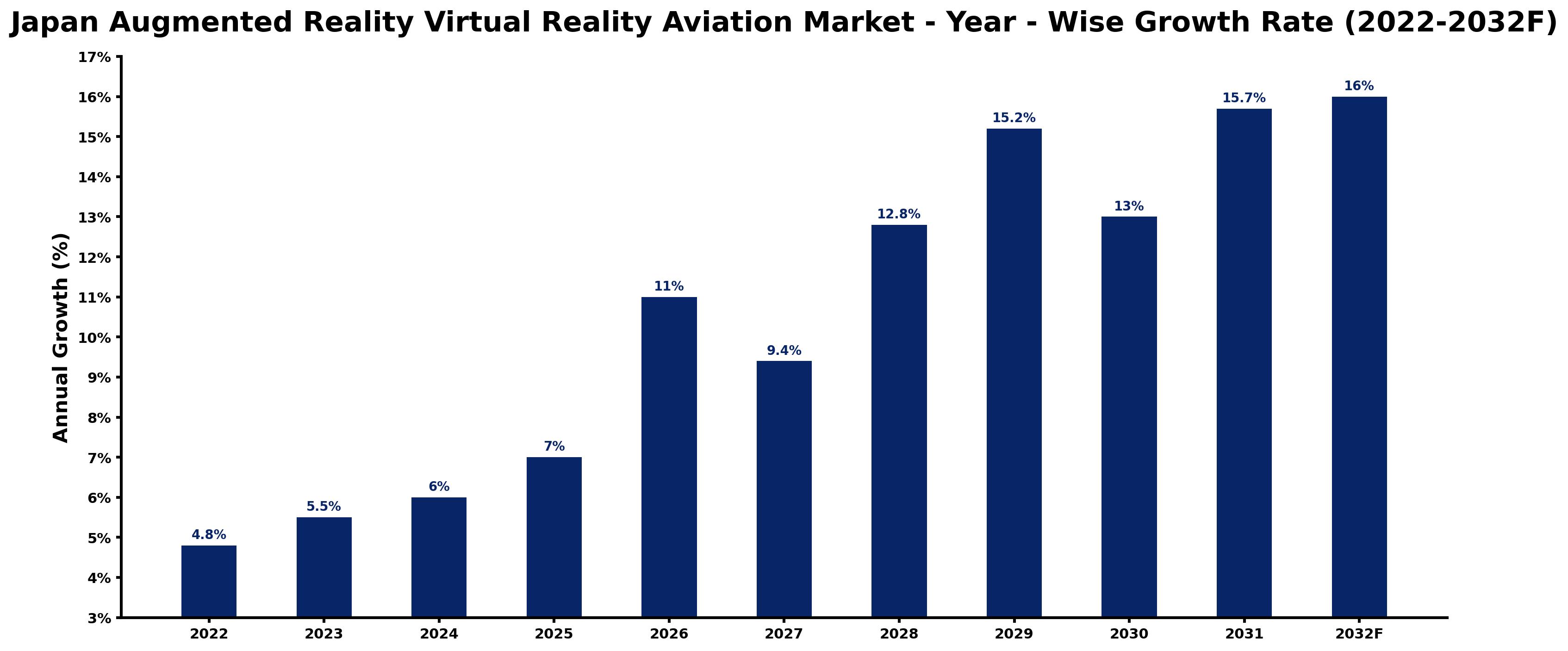
Annual growth estimates for each year appear below with the principal reason behind them, explaining the shifts that set the pace of the market.
| Year | Estimated Annual Growth (%) | Market Rationale |
| 2022 | 4.8 | The aviation industry showed steady demand for AR and VR technologies. |
| 2023 | 5.5 | Growth accelerated as pilot training programs increasingly adopted immersive technologies. |
| 2024 | 6.0 | Investment in aviation simulation technologies expanded, boosting demand further. |
| 2025 | 7.0 | The Tokyo metropolitan area emerged as a hub for aviation technology development. |
| 2026 | 11.0 | A national strategy for digital transformation in aviation is expected to drive growth. |
| 2027 | 9.4 | Demand growth slows as market matures and competition increases. |
| 2028 | 12.8 | Technological advancements in AR and VR are projected to improve training capabilities. |
| 2029 | 15.2 | Military applications for VR training are anticipated to rise. |
| 2030 | 13.0 | Growth slows as the market reaches a more stable phase of development. |
| 2031 | 15.7 | Increased investments in aviation simulation technologies will drive demand. |
| 2032 | 16.0 | Demand peaks as the aviation sector fully integrates AR and VR technologies. |
Note: Market size estimations and growth projections presented in this report are based on 6Wresearch's proprietary forecasting methodology, utilizing the latest available industry data, government publications, and primary research inputs.
Japan Augmented Reality Virtual Reality Aviation Market Synopsis
Augmented Reality Virtual Reality Aviation technologies improve training and operational efficiency through immersive experiences. In Japan, the market is expanding due to strong domestic demand and military applications. The Tokyo metropolitan area serves as a key hub for aviation technology development, while the Ministry of Defense's VR training program encourages further investment. With AR technology used in over 50% of pilot training programs, the market is poised for growth as these technologies become integral to aviation operations.
Market Dynamics Impact Analysis (2026–2032)
| Factor | Type | Impact | Primary Segment Affected |
| Growing adoption of AR in pilot training programs | Driver | High | Pilot Training |
| Investment in aviation simulation technologies | Driver | High | Aviation Simulation |
| Increased military investment in VR training | Opportunity | High | Military |
| Expansion of aviation technology hubs in Tokyo | Opportunity | Medium | Aerospace |
| High costs associated with AR/VR implementation | Restraint | High | Aviation |
| Limited awareness of AR/VR benefits among smaller operators | Restraint | Medium | Pilot Training |
| Competition among technology providers | Challenge | High | Aviation Simulation |
| Technological integration challenges in existing systems | Challenge | Medium | Military |
Evaluation of Drivers in Japan Augmented Reality Virtual Reality Aviation Market (2026–2032)
Below are the drivers that matter most for revenue growth, with supporting evidence.
| Drivers | Primary Segment Affected | Why It Matters (Evidence) |
| Increased demand for immersive training environments | Pilot Training | AR technology is utilized in over 50% of pilot training programs in Japan. |
| Growing investment in aviation simulation technologies | Aviation Simulation | Japan has invested 200 million JPY in aviation simulation technologies in 2023. |
| Military initiatives for VR training | Military | The Ministry of Defense has initiated a program for VR training in military aviation. |
| Technological advancements in AR and VR | Aerospace | The Japan Aerospace Exploration Agency promotes AR/VR applications in aerospace. |
| Rising safety standards in aviation training | Aviation | ISO 9001 standards are applied in aviation training facilities across Japan. |
Japan's investment of 200 million JPY in aviation simulation technologies in 2023 reflects a growing commitment to improve training capabilities. Rising safety standards in aviation training also encourage more purchases from training facilities across the country.
Evaluation of Restraints in Japan Augmented Reality Virtual Reality Aviation Market
These restraints slow adoption and weigh on supplier margins.
| Market Restraint | Primary Segment Affected | Why It Matters (Evidence) |
| High costs associated with AR/VR implementation | Aviation | The investment required for AR and VR technologies can be substantial, limiting adoption by smaller operators. |
| Limited awareness of AR/VR benefits among smaller operators | Pilot Training | Many smaller aviation operators lack knowledge about the advantages of AR and VR, hindering market growth. |
| Technological integration challenges in existing systems | Military | Existing military training systems may struggle to incorporate new AR and VR technologies effectively. |
| Competition among technology providers | Aviation Simulation | Intense competition can lead to price wars, affecting profitability for suppliers in the aviation simulation market. |
| Regulatory hurdles in aviation technology adoption | Aerospace | Compliance with stringent aviation regulations can delay the implementation of new AR and VR technologies. |
Japan Augmented Reality Virtual Reality Aviation Market Challenges
Buyers in the aviation sector contend with stringent regulations from the Civil Aviation Bureau of Japan, which can delay the implementation of new AR and VR technologies by up to six months, impacting training schedules. Producers face a shortage of skilled personnel in AR and VR systems, potentially costing them around 150 million JPY in lost revenue annually. High initial investment costs for technology upgrades pose challenges for smaller training facilities, limiting their competitiveness. Buyers also encounter fluctuating demand for training programs, leading to resource underutilisation and increased operational expenses.
Trends in the Japan Augmented Reality Virtual Reality Aviation Market
The following changes are redrawing the Japan Augmented Reality Virtual Reality Aviation Market.
- Shift towards Immersive Training: Aviation training facilities are increasingly adopting immersive technologies, with the Tokyo Flight Training Center employing VR for pilot assessments. In 2023, over 50% of pilot training programs in Japan utilized AR technology.
- Growing Military Interest in VR Training: Military applications for VR training are expanding, driven by the Ministry of Defense's initiatives. The sector is expected to see a 17% growth in VR training adoption by 2032.
- Transition from Traditional to Digital Training Methods: A shift from traditional training methods to digital solutions is occurring, with the Japan Aerospace Exploration Agency promoting AR/VR applications. This transition is likely to improve operational efficiency in aviation.
- Expansion of Aviation Technology Hubs: The Tokyo metropolitan area is becoming a key hub for aviation technology development, attracting investments and encouraging innovation. In 2023, Japan launched a national strategy for digital transformation in aviation.
Investment Opportunities in the Japan Augmented Reality Virtual Reality Aviation Market
The following areas offer the clearest openings for investors and suppliers in the Japan Augmented Reality Virtual Reality Aviation Market.
- Investment gap in AR/VR technologies: With Japan investing 200 million JPY in aviation simulation technologies, there is a notable gap for further investment in AR/VR. Aviation training facilities can benefit from partnerships with technology providers.
- Demand for military VR training solutions: The military sector is increasingly seeking advanced VR training solutions, presenting opportunities for suppliers. Collaborating with defense contractors can facilitate market entry.
- Aviation technology development in Tokyo: The Tokyo metropolitan area is a hub for aviation technology development, creating opportunities for investment in AR/VR. Local partnerships can improve market penetration.
- Rising demand for aviation simulation technologies: With the Civil Aviation Bureau of Japan overseeing aviation safety standards, there is a growing need for advanced simulation technologies. Suppliers can enter the market through certification and compliance with regulations.
Government Initiatives in the Japan Augmented Reality Virtual Reality Aviation Market
The Act against Unjustifiable Premiums and Misleading Representations, enacted in 1962, prohibits misleading advertising of aviation technologies, ensuring that producers maintain transparency in their offerings. This law complements the Industrial Standardization Act, which governs product and test standards in the aviation sector, building consumer confidence in AR and VR technologies.
The Consumer Affairs Agency oversees compliance with advertising standards, ensuring that AR and VR technologies in aviation are marketed transparently. This agency plays a key role in approving projects aimed at integrating these technologies into training, ensuring adherence to safety standards.
Future Insight of the Japan Augmented Reality Virtual Reality Aviation Market
Investment in aviation simulation technologies will reach approximately 500 million JPY by 2032, creating a pipeline for advanced training facilities. Demand for immersive training solutions will grow as the national strategy for digital transformation progresses, improving pilot assessments and maintenance procedures. The integration of updated quality standards will improve training outcomes for buyers and suppliers. Military VR training programmes will drive innovation, benefiting commercial applications and expanding market potential.
Market Segmentation Analysis
Japan Augmented Reality Virtual Reality Aviation Market report covers a detailed analysis of the following market segments:
By Technology Type – VR Leads, AR Expected to Grow Fastest
According to Bhawna Singh, Assistant Manager at 6Wresearch, VR took 54% of technology type revenue in 2025, more than any other category. Virtual Reality holds the largest share in Japan's aviation market due to its vital role in creating realistic flight training environments. For instance, VR is essential in over 50% of pilot training programs, showcasing its importance in enhancing training effectiveness. AR is projected to grow fastest, at a CAGR of 18.5% during 2026–2032. Augmented Reality is experiencing rapid growth because of its application in interactive training simulations. The national strategy for digital transformation in aviation, launched in 2023, will further promote the integration of AR technologies in training. Suppliers must focus on developing AR technologies to meet the growing demand for interactive training solutions.
By End User – Aviation Leads, Military Expected to Grow Fastest
The largest end user category in 2025 was Aviation, at 49% of revenue. The Aviation sector holds the largest share as it extensively employs AR and VR for training and operational scenarios. This is illustrated by the Tokyo Flight Training Center, which utilises VR for pilot assessments, showcasing the sector's dedication to advanced training methods. Over 2026–2032, Military is expected to post the fastest growth, at a CAGR of 17.0%. The Military sector is expanding quickly due to its essential use of AR and VR for tactical training and mission planning. The Ministry of Defense's initiative for VR training in military aviation underscores the urgent need for advanced training technologies in this field. Buyers in the military sector should focus on investing in VR technologies to improve training effectiveness.
By Application – Pilot Training Leads, Aviation Simulation Expected to Grow Fastest
Pilot Training accounted for 48% of the market by application in 2025. Pilot Training is the foremost application as it is crucial for enhancing skills within the aviation sector. The extensive use of VR in pilot training programmes highlights its significance in producing competent pilots. Aviation Simulation is set to record the highest CAGR in this split, 17.7% over 2026–2032. Aviation Simulation is the fastest-growing application, primarily due to its essential role in ensuring operational readiness. The 200 million JPY investment in aviation simulation technologies in 2023 indicates a strong commitment to improving training methodologies. Suppliers should expand their product lines in aviation simulation to capitalise on this rapidly growing market.
By Functionality – Flight Simulation Leads, Virtual Training Expected to Grow Fastest
With 51% of functionality revenue in 2025, Flight Simulation was the largest category. Flight Simulation leads the market due to its key role in pilot training and assessment processes. Its established presence in training facilities across Japan demonstrates its critical importance in preparing pilots for real-world scenarios. The quickest growth will come from Virtual Training, forecast to expand at a CAGR of 17.2% between 2026 and 2032. Virtual Training is growing rapidly, driven by its importance in remote learning scenarios. The integration of VR technologies into training programmes supports the increasing demand for flexible and accessible training options. Suppliers must invest in virtual training solutions to meet the rising demand for remote learning capabilities.
Key Attractiveness of the Report
- 10 Years of Market Numbers
- Historical Data Starting from 2022 to 2025
- Base Year 2025
- Forecast Data until 2032
- Key Performance Indicators Impacting the Market
- Major Upcoming Developments and Projects
Key Highlights of the Report:
- Japan Augmented Reality Virtual Reality Aviation Market Outlook
- Market Size of Japan Augmented Reality Virtual Reality Aviation Market, 2025
- Forecast of Japan Augmented Reality Virtual Reality Aviation Market, 2032
- Historical Data and Forecast of Japan Augmented Reality Virtual Reality Aviation Revenues & Volume for the Period 2022-2032
- Japan Augmented Reality Virtual Reality Aviation Market Trend Evolution
- Japan Augmented Reality Virtual Reality Aviation Market Drivers and Challenges
- Japan Augmented Reality Virtual Reality Aviation Price Trends
- Japan Augmented Reality Virtual Reality Aviation Porter's Five Forces
- Japan Augmented Reality Virtual Reality Aviation Industry Life Cycle
- Historical Data and Forecast of Japan Augmented Reality Virtual Reality Aviation Market Revenues & Volume By Technology Type for the Period 2022-2032
- Historical Data and Forecast of Japan Augmented Reality Virtual Reality Aviation Market Revenues & Volume By AR for the Period 2022-2032
- Historical Data and Forecast of Japan Augmented Reality Virtual Reality Aviation Market Revenues & Volume By VR for the Period 2022-2032
- Historical Data and Forecast of Japan Augmented Reality Virtual Reality Aviation Market Revenues & Volume By MR for the Period 2022-2032
- Historical Data and Forecast of Japan Augmented Reality Virtual Reality Aviation Market Revenues & Volume By End User for the Period 2022-2032
- Historical Data and Forecast of Japan Augmented Reality Virtual Reality Aviation Market Revenues & Volume By Aerospace for the Period 2022-2032
- Historical Data and Forecast of Japan Augmented Reality Virtual Reality Aviation Market Revenues & Volume By Aviation for the Period 2022-2032
- Historical Data and Forecast of Japan Augmented Reality Virtual Reality Aviation Market Revenues & Volume By Military for the Period 2022-2032
- Historical Data and Forecast of Japan Augmented Reality Virtual Reality Aviation Market Revenues & Volume By Application for the Period 2022-2032
- Historical Data and Forecast of Japan Augmented Reality Virtual Reality Aviation Market Revenues & Volume By Pilot Training for the Period 2022-2032
- Historical Data and Forecast of Japan Augmented Reality Virtual Reality Aviation Market Revenues & Volume By Maintenance for the Period 2022-2032
- Historical Data and Forecast of Japan Augmented Reality Virtual Reality Aviation Market Revenues & Volume By Aviation Simulation for the Period 2022-2032
- Historical Data and Forecast of Japan Augmented Reality Virtual Reality Aviation Market Revenues & Volume By Functionality for the Period 2022-2032
- Historical Data and Forecast of Japan Augmented Reality Virtual Reality Aviation Market Revenues & Volume By Flight Simulation for the Period 2022-2032
- Historical Data and Forecast of Japan Augmented Reality Virtual Reality Aviation Market Revenues & Volume By Virtual Training for the Period 2022-2032
- Historical Data and Forecast of Japan Augmented Reality Virtual Reality Aviation Market Revenues & Volume By Cockpit Interaction for the Period 2022-2032
- Japan Augmented Reality Virtual Reality Aviation Import Export Trade Statistics
- Market Opportunity Assessment By Technology Type
- Market Opportunity Assessment By End User
- Market Opportunity Assessment By Application
- Market Opportunity Assessment By Functionality
- Japan Augmented Reality Virtual Reality Aviation Top Companies Market Share
- Japan Augmented Reality Virtual Reality Aviation Competitive Benchmarking By Technical and Operational Parameters
- Japan Augmented Reality Virtual Reality Aviation Company Profiles
- Japan Augmented Reality Virtual Reality Aviation Key Strategic Recommendations
Market Covered
The study includes the following segmentation.
By Technology Type
- AR
- VR
- MR
By End User
- Aerospace
- Aviation
- Military
By Application
- Pilot Training
- Maintenance
- Aviation Simulation
By Functionality
- Flight Simulation
- Virtual Training
- Cockpit Interaction































