Japan Aviation Defense and Space Market Size & Growth Rate
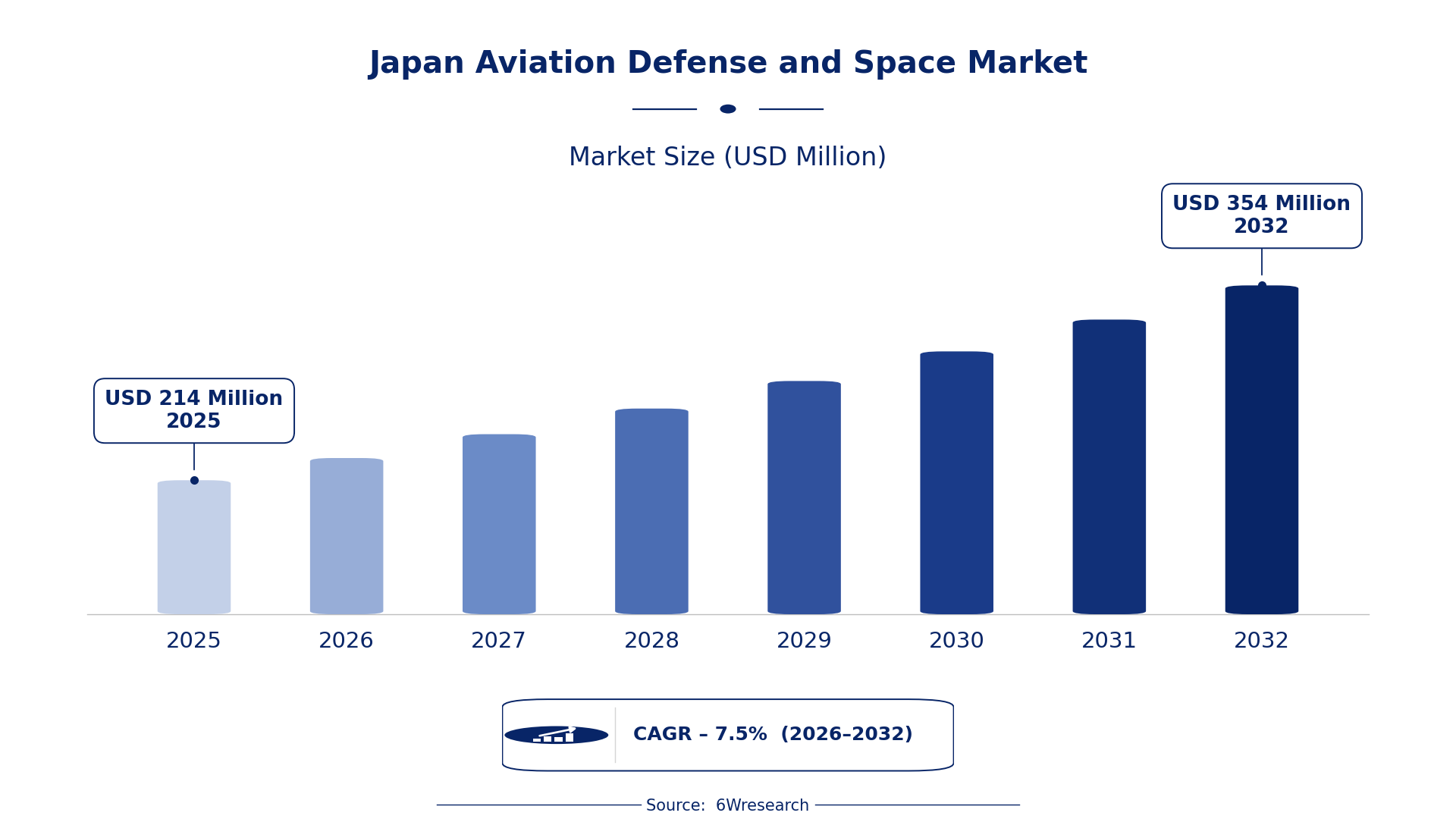
According to 6Wresearch internal database and industry insights, the Japan Aviation Defense and Space Market was valued at USD 214 Million in 2025 and is projected to reach USD 354 Million by 2032, growing at a CAGR of approximately 7.5% during 2026–2032.
Japan Aviation Defense and Space Market Highlights
| Report Metric | Details |
| Report Name | Japan Aviation Defense and Space Market (2026-2032) |
| Market Size 2025 | USD 214 Million |
| Market Size 2032 | USD 354 Million |
| Absolute Growth 2025–2032 | USD 140 Million |
| CAGR 2026–2032 | 7.5% |
| Peak Annual Growth | 8.4% in 2027 |
| Forecast Period | 2026–2032 |
| Historical Data | 2022–2025 |
| Base Year | 2025 |
| Leading Application, 2025 | Military Aviation (49% share) |
| Leading Platform, 2025 | Aircraft (40% share) |
| Leading End use, 2025 | Government (44% share) |
| Leading Technology, 2025 | Aerospace Technologies (45% share) |
| Fastest-Growing Application | Commercial Aviation (9.7% CAGR) |
| Fastest-Growing Platform | Spacecraft (10.2% CAGR) |
| Fastest-Growing End use | Private Sector (9.3% CAGR) |
| Fastest-Growing Technology | Defense Technologies (10.0% CAGR) |
| Growing Sector | Military Aviation |
| Key End Users | Government, Private Sector, Research Institutions |
Japan Aviation Defense and Space Market Year-wise Growth Rate and Key Drivers (2022–2032)
This graph illustrates the annual growth rates of the market from 2022 to 2032, highlighting a steady upward trajectory and projected market expansion over the forecast period.
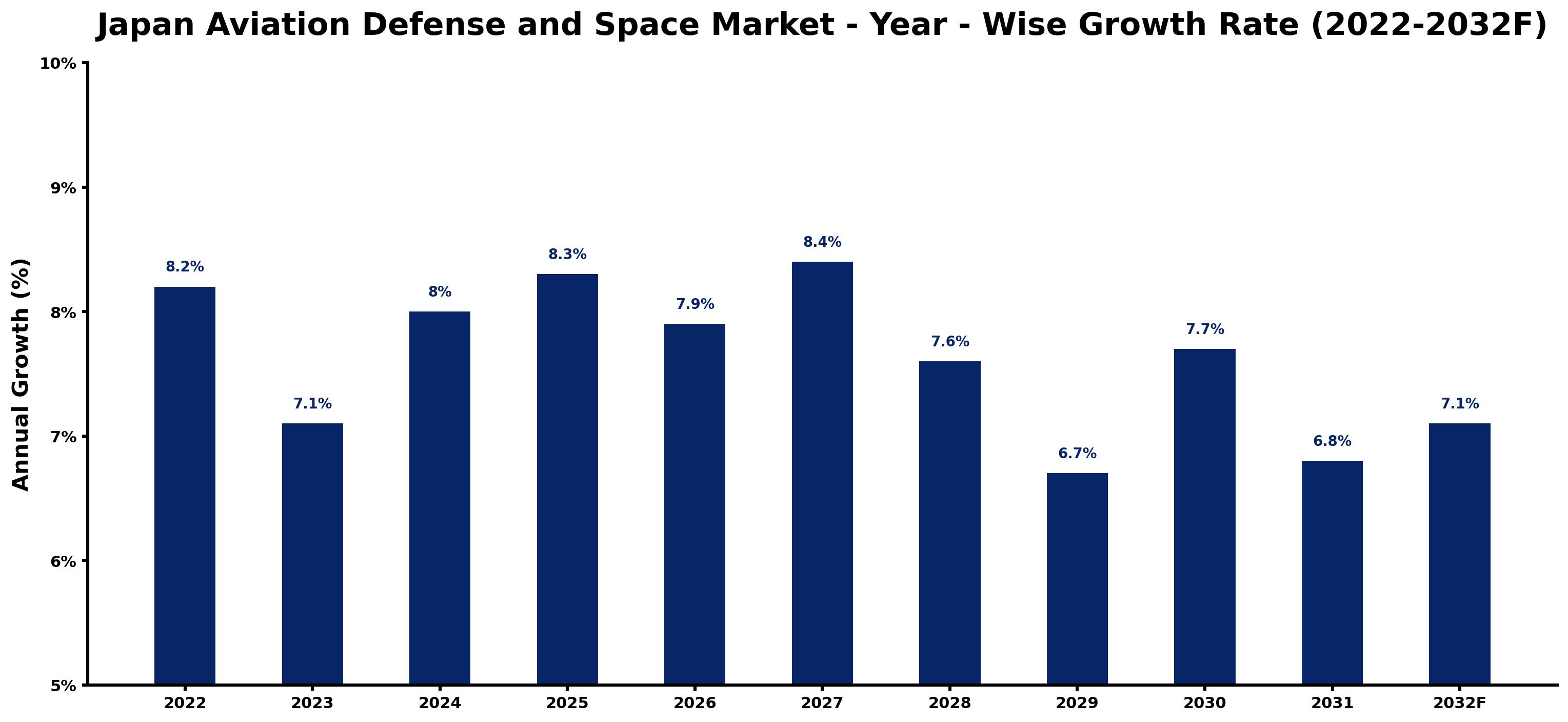
For each year, the table pairs the estimated growth rate with the leading influence on demand, showing how the drivers changed across the period.
| Year | Estimated Annual Growth (%) | Market Rationale |
| 2022 | 8.2 | Demand remained strong due to ongoing government contracts and investments. |
| 2023 | 7.1 | Growth slowed as the market adjusted to previous high levels of activity. |
| 2024 | 8.0 | Increased investments in aerospace technologies drove a faster growth rate. |
| 2025 | 8.3 | Demand surged as major defense projects reached critical phases of development. |
| 2026 | 7.9 | Growth is expected to slow slightly as the market stabilises after peak demand years. |
| 2027 | 8.4 | The market is projected to peak as new defense initiatives are launched and funded. |
| 2028 | 7.6 | Growth is expected to slow as the market begins to normalise after previous peaks. |
| 2029 | 6.7 | Demand will continue to slow as projects enter later stages of development. |
| 2030 | 7.7 | Growth is anticipated to pick up again as new satellite technologies gain traction. |
| 2031 | 6.8 | The market will experience a slight slowdown as investments adjust to new priorities. |
| 2032 | 7.1 | Growth is expected to accelerate as new defense strategies are implemented. |
Note: Market size estimations and growth projections presented in this report are based on 6Wresearch's proprietary forecasting methodology, utilizing the latest available industry data, government publications, and primary research inputs.
Japan Aviation Defense and Space Market Synopsis
Aviation Defense and Space encompasses technologies and systems used for military, commercial, and exploratory purposes in Japan. The Japan Aviation Defense and Space Market is driven by government contracts, private sector investments, and international collaborations. With the Ministry of Defense allocating approximately 5 trillion JPY annually for defense projects, demand is expected to remain strong, particularly in military aviation and satellite technologies, which support national defense and scientific research.
Market Dynamics Impact Analysis (2026–2032)
| Factor | Type | Impact | Primary Segment Affected |
| Government contracts drive demand for military aviation systems. | Driver | High | Military Aviation |
| Rising investments in aerospace technologies enhance capabilities. | Driver | High | Aerospace Technologies |
| Growing need for satellite technologies presents opportunities. | Opportunity | High | Satellite Technologies |
| Increased private sector involvement in aerospace projects creates demand. | Opportunity | High | Commercial Aviation |
| High costs of advanced technologies limit market entry for new players. | Restraint | Medium | Defense Systems |
| Compliance with stringent quality standards can delay project timelines. | Restraint | Medium | Aerospace Technologies |
| Limited skilled workforce affects production capacity in the sector. | Challenge | High | Military Aviation |
| Regulatory hurdles can slow down project approvals and implementations. | Challenge | High | Space Exploration |
Evaluation of Drivers in Japan Aviation Defense and Space Market (2026–2032)
Demand rests on the following drivers, each shown with the segment it touches most.
| Drivers | Primary Segment Affected | Why It Matters (Evidence) |
| Government contracts for defense projects boost military aviation demand. | Military Aviation | The Ministry of Defense allocates approximately 5 trillion JPY annually for defense-related projects. |
| Increased investment in aerospace technologies improves production capabilities. | Aerospace Technologies | Japan's aerospace industry employs over 100,000 people across various sectors. |
| Rising demand for satellite launches drives growth in the space sector. | Satellite Technologies | Japan has launched over 50 satellites since 2000, enhancing its space capabilities. |
| Growing interest in commercial aviation fuels new aircraft orders. | Commercial Aviation | The Tokyo Aerospace and Defense Expo showcases advancements in aviation technology. |
| Technological advancements in defense systems create new market opportunities. | Defense Systems | The government aims to increase defense spending by 1.2% annually through 2025. |
A wider customer base explains much of the growth, as contracts for military aviation projects drive demand. Increased orders for aircraft and defense systems are supported by substantial investments in aerospace technologies, which employ over 100,000 people in the sector. Japan's space sector benefits from the launch of over 50 satellites since 2000, strengthening its capabilities. The Tokyo Aerospace and Defense Expo showcases advancements, further stimulating interest in commercial aviation and satellite technologies.
Evaluation of Restraints in Japan Aviation Defense and Space Market
These are the pressures that could keep growth below its potential.
| Market Restraint | Primary Segment Affected | Why It Matters (Evidence) |
| High costs of advanced technologies limit market entry for new players. | Defense Systems | The expenses associated with developing advanced defense systems can deter investment. |
| Compliance with stringent quality standards can delay project timelines. | Aerospace Technologies | Adhering to ISO 9001 standards requires rigorous testing and certification. |
| Limited skilled workforce affects production capacity in the sector. | Military Aviation | A shortage of qualified engineers and technicians can hinder project execution. |
| Regulatory hurdles can slow down project approvals and implementations. | Space Exploration | Complex regulations may extend the timeline for launching new satellite missions. |
| Market competition drives pricing pressures on suppliers. | Commercial Aviation | Increasing competition among suppliers can lead to reduced profit margins. |
Japan Aviation Defense and Space Market Challenges
Producers face challenges with rising government contracts, complicating their ability to meet demand and delaying project completions, which costs buyers potential revenue from critical defense initiatives. Technology gaps arise from insufficient R&D funding, limiting the development of advanced systems and forcing buyers to rely on outdated technologies. Increased material costs are projected to rise by 10% over the next few years, burdening producers and leading to higher prices for buyers. Supply chain disruptions, exacerbated by global events, can delay deliveries, impacting timelines for buyers reliant on timely project execution.
Trends in the Japan Aviation Defense and Space Market
Below are the shifts with the largest effect on the Japan Aviation Defense and Space Market.
- Shift in Focus to Satellite Technologies: Investments are increasingly directed towards satellite technologies, with Japan launching over 50 satellites since 2000. This trend reflects a growing emphasis on improving communication and navigation capabilities.
- Increased Collaboration in Aerospace R&D: The Tokyo region is emerging as a hub for aerospace research and development, housing major institutions. This collaboration is likely to accelerate innovation in aerospace technologies, supported by funding from various sources.
- Expansion of Drone Technology Initiatives: The government has initiated a 10-year plan to improve drone technology for disaster response. This initiative aims to strengthen capabilities in emergency management, reflecting a growing focus on unmanned systems.
- Rising Demand for Military Aviation Systems: The military aviation sector is experiencing increased demand due to government contracts. The Ministry of Defense's annual budget of approximately 5 trillion JPY underpins this growth.
Investment Opportunities in the Japan Aviation Defense and Space Market
The openings below show where demand in the Japan Aviation Defense and Space Market is visible and how suppliers can enter.
- Investment in Satellite Technologies: The demand for satellite launches presents an opportunity for suppliers to invest in satellite technologies. The government aims to improve its capabilities, making this a promising area for growth.
- Partnerships for Aerospace R&D: Collaborating with local research institutions can facilitate entry into Japan's aerospace market. The Tokyo region is a hub for innovation, providing a strategic advantage for new entrants.
- Supply of Advanced Defense Systems: The need for advanced defense systems is increasing, driven by government contracts. Suppliers can target military aviation projects to meet this demand, supported by a budget of 5 trillion JPY.
- Expansion into Commercial Aviation: The commercial aviation sector is growing rapidly, with a projected growth rate of 9.7%. Suppliers can capitalise on this trend by offering innovative aircraft solutions to meet market needs.
Government Initiatives in the Japan Aviation Defense and Space Market
The GX Basic Policy, adopted in 2023, aims for about JPY 150 trillion of public-private decarbonisation investment over 10 years, strengthening the regulatory framework for aerospace technologies. This builds on the Industrial Standardization Act, which governs JIS product and test standards, ensuring quality and safety in aerospace manufacturing.
The Japan Aerospace Exploration Agency (JAXA) oversees space missions and research, facilitating advancements in satellite technologies. The agency supports various projects with significant funding, boosting Japan's capabilities in space exploration and technology development.
Future Insight of the Japan Aviation Defense and Space Market
The upcoming 10-year plan for satellite technology development will improve communication and data collection capabilities across various sectors. By 2032, Japan's aerospace sector is expected to launch over 20 additional satellites, expanding its space capabilities. New aerospace research facilities will facilitate collaboration, driving technological breakthroughs. With defense spending increasing by 1.2% annually through 2025, suppliers can anticipate a more dynamic market, encouraging further investment in next-generation systems.
Market Segmentation Analysis
Japan Aviation Defense and Space Market report covers a detailed analysis of the following market segments:
By Application – Military Aviation Leads, Commercial Aviation Expected to Grow Fastest
According to Bhawna Singh, Assistant Manager at 6Wresearch, Military Aviation took 49% of application revenue in 2025, more than any other category. Military Aviation holds the largest share as it is essential for national defense operations, supported by substantial government funding of approximately 5 trillion JPY annually. This consistent investment ensures a steady demand for military aviation technologies and systems within the sector. Commercial Aviation is projected to grow fastest, at a CAGR of 9.7% during 2026–2032. Commercial Aviation is witnessing rapid growth due to the increasing demand for passenger and cargo transport, particularly in urban areas. The Tokyo region's status as a hub for aerospace R&D plays a crucial role in facilitating this expansion. Suppliers should focus on enhancing their offerings for commercial aviation to capitalise on this growth opportunity.
By Platform – Aircraft Leads, Spacecraft Expected to Grow Fastest
With 40% of platform revenue in 2025, Aircraft was the largest category. Aircraft dominates the market as the primary mode of transportation and military use, with Japan's military aviation fleet consisting of over 300 aircraft. This extensive installed base creates a continuous demand for aircraft technologies and systems across various applications. The quickest growth will come from Spacecraft, forecast to expand at a CAGR of 10.2% between 2026 and 2032. Spacecraft is the fastest growing platform, driven by Japan's strategic focus on enhancing its space capabilities, having launched over 50 satellites since 2000. This commitment to satellite launches and space missions indicates a strong future trajectory for spacecraft technologies. Buyers can expect a greater availability of advanced spacecraft solutions as the market continues to develop.
By End use – Government Leads, Private Sector Expected to Grow Fastest
In 2025, Government led the end use split with a 44% share. The Government sector leads the market as the main user for defense and aerospace projects, heavily investing in military and infrastructure developments. This consistent funding underpins the stability and growth of the aviation defense and space market. Over 2026–2032, Private Sector is expected to post the fastest growth, at a CAGR of 9.3%. The Private Sector is the fastest growing end use, reflecting the rising demand for commercial aviation and satellite services. This growth is supported by increasing private investments in aerospace technologies. Suppliers should align their strategies to cater to the growing needs of the private sector.
By Technology – Aerospace Technologies Lead, Defense Technologies Expected to Grow Fastest
Aerospace Technologies held 45% of the Japan Aviation Defense and Space Market by technology in 2025. Aerospace Technologies leads the segment, being crucial for the development of both aircraft and spacecraft, ensuring operational safety and efficiency. The adherence to ISO 9001 standards in aerospace manufacturing underscores its importance in maintaining quality and reliability. Defense Technologies are set to record the highest CAGR in this split, 10.0% over 2026–2032. Defense Technologies is experiencing rapid growth, essential for military applications and supported by the government's plan to increase defense spending by 1.2% annually through 2025. This commitment to enhancing military capabilities will drive further advancements in defense technologies. Suppliers must focus on innovation in defense technologies to meet the increasing demands of military applications.
Key Attractiveness of the Report
- 10 Years of Market Numbers
- Historical Data Starting from 2022 to 2025
- Base Year 2025
- Forecast Data until 2032
- Key Performance Indicators Impacting the Market
- Major Upcoming Developments and Projects
Key Highlights of the Report:
- Japan Aviation Defense and Space Market Outlook
- Market Size of Japan Aviation Defense and Space Market, 2025
- Forecast of Japan Aviation Defense and Space Market, 2032
- Historical Data and Forecast of Japan Aviation Defense and Space Revenues & Volume for the Period 2022-2032
- Japan Aviation Defense and Space Market Trend Evolution
- Japan Aviation Defense and Space Market Drivers and Challenges
- Japan Aviation Defense and Space Price Trends
- Japan Aviation Defense and Space Porter's Five Forces
- Japan Aviation Defense and Space Industry Life Cycle
- Historical Data and Forecast of Japan Aviation Defense and Space Market Revenues & Volume By Application for the Period 2022-2032
- Historical Data and Forecast of Japan Aviation Defense and Space Market Revenues & Volume By Military Aviation for the Period 2022-2032
- Historical Data and Forecast of Japan Aviation Defense and Space Market Revenues & Volume By Commercial Aviation for the Period 2022-2032
- Historical Data and Forecast of Japan Aviation Defense and Space Market Revenues & Volume By Space Exploration for the Period 2022-2032
- Historical Data and Forecast of Japan Aviation Defense and Space Market Revenues & Volume By Defense Systems for the Period 2022-2032
- Historical Data and Forecast of Japan Aviation Defense and Space Market Revenues & Volume By Platform for the Period 2022-2032
- Historical Data and Forecast of Japan Aviation Defense and Space Market Revenues & Volume By Aircraft for the Period 2022-2032
- Historical Data and Forecast of Japan Aviation Defense and Space Market Revenues & Volume By Spacecraft for the Period 2022-2032
- Historical Data and Forecast of Japan Aviation Defense and Space Market Revenues & Volume By Drones for the Period 2022-2032
- Historical Data and Forecast of Japan Aviation Defense and Space Market Revenues & Volume By Missiles for the Period 2022-2032
- Historical Data and Forecast of Japan Aviation Defense and Space Market Revenues & Volume By End use for the Period 2022-2032
- Historical Data and Forecast of Japan Aviation Defense and Space Market Revenues & Volume By Government for the Period 2022-2032
- Historical Data and Forecast of Japan Aviation Defense and Space Market Revenues & Volume By Private Sector for the Period 2022-2032
- Historical Data and Forecast of Japan Aviation Defense and Space Market Revenues & Volume By Research and Development for the Period 2022-2032
- Historical Data and Forecast of Japan Aviation Defense and Space Market Revenues & Volume By Technology for the Period 2022-2032
- Historical Data and Forecast of Japan Aviation Defense and Space Market Revenues & Volume By Aerospace Technologies for the Period 2022-2032
- Historical Data and Forecast of Japan Aviation Defense and Space Market Revenues & Volume By Defense Technologies for the Period 2022-2032
- Historical Data and Forecast of Japan Aviation Defense and Space Market Revenues & Volume By Satellite Technologies for the Period 2022-2032
- Japan Aviation Defense and Space Import Export Trade Statistics
- Market Opportunity Assessment By Application
- Market Opportunity Assessment By Platform
- Market Opportunity Assessment By End use
- Market Opportunity Assessment By Technology
- Japan Aviation Defense and Space Top Companies Market Share
- Japan Aviation Defense and Space Competitive Benchmarking By Technical and Operational Parameters
- Japan Aviation Defense and Space Company Profiles
- Japan Aviation Defense and Space Key Strategic Recommendations
Market Covered
Segments analysed in this report are listed below.
By Application
- Military Aviation
- Commercial Aviation
- Space Exploration
- Defense Systems
By Platform
- Aircraft
- Spacecraft
- Drones
- Missiles
By End use
- Government
- Private Sector
- Research and Development
By Technology
- Aerospace Technologies
- Defense Technologies
- Satellite Technologies































