Japan Aviation & Defense Cyber Security Market Size & Growth Rate
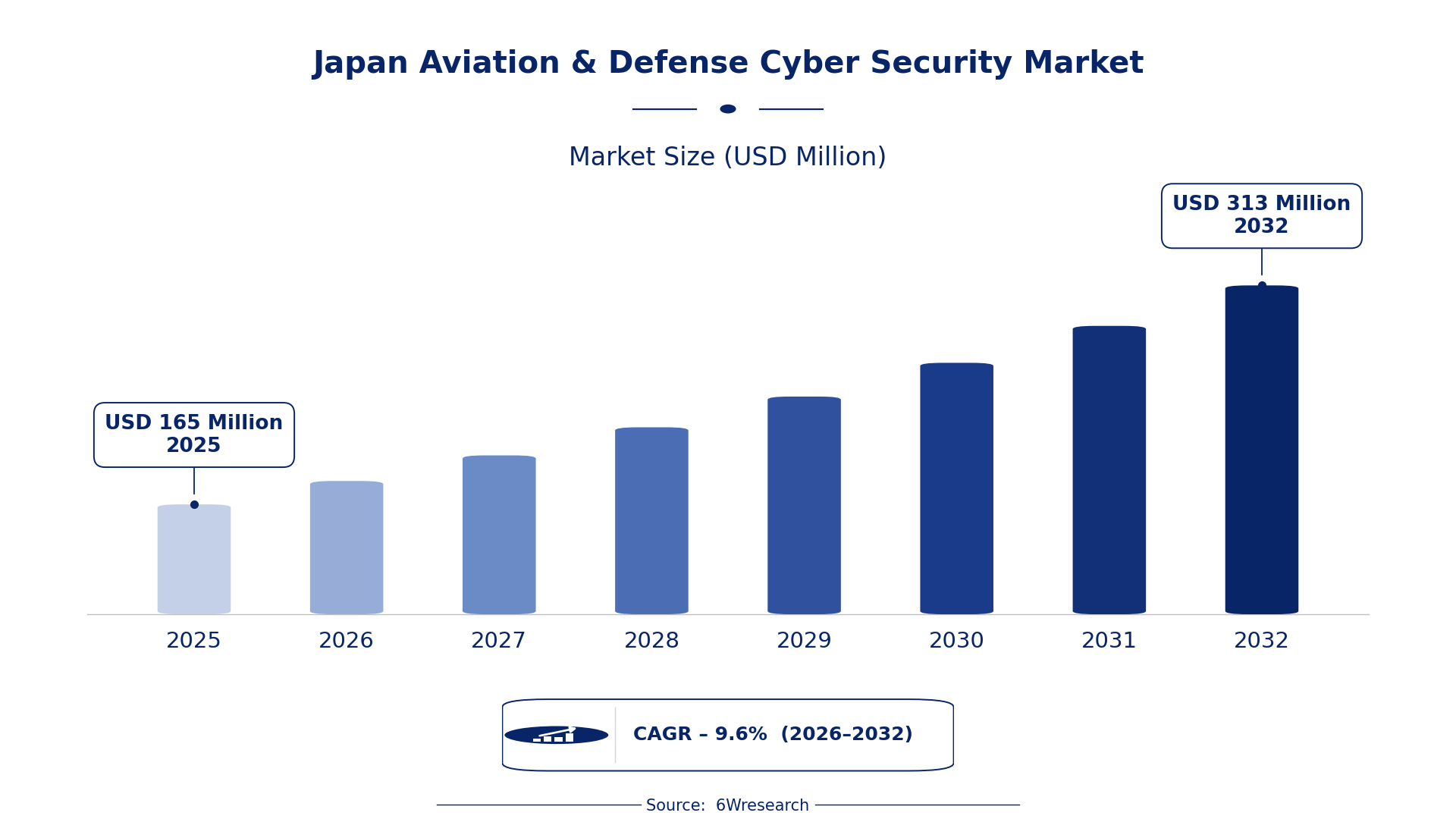
According to 6Wresearch internal database and industry insights, the Japan Aviation & Defense Cyber Security Market was valued at USD 165 Million in 2025 and is projected to reach USD 313 Million by 2032, growing at a CAGR of approximately 9.6% during 2026–2032.
Japan Aviation & Defense Cyber Security Market Highlights
| Report Metric | Details |
| Report Name | Japan Aviation & Defense Cyber Security Market (2026-2032) |
| Market Size 2025 | USD 165 Million |
| Market Size 2032 | USD 313 Million |
| Absolute Growth 2025–2032 | USD 148 Million |
| CAGR 2026–2032 | 9.6% |
| Peak Annual Growth | 10.4% in 2028 |
| Forecast Period | 2026–2032 |
| Historical Data | 2022–2025 |
| Base Year | 2025 |
| Leading Component, 2025 | Service (57% share) |
| Leading Deployment, 2025 | On-Cloud (60% share) |
| Fastest-Growing Component | Solution (12.9% CAGR) |
| Fastest-Growing Deployment | On-Premise (13.3% CAGR) |
| Growing Sector | Aviation and Defense |
| Key End Users | Defense agencies, aviation operators, cybersecurity service providers |
Japan Aviation & Defense Cyber Security Market Year-wise Growth Rate and Key Drivers (2022–2032)
This graph illustrates the annual growth rates of the market from 2022 to 2032, highlighting a steady upward trajectory and projected market expansion over the forecast period.
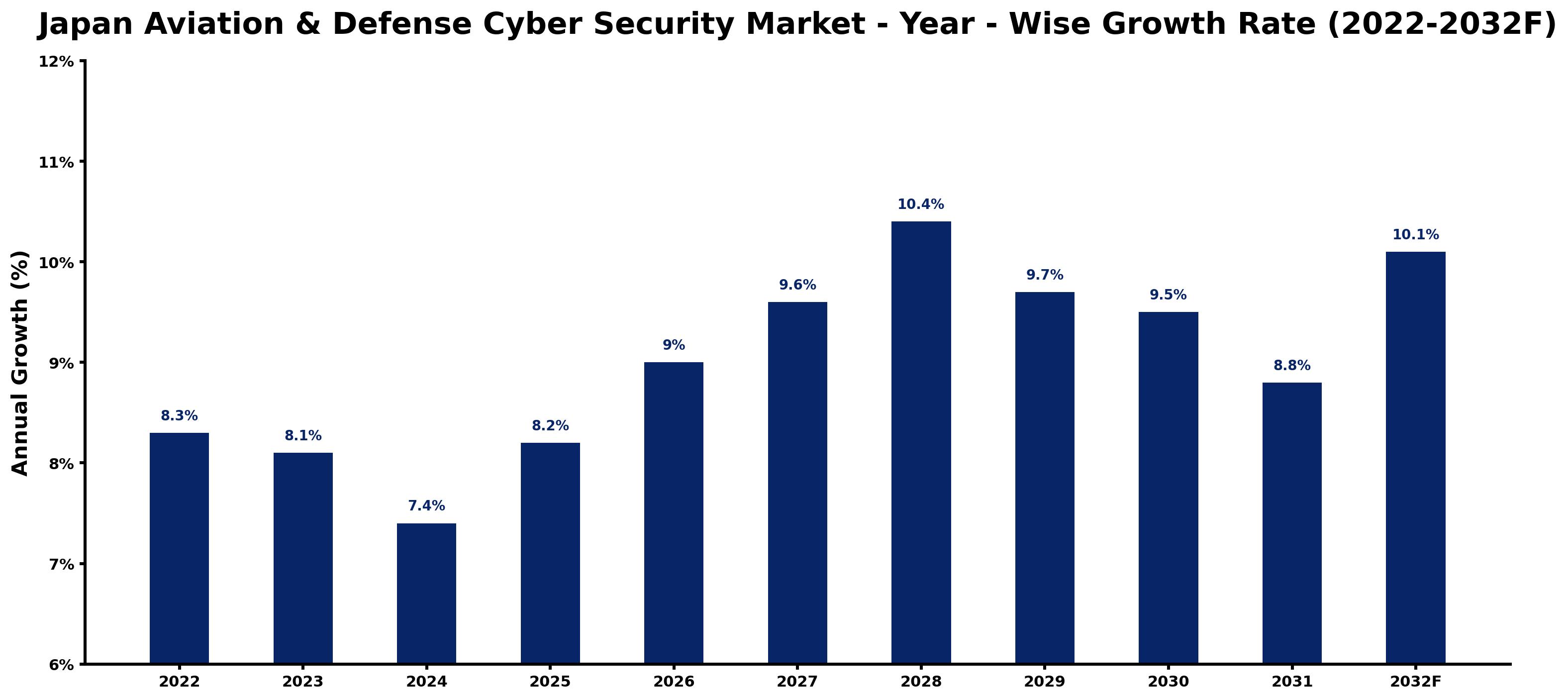
For each year, the table pairs the estimated growth rate with the leading influence on demand, showing how the drivers changed across the period.
| Year | Estimated Annual Growth (%) | Market Rationale |
| 2022 | 8.3 | The market experienced a strong demand from both aviation and defense sectors. |
| 2023 | 8.1 | Demand continued but growth slowed due to market saturation in some areas. |
| 2024 | 7.4 | The market saw a further slowdown as competition intensified among providers. |
| 2025 | 8.2 | Growth accelerated as new cybersecurity initiatives were launched by the Ministry of Defense. |
| 2026 | 9.0 | Investment in cybersecurity solutions increased, leading to higher demand from defense agencies. |
| 2027 | 9.6 | Demand rose as more organizations adopted advanced security measures. |
| 2028 | 10.4 | The market peaked with heightened investments in cybersecurity technologies. |
| 2029 | 9.7 | Growth slowed slightly as the market matured and competition increased. |
| 2030 | 9.5 | Demand continued to grow, but at a slower pace as providers adjusted strategies. |
| 2031 | 8.8 | The market saw a further slowdown as buyers became more selective in procurement. |
| 2032 | 10.1 | Growth picked up again as new regulations prompted increased cybersecurity investments. |
Note: Market size estimations and growth projections presented in this report are based on 6Wresearch's proprietary forecasting methodology, utilizing the latest available industry data, government publications, and primary research inputs.
Japan Aviation & Defense Cyber Security Market Synopsis
Aviation & Defense Cyber Security focuses on safeguarding aviation and defense systems from cyber threats through advanced technologies. The market is expanding due to ongoing investments in cybersecurity initiatives, particularly from the Ministry of Defense, which allocated ¥1 trillion in 2023. Key regions like Tokyo and Osaka are driving demand, while the implementation of ISO/IEC 27001 standard improves information security management. As the defense budget reaches ¥6.8 trillion, the need for robust cybersecurity solutions continues to grow.
Market Dynamics Impact Analysis (2026–2032)
| Factor | Type | Impact | Primary Segment Affected |
| Increased government funding for cybersecurity initiatives | Driver | High | Service |
| Growing number of cyber threats targeting defense systems | Driver | High | Solution |
| Rising demand for cybersecurity training programs for defense personnel | Opportunity | High | Service |
| Expansion of cybersecurity solutions for aviation operations | Opportunity | High | Solution |
| Limited awareness among smaller aviation firms regarding cybersecurity needs | Restraint | Medium | Service |
| High costs associated with implementing advanced cybersecurity measures | Restraint | High | Solution |
| Shortage of skilled cybersecurity professionals in the market | Challenge | High | Service |
| Rapid technological changes requiring continuous updates to systems | Challenge | Medium | Solution |
Evaluation of Drivers in Japan Aviation & Defense Cyber Security Market (2026–2032)
The factors lifting demand, and the evidence behind each, are summarised below.
| Drivers | Primary Segment Affected | Why It Matters (Evidence) |
| Increased government investment in cybersecurity | Service | The Ministry of Defense allocated ¥1 trillion for cybersecurity in 2023, boosting demand for services. |
| Rising cyber threats to aviation and defense systems | Solution | Increased incidents of cyber attacks have led to higher demand for protective solutions. |
| Implementation of ISO/IEC 27001 standard | Service | Adoption of this standard by organizations drives the need for compliance and security services. |
| Mandatory cybersecurity training for defense personnel | Service | Since 2022, training programs have been required, driving demand for educational services. |
| Expansion of aviation operations in key regions | Solution | With over 80 commercial airports in Japan, demand for advanced cybersecurity solutions is surging. |
The allocation of ¥1 trillion for cybersecurity in 2023 has spurred demand for services, particularly in the aviation sector. Increased incidents of cyber attacks have prompted organizations to seek advanced protective solutions. The expansion of aviation operations in key regions necessitates advanced security measures, further increasing demand for cybersecurity solutions.
Evaluation of Restraints in Japan Aviation & Defense Cyber Security Market
The main factors holding the market back are set out below.
| Market Restraint | Primary Segment Affected | Why It Matters (Evidence) |
| Limited awareness of cybersecurity needs among smaller aviation firms | Service | Many smaller firms lack knowledge about necessary cybersecurity measures, hindering service uptake. |
| High costs of implementing advanced cybersecurity solutions | Solution | The financial burden of sophisticated systems deters some organizations from investing in security. |
| Shortage of skilled cybersecurity professionals | Service | The lack of qualified personnel limits the ability of firms to strengthen their cybersecurity posture. |
| Rapid technological changes requiring frequent updates | Solution | Organizations face challenges in keeping systems current, leading to potential vulnerabilities. |
| Complexity of integrating new cybersecurity solutions | Service | Difficulties in merging new systems with existing infrastructure can slow adoption rates. |
Japan Aviation & Defense Cyber Security Market Challenges
Cybersecurity training programs for defense personnel have been mandatory since 2022, yet many personnel still lack adequate skills, delaying readiness and increasing vulnerability to cyber threats for defence contractors. Upgrading systems to comply with ISO/IEC 27001 standards can take months, disrupting operations for aviation service providers. The Ministry of Defense's allocation of ¥1 trillion for cybersecurity initiatives in 2023 highlights the high costs associated with implementing effective measures, impacting budget allocations for other critical areas. Buyers face challenges due to evolving regulations, resulting in unexpected costs and delays in securing necessary solutions.
Trends in the Japan Aviation & Defense Cyber Security Market
Four trends stand out in the Japan Aviation & Defense Cyber Security Market.
- Cybersecurity Training Programmes Gaining Importance: Mandatory cybersecurity training for defense personnel since 2022 has increased demand for training services. Approximately 10,000 personnel are expected to undergo training annually, ensuring a more secure defense framework.
- Shift Towards ISO/IEC 27001 Compliance: Organizations are increasingly adopting ISO/IEC 27001 to improve information security management. In 2023, over 300 companies in Japan have achieved certification, reflecting a growing commitment to cybersecurity standards.
- Expansion of Cybersecurity Solutions in Aviation: The aviation sector is increasingly investing in cybersecurity solutions to protect operations. With over 80 commercial airports in Japan, demand for advanced security measures is surging.
- Growth in On-Premise Solutions: On-Premise cybersecurity solutions are gaining traction due to their effectiveness in securing critical infrastructure. The segment is projected to grow at a CAGR of 13.3% from 2026 to 2032.
Investment Opportunities in the Japan Aviation & Defense Cyber Security Market
Several openings in the Japan Aviation & Defense Cyber Security Market merit attention from investors.
- Partnerships with Defense Agencies: Now is the time to establish partnerships with defense agencies to supply cybersecurity services, especially with a ¥1 trillion budget for 2023. Collaborating with local firms can facilitate market entry.
- Investment in Cybersecurity Training Services: With the mandatory training programs for defense personnel, there is a gap in service provision. Investing in training services can capture a growing market, especially in Tokyo and Osaka.
- Supply of Advanced Cybersecurity Solutions: The increasing complexity of cyber threats creates a demand for advanced solutions. Focusing on the aviation sector, where over 80 airports require effective security, presents a significant opportunity.
- Approval for Cybersecurity Standards Compliance: With the rise in ISO/IEC 27001 adoption, firms can invest in compliance consulting services. The growing number of certified companies indicates a strong market for support services.
Government Initiatives in the Japan Aviation & Defense Cyber Security Market
The Digital Agency, established in September 2021, leads the government's digital transformation efforts, setting cybersecurity standards across sectors. This initiative complements the Industrial Standardization Act, which governs product and test standards, ensuring compliance and security in aviation and defense operations. The focus on cybersecurity is essential for maintaining the integrity of aviation systems and protecting sensitive data.
Defense agencies utilize the Cybersecurity Strategy Council's framework to implement security measures effectively. The council provides funding for projects aimed at strengthening cybersecurity, with a focus on critical infrastructure protection. This funding supports initiatives that improve the overall security posture of aviation and defense systems.
Future Insight of the Japan Aviation & Defense Cyber Security Market
By 2032, Japan's cybersecurity framework will evolve due to the Ministry of Defense's strategic initiatives, prompting suppliers to innovate their offerings. The Japan Defense Agency's 2023-2025 cybersecurity strategy will drive the development of advanced technologies, improving protection for aviation systems. The total defense budget of ¥6.8 trillion will enable greater investment in research and infrastructure, benefiting both buyers and suppliers. Enhanced collaboration with the National Institute of Information and Communications Technology will further strengthen capabilities across the aviation and defense sectors.
Market Segmentation Analysis
Japan Aviation & Defense Cyber Security Market report covers a detailed analysis of the following market segments:
By Component – Service Leads, Solution Expected to Grow Fastest
According to Ravi Bhandari, Research Head at 6Wresearch, Service took 57% of component revenue in 2025, more than any other category. The service segment holds the largest share as it is essential for ongoing security assessments and incident response, particularly highlighted by the mandatory cybersecurity training for defence personnel that began in 2022. The substantial allocation of ¥1 trillion for cybersecurity initiatives in 2023 by the Ministry of Defense further emphasises the reliance on these services. Solution is set to record the highest CAGR in this split, 12.9% over 2026–2032. The solution segment is witnessing rapid growth as organisations increasingly seek necessary tools to protect critical systems, especially with Japan's defence budget reaching ¥6.8 trillion in 2023. This growth in solutions will likely reinforce the service segment's dominance, as the need for comprehensive cybersecurity measures continues to expand. Suppliers must enhance their service offerings to meet the rising demand for cybersecurity solutions in the aviation and defence sectors.
By Deployment – On-Cloud Leads, On-Premise Expected to Grow Fastest
On-Cloud held 60% of the Japan Aviation & Defense Cyber Security Market by deployment in 2025. The on-cloud deployment segment leads the market due to its flexibility for various applications, although it is less common in sensitive defence environments. This trend is illustrated by the operational strategies of Japan's over 80 commercial airports, which are adopting cloud solutions for improved efficiency. Over 2026–2032, On-Premise is expected to post the fastest growth, at a CAGR of 13.3%. The on-premise deployment segment is growing rapidly as organisations prioritise the security of critical infrastructure, particularly in defence operations where data sensitivity is paramount. As the on-cloud segment gains traction, the on-premise segment will continue to thrive due to its direct security advantages. Buyers should carefully assess their deployment strategies, ensuring a balance between flexibility and the necessity for robust security in critical operations.
Key Attractiveness of the Report
- 10 Years of Market Numbers
- Historical Data Starting from 2022 to 2025
- Base Year 2025
- Forecast Data until 2032
- Key Performance Indicators Impacting the Market
- Major Upcoming Developments and Projects
Key Highlights of the Report:
- Japan Aviation & Defense Cyber Security Market Outlook
- Market Size of Japan Aviation & Defense Cyber Security Market, 2025
- Forecast of Japan Aviation & Defense Cyber Security Market, 2032
- Historical Data and Forecast of Japan Aviation & Defense Cyber Security Revenues & Volume for the Period 2022-2032
- Japan Aviation & Defense Cyber Security Market Trend Evolution
- Japan Aviation & Defense Cyber Security Market Drivers and Challenges
- Japan Aviation & Defense Cyber Security Price Trends
- Japan Aviation & Defense Cyber Security Porter's Five Forces
- Japan Aviation & Defense Cyber Security Industry Life Cycle
- Historical Data and Forecast of Japan Aviation & Defense Cyber Security Market Revenues & Volume By Component for the Period 2022-2032
- Historical Data and Forecast of Japan Aviation & Defense Cyber Security Market Revenues & Volume By Service for the Period 2022-2032
- Historical Data and Forecast of Japan Aviation & Defense Cyber Security Market Revenues & Volume By Solution for the Period 2022-2032
- Historical Data and Forecast of Japan Aviation & Defense Cyber Security Market Revenues & Volume By Deployment for the Period 2022-2032
- Historical Data and Forecast of Japan Aviation & Defense Cyber Security Market Revenues & Volume By On-Cloud for the Period 2022-2032
- Historical Data and Forecast of Japan Aviation & Defense Cyber Security Market Revenues & Volume By On-Premise for the Period 2022-2032
- Japan Aviation & Defense Cyber Security Import Export Trade Statistics
- Market Opportunity Assessment By Component
- Market Opportunity Assessment By Deployment
- Japan Aviation & Defense Cyber Security Top Companies Market Share
- Japan Aviation & Defense Cyber Security Competitive Benchmarking By Technical and Operational Parameters
- Japan Aviation & Defense Cyber Security Company Profiles
- Japan Aviation & Defense Cyber Security Key Strategic Recommendations
Market Covered
Segments analysed in this report are listed below.
By Component
- Service
- Solution
By Deployment
- On-Cloud
- On-Premise































