Japan B2B E-commerce Market Size & Growth Rate
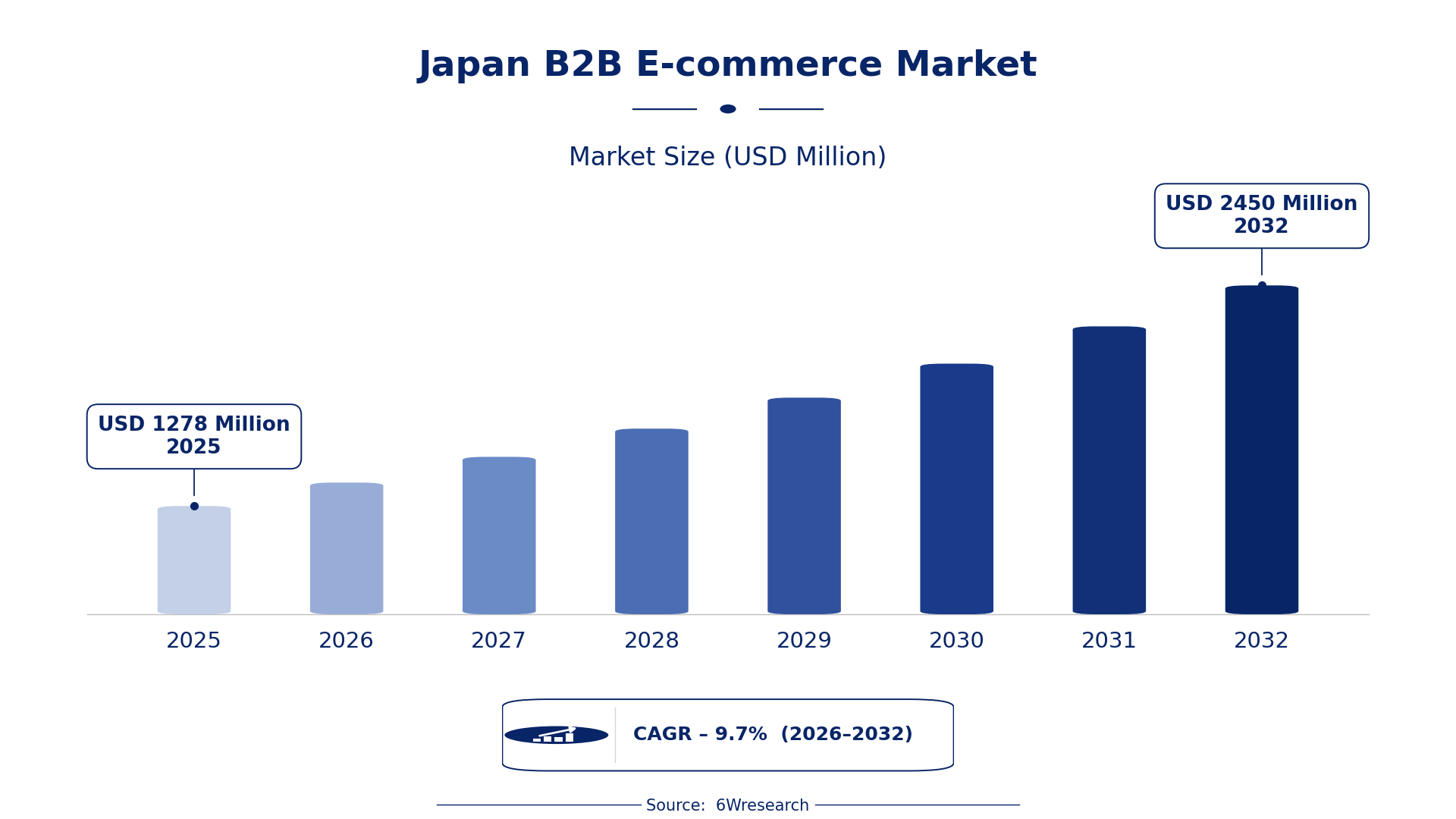
According to 6Wresearch internal database and industry insights, the Japan B2B E-commerce Market was valued at USD 1,278 Million in 2025 and is projected to reach USD 2,450 Million by 2032, growing at a CAGR of approximately 9.7% during 2026–2032.
Japan B2B E-commerce Market Highlights
| Report Metric | Details |
| Report Name | Japan B2B E-commerce Market (2026-2032) |
| Market Size 2025 | USD 1,278 Million |
| Market Size 2032 | USD 2,450 Million |
| Absolute Growth 2025–2032 | USD 1,172 Million |
| CAGR 2026–2032 | 9.7% |
| Peak Annual Growth | 11.2% in 2026 |
| Forecast Period | 2026–2032 |
| Historical Data | 2022–2025 |
| Base Year | 2025 |
| Leading Product, 2025 | Physical Goods (68% share) |
| Leading Market Type, 2025 | Wholesale Products (67% share) |
| Leading Application, 2025 | B2B Product Sales (55% share) |
| Leading End User, 2025 | B2B Product Sales (62% share) |
| Leading Distribution Channel, 2025 | Direct Sales (56% share) |
| Fastest-Growing Product | Digital Products (13.3% CAGR) |
| Fastest-Growing Market Type | Software & SaaS (13.5% CAGR) |
| Fastest-Growing Application | Business Solutions Subscriptions (12.7% CAGR) |
| Fastest-Growing End User | Business Solutions Subscriptions (12.2% CAGR) |
| Fastest-Growing Distribution Channel | Online Sales (11.9% CAGR) |
| Growing Sector | B2B Product Sales |
| Key End Users | manufacturers, retailers, wholesalers, service providers |
Japan B2B E-commerce Market Year-wise Growth Rate and Key Drivers (2022–2032)
This graph illustrates the annual growth rates of the market from 2022 to 2032, highlighting a steady upward trajectory and projected market expansion over the forecast period.
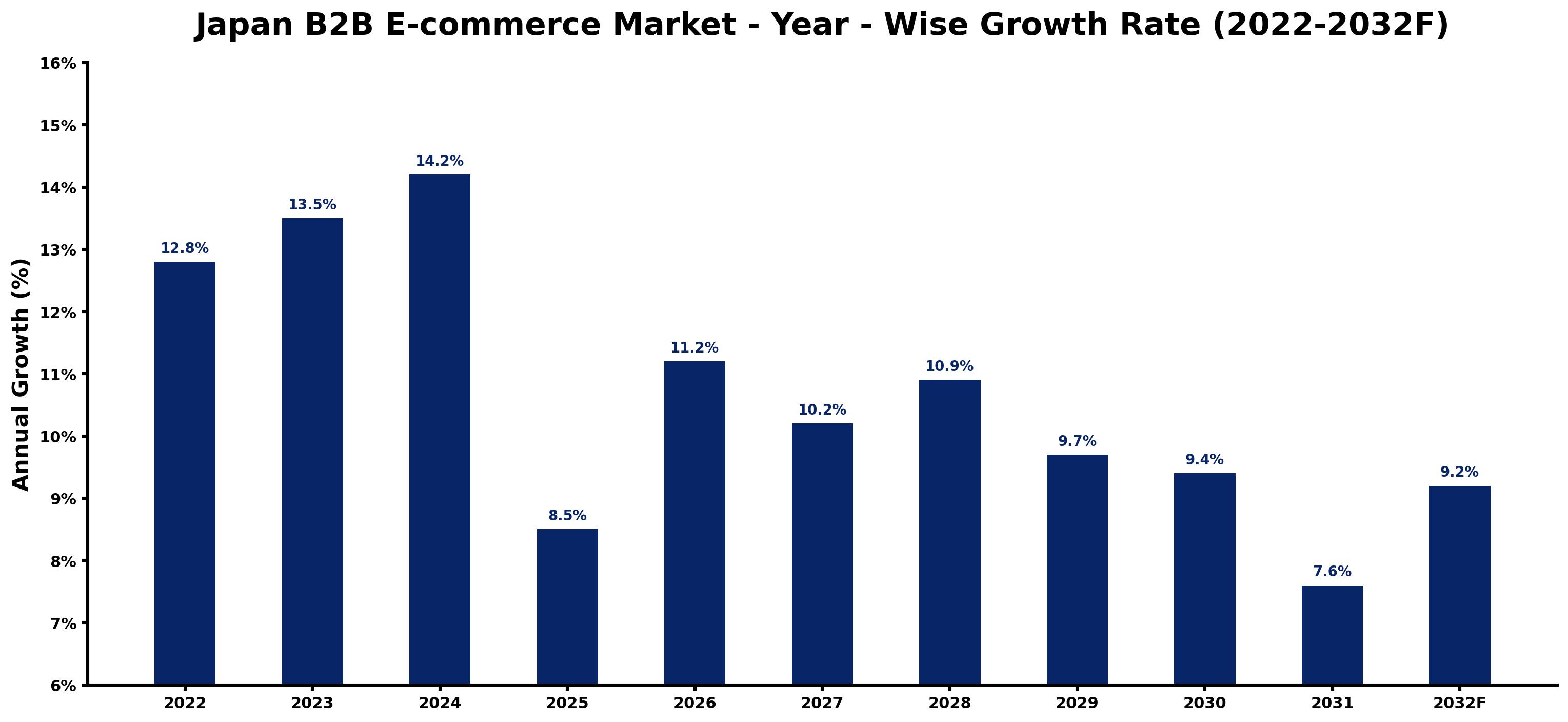
Each row of the following table gives one year's estimated growth and the event or demand shift that explains it.
| Year | Estimated Annual Growth (%) | Market Rationale |
| 2022 | 12.8 | The market showed strong activity with a growth rate reflecting increasing digital transactions. |
| 2023 | 13.5 | Growth continued to accelerate as more businesses adopted e-commerce platforms for procurement. |
| 2024 | 14.2 | The market experienced its highest growth rate, driven by increases in online sales. |
| 2025 | 8.5 | Growth slowed as the market began to stabilise after rapid expansion in previous years. |
| 2026 | 11.2 | The market is expected to rebound with renewed interest in digital solutions and e-commerce platforms. |
| 2027 | 10.2 | Growth will decelerate slightly as businesses adjust to evolving digital needs. |
| 2028 | 10.9 | The market is projected to see a resurgence in growth as mobile commerce gains traction. |
| 2029 | 9.7 | Growth will slow again as the market approaches maturity with established players dominating. |
| 2030 | 9.4 | The market is expected to continue growing, albeit at a slower pace as competition intensifies. |
| 2031 | 7.6 | Growth will slow further as market saturation becomes more pronounced among key segments. |
| 2032 | 9.2 | The market is projected to pick up pace again, driven by advancements in technology. |
Note: Market size estimations and growth projections presented in this report are based on 6Wresearch's proprietary forecasting methodology, utilizing the latest available industry data, government publications, and primary research inputs.
Japan B2B E-commerce Market Synopsis
B2B e-commerce facilitates transactions between businesses, primarily involving physical goods and digital products. The Japan B2B E-commerce Market is growing due to the rising adoption of digital payment solutions and the expansion of online sales channels. In 2022, the market was valued at approximately 200 trillion JPY, with contributions from sectors like manufacturing and retail. Ongoing digital transformation initiatives are driving demand, particularly in major hubs such as Tokyo and Osaka.
Market Dynamics Impact Analysis (2026–2032)
| Factor | Type | Impact | Primary Segment Affected |
| Growing adoption of digital payment solutions | Driver | High | B2B Product Sales |
| Expansion of online sales channels | Driver | High | Wholesale Products |
| Increasing demand for software solutions | Opportunity | High | Software & SaaS |
| Rise in mobile commerce usage | Opportunity | Medium | Digital Products |
| Market saturation in key segments | Restraint | High | B2B Product Sales |
| Competition among established players | Restraint | Medium | Wholesale Products |
| Challenges in logistics and delivery systems | Challenge | High | Online Sales |
| Need for compliance with data security standards | Challenge | Medium | Digital Products |
Evaluation of Drivers in Japan B2B E-commerce Market (2026–2032)
The main growth drivers and the segments they affect most are set out below.
| Drivers | Primary Segment Affected | Why It Matters (Evidence) |
| Increased digital payment adoption | B2B Product Sales | As of 2023, around 60% of B2B transactions are conducted using digital payments, improving transaction efficiency. |
| Expansion of online sales channels | Wholesale Products | In 2023, 70% of B2B companies reported using online platforms for procurement, driving bulk transactions. |
| Growing demand for software solutions | Software & SaaS | The average annual spending on B2B software solutions per company is estimated at 5 million JPY, reflecting strong investment. |
| Rising mobile commerce usage | Digital Products | The B2B e-commerce market is expected to see a rise in mobile commerce usage by 2025, attracting more users. |
| Increased logistics capacity | Online Sales | Japan's e-commerce logistics market is projected to grow, supporting the rise in online sales. |
Several shifts outside the market lift sales. The adoption of digital payment solutions has reached around 60% in B2B transactions, enabling smoother transactions for businesses. In 2023, 70% of B2B companies utilised online platforms for procurement, boosting demand for wholesale products. The average annual spending on B2B software solutions is estimated at 5 million JPY, indicating strong investment in digital tools. The logistics market is set to grow, improving delivery capabilities for online sales. This combination of factors is driving increased purchasing, particularly in manufacturing and retail.
Evaluation of Restraints in Japan B2B E-commerce Market
The table below lists the restraints and the evidence behind each.
| Market Restraint | Primary Segment Affected | Why It Matters (Evidence) |
| Market saturation in key segments | B2B Product Sales | As competition intensifies, established players dominate, limiting growth opportunities for new entrants. |
| Challenges in logistics and delivery systems | Online Sales | Inefficiencies in logistics can delay deliveries, affecting customer satisfaction and repeat business. |
| Need for compliance with data security standards | Digital Products | Platforms must obtain ISO/IEC 27001 certification, which can be costly and time-consuming. |
| Competition among established players | Wholesale Products | Intense competition leads to price wars, reducing profit margins for new and smaller businesses. |
| Limited awareness of e-commerce benefits | Software & SaaS | Some businesses remain hesitant to adopt e-commerce due to lack of understanding, hindering market growth. |
Japan B2B E-commerce Market Challenges
In 2023, the average transaction value in B2B e-commerce is approximately 1 million JPY per order, which creates high costs that hinder small businesses from scaling effectively. Regulatory requirements, such as the JIS X 8341-3 standard for accessibility, impose additional burdens, delaying platform updates for suppliers. Supply chain inefficiencies are prevalent, particularly in logistics, where the demand for e-commerce exceeds current capabilities, resulting in longer delivery times for buyers. Many SMEs lack digital marketing skills, limiting their online competitiveness and leading to significant revenue losses.
Trends in the Japan B2B E-commerce Market
Buyers and suppliers in the Japan B2B E-commerce Market are adjusting to the following trends.
- Shift in Procurement Practices: Manufacturers are increasingly adopting online platforms for procurement, with 70% using these solutions in 2023. This shift improves efficiency and reduces costs.
- Transition to Mobile Commerce: The B2B e-commerce market is seeing a rise in mobile commerce usage, projected to grow by 2025, allowing businesses to transact on-the-go.
- Emergence of Software Solutions: Business Solutions Subscriptions are gaining traction, with a CAGR of 12.7% expected from 2026 to 2032, driven by the need for ongoing support and management.
- Prioritisation of Data Security Standards: The ISO/IEC 27001 certification is increasingly sought by B2B e-commerce platforms, reflecting a growing emphasis on data security and consumer trust.
Investment Opportunities in the Japan B2B E-commerce Market
The following areas offer the clearest openings for investors and suppliers in the Japan B2B E-commerce Market.
- Timing for Digital Transformation: With the government allocating 10 billion JPY for digital infrastructure development, there is an opportunity for investment in e-commerce platforms.
- Gap in Software Solutions: The average annual spending on B2B software solutions per company is estimated at 5 million JPY, indicating a strong demand for new solutions.
- Focus on Major Hubs: Tokyo and Osaka are key regions for B2B e-commerce activities, presenting opportunities for businesses to establish local partnerships and expand their reach.
- Entry through Local Partnerships: Collaborating with local firms can facilitate entry into the Japanese market, especially in sectors like manufacturing and retail.
Government Initiatives in the Japan B2B E-commerce Market
The Semiconductor and Digital Industry Strategy, established by METI in June 2021, aims to secure domestic semiconductor manufacturing. This measure is important for B2B e-commerce, as it ensures a stable supply of essential components for platforms.
The Digital Agency, established in September 2021, leads government digital transformation efforts. It supports businesses in adopting e-commerce solutions, ensuring they meet common system standards and can efficiently operate in the economy.
Future Insight of the Japan B2B E-commerce Market
A policy-driven shift to increase the digital economy's contribution to GDP by 20% by 2025 will drive progress in B2B e-commerce. The METI programme launched in 2023 will support digital transformation, enabling SMEs to adopt more effective e-commerce strategies. As mobile commerce usage rises, suppliers will need to adapt their platforms for mobile users. Enhanced logistics capabilities will lead to faster delivery times, improving service reliability for buyers.
Market Segmentation Analysis
Japan B2B E-commerce Market report covers a detailed analysis of the following market segments:
By Product – Physical Goods Lead, Digital Products Expected to Grow Fastest
According to Shubham Deep, Research Manager at 6Wresearch, Physical Goods accounted for 68% of the market by product in 2025. Physical goods are essential in Japan's B2B e-commerce market, especially in wholesale distribution within manufacturing and retail sectors. The average transaction value of approximately 1 million JPY highlights the significance of these transactions. Digital Products are set to record the highest CAGR in this split, 13.3% over 2026–2032. Digital products are experiencing rapid growth as businesses increasingly rely on software solutions and subscriptions for operational efficiency. The average annual spending on B2B software solutions, estimated at 5 million JPY per company, reflects this upward trend. Suppliers should prioritise their digital product strategies to meet the rising demand.
By Market Type – Wholesale Products Lead, Software & SaaS Expected to Grow Fastest
Wholesale Products held 67% of the Japan B2B E-commerce Market by market type in 2025. Wholesale products hold the largest share in Japan's B2B e-commerce market as they facilitate bulk transactions essential for business operations. This segment is supported by over 70% of B2B companies using online platforms for procurement. The quickest growth will come from Software & SaaS, forecast to expand at a CAGR of 13.5% between 2026 and 2032. Software and SaaS are rapidly gaining traction as businesses seek effective management solutions, reflecting the increasing reliance on digital tools. The government's initiatives to support digital transformation further fuel this growth. Buyers will benefit from a wider range of software solutions as suppliers expand their offerings.
By Application – B2B Product Sales Leads, Business Solutions Subscriptions Expected to Grow Fastest
The largest application category in 2025 was B2B Product Sales, at 55% of revenue. B2B product sales are integral to the functionality of e-commerce platforms, serving businesses that require efficient procurement solutions. The fact that over 10 million users are registered on B2B e-commerce platforms in Japan highlights the significance of this segment. Over 2026–2032, Business Solutions Subscriptions are expected to post the fastest growth, at a CAGR of 12.7%. Business solutions subscriptions are expanding quickly as companies seek ongoing services to improve their operations. This growth is supported by the rising adoption of digital payment solutions in B2B transactions, which stands at approximately 60%. Suppliers should prioritise subscription-based models to meet the rising demand for continuous business solutions.
By End User – B2B Product Sales Leads, Business Solutions Subscriptions Expected to Grow Fastest
In 2025, B2B Product Sales led the end user split with a 62% share. B2B product sales serve as the backbone of e-commerce platforms, facilitating crucial transactions between businesses. A 15% increase in online sales for B2B products in 2023 illustrates the importance of this segment. Business Solutions Subscriptions are projected to grow fastest, at a CAGR of 12.2% during 2026–2032. Business solutions subscriptions are gaining momentum as companies seek dependable services for ongoing support. The government's aim to boost the digital economy's GDP contribution by 20% by 2025 further drives this growth. Buyers can anticipate more customised business solutions as suppliers respond to the subscription trend.
By Distribution Channel – Direct Sales Leads, Online Sales Expected to Grow Fastest
With 56% of distribution channel revenue in 2025, Direct Sales was the largest category. Direct sales remain the primary distribution channel, providing personalised transactions that enhance customer relationships. This approach is particularly effective in sectors where relationship management is vital for transaction success. Online Sales is set to record the highest CAGR in this split, 11.9% over 2026–2032. Online sales are the fastest-growing distribution channel, fuelled by the increasing shift towards digital transactions among B2B firms. The presence of over 1,000 B2B e-commerce platforms in Japan signifies this transition towards online channels. Suppliers need to strengthen their online strategies to leverage the expanding digital sales trend.
Key Attractiveness of the Report
- 10 Years of Market Numbers
- Historical Data Starting from 2022 to 2025
- Base Year 2025
- Forecast Data until 2032
- Key Performance Indicators Impacting the Market
- Major Upcoming Developments and Projects
Key Highlights of the Report:
- Japan B2B E-commerce Market Outlook
- Market Size of Japan B2B E-commerce Market,2025
- Forecast of Japan B2B E-commerce Market, 2032
- Historical Data and Forecast of Japan B2B E-commerce Revenues & Volume for the Period 2022-2032
- Japan B2B E-commerce Market Trend Evolution
- Japan B2B E-commerce Market Drivers and Challenges
- Japan B2B E-commerce Price Trends
- Japan B2B E-commerce Porter's Five Forces
- Japan B2B E-commerce Industry Life Cycle
- Historical Data and Forecast of Japan B2B E-commerce Market Revenues & Volume By Product for the Period 2022-2032
- Historical Data and Forecast of Japan B2B E-commerce Market Revenues & Volume By Physical Goods for the Period 2022-2032
- Historical Data and Forecast of Japan B2B E-commerce Market Revenues & Volume By Digital Products for the Period 2022-2032
- Historical Data and Forecast of Japan B2B E-commerce Market Revenues & Volume By Market Type for the Period 2022-2032
- Historical Data and Forecast of Japan B2B E-commerce Market Revenues & Volume By Wholesale Products for the Period 2022-2032
- Historical Data and Forecast of Japan B2B E-commerce Market Revenues & Volume By Software & SaaS for the Period 2022-2032
- Historical Data and Forecast of Japan B2B E-commerce Market Revenues & Volume By Application for the Period 2022-2032
- Historical Data and Forecast of Japan B2B E-commerce Market Revenues & Volume By B2B Product Sales for the Period 2022-2032
- Historical Data and Forecast of Japan B2B E-commerce Market Revenues & Volume By Business Solutions Subscriptions for the Period 2022-2032
- Historical Data and Forecast of Japan B2B E-commerce Market Revenues & Volume By End User for the Period 2022-2032
- Historical Data and Forecast of Japan B2B E-commerce Market Revenues & Volume By B2B Product Sales for the Period 2022-2032
- Historical Data and Forecast of Japan B2B E-commerce Market Revenues & Volume By Business Solutions Subscriptions for the Period 2022-2032
- Historical Data and Forecast of Japan B2B E-commerce Market Revenues & Volume By Distribution Channel for the Period 2022-2032
- Historical Data and Forecast of Japan B2B E-commerce Market Revenues & Volume By Direct Sales for the Period 2022-2032
- Historical Data and Forecast of Japan B2B E-commerce Market Revenues & Volume By Online Sales for the Period 2022-2032
- Japan B2B E-commerce Import Export Trade Statistics
- Market Opportunity Assessment By Product
- Market Opportunity Assessment By Market Type
- Market Opportunity Assessment By Application
- Market Opportunity Assessment By End User
- Market Opportunity Assessment By Distribution Channel
- Japan B2B E-commerce Top Companies Market Share
- Japan B2B E-commerce Competitive Benchmarking By Technical and Operational Parameters
- Japan B2B E-commerce Company Profiles
- Japan B2B E-commerce Key Strategic Recommendations
Market Covered
Segments analysed in this report are listed below.
By Product
- Physical Goods
- Digital Products
By Market Type
- Wholesale Products
- Software & SaaS
By Application
- B2B Product Sales
- Business Solutions Subscriptions
By End User
- B2B Product Sales
- Business Solutions Subscriptions
By Distribution Channel
- Direct Sales
- Online Sales































