Japan Boring Tools Market Size & Growth Rate
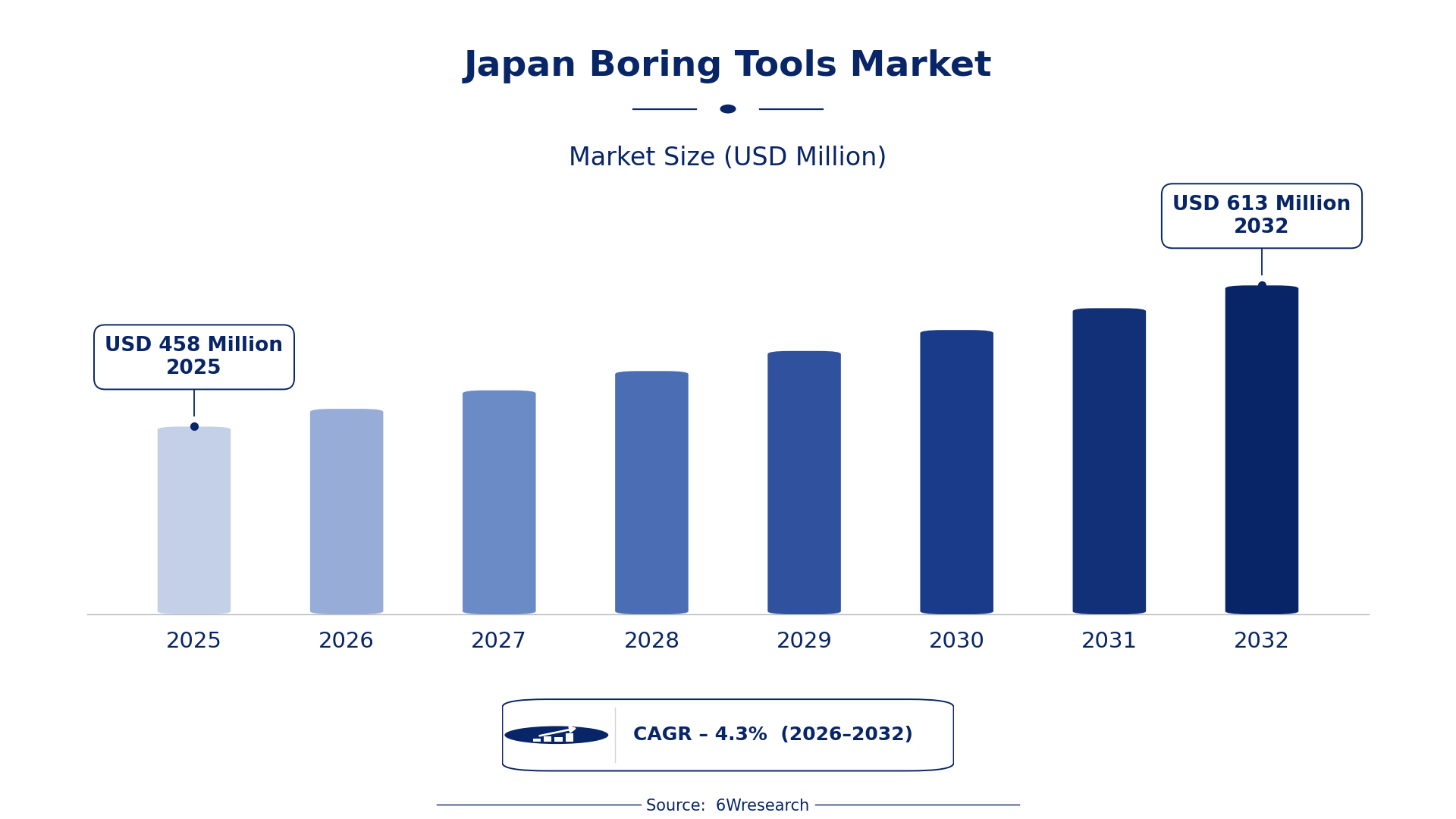
According to 6Wresearch internal database and industry insights, the Japan Boring Tools Market was valued at USD 458 Million in 2025 and is projected to reach USD 613 Million by 2032, growing at a CAGR of approximately 4.3% during 2026–2032.
Japan Boring Tools Market Highlights
| Report Metric | Details |
| Report Name | Japan Boring Tools Market (2026-2032) |
| Market Size 2025 | USD 458 Million |
| Market Size 2032 | USD 613 Million |
| Absolute Growth 2025–2032 | USD 155 Million |
| CAGR 2026–2032 | 4.3% |
| Peak Annual Growth | 5.1% in 2028 |
| Forecast Period | 2026–2032 |
| Historical Data | 2022–2025 |
| Base Year | 2025 |
| Leading Type, 2025 | Fine Boring (63% share) |
| Fastest-Growing Type | Rough Boring (5.8% CAGR) |
| Growing Sector | Rough Boring |
| Key End Users | Fine Boring, Rough Boring |
Japan Boring Tools Market Year-wise Growth Rate and Key Drivers (2022–2032)
This graph illustrates the annual growth rates of the market from 2022 to 2032, highlighting a steady upward trajectory and projected market expansion over the forecast period.
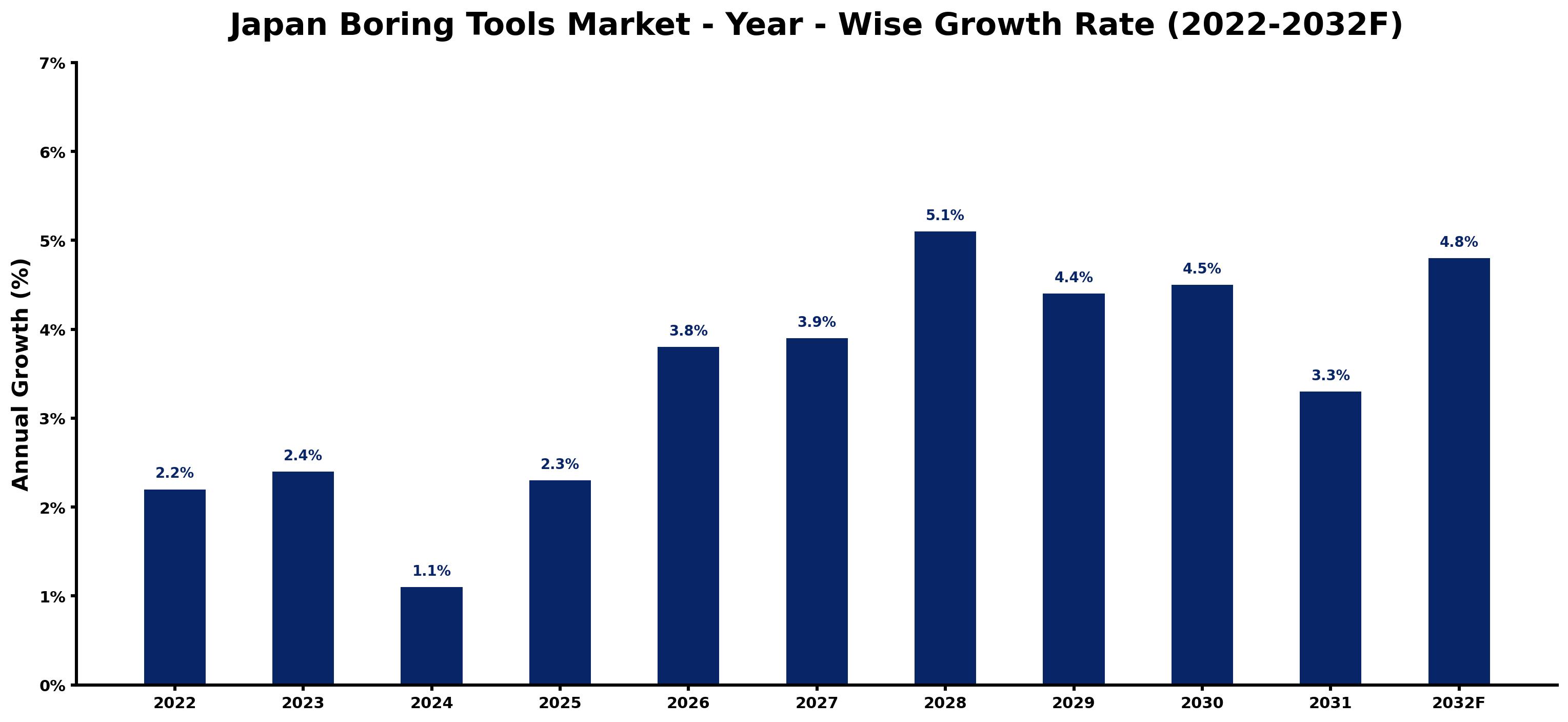
Below, each year's estimated growth is shown next to the factor that most influenced it.
| Year | Estimated Annual Growth (%) | Market Rationale |
| 2022 | 2.2 | The market was stable, reflecting ongoing demand from the manufacturing sector. |
| 2023 | 2.4 | Growth accelerated due to increased precision requirements in automotive production. |
| 2024 | 1.1 | Growth slowed as manufacturers adjusted to previous investments and demand patterns. |
| 2025 | 2.3 | Demand rose again as production values in automotive and machinery improved. |
| 2026 | 3.8 | A faster growth rate is anticipated as investments in advanced manufacturing technologies increase. |
| 2027 | 3.9 | Growth will continue as the installed base of CNC machines expands further. |
| 2028 | 5.1 | The peak growth rate will be reached, driven by heightened demand for precision tools. |
| 2029 | 4.4 | Growth will slow slightly as the market begins to stabilise after peak demand. |
| 2030 | 4.5 | Demand will increase again as manufacturers focus on productivity improvements. |
| 2031 | 3.3 | Growth will slow as the market adjusts to a more mature phase of development. |
| 2032 | 4.8 | The market is expected to grow steadily as investments in automation continue. |
Note: Market size estimations and growth projections presented in this report are based on 6Wresearch's proprietary forecasting methodology, utilizing the latest available industry data, government publications, and primary research inputs.
Japan Boring Tools Market Synopsis
Boring tools are precision instruments essential for machining processes, primarily used to create holes in various materials. The automotive sector in Japan, with a production value exceeding 10 trillion yen, significantly drives the Japan Boring Tools Market. Investments in advanced manufacturing technologies and increased automation adoption in production processes are key factors supporting market expansion. The Tokyo Metropolitan area serves as a hub for manufacturers and users of boring tools, further bolstering growth in the sector.
Market Dynamics Impact Analysis (2026–2032)
| Factor | Type | Impact | Primary Segment Affected |
| Growth in the automotive sector drives demand for fine boring tools, enhancing precision in manufacturing. | Driver | High | Fine Boring |
| Investment in advanced manufacturing technologies boosts the need for rough boring tools in heavy machinery. | Driver | High | Rough Boring |
| Increased automation in manufacturing creates opportunities for suppliers of advanced boring tools. | Opportunity | High | Fine Boring |
| The rising production of heavy machinery in Aichi and Osaka presents a growing market for rough boring tools. | Opportunity | High | Rough Boring |
| Quality standards set by JIS B 6330 may limit the entry of new manufacturers into the market. | Restraint | Medium | Fine Boring |
| High competition among manufacturers can lead to price pressures in the rough boring segment. | Restraint | Medium | Rough Boring |
| The need for ISO 9001 certification can delay product launches for new manufacturers. | Challenge | High | Fine Boring |
| Investment in automation technologies requires significant upfront costs, affecting smaller manufacturers. | Challenge | High | Rough Boring |
Evaluation of Drivers in Japan Boring Tools Market (2026–2032)
The factors lifting demand, and the evidence behind each, are summarised below.
| Drivers | Primary Segment Affected | Why It Matters (Evidence) |
| Increased automotive production drives demand for fine boring tools, improving precision in components. | Fine Boring | The automotive sector's production value exceeds 10 trillion yen, necessitating high-precision tools. |
| Rising investments in heavy machinery manufacturing boost the need for rough boring tools. | Rough Boring | Manufacturing hubs in Aichi and Osaka are increasing tool usage due to high production demands. |
| The installed base of CNC machines, exceeding 300,000 units, fuels demand for boring tools. | Fine Boring | CNC machines require precision tools for efficient operation, driving purchases. |
| Government initiatives promoting automation in manufacturing create demand for advanced boring tools. | Rough Boring | These initiatives stimulate productivity, leading to higher tool requirements. |
| Industry trade shows showcase innovations, stimulating interest in boring tools. | Fine Boring | Such events highlight advancements, encouraging manufacturers to upgrade their toolsets. |
Most of the extra volume comes from the automotive sector, which has a production value exceeding 10 trillion yen, driving demand for fine boring tools. The installed base of CNC machines in Japan exceeds 300,000 units, creating a strong need for precision instruments. Industry trade shows showcase innovations that encourage manufacturers to upgrade their boring tools, further increasing demand for these precision instruments.
Evaluation of Restraints in Japan Boring Tools Market
Below are the constraints most often cited by buyers and suppliers, with the segment each affects.
| Market Restraint | Primary Segment Affected | Why It Matters (Evidence) |
| Quality standards set by JIS B 6330 may limit new entrants into the market, affecting competition. | Fine Boring | Manufacturers must comply with stringent quality requirements, delaying market entry. |
| High competition can lead to price pressures, impacting profitability for rough boring tool manufacturers. | Rough Boring | Intense rivalry among established players can squeeze margins. |
| The need for ISO 9001 certification can delay product launches for new manufacturers, limiting their market access. | Fine Boring | Certification processes are time-consuming and costly for new entrants. |
| Investment in automation technologies requires substantial upfront costs, affecting smaller manufacturers' participation. | Rough Boring | Smaller firms may struggle to afford the necessary technology investments. |
| Market fluctuations in the automotive sector can lead to unpredictable demand for boring tools, complicating production planning. | Fine Boring | Dependence on automotive production makes the market vulnerable to sector-specific downturns. |
Japan Boring Tools Market Challenges
Japan's automotive sector generates over 10 trillion yen, yet compliance with the JIS B 6330 standard can extend production timelines for manufacturers, reducing their market responsiveness. Rapid technological advancements leave producers struggling to integrate new systems, resulting in inefficiencies that cost buyers approximately 15% in lost productivity. A shortage of skilled technicians restricts operational capabilities in plants, raising costs for manufacturers and leading to higher prices for buyers. Rising material costs for high-speed steel and carbide are squeezing margins, forcing producers to pass on expenses to customers, which can increase prices by up to 10%.
Trends in the Japan Boring Tools Market
Buyers and suppliers in the Japan Boring Tools Market are adjusting to the following trends.
- Shift in Manufacturing Focus to Automation: The Tokyo Metropolitan area is increasingly adopting automation technologies in manufacturing, driven by government initiatives. In 2023, the METI launched a program to boost productivity, which is expected to increase the demand for boring tools.
- Rising Demand for Precision Engineering: Automotive manufacturers are prioritising precision engineering to improve product quality, particularly in regions like Aichi. The production value in this sector exceeds 10 trillion yen, reflecting the growing need for fine boring tools.
- Transition to Advanced Manufacturing Technologies: The introduction of advanced manufacturing technologies is reshaping the boring tools market. The Japan International Machine Tool Fair highlighted innovations that are expected to drive new investments in tool optimization strategies.
- Increased Focus on Quality Standards: Manufacturers are increasingly pursuing ISO 9001 certification to ensure quality management. This trend is evident among boring tool producers, as compliance with these standards is essential for market competitiveness.
Investment Opportunities in the Japan Boring Tools Market
Several openings in the Japan Boring Tools Market merit attention from investors.
- Tokyo Metropolitan Area: The Tokyo Metropolitan area is experiencing a surge in demand for advanced boring tools, with the market gap expected to reach JPY 20 billion. Manufacturers can enter this market by partnering with local firms to enhance distribution.
- Automotive Manufacturers: Automotive manufacturers are looking for high-precision boring tools to meet increasing production values. With the sector exceeding 10 trillion yen, suppliers can establish relationships with these manufacturers to capture demand.
- Heavy Machinery Production: Investment in heavy machinery production is rising, creating a need for rough boring tools. Regions like Aichi are ideal for suppliers to focus on, given their manufacturing concentration.
- Industry Trade Shows: The annual Japan International Machine Tool Fair presents opportunities for suppliers to showcase innovations. Engaging with attendees can help identify new buyers and trends in the boring tools market.
Government Initiatives in the Japan Boring Tools Market
The Act against Unjustifiable Premiums and Misleading Representations, established in 1962, prohibits misleading labelling and advertising of goods. This law ensures that manufacturers of boring tools maintain transparency in their marketing practices, fostering trust among buyers and enhancing market competitiveness.
The Industrial Standardization Act, amended in 2019, governs JIS product and test standards. Compliance with these standards is crucial for manufacturers, as it ensures product quality and safety, making their offerings more appealing to buyers in the market.
Future Insight of the Japan Boring Tools Market
Investment in advanced manufacturing technologies will accelerate, driving demand for precision boring tools. By 2032, the installed base of CNC machines is projected to exceed 400,000 units, significantly increasing the need for these instruments. Automation initiatives will streamline production processes, benefiting suppliers by enhancing efficiency. The Japan International Machine Tool Fair will showcase ongoing innovations, shaping the future of the market and providing buyers with access to cutting-edge solutions.
Market Segmentation Analysis
Japan Boring Tools Market report covers a detailed analysis of the following market segments:
By Type – Fine Boring Leads, Rough Boring Expected to Grow Fastest
According to Bhawna Singh, Assistant Manager at 6Wresearch, in 2025, Fine Boring led the type split with a 63% share. Fine boring tools dominate the market due to their critical application in the automotive sector, which boasts a production value exceeding 10 trillion yen. Their role in ensuring high precision for high-tolerance applications makes them indispensable for manufacturers in this industry. Rough Boring is set to record the highest CAGR in this split, 5.8% over 2026–2032. Rough boring tools are experiencing rapid growth as they are vital for initial hole sizing and material removal in heavy machinery, especially in regions like Aichi and Osaka. The surge in demand is further fuelled by government initiatives that promote automation in manufacturing processes. This suggests that suppliers should focus on enhancing their offerings of rough boring tools to capitalise on the growing demand in heavy machinery.
Key Attractiveness of the Report
- 10 Years of Market Numbers
- Historical Data Starting from 2022 to 2025
- Base Year 2025
- Forecast Data until 2032
- Key Performance Indicators Impacting the Market
- Major Upcoming Developments and Projects
Key Highlights of the Report:
- Japan Boring Tools Market Outlook
- Market Size of Japan Boring Tools Market, 2025
- Forecast of Japan Boring Tools Market, 2032
- Historical Data and Forecast of Japan Boring Tools Revenues & Volume for the Period 2022-2032
- Japan Boring Tools Market Trend Evolution
- Japan Boring Tools Market Drivers and Challenges
- Japan Boring Tools Price Trends
- Japan Boring Tools Porter's Five Forces
- Japan Boring Tools Industry Life Cycle
- Historical Data and Forecast of Japan Boring Tools Market Revenues & Volume By Type for the Period 2022-2032
- Historical Data and Forecast of Japan Boring Tools Market Revenues & Volume By Fine Boring for the Period 2022-2032
- Historical Data and Forecast of Japan Boring Tools Market Revenues & Volume By Rough Boring for the Period 2022-2032
- Japan Boring Tools Import Export Trade Statistics
- Market Opportunity Assessment By Type
- Japan Boring Tools Top Companies Market Share
- Japan Boring Tools Competitive Benchmarking By Technical and Operational Parameters
- Japan Boring Tools Company Profiles
- Japan Boring Tools Key Strategic Recommendations
Market Covered
Segments analysed in this report are listed below.
By Type
- Fine Boring
- Rough Boring































