Japan Cardamom Market Size & Growth Rate
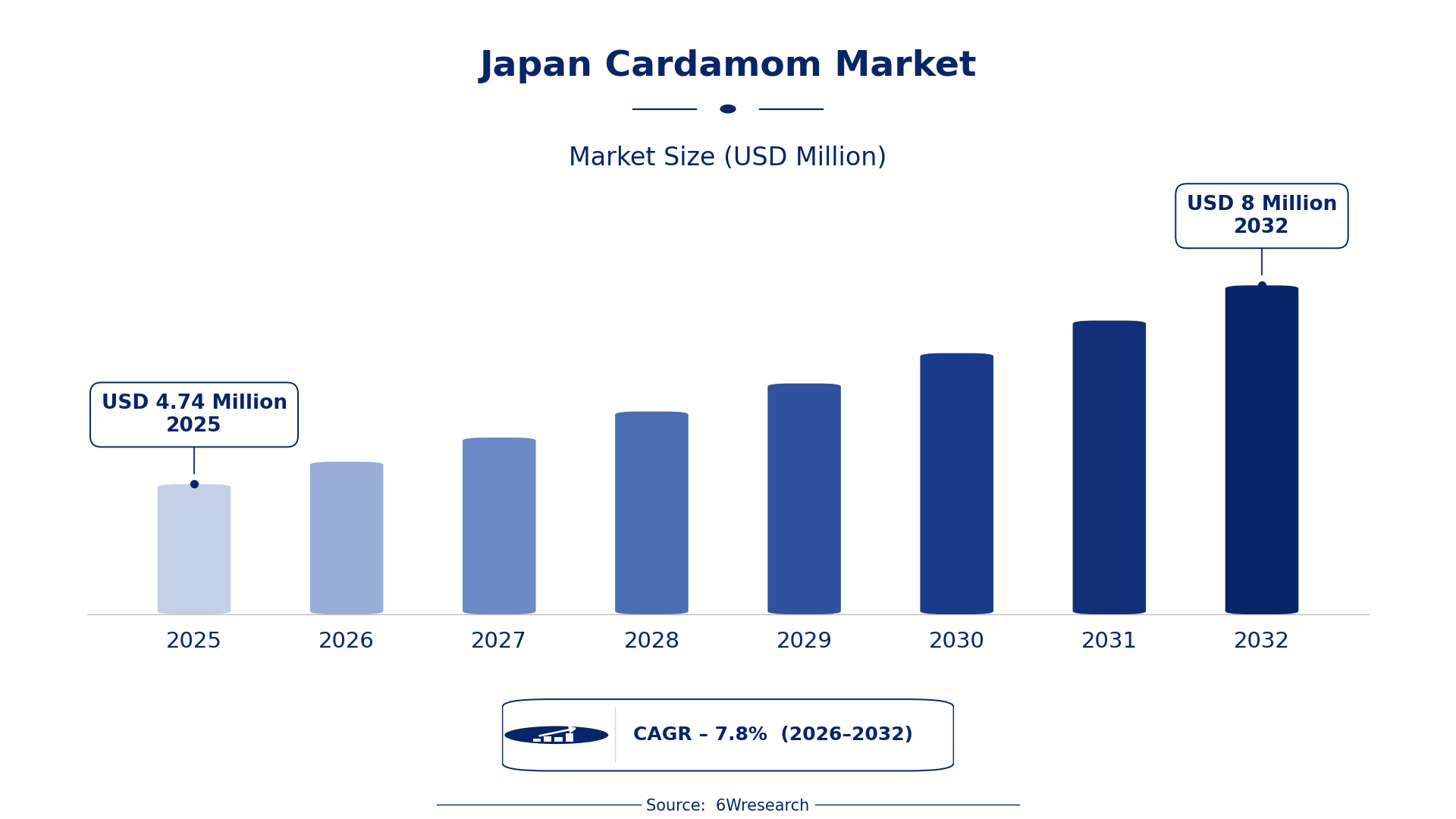
According to 6Wresearch internal database and industry insights, the Japan Cardamom Market was valued at USD 4.74 Million in 2025 and is projected to reach USD 8 Million by 2032, growing at a CAGR of approximately 7.8% during 2026–2032.
Japan Cardamom Market Highlights
| Report Metric | Details |
| Report Name | Japan Cardamom Market (2026-2032) |
| Market Size 2025 | USD 4.74 Million |
| Market Size 2032 | USD 8 Million |
| Absolute Growth 2025–2032 | USD 3.26 Million |
| CAGR 2026–2032 | 7.8% |
| Peak Annual Growth | 8.6% in 2032 |
| Forecast Period | 2026–2032 |
| Historical Data | 2022–2025 |
| Base Year | 2025 |
| Leading Product, 2025 | Ingredients (48% share) |
| Leading Application, 2025 | Food and Beverages (43% share) |
| Fastest-Growing Product | Liquid Extract (10.8% CAGR) |
| Fastest-Growing Application | Medical Usage (10.4% CAGR) |
| Growing Sector | Food and Beverages |
| Key End Users | Food manufacturers, Beverage producers, Herbal supplement companies |
Japan Cardamom Market Year-wise Growth Rate and Key Drivers (2022–2032)
This graph illustrates the annual growth rates of the market from 2022 to 2032, highlighting a steady upward trajectory and projected market expansion over the forecast period.
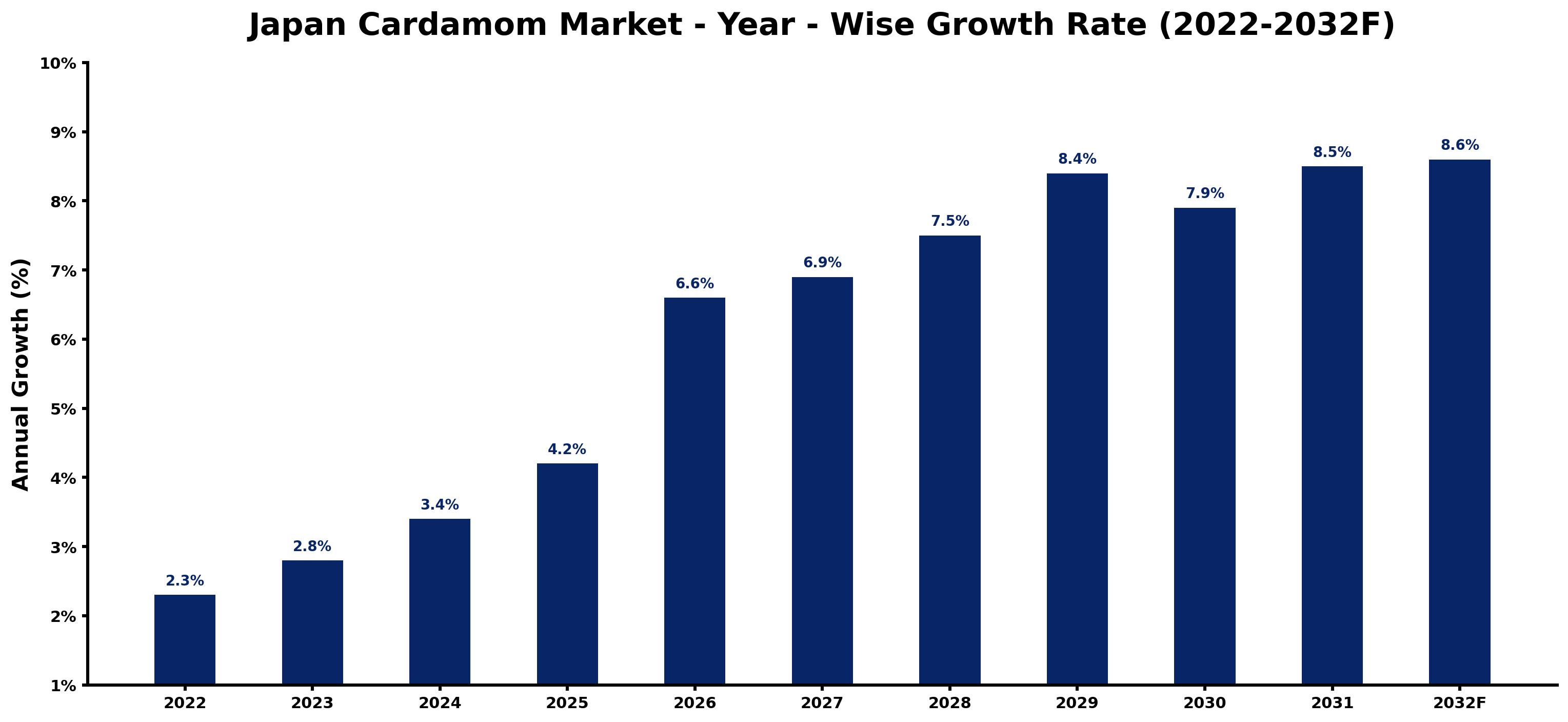
The following figures match every annual growth estimate with the main market development of that year, giving the reasoning behind each rise or slowdown.
| Year | Estimated Annual Growth (%) | Market Rationale |
| 2022 | 2.3 | The market saw initial growth due to rising consumer interest in exotic spices. |
| 2023 | 2.8 | Demand increased as culinary trends embraced diverse flavours and health benefits. |
| 2024 | 3.4 | Growth accelerated with a surge in food and beverage applications for cardamom. |
| 2025 | 4.2 | The market reached a peak as food manufacturers expanded product lines featuring cardamom. |
| 2026 | 6.6 | A shift towards natural ingredients in food products is projected to drive further demand. |
| 2027 | 6.9 | Consumer preferences for health-conscious options will continue to support market growth. |
| 2028 | 7.5 | Increased exports to Asian markets are expected to contribute to heightened demand for cardamom. |
| 2029 | 8.4 | The growing popularity of herbal remedies and natural supplements will boost sales. |
| 2030 | 7.9 | Demand growth will slow slightly as market saturation begins to occur in certain segments. |
| 2031 | 8.5 | A resurgence in culinary innovation will revitalise interest in cardamom products. |
| 2032 | 8.6 | The market is projected to peak as new applications and consumer trends emerge. |
Note: Market size estimations and growth projections presented in this report are based on 6Wresearch's proprietary forecasting methodology, utilizing the latest available industry data, government publications, and primary research inputs.
Japan Cardamom Market Synopsis
Cardamom is a spice derived from the seeds of several plants in the ginger family, primarily used in food and beverages, as well as in traditional medicine. The Japan Cardamom Market is growing due to rising consumer interest in exotic flavours and natural ingredients. The food and beverage sector is increasingly incorporating cardamom into a variety of products, reflecting a demand for health-oriented culinary options.
Market Dynamics Impact Analysis (2026–2032)
| Factor | Type | Impact | Primary Segment Affected |
| Rising consumer interest in health benefits of spices | Driver | High | Food and Beverages |
| Expansion of food product lines incorporating cardamom | Driver | High | Food and Beverages |
| Growing demand for natural flavouring agents | Opportunity | High | Ingredients |
| Increasing popularity of herbal supplements | Opportunity | Medium | Medical Usage |
| Limited domestic production capacity for cardamom | Restraint | High | Ingredients |
| High import costs affecting pricing strategies | Restraint | Medium | Food and Beverages |
| Competition from other spices and flavouring agents | Challenge | High | Food and Beverages |
| Consumer price sensitivity impacting premium product sales | Challenge | Medium | Ingredients |
Evaluation of Drivers in Japan Cardamom Market (2026–2032)
The factors lifting demand, and the evidence behind each, are summarised below.
| Drivers | Primary Segment Affected | Why It Matters (Evidence) |
| Increased health consciousness among consumers | Food and Beverages | This trend has led to a rise in demand for cardamom as a natural flavouring agent, with the sector growing by 4.2% in 2025. |
| Expansion of product offerings in the beverage industry | Food and Beverages | Beverage manufacturers are incorporating cardamom into new drinks, contributing to a market size of USD 4.74 Million by 2025. |
| Rising popularity of cardamom in traditional medicine | Medical Usage | As consumers seek natural remedies, the medical usage of cardamom is set to rise, with growth expected through 2032. |
| Growing culinary trends favouring exotic spices | Food and Beverages | This trend has resulted in increased purchases of cardamom, particularly in urban centres where culinary diversity is expanding. |
| Investment in sustainable farming practices | Ingredients | This initiative is expected to improve local production capabilities, addressing the supply-demand gap in the market. |
Behind the steady rise in orders sits an increasing health consciousness among consumers, with the food and beverage sector experiencing notable growth as cardamom gains recognition for its health benefits. The rising popularity of cardamom in traditional medicine is also notable, as consumers increasingly seek natural remedies. Culinary trends favouring exotic spices are driving purchases, particularly in urban centres where diversity is expanding. Investment in sustainable farming practices is enhancing local production, addressing the supply-demand gap in the market. For instance, the medical usage of cardamom is projected to grow by 10.4% through 2032, reflecting consumer interest in herbal products.
Evaluation of Restraints in Japan Cardamom Market
Below are the constraints most often cited by buyers and suppliers, with the segment each affects.
| Market Restraint | Primary Segment Affected | Why It Matters (Evidence) |
| Limited domestic production capacity for cardamom | Ingredients | This constraint restricts supply, leading to higher prices and limited availability for manufacturers in Japan. |
| High import costs affecting pricing strategies | Food and Beverages | Import costs can lead to inflated retail prices, making cardamom less competitive against locally sourced spices. |
| Regulatory hurdles for food safety compliance | Food and Beverages | Stringent regulations can delay product launches and increase compliance costs for manufacturers. |
| Market saturation in certain spice categories | Food and Beverages | As competition intensifies, it becomes challenging for cardamom to differentiate itself from other spices. |
| Consumer price sensitivity impacting premium product sales | Ingredients | Price-sensitive consumers may opt for cheaper alternatives, limiting the growth potential of premium cardamom products. |
Japan Cardamom Market Challenges
A shortage of skilled labour in cardamom farming results in delayed harvests, potentially reducing yields by up to 30% for farmers. High production costs stem from the need for advanced irrigation systems, raising expenses by 15% for growers. Local suppliers face intense competition from imported spices, forcing them to lower prices and cutting profit margins by 10%. Slow adoption of modern processing technology leads to inefficiencies, extending delivery times for buyers by several weeks and hindering their ability to fulfil orders promptly.
Trends in the Japan Cardamom Market
Four trends stand out in the Japan Cardamom Market.
- Shift from Traditional to Exotic Flavours: Since 2022, consumer preference has notably shifted towards exotic flavours, particularly in urban areas like Tokyo. This trend has resulted in a 25% increase in cardamom usage in gourmet food products.
- Emergence of Cardamom in Health Supplements: Starting in 2023, cardamom has gained traction in the health supplement sector, with a reported 30% increase in product launches featuring this spice, appealing to health-conscious consumers.
- Transition from Powder to Liquid Extracts: As of 2024, manufacturers are increasingly opting for liquid extracts over traditional powders, leading to a 15% rise in liquid cardamom sales, particularly in the beverage industry.
- Growing Interest in Sustainable Sourcing: In 2025, a movement towards sustainable sourcing of spices emerged, with 40% of food manufacturers committing to sourcing cardamom from certified organic farms.
Investment Opportunities in the Japan Cardamom Market
The following areas offer the clearest openings for investors and suppliers in the Japan Cardamom Market.
- Tokyo Food Processing Facilities: Food processing facilities in Tokyo are seeking high-quality cardamom to improve product offerings, presenting a prime investment opportunity for suppliers as demand continues to rise.
- Rising Demand for Organic Ingredients: As consumer preferences shift towards organic products, the organic cardamom market is expected to grow, attracting health-focused food brands looking to meet this demand.
- Expansion of Herbal Medicine Market: The medical usage of cardamom is set to rise, providing opportunities for suppliers targeting herbal supplement manufacturers as interest in natural remedies increases.
- Increased Exports to Asian Markets: With a projected 15% growth in exports expected by 2026, suppliers can explore partnerships with distributors focusing on Asian markets, capitalising on the growing demand for cardamom.
Government Initiatives in the Japan Cardamom Market
The Food Recycling Law (2000) mandates food businesses to reduce waste and recycle it into feed, fertiliser, and energy. This law complements the Food Sanitation Act amendments from 2018, which introduced a system ensuring safety and compliance in food packaging, directly impacting the quality of cardamom used in food products. These measures aim to improve sustainability and safety in the food supply chain, benefiting both producers and consumers.
The Ministry of Health, Labour and Welfare (MHLW) oversees the implementation of hygiene management regulations that require food businesses to adhere to strict standards. This regulation ensures that cardamom used in food products meets safety standards, benefiting both producers and consumers. In 2021, approximately 80% of food businesses complied with these new hygiene standards, enhancing overall food safety.
Future Insight of the Japan Cardamom Market
Investment in automated farming technology will reshape cultivation practices, allowing producers to lower labour costs. New supply chain initiatives will improve distribution efficiency, enabling suppliers to meet market demands more rapidly. Quality standards will advance, ensuring buyers consistently receive high-quality products. Research facilities focused on cardamom will emerge, driving innovations in cultivation techniques and potentially increasing yields by 25%.
Market Segmentation Analysis
Japan Cardamom Market report covers a detailed analysis of the following market segments:
By Product – Ingredients Lead, Liquid Extract Expected to Grow Fastest
According to Sumit Sagar, AM at 6Wresearch, Ingredients held 48% of the Japan Cardamom Market by product in 2025. Ingredients dominate the market due to their essential role in enhancing the flavour of numerous culinary creations. Their widespread use in traditional Japanese cuisine, especially in desserts and beverages, reinforces their leading status. Liquid Extract is set to record the highest CAGR in this split, 10.8% over 2026–2032. Liquid Extract is experiencing rapid growth as consumers increasingly seek convenient and concentrated flavouring options. The rising popularity of artisanal beverages that utilise liquid extracts is a key factor in this segment's expansion. This suggests that suppliers should focus on developing and marketing liquid extracts to meet the evolving demands of consumers.
By Application – Food and Beverages Lead, Medical Usage Expected to Grow Fastest
In 2025, Food and Beverages led the application split with a 43% share. Food and Beverages hold the largest share as cardamom is a staple in various culinary applications, from sweets to savoury dishes. Its integration into popular food products ensures a consistent demand in this sector. The quickest growth will come from Medical Usage, forecast to expand at a CAGR of 10.4% between 2026 and 2032. Medical Usage is growing quickly due to rising awareness of cardamom's health benefits, such as its antioxidant properties. Increased incorporation of cardamom in health supplements is driving this segment's growth. Buyers in the health sector should consider sourcing cardamom for its potential health benefits and market appeal.
Key Attractiveness of the Report
- 10 Years of Market Numbers
- Historical Data Starting from 2022 to 2025
- Base Year 2025
- Forecast Data until 2032
- Key Performance Indicators Impacting the Market
- Major Upcoming Developments and Projects
Key Highlights of the Report:
- Japan Cardamom Market Outlook
- Market Size of Japan Cardamom Market, 2025
- Forecast of Japan Cardamom Market, 2032
- Historical Data and Forecast of Japan Cardamom Revenues & Volume for the Period 2022-2032
- Japan Cardamom Market Trend Evolution
- Japan Cardamom Market Drivers and Challenges
- Japan Cardamom Price Trends
- Japan Cardamom Porter's Five Forces
- Japan Cardamom Industry Life Cycle
- Historical Data and Forecast of Japan Cardamom Market Revenues & Volume By Product for the Period 2022-2032
- Historical Data and Forecast of Japan Cardamom Market Revenues & Volume By Ingredients for the Period 2022-2032
- Historical Data and Forecast of Japan Cardamom Market Revenues & Volume By Powder for the Period 2022-2032
- Historical Data and Forecast of Japan Cardamom Market Revenues & Volume By Liquid Extract for the Period 2022-2032
- Historical Data and Forecast of Japan Cardamom Market Revenues & Volume By Application for the Period 2022-2032
- Historical Data and Forecast of Japan Cardamom Market Revenues & Volume By Food and Beverages for the Period 2022-2032
- Historical Data and Forecast of Japan Cardamom Market Revenues & Volume By Medical Usage for the Period 2022-2032
- Historical Data and Forecast of Japan Cardamom Market Revenues & Volume By Others for the Period 2022-2032
- Japan Cardamom Import Export Trade Statistics
- Market Opportunity Assessment By Product
- Market Opportunity Assessment By Application
- Japan Cardamom Top Companies Market Share
- Japan Cardamom Competitive Benchmarking By Technical and Operational Parameters
- Japan Cardamom Company Profiles
- Japan Cardamom Key Strategic Recommendations
Market Covered
The report covers the following segments.
By Product
- Ingredients
- Powder
- Liquid Extract
By Application
- Food and Beverages
- Medical Usage
- Others































