Japan Children's Entertainment Centers Market Size & Growth Rate
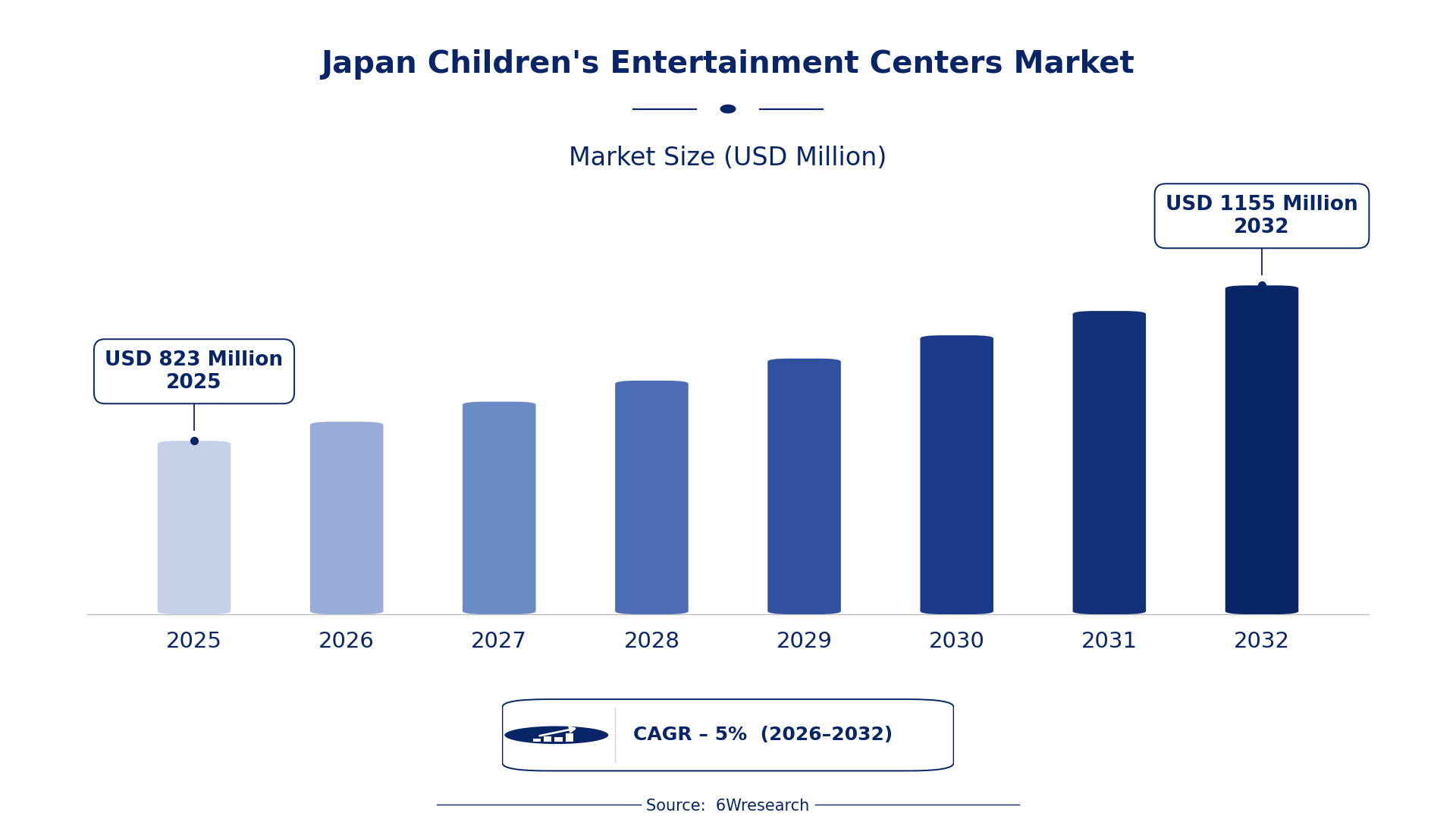
According to 6Wresearch internal database and industry insights, the Japan Children's Entertainment Centers Market was valued at USD 823 Million in 2025 and is projected to reach USD 1,155 Million by 2032, growing at a CAGR of approximately 5% during 2026–2032.
Japan Children's Entertainment Centers Market Highlights
| Report Metric | Details |
| Report Name | Japan Children's Entertainment Centers Market (2026-2032) |
| Market Size 2025 | USD 823 Million |
| Market Size 2032 | USD 1,155 Million |
| Absolute Growth 2025–2032 | USD 332 Million |
| CAGR 2026–2032 | 5% |
| Peak Annual Growth | 6.2% in 2032 |
| Forecast Period | 2026–2032 |
| Historical Data | 2022–2025 |
| Base Year | 2025 |
| Leading Entertainment Type, 2025 | Indoor Play Areas (40% share) |
| Leading Technology Type, 2025 | Soft Play Systems (42% share) |
| Leading Target Age Group, 2025 | Toddlers & Kids (51% share) |
| Leading Application, 2025 | Family Entertainment Centers (33% share) |
| Fastest-Growing Entertainment Type | Virtual Reality (7.1% CAGR) |
| Fastest-Growing Technology Type | VR Gaming Tech (7.3% CAGR) |
| Fastest-Growing Target Age Group | Pre-teens & Teens (6.9% CAGR) |
| Fastest-Growing Application | Interactive and Immersive Experiences (7.4% CAGR) |
| Growing Sector | Children's entertainment |
| Key End Users | Families, Educational institutions, Local governments |
Japan Children's Entertainment Centers Market Year-wise Growth Rate and Key Drivers (2022–2032)
This graph illustrates the annual growth rates of the market from 2022 to 2032, highlighting a steady upward trajectory and projected market expansion over the forecast period.
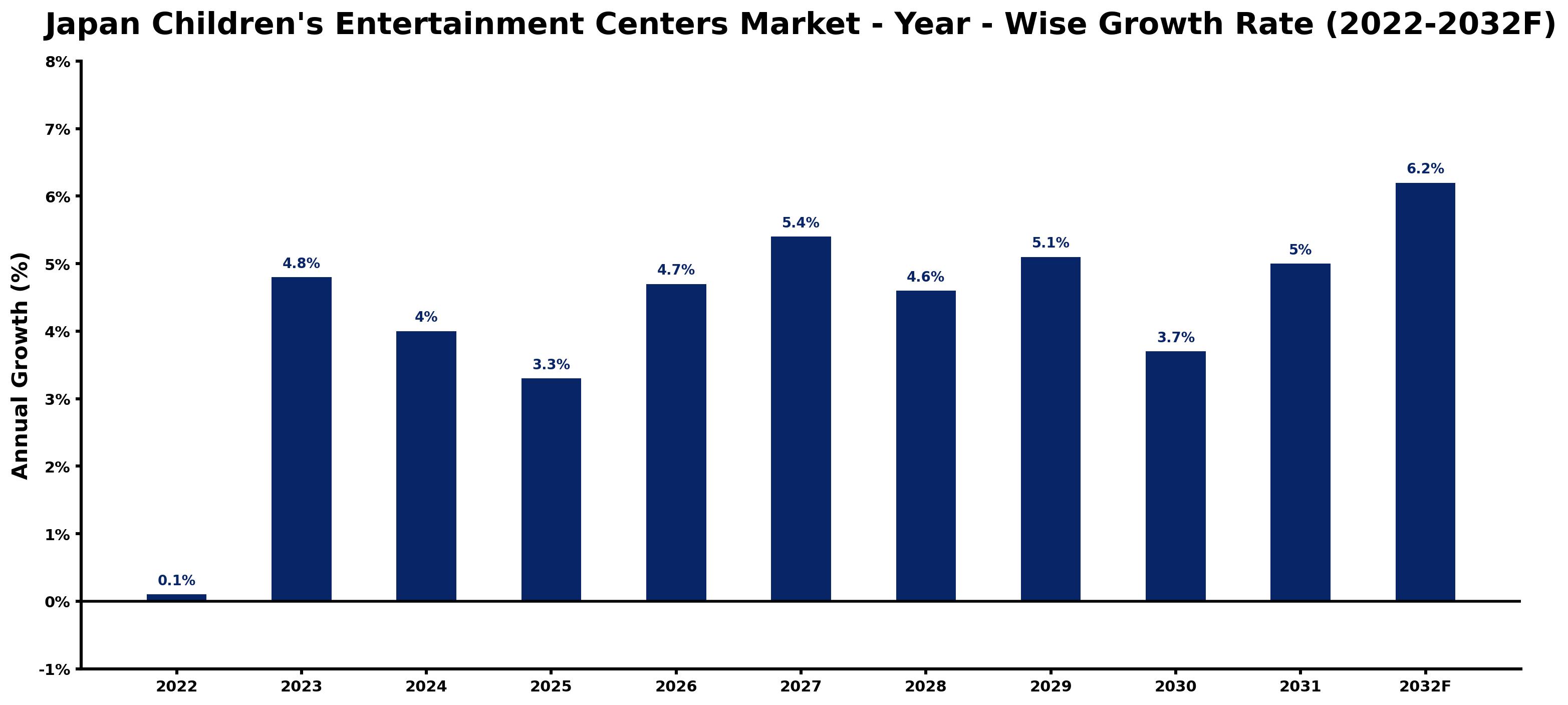
For each year, the table pairs the estimated growth rate with the leading influence on demand, showing how the drivers changed across the period.
| Year | Estimated Annual Growth (%) | Market Rationale |
| 2022 | 0.1 | The market experienced minimal growth as consumers adjusted to new entertainment options. |
| 2023 | 4.8 | Visitor numbers surged, contributing to a notable rise in market growth. |
| 2024 | 4.0 | Growth slowed as competition intensified among entertainment options available. |
| 2025 | 3.3 | Expansion continued, but at a reduced growth rate due to market saturation. |
| 2026 | 4.7 | New attractions and facilities are set to drive a resurgence in growth rates. |
| 2027 | 5.4 | Interest in immersive experiences is expected to further boost market performance. |
| 2028 | 4.6 | A slight slowdown is projected as consumer preferences evolve. |
| 2029 | 5.1 | Investment in technology is anticipated to renew interest in entertainment centers. |
| 2030 | 3.7 | Growth is expected to moderate as the market stabilises. |
| 2031 | 5.0 | New entertainment options will spur growth once again. |
| 2032 | 6.2 | The market is projected to peak as demand for family entertainment reaches new heights. |
Note: Market size estimations and growth projections presented in this report are based on 6Wresearch's proprietary forecasting methodology, utilizing the latest available industry data, government publications, and primary research inputs.
Japan Children's Entertainment Centers Market Synopsis
Children's Entertainment Centers are facilities designed for recreational activities targeting children, featuring indoor play areas, arcade games, and educational experiences. Demand arises from approximately 12 million children aged 0-14, alongside a growing interest in family-friendly entertainment. Local governments and industry associations actively promote these centers, stimulating investment and creativity, which draws families seeking engaging recreational activities.
Market Dynamics Impact Analysis (2026–2032)
| Factor | Type | Impact | Primary Segment Affected |
| Growing population of children aged 0-14 drives demand for entertainment options. | Driver | High | Family Entertainment Centers |
| Increased investment in immersive technologies enhances visitor experiences. | Driver | High | Virtual Reality |
| Expansion of educational play areas creates new market opportunities. | Opportunity | High | Educational Play |
| Local government subsidies for family entertainment encourage new center openings. | Opportunity | High | Indoor Play Areas |
| Intense competition among entertainment providers limits market growth. | Restraint | Medium | Arcade Games |
| High operational costs can deter new entrants into the market. | Restraint | Medium | Soft Play Systems |
| Regulatory compliance can increase operational burdens for center owners. | Challenge | High | Family Entertainment Centers |
| The need for continuous innovation poses challenges for existing centers. | Challenge | Medium | Virtual Reality |
Evaluation of Drivers in Japan Children's Entertainment Centers Market (2026–2032)
These are the developments adding the most demand over the forecast period.
| Drivers | Primary Segment Affected | Why It Matters (Evidence) |
| Increasing number of children aged 0-14 in Japan. | Family Entertainment Centers | This demographic growth translates to a higher demand for recreational facilities, with approximately 12 million children in this age group. |
| Rising popularity of educational play areas. | Educational Play | Over 30% of centers now offer educational play, attracting parents seeking learning opportunities for their children. |
| Expansion of virtual reality experiences in centers. | Virtual Reality | Over 200 centers are now offering VR experiences, appealing to older children and enhancing engagement in entertainment options. |
| Local government initiatives promoting family-friendly entertainment. | Indoor Play Areas | Subsidies from local governments support the establishment of new centers, increasing overall market capacity. |
| Growing interest in interactive and immersive experiences. | Interactive and Immersive Experiences | Interactive tech installations have increased by 25% in 2023, attracting more visitors. |
Several shifts outside the market propel sales. The population of children aged 0-14 in Japan is approximately 12 million, creating strong demand for entertainment options. More than 30% of centers now provide educational play areas, appealing to parents who seek learning opportunities for their children. The rise of interactive experiences, with a 25% increase in installations in 2023, attracts more visitors and fuels demand for these facilities.
Evaluation of Restraints in Japan Children's Entertainment Centers Market
These restraints slow adoption and weigh on supplier margins.
| Market Restraint | Primary Segment Affected | Why It Matters (Evidence) |
| Intense competition among entertainment providers limits market growth. | Arcade Games | With many centers offering similar attractions, differentiation becomes challenging, impacting visitor numbers. |
| High operational costs can deter new entrants into the market. | Soft Play Systems | The expense of maintaining safety standards and equipment can limit the ability of new centers to compete. |
| Regulatory compliance increases operational burdens for center owners. | Family Entertainment Centers | Adherence to safety standards under the JIS Z 8401 standard requires substantial investment and ongoing management. |
| Market saturation in urban areas can restrict growth potential. | Indoor Play Areas | As more centers open, attracting visitors becomes increasingly difficult in densely populated regions. |
| Limited awareness of educational play benefits may hinder growth. | Educational Play | Some parents may not recognise the value of educational play, affecting demand for these offerings. |
Japan Children's Entertainment Centers Market Challenges
Parents face limited variety in recreational options, as 60% of centers report similar activities, leading to a 20% decline in repeat visits. This issue arises because many facilities concentrate on traditional play, which does not engage diverse family interests. Suppliers encounter sourcing challenges for unique play structures, with local manufacturing limitations causing delays of up to six months for new installations. Gaps in staff training hinder the implementation of educational programs, costing centers potential revenue from these offerings. Increased competition is evident, as 60% of centers report rising visitor numbers, prompting many to lower entry fees and affecting profitability.
Trends in the Japan Children's Entertainment Centers Market
Buyers and suppliers in the Japan Children's Entertainment Centers Market are adjusting to the following trends.
- Shift towards Interactive and Immersive Experiences: Tokyo is experiencing a shift towards interactive and immersive experiences in children’s entertainment centers. A 25% increase in interactive tech installations in 2023 reflects this trend, attracting more visitors.
- Growth of Educational Play Areas: In 2023, over 30% of children's entertainment centers in Japan offer educational play areas. This trend caters to parents seeking learning opportunities, reflecting a growing demand for educational entertainment.
- Rise of Virtual Reality Experiences: Since 2022, the number of centers offering virtual reality experiences has surged, with over 200 facilities providing this technology. This shift caters to older children and enhances the overall entertainment value.
- Expansion of Family Entertainment Centers: Family Entertainment Centers are becoming increasingly popular, particularly in urban areas like Tokyo. With a projected 33% share by 2025, these centers are adapting to meet the diverse needs of families.
Investment Opportunities in the Japan Children's Entertainment Centers Market
Where to invest in the Japan Children's Entertainment Centers Market: the main openings are set out below.
- Investment in Indoor Play Areas: Tokyo is a prime location for investment in indoor play areas, with over 1,000 centers across Japan. The average entry fee of 1,500 yen indicates a market gap for new facilities.
- Supply of Educational Play Programs: With 30% of centers offering educational play, there is a growing opportunity to supply educational programs. The Japan Child Education Association supports these initiatives, enhancing market potential.
- Development of Virtual Reality Attractions: As over 200 centers now offer VR experiences, there is a significant opportunity to develop new attractions. This trend is particularly appealing to pre-teens and teens seeking advanced entertainment options.
- Expansion of Interactive Tech Installations: The 25% increase in interactive tech installations in 2023 highlights a market opportunity. Suppliers can partner with centers to enhance engagement through innovative technology.
Government Initiatives in the Japan Children's Entertainment Centers Market
The GX Basic Policy adopted in 2023 aims for JPY 150 trillion in public-private decarbonisation investment, benefiting children's entertainment centers by promoting sustainable practices. This initiative complements existing laws like the Industrial Standardization Act, which governs safety standards in facility design.
The Consumer Affairs Agency oversees the Act against Unjustifiable Premiums and Misleading Representations, ensuring accurate advertising for entertainment centers. This regulation protects consumers and encourages centers to maintain transparency in their offerings.
Future Insight of the Japan Children's Entertainment Centers Market
By 2032, local government initiatives will shift focus towards promoting educational play experiences, encouraging suppliers to incorporate advanced technology. Interactive installations have already increased by 25% in 2023, reflecting a growing demand for engaging activities. New safety standards will enhance consumer confidence, leading to higher family visitation rates. With Japan's population of children aged 0-14 remaining around 12 million, centers will need to innovate continuously to attract and retain young visitors.
Market Segmentation Analysis
Japan Children's Entertainment Centers Market report covers a detailed analysis of the following market segments:
By Entertainment Type – Indoor Play Areas Lead, Virtual Reality Expected to Grow Fastest
According to Bhawna Singh, Assistant Manager at 6Wresearch, Indoor Play Areas took 40% of entertainment type revenue in 2025, more than any other category. Indoor play areas hold the largest share as they provide a safe space for children to engage in physical activities, making them essential for family-oriented entertainment. Their prevalence in over 1,000 centers across Japan, particularly in urban areas like Tokyo, underscores their importance. The quickest growth will come from Virtual Reality, forecast to expand at a CAGR of 7.1% between 2026 and 2032. The increasing adoption of virtual reality experiences is noteworthy, as they deliver immersive activities that captivate older children, with over 200 centers incorporating this technology. This trend indicates a growing demand for advanced entertainment options, further establishing the segment's future. Suppliers should focus on enhancing indoor play offerings while integrating virtual reality to meet evolving consumer preferences.
By Technology Type – Soft Play Systems Lead, VR Gaming Tech Expected to Grow Fastest
The largest technology type category in 2025 was Soft Play Systems, at 42% of revenue. Soft play systems dominate the market as they are vital for younger children to explore in a secure manner, being a standard feature in 80% of indoor play areas. Their essential role in facilitating safe play experiences solidifies their leading position in the technology segment. Over 2026–2032, VR Gaming Tech is expected to post the fastest growth, at a CAGR of 7.3%. VR gaming tech is rapidly gaining popularity, appealing to families seeking unique entertainment experiences, although its adoption is not yet widespread. As more centers begin to embrace this technology, its growth trajectory is expected to accelerate significantly. Providers must prioritise soft play systems while also considering the integration of VR gaming tech to attract a broader audience.
By Target Age Group – Toddlers & Kids Lead, Pre-teens & Teens Expected to Grow Fastest
In 2025, Toddlers & Kids led the target age group split with a 51% share. Toddlers and kids are the primary target demographic for most centers, with the average visitor age ranging from 3 to 12 years. This age group generates substantial foot traffic, making it essential for centers to cater to their specific needs. Pre-teens & Teens are projected to grow fastest, at a CAGR of 6.9% during 2026–2032. Pre-teens and teens are emerging as a rapidly growing segment, drawn to more sophisticated gaming and entertainment options, indicating a shift towards catering to older children. This trend suggests potential for increased investment in attractions suited for this age group. Operators should tailor their offerings to engage pre-teens and teens, ensuring a diverse range of entertainment options.
By Application – Family Entertainment Centers Lead, Interactive and Immersive Experiences Expected to Grow Fastest
Family Entertainment Centers held 33% of the Japan Children's Entertainment Centers Market by application in 2025. Family entertainment centers are the leading type of establishment for children's recreation, serving as comprehensive destinations for families seeking leisure activities. Their prominence is reinforced by local government support for family-friendly entertainment initiatives. Interactive and Immersive Experiences are set to record the highest CAGR in this split, 7.4% over 2026–2032. Interactive and immersive experiences are increasingly favoured within centers, enhancing visitor engagement and encouraging repeat patronage. This trend highlights the necessity for continuous innovation in entertainment offerings to meet consumer expectations. Businesses should prioritise the development of interactive experiences to remain competitive and satisfy consumer demands.
Key Attractiveness of the Report
- 10 Years of Market Numbers
- Historical Data Starting from 2022 to 2025
- Base Year 2025
- Forecast Data until 2032
- Key Performance Indicators Impacting the Market
- Major Upcoming Developments and Projects
Key Highlights of the Report:
- Japan Children's Entertainment Centers Market Outlook
- Market Size of Japan Children's Entertainment Centers Market, 2025
- Forecast of Japan Children's Entertainment Centers Market, 2032
- Historical Data and Forecast of Japan Children's Entertainment Centers Revenues & Volume for the Period 2022-2032
- Japan Children's Entertainment Centers Market Trend Evolution
- Japan Children's Entertainment Centers Market Drivers and Challenges
- Japan Children's Entertainment Centers Price Trends
- Japan Children's Entertainment Centers Porter's Five Forces
- Japan Children's Entertainment Centers Industry Life Cycle
- Historical Data and Forecast of Japan Children's Entertainment Centers Market Revenues & Volume By Entertainment Type for the Period 2022-2032
- Historical Data and Forecast of Japan Children's Entertainment Centers Market Revenues & Volume By Indoor Play Areas for the Period 2022-2032
- Historical Data and Forecast of Japan Children's Entertainment Centers Market Revenues & Volume By Virtual Reality for the Period 2022-2032
- Historical Data and Forecast of Japan Children's Entertainment Centers Market Revenues & Volume By Arcade Games for the Period 2022-2032
- Historical Data and Forecast of Japan Children's Entertainment Centers Market Revenues & Volume By Educational Play for the Period 2022-2032
- Historical Data and Forecast of Japan Children's Entertainment Centers Market Revenues & Volume By Technology Type for the Period 2022-2032
- Historical Data and Forecast of Japan Children's Entertainment Centers Market Revenues & Volume By Soft Play Systems for the Period 2022-2032
- Historical Data and Forecast of Japan Children's Entertainment Centers Market Revenues & Volume By VR Gaming Tech for the Period 2022-2032
- Historical Data and Forecast of Japan Children's Entertainment Centers Market Revenues & Volume By Electronic Gaming for the Period 2022-2032
- Historical Data and Forecast of Japan Children's Entertainment Centers Market Revenues & Volume By Interactive Tech for the Period 2022-2032
- Historical Data and Forecast of Japan Children's Entertainment Centers Market Revenues & Volume By Target Age Group for the Period 2022-2032
- Historical Data and Forecast of Japan Children's Entertainment Centers Market Revenues & Volume By Toddlers & Kids for the Period 2022-2032
- Historical Data and Forecast of Japan Children's Entertainment Centers Market Revenues & Volume By Pre-teens & Teens for the Period 2022-2032
- Historical Data and Forecast of Japan Children's Entertainment Centers Market Revenues & Volume By All Age Groups for the Period 2022-2032
- Historical Data and Forecast of Japan Children's Entertainment Centers Market Revenues & Volume By Kids & Pre-teens for the Period 2022-2032
- Historical Data and Forecast of Japan Children's Entertainment Centers Market Revenues & Volume By Application for the Period 2022-2032
- Historical Data and Forecast of Japan Children's Entertainment Centers Market Revenues & Volume By Family Entertainment Centers for the Period 2022-2032
- Historical Data and Forecast of Japan Children's Entertainment Centers Market Revenues & Volume By Interactive and Immersive Experiences for the Period 2022-2032
- Historical Data and Forecast of Japan Children's Entertainment Centers Market Revenues & Volume By Fun Zones for the Period 2022-2032
- Historical Data and Forecast of Japan Children's Entertainment Centers Market Revenues & Volume By Learning-Based Entertainment for the Period 2022-2032
- Japan Children's Entertainment Centers Import Export Trade Statistics
- Market Opportunity Assessment By Entertainment Type
- Market Opportunity Assessment By Technology Type
- Market Opportunity Assessment By Target Age Group
- Market Opportunity Assessment By Application
- Japan Children's Entertainment Centers Top Companies Market Share
- Japan Children's Entertainment Centers Competitive Benchmarking By Technical and Operational Parameters
- Japan Children's Entertainment Centers Company Profiles
- Japan Children's Entertainment Centers Key Strategic Recommendations
Market Covered
The report covers the following segments.
By Entertainment Type
- Indoor Play Areas
- Virtual Reality
- Arcade Games
- Educational Play
By Technology Type
- Soft Play Systems
- VR Gaming Tech
- Electronic Gaming
- Interactive Tech
By Target Age Group
- Toddlers & Kids
- Pre-teens & Teens
- All Age Groups
- Kids & Pre-teens
By Application
- Family Entertainment Centers
- Interactive and Immersive Experiences
- Fun Zones
- Learning-Based Entertainment































