Japan Cinematographic Camera Market Size & Growth Rate
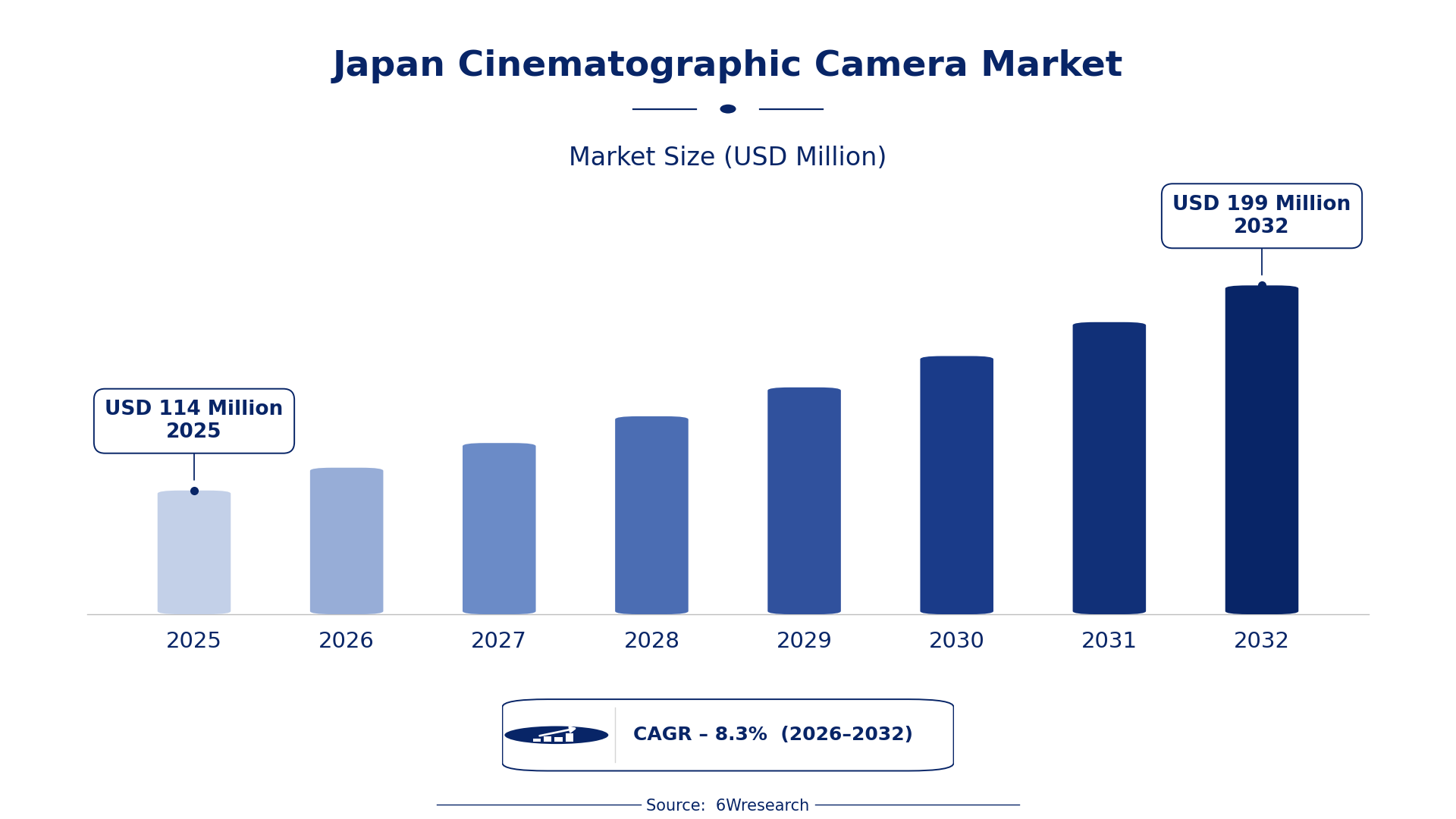
According to 6Wresearch internal database and industry insights, the Japan Cinematographic Camera Market was valued at USD 114 Million in 2025 and is projected to reach USD 199 Million by 2032, growing at a CAGR of approximately 8.3% during 2026–2032.
Japan Cinematographic Camera Market Highlights
| Report Metric | Details |
| Report Name | Japan Cinematographic Camera Market (2026-2032) |
| Market Size 2025 | USD 114 Million |
| Market Size 2032 | USD 199 Million |
| Absolute Growth 2025–2032 | USD 85 Million |
| CAGR 2026–2032 | 8.3% |
| Peak Annual Growth | 10.2% in 2032 |
| Forecast Period | 2026–2032 |
| Historical Data | 2022–2025 |
| Base Year | 2025 |
| Leading Type, 2025 | Digital Camera (55% share) |
| Leading Application, 2025 | Professional (49% share) |
| Leading End User, 2025 | Filmmakers (42% share) |
| Leading Price Range, 2025 | HighEnd (51% share) |
| Fastest-Growing Application | Amateur (11.0% CAGR) |
| Fastest-Growing End User | Studios (10.6% CAGR) |
| Fastest-Growing Price Range | MidRange (10.7% CAGR) |
| Growing Sector | Film production |
| Key End Users | Filmmakers, studios, photographers |
Japan Cinematographic Camera Market Year-wise Growth Rate and Key Drivers (2022–2032)
This graph illustrates the annual growth rates of the market from 2022 to 2032, highlighting a steady upward trajectory and projected market expansion over the forecast period.
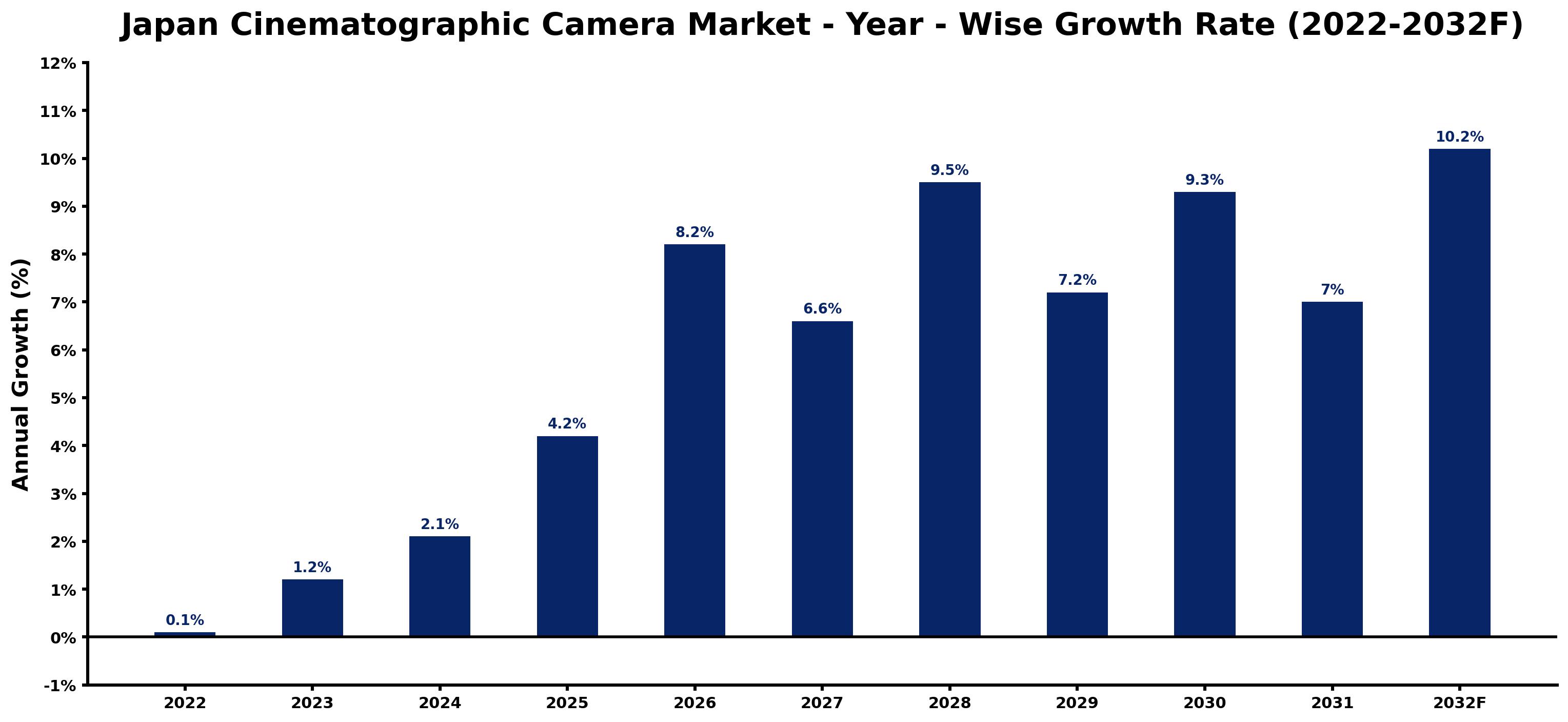
The yearly estimates that follow link every growth rate to its principal driver, so readers can see why the pace changed in each period.
| Year | Estimated Annual Growth (%) | Market Rationale |
| 2022 | 0.1 | The market showed minimal growth due to cautious spending by filmmakers and studios. |
| 2023 | 1.2 | Demand increased as filmmakers began to invest in new digital technologies and equipment. |
| 2024 | 2.1 | Growth continued as more projects were initiated, boosting camera purchases among professionals. |
| 2025 | 4.2 | The market peaked historically as the Tokyo region produced a record number of films. |
| 2026 | 8.2 | Investment surged with new government support for local film production and technology. |
| 2027 | 6.6 | Growth slowed as the market adjusted to previous high levels of investment. |
| 2028 | 9.5 | Demand picked up again as filmmakers sought to upgrade their equipment for new projects. |
| 2029 | 7.2 | The market experienced a slowdown in growth as competition intensified among producers. |
| 2030 | 9.3 | Investment in high-end cameras rose as filmmakers aimed for higher production quality. |
| 2031 | 7.0 | Growth decelerated as the market stabilised after a period of rapid expansion. |
| 2032 | 10.2 | The market is projected to reach its peak growth as digital cameras become essential for filmmakers. |
Note: Market size estimations and growth projections presented in this report are based on 6Wresearch's proprietary forecasting methodology, utilizing the latest available industry data, government publications, and primary research inputs.
Japan Cinematographic Camera Market Synopsis
Cinematographic cameras are essential devices for capturing motion pictures, utilising both film and digital technology. The primary users include filmmakers and studios, with demand driven by a vibrant film production scene in the Tokyo region. The Japan Cinematographic Camera Market is growing due to over 300 feature films produced annually, alongside government initiatives that promote local film production and technology development, leading to heightened investment in advanced cinematographic equipment.
Market Dynamics Impact Analysis (2026–2032)
| Factor | Type | Impact | Primary Segment Affected |
| Increased investment in digital cinematography technology | Driver | High | Digital Camera |
| Rising number of feature films produced annually | Driver | High | Filmmakers |
| Expansion of film studios in Tokyo | Opportunity | High | Studios |
| Growing demand for high-quality production equipment | Opportunity | High | Professional |
| High costs of professional-grade cameras | Restraint | Medium | HighEnd |
| Limited market for film cameras in niche applications | Restraint | Medium | Film Camera |
| Compliance with JIS S 0010 quality standards | Challenge | High | Digital Camera |
| Capacity constraints in local manufacturing of cinematographic equipment | Challenge | Medium | Professional |
Evaluation of Drivers in Japan Cinematographic Camera Market (2026–2032)
Demand rests on the following drivers, each shown with the segment it touches most.
| Drivers | Primary Segment Affected | Why It Matters (Evidence) |
| Investment in digital cinematography technology | Digital Camera | Digital cameras account for over 70% of the market, driving demand for advanced cameras among filmmakers. |
| Growing number of feature films produced | Filmmakers | With over 300 films produced annually, filmmakers require high-quality cameras for production. |
| Government support for local film production | Studios | Subsidies for equipment purchases encourage studios to invest in new cinematographic technology. |
| Demand for high-quality production equipment | Professional | The average price for professional cameras ranges from ¥500,000 to ¥5,000,000, reflecting high investment. |
| Expansion of film studios in Tokyo | Filmmakers | The Tokyo region is a major hub for film production, attracting investment and talent. |
Much of the new demand stems from the rising number of feature films produced each year, with over 300 films reported in 2023. This increase in production compels filmmakers to invest in high-quality digital cameras, which represent a substantial share of the market. The prominence of the Tokyo region in film production further amplifies the need for advanced cinematographic technology. Consequently, the market experiences considerable investment in professional-grade cameras, with prices reflecting the high stakes of contemporary filmmaking.
Evaluation of Restraints in Japan Cinematographic Camera Market
The main factors holding the market back are set out below.
| Market Restraint | Primary Segment Affected | Why It Matters (Evidence) |
| High costs associated with professional-grade cameras | HighEnd | The average price range of professional cameras limits access for smaller production companies. |
| Limited market for film cameras in niche applications | Film Camera | Film cameras are primarily used for artistic projects, reducing overall demand. |
| Compliance with JIS S 0010 quality standards | Digital Camera | Producers must ensure equipment meets strict quality standards, which adds to costs. |
| Capacity constraints in local manufacturing of cinematographic equipment | Professional | Limited production capacity can delay equipment availability for filmmakers. |
| Dependence on imported specialized cameras | Digital Camera | Certain high-end models are imported, affecting supply chain stability. |
Japan Cinematographic Camera Market Challenges
In Japan, over 300 feature films are produced annually, but the average price of a professional cinematographic camera ranges from ¥500,000 to ¥5,000,000, making it hard for independent filmmakers to acquire quality equipment. Local manufacturers face intense competition from imported cameras, forcing them to lower prices and risking product quality for studios. A shortage of skilled technicians leads to project delays, extending timelines by up to three months for production companies. Buyers often encounter difficulties sourcing equipment that meets the JIS S 0010 standard, resulting in increased costs and longer procurement times for studios and production companies.
Trends in the Japan Cinematographic Camera Market
Buyers and suppliers in the Japan Cinematographic Camera Market are adjusting to the following trends.
- Tokyo International Film Festival Showcasing New Technologies: The Tokyo International Film Festival showcases advancements in cinematography, featuring the latest digital camera technologies. In 2023, the festival attracted over 100,000 attendees, reflecting a growing interest in modern filmmaking techniques.
- Shift from Film to Digital Cameras: The cinematographic market is increasingly favouring digital technology, with digital cameras now accounting for over 70% of sales. This shift is evident as filmmakers adopt digital formats for improved production efficiency.
- Growing Interest in High-End Cameras: The demand for high-end cinematographic cameras is on the rise, with the average price reaching ¥5,000,000. This trend is clear as filmmakers pursue superior quality for feature films and high-profile projects.
- Expansion of Film Studios in Tokyo: The Tokyo region is experiencing a surge in film studio developments, with numerous new facilities opening. This expansion is expected to significantly boost local production capacity, supporting the growing film industry.
Investment Opportunities in the Japan Cinematographic Camera Market
The following opportunities in the Japan Cinematographic Camera Market pair current demand with a clear way in.
- Tokyo Film Studios Expansion: The expansion of film studios in Tokyo offers an opportunity for suppliers of cinematographic equipment. With over 300 films produced annually, there is an increasing need for high-quality cameras.
- Investment in Digital Cinematography: Filmmakers are increasingly investing in digital cinematography technology, with digital cameras accounting for a large share of the market. Suppliers can target this demand by providing advanced models.
- New Government Support for Equipment Purchases: Recent government subsidies for equipment purchases present a timely opportunity for manufacturers. This support encourages studios to invest in new cinematographic technology.
- Growing Market for Professional Cameras: The average price of professional cameras ranges from ¥500,000 to ¥5,000,000, indicating a substantial market for high-end equipment. Suppliers can cater to this demand by offering premium options.
Government Initiatives in the Japan Cinematographic Camera Market
The Semiconductor and Digital Industry Strategy, established in June 2021, strengthens previous measures by securing domestic semiconductor manufacturing for cinematographic technology. This law aims to improve local production capabilities, ensuring a steady supply of essential components for camera manufacturing. The strategy is projected to support the growth of the cinematographic camera market by promoting innovation and reducing dependency on imports.
The Ministry of Economy, Trade and Industry oversees funding for projects that support the development of advanced cinematographic technologies. This agency approves grants and subsidies aimed at improving the competitiveness of local producers. In 2023, it allocated ¥2 billion to support local film production initiatives, benefiting numerous production companies.
Future Insight of the Japan Cinematographic Camera Market
New film production facilities will emerge by 2032, driven by government initiatives aimed at enhancing local filmmaking capabilities. The Tokyo International Film Festival will continue to showcase advancements in cinematography, attracting global interest. Digital technology will dominate the market, with projections indicating that over 70% of cameras will be digital, improving production efficiency. Training programmes will cultivate a skilled workforce, ensuring the industry can effectively meet future demands.
Market Segmentation Analysis
Japan Cinematographic Camera Market report covers a detailed analysis of the following market segments:
By Type – Digital Camera Leads and Records the Fastest Growth
According to Bhawna Singh, Assistant Manager at 6Wresearch, with 55% of type revenue in 2025, Digital Camera was the largest category. Digital cameras dominate the market as they are extensively utilised by filmmakers in Japan, with over 70% of cinematographic cameras being digital. This trend is particularly evident in the Tokyo region, where numerous studios depend on digital technology for their productions. The same category is also set to grow fastest, at a CAGR of 10.7% during 2026–2032. The digital camera segment is poised for ongoing growth as filmmakers increasingly seek advanced technology for enhanced image quality. Additionally, government initiatives promoting local film production will further boost the demand for digital cameras. Suppliers must focus on advancing digital camera technology to meet the rising expectations of filmmakers.
By Application – Professional Leads, Amateur Expected to Grow Fastest
In 2025, Professional led the application split with a 49% share. The professional application segment holds the largest share as high-quality cameras are essential for producing feature films, with over 300 films produced annually in Japan. Professionals in the industry rely heavily on these devices to achieve the desired cinematic quality. The quickest growth will come from Amateur, forecast to expand at a CAGR of 11.0% between 2026 and 2032. Amateur applications are experiencing the fastest growth as more individuals engage in filmmaking, supported by affordable technology and online platforms for sharing content. This segment's expansion indicates a rising interest in cinematography among the general public. Suppliers may consider diversifying their product lines to cater to the increasing number of amateur filmmakers.
By End User – Filmmakers Lead, Studios Expected to Grow Fastest
Filmmakers took 42% of end user revenue in 2025, more than any other category. Filmmakers are the primary users of cinematographic cameras, driving the demand for high-quality equipment within Japan's film industry. With over 25,000 professionals employed in production roles, their influence on market dynamics is substantial. Studios are set to record the highest CAGR in this split, 10.6% over 2026–2032. Studios are witnessing the fastest growth among end users, as they invest heavily in sophisticated cinematographic technology to elevate production standards. This shift reflects an increasing emphasis on quality in content creation across the sector. Suppliers should concentrate on developing customised solutions for studios to capitalise on this growing segment.
By Price Range – HighEnd Leads, MidRange Expected to Grow Fastest
HighEnd accounted for 51% of the market by price range in 2025. High-end cameras lead the market due to their necessity for professional filmmakers who require superior quality and performance for film production. The average price range of ¥500,000 to ¥5,000,000 reflects the investment professionals are willing to make for top-tier equipment. Over 2026–2032, MidRange is expected to post the fastest growth, at a CAGR of 10.7%. Mid-range cameras are seeing the fastest growth as serious enthusiasts seek quality without the high costs associated with professional models. This segment's expansion indicates a broader market appeal for versatile, accessible cinematographic options. Suppliers should focus on mid-range offerings to attract the growing base of serious amateur filmmakers.
Key Attractiveness of the Report
- 10 Years of Market Numbers
- Historical Data Starting from 2022 to 2025
- Base Year 2025
- Forecast Data until 2032
- Key Performance Indicators Impacting the Market
- Major Upcoming Developments and Projects
Key Highlights of the Report:
- Japan Cinematographic Camera Market Outlook
- Market Size of Japan Cinematographic Camera Market, 2025
- Forecast of Japan Cinematographic Camera Market, 2032
- Historical Data and Forecast of Japan Cinematographic Camera Revenues & Volume for the Period 2022-2032
- Japan Cinematographic Camera Market Trend Evolution
- Japan Cinematographic Camera Market Drivers and Challenges
- Japan Cinematographic Camera Price Trends
- Japan Cinematographic Camera Porter's Five Forces
- Japan Cinematographic Camera Industry Life Cycle
- Historical Data and Forecast of Japan Cinematographic Camera Market Revenues & Volume By Type for the Period 2022-2032
- Historical Data and Forecast of Japan Cinematographic Camera Market Revenues & Volume By Film Camera for the Period 2022-2032
- Historical Data and Forecast of Japan Cinematographic Camera Market Revenues & Volume By Digital Camera for the Period 2022-2032
- Historical Data and Forecast of Japan Cinematographic Camera Market Revenues & Volume By Application for the Period 2022-2032
- Historical Data and Forecast of Japan Cinematographic Camera Market Revenues & Volume By Professional for the Period 2022-2032
- Historical Data and Forecast of Japan Cinematographic Camera Market Revenues & Volume By Amateur for the Period 2022-2032
- Historical Data and Forecast of Japan Cinematographic Camera Market Revenues & Volume By Industrial for the Period 2022-2032
- Historical Data and Forecast of Japan Cinematographic Camera Market Revenues & Volume By End User for the Period 2022-2032
- Historical Data and Forecast of Japan Cinematographic Camera Market Revenues & Volume By Filmmakers for the Period 2022-2032
- Historical Data and Forecast of Japan Cinematographic Camera Market Revenues & Volume By Photographers for the Period 2022-2032
- Historical Data and Forecast of Japan Cinematographic Camera Market Revenues & Volume By Studios for the Period 2022-2032
- Historical Data and Forecast of Japan Cinematographic Camera Market Revenues & Volume By Price Range for the Period 2022-2032
- Historical Data and Forecast of Japan Cinematographic Camera Market Revenues & Volume By Budget for the Period 2022-2032
- Historical Data and Forecast of Japan Cinematographic Camera Market Revenues & Volume By MidRange for the Period 2022-2032
- Historical Data and Forecast of Japan Cinematographic Camera Market Revenues & Volume By HighEnd for the Period 2022-2032
- Japan Cinematographic Camera Import Export Trade Statistics
- Market Opportunity Assessment By Type
- Market Opportunity Assessment By Application
- Market Opportunity Assessment By End User
- Market Opportunity Assessment By Price Range
- Japan Cinematographic Camera Top Companies Market Share
- Japan Cinematographic Camera Competitive Benchmarking By Technical and Operational Parameters
- Japan Cinematographic Camera Company Profiles
- Japan Cinematographic Camera Key Strategic Recommendations
Market Covered
The study includes the following segmentation.
By Type
- Film Camera
- Digital Camera
By Application
- Professional
- Amateur
- Industrial
By End User
- Filmmakers
- Photographers
- Studios
By Price Range
- Budget
- MidRange
- HighEnd































