Japan Cleaning Robot Market Size & Growth Rate
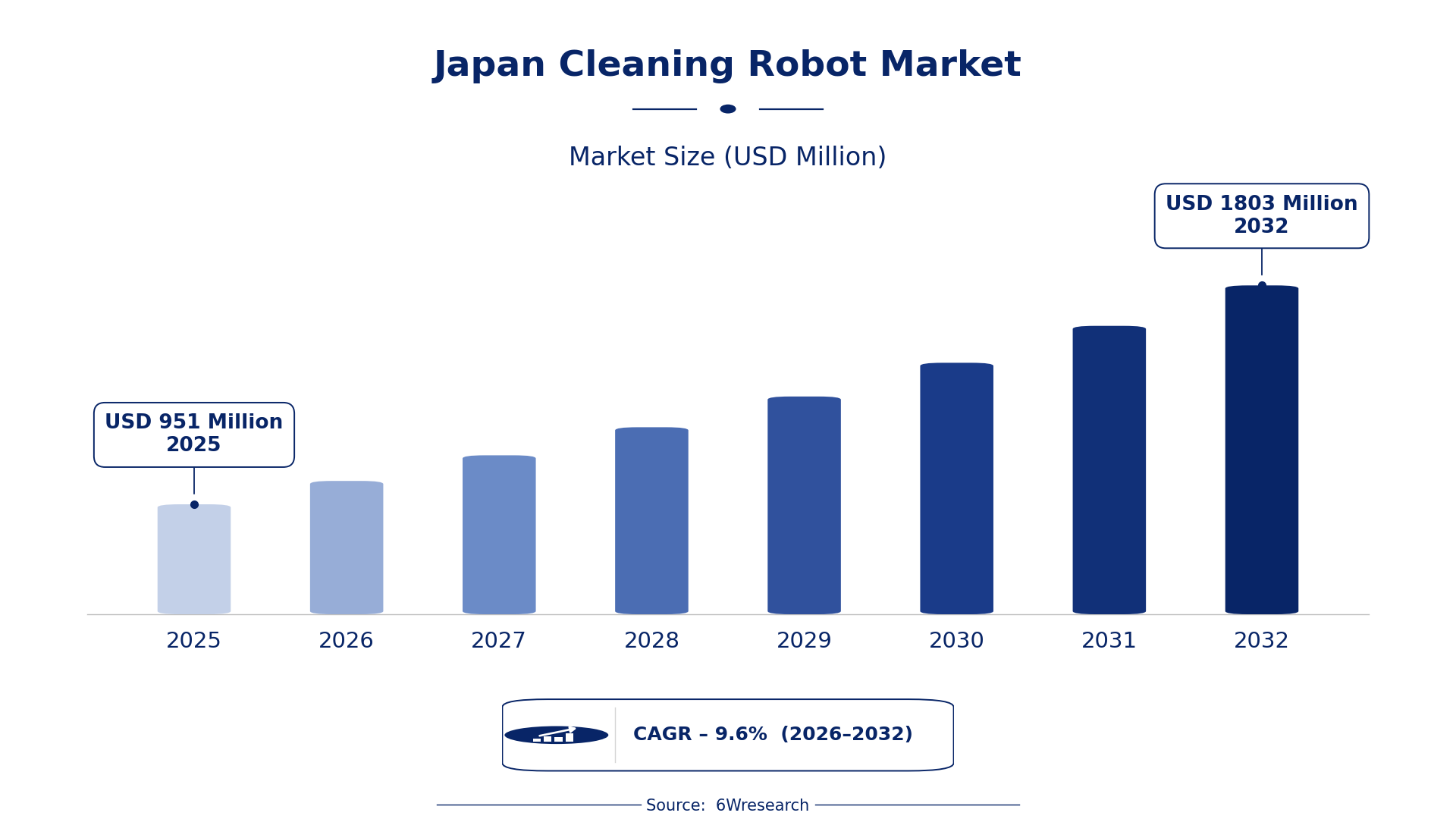
According to 6Wresearch internal database and industry insights, the Japan Cleaning Robot Market was valued at USD 951 Million in 2025 and is projected to reach USD 1,803 Million by 2032, growing at a CAGR of approximately 9.6% during 2026–2032.
Japan Cleaning Robot Market Highlights
| Report Metric | Details |
| Report Name | Japan Cleaning Robot Market (2026-2032) |
| Market Size 2025 | USD 951 Million |
| Market Size 2032 | USD 1,803 Million |
| Absolute Growth 2025–2032 | USD 852 Million |
| CAGR 2026–2032 | 9.6% |
| Peak Annual Growth | 11.8% in 2026 |
| Forecast Period | 2026–2032 |
| Historical Data | 2022–2025 |
| Base Year | 2025 |
| Leading Product, 2025 | Floor Cleaning Robots (44% share) |
| Leading Operation Mode, 2025 | Self-driven (60% share) |
| Leading Type, 2025 | Personal Cleaning Robots (65% share) |
| Leading Sales Channel, 2025 | Online (58% share) |
| Leading Application, 2025 | Residential (45% share) |
| Fastest-Growing Product | Lawn Cleaning Robots (13.5% CAGR) |
| Fastest-Growing Type | Professional Cleaning Robots (13.1% CAGR) |
| Fastest-Growing Sales Channel | Offline (11.8% CAGR) |
| Fastest-Growing Application | Commercial (12.3% CAGR) |
| Growing Sector | Residential Cleaning |
| Key End Users | Households, Commercial establishments, Hospitality sector |
Japan Cleaning Robot Market Year-wise Growth Rate and Key Drivers (2022–2032)
This graph illustrates the annual growth rates of the market from 2022 to 2032, highlighting a steady upward trajectory and projected market expansion over the forecast period.
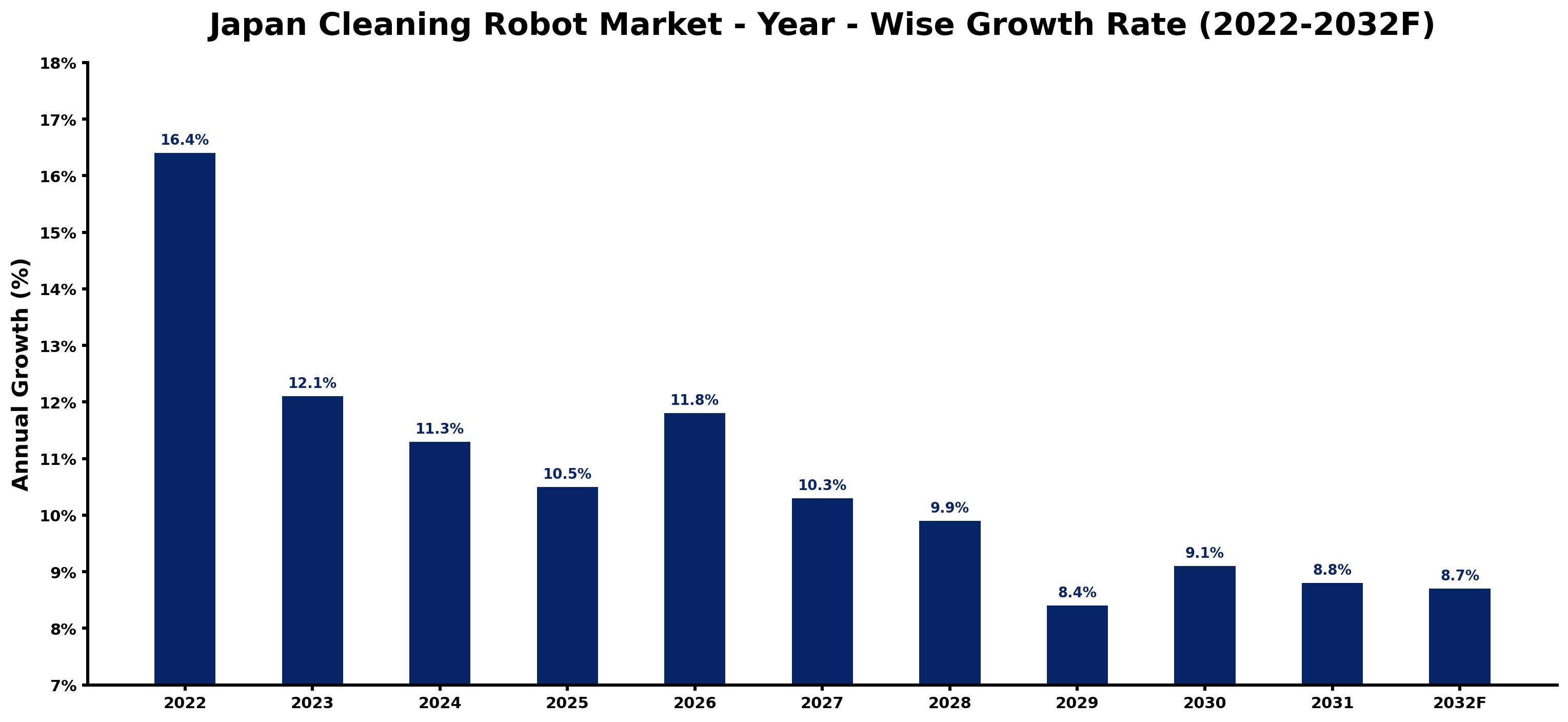
Below, each year's estimated growth is shown next to the factor that most influenced it.
| Year | Estimated Annual Growth (%) | Market Rationale |
| 2022 | 16.4 | The market saw strong demand driven by urbanisation and technological advancements. |
| 2023 | 12.1 | Growth slowed as market saturation began to affect new purchases. |
| 2024 | 11.3 | The introduction of new models helped maintain interest among consumers. |
| 2025 | 10.5 | Demand remained steady as households increasingly adopted cleaning robots. |
| 2026 | 11.8 | Growth is expected to accelerate with rising investments in robotics technology. |
| 2027 | 10.3 | A slight slowdown is projected as competition intensifies in the market. |
| 2028 | 9.9 | Market growth is expected to continue slowing as consumer preferences stabilise. |
| 2029 | 8.4 | Demand is projected to remain steady but show signs of normalisation in growth rates. |
| 2030 | 9.1 | Growth is expected to pick up again as new cleaning technologies are introduced. |
| 2031 | 8.8 | The market is projected to experience a slight slowdown as consumer spending adjusts. |
| 2032 | 8.7 | Growth is expected to stabilise as the market matures and competition increases. |
Note: Market size estimations and growth projections presented in this report are based on 6Wresearch's proprietary forecasting methodology, utilizing the latest available industry data, government publications, and primary research inputs.
Japan Cleaning Robot Market Synopsis
Cleaning robots are automated devices designed for various cleaning tasks, including floor, lawn, and pool maintenance. The Japan Cleaning Robot Market is expanding, driven by urban living and an aging population. Approximately 5 million households used cleaning robots in 2022, highlighting strong market penetration. The Tokyo metropolitan area is a key region for sales, supported by government initiatives like the "Robot Strategy". Demand for these devices is set to rise as households and businesses increasingly invest in automation technologies.
Market Dynamics Impact Analysis (2026–2032)
| Factor | Type | Impact | Primary Segment Affected |
| Urbanisation is increasing demand for efficient cleaning solutions. | Driver | High | Floor Cleaning Robots |
| Technological advancements are creating new product offerings. | Driver | High | Personal Cleaning Robots |
| Growing interest in home automation presents new market opportunities. | Opportunity | High | Residential |
| Increased focus on hygiene in commercial spaces drives demand. | Opportunity | High | Professional Cleaning Robots |
| High initial costs deter some potential buyers from purchasing. | Restraint | Medium | Pool Cleaning Robots |
| Limited awareness of cleaning robot benefits restricts market growth. | Restraint | Medium | Window Cleaning Robots |
| Competition from traditional cleaning methods remains a challenge. | Challenge | High | Floor Cleaning Robots |
| Technological integration issues can delay product adoption. | Challenge | Medium | Personal Cleaning Robots |
Evaluation of Drivers in Japan Cleaning Robot Market (2026–2032)
Demand rests on the following drivers, each shown with the segment it touches most.
| Drivers | Primary Segment Affected | Why It Matters (Evidence) |
| Urbanisation increases the need for efficient cleaning solutions. | Floor Cleaning Robots | In the Tokyo metropolitan area, the population density drives demand for automated cleaning devices. |
| Technological advancements improve product capabilities. | Personal Cleaning Robots | New features in cleaning robots attract more households, with 5 million households using them in 2022. |
| Rising disposable incomes allow for higher spending on home automation. | Residential | As average household sizes decrease, families are investing in cleaning robots for convenience. |
| Increased focus on hygiene in commercial spaces boosts demand. | Professional Cleaning Robots | The hospitality sector is adopting cleaning robots to maintain cleanliness standards. |
| Government initiatives support robotics innovation in cleaning technologies. | Pool Cleaning Robots | The 2023 program by the Ministry of Economy, Trade and Industry encourages investment in cleaning automation. |
A wider customer base explains much of the growth, as urbanisation in Japan's major cities fuels demand for cleaning solutions. In 2022, approximately 5 million households were using these devices, indicating strong market penetration. Increased disposable incomes allow families to invest in cleaning technology, with the average household size influencing purchasing decisions. The hospitality sector increasingly adopts cleaning robots to maintain hygiene protocols, reflecting a broader trend in commercial spaces.
Evaluation of Restraints in Japan Cleaning Robot Market
The key brakes on demand, and where they bite hardest, are shown below.
| Market Restraint | Primary Segment Affected | Why It Matters (Evidence) |
| High initial costs deter potential buyers from investing in cleaning robots. | Pool Cleaning Robots | The average price of residential cleaning robots ranges from 30,000 to 100,000 yen, limiting accessibility. |
| Limited awareness of cleaning robot benefits restricts market growth. | Window Cleaning Robots | Many consumers prefer traditional cleaning methods due to unfamiliarity with automated solutions. |
| Competition from traditional cleaning methods persists. | Floor Cleaning Robots | Households often rely on manual cleaning, which can be perceived as more thorough. |
| Technological integration issues can delay product adoption. | Personal Cleaning Robots | Some users face difficulties in integrating cleaning robots with smart home systems. |
| Market saturation affects new purchases among existing users. | Residential | As many households already own cleaning robots, demand for new models is slowing. |
Japan Cleaning Robot Market Challenges
High technology costs limit buyer access to advanced cleaning robots, making them unaffordable for many households and small businesses. Component prices have risen, with residential cleaning robots averaging between 30,000 and 100,000 yen, which discourages potential customers from investing. Regulatory standards such as ISO 13482 impose compliance costs on manufacturers, delaying product launches and reducing responsiveness to market demands. Supply chain disruptions hinder the availability of essential parts, forcing suppliers to extend lead times, which impacts buyers who depend on timely deliveries for their cleaning needs.
Trends in the Japan Cleaning Robot Market
The shifts below are changing how Japan Cleaning Robot Market products are bought and supplied.
- Rise of Smart Cleaning Solutions: The "Robot Strategy" launched in 2015 promotes the integration of robotics into daily life. This initiative aims to increase adoption by 20% over the next five years.
- Shift Towards Autonomous Cleaning: Since 2023, there has been a noticeable shift towards self-driven cleaning robots. This trend is evident in residential areas, where demand for autonomous devices has surged by 15%.
- Growing Popularity of Pool Cleaning Robots: In 2023, pool cleaning robots gained traction in residential areas with a high number of private pools. This segment is expected to grow by 12% annually, driven by increased leisure activities at home.
- Increased Adoption in Commercial Spaces: The hospitality industry is increasingly adopting professional cleaning robots to maintain hygiene standards. Reports indicate a 10% rise in usage among hotels and restaurants in 2023.
Investment Opportunities in the Japan Cleaning Robot Market
Several openings in the Japan Cleaning Robot Market merit attention from investors.
- Investment in Residential Cleaning Robots: The demand for personal cleaning robots is rising, with 5 million households using them in 2022. Suppliers should target urban areas, especially in Tokyo, where convenience is a priority.
- Expansion of Professional Cleaning Robots: The hospitality sector is increasingly investing in professional cleaning robots, with a projected growth of 12.3% by 2032. Suppliers can enter this market by partnering with hotels and service providers.
- Development of Window Cleaning Robots: The limited use of window cleaning robots presents an opportunity for innovation. Suppliers should focus on high-rise buildings in urban areas, where safety regulations drive demand.
- Growth in Pool Cleaning Robots: With a 12% annual growth rate expected, suppliers should target regions with many private pools. Collaborating with residential developers can facilitate market entry.
Government Initiatives in the Japan Cleaning Robot Market
The New Robot Strategy initiated in 2015 aims to expand robot use across various sectors, including cleaning. This strategy promotes robotics technology, leading to increased investments and innovation in cleaning robots. In 2023, the Japanese government allocated funds to support research in autonomous cleaning technologies, further enhancing the market's growth potential.
The Ministry of Economy, Trade and Industry facilitates the implementation of government initiatives, providing funding and support for projects that improve cleaning technologies. In 2023, the agency reported a rise in investments in cleaning robot technology by local firms, with funding amounting to several million yen, further driving market growth.
Future Insight of the Japan Cleaning Robot Market
The "Smart Robotics Initiative" will facilitate the introduction of advanced automated systems by 2032. Urbanisation will increase demand for robotic solutions in densely populated areas, prompting suppliers to innovate. Investment in autonomous technologies will lead to more efficient and cost-effective products. As cleaning robots become commonplace in various sectors, buyers will benefit from improved reliability while suppliers will encounter new growth opportunities.
Market Segmentation Analysis
Japan Cleaning Robot Market report covers a detailed analysis of the following market segments:
By Product – Floor Cleaning Robots Lead, Lawn Cleaning Robots Expected to Grow Fastest
According to Vasudha, AM at 6Wresearch, Floor Cleaning Robots took 44% of product revenue in 2025, more than any other category. Floor cleaning robots dominate the market because they are extensively used for efficient floor maintenance in homes and businesses, with around 5 million households in Japan currently employing them. This high penetration rate underscores their critical role in both residential and commercial cleaning routines. The quickest growth will come from Lawn Cleaning Robots, forecast to expand at a CAGR of 13.5% between 2026 and 2032. Lawn cleaning robots are experiencing rapid growth as urban households increasingly invest in maintaining their gardens, particularly in regions with limited outdoor space. The rising number of private homes with gardens significantly contributes to this segment's expansion. Suppliers should focus on developing features that cater to the growing interest in lawn maintenance to capitalise on this trend.
By Operation Mode – Self-driven Leads and Records the Fastest Growth
Self-driven held 60% of the Japan Cleaning Robot Market by operation mode in 2025. Self-driven cleaning robots lead the market as they are predominantly used for autonomous cleaning tasks in various environments, making them highly desirable for consumers. Their independent operation appeals particularly to busy households and commercial settings, enhancing their market presence. Self-driven is also forecast to expand faster than any other category, at a CAGR of 11.5% over 2026–2032. The self-driven segment is also the fastest-growing, spurred by advancements in robotics technology that improve efficiency and user-friendliness. As consumer familiarity with automation increases, demand for these robots is expected to rise significantly. Suppliers must prioritise advancements in self-driven technology to stay competitive in a rapidly changing market.
By Type – Personal Cleaning Robots Lead, Professional Cleaning Robots Expected to Grow Fastest
With 65% of type revenue in 2025, Personal Cleaning Robots was the largest category. Personal cleaning robots hold the largest share as they cater directly to household cleaning needs, appealing to the busy lifestyles of Japanese families. Their popularity is reflected in the increasing number of households adopting these devices for everyday cleaning tasks. Professional Cleaning Robots are projected to grow fastest, at a CAGR of 13.1% during 2026–2032. Professional cleaning robots are growing quickly, driven by the demand from commercial sectors seeking efficient cleaning solutions for larger spaces. This growth is supported by the hospitality industry's push for improved operational efficiency. Suppliers should consider targeting commercial clients with tailored solutions to capitalise on the rising demand for professional cleaning robots.
By Sales Channel – Online Leads, Offline Expected to Grow Fastest
The largest sales channel category in 2025 was Online, at 58% of revenue. Online sales channels are the leading method for purchasing cleaning robots due to their convenience and ability to reach a wider audience, especially in urban areas where busy lifestyles favour online shopping. This trend is indicative of changing consumer preferences towards digital purchasing. Over 2026–2032, Offline is expected to post the fastest growth, at a CAGR of 11.8%. The offline sales channel is growing as consumers seek tactile experiences before making purchases, particularly for high-value items like cleaning robots. This shift suggests an opportunity for suppliers to adopt hybrid sales strategies that cater to varying consumer needs. Suppliers should implement a balanced strategy that incorporates both online and offline sales channels to maximise market penetration.
By Application – Residential Leads, Commercial Expected to Grow Fastest
Residential accounted for 45% of the market by application in 2025. The residential application leads the market, serving as the primary segment for cleaning robots and addressing the needs of individual households. This segment's growth is largely influenced by Japan's aging population, which increasingly relies on automation for everyday tasks. The quickest growth will come from Commercial, forecast to expand at a CAGR of 12.3% between 2026 and 2032. Commercial applications are expanding quickly as businesses recognise the efficiency advantages of cleaning robots, especially in offices and retail spaces. This trend is expected to accelerate as more companies invest in technology to optimise their operations. Suppliers should refine their marketing strategies to effectively target both residential and commercial markets.
Key Attractiveness of the Report
- 10 Years of Market Numbers
- Historical Data Starting from 2022 to 2025
- Base Year 2025
- Forecast Data until 2032
- Key Performance Indicators Impacting the Market
- Major Upcoming Developments and Projects
Key Highlights of the Report:
- Japan Cleaning Robot Market Outlook
- Market Size of Japan Cleaning Robot Market, 2025
- Forecast of Japan Cleaning Robot Market, 2032
- Historical Data and Forecast of Japan Cleaning Robot Revenues & Volume for the Period 2022-2032
- Japan Cleaning Robot Market Trend Evolution
- Japan Cleaning Robot Market Drivers and Challenges
- Japan Cleaning Robot Price Trends
- Japan Cleaning Robot Porter's Five Forces
- Japan Cleaning Robot Industry Life Cycle
- Historical Data and Forecast of Japan Cleaning Robot Market Revenues & Volume By Product for the Period 2022-2032
- Historical Data and Forecast of Japan Cleaning Robot Market Revenues & Volume By Floor Cleaning Robots for the Period 2022-2032
- Historical Data and Forecast of Japan Cleaning Robot Market Revenues & Volume By Lawn Cleaning Robots for the Period 2022-2032
- Historical Data and Forecast of Japan Cleaning Robot Market Revenues & Volume By Pool Cleaning Robots for the Period 2022-2032
- Historical Data and Forecast of Japan Cleaning Robot Market Revenues & Volume By Window Cleaning Robots for the Period 2022-2032
- Historical Data and Forecast of Japan Cleaning Robot Market Revenues & Volume By Operation Mode for the Period 2022-2032
- Historical Data and Forecast of Japan Cleaning Robot Market Revenues & Volume By Self-driven for the Period 2022-2032
- Historical Data and Forecast of Japan Cleaning Robot Market Revenues & Volume By Remote Controlled for the Period 2022-2032
- Historical Data and Forecast of Japan Cleaning Robot Market Revenues & Volume By Type for the Period 2022-2032
- Historical Data and Forecast of Japan Cleaning Robot Market Revenues & Volume By Personal Cleaning Robots for the Period 2022-2032
- Historical Data and Forecast of Japan Cleaning Robot Market Revenues & Volume By Professional Cleaning Robots for the Period 2022-2032
- Historical Data and Forecast of Japan Cleaning Robot Market Revenues & Volume By Sales Channel for the Period 2022-2032
- Historical Data and Forecast of Japan Cleaning Robot Market Revenues & Volume By Online for the Period 2022-2032
- Historical Data and Forecast of Japan Cleaning Robot Market Revenues & Volume By Offline for the Period 2022-2032
- Historical Data and Forecast of Japan Cleaning Robot Market Revenues & Volume By Application for the Period 2022-2032
- Historical Data and Forecast of Japan Cleaning Robot Market Revenues & Volume By Residential for the Period 2022-2032
- Historical Data and Forecast of Japan Cleaning Robot Market Revenues & Volume By Commercial for the Period 2022-2032
- Historical Data and Forecast of Japan Cleaning Robot Market Revenues & Volume By Industrial for the Period 2022-2032
- Historical Data and Forecast of Japan Cleaning Robot Market Revenues & Volume By Healthcare for the Period 2022-2032
- Historical Data and Forecast of Japan Cleaning Robot Market Revenues & Volume By Others for the Period 2022-2032
- Japan Cleaning Robot Import Export Trade Statistics
- Market Opportunity Assessment By Product
- Market Opportunity Assessment By Operation Mode
- Market Opportunity Assessment By Type
- Market Opportunity Assessment By Sales Channel
- Market Opportunity Assessment By Application
- Japan Cleaning Robot Top Companies Market Share
- Japan Cleaning Robot Competitive Benchmarking By Technical and Operational Parameters
- Japan Cleaning Robot Company Profiles
- Japan Cleaning Robot Key Strategic Recommendations
Market Covered
The study includes the following segmentation.
By Product
- Floor Cleaning Robots
- Lawn Cleaning Robots
- Pool Cleaning Robots
- Window Cleaning Robots
By Operation Mode
- Self-driven
- Remote Controlled
By Type
- Personal Cleaning Robots
- Professional Cleaning Robots
By Sales Channel
- Online
- Offline
By Application
- Residential
- Commercial
- Industrial
- Healthcare
- Others































