Japan Construction Stone Market Size & Growth Rate
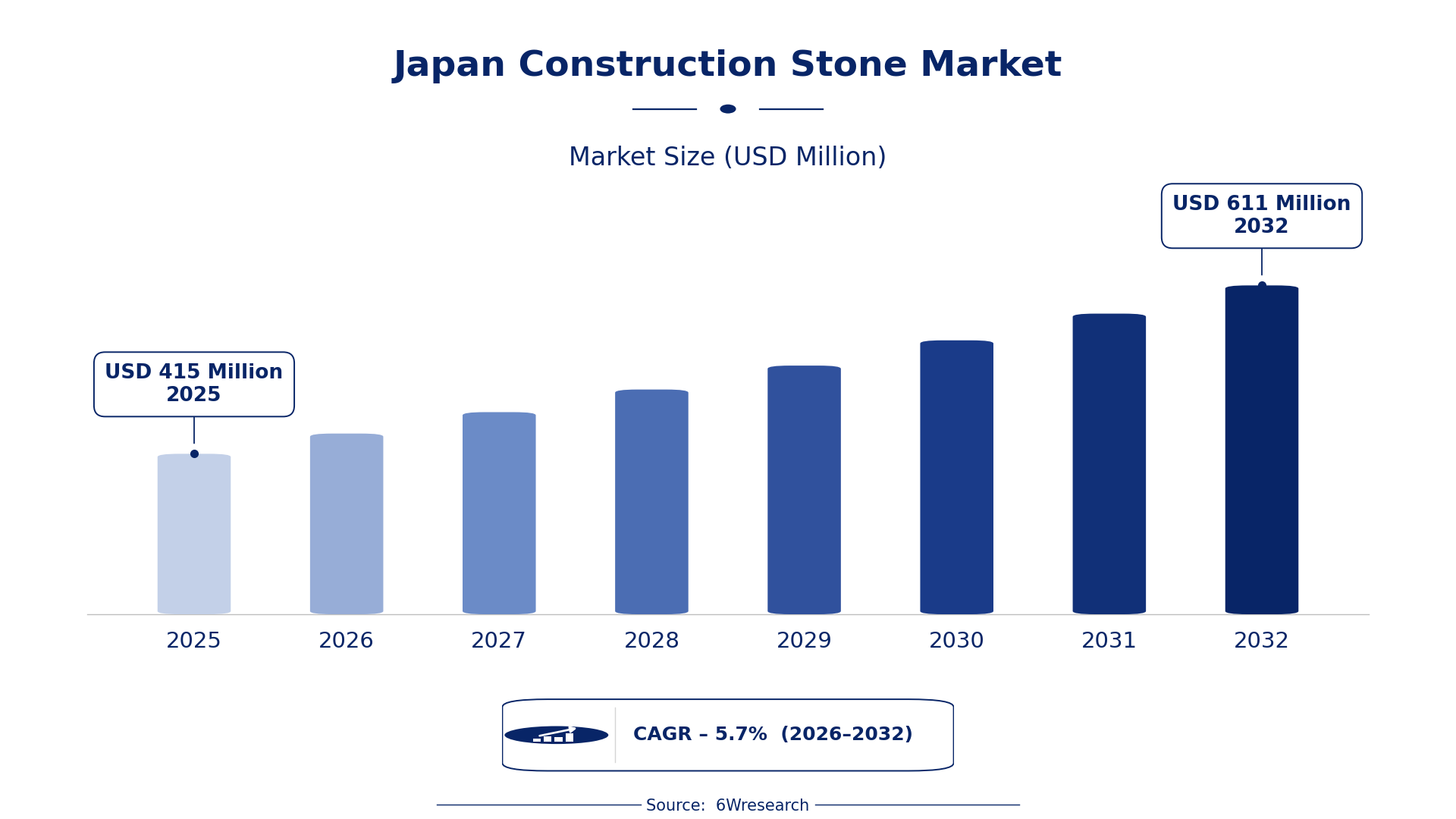
According to 6Wresearch internal database and industry insights, the Japan Construction Stone Market was valued at USD 415 Million in 2025 and is projected to reach USD 611 Million by 2032, growing at a CAGR of approximately 5.7% during 2026–2032.
Japan Construction Stone Market Highlights
| Report Metric | Details |
| Report Name | Japan Construction Stone Market (2026-2032) |
| Market Size 2025 | USD 415 Million |
| Market Size 2032 | USD 611 Million |
| Absolute Growth 2025–2032 | USD 196 Million |
| CAGR 2026–2032 | 5.7% |
| Peak Annual Growth | 6.7% in 2032 |
| Forecast Period | 2026–2032 |
| Historical Data | 2022–2025 |
| Base Year | 2025 |
| Leading Type, 2025 | Construction Aggregates (59% share) |
| Leading Application, 2025 | Public Infrastructure (40% share) |
| Fastest-Growing Type | Natural Stones (7.8% CAGR) |
| Fastest-Growing Application | Commercial Infrastructure (7.6% CAGR) |
| Growing Sector | Commercial Infrastructure |
| Key End Users | Public Infrastructure, Commercial Infrastructure, Residential Infrastructure |
Japan Construction Stone Market Year-wise Growth Rate and Key Drivers (2022–2032)
This graph illustrates the annual growth rates of the market from 2022 to 2032, highlighting a steady upward trajectory and projected market expansion over the forecast period.
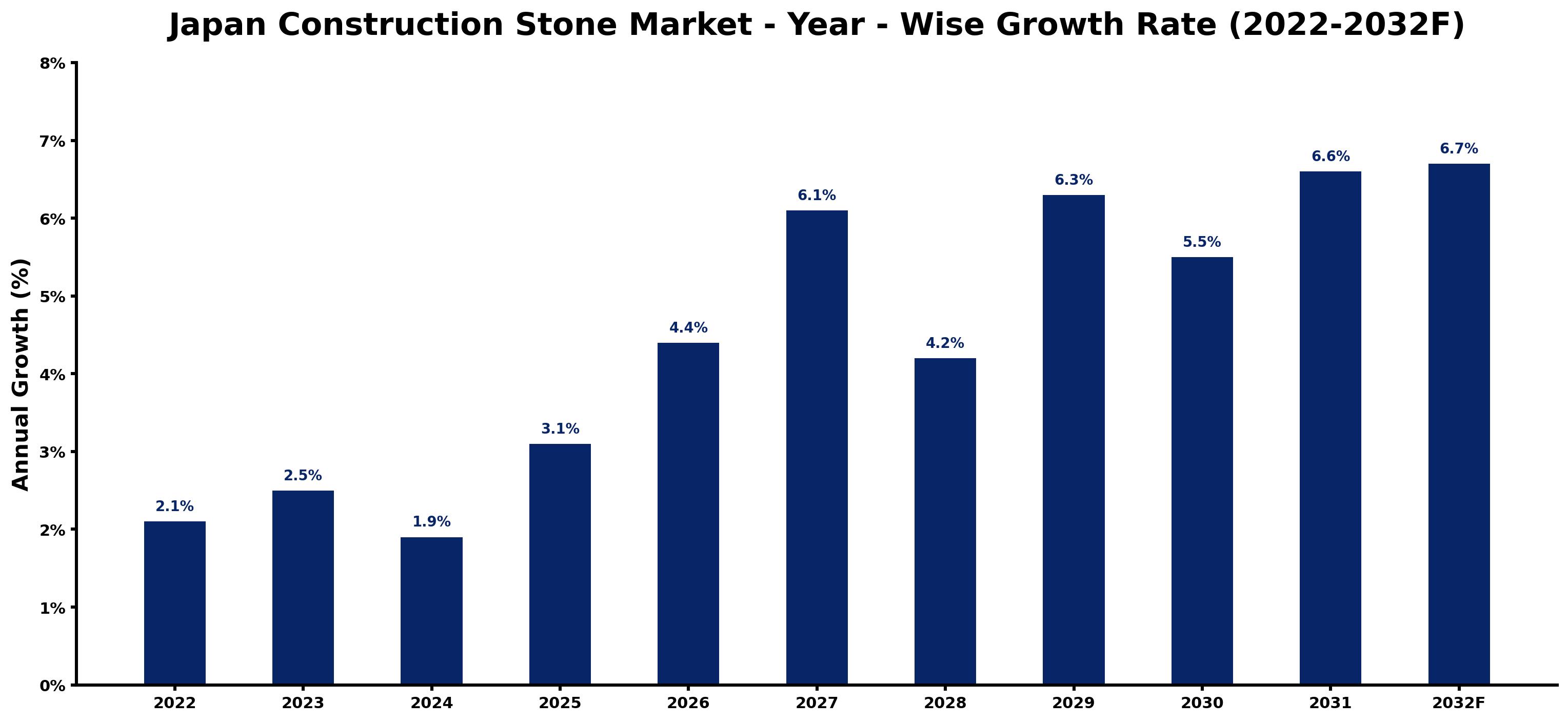
The yearly estimates that follow link every growth rate to its principal driver, so readers can see why the pace changed in each period.
| Year | Estimated Annual Growth (%) | Market Rationale |
| 2022 | 2.1 | The market showed steady activity due to ongoing infrastructure projects. |
| 2023 | 2.5 | Demand increased as public infrastructure spending rose during the year. |
| 2024 | 1.9 | Growth slowed as some projects faced delays, impacting overall demand for materials. |
| 2025 | 3.1 | A surge in public infrastructure projects boosted demand for construction stone. |
| 2026 | 4.4 | Investment in residential construction is expected to expand, driving higher demand for aggregates. |
| 2027 | 6.1 | Growing urban development in metropolitan areas is projected to increase the need for construction stone. |
| 2028 | 4.2 | The market is expected to experience a slowdown as some infrastructure projects reach completion. |
| 2029 | 6.3 | Demand is projected to accelerate again, driven by new commercial infrastructure developments. |
| 2030 | 5.5 | Growth is expected to moderate as the market adjusts to completed projects and new regulations. |
| 2031 | 6.6 | Demand is projected to rise sharply due to increased residential construction activities across the country. |
| 2032 | 6.7 | The market is expected to peak as infrastructure investments reach new heights. |
Note: Market size estimations and growth projections presented in this report are based on 6Wresearch's proprietary forecasting methodology, utilizing the latest available industry data, government publications, and primary research inputs.
Japan Construction Stone Market Synopsis
Construction stone consists of aggregates and natural stones essential for various building applications, sourced from quarries and processed to meet specific standards. The Japan Construction Stone Market is growing due to ongoing public infrastructure projects, with public infrastructure accounting for 45% of total construction spending in 2022. The Kanto region leads in aggregate production, while urban development in the Tokyo metropolitan area drives demand, supported by a ¥1 trillion government investment for infrastructure in 2023. This growth is further driven by rising residential construction activities and increasing aesthetic appeal for natural stones in commercial buildings.
Market Dynamics Impact Analysis (2026–2032)
| Factor | Type | Impact | Primary Segment Affected |
| Rising public infrastructure spending | Driver | High | Public Infrastructure |
| Urban development in metropolitan areas | Driver | High | Residential Infrastructure |
| Growing demand for natural stones in commercial buildings | Opportunity | Medium | Natural Stones |
| Increased investment in residential construction | Opportunity | Medium | Residential Infrastructure |
| Regulatory compliance costs for construction materials | Restraint | High | Construction Aggregates |
| Limited availability of natural stone resources | Restraint | Medium | Natural Stones |
| High transportation costs for aggregates | Challenge | High | Construction Aggregates |
| Competition from alternative building materials | Challenge | Medium | Natural Stones |
Evaluation of Drivers in Japan Construction Stone Market (2026–2032)
Demand rests on the following drivers, each shown with the segment it touches most.
| Drivers | Primary Segment Affected | Why It Matters (Evidence) |
| Growing public infrastructure investment | Public Infrastructure | The Japanese government allocated ¥1 trillion for infrastructure development in 2023, increasing demand for construction stone among contractors. |
| Rising residential construction activities | Residential Infrastructure | Residential construction in Japan is projected to require 30 million tons of aggregates annually, driving purchases from suppliers. |
| Increased usage of natural stones | Commercial Infrastructure | Natural stone usage in commercial buildings has increased by 15% in recent years, reflecting a shift in buyer preferences. |
| High demand in urban areas | Construction Aggregates | The Tokyo metropolitan area has a high demand for construction stone due to ongoing urban development projects, enhancing purchases. |
| Compliance with quality standards | Natural Stones | ISO 9001 certification is commonly required for construction stone suppliers, ensuring quality and reliability in material sourcing. |
Much of the new demand traces back to the Kanto region, the largest producer of construction aggregates in Japan. Urban development in this area is driven by a ¥1 trillion investment in infrastructure for 2023, boosting the need for construction materials. Public infrastructure projects accounted for 45% of total construction spending in 2022, increasing purchases by contractors. The projected need for 40 million tons of aggregates annually for residential construction further drives demand, particularly in metropolitan areas. Additionally, the aesthetic appeal of natural stones is reflected in a 15% increase in their usage in commercial buildings, highlighting a shift in buyer preferences.
Evaluation of Restraints in Japan Construction Stone Market
The key brakes on demand, and where they bite hardest, are shown below.
| Market Restraint | Primary Segment Affected | Why It Matters (Evidence) |
| Compliance with stringent construction material standards | Construction Aggregates | The JIS A 5005 standard requires rigorous testing, increasing costs for suppliers. |
| Limited natural stone resources in certain regions | Natural Stones | Natural stones are primarily sourced from the Kyushu region, which faces resource constraints. |
| High transportation costs for aggregates | Construction Aggregates | Transportation costs can impact the pricing of construction stone, affecting buyer decisions. |
| Competition from alternative building materials | Natural Stones | The rise of synthetic materials offers cheaper options, limiting the market for natural stones. |
| Market fluctuations due to regulatory changes | Public Infrastructure | Changes in regulations can lead to project delays, impacting the demand for construction stone. |
Japan Construction Stone Market Challenges
Japan produces over 100 million tons of aggregates annually, yet rising operational costs have surged by 20% this year due to increased energy prices, burdening buyers with higher project expenses. Public infrastructure projects, which accounted for 45% of construction spending in 2022, face delays as contractors struggle to secure timely deliveries from producers. Strict adherence to ISO 9001 certification causes a backlog in approvals, delaying projects by up to six months for suppliers. Limited technology adoption, with only 30% of producers using advanced machinery, restricts efficiency and raises costs for buyers.
Trends in the Japan Construction Stone Market
Several trends are reshaping the Japan Construction Stone Market; the most important are set out below.
- Shift towards Sustainable Construction Practices: Since 2022, there has been a notable shift towards sustainable construction practices, influenced by the Building Energy Efficiency Act. This trend is driving demand for eco-friendly construction materials, including aggregates that meet energy efficiency standards.
- Increase in Urban Residential Development: In 2023, urban residential development surged, with a projected need for 40 million tons of aggregates annually. This trend indicates a growing focus on housing in metropolitan areas, creating opportunities for suppliers.
- Rising Popularity of Natural Stones in Commercial Spaces: The use of natural stones in commercial buildings has increased by 15% in recent years, reflecting a shift towards aesthetic appeal in design. This trend highlights the potential for growth in the natural stones segment.
- Expansion of Public Infrastructure Projects: Since 2023, public infrastructure projects have expanded due to a ¥1 trillion government investment. This expansion is expected to create sustained demand for construction aggregates across various applications.
Investment Opportunities in the Japan Construction Stone Market
Investors looking at the Japan Construction Stone Market should consider the following areas.
- Timing for Investment in Infrastructure: With the government allocating ¥1 trillion for infrastructure development in 2023, there is a pressing need for construction materials. Suppliers can target public infrastructure projects in urban areas to meet this demand.
- Focus on Residential Construction: The projected requirement of 40 million tons of aggregates annually for residential construction presents a significant opportunity. Suppliers should engage with residential developers in the Tokyo metropolitan area to capitalise on this growth.
- Natural Stones for Aesthetic Projects: The increasing popularity of natural stones in commercial spaces, rising by 15%, indicates a demand for aesthetically pleasing materials. Suppliers can focus on providing high-quality natural stones to meet this trend.
- Public Infrastructure Development: The expansion of public infrastructure projects creates a demand for construction aggregates. Suppliers should align with government initiatives to supply materials for these projects.
Government Initiatives in the Japan Construction Stone Market
The Building Energy Efficiency Act (2015, amended 2022) mandates that all new buildings meet energy standards starting April 2025. This measure requires that construction materials contribute to overall energy efficiency, influencing suppliers to adopt compliant materials and ensuring better performance in building projects.
The Ministry of Land, Infrastructure, Transport and Tourism oversees the implementation of construction standards, ensuring compliance with regulations. This agency funds various infrastructure projects, benefiting suppliers who meet the required standards and creating opportunities for improved market access.
Future Insight of the Japan Construction Stone Market
Investment in infrastructure development will create substantial demand for construction stone by 2032. Residential construction will require 30 million tons of aggregates annually, prompting suppliers to enhance production capabilities. New standards like JIS A 5005 will streamline quality assurance, benefiting buyers with improved material reliability. Advancements in processing technology will enable suppliers to cut costs and improve delivery times, ultimately supporting the growth of urban development projects.
Market Segmentation Analysis
Japan Construction Stone Market report covers a detailed analysis of the following market segments:
By Type – Construction Aggregates Lead, Natural Stones Expected to Grow Fastest
According to Vasudha, AM at 6Wresearch, Construction Aggregates accounted for 59% of the market by type in 2025. Construction aggregates dominate the market as they are crucial for concrete and road base materials, essential for a variety of construction projects in Japan. The Kanto region's production of over 100 million tons annually ensures a steady supply to meet the high demand. Over 2026–2032, Natural Stones are expected to post the fastest growth, at a CAGR of 7.8%. Natural stones are rapidly gaining popularity due to their aesthetic appeal in architectural designs, particularly in urban areas. The 15% increase in usage of natural stones in commercial buildings highlights a growing trend among developers prioritising aesthetics. Suppliers must enhance their offerings of natural stones to meet the rising demand in commercial construction.
By Application – Public Infrastructure Leads, Commercial Infrastructure Expected to Grow Fastest
The largest application category in 2025 was Public Infrastructure, at 40% of revenue. Public infrastructure projects account for 45% of total construction spending, underscoring the critical importance of construction stone for essential facilities such as roads and bridges. The government's ¥1 trillion allocation for infrastructure development further solidifies the significance of this segment in Japan. Commercial Infrastructure is projected to grow fastest, at a CAGR of 7.6% during 2026–2032. Commercial infrastructure is experiencing rapid growth as investments in retail and office spaces increase, driven by urban development initiatives. This trend indicates a rising demand for construction stone as urban areas expand and modernise. Buyers should anticipate a shift in supply emphasis towards commercial infrastructure to align with market trends.
Key Attractiveness of the Report
- 10 Years of Market Numbers
- Historical Data Starting from 2022 to 2025
- Base Year 2025
- Forecast Data until 2032
- Key Performance Indicators Impacting the Market
- Major Upcoming Developments and Projects
Key Highlights of the Report:
- Japan Construction Stone Market Outlook
- Market Size of Japan Construction Stone Market, 2025
- Forecast of Japan Construction Stone Market, 2032
- Historical Data and Forecast of Japan Construction Stone Revenues & Volume for the Period 2022-2032
- Japan Construction Stone Market Trend Evolution
- Japan Construction Stone Market Drivers and Challenges
- Japan Construction Stone Price Trends
- Japan Construction Stone Porter's Five Forces
- Japan Construction Stone Industry Life Cycle
- Historical Data and Forecast of Japan Construction Stone Market Revenues & Volume By Type for the Period 2022-2032
- Historical Data and Forecast of Japan Construction Stone Market Revenues & Volume By Construction Aggregates for the Period 2022-2032
- Historical Data and Forecast of Japan Construction Stone Market Revenues & Volume By Natural Stones for the Period 2022-2032
- Historical Data and Forecast of Japan Construction Stone Market Revenues & Volume By Application for the Period 2022-2032
- Historical Data and Forecast of Japan Construction Stone Market Revenues & Volume By Public Infrastructure for the Period 2022-2032
- Historical Data and Forecast of Japan Construction Stone Market Revenues & Volume By Commercial Infrastructure for the Period 2022-2032
- Historical Data and Forecast of Japan Construction Stone Market Revenues & Volume By Residential Infrastructure for the Period 2022-2032
- Japan Construction Stone Import Export Trade Statistics
- Market Opportunity Assessment By Type
- Market Opportunity Assessment By Application
- Japan Construction Stone Top Companies Market Share
- Japan Construction Stone Competitive Benchmarking By Technical and Operational Parameters
- Japan Construction Stone Company Profiles
- Japan Construction Stone Key Strategic Recommendations
Market Covered
Coverage by segment is as follows.
By Type
- Construction Aggregates
- Natural Stones
By Application
- Public Infrastructure
- Commercial Infrastructure
- Residential Infrastructure































