Japan Cottonseed Market Size & Growth Rate
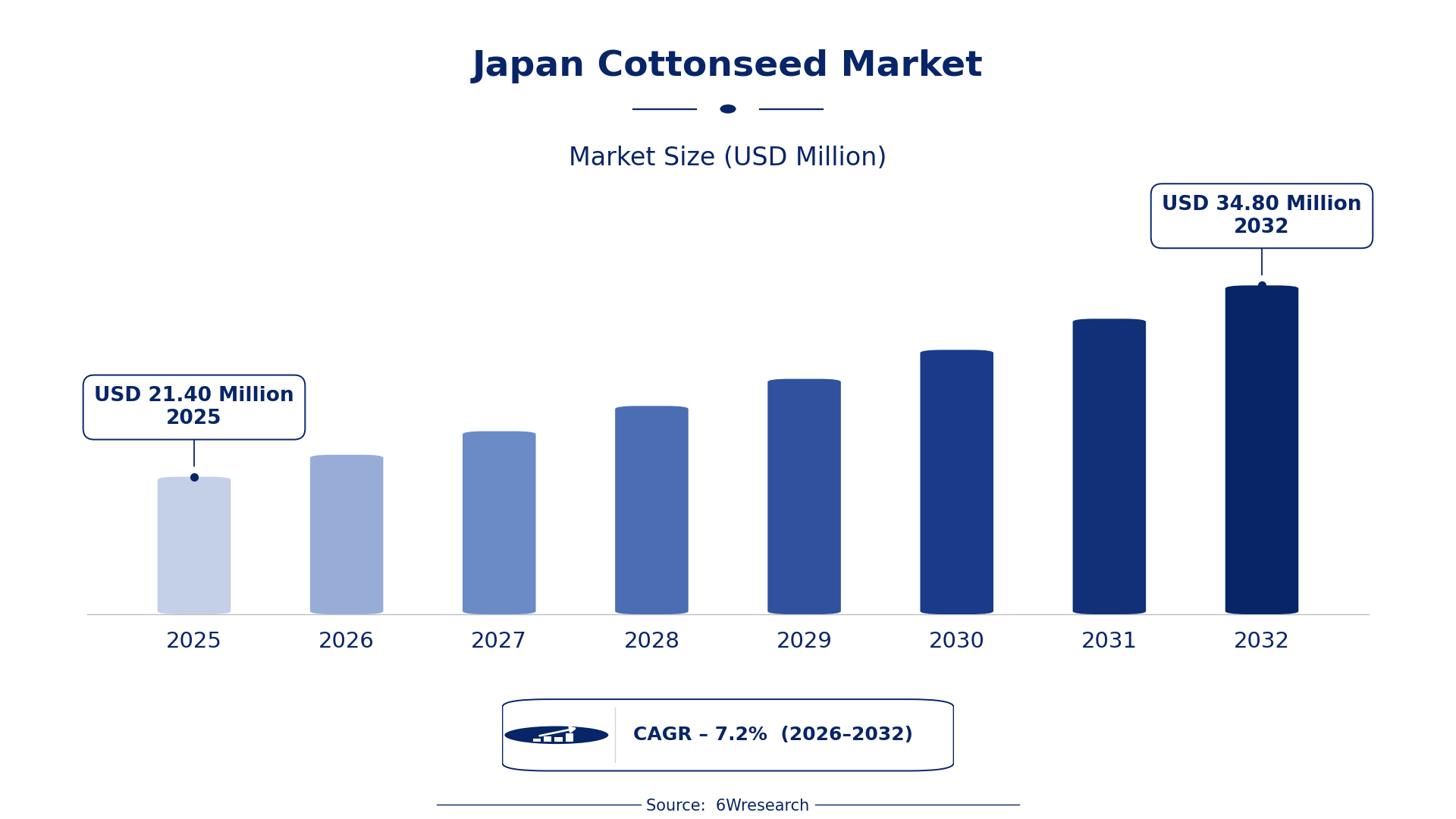
According to 6Wresearch internal database and industry insights, the Japan Cottonseed Market was valued at USD 21.40 Million in 2025 and is projected to reach USD 34.80 Million by 2032, growing at a CAGR of approximately 7.2% during 2026–2032.
Japan Cottonseed Market Highlights
| Report Metric | Details |
| Report Name | Japan Cottonseed Market (2026-2032) |
| Market Size 2025 | USD 21.40 Million |
| Market Size 2032 | USD 34.80 Million |
| Absolute Growth 2025–2032 | USD 13.40 Million |
| CAGR 2026–2032 | 7.2% |
| Peak Annual Growth | 8.4% in 2028 |
| Forecast Period | 2026–2032 |
| Historical Data | 2022–2025 |
| Base Year | 2025 |
| Leading Type, 2025 | Upland Cotton (43% share) |
| Leading Application, 2025 | Cottonseed Oil Production (55% share) |
| Fastest-Growing Application | Cotton Planting and (8.9% CAGR) |
| Growing Sector | Animal Feed Production |
| Key End Users | Food manufacturers, livestock producers, agricultural suppliers |
Japan Cottonseed Market Year-wise Growth Rate and Key Drivers (2022–2032)
This graph illustrates the annual growth rates of the market from 2022 to 2032, highlighting a steady upward trajectory and projected market expansion over the forecast period.
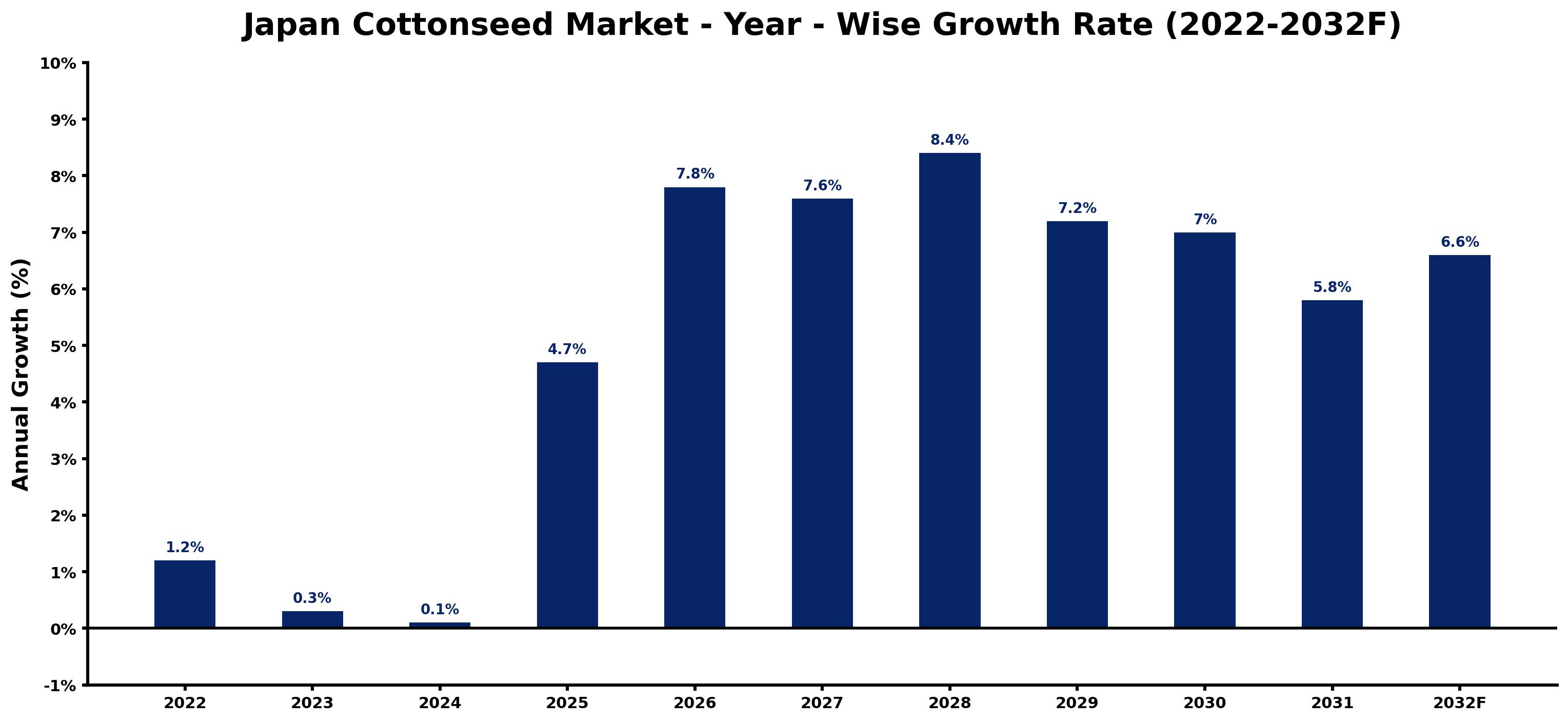
For each year, the table pairs the estimated growth rate with the leading influence on demand, showing how the drivers changed across the period.
| Year | Estimated Annual Growth (%) | Market Rationale |
| 2022 | 1.2 | The market experienced modest growth due to limited domestic cotton production. |
| 2023 | 0.3 | Growth slowed as the reliance on imports continued to dominate the market. |
| 2024 | 0.1 | The market showed minimal growth as demand remained stable amid high reliance on imports. |
| 2025 | 4.7 | Growth accelerated as cottonseed oil production gained traction in the food industry. |
| 2026 | 7.8 | Demand is expected to rise as consumption of cottonseed oil increases. |
| 2027 | 7.6 | Growth is projected to slow slightly as the market stabilises after a strong previous year. |
| 2028 | 8.4 | The market is expected to peak with heightened demand for cottonseed oil in various applications. |
| 2029 | 7.2 | Growth is projected to slow as the market adjusts to peak demand levels. |
| 2030 | 7.0 | The market will continue to grow, albeit at a slower rate than the previous year. |
| 2031 | 5.8 | Demand growth is expected to decelerate as the market approaches a stabilisation phase. |
| 2032 | 6.6 | Growth is projected to resume as new applications for cottonseed oil emerge. |
Note: Market size estimations and growth projections presented in this report are based on 6Wresearch's proprietary forecasting methodology, utilizing the latest available industry data, government publications, and primary research inputs.
Japan Cottonseed Market Synopsis
Cottonseed serves as a byproduct of cotton production, primarily utilised for oil extraction and animal feed. In Japan, the Japan Cottonseed Market is characterised by a heavy reliance on imports, with over 90% of cotton sourced from abroad. The main applications include cottonseed oil production and livestock feed, driven by the food industry’s demand for high-quality oils. In 2023, the cottonseed oil market was valued at approximately 20 billion yen, indicating strong potential for growth in this sector, supported by rising health consciousness and sustainable agricultural practices.
Market Dynamics Impact Analysis (2026–2032)
| Factor | Type | Impact | Primary Segment Affected |
| Rising consumption of cottonseed oil in the food industry | Driver | High | Cottonseed Oil Production |
| Increased demand for protein-rich animal feed | Driver | High | Upland Cotton |
| Growing health consciousness among consumers | Opportunity | Medium | Cottonseed Oil Production |
| Expansion of sustainable agricultural practices | Opportunity | Medium | Upland Cotton |
| Dependence on imports for cotton supply | Restraint | High | Cottonseed Oil Production |
| Limited domestic cotton cultivation capacity | Restraint | High | Upland Cotton |
| Fluctuations in global cotton prices | Challenge | Medium | Cottonseed Oil Production |
| Competition from alternative oil sources | Challenge | Medium | Cottonseed Oil Production |
Evaluation of Drivers in Japan Cottonseed Market (2026–2032)
The factors lifting demand, and the evidence behind each, are summarised below.
| Drivers | Primary Segment Affected | Why It Matters (Evidence) |
| Increased consumption of cottonseed oil for frying | Cottonseed Oil Production | The average consumption of cottonseed oil in Japan is around 50,000 tons per year, reflecting demand from the food industry. |
| Rising demand for protein-rich animal feed | Upland Cotton | Cottonseed meal is increasingly used in livestock production, supporting the need for high-quality feed. |
| Health trends favouring plant-based oils | Cottonseed Oil Production | The food industry is shifting towards healthier oil options, boosting cottonseed oil usage. |
| Promotion of sustainable agricultural practices | Upland Cotton | Sustainable practices are encouraged, increasing the focus on cotton cultivation. |
| Growing applications in food processing | Cottonseed Oil Production | Cottonseed oil's versatility in food applications drives its increasing demand. |
What keeps demand rising is the increased consumption of cottonseed oil for frying, with average consumption around 50,000 tons annually, primarily reflecting the food industry's focus on quality oils. The need for protein-rich animal feed boosts the use of cottonseed meal in livestock production, as it serves as a valuable source of nutrition. The versatility of cottonseed oil in various food applications further drives its demand, reflecting changing consumer preferences. The promotion of sustainable agricultural practices is increasing the focus on cotton cultivation, which supports supply and meets rising demand.
Evaluation of Restraints in Japan Cottonseed Market
Below are the constraints most often cited by buyers and suppliers, with the segment each affects.
| Market Restraint | Primary Segment Affected | Why It Matters (Evidence) |
| Dependence on imports for cotton supply | Cottonseed Oil Production | Japan imports over 90% of its cotton, limiting local supply and affecting market stability. |
| Limited domestic cotton cultivation capacity | Upland Cotton | Japan's cotton production is approximately 1,000 tons annually, restricting growth potential. |
| Fluctuations in global cotton prices | Cottonseed Oil Production | Global price volatility impacts the cost structure for cottonseed oil producers. |
| Competition from alternative oil sources | Cottonseed Oil Production | The rising popularity of other vegetable oils challenges cottonseed oil's market share. |
| Consumer preferences shifting towards organic products | Cottonseed Oil Production | Growing interest in organic oils may limit conventional cottonseed oil sales. |
Japan Cottonseed Market Challenges
Outdated ginning technology limits cottonseed extraction efficiency, resulting in lower quality and higher prices for producers. Japan's cotton production stands at only 1,000 tons annually, forcing buyers to rely on imports for over 90% of their cottonseed needs, which increases costs and supply chain risks. A shortage of skilled workers in sustainable agricultural practices hampers domestic cultivation efforts, compelling buyers to depend on imported cottonseed meal for animal feed. Strict JIS standards for cottonseed oil quality impose compliance costs on suppliers, complicating market entry for new players and delaying product launches.
Trends in the Japan Cottonseed Market
Below are the shifts with the largest effect on the Japan Cottonseed Market.
- Shift towards Healthier Oil Options: The food industry is increasingly focusing on healthier oil alternatives, with cottonseed oil gaining popularity. In 2023, the average consumption reached around 50,000 tons, reflecting this trend.
- Transition to Sustainable Agricultural Practices: Japan is adopting more sustainable agricultural practices, particularly in cotton cultivation. The Ministry of Agriculture, Forestry and Fisheries has promoted these methods, which are expected to improve cottonseed production.
- Emergence of Cottonseed Meal in Livestock Feed: Cottonseed meal is becoming a preferred protein source in animal feed, driven by its nutritional benefits. This shift is evident in livestock production practices across Japan.
- Growing Demand for Edible Oils: The demand for edible oils is on the rise, with cottonseed oil being a key player. The market was valued at approximately 20 billion yen in 2023, indicating strong consumer interest.
Investment Opportunities in the Japan Cottonseed Market
The openings below show where demand in the Japan Cottonseed Market is visible and how suppliers can enter.
- Food Industry Seeking Quality Oils: The food industry requires high-quality oils, presenting an opportunity for cottonseed oil suppliers. With an average consumption of 50,000 tons annually, suppliers can meet this demand through local partnerships.
- Livestock Producers Needing Protein Sources: Livestock producers are increasingly looking for protein-rich feed options, creating a demand for cottonseed meal. The growing livestock sector in Kumamoto and Kagoshima regions offers a potential market.
- Sustainable Practices in Agriculture: The push for sustainable agricultural practices opens avenues for investment in cotton cultivation. The Ministry of Agriculture, Forestry and Fisheries supports initiatives that improve cotton production.
- Expansion of Edible Oil Market: The edible oil market is expanding, with cottonseed oil gaining traction. Suppliers can enter this market by ensuring compliance with JIS standards for quality assurance.
Government Initiatives in the Japan Cottonseed Market
The Industrial Standardization Act governs JIS product and test standards, ensuring quality in cottonseed oil production. Compliance with these standards is essential for producers to maintain market access and consumer trust. The Act was amended and renamed in 2019, reflecting ongoing efforts to maintain product quality and safety.
The Ministry of Agriculture, Forestry and Fisheries oversees the implementation of agricultural standards and practices. This agency ensures that producers adhere to sustainable practices, which helps maintain consumer confidence in the market.
Future Insight of the Japan Cottonseed Market
New sustainable agricultural projects will emerge by 2032, driven by the Ministry of Agriculture, Forestry and Fisheries' initiatives. Japan's cottonseed oil market, valued at approximately 20 billion yen in 2023, will see improved quality and availability as processing facilities are upgraded. Advanced extraction methods will enable suppliers to meet consumer preferences for healthier options. The Food Safety Commission's oversight will ensure safety standards are maintained, building trust among buyers and stabilising the market.
Market Segmentation Analysis
Japan Cottonseed Market report covers a detailed analysis of the following market segments:
By Type – Upland Cotton Leads and Records the Fastest Growth
According to Vasudha, AM at 6Wresearch, in 2025, Upland Cotton led the type split with a 43% share. Upland Cotton holds the largest share in Japan due to its predominant use in textile production, which drives demand for cottonseed byproducts. The established supply chain from imported cotton ensures that Upland Cotton remains a reliable source for cottonseed applications. The same category is also set to grow fastest, at a CAGR of 9.7% during 2026–2032. Upland Cotton's growth rate is supported by the rising demand for cottonseed oil in the food industry, particularly for frying. With an average consumption of around 50,000 tons per year, the market for cottonseed oil is set to expand further. This indicates that suppliers should focus on Upland Cotton to meet the growing needs for cottonseed oil in Japan.
By Application – Cottonseed Oil Production Leads, Cotton Planting and Expected to Grow Fastest
The largest application category in 2025 was Cottonseed Oil Production, at 55% of revenue. Cottonseed Oil Production leads the market as it is a vital component in the food industry, particularly for frying. The market value of Japan's cottonseed oil was approximately 20 billion yen in 2023, reflecting its importance. Cotton Planting and is set to record the highest CAGR in this split, 8.9% over 2026–2032. Cotton Planting is experiencing rapid growth as agricultural practices evolve, supported by initiatives from the Ministry of Agriculture, Forestry and Fisheries. This focus on sustainable practices will likely increase the demand for cottonseed in the coming years. Buyers should consider the expanding role of cotton planting in ensuring a steady supply of cottonseed for various applications.
Key Attractiveness of the Report
- 10 Years of Market Numbers
- Historical Data Starting from 2022 to 2025
- Base Year 2025
- Forecast Data until 2032
- Key Performance Indicators Impacting the Market
- Major Upcoming Developments and Projects
Key Highlights of the Report:
- Japan Cottonseed Market Outlook
- Market Size of Japan Cottonseed Market, 2025
- Forecast of Japan Cottonseed Market, 2032
- Historical Data and Forecast of Japan Cottonseed Revenues & Volume for the Period 2022-2032
- Japan Cottonseed Market Trend Evolution
- Japan Cottonseed Market Drivers and Challenges
- Japan Cottonseed Price Trends
- Japan Cottonseed Porter's Five Forces
- Japan Cottonseed Industry Life Cycle
- Historical Data and Forecast of Japan Cottonseed Market Revenues & Volume By Type for the Period 2022-2032
- Historical Data and Forecast of Japan Cottonseed Market Revenues & Volume By Upland Cotton, for the Period 2022-2032
- Historical Data and Forecast of Japan Cottonseed Market Revenues & Volume By Tree Cotton, for the Period 2022-2032
- Historical Data and Forecast of Japan Cottonseed Market Revenues & Volume By Extra-long Staple Cotton, for the Period 2022-2032
- Historical Data and Forecast of Japan Cottonseed Market Revenues & Volume By Levant Cotton for the Period 2022-2032
- Historical Data and Forecast of Japan Cottonseed Market Revenues & Volume By Application for the Period 2022-2032
- Historical Data and Forecast of Japan Cottonseed Market Revenues & Volume By Cotton Planting and for the Period 2022-2032
- Historical Data and Forecast of Japan Cottonseed Market Revenues & Volume By Cottonseed Oil Production for the Period 2022-2032
- Japan Cottonseed Import Export Trade Statistics
- Market Opportunity Assessment By Type
- Market Opportunity Assessment By Application
- Japan Cottonseed Top Companies Market Share
- Japan Cottonseed Competitive Benchmarking By Technical and Operational Parameters
- Japan Cottonseed Company Profiles
- Japan Cottonseed Key Strategic Recommendations
Market Covered
The report covers the following segments.
By Type
- Upland Cotton
- Tree Cotton
- Extra-long Staple Cotton
- Levant Cotton
By Application
- Cotton Planting and
- Cottonseed Oil Production































