Japan Cryogenic Pump Market Size & Growth Rate
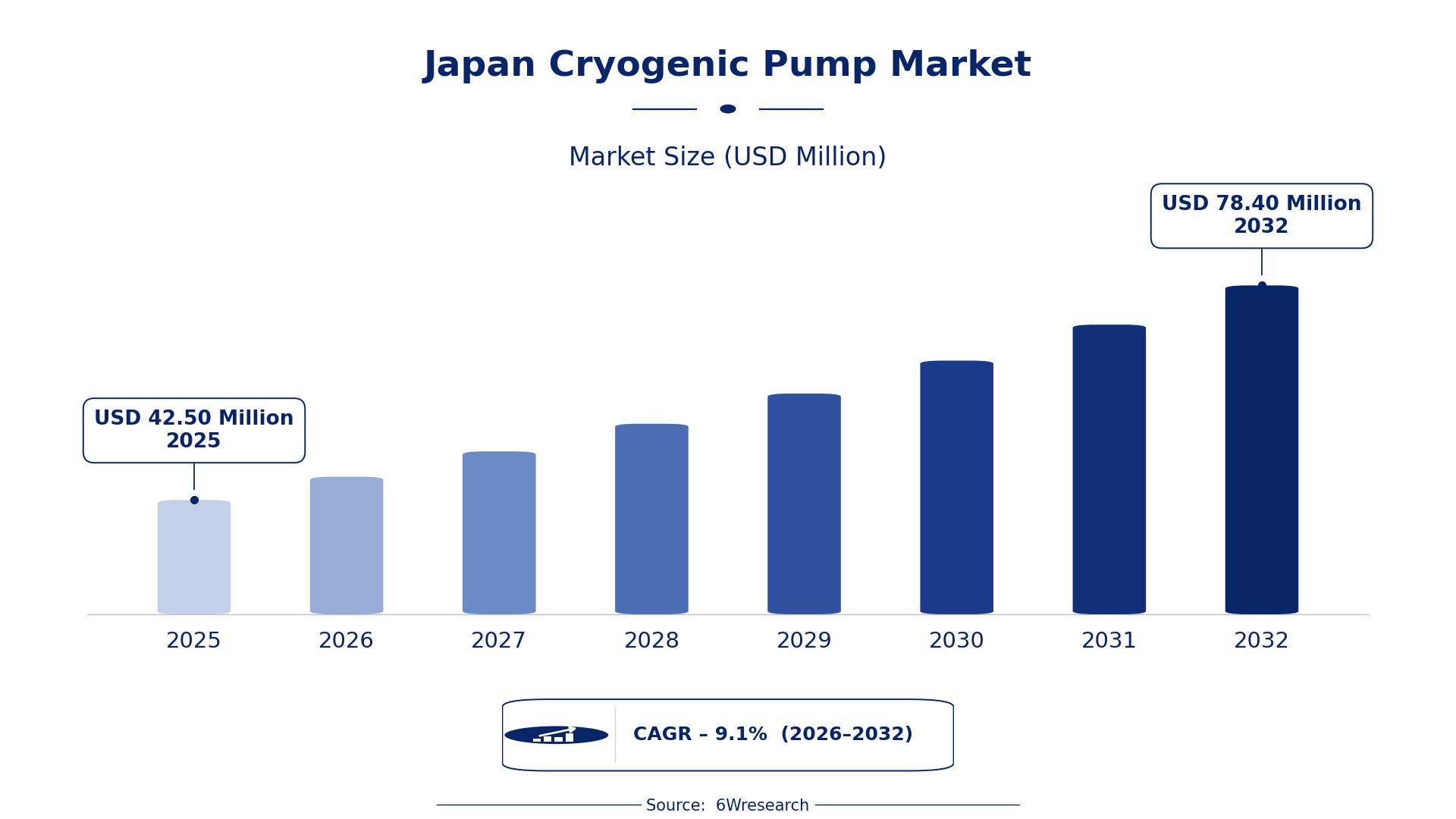
According to 6Wresearch internal database and industry insights, the Japan Cryogenic Pump Market was valued at USD 42.50 Million in 2025 and is projected to reach USD 78.40 Million by 2032, growing at a CAGR of approximately 9.1% during 2026–2032.
Japan Cryogenic Pump Market Highlights
| Report Metric | Details |
| Report Name | Japan Cryogenic Pump Market (2026-2032) |
| Market Size 2025 | USD 42.50 Million |
| Market Size 2032 | USD 78.40 Million |
| Absolute Growth 2025–2032 | USD 35.90 Million |
| CAGR 2026–2032 | 9.1% |
| Peak Annual Growth | 9.8% in 2032 |
| Forecast Period | 2026–2032 |
| Historical Data | 2022–2025 |
| Base Year | 2025 |
| Leading Design, 2025 | Submersible (61% share) |
| Leading Cryogen, 2025 | Nitrogen (35% share) |
| Leading End User, 2025 | Energy & Power (39% share) |
| Fastest-Growing Design | Non-Submersible (11.3% CAGR) |
| Fastest-Growing Cryogen | Argon (12.8% CAGR) |
| Fastest-Growing End User | Chemicals (12.0% CAGR) |
| Growing Sector | Energy & Power |
| Key End Users | Energy sector, Healthcare sector, Pharmaceutical industry |
Japan Cryogenic Pump Market Year-wise Growth Rate and Key Drivers (2022–2032)
This graph illustrates the annual growth rates of the market from 2022 to 2032, highlighting a steady upward trajectory and projected market expansion over the forecast period.
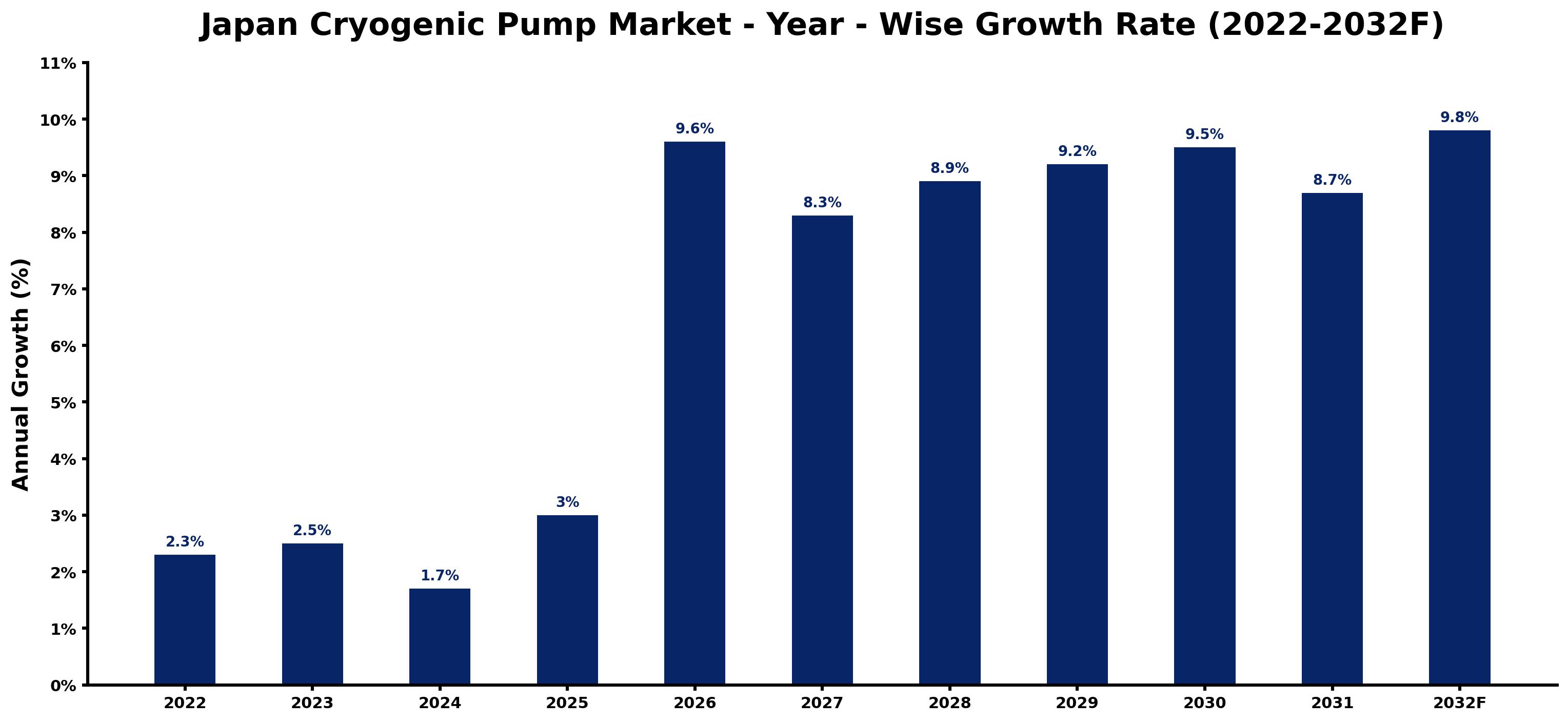
The yearly estimates that follow link every growth rate to its principal driver, so readers can see why the pace changed in each period.
| Year | Estimated Annual Growth (%) | Market Rationale |
| 2022 | 2.3 | The market experienced steady growth due to ongoing demand from the energy sector. |
| 2023 | 2.5 | Increased LNG imports contributed to a faster growth rate compared to the previous year. |
| 2024 | 1.7 | Growth slowed slightly as the market adjusted to previous expansions and demand stabilised. |
| 2025 | 3.0 | A surge in healthcare applications drove growth faster than the previous year. |
| 2026 | 9.6 | Investment in hydrogen infrastructure is expected to boost market growth. |
| 2027 | 8.3 | Growth is projected to slow as the market begins to normalise after rapid expansion in previous years. |
| 2028 | 8.9 | Demand is expected to increase again due to rising interest in hydrogen applications. |
| 2029 | 9.2 | The market is projected to see further growth as energy companies invest in cryogenic technologies. |
| 2030 | 9.5 | Continued investments in LNG infrastructure will support a higher growth rate. |
| 2031 | 8.7 | Growth is expected to slow slightly as the market matures and competition intensifies. |
| 2032 | 9.8 | A peak in growth is projected due to advancements in cryogenic technologies. |
Note: Market size estimations and growth projections presented in this report are based on 6Wresearch's proprietary forecasting methodology, utilizing the latest available industry data, government publications, and primary research inputs.
Japan Cryogenic Pump Market Synopsis
Cryogenic pumps are critical devices for transferring cryogenic fluids at low temperatures, primarily serving the energy and healthcare sectors. The Japan Cryogenic Pump Market is growing due to rising LNG imports, which hit 80 million tons in 2023, alongside increasing demand for hydrogen energy. The healthcare sector, with over 1,000 hospitals employing cryogenic technologies, further drives market growth, presenting opportunities for manufacturers and suppliers.
Market Dynamics Impact Analysis (2026–2032)
| Factor | Type | Impact | Primary Segment Affected |
| Rising LNG imports drive demand for efficient cryogenic pumping solutions. | Driver | High | LNG |
| Investment in hydrogen infrastructure is increasing demand for cryogenic pumps. | Driver | High | Hydrogen |
| Growing healthcare applications present opportunities for cryogenic pump suppliers. | Opportunity | High | Healthcare & Pharmaceuticals |
| Expansion of LNG infrastructure creates a need for additional cryogenic pump capacity. | Opportunity | High | Energy & Power |
| Regulatory compliance costs can hinder market growth for manufacturers. | Restraint | Medium | Submersible |
| Competition among suppliers may limit pricing flexibility in the market. | Restraint | Medium | Submersible |
| Limited supply capacity may delay project timelines for buyers. | Challenge | High | Energy & Power |
| Technological advancements require continuous investment from manufacturers. | Challenge | High | Healthcare & Pharmaceuticals |
Evaluation of Drivers in Japan Cryogenic Pump Market (2026–2032)
The main growth drivers and the segments they affect most are set out below.
| Drivers | Primary Segment Affected | Why It Matters (Evidence) |
| Increased LNG imports necessitate advanced cryogenic pumping solutions. | LNG | Japan's LNG imports reached 80 million tons in 2023, driving demand for efficient pumps. |
| Investment in hydrogen infrastructure boosts demand for cryogenic pumps. | Hydrogen | Japan aims to establish 800 hydrogen stations by 2030, increasing pump requirements. |
| Growing healthcare applications boost demand for cryogenic technologies. | Healthcare & Pharmaceuticals | Over 1,000 hospitals in Japan utilise cryogenic technologies for medical gas supply. |
| Rising energy sector investments drive cryogenic pump purchases. | Energy & Power | The energy sector's focus on LNG and hydrogen fuels demand for cryogenic pumps. |
| Technological advancements improve pump efficiency and reliability. | Submersible | Compliance with ISO 9001 standards improves manufacturing quality and market competitiveness. |
Buyers are adding capacity as Japan's LNG imports reached 80 million tons in 2023, necessitating advanced cryogenic pumping solutions. Investment in hydrogen infrastructure is expected to increase the number of hydrogen stations to 800 by 2030, driving demand for cryogenic pumps. The healthcare sector is expanding its applications for medical gas supply, with over 1,000 hospitals utilising cryogenic technologies. Energy sector investments in LNG and hydrogen further fuel the need for efficient pumps. Manufacturers are investing in R&D to improve product quality, ensuring that suppliers meet growing demand effectively.
Evaluation of Restraints in Japan Cryogenic Pump Market
These are the pressures that could keep growth below its potential.
| Market Restraint | Primary Segment Affected | Why It Matters (Evidence) |
| Regulatory compliance costs can hinder market growth for manufacturers. | Submersible | Compliance with standards like JIS B 8350 increases operational costs for manufacturers. |
| Competition among suppliers may limit pricing flexibility in the market. | Submersible | Intense competition forces suppliers to keep prices low, impacting profit margins. |
| Limited supply capacity may delay project timelines for buyers. | Energy & Power | Insufficient production capacity can slow down the delivery of essential equipment. |
| Technological advancements require continuous investment from manufacturers. | Healthcare & Pharmaceuticals | Manufacturers must invest in R&D to keep up with evolving technologies and standards. |
| Market maturity may limit growth opportunities for new entrants. | Submersible | Established players dominate the market, making it challenging for new entrants to gain traction. |
Japan Cryogenic Pump Market Challenges
High production costs of cryogenic pumps present a major hurdle, as manufacturers face rising material expenses, resulting in a 15% increase in prices for buyers. Buyers in the energy sector encounter delays in project timelines due to stringent regulations from the Ministry of Health, Labour and Welfare, which can extend lead times by up to six months. Complex compliance with ISO 9001 standards adds operational costs for suppliers, reaching 10% of total expenses. Technological advancements lag behind demand, with only 20% of hospitals fully equipped with the latest technologies, limiting service efficiency for healthcare providers.
Trends in the Japan Cryogenic Pump Market
Several trends are reshaping the Japan Cryogenic Pump Market; the most important are set out below.
- Shift towards Hydrogen Applications: Japan is focusing on hydrogen energy, with plans for 800 hydrogen stations by 2030. This shift is driving demand for cryogenic pumps, essential for liquefied hydrogen production, projected to reach significant volumes.
- Growth in Healthcare Applications: The healthcare sector is experiencing a surge in cryogenic pump usage, with over 1,000 hospitals adopting these technologies. This trend highlights the importance of cryogenic pumps in medical gas supply and storage.
- Expansion of LNG Infrastructure: The Tokyo metropolitan area is becoming a key industrial hub for cryogenic pump usage, driven by rising LNG imports. In 2023, Japan's LNG imports reached 80 million tons, necessitating efficient pumping solutions.
- Adoption of ISO Standards: Japan has implemented ISO 9001 standards for cryogenic pump manufacturing, improving quality management. This adoption ensures that products meet international quality benchmarks, increasing competitiveness.
Investment Opportunities in the Japan Cryogenic Pump Market
The following areas offer the clearest openings for investors and suppliers in the Japan Cryogenic Pump Market.
- Energy Sector Investment: Energy companies are making substantial investments in LNG infrastructure, creating opportunities for cryogenic pump suppliers. With Japan's LNG imports reaching 80 million tons in 2023, suppliers can address the rising demand.
- Healthcare Sector Expansion: The growth of the healthcare sector offers a chance for cryogenic pump manufacturers. With over 1,000 hospitals employing cryogenic technologies, suppliers can effectively target this expanding market.
- Hydrogen Energy Development: The push for hydrogen energy opens avenues for manufacturers to supply cryogenic pumps. Japan's aim of establishing 800 hydrogen stations by 2030 highlights the demand for these technologies.
- Technological Advancements: Investing in advanced cryogenic pump technologies can yield benefits. As manufacturers comply with ISO 9001 standards, they can improve product quality and attract more buyers.
Government Initiatives in the Japan Cryogenic Pump Market
The Water Supply Act (1957) and the Sewerage Act (1958) set essential standards for water quality and wastewater treatment, impacting the manufacturing and operation of cryogenic pumps. These laws ensure that cryogenic pumps used in healthcare and energy sectors meet safety and efficiency standards, promoting better practices in the industry.
In 2023, the Ministry of Health, Labour and Welfare approved funding for projects aimed at improving medical gas supply systems in hospitals. This initiative supports the adoption of cryogenic technologies, ensuring that healthcare facilities can efficiently utilise cryogenic pumps.
Future Insight of the Japan Cryogenic Pump Market
Energy sector buyers will increasingly adopt advanced technologies by 2032, driven by the growing demand for efficient LNG solutions. The production of liquefied hydrogen will rise, supported by Japan's investment in hydrogen infrastructure, targeting 800 hydrogen stations by 2030. Compliance with JIS B 8350 standards will ensure higher performance in pump manufacturing. The anticipated increase in LNG imports, projected to reach 80 million tons, will further necessitate improved pumping solutions.
Market Segmentation Analysis
Japan Cryogenic Pump Market report covers a detailed analysis of the following market segments:
By Design – Submersible Leads, Non-Submersible Expected to Grow Fastest
According to Bhawna Singh, Assistant Manager at 6Wresearch, Submersible took 61% of design revenue in 2025, more than any other category. The submersible segment captures the largest share because it is crucial for deep cryogenic applications, especially in LNG storage. This segment thrives in key industrial regions like the Tokyo metropolitan area, where efficient storage solutions are in high demand. Non-Submersible is set to record the highest CAGR in this split, 11.3% over 2026–2032. The non-submersible segment is poised for rapid growth as it increasingly serves diverse industrial processes that require cryogenic fluids. With Japan's focus on expanding hydrogen infrastructure, the demand for these pumps is expected to rise significantly. Suppliers should focus on developing non-submersible pumps to capitalise on the expanding industrial applications.
By Cryogen – Nitrogen Leads, Argon Expected to Grow Fastest
In 2025, Nitrogen led the cryogen split with a 35% share. Nitrogen holds the largest share as it is extensively used across multiple industries for cooling and preservation applications. Its broad applicability ensures a steady demand, particularly in sectors like food processing and electronics. Argon is projected to grow fastest, at a CAGR of 12.8% during 2026–2032. The argon segment is growing quickly due to its rising usage in welding and metal processing applications, which are expanding as manufacturing activities increase. This growth reflects a trend towards more efficient and high-quality production processes. Buyers should consider diversifying their cryogen supply sources to ensure consistent availability of nitrogen and take advantage of the growing argon market.
By End User – Energy & Power Leads, Chemicals Expected to Grow Fastest
Energy & Power accounted for 39% of the market by end user in 2025. The energy and power sector holds the largest share as it extensively employs cryogenic pumps for LNG and hydrogen applications, with Japan importing 80 million tons of LNG in 2023. This sector's critical role in the energy transition solidifies its leading position. The quickest growth will come from Chemicals, forecast to expand at a CAGR of 12.0% between 2026 and 2032. The chemicals sector is witnessing rapid growth as it adopts cryogenic pumps for processing and manufacturing needs. This surge is driven by the industry's demand for improved production efficiency to satisfy increasing market requirements. Suppliers need to tailor their products to meet the specific needs of the chemicals sector to take advantage of its growth opportunities.
Key Attractiveness of the Report
- 10 Years of Market Numbers
- Historical Data Starting from 2022 to 2025
- Base Year 2025
- Forecast Data until 2032
- Key Performance Indicators Impacting the Market
- Major Upcoming Developments and Projects
Key Highlights of the Report:
- Japan Cryogenic Pump Market Outlook
- Market Size of Japan Cryogenic Pump Market, 2025
- Forecast of Japan Cryogenic Pump Market, 2032
- Historical Data and Forecast of Japan Cryogenic Pump Revenues & Volume for the Period 2022-2032
- Japan Cryogenic Pump Market Trend Evolution
- Japan Cryogenic Pump Market Drivers and Challenges
- Japan Cryogenic Pump Price Trends
- Japan Cryogenic Pump Porter's Five Forces
- Japan Cryogenic Pump Industry Life Cycle
- Historical Data and Forecast of Japan Cryogenic Pump Market Revenues & Volume By Design for the Period 2022-2032
- Historical Data and Forecast of Japan Cryogenic Pump Market Revenues & Volume By Submersible for the Period 2022-2032
- Historical Data and Forecast of Japan Cryogenic Pump Market Revenues & Volume By Non-Submersible for the Period 2022-2032
- Historical Data and Forecast of Japan Cryogenic Pump Market Revenues & Volume By Cryogen for the Period 2022-2032
- Historical Data and Forecast of Japan Cryogenic Pump Market Revenues & Volume By Nitrogen for the Period 2022-2032
- Historical Data and Forecast of Japan Cryogenic Pump Market Revenues & Volume By Argon for the Period 2022-2032
- Historical Data and Forecast of Japan Cryogenic Pump Market Revenues & Volume By Oxygen for the Period 2022-2032
- Historical Data and Forecast of Japan Cryogenic Pump Market Revenues & Volume By LNG for the Period 2022-2032
- Historical Data and Forecast of Japan Cryogenic Pump Market Revenues & Volume By Helium for the Period 2022-2032
- Historical Data and Forecast of Japan Cryogenic Pump Market Revenues & Volume By Hydrogen for the Period 2022-2032
- Historical Data and Forecast of Japan Cryogenic Pump Market Revenues & Volume By End User for the Period 2022-2032
- Historical Data and Forecast of Japan Cryogenic Pump Market Revenues & Volume By Energy & Power for the Period 2022-2032
- Historical Data and Forecast of Japan Cryogenic Pump Market Revenues & Volume By Chemicals for the Period 2022-2032
- Historical Data and Forecast of Japan Cryogenic Pump Market Revenues & Volume By Metallurgy for the Period 2022-2032
- Historical Data and Forecast of Japan Cryogenic Pump Market Revenues & Volume By Healthcare & Pharmaceuticals for the Period 2022-2032
- Japan Cryogenic Pump Import Export Trade Statistics
- Market Opportunity Assessment By Design
- Market Opportunity Assessment By Cryogen
- Market Opportunity Assessment By End User
- Japan Cryogenic Pump Top Companies Market Share
- Japan Cryogenic Pump Competitive Benchmarking By Technical and Operational Parameters
- Japan Cryogenic Pump Company Profiles
- Japan Cryogenic Pump Key Strategic Recommendations
Market Covered
Segments analysed in this report are listed below.
By Design
- Submersible
- Non-Submersible
By Cryogen
- Nitrogen
- Argon
- Oxygen
- LNG
- Helium
- Hydrogen
By End User
- Energy & Power
- Chemicals
- Metallurgy
- Healthcare & Pharmaceuticals































