Japan E-Learning Packaged Content Market Size & Growth Rate
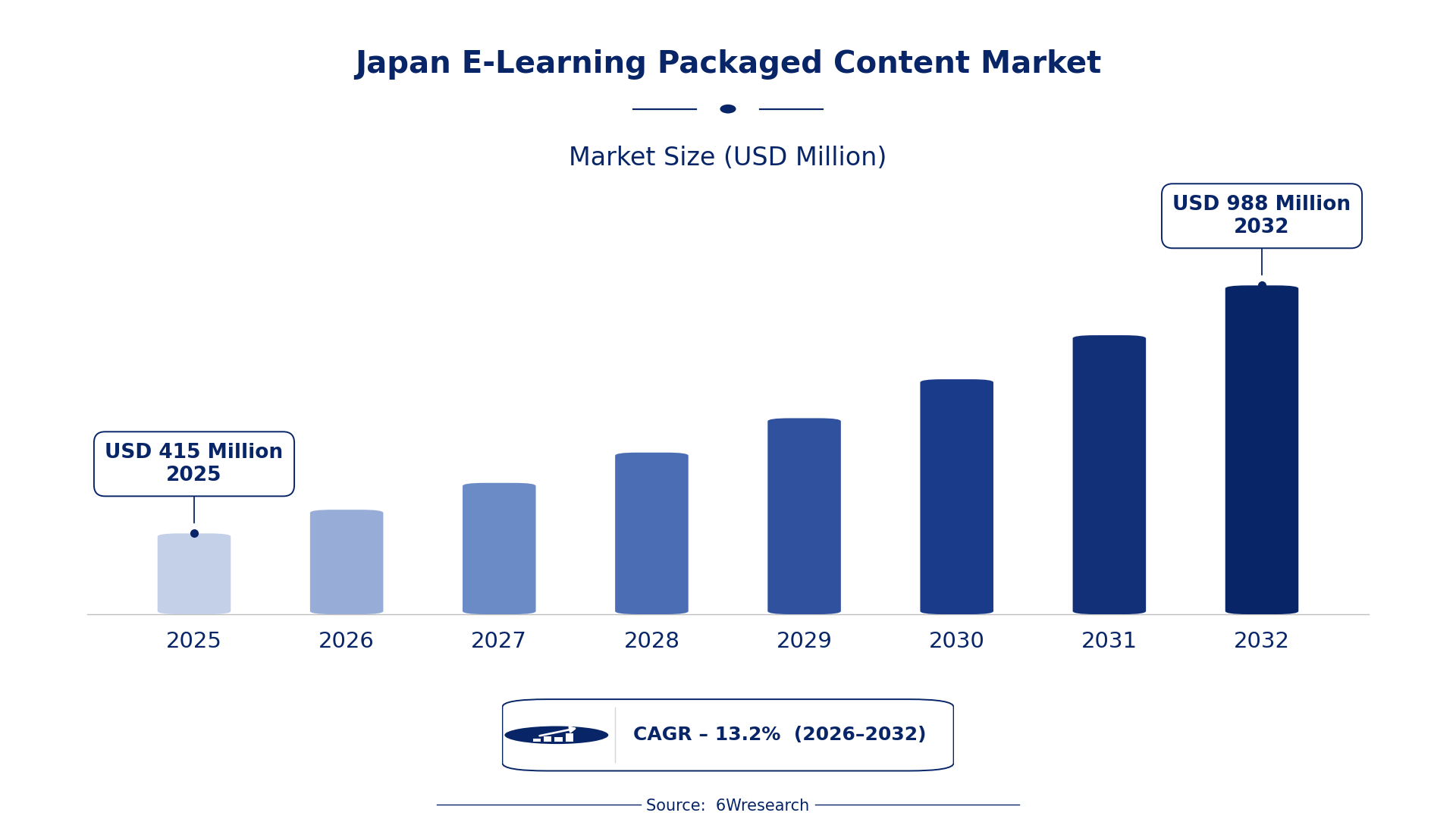
According to 6Wresearch internal database and industry insights, the Japan E-Learning Packaged Content Market was valued at USD 415 Million in 2025 and is projected to reach USD 988 Million by 2032, growing at a CAGR of approximately 13.2% during 2026–2032.
Japan E-Learning Packaged Content Market Highlights
| Report Metric | Details |
| Report Name | Japan E-Learning Packaged Content Market (2026-2032) |
| Market Size 2025 | USD 415 Million |
| Market Size 2032 | USD 988 Million |
| Absolute Growth 2025–2032 | USD 573 Million |
| CAGR 2026–2032 | 13.2% |
| Peak Annual Growth | 14.2% in 2032 |
| Forecast Period | 2026–2032 |
| Historical Data | 2022–2025 |
| Base Year | 2025 |
| Leading Content Type, 2025 | Professional Certification (38% share) |
| Leading Delivery Mode, 2025 | Online Courses (32% share) |
| Leading Distribution Channel, 2025 | Online Platforms (48% share) |
| Leading End User, 2025 | Students (38% share) |
| Leading Application Area, 2025 | Education & Training (34% share) |
| Fastest-Growing Content Type | Soft Skills Programs (18.3% CAGR) |
| Fastest-Growing Delivery Mode | Gamified Learning (18.2% CAGR) |
| Fastest-Growing Distribution Channel | SaaS Channels (17.4% CAGR) |
| Fastest-Growing End User | Corporates (16.9% CAGR) |
| Fastest-Growing Application Area | Skill Development (16.0% CAGR) |
| Growing Sector | Education & Training |
| Key End Users | Students, Corporates, Educational Institutes, Professionals |
Japan E-Learning Packaged Content Market Year-wise Growth Rate and Key Drivers (2022–2032)
This graph illustrates the annual growth rates of the market from 2022 to 2032, highlighting a steady upward trajectory and projected market expansion over the forecast period.
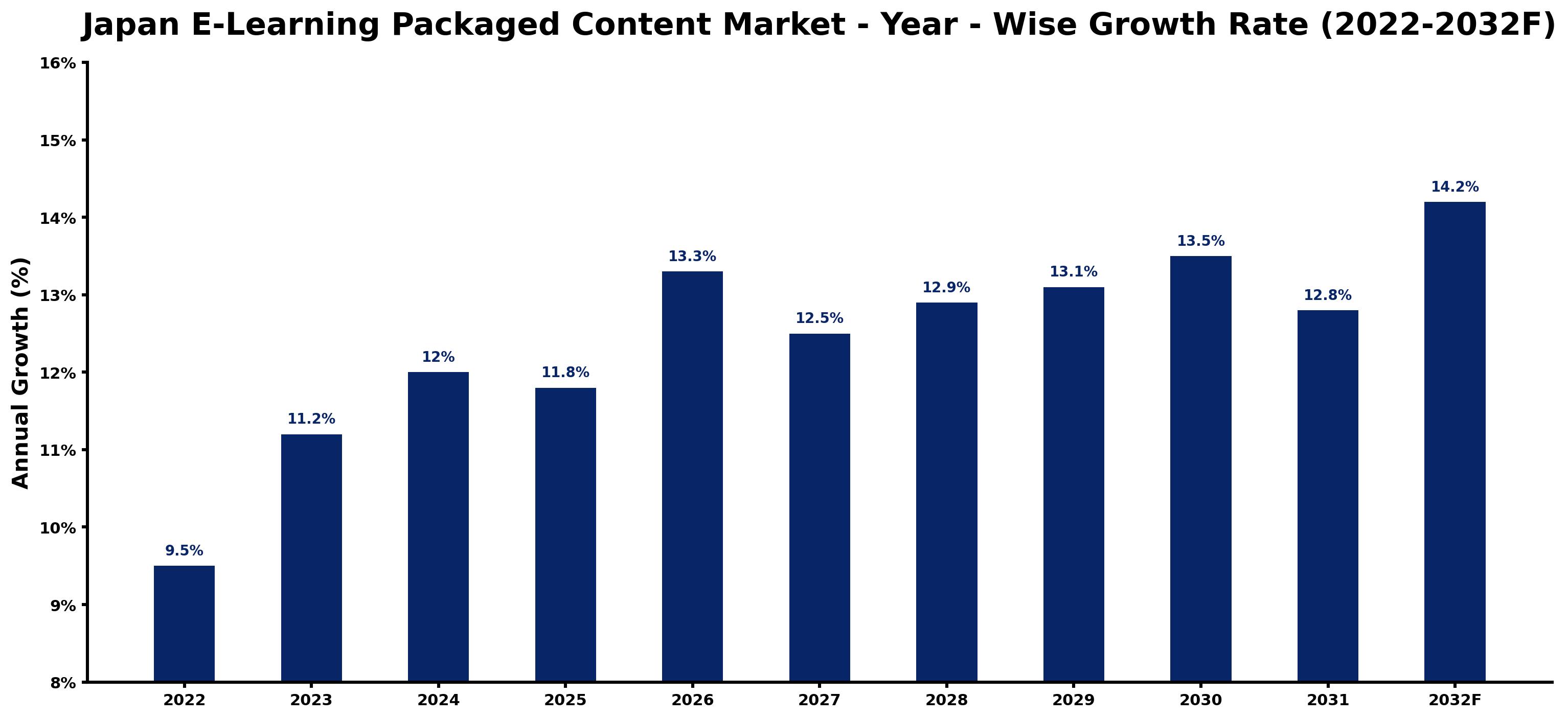
The table below sets out the estimated growth rate for each year and the main factor behind it.
| Year | Estimated Annual Growth (%) | Market Rationale |
| 2022 | 9.5 | The market saw steady growth as educational institutions began adopting digital tools. |
| 2023 | 11.2 | Corporate training programmes expanded, increasing the demand for e-learning content. |
| 2024 | 12.0 | The introduction of new STEM initiatives boosted interest in educational technology. |
| 2025 | 11.8 | Growth slowed as the market matured, yet demand for online courses remained strong. |
| 2026 | 13.3 | The rise of gamified learning is expected to attract new users, increasing engagement in training. |
| 2027 | 12.5 | A slight slowdown is projected as competition intensifies among e-learning providers. |
| 2028 | 12.9 | Increased focus on skill development will lead to renewed interest in e-learning solutions. |
| 2029 | 13.1 | Demand is expected to surge as more corporations adopt e-learning for employee training. |
| 2030 | 13.5 | The market will continue to grow as technology integration in education advances. |
| 2031 | 12.8 | Growth is projected to slow slightly, but the demand for professional certification will remain high. |
| 2032 | 14.2 | The market is expected to peak as digital transformation initiatives reach their goals. |
Note: Market size estimations and growth projections presented in this report are based on 6Wresearch's proprietary forecasting methodology, utilizing the latest available industry data, government publications, and primary research inputs.
Japan E-Learning Packaged Content Market Synopsis
E-Learning Packaged Content consists of digital educational materials designed for various learning purposes, including STEM, soft skills, and language education. The Japan E-Learning Packaged Content Market is growing rapidly, driven by a notable increase in online learning engagement, which reached 30 million users in 2023. The push for digital transformation in education and corporate training, alongside government initiatives, fuels this growth, with the market projected to reach 1 trillion yen by 2025. The increasing adoption of online courses and professional certification programs also contributes to this upward trend.
Market Dynamics Impact Analysis (2026–2032)
| Factor | Type | Impact | Primary Segment Affected |
| Growing adoption of online courses | Driver | High | Online Courses |
| Increased corporate training budgets | Driver | High | Corporates |
| Rising demand for language learning | Opportunity | Medium | Language Learning Packs |
| Expansion of STEM education initiatives | Opportunity | Medium | STEM Modules |
| High competition among providers | Restraint | High | Professional Certification |
| Limited awareness of e-learning benefits | Restraint | Medium | Soft Skills Programs |
| High costs of content development | Challenge | High | Gamified Learning |
| Technological integration challenges | Challenge | Medium | LMS Integration |
Evaluation of Drivers in Japan E-Learning Packaged Content Market (2026–2032)
The main growth drivers and the segments they affect most are set out below.
| Drivers | Primary Segment Affected | Why It Matters (Evidence) |
| Increase in online learning participants | Online Courses | In 2023, 30 million individuals engaged in online learning, prompting educational institutions to invest more in e-learning solutions. |
| Corporate training demand | Corporates | 60% of corporations reported using e-learning for employee training, resulting in increased purchases of packaged content. |
| Government support for digital learning | STEM Modules | Government initiatives promote digital education, driving institutions to adopt e-learning materials. |
| Popularity of language learning apps | Language Learning Packs | Over 10 million users engage with language learning apps, boosting demand for effective e-learning content. |
| Integration of gamified learning | Gamified Learning | Gamified elements in training increase engagement, resulting in higher adoption rates in corporate training. |
Buyers are adding capacity as 30 million individuals engaged in online learning in 2023 prompted educational institutions to invest in e-learning solutions. Corporate training demand is also rising, with 60% of corporations reporting the use of e-learning for employee development. The popularity of language learning apps, with over 10 million users, drives demand for effective educational materials. The integration of gamified learning is reshaping corporate training, increasing engagement and adoption rates.
Evaluation of Restraints in Japan E-Learning Packaged Content Market
These are the pressures that could keep growth below its potential.
| Market Restraint | Primary Segment Affected | Why It Matters (Evidence) |
| Intense competition among e-learning providers | Professional Certification | High competition limits profit margins, making it challenging for providers to sustain growth. |
| Lack of awareness about e-learning benefits | Soft Skills Programs | Limited understanding among potential users slows down the adoption of soft skills training. |
| High content development costs | Gamified Learning | Developing engaging gamified content requires substantial investment, deterring some providers from entering the market. |
| Technological integration issues | LMS Integration | Challenges in integrating learning management systems hinder the effective delivery of e-learning content. |
| Limited funding for educational technology | STEM Modules | Budget constraints in educational institutions restrict investments in advanced e-learning solutions. |
Japan E-Learning Packaged Content Market Challenges
Buyers face intense competition from over 1,000 e-learning providers, leading to price reductions that complicate their search for quality educational materials. Suppliers encounter inflated operational costs due to regulatory compliance with ISO 21001:2018, which can delay content availability and hinder market responsiveness. Limited localised content forces buyers to rely on international sources, extending implementation timelines and increasing costs. Many corporations, around 60%, report dissatisfaction with current e-learning solutions, struggling to engage employees effectively through existing offerings, which can lower training effectiveness and productivity.
Trends in the Japan E-Learning Packaged Content Market
The shifts below are changing how Japan E-Learning Packaged Content Market products are bought and supplied.
- Digital Learning Initiatives Transforming Education: The push for digital learning is reshaping education in Japan, with government funding aimed at integrating ICT in schools. This initiative is projected to reach 1 trillion yen by 2025, driving demand for e-learning content.
- Corporates Prioritising E-Learning for Training: Corporates are increasingly prioritising e-learning for employee training, with 60% adopting online solutions in 2023. This shift is expected to lead to greater investments in packaged content.
- Shift Towards Gamified Learning in Training: Gamified learning is gaining traction in corporate training, increasing engagement and effectiveness. With a projected CAGR of 18.2%, this trend is reshaping how training is delivered.
- Increased Focus on Language Learning: Language learning is becoming a priority, with over 10 million users engaging with language apps. This trend is driving demand for effective e-learning packages.
Investment Opportunities in the Japan E-Learning Packaged Content Market
Where to invest in the Japan E-Learning Packaged Content Market: the main openings are set out below.
- E-Learning Packaged Content for Corporates: Corporates are looking to invest in e-learning solutions, with 60% already using them for training. This presents an opportunity to supply tailored content that meets their specific needs.
- Language Learning Packs for Students: With over 10 million users of language learning apps, there is a gap for high-quality content. Educational institutes can invest in developing comprehensive language packs.
- Gamified Learning Solutions for Corporates: The rise of gamified learning offers a chance to create engaging training modules. Corporates are eager for innovative solutions to improve employee training experiences.
- STEM Modules for Educational Institutions: With government support for STEM education, educational institutions are seeking effective e-learning solutions. This is an opportunity to supply content that aligns with national initiatives.
Government Initiatives in the Japan E-Learning Packaged Content Market
The Ministry of Education's 'GIGA School Program' promotes digital learning and aims to integrate ICT in education by 2025. This initiative supports schools in adopting e-learning solutions, enhancing the quality of education. With a target of reaching 30 million online learners, the program encourages investment in digital infrastructure and resources, ensuring that educational institutions can effectively implement e-learning content. As a result, this policy framework directly impacts the availability and quality of e-learning packaged content for buyers.
The 'Future School' initiative, with a funding target of 100 billion yen by 2025, aims to enhance digital literacy in schools. The Ministry of Education oversees this program, which supports the development of e-learning resources and infrastructure. By facilitating access to digital tools and training for educators, the initiative enables schools to adopt innovative e-learning solutions, ultimately benefiting students and educational institutions in Japan.
Future Insight of the Japan E-Learning Packaged Content Market
A policy-driven shift towards enhanced ICT integration in education will reshape the e-learning market by 2032, prompting suppliers to develop more engaging and interactive content. The e-learning market will reach 1 trillion yen by 2025, driving investments in cutting-edge technologies and diverse content delivery methods. As participation in online courses continues to rise, educational institutions will expand their offerings, including a wider array of professional certification programs to address evolving workforce needs. The emphasis on mobile learning will transform access to educational materials, making learning more flexible and accessible.
Market Segmentation Analysis
Japan E-Learning Packaged Content Market report covers a detailed analysis of the following market segments:
By Content Type – Professional Certification Leads, Soft Skills Programs Expected to Grow Fastest
According to Vasu Joshi, Associate Consultant at 6Wresearch, Professional Certification took 38% of content type revenue in 2025, more than any other category. Professional Certification holds the largest share as it is crucial for individuals aiming for career advancement and skill validation. The increasing number of online offerings from educational institutions illustrates its significance in the competitive job market. Soft Skills Programs are projected to grow fastest, at a CAGR of 18.3% during 2026–2032. Soft Skills Programs are witnessing rapid growth due to the rising focus on interpersonal skills in various industries, with enrolments increasing notably in recent years. This trend highlights the growing recognition of soft skills as vital for success in the workplace. Suppliers should focus on developing soft skills content to meet the rising demand from both students and corporates.
By Delivery Mode – Online Courses Lead, Gamified Learning Expected to Grow Fastest
The largest delivery mode category in 2025 was Online Courses, at 32% of revenue. Online Courses dominate the market as they serve as the primary format for delivering e-learning content, catering to a wide audience across various sectors. Their accessibility and flexibility make them the preferred choice for learners seeking diverse educational experiences. Over 2026–2032, Gamified Learning is expected to post the fastest growth, at a CAGR of 18.2%. Gamified Learning is gaining traction due to its ability to engage users and improve retention rates, particularly in corporate training environments. This method aligns well with the increasing preference for interactive and enjoyable learning experiences. Suppliers must invest in gamified solutions to attract and retain users looking for engaging educational experiences.
By Distribution Channel – Online Platforms Lead, SaaS Channels Expected to Grow Fastest
In 2025, Online Platforms led the distribution channel split with a 48% share. Online Platforms are the leading distribution channel, providing essential access to e-learning content for millions of users across Japan. Their widespread adoption by educational providers ensures a steady flow of learners seeking diverse materials. The quickest growth will come from SaaS Channels, forecast to expand at a CAGR of 17.4% between 2026 and 2032. SaaS Channels are rapidly growing as they offer flexible and scalable solutions for delivering e-learning, appealing to both institutions and corporate clients. This shift reflects a broader trend towards cloud-based solutions in education. Suppliers should consider expanding their presence on SaaS platforms to capture the growing market share in e-learning distribution.
By End User – Students Lead, Corporates Expected to Grow Fastest
Students held 38% of the Japan E-Learning Packaged Content Market by end user in 2025. Students represent the largest user group for e-learning content, showcasing the widespread adoption of digital learning in educational environments. Their increasing participation in online courses reflects a shift towards more flexible and accessible learning options. Corporates are set to record the highest CAGR in this split, 16.9% over 2026–2032. Corporates are quickly becoming a prominent user segment for e-learning, as many organisations prioritise digital solutions for employee training. This shift indicates a growing preference for scalable and efficient training methods within the corporate sector. Suppliers should tailor their offerings to meet the specific training requirements of corporate clients.
By Application Area – Education & Training Leads, Skill Development Expected to Grow Fastest
Education & Training accounted for 34% of the market by application area in 2025. Education & Training is the leading application area for e-learning solutions, covering a diverse range of subjects and skills. The ongoing digital transformation in educational institutions reinforces this segment's prominence in the market. Skill Development is projected to grow fastest, at a CAGR of 16.0% during 2026–2032. Skill Development is the fastest growing application area, driven by the increasing need for continuous learning and adaptation in the workforce. The focus on upskilling and reskilling highlights the changing requirements of the job market. Suppliers should concentrate on creating content that facilitates skill development in order to align with current market demands.
Key Attractiveness of the Report
- 10 Years of Market Numbers
- Historical Data Starting from 2022 to 2025
- Base Year 2025
- Forecast Data until 2032
- Key Performance Indicators Impacting the Market
- Major Upcoming Developments and Projects
Key Highlights of the Report:
- Japan E-Learning Packaged Content Market Outlook
- Market Size of Japan E-Learning Packaged Content Market, 2025
- Forecast of Japan E-Learning Packaged Content Market, 2032
- Historical Data and Forecast of Japan E-Learning Packaged Content Market Revenues & Volume for the Period 2022-2032F
- Japan E-Learning Packaged Content Market Trend Evolution
- Japan E-Learning Packaged Content Market Drivers and Challenges
- Japan E-Learning Packaged Content Market Price Trends
- Japan E-Learning Packaged Content Market Porter's Five Forces
- Japan E-Learning Packaged Content Market Industry Life Cycle
- Historical Data and Forecast of Japan E-Learning Packaged Content Market Revenues & Volume By Content Type for the Period 2022-2032F
- Historical Data and Forecast of Japan E-Learning Packaged Content Market Revenues & Volume By STEM Modules for the Period 2022-2032F
- Historical Data and Forecast of Japan E-Learning Packaged Content Market Revenues & Volume By Soft Skills Programs for the Period 2022-2032F
- Historical Data and Forecast of Japan E-Learning Packaged Content Market Revenues & Volume By Professional Certification for the Period 2022-2032F
- Historical Data and Forecast of Japan E-Learning Packaged Content Market Revenues & Volume By Language Learning Packs for the Period 2022-2032F
- Historical Data and Forecast of Japan E-Learning Packaged Content Market Revenues & Volume By Delivery Mode for the Period 2022-2032F
- Historical Data and Forecast of Japan E-Learning Packaged Content Market Revenues & Volume By Video & Interactive for the Period 2022-2032F
- Historical Data and Forecast of Japan E-Learning Packaged Content Market Revenues & Volume By Gamified Learning for the Period 2022-2032F
- Historical Data and Forecast of Japan E-Learning Packaged Content Market Revenues & Volume By Online Courses for the Period 2022-2032F
- Historical Data and Forecast of Japan E-Learning Packaged Content Market Revenues & Volume By Mobile Apps for the Period 2022-2032F
- Historical Data and Forecast of Japan E-Learning Packaged Content Market Revenues & Volume By Distribution Channel for the Period 2022-2032F
- Historical Data and Forecast of Japan E-Learning Packaged Content Market Revenues & Volume By Online Platforms for the Period 2022-2032F
- Historical Data and Forecast of Japan E-Learning Packaged Content Market Revenues & Volume By LMS Integration for the Period 2022-2032F
- Historical Data and Forecast of Japan E-Learning Packaged Content Market Revenues & Volume By Direct Sales for the Period 2022-2032F
- Historical Data and Forecast of Japan E-Learning Packaged Content Market Revenues & Volume By SaaS Channels for the Period 2022-2032F
- Historical Data and Forecast of Japan E-Learning Packaged Content Market Revenues & Volume By End User for the Period 2022-2032F
- Historical Data and Forecast of Japan E-Learning Packaged Content Market Revenues & Volume By Students for the Period 2022-2032F
- Historical Data and Forecast of Japan E-Learning Packaged Content Market Revenues & Volume By Corporates for the Period 2022-2032F
- Historical Data and Forecast of Japan E-Learning Packaged Content Market Revenues & Volume By Professionals for the Period 2022-2032F
- Historical Data and Forecast of Japan E-Learning Packaged Content Market Revenues & Volume By Educational Institutes for the Period 2022-2032F
- Historical Data and Forecast of Japan E-Learning Packaged Content Market Revenues & Volume By Application Area for the Period 2022-2032F
- Historical Data and Forecast of Japan E-Learning Packaged Content Market Revenues & Volume By Education & Training for the Period 2022-2032F
- Historical Data and Forecast of Japan E-Learning Packaged Content Market Revenues & Volume By Employee Training for the Period 2022-2032F
- Historical Data and Forecast of Japan E-Learning Packaged Content Market Revenues & Volume By Skill Development for the Period 2022-2032F
- Historical Data and Forecast of Japan E-Learning Packaged Content Market Revenues & Volume By Language Education for the Period 2022-2032F
- Japan E-Learning Packaged Content Market Import Export Trade Statistics
- Market Opportunity Assessment By Content Type
- Market Opportunity Assessment By Delivery Mode
- Market Opportunity Assessment By Distribution Channel
- Market Opportunity Assessment By End User
- Market Opportunity Assessment By Application Area
- Japan E-Learning Packaged Content Market Top Companies Market Share
- Japan E-Learning Packaged Content Market Competitive Benchmarking By Technical and Operational Parameters
- Japan E-Learning Packaged Content Market Company Profiles
- Japan E-Learning Packaged Content Market Key Strategic Recommendations
Market Covered
This report examines the market across the segments below.
By Content Type
- STEM Modules
- Soft Skills Programs
- Professional Certification
- Language Learning Packs
By Delivery Mode
- Video & Interactive
- Gamified Learning
- Online Courses
- Mobile Apps
By Distribution Channel
- Online Platforms
- LMS Integration
- Direct Sales
- SaaS Channels
By End User
- Students
- Corporates
- Professionals
- Educational Institutes
By Application Area
- Education & Training
- Employee Training
- Skill Development
- Language Education































