Japan Edutainment Market Size & Growth Rate
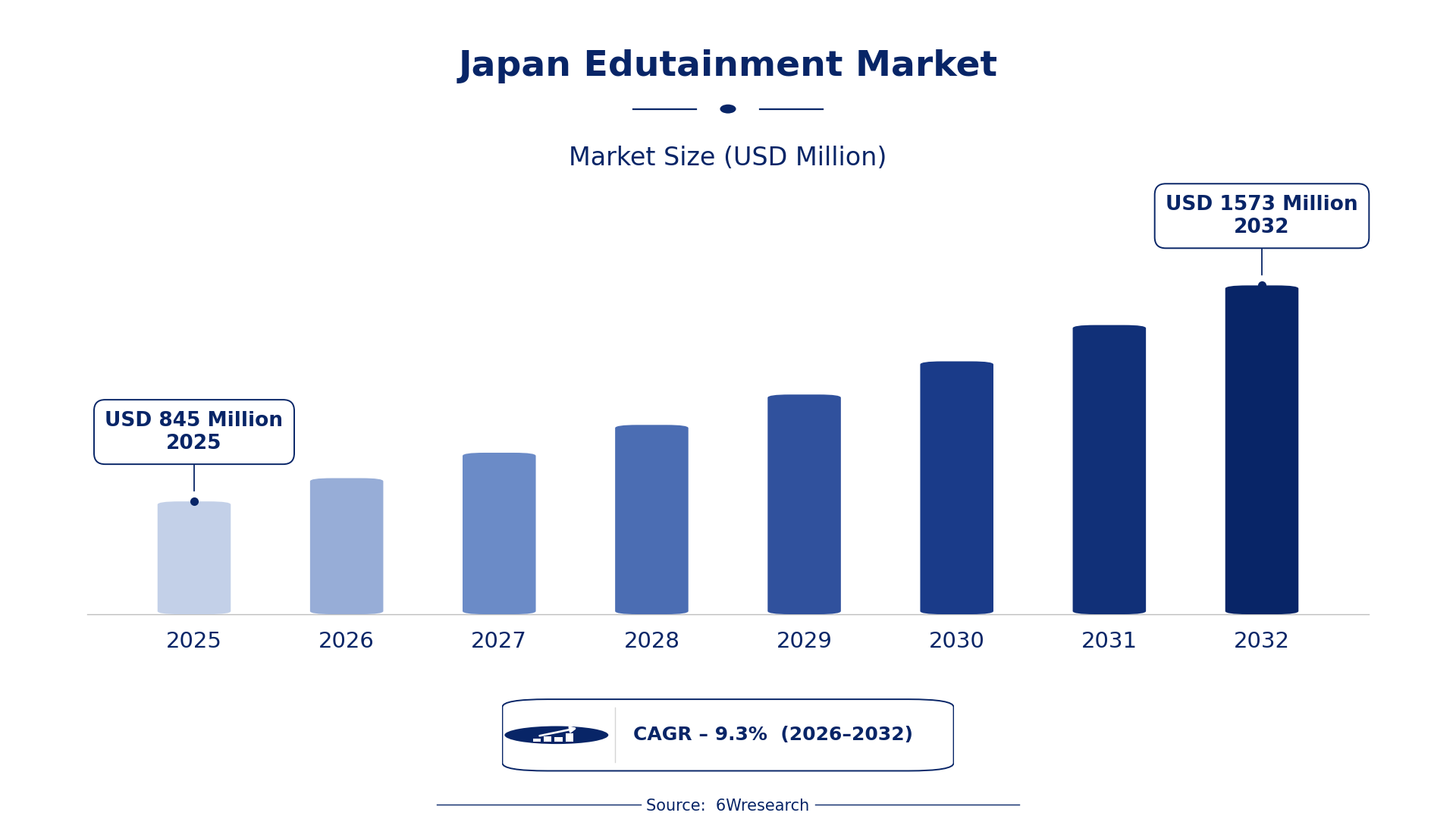
According to 6Wresearch internal database and industry insights, the Japan Edutainment Market was valued at USD 845 Million in 2025 and is projected to reach USD 1,573 Million by 2032, growing at a CAGR of approximately 9.3% during 2026–2032.
Japan Edutainment Market Highlights
| Report Metric | Details |
| Report Name | Japan Edutainment Market (2026-2032) |
| Market Size 2025 | USD 845 Million |
| Market Size 2032 | USD 1,573 Million |
| Absolute Growth 2025–2032 | USD 728 Million |
| CAGR 2026–2032 | 9.3% |
| Peak Annual Growth | 10.2% in 2026 |
| Forecast Period | 2026–2032 |
| Historical Data | 2022–2025 |
| Base Year | 2025 |
| Leading Content Type, 2025 | Educational Games (38% share) |
| Leading Platform, 2025 | Mobile Apps (52% share) |
| Leading Application Area, 2025 | Learning (44% share) |
| Leading Distribution Channel, 2025 | App Stores (43% share) |
| Leading End User, 2025 | Students (40% share) |
| Fastest-Growing Content Type | AR/VR Learning (13.0% CAGR) |
| Fastest-Growing Application Area | Skill Development (10.9% CAGR) |
| Fastest-Growing Distribution Channel | Content Providers (11.5% CAGR) |
| Fastest-Growing End User | Learners (11.7% CAGR) |
| Growing Sector | educational technology |
| Key End Users | students, families, educational institutions |
Japan Edutainment Market Year-wise Growth Rate and Key Drivers (2022–2032)
This graph illustrates the annual growth rates of the market from 2022 to 2032, highlighting a steady upward trajectory and projected market expansion over the forecast period.
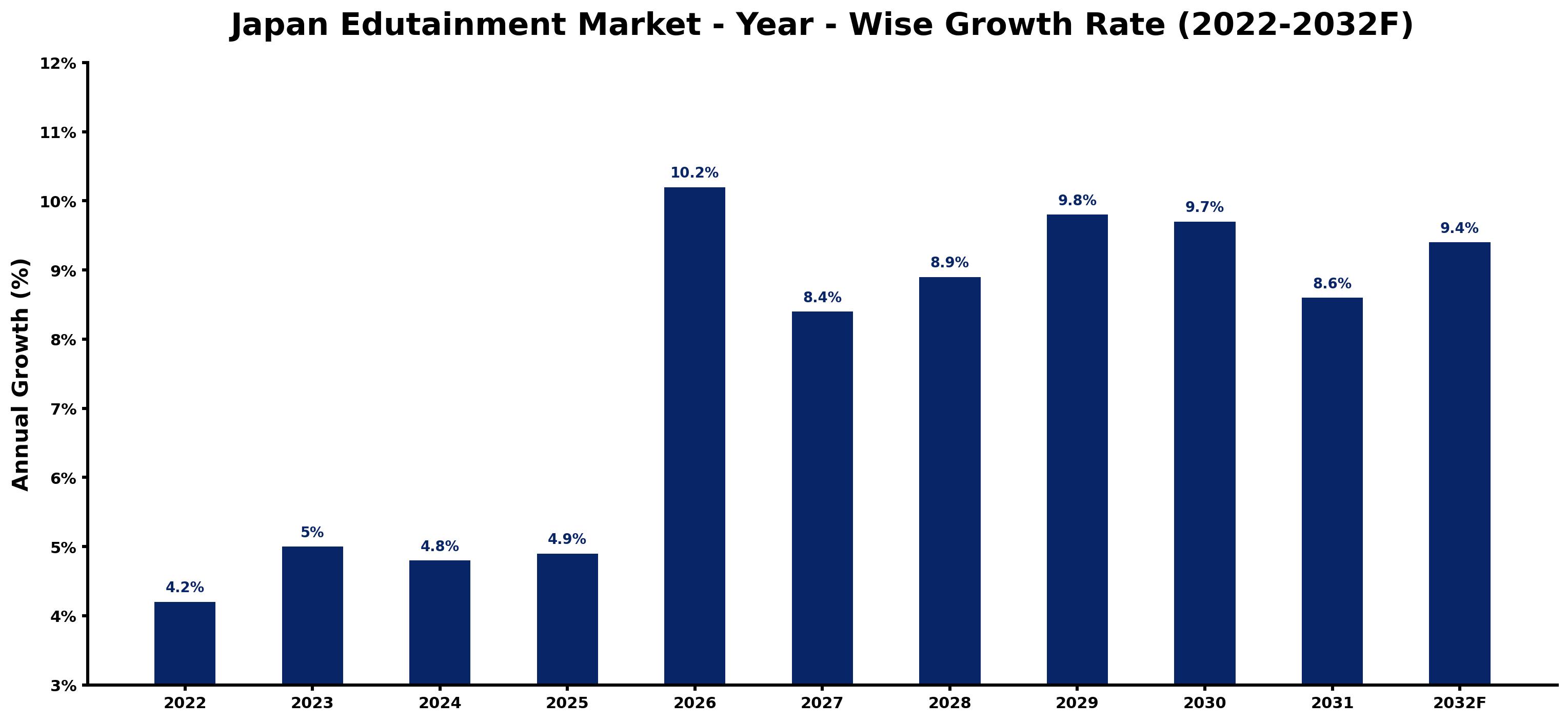
Below, each year's estimated growth is shown next to the factor that most influenced it.
| Year | Estimated Annual Growth (%) | Market Rationale |
| 2022 | 4.2 | The market showed steady growth with increasing interest in interactive learning tools. |
| 2023 | 5.0 | Growth accelerated as educational institutions adopted more digital platforms for teaching. |
| 2024 | 4.8 | Growth slowed slightly due to market saturation in certain edutainment segments. |
| 2025 | 4.9 | Demand rose again as families invested in home learning solutions and apps. |
| 2026 | 10.2 | The market peaked with widespread adoption of AR/VR tools in schools. |
| 2027 | 8.4 | Growth slowed as the market began to stabilise after rapid expansion. |
| 2028 | 8.9 | Demand increased again, driven by new content delivery methods. |
| 2029 | 9.8 | Growth continued as immersive education gained traction in urban areas. |
| 2030 | 9.7 | The market saw a slight slowdown as competition intensified among providers. |
| 2031 | 8.6 | Growth slowed further as the market matured and user preferences evolved. |
| 2032 | 9.4 | The market rebounded with renewed interest in skill development initiatives. |
Note: Market size estimations and growth projections presented in this report are based on 6Wresearch's proprietary forecasting methodology, utilizing the latest available industry data, government publications, and primary research inputs.
Japan Edutainment Market Synopsis
Edutainment combines education and entertainment through interactive content, utilising advanced technologies like AR and gamification. The Japan Edutainment Market is experiencing growth driven by educational institutions, families seeking engaging learning experiences, and the increasing integration of immersive technologies in curricula across urban areas, particularly in Tokyo and Osaka. The market is projected to grow from USD 845 Million in 2025 to USD 1,573 Million by 2032, reflecting a growing interest in immersive educational tools.
Market Dynamics Impact Analysis (2026–2032)
| Factor | Type | Impact | Primary Segment Affected |
| Growing adoption of AR/VR learning tools in schools | Driver | High | AR/VR Learning |
| Increased downloads of mobile learning apps | Driver | High | Mobile Apps |
| Rising demand for immersive educational experiences | Opportunity | High | Experiential Learning |
| Growing interest in skill development programs | Opportunity | Medium | Skill Development |
| Limited access to technology in rural areas | Restraint | High | Digital Platforms |
| Market saturation in traditional educational games | Restraint | Medium | Educational Games |
| High development costs for AR/VR content | Challenge | High | AR/VR Learning |
| Intense competition among content providers | Challenge | Medium | Content Providers |
Evaluation of Drivers in Japan Edutainment Market (2026–2032)
The factors lifting demand, and the evidence behind each, are summarised below.
| Drivers | Primary Segment Affected | Why It Matters (Evidence) |
| Integration of AR/VR tools into school curricula | AR/VR Learning | In Tokyo, over 70% of schools reported using AR/VR tools, improving student engagement. |
| Surge in mobile app downloads for learning | Mobile Apps | In 2023, mobile learning apps saw a 30% increase in downloads, indicating rising consumer interest. |
| Expansion of immersive education programs | Experiential Learning | Experiential learning programs are supported by educational agencies, promoting hands-on skills development. |
| Growing investment in skill development initiatives | Skill Development | The national education strategy for 2023-2025 includes funding for skill development programs. |
| Increased collaboration between content providers and institutions | Content Providers | Content providers are partnering with schools to create tailored educational materials. |
Orders keep climbing as educational institutions integrate AR/VR learning tools into their curricula, with over 70% adoption reported. The surge in mobile app downloads for learning, which increased by 30% in 2023, reflects rising consumer interest in engaging educational content. Collaborations between content providers and institutions are increasingly common, improving the relevance and effectiveness of educational materials.
Evaluation of Restraints in Japan Edutainment Market
Several factors work against faster growth; the main ones are summarised below.
| Market Restraint | Primary Segment Affected | Why It Matters (Evidence) |
| Limited access to technology in rural areas | Digital Platforms | Approximately 30% of rural schools lack adequate digital infrastructure, hindering edutainment adoption. |
| Market saturation in traditional educational games | Educational Games | Many educational games are already integrated into curricula, limiting new market entrants. |
| High development costs for AR/VR content | AR/VR Learning | Creating AR/VR content requires investment, with costs averaging around USD 100,000 per project. |
| Intense competition among content providers | Content Providers | Over 1,000 edutainment apps are available, making it challenging for new entrants to gain market share. |
| Regulatory hurdles for new educational technologies | Mobile Apps | Compliance with the JIS X 8341-3 standard can delay product launches. |
Japan Edutainment Market Challenges
A shortage of skilled developers hampers the creation of interactive edutainment content, leading to delays in product launches for content providers and limiting options for schools. Heightened competition among developers results in reduced prices, which may erode profit margins for suppliers and restrict their ability to invest in quality improvements. Stringent regulations from the Ministry of Education regarding digital content can prolong the approval process for new educational tools, affecting schools' access to necessary resources. Rapid technological advancements require frequent updates to platforms, increasing costs for producers who must continually adapt to new standards.
Trends in the Japan Edutainment Market
The trends below show where the Japan Edutainment Market is heading.
- Shift towards AR/VR Learning Tools: In 2023, the Tokyo Metropolitan Government initiated a programme to integrate AR/VR learning in schools, with over 70% of institutions adopting these tools, indicating a shift in educational methods.
- Increase in Mobile Learning App Usage: In 2023, mobile learning apps accounted for 52% of the edutainment market, reflecting a growing preference for on-the-go educational solutions among families and students.
- Expansion of Experiential Learning Programs: Experiential learning has gained popularity, with various educational agencies supporting hands-on programs, leading to a 15% increase in participation among students in 2023.
- Rising Demand for Skill Development Content: The national education strategy for 2023-2025 emphasises skill development, resulting in a 20% increase in educational content focused on practical skills.
Investment Opportunities in the Japan Edutainment Market
Where to invest in the Japan Edutainment Market: the main openings are set out below.
- Families investing in home learning solutions: With over 70% of families seeking engaging educational content, there is a chance to provide interactive learning tools and apps.
- Growing demand for tailored educational content: The market gap for personalised learning experiences is apparent, with a notable rise in demand for customised educational materials.
- Investment in AR/VR educational tools: With the Tokyo Metropolitan Government's initiative, there is a growing need for suppliers of AR/VR learning tools to meet the increasing demand in schools.
- Collaboration with educational institutions: Content providers can enter the market by partnering with schools to develop tailored educational content, addressing the rising interest in immersive learning.
Government Initiatives in the Japan Edutainment Market
The Semiconductor and Digital Industry Strategy, established by METI in June 2021, aims to secure domestic semiconductor manufacturing, which is vital for developing edutainment technologies. This policy supports producers by ensuring access to essential components for creating digital learning tools, improving their market competitiveness. The AI Promotion Act, set for 2025, will further benefit edutainment content creation by establishing a national framework for research and development.
The Digital Agency oversees the government's digital transformation efforts, approving funding for various digital education initiatives. In 2023, the agency allocated USD 50 million to improve technology access in schools, directly impacting edutainment adoption. Furthermore, the agency implements common system standards, ensuring that educational technologies meet quality benchmarks.
Future Insight of the Japan Edutainment Market
Educational institutions will prioritise immersive learning tools, resulting in a shift towards more engaging educational experiences. The government will maintain its commitment to funding digital education initiatives, aiming to improve technology access for all users. By 2032, over 50% of educational institutions will likely employ AR/VR tools, transforming traditional teaching methods. The Tokyo Metropolitan Government's AR/VR programme is expected to inspire similar projects nationwide, promoting widespread integration of these technologies in education.
Market Segmentation Analysis
Japan Edutainment Market report covers a detailed analysis of the following market segments:
By Content Type – Educational Games Lead, AR/VR Learning Expected to Grow Fastest
According to Prakhar Dixit, Senior Research Analyst at 6Wresearch, in 2025, Educational Games led the content type split with a 38% share. Educational games lead the market due to their widespread integration in both educational institutions and homes, effectively engaging learners. Many prefectures have embedded these games into their curricula, which significantly enhances student involvement and interest in educational activities. AR/VR Learning is projected to grow fastest, at a CAGR of 13.0% during 2026–2032. AR/VR learning is rapidly gaining popularity as it provides immersive experiences that engage users more effectively. The Tokyo Metropolitan Government's initiative to boost AR/VR learning in schools exemplifies the increasing demand for these advanced technologies. Suppliers should focus on creating educational games and AR/VR content to align with the growing market demand.
By Platform – Mobile Apps Lead and Record the Fastest Growth
The largest platform category in 2025 was Mobile Apps, at 52% of revenue. Mobile apps dominate the market as they are commonly used for on-the-go learning, appealing to a broad audience. This trend is reflected in the 30% increase in downloads over the past year, indicating strong consumer interest. Its lead should widen, with a projected CAGR of 10.5% during 2026–2032, the highest in this split. The rapid growth of mobile apps is sustained by their convenience and accessibility, making them the preferred choice for learners. As more educational institutions adopt these platforms, their popularity will continue to rise. Suppliers must prioritise mobile app development to meet the increasing demand for accessible learning solutions.
By Application Area – Learning Leads, Skill Development Expected to Grow Fastest
Learning accounted for 44% of the market by application area in 2025. Learning is the primary function of edutainment products, making it the leading application area in the market. The adoption of digital platforms by over 70% of schools highlights the commitment to enhancing learning experiences nationwide. Over 2026–2032, Skill Development is expected to post the fastest growth, at a CAGR of 10.9%. Skill development is the fastest-growing application area, concentrating on improving specific skills through interactive content. The inclusion of skill development initiatives in the national education strategy for 2023-2025 further accelerates this segment's growth. Buyers should seek products that facilitate skill development to maximise educational effectiveness.
By Distribution Channel – App Stores Lead, Content Providers Expected to Grow Fastest
App Stores took 43% of distribution channel revenue in 2025, more than any other category. App stores serve as the main distribution channel for mobile edutainment apps, offering users easy access to a diverse range of content. The presence of over 1,000 edutainment apps in 2023 demonstrates the success of this distribution approach. The quickest growth will come from Content Providers, forecast to expand at a CAGR of 11.5% between 2026 and 2032. Content providers are emerging as the fastest distribution channel, supplying customised educational content to various platforms. Their collaborations with educational institutions ensure a steady stream of relevant and engaging resources. Suppliers should consider partnerships with content providers to improve distribution strategies and broaden their market presence.
By End User – Students Lead, Learners Expected to Grow Fastest
Students held 40% of the Japan Edutainment Market by end user in 2025. Students represent the primary end-users of edutainment products, driving the demand for engaging educational content. Their substantial presence within the youth demographic highlights the necessity of targeting this group effectively. Learners are projected to grow fastest, at a CAGR of 11.7% during 2026–2032. Learners, which include individuals of all ages seeking educational content, are the fastest-growing segment in the market. The rising interest in immersive learning technologies is a key factor contributing to this growth. Suppliers must create diverse content that appeals to both students and lifelong learners to capture a wider audience.
Key Attractiveness of the Report
- 10 Years of Market Numbers
- Historical Data Starting from 2022 to 2025
- Base Year 2025
- Forecast Data until 2032
- Key Performance Indicators Impacting the Market
- Major Upcoming Developments and Projects
Key Highlights of the Report:
- Japan Edutainment Market Outlook
- Market Size of Japan Edutainment Market, 2025
- Forecast of Japan Edutainment Market, 2032
- Historical Data and Forecast of Japan Edutainment Market Revenues & Volume for the Period 2022-2032F
- Japan Edutainment Market Trend Evolution
- Japan Edutainment Market Drivers and Challenges
- Japan Edutainment Market Price Trends
- Japan Edutainment Market Porter's Five Forces
- Japan Edutainment Market Industry Life Cycle
- Historical Data and Forecast of Japan Edutainment Market Revenues & Volume By Content Type for the Period 2022-2032F
- Historical Data and Forecast of Japan Edutainment Market Revenues & Volume By Educational Games for the Period 2022-2032F
- Historical Data and Forecast of Japan Edutainment Market Revenues & Volume By Interactive Videos for the Period 2022-2032F
- Historical Data and Forecast of Japan Edutainment Market Revenues & Volume By Theme-based Content for the Period 2022-2032F
- Historical Data and Forecast of Japan Edutainment Market Revenues & Volume By AR/VR Learning for the Period 2022-2032F
- Historical Data and Forecast of Japan Edutainment Market Revenues & Volume By Platform for the Period 2022-2032F
- Historical Data and Forecast of Japan Edutainment Market Revenues & Volume By Mobile Apps for the Period 2022-2032F
- Historical Data and Forecast of Japan Edutainment Market Revenues & Volume By Streaming Platforms for the Period 2022-2032F
- Historical Data and Forecast of Japan Edutainment Market Revenues & Volume By Physical Venues for the Period 2022-2032F
- Historical Data and Forecast of Japan Edutainment Market Revenues & Volume By Digital Platforms for the Period 2022-2032F
- Historical Data and Forecast of Japan Edutainment Market Revenues & Volume By Application Area for the Period 2022-2032F
- Historical Data and Forecast of Japan Edutainment Market Revenues & Volume By Learning for the Period 2022-2032F
- Historical Data and Forecast of Japan Edutainment Market Revenues & Volume By Skill Development for the Period 2022-2032F
- Historical Data and Forecast of Japan Edutainment Market Revenues & Volume By Experiential Learning for the Period 2022-2032F
- Historical Data and Forecast of Japan Edutainment Market Revenues & Volume By Immersive Education for the Period 2022-2032F
- Historical Data and Forecast of Japan Edutainment Market Revenues & Volume By Distribution Channel for the Period 2022-2032F
- Historical Data and Forecast of Japan Edutainment Market Revenues & Volume By App Stores for the Period 2022-2032F
- Historical Data and Forecast of Japan Edutainment Market Revenues & Volume By Content Providers for the Period 2022-2032F
- Historical Data and Forecast of Japan Edutainment Market Revenues & Volume By Direct Sales for the Period 2022-2032F
- Historical Data and Forecast of Japan Edutainment Market Revenues & Volume By Technology Vendors for the Period 2022-2032F
- Historical Data and Forecast of Japan Edutainment Market Revenues & Volume By End User for the Period 2022-2032F
- Historical Data and Forecast of Japan Edutainment Market Revenues & Volume By Students for the Period 2022-2032F
- Historical Data and Forecast of Japan Edutainment Market Revenues & Volume By Learners for the Period 2022-2032F
- Historical Data and Forecast of Japan Edutainment Market Revenues & Volume By Families for the Period 2022-2032F
- Historical Data and Forecast of Japan Edutainment Market Revenues & Volume By Institutions for the Period 2022-2032F
- Japan Edutainment Market Import Export Trade Statistics
- Market Opportunity Assessment By Content Type
- Market Opportunity Assessment By Platform
- Market Opportunity Assessment By Application Area
- Market Opportunity Assessment By Distribution Channel
- Market Opportunity Assessment By End User
- Japan Edutainment Market Top Companies Market Share
- Japan Edutainment Market Competitive Benchmarking By Technical and Operational Parameters
- Japan Edutainment Market Company Profiles
- Japan Edutainment Market Key Strategic Recommendations
Market Covered
The following segment groups are covered in the report.
By Content Type
- Educational Games
- Interactive Videos
- Theme-based Content
- AR/VR Learning
By Platform
- Mobile Apps
- Streaming Platforms
- Physical Venues
- Digital Platforms
By Application Area
- Learning
- Skill Development
- Experiential Learning
- Immersive Education
By Distribution Channel
- App Stores
- Content Providers
- Direct Sales
- Technology Vendors
By End User
- Students
- Learners
- Families
- Institutions































