Japan Electronics Manufacturing Analytics Market Size & Growth Rate
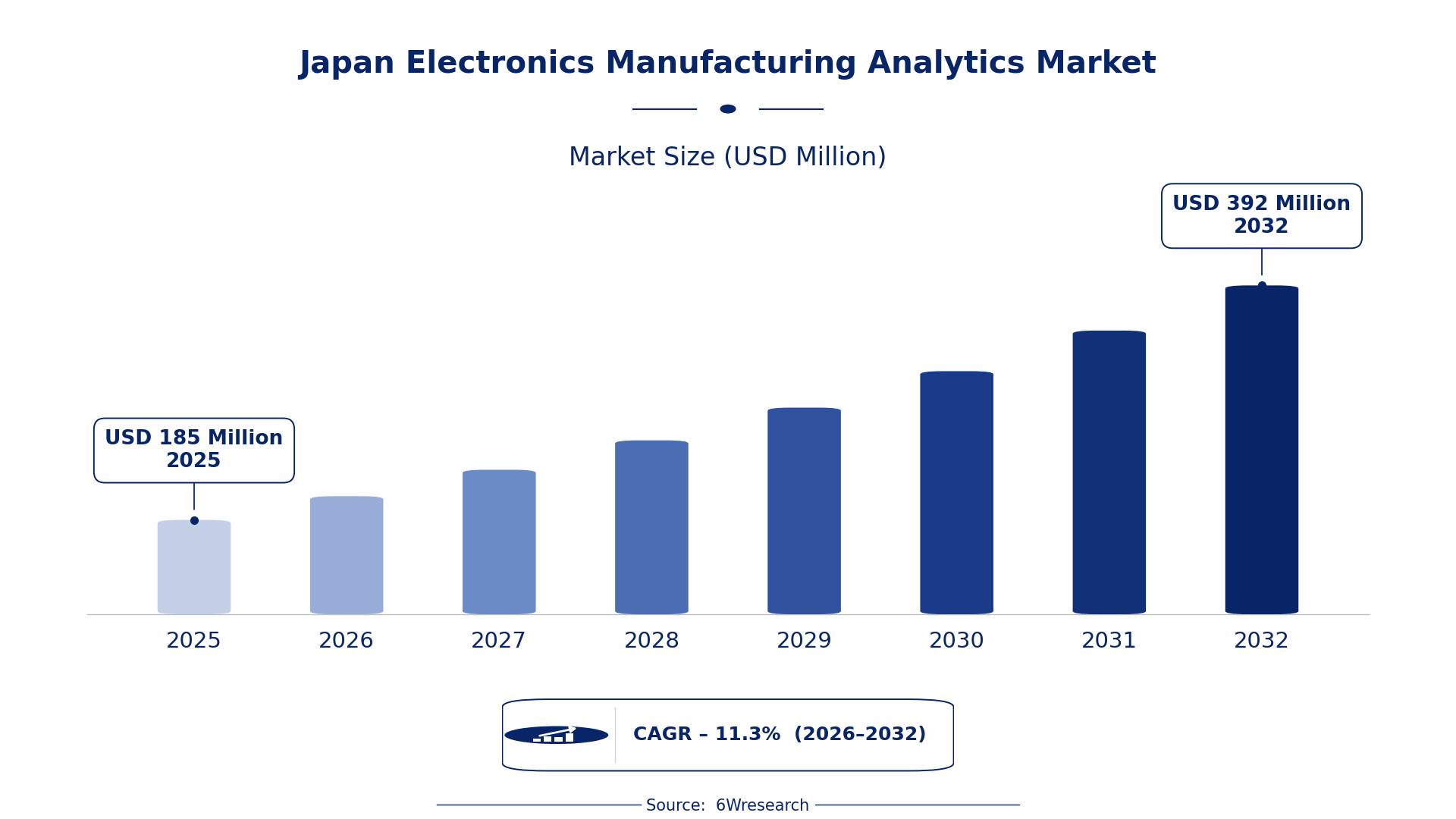
According to 6Wresearch internal database and industry insights, the Japan Electronics Manufacturing Analytics Market was valued at USD 185 Million in 2025 and is projected to reach USD 392 Million by 2032, growing at a CAGR of approximately 11.3% during 2026–2032.
Japan Electronics Manufacturing Analytics Market Highlights
| Report Metric | Details |
| Report Name | Japan Electronics Manufacturing Analytics Market (2026-2032) |
| Market Size 2025 | USD 185 Million |
| Market Size 2032 | USD 392 Million |
| Absolute Growth 2025–2032 | USD 207 Million |
| CAGR 2026–2032 | 11.3% |
| Peak Annual Growth | 12.9% in 2028 |
| Forecast Period | 2026–2032 |
| Historical Data | 2022–2025 |
| Base Year | 2025 |
| Leading Analytics Type, 2025 | Predictive (49% share) |
| Leading Deployment Model, 2025 | Cloud (48% share) |
| Leading Use Case, 2025 | Downtime Alerts (43% share) |
| Leading End User, 2025 | Foundries (46% share) |
| Fastest-Growing Analytics Type | Prescriptive (15.3% CAGR) |
| Fastest-Growing Deployment Model | On-Premise (15.9% CAGR) |
| Fastest-Growing Use Case | Yield Improvement (14.6% CAGR) |
| Fastest-Growing End User | SMT Lines (14.0% CAGR) |
| Growing Sector | Electronics manufacturing |
| Key End Users | Foundries, PCB Manufacturers, SMT Lines, EMS Providers |
Japan Electronics Manufacturing Analytics Market Year-wise Growth Rate and Key Drivers (2022–2032)
This graph illustrates the annual growth rates of the market from 2022 to 2032, highlighting a steady upward trajectory and projected market expansion over the forecast period.
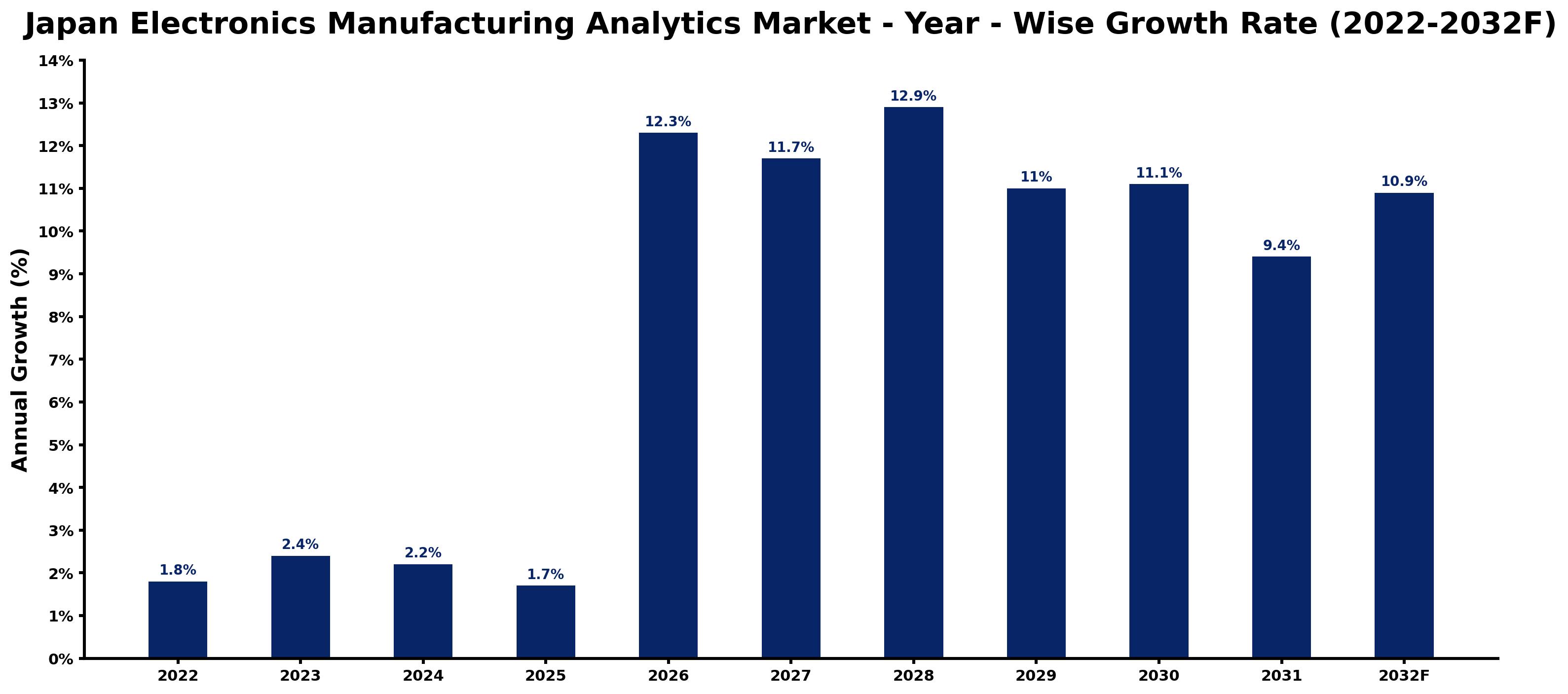
The table below sets out the estimated growth rate for each year and the main factor behind it.
| Year | Estimated Annual Growth (%) | Market Rationale |
| 2022 | 1.8 | The market experienced steady growth, supported by ongoing investments in analytics technologies. |
| 2023 | 2.4 | Growth accelerated as manufacturers increasingly adopted advanced analytics to improve production processes. |
| 2024 | 2.2 | The market saw a slowdown as some companies delayed investments amid economic uncertainty. |
| 2025 | 1.7 | Growth continued to slow as firms focused on optimising existing processes rather than expanding. |
| 2026 | 12.3 | Demand is expected to surge as companies ramp up investments in predictive analytics for better forecasting. |
| 2027 | 11.7 | A slight slowdown is projected as the market adjusts to new technology implementations. |
| 2028 | 12.9 | The peak growth year will see increased adoption of real-time analytics across various sectors. |
| 2029 | 11.0 | Growth is expected to moderate as the market stabilises following rapid expansions in previous years. |
| 2030 | 11.1 | Demand will rise again as manufacturers embrace AI technologies for improved analytics capabilities. |
| 2031 | 9.4 | A further slowdown is projected as the market matures and competition intensifies. |
| 2032 | 10.9 | Growth is expected to rebound as companies seek effective solutions to improve production efficiency. |
Note: Market size estimations and growth projections presented in this report are based on 6Wresearch's proprietary forecasting methodology, utilizing the latest available industry data, government publications, and primary research inputs.
Japan Electronics Manufacturing Analytics Market Synopsis
Electronics Manufacturing Analytics employs data analysis technologies to improve manufacturing processes, concentrating on optimising production efficiency and reducing waste. The Japan Electronics Manufacturing Analytics Market is projected to invest approximately ¥500 billion in analytics technologies by 2025. The increasing adoption of predictive and real-time analytics is driving demand as manufacturers seek to enhance product quality and operational efficiency.
Market Dynamics Impact Analysis (2026–2032)
| Factor | Type | Impact | Primary Segment Affected |
| Increased investments in predictive analytics | Driver | High | Predictive |
| Growing demand for real-time decision-making | Driver | High | Real-Time |
| Adoption of advanced analytics in foundries | Opportunity | High | Foundries |
| Need for improved yield rates in manufacturing | Opportunity | High | Yield Improvement |
| High costs of implementing analytics solutions | Restraint | High | Predictive |
| Limited understanding of analytics capabilities | Restraint | Medium | Predictive |
| Compliance with evolving industry standards | Challenge | High | Predictive |
| Capacity constraints in scaling analytics solutions | Challenge | Medium | Predictive |
Evaluation of Drivers in Japan Electronics Manufacturing Analytics Market (2026–2032)
The following drivers explain most of the expected growth.
| Drivers | Primary Segment Affected | Why It Matters (Evidence) |
| Investment in predictive analytics technologies | Predictive | Foundries are increasingly adopting predictive analytics to improve yield rates, with a projected investment of ¥500 billion by 2025. |
| Demand for real-time analytics solutions | Real-Time | Over 300 PCB manufacturing facilities rely on real-time analytics to maintain operational efficiency, ensuring timely production decisions. |
| Focus on optimising production processes | Yield Improvement | Manufacturers are prioritising yield improvement analytics to maximise output quality, especially in SMT lines, boosting their competitiveness. |
| Integration of AI in analytics | Predictive | The Japanese electronics market is projected to grow steadily, supported by advancements in AI and IoT technologies that enhance analytics capabilities. |
| Government support for smart manufacturing | Predictive | The Ministry of Economy, Trade and Industry (METI) promotes initiatives for smart manufacturing technologies, facilitating analytics adoption. |
Buyers are adding capacity as they invest in predictive analytics technologies to enhance manufacturing processes. For instance, foundries are projected to invest approximately ¥500 billion in analytics by 2025, facilitating better yield rates. Real-time analytics solutions are essential for over 300 PCB manufacturing facilities, enabling immediate decision-making during production. The integration of AI technologies is driving advancements in analytics capabilities across the sector.
Evaluation of Restraints in Japan Electronics Manufacturing Analytics Market
Several factors work against faster growth; the main ones are summarised below.
| Market Restraint | Primary Segment Affected | Why It Matters (Evidence) |
| High costs associated with analytics implementation | Predictive | The average life expectancy of electronics manufacturing equipment is around 10 years, necessitating costly upgrades. |
| Limited understanding of analytics capabilities | Predictive | Many manufacturers lack expertise in effectively implementing analytics, which hinders their operational improvements. |
| Compliance with industry standards like ISO 9001 | Predictive | Adhering to quality management standards complicates operations and adds costs for manufacturers. |
| Data security concerns during analytics adoption | Predictive | Manufacturers are cautious about data breaches, affecting their willingness to adopt new technologies. |
| Inadequate infrastructure for analytics deployment | Predictive | The existing infrastructure in some facilities may not support advanced analytics solutions. |
Japan Electronics Manufacturing Analytics Market Challenges
Producers struggle with a shortage of skilled workers, as the ageing population reduces the available talent pool, leading to production delays that impact output. Buyers encounter intense competition from global firms that implement advanced analytics faster, resulting in diminished market presence and lost sales opportunities. Rising costs for new technology adoption burden producers, with analytics investments expected to reach ¥500 billion by 2025, straining financial resources. Regulatory compliance with ISO 9001 standards demands additional operational resources, diverting funds from essential innovation for electronics manufacturers.
Trends in the Japan Electronics Manufacturing Analytics Market
Four trends stand out in the Japan Electronics Manufacturing Analytics Market.
- Shift from On-Premise to Cloud Analytics: Foundries are increasingly adopting cloud-based analytics solutions, with Cloud accounting for 48% of the deployment model in 2025. This shift allows for scalable data storage and access, improving operational flexibility.
- Emergence of Real-Time Analytics: In 2023, real-time analytics became essential for over 300 PCB manufacturing facilities, enabling immediate decision-making during production. This trend highlights the growing importance of timely data in manufacturing processes.
- Transition from Descriptive to Predictive Analytics: The adoption of predictive analytics has accelerated since 2026, with a projected CAGR of 15.3% for the Prescriptive segment. This change reflects manufacturers' focus on forecasting potential issues before they occur.
- Prioritisation of Yield Improvement Analytics: Yield Improvement analytics is gaining traction, with a CAGR of 14.6% expected from 2026 to 2032. This trend is driven by manufacturers' need to maximise output quality and reduce waste.
Investment Opportunities in the Japan Electronics Manufacturing Analytics Market
The following areas offer the clearest openings for investors and suppliers in the Japan Electronics Manufacturing Analytics Market.
- Supply of Advanced Analytics Solutions: With Japan's electronics sector expected to invest ¥500 billion in analytics technologies by 2025, suppliers should focus on providing advanced analytics solutions to foundries and PCB manufacturers.
- Investment in Real-Time Analytics Tools: The demand for real-time decision-making presents an opportunity for suppliers of analytics tools, especially in the Kanto region, where over 40% of production occurs.
- Development of Predictive Analytics Software: As the adoption of predictive analytics increases, software developers have the chance to create tailored solutions for the electronics manufacturing sector.
- Creation of Analytics Training Programs: With many manufacturers lacking expertise, there is a growing requirement for training programs centred on analytics capabilities, particularly for SMEs adopting advanced solutions.
Government Initiatives in the Japan Electronics Manufacturing Analytics Market
The Waste Management and Public Cleansing Act, established in 1970, mandates the proper treatment and disposal of industrial waste, impacting electronics manufacturers by enforcing strict waste management practices. The Semiconductor and Digital Industry Strategy, introduced by METI in June 2021, aims to secure domestic semiconductor manufacturing, encouraging investment in analytics technologies to improve production processes.
The Digital Agency, established in September 2021, leads government digital transformation initiatives, providing funding for projects that improve analytics capabilities. The subsidy program for SMEs adopting advanced analytics solutions initiated in 2023 supports smaller manufacturers in implementing these technologies, ensuring they remain competitive.
Future Insight of the Japan Electronics Manufacturing Analytics Market
By 2032, buyers will experience improved production efficiency as AI integration becomes standard in manufacturing processes. The government's subsidy program for SMEs adopting advanced analytics will encourage innovation among suppliers, driving the creation of more effective solutions. Investment in smart manufacturing technologies will rise, with analytics technologies expected to be integrated into over 10,000 units across various facilities. Regular upgrades will be essential, as the average lifespan of electronics manufacturing equipment is around 10 years, ensuring suppliers maintain their competitive edge.
Market Segmentation Analysis
Japan Electronics Manufacturing Analytics Market report covers a detailed analysis of the following market segments:
By Analytics Type – Predictive Leads, Prescriptive Expected to Grow Fastest
According to Saurav Kr Singh, Senior Research Analyst at 6Wresearch, with 49% of analytics type revenue in 2025, Predictive was the largest category. Predictive analytics holds the largest share as it is essential for identifying potential issues before they disrupt production, ensuring smooth operations. Its widespread application in over 10,000 SMT lines demonstrates its integral role in the electronics manufacturing sector. Prescriptive is set to record the highest CAGR in this split, 15.3% over 2026–2032. The prescriptive analytics segment is experiencing rapid growth because it delivers actionable recommendations that manufacturers are increasingly prioritising for process optimisation. This trend is further supported by government initiatives aimed at advancing manufacturing capabilities. Suppliers should prioritise enhancing prescriptive analytics solutions to meet the rising demand from manufacturers.
By Deployment Model – Cloud Leads, On-Premise Expected to Grow Fastest
Cloud accounted for 48% of the market by deployment model in 2025. The cloud deployment model leads the market due to its ability to provide scalable data storage and access, which is crucial for managing extensive production data. This model particularly supports manufacturers looking to optimise operations across multiple sites. On-Premise is projected to grow fastest, at a CAGR of 15.9% during 2026–2032. On-premise deployment is growing the fastest as companies seek greater control over their data for enhanced security and compliance. The anticipated investment of approximately ¥500 billion in analytics technologies by 2025 underscores this shift. Buyers may increasingly prefer on-premise solutions for sensitive data, prompting suppliers to adjust their offerings accordingly.
By Use Case – Downtime Alerts Lead, Yield Improvement Expected to Grow Fastest
Downtime Alerts held 43% of the Japan Electronics Manufacturing Analytics Market by use case in 2025. Downtime alerts are the leading use case as they play a critical role in minimising production halts, directly impacting operational efficiency. Their importance is underscored by the real-time analytics needs of over 300 PCB manufacturing facilities nationwide. Over 2026–2032, Yield Improvement is expected to post the fastest growth, at a CAGR of 14.6%. Yield improvement is the fastest-growing use case as manufacturers focus on maximising output quality, which is vital in a competitive landscape. This growth is driven by the increasing adoption of predictive analytics in foundries. Suppliers should concentrate on developing solutions that support yield improvement to align with manufacturers' quality enhancement goals.
By End User – Foundries Lead, SMT Lines Expected to Grow Fastest
In 2025, Foundries led the end user split with a 46% share. Foundries dominate the end-user segment as they are major users of analytics for process optimisation, which is vital for maintaining competitive advantage. Their extensive operations necessitate advanced analytics to improve yield and efficiency. The quickest growth will come from SMT Lines, forecast to expand at a CAGR of 14.0% between 2026 and 2032. SMT lines are the fastest-growing end-user segment due to their heavy reliance on analytics for efficiency, particularly as manufacturers upgrade their technologies. The push for advanced analytics solutions in SMEs is further propelling this growth. Suppliers must tailor their offerings to meet the specific needs of SMT lines to capture this growing market.
Key Attractiveness of the Report
- 10 Years of Market Numbers
- Historical Data Starting from 2022 to 2025
- Base Year 2025
- Forecast Data until 2032
- Key Performance Indicators Impacting the Market
- Major Upcoming Developments and Projects
Key Highlights of the Report:
- Japan Electronics Manufacturing Analytics Market Outlook
- Market Size of Japan Electronics Manufacturing Analytics Market, 2025
- Forecast of Japan Electronics Manufacturing Analytics Market, 2032
- Historical Data and Forecast of Japan Electronics Manufacturing Analytics Revenues & Volume for the Period 2022-2032F
- Japan Electronics Manufacturing Analytics Market Trend Evolution
- Japan Electronics Manufacturing Analytics Market Drivers and Challenges
- Japan Electronics Manufacturing Analytics Price Trends
- Japan Electronics Manufacturing Analytics Porter's Five Forces
- Japan Electronics Manufacturing Analytics Industry Life Cycle
- Historical Data and Forecast of Japan Electronics Manufacturing Analytics Market Revenues & Volume By Analytics Type for the Period 2022-2032F
- Historical Data and Forecast of Japan Electronics Manufacturing Analytics Market Revenues & Volume By Predictive for the Period 2022-2032F
- Historical Data and Forecast of Japan Electronics Manufacturing Analytics Market Revenues & Volume By Prescriptive for the Period 2022-2032F
- Historical Data and Forecast of Japan Electronics Manufacturing Analytics Market Revenues & Volume By Descriptive for the Period 2022-2032F
- Historical Data and Forecast of Japan Electronics Manufacturing Analytics Market Revenues & Volume By Real-Time for the Period 2022-2032F
- Historical Data and Forecast of Japan Electronics Manufacturing Analytics Market Revenues & Volume By Deployment Model for the Period 2022-2032F
- Historical Data and Forecast of Japan Electronics Manufacturing Analytics Market Revenues & Volume By Cloud for the Period 2022-2032F
- Historical Data and Forecast of Japan Electronics Manufacturing Analytics Market Revenues & Volume By On-Premise for the Period 2022-2032F
- Historical Data and Forecast of Japan Electronics Manufacturing Analytics Market Revenues & Volume By Hybrid for the Period 2022-2032F
- Historical Data and Forecast of Japan Electronics Manufacturing Analytics Market Revenues & Volume By Edge for the Period 2022-2032F
- Historical Data and Forecast of Japan Electronics Manufacturing Analytics Market Revenues & Volume By Use Case for the Period 2022-2032F
- Historical Data and Forecast of Japan Electronics Manufacturing Analytics Market Revenues & Volume By Downtime Alerts for the Period 2022-2032F
- Historical Data and Forecast of Japan Electronics Manufacturing Analytics Market Revenues & Volume By Yield Improvement for the Period 2022-2032F
- Historical Data and Forecast of Japan Electronics Manufacturing Analytics Market Revenues & Volume By Scrap Analysis for the Period 2022-2032F
- Historical Data and Forecast of Japan Electronics Manufacturing Analytics Market Revenues & Volume By Line Monitoring for the Period 2022-2032F
- Historical Data and Forecast of Japan Electronics Manufacturing Analytics Market Revenues & Volume By End User for the Period 2022-2032F
- Historical Data and Forecast of Japan Electronics Manufacturing Analytics Market Revenues & Volume By Foundries for the Period 2022-2032F
- Historical Data and Forecast of Japan Electronics Manufacturing Analytics Market Revenues & Volume By SMT Lines for the Period 2022-2032F
- Historical Data and Forecast of Japan Electronics Manufacturing Analytics Market Revenues & Volume By PCB Manufacturers for the Period 2022-2032F
- Historical Data and Forecast of Japan Electronics Manufacturing Analytics Market Revenues & Volume By EMS Providers for the Period 2022-2032F
- Japan Electronics Manufacturing Analytics Import Export Trade Statistics
- Market Opportunity Assessment By Analytics Type
- Market Opportunity Assessment By Deployment Model
- Market Opportunity Assessment By Use Case
- Market Opportunity Assessment By End User
- Japan Electronics Manufacturing Analytics Top Companies Market Share
- Japan Electronics Manufacturing Analytics Competitive Benchmarking By Technical and Operational Parameters
- Japan Electronics Manufacturing Analytics Company Profiles
- Japan Electronics Manufacturing Analytics Key Strategic Recommendations
Market Covered
The study includes the following segmentation.
By Analytics Type
- Predictive
- Prescriptive
- Descriptive
- Real-Time
By Deployment Model
- Cloud
- On-Premise
- Hybrid
- Edge
By Use Case
- Downtime Alerts
- Yield Improvement
- Scrap Analysis
- Line Monitoring
By End User
- Foundries
- SMT Lines
- PCB Manufacturers
- EMS Providers































