Japan Electronics Materials Market Size & Growth Rate
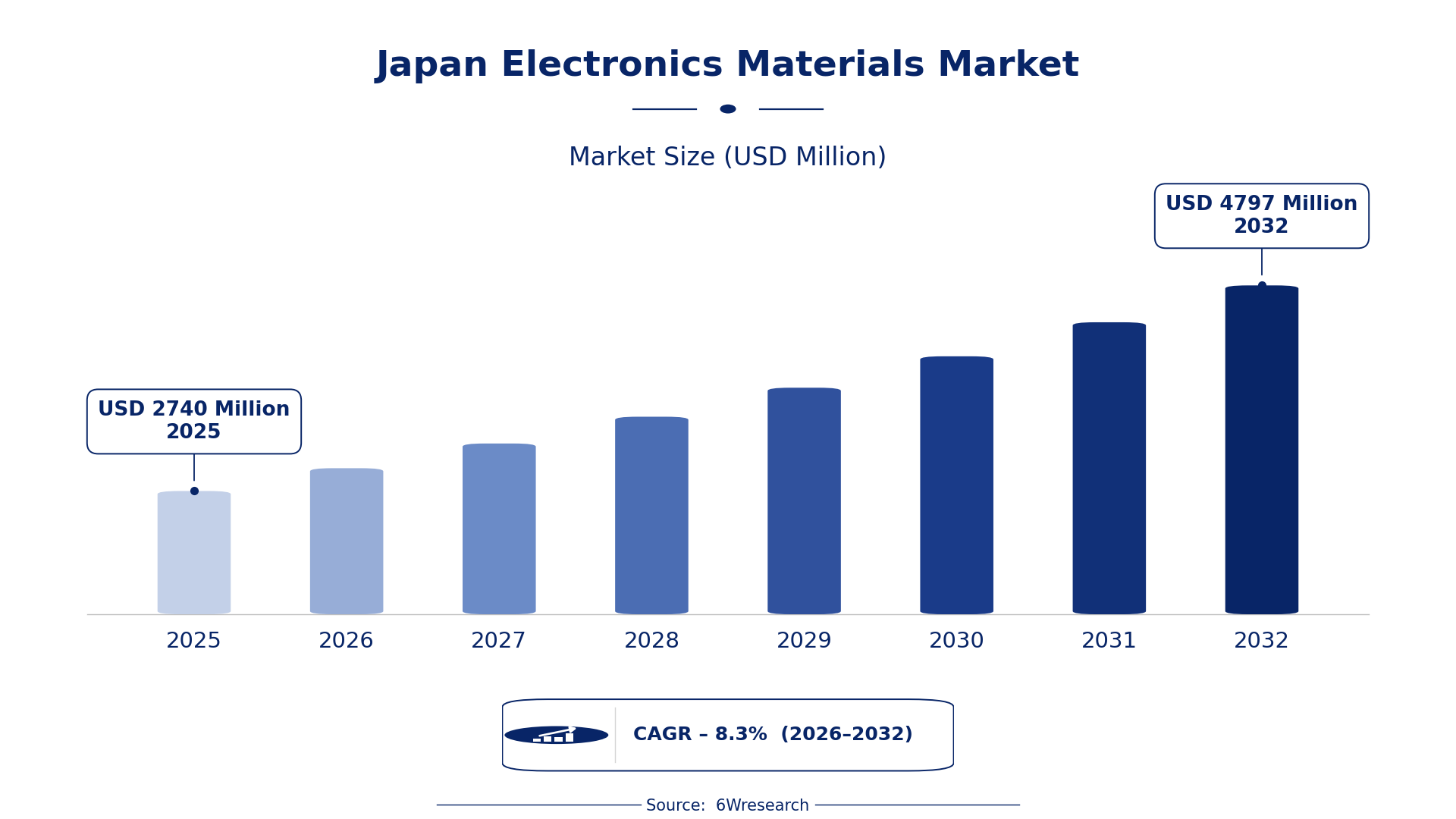
According to 6Wresearch internal database and industry insights, the Japan Electronics Materials Market was valued at USD 2,740 Million in 2025 and is projected to reach USD 4,797 Million by 2032, growing at a CAGR of approximately 8.3% during 2026–2032.
Japan Electronics Materials Market Highlights
| Report Metric | Details |
| Report Name | Japan Electronics Materials Market (2026-2032) |
| Market Size 2025 | USD 2,740 Million |
| Market Size 2032 | USD 4,797 Million |
| Absolute Growth 2025–2032 | USD 2,057 Million |
| CAGR 2026–2032 | 8.3% |
| Peak Annual Growth | 9.0% in 2026 |
| Forecast Period | 2026–2032 |
| Historical Data | 2022–2025 |
| Base Year | 2025 |
| Leading Material Type, 2025 | Semiconductor (36% share) |
| Leading Usage Area, 2025 | Chip Fabrication (40% share) |
| Leading Conductivity, 2025 | High (44% share) |
| Leading End User, 2025 | Foundries (44% share) |
| Fastest-Growing Material Type | Dielectric (11.8% CAGR) |
| Fastest-Growing Usage Area | PCB Substrates (9.8% CAGR) |
| Fastest-Growing Conductivity | Low (10.6% CAGR) |
| Fastest-Growing End User | Board Designers (10.5% CAGR) |
| Growing Sector | Semiconductors |
| Key End Users | Foundries, PCB manufacturers, automotive electronics, flexible electronics |
Japan Electronics Materials Market Year-wise Growth Rate and Key Drivers (2022–2032)
This graph illustrates the annual growth rates of the market from 2022 to 2032, highlighting a steady upward trajectory and projected market expansion over the forecast period.
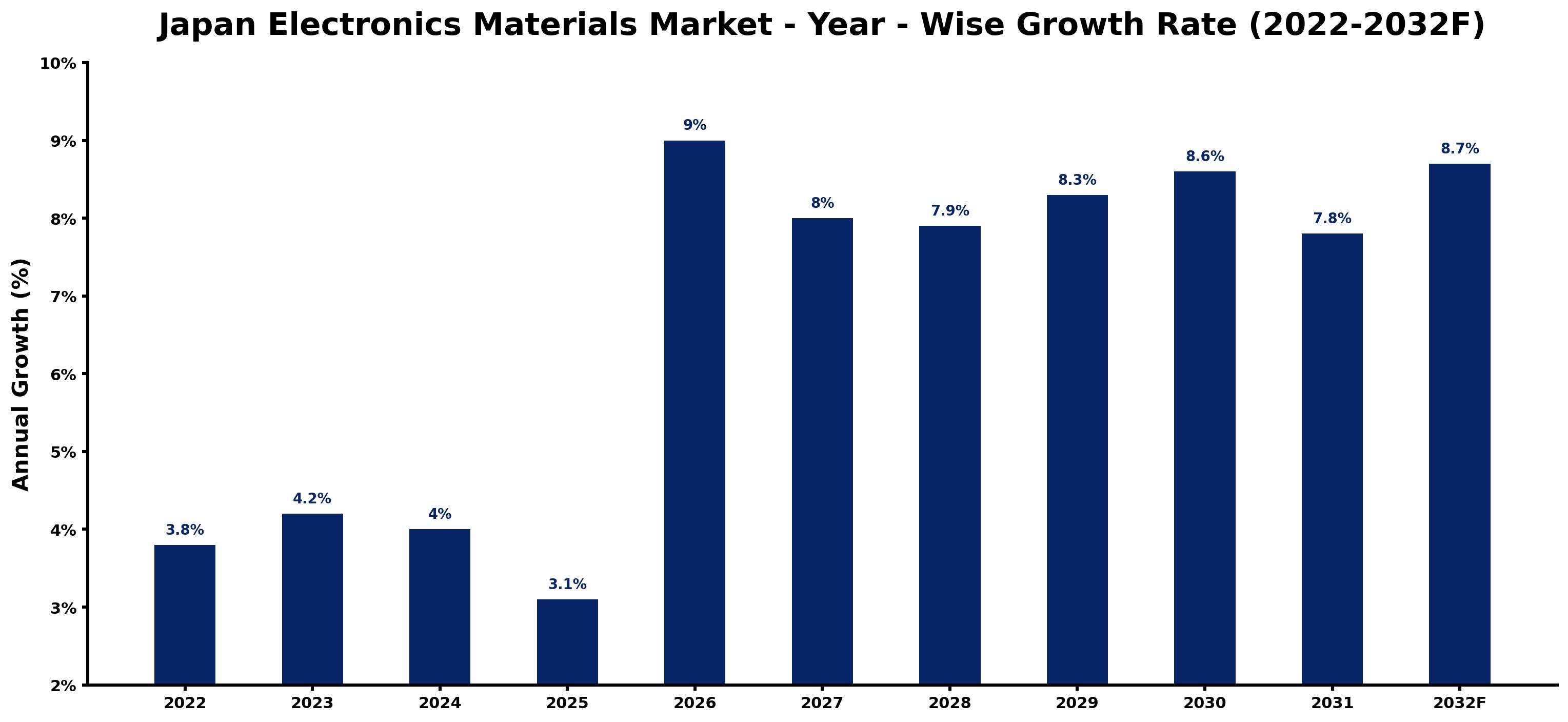
Below, each year's estimated growth is shown next to the factor that most influenced it.
| Year | Estimated Annual Growth (%) | Market Rationale |
| 2022 | 3.8 | The market experienced steady growth due to strong domestic demand in electronics. |
| 2023 | 4.2 | Growth accelerated as semiconductor production increased, reflecting industry resilience. |
| 2024 | 4.0 | Growth slowed slightly as market conditions stabilised after previous gains. |
| 2025 | 3.1 | Demand continued to grow, albeit at a slower pace, as investments normalised. |
| 2026 | 9.0 | Growth surged due to heightened investments in semiconductor manufacturing and R&D. |
| 2027 | 8.0 | Growth moderated as the market adjusted to the rapid expansion of the previous year. |
| 2028 | 7.9 | Growth slowed as the market stabilised, reflecting a normalisation after rapid expansion. |
| 2029 | 8.3 | Growth rebounded as demand for high-performance materials increased significantly. |
| 2030 | 8.6 | The market continued to expand, driven by ongoing technological advancements. |
| 2031 | 7.8 | Growth slowed again as the market matured, reflecting a stabilisation phase. |
| 2032 | 8.7 | Demand is expected to rise as new applications in electronics emerge. |
Note: Market size estimations and growth projections presented in this report are based on 6Wresearch's proprietary forecasting methodology, utilizing the latest available industry data, government publications, and primary research inputs.
Japan Electronics Materials Market Synopsis
Electronics materials are vital components in the manufacturing of electronic devices, including semiconductors, dielectrics, and thermal interfaces. The Tokyo region serves as a hub for semiconductor foundries and PCB manufacturers, driving demand. The Japan Electronics Materials Market is expanding, supported by rising investments in semiconductor production, with approximately JPY 150 trillion targeted for decarbonisation initiatives over the next decade. The increasing need for thermal interface materials due to heat dissipation in electronics further fuels market growth.
Market Dynamics Impact Analysis (2026–2032)
| Factor | Type | Impact | Primary Segment Affected |
| Increasing investments in semiconductor manufacturing | Driver | High | Semiconductor |
| Growing demand for thermal management solutions | Driver | High | Thermal Interface |
| Expansion of PCB manufacturing capabilities | Opportunity | High | PCB Substrates |
| Rising applications in flexible electronics | Opportunity | High | Flexible Electronics |
| High-quality standards impacting production costs | Restraint | Medium | Semiconductor |
| Challenges in sourcing raw materials for production | Restraint | Medium | Dielectric |
| Limited skilled workforce in advanced manufacturing | Challenge | High | Chip Fabrication |
| Technological advancements outpacing current production capabilities | Challenge | High | Conductive Ink |
Evaluation of Drivers in Japan Electronics Materials Market (2026–2032)
The factors lifting demand, and the evidence behind each, are summarised below.
| Drivers | Primary Segment Affected | Why It Matters (Evidence) |
| Increased domestic semiconductor production | Semiconductor | Japan produced 1.5 million tons of semiconductor materials in 2022, boosting local supply and demand. |
| Rising need for efficient thermal management | Thermal Interface | The demand for thermal interface materials is increasing due to rising electronics heat dissipation, with a projected growth of 20% by 2025. |
| Growth in automotive electronics applications | Chip Fabrication | The automotive sector's expansion drives demand for advanced chip fabrication technologies, with investments expected to reach ¥10 billion. |
| Investment in flexible electronics technologies | Flexible Electronics | The Flexible Electronics Association promotes innovation, leading to increased adoption in various applications, with market growth projected at 15% annually. |
| Demand for high-performance conductive inks | Conductive Ink | The growth in printed electronics applications is driving the need for high-quality conductive inks, with demand expected to rise significantly. |
Volumes grow due to increased domestic semiconductor production, with Japan producing 1.5 million tons of semiconductor materials in 2022, boosting local supply. The rising demand for efficient thermal management solutions drives the need for thermal interface materials, critical for managing heat dissipation in electronic devices. Growth in automotive electronics applications further increases chip fabrication requirements, reflecting the sector's expansion. Investment in flexible electronics technologies encourages adoption, while the demand for high-performance conductive inks rises as printed electronics applications expand, leading to increased purchases from manufacturers.
Evaluation of Restraints in Japan Electronics Materials Market
Below are the constraints most often cited by buyers and suppliers, with the segment each affects.
| Market Restraint | Primary Segment Affected | Why It Matters (Evidence) |
| High-quality standards impacting production costs | Semiconductor | Strict adherence to ISO 9001 standards raises production costs for manufacturers. |
| Challenges in sourcing raw materials for production | Dielectric | Limited availability of essential materials affects the production capacity of dielectrics, hindering supply. |
| Limited skilled workforce in advanced manufacturing | Chip Fabrication | A shortage of skilled workers hampers the growth of chip fabrication capabilities, affecting production timelines. |
| Technological advancements outpacing current production capabilities | Conductive Ink | Rapid technological changes create a gap between production capabilities and market demands, complicating supply chains. |
| Regulatory compliance costs for chemical substances | Thermal Interface | Compliance with the Chemical Substances Control Law increases operational costs for manufacturers, impacting pricing. |
Japan Electronics Materials Market Challenges
Tokyo's semiconductor foundries face competition from emerging markets, forcing local producers to cut prices and risking profit margins. Compliance with JIS standards raises operational costs for manufacturers, potentially delaying product launches by up to six months for suppliers. Rapid technological advancements require continuous R&D investment, straining the financial resources of smaller suppliers and limiting their innovation capabilities. Buyers encounter longer lead times for thermal interface materials, disrupting production schedules and potentially delaying product releases by several weeks, impacting their market readiness.
Trends in the Japan Electronics Materials Market
These developments are changing demand patterns in the Japan Electronics Materials Market.
- Shift in Focus to Thermal Management Solutions: Foundries are prioritising thermal management solutions to tackle rising heat dissipation in electronics. The demand for thermal interface materials has surged, with the market expected to grow by 20% by 2025.
- Emergence of Flexible Electronics: The Kansai region is witnessing a rise in flexible electronics applications, driven by demand for lightweight materials. This shift is evidenced by a growing number of projects in flexible electronics, with investments expected to reach ¥5 billion.
- Transition to Advanced Semiconductor Manufacturing: Since 2021, Japan has concentrated on enhancing semiconductor manufacturing capabilities, leading to increased production. This transition is backed by substantial government funding, with ¥10 billion allocated for electronics R&D in 2023.
- Growing Demand for High-Performance Conductive Inks: The demand for high-performance conductive inks is increasing, particularly in printed electronics applications. This trend reflects the growing need for innovative materials, with market growth expected to continue at 15% annually.
Investment Opportunities in the Japan Electronics Materials Market
The openings below show where demand in the Japan Electronics Materials Market is visible and how suppliers can enter.
- Investment in Semiconductor Manufacturing: Now is the time to invest in semiconductor manufacturing capabilities, as Japan aims for a 46% reduction in greenhouse gases by 2030. Foundries in the Tokyo region are seeking local partners to boost production.
- Supply of Thermal Management Solutions: With the increasing demand for thermal interface materials, suppliers can target the automotive sector, which is expanding rapidly. The timing aligns with rising heat dissipation needs in electronics, creating a market gap.
- Expansion of PCB Manufacturing: The Kansai region offers opportunities for PCB substrate manufacturing, with a growing market gap. Investors can enter this space by collaborating with local manufacturers to meet rising demand, projected to grow by 12%.
- Development of Flexible Electronics: Investing in flexible electronics materials is timely, given the sector's projected growth. The Flexible Electronics Association is actively promoting innovation, creating opportunities for new suppliers to enter the market.
Government Initiatives in the Japan Electronics Materials Market
The Semiconductor and Digital Industry Strategy, established by METI in June 2021, aims to secure domestic semiconductor manufacturing. This strategy mandates investments in advanced technologies, ensuring that producers meet the increasing demand for high-quality materials. In 2023, the government allocated ¥10 billion to support research and development in electronics, enhancing the capabilities of local manufacturers.
The Ministry of Economy, Trade and Industry oversees the approval of funding for electronics R&D initiatives. In 2023, the government allocated ¥10 billion to support research and development in electronics, enhancing the capabilities of local manufacturers.
Future Insight of the Japan Electronics Materials Market
The upcoming semiconductor supply chain programme will improve production efficiency by 2032, benefiting both suppliers and buyers. Aiming for ¥150 trillion in decarbonisation investments will drive advancements in sustainable electronics materials. The Tokyo Metropolitan Government's smart electronics initiatives will encourage innovations in product design and application. With over 200 million electronic devices in use, the demand for high-quality materials will escalate, compelling suppliers to adopt advanced manufacturing techniques.
Market Segmentation Analysis
Japan Electronics Materials Market report covers a detailed analysis of the following market segments:
By Material Type – Semiconductor Leads, Dielectric Expected to Grow Fastest
According to Saurav Kr Singh, Senior Research Analyst at 6Wresearch, Semiconductor accounted for 36% of the market by material type in 2025. The semiconductor segment holds the largest share due to its critical importance in chip manufacturing, which is a cornerstone of the electronics industry. Japan's production of 1.5 million tons of semiconductor materials in 2022 underlines the robust domestic supply supporting this segment. Dielectric is set to record the highest CAGR in this split, 11.8% over 2026–2032. The dielectric segment is experiencing rapid growth as the demand for insulation in circuits rises, particularly in advanced electronic applications. The Tokyo region, known for its semiconductor foundries, significantly contributes to this growth trajectory. Suppliers should focus on enhancing dielectric offerings to meet the rising demand in the electronics sector.
By Usage Area – Chip Fabrication Leads, PCB Substrates Expected to Grow Fastest
Chip Fabrication held 40% of the Japan Electronics Materials Market by usage area in 2025. Chip fabrication leads the usage area as it is fundamental to electronics manufacturing, ensuring the production of high-quality devices. The installed base of over 200 million electronic devices in Japan underscores the critical nature of this segment. Over 2026–2032, PCB Substrates are expected to post the fastest growth, at a CAGR of 9.8%. PCB substrates are witnessing the fastest growth due to their foundational role in circuit boards, which are essential for various electronic applications. The Kansai region's strong PCB substrate manufacturing capabilities are driving this growth. Buyers should prioritise sourcing high-quality PCB substrates to support the increasing complexity of electronic designs.
By Conductivity – High Leads, Low Expected to Grow Fastest
High took 44% of conductivity revenue in 2025, more than any other category. High conductivity materials dominate the market as they are essential for high-performance applications, particularly in advanced electronics. Their necessity is highlighted by strong demand from sectors that require efficient energy transfer. The quickest growth will come from Low, forecast to expand at a CAGR of 10.6% between 2026 and 2032. Low conductivity materials are rapidly growing as they find applications in less critical areas, allowing for cost-effective solutions in certain designs. This trend indicates a shift towards more versatile material usage in electronics. Suppliers should consider expanding their low conductivity offerings to meet the diverse needs of the electronics market.
By End User – Foundries Lead, Board Designers Expected to Grow Fastest
The largest end user category in 2025 was Foundries, at 44% of revenue. Foundries represent the largest end user segment as they are major consumers of materials required for chip production. The concentration of semiconductor foundries in the Tokyo region further solidifies this segment's dominance. Board Designers are projected to grow fastest, at a CAGR of 10.5% during 2026–2032. Board designers are the fastest-growing end user group, utilising materials in innovative designs for new electronic products. This growth is driven by the increasing complexity of electronic devices and the need for tailored solutions. Suppliers must engage with board designers to understand their evolving requirements and provide customised materials.
Key Attractiveness of the Report
- 10 Years of Market Numbers
- Historical Data Starting from 2022 to 2025
- Base Year 2025
- Forecast Data until 2032
- Key Performance Indicators Impacting the Market
- Major Upcoming Developments and Projects
Key Highlights of the Report:
- Japan Electronics Materials Market Outlook
- Market Size of Japan Electronics Materials Market, 2025
- Forecast of Japan Electronics Materials Market, 2032
- Historical Data and Forecast of Japan Electronics Materials Revenues & Volume for the Period 2022-2032F
- Japan Electronics Materials Market Trend Evolution
- Japan Electronics Materials Market Drivers and Challenges
- Japan Electronics Materials Price Trends
- Japan Electronics Materials Porter's Five Forces
- Japan Electronics Materials Industry Life Cycle
- Historical Data and Forecast of Japan Electronics Materials Market Revenues & Volume By Material Type for the Period 2022-2032F
- Historical Data and Forecast of Japan Electronics Materials Market Revenues & Volume By Semiconductor for the Period 2022-2032F
- Historical Data and Forecast of Japan Electronics Materials Market Revenues & Volume By Dielectric for the Period 2022-2032F
- Historical Data and Forecast of Japan Electronics Materials Market Revenues & Volume By Conductive Ink for the Period 2022-2032F
- Historical Data and Forecast of Japan Electronics Materials Market Revenues & Volume By Thermal Interface for the Period 2022-2032F
- Historical Data and Forecast of Japan Electronics Materials Market Revenues & Volume By Usage Area for the Period 2022-2032F
- Historical Data and Forecast of Japan Electronics Materials Market Revenues & Volume By Chip Fabrication for the Period 2022-2032F
- Historical Data and Forecast of Japan Electronics Materials Market Revenues & Volume By PCB Substrates for the Period 2022-2032F
- Historical Data and Forecast of Japan Electronics Materials Market Revenues & Volume By Printed Circuits for the Period 2022-2032F
- Historical Data and Forecast of Japan Electronics Materials Market Revenues & Volume By Heat Sinks for the Period 2022-2032F
- Historical Data and Forecast of Japan Electronics Materials Market Revenues & Volume By Conductivity for the Period 2022-2032F
- Historical Data and Forecast of Japan Electronics Materials Market Revenues & Volume By High for the Period 2022-2032F
- Historical Data and Forecast of Japan Electronics Materials Market Revenues & Volume By Low for the Period 2022-2032F
- Historical Data and Forecast of Japan Electronics Materials Market Revenues & Volume By Medium for the Period 2022-2032F
- Historical Data and Forecast of Japan Electronics Materials Market Revenues & Volume By Thermal for the Period 2022-2032F
- Historical Data and Forecast of Japan Electronics Materials Market Revenues & Volume By End User for the Period 2022-2032F
- Historical Data and Forecast of Japan Electronics Materials Market Revenues & Volume By Foundries for the Period 2022-2032F
- Historical Data and Forecast of Japan Electronics Materials Market Revenues & Volume By Board Designers for the Period 2022-2032F
- Historical Data and Forecast of Japan Electronics Materials Market Revenues & Volume By Flexible Electronics for the Period 2022-2032F
- Historical Data and Forecast of Japan Electronics Materials Market Revenues & Volume By Power Units for the Period 2022-2032F
- Japan Electronics Materials Import Export Trade Statistics
- Market Opportunity Assessment By Material Type
- Market Opportunity Assessment By Usage Area
- Market Opportunity Assessment By Conductivity
- Market Opportunity Assessment By End User
- Japan Electronics Materials Top Companies Market Share
- Japan Electronics Materials Competitive Benchmarking By Technical and Operational Parameters
- Japan Electronics Materials Company Profiles
- Japan Electronics Materials Key Strategic Recommendations
Market Covered
The report covers the following segments.
By Material Type
- Semiconductor
- Dielectric
- Conductive Ink
- Thermal Interface
By Usage Area
- Chip Fabrication
- PCB Substrates
- Printed Circuits
- Heat Sinks
By Conductivity
- High
- Low
- Medium
- Thermal
By End User
- Foundries
- Board Designers
- Flexible Electronics
- Power Units































