Japan Electronics Quality Control Market Size & Growth Rate
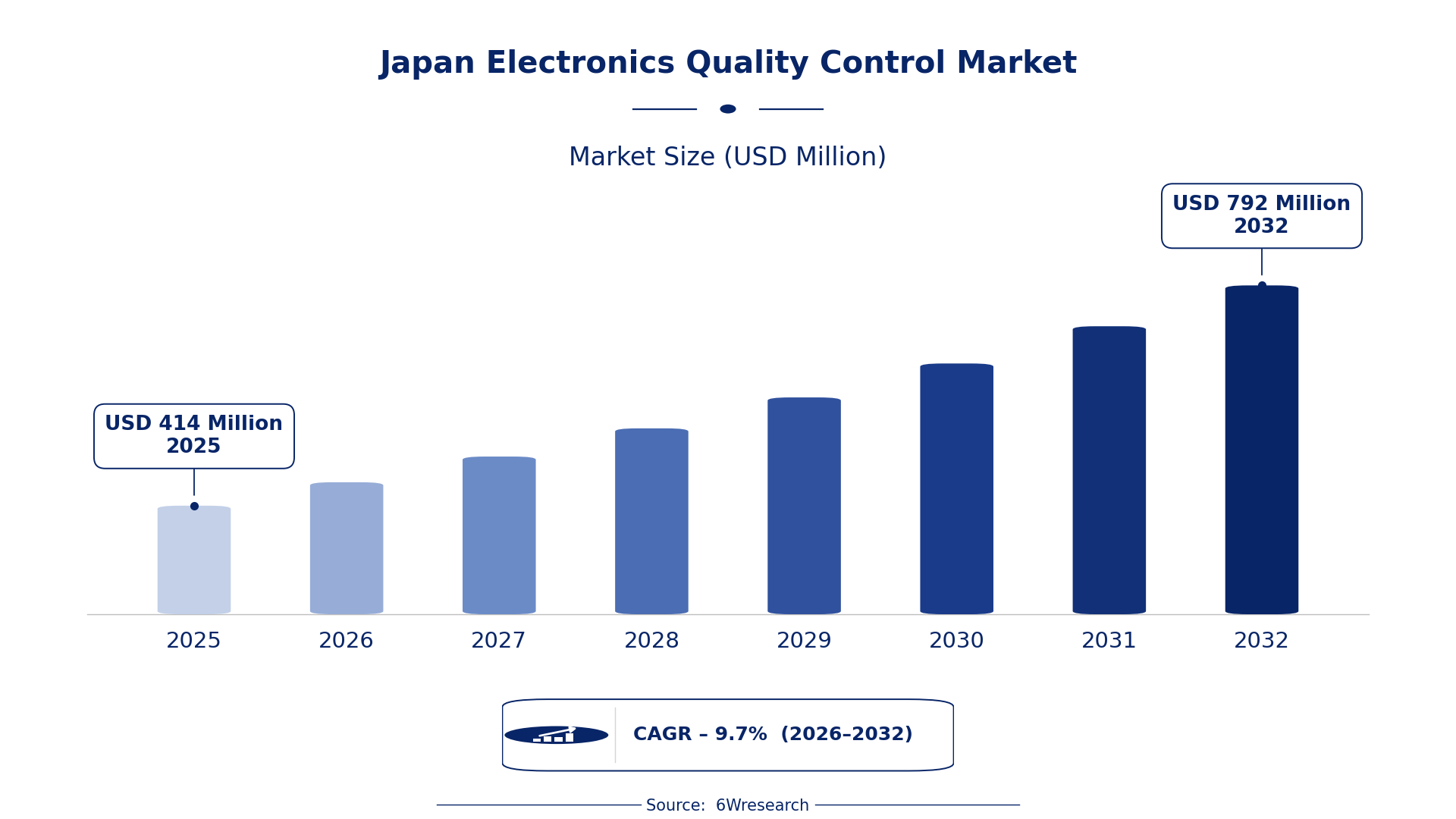
According to 6Wresearch internal database and industry insights, the Japan Electronics Quality Control Market was valued at USD 414 Million in 2025 and is projected to reach USD 792 Million by 2032, growing at a CAGR of approximately 9.7% during 2026–2032.
Japan Electronics Quality Control Market Highlights
| Report Metric | Details |
| Report Name | Japan Electronics Quality Control Market (2026-2032) |
| Market Size 2025 | USD 414 Million |
| Market Size 2032 | USD 792 Million |
| Absolute Growth 2025–2032 | USD 378 Million |
| CAGR 2026–2032 | 9.7% |
| Peak Annual Growth | 10.5% in 2028 |
| Forecast Period | 2026–2032 |
| Historical Data | 2022–2025 |
| Base Year | 2025 |
| Leading QC Type, 2025 | Visual Inspection (39% share) |
| Leading Inspection Tool, 2025 | AOI Systems (42% share) |
| Leading Frequency, 2025 | Inline (50% share) |
| Leading End User, 2025 | SMT Lines (51% share) |
| Fastest-Growing QC Type | Electrical Testing (13.7% CAGR) |
| Fastest-Growing Inspection Tool | Flying Probe (12.4% CAGR) |
| Fastest-Growing Frequency | Final Stage (12.5% CAGR) |
| Fastest-Growing End User | EMS Companies (12.3% CAGR) |
| Growing Sector | EMS Companies |
| Key End Users | SMT Lines, EMS Companies, OEMs, High-Reliability |
Japan Electronics Quality Control Market Year-wise Growth Rate and Key Drivers (2022–2032)
This graph illustrates the annual growth rates of the market from 2022 to 2032, highlighting a steady upward trajectory and projected market expansion over the forecast period.
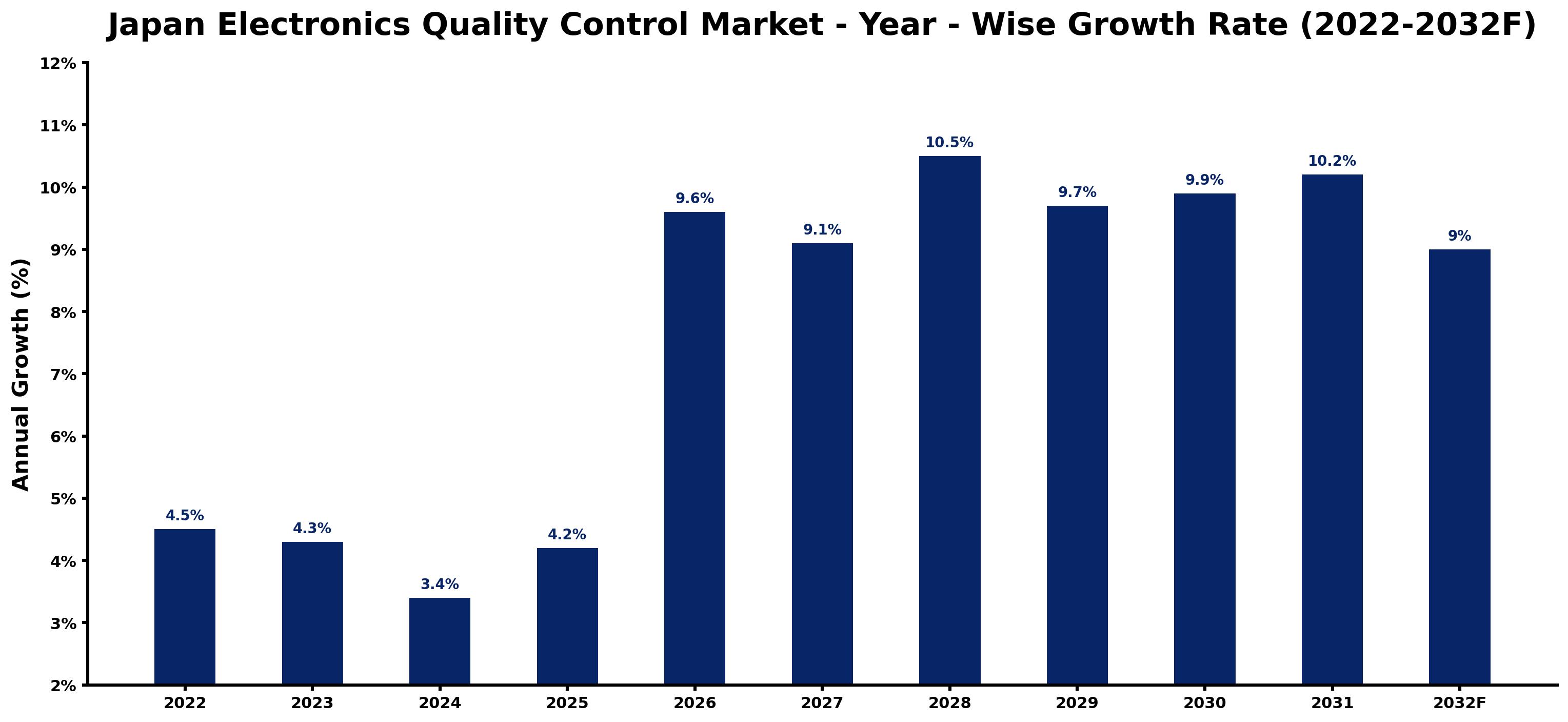
Each row of the following table gives one year's estimated growth and the event or demand shift that explains it.
| Year | Estimated Annual Growth (%) | Market Rationale |
| 2022 | 4.5 | Demand remained strong as the electronics sector continued to recover from previous disruptions. |
| 2023 | 4.3 | Growth slowed slightly as manufacturers adjusted to supply chain challenges and inflationary pressures. |
| 2024 | 3.4 | Market expansion continued but at a reduced pace due to ongoing economic uncertainties. |
| 2025 | 4.2 | A resurgence in investment in quality control technologies spurred faster growth this year. |
| 2026 | 9.6 | Increased adoption of advanced inspection technologies will drive demand growth. |
| 2027 | 9.1 | Growth is projected to moderate as the market adjusts to the higher investment levels seen in previous years. |
| 2028 | 10.5 | A peak in demand is anticipated as manufacturers seek to improve quality and efficiency. |
| 2029 | 9.7 | Market growth is expected to slow slightly as saturation in some segments begins to appear. |
| 2030 | 9.9 | Demand is projected to rebound as new technologies are integrated into production processes. |
| 2031 | 10.2 | Continued investment in quality assurance technologies will support growth this year. |
| 2032 | 9.0 | Growth is expected to decelerate as the market stabilises after several years of rapid expansion. |
Note: Market size estimations and growth projections presented in this report are based on 6Wresearch's proprietary forecasting methodology, utilizing the latest available industry data, government publications, and primary research inputs.
Japan Electronics Quality Control Market Synopsis
Electronics Quality Control involves various testing methods to ensure product reliability and performance, utilising advanced technologies for inspection. The Japan Electronics Quality Control Market is projected to grow, driven by electronics exports valued at approximately 10 trillion JPY in 2023 and strong domestic demand. Inline testing in SMT lines, exceeding 70%, and the promotion of advanced manufacturing technologies by the Ministry of Economy, Trade and Industry are key drivers of market growth.
Market Dynamics Impact Analysis (2026–2032)
| Factor | Type | Impact | Primary Segment Affected |
| Rising demand for high-quality electronics drives the need for advanced testing methods. | Driver | High | Visual Inspection |
| Growing exports of electronics products necessitate stringent quality control measures. | Driver | High | Functional Testing |
| The increasing number of electronics manufacturers in the Tokyo region creates opportunities for new inspection technologies. | Opportunity | High | Visual Inspection |
| The demand for specialized testing equipment in high-reliability sectors presents investment potential. | Opportunity | High | High-Reliability |
| High initial investment costs for quality control technologies can deter smaller manufacturers. | Restraint | Medium | Visual Inspection |
| Limited availability of skilled technicians for advanced quality control processes may hinder growth. | Restraint | Medium | Visual Inspection |
| Competition among manufacturers may lead to price wars, affecting margins. | Challenge | High | Visual Inspection |
| Technological advancements require continuous investment, straining budgets for smaller firms. | Challenge | Medium | Visual Inspection |
Evaluation of Drivers in Japan Electronics Quality Control Market (2026–2032)
The table below links each growth driver to the segment it affects and the evidence for it.
| Drivers | Primary Segment Affected | Why It Matters (Evidence) |
| Increased exports of electronics products necessitate rigorous quality checks. | Functional Testing | Japan's electronics exports were valued at approximately 10 trillion JPY in 2023, leading to heightened demand for functional testing. |
| The adoption of advanced inspection technologies enhances production efficiency. | AOI Systems | The installed base of AOI systems in Japan exceeds 5,000 units, driving demand for more efficient quality control. |
| The push for compliance with the JIS Z 9901 standard drives investment in quality control. | Visual Inspection | Over 80% of OEMs in Japan implement functional testing, reflecting the need for compliance with industry standards. |
| Growing automation in inspection processes boosts demand for advanced equipment. | X-Ray Inspection | The government launched a program in 2023 to enhance automation in inspection processes, increasing demand for X-Ray inspection equipment. |
| Rising consumer expectations for product quality drive manufacturers to invest in quality control. | Electrical Testing | The average investment in quality control technologies is around 500 million JPY per company, indicating a focus on quality assurance. |
Orders keep climbing as Japan's electronics exports reached approximately 10 trillion JPY in 2023, prompting manufacturers to invest in functional testing to meet quality standards. The installed base of AOI systems exceeds 5,000 units, which fuels demand for more efficient quality control methods. Compliance with the JIS Z 9901 standard is a priority, with over 80% of OEMs implementing functional testing. The average investment in quality control technologies stands at around 500 million JPY per company, reflecting a strong commitment to quality assurance.
Evaluation of Restraints in Japan Electronics Quality Control Market
The key brakes on demand, and where they bite hardest, are shown below.
| Market Restraint | Primary Segment Affected | Why It Matters (Evidence) |
| High initial costs for implementing advanced quality control technologies can limit access for smaller firms. | Visual Inspection | The average investment in quality control technologies is around 500 million JPY per company, which may be prohibitive for smaller manufacturers. |
| A shortage of skilled technicians in advanced quality control processes can hinder operational efficiency. | Visual Inspection | The electronics sector includes over 1,000 companies, but the demand for skilled labour outpaces supply. |
| Market saturation in certain segments may slow growth rates. | Visual Inspection | As the installed base of certain inspection technologies grows, new sales opportunities may diminish. |
| The rapid pace of technological change requires continuous investment, straining budgets for smaller firms. | Visual Inspection | Smaller manufacturers may struggle to keep up with advancements due to limited financial resources. |
| Intense competition among manufacturers may lead to price wars, affecting profitability. | Visual Inspection | Competition in the electronics sector pressures companies to reduce prices, impacting margins. |
Japan Electronics Quality Control Market Challenges
Intense competition among over 1,000 companies in Japan's electronics sector forces suppliers to reduce prices, leading to thinner profit margins. Rapid technological advancements require producers to frequently upgrade quality control systems, which delays implementation and raises operational expenses. Adhering to the JIS Z 9901 standard demands significant investments in new testing equipment, often around 500 million JPY per company, placing financial strain on smaller firms. Increasing minimum wage, currently at JPY 1,055 per hour, raises operational costs for manufacturers, pushing them to adjust pricing strategies that may burden buyers.
Trends in the Japan Electronics Quality Control Market
These developments are changing demand patterns in the Japan Electronics Quality Control Market.
- Shift from Manual to Automated Inspection: The electronics sector is increasingly adopting automated inspection methods, particularly in the Tokyo region, where over 70% of SMT lines now utilise inline testing. This shift improves efficiency and reduces human error, making quality control processes more reliable.
- Emergence of Real-Time Quality Monitoring: Manufacturers are prioritising real-time quality monitoring systems, especially in high-reliability sectors like aerospace. The adoption of advanced technologies is projected to exceed 1,200 units annually for X-Ray inspection equipment, indicating a growing trend towards immediate quality assurance.
- Transition to Advanced Functional Testing: Functional testing is becoming increasingly critical, particularly among OEMs, with over 80% implementing these processes. This trend reflects a broader industry focus on ensuring product reliability and compliance with stringent standards.
- Growing Demand for Inline Testing: Inline testing is gaining traction in the electronics manufacturing sector, especially within SMT lines, where adoption rates exceed 70%. This trend underscores the industry's commitment to maintaining high-quality standards during production.
Investment Opportunities in the Japan Electronics Quality Control Market
The openings below show where demand in the Japan Electronics Quality Control Market is visible and how suppliers can enter.
- Investment in Advanced Inspection Technologies: Tokyo's electronics manufacturers are seeking to upgrade their inspection technologies, with a projected demand for 1,200 units of X-Ray inspection equipment annually. This presents an opportunity for suppliers to meet the rising need for advanced quality control solutions.
- Expansion of Inline Testing Capabilities: With inline testing adoption rates exceeding 70% in SMT lines, manufacturers are looking to improve their capabilities. Suppliers can enter this market by partnering with local firms to provide advanced inspection solutions.
- Automation in Quality Control Processes: The government has launched initiatives to promote automation in inspection processes, creating opportunities for technology providers. This is a timely chance for suppliers to invest in automation technologies that align with industry needs.
- Growing Demand from High-Reliability Sectors: High-reliability sectors, such as aerospace, are increasingly requiring specialised testing equipment. Suppliers can target these sectors by offering tailored solutions that meet stringent quality standards.
Government Initiatives in the Japan Electronics Quality Control Market
The Electrical Appliance and Material Safety Act (1961) regulates the safety of electrical appliances and materials in Japan, ensuring that producers comply with safety standards. This act mandates rigorous testing and certification processes, impacting how manufacturers approach quality control in their production lines. Compliance with these standards is essential for maintaining market access and consumer trust.
The Semiconductor and Digital Industry Strategy overseen by the Ministry of Economy, Trade and Industry (METI) includes funding for advanced manufacturing technologies, which supports the development of quality control processes essential for maintaining high standards in electronics production.
Future Insight of the Japan Electronics Quality Control Market
By 2032, clinics will benefit from streamlined inspection processes driven by government automation initiatives and technological advancements. The annual demand for advanced inspection equipment will grow, reflecting a shift towards more sophisticated testing methods. Quality control technologies will evolve to improve product reliability, particularly in high-reliability sectors like aerospace. As Japan's population stabilises around 125 million, the scale of electronics production will adapt, ensuring a steady supply of quality products for both domestic and export markets.
Market Segmentation Analysis
Japan Electronics Quality Control Market report covers a detailed analysis of the following market segments:
By QC Type – Visual Inspection Leads, Electrical Testing Expected to Grow Fastest
According to Saurav Kr Singh, Senior Research Analyst at 6Wresearch, Visual Inspection held 39% of the Japan Electronics Quality Control Market by qc type in 2025. Visual Inspection holds the largest share as it is essential for identifying surface defects, which is crucial in maintaining product reliability. Its widespread implementation across numerous manufacturing facilities reinforces its importance in adhering to quality standards. Electrical Testing is set to record the highest CAGR in this split, 13.7% over 2026–2032. Electrical Testing is experiencing rapid growth due to its critical role in verifying circuit functionality, particularly as the demand for reliable electronics continues to increase. The substantial annual investment in quality control technologies reflects a strong commitment to advancing this testing method. Suppliers should prioritise the development of advanced electrical testing solutions to cater to the rising demand from manufacturers.
By Inspection Tool – AOI Systems Lead, Flying Probe Expected to Grow Fastest
AOI Systems took 42% of inspection tool revenue in 2025, more than any other category. AOI Systems dominate the market as they provide automated visual inspection for efficiency, which is vital for high-volume production. The installed base of over 5,000 units in Japan reflects their widespread adoption among electronics manufacturers. Over 2026–2032, Flying Probe is expected to post the fastest growth, at a CAGR of 12.4%. Flying Probe technology is growing quickly because it allows for testing without fixtures, making it adaptable for various production setups. This flexibility is particularly appealing as manufacturers seek to optimise their testing processes. Buyers should consider investing in Flying Probe systems to improve testing efficiency and reduce setup times.
By Frequency – Inline Leads, Final Stage Expected to Grow Fastest
With 50% of frequency revenue in 2025, Inline was the largest category. Inline testing is the leading frequency method as it is seamlessly integrated into production lines for real-time checks, providing immediate feedback on quality. The high adoption rate exceeding 70% in SMT lines demonstrates its effectiveness in maintaining quality standards. Final Stage is projected to grow fastest, at a CAGR of 12.5% during 2026–2032. Final Stage testing is growing rapidly as it ensures quality before shipment, which is essential for maintaining customer satisfaction. The increasing emphasis on quality assurance within the electronics sector significantly contributes to this surge in demand. Suppliers must enhance their final stage testing solutions to align with the growing focus on pre-shipment quality assurance.
By End User – SMT Lines Lead, EMS Companies Expected to Grow Fastest
The largest end user category in 2025 was SMT Lines, at 51% of revenue. SMT Lines are the largest end user segment as they are critical for surface mount technology production, a foundational aspect of the electronics industry. The substantial investment in quality control technologies by SMT manufacturers highlights their significance in the market. The quickest growth will come from EMS Companies, forecast to expand at a CAGR of 12.3% between 2026 and 2032. EMS Companies are the fastest-growing end user group due to their need for stringent quality checks to meet client specifications and uphold service quality. The increasing reliance on outsourced manufacturing services contributes to this growth. Suppliers should tailor their offerings to address the specific quality needs of EMS Companies to capture this expanding market.
Key Attractiveness of the Report
- 10 Years of Market Numbers
- Historical Data Starting from 2022 to 2025
- Base Year 2025
- Forecast Data until 2032
- Key Performance Indicators Impacting the Market
- Major Upcoming Developments and Projects
Key Highlights of the Report:
- Japan Electronics Quality Control Market Outlook
- Market Size of Japan Electronics Quality Control Market, 2025
- Forecast of Japan Electronics Quality Control Market, 2032
- Historical Data and Forecast of Japan Electronics Quality Control Revenues & Volume for the Period 2022-2032F
- Japan Electronics Quality Control Market Trend Evolution
- Japan Electronics Quality Control Market Drivers and Challenges
- Japan Electronics Quality Control Price Trends
- Japan Electronics Quality Control Porter's Five Forces
- Japan Electronics Quality Control Industry Life Cycle
- Historical Data and Forecast of Japan Electronics Quality Control Market Revenues & Volume By QC Type for the Period 2022-2032F
- Historical Data and Forecast of Japan Electronics Quality Control Market Revenues & Volume By Visual Inspection for the Period 2022-2032F
- Historical Data and Forecast of Japan Electronics Quality Control Market Revenues & Volume By Electrical Testing for the Period 2022-2032F
- Historical Data and Forecast of Japan Electronics Quality Control Market Revenues & Volume By Functional Testing for the Period 2022-2032F
- Historical Data and Forecast of Japan Electronics Quality Control Market Revenues & Volume By X-Ray Inspection for the Period 2022-2032F
- Historical Data and Forecast of Japan Electronics Quality Control Market Revenues & Volume By Inspection Tool for the Period 2022-2032F
- Historical Data and Forecast of Japan Electronics Quality Control Market Revenues & Volume By AOI Systems for the Period 2022-2032F
- Historical Data and Forecast of Japan Electronics Quality Control Market Revenues & Volume By Flying Probe for the Period 2022-2032F
- Historical Data and Forecast of Japan Electronics Quality Control Market Revenues & Volume By ICT Fixtures for the Period 2022-2032F
- Historical Data and Forecast of Japan Electronics Quality Control Market Revenues & Volume By AXI Machines for the Period 2022-2032F
- Historical Data and Forecast of Japan Electronics Quality Control Market Revenues & Volume By Frequency for the Period 2022-2032F
- Historical Data and Forecast of Japan Electronics Quality Control Market Revenues & Volume By Inline for the Period 2022-2032F
- Historical Data and Forecast of Japan Electronics Quality Control Market Revenues & Volume By Final Stage for the Period 2022-2032F
- Historical Data and Forecast of Japan Electronics Quality Control Market Revenues & Volume By Random Batch for the Period 2022-2032F
- Historical Data and Forecast of Japan Electronics Quality Control Market Revenues & Volume By Rework Stage for the Period 2022-2032F
- Historical Data and Forecast of Japan Electronics Quality Control Market Revenues & Volume By End User for the Period 2022-2032F
- Historical Data and Forecast of Japan Electronics Quality Control Market Revenues & Volume By SMT Lines for the Period 2022-2032F
- Historical Data and Forecast of Japan Electronics Quality Control Market Revenues & Volume By EMS Companies for the Period 2022-2032F
- Historical Data and Forecast of Japan Electronics Quality Control Market Revenues & Volume By OEMs for the Period 2022-2032F
- Historical Data and Forecast of Japan Electronics Quality Control Market Revenues & Volume By High-Reliability for the Period 2022-2032F
- Japan Electronics Quality Control Import Export Trade Statistics
- Market Opportunity Assessment By QC Type
- Market Opportunity Assessment By Inspection Tool
- Market Opportunity Assessment By Frequency
- Market Opportunity Assessment By End User
- Japan Electronics Quality Control Top Companies Market Share
- Japan Electronics Quality Control Competitive Benchmarking By Technical and Operational Parameters
- Japan Electronics Quality Control Company Profiles
- Japan Electronics Quality Control Key Strategic Recommendations
Market Covered
Coverage by segment is as follows.
By QC Type
- Visual Inspection
- Electrical Testing
- Functional Testing
- X-Ray Inspection
By Inspection Tool
- AOI Systems
- Flying Probe
- ICT Fixtures
- AXI Machines
By Frequency
- Inline
- Final Stage
- Random Batch
- Rework Stage
By End User
- SMT Lines
- EMS Companies
- OEMs
- High-Reliability































