Japan Enterprise Risk AI Market Size & Growth Rate
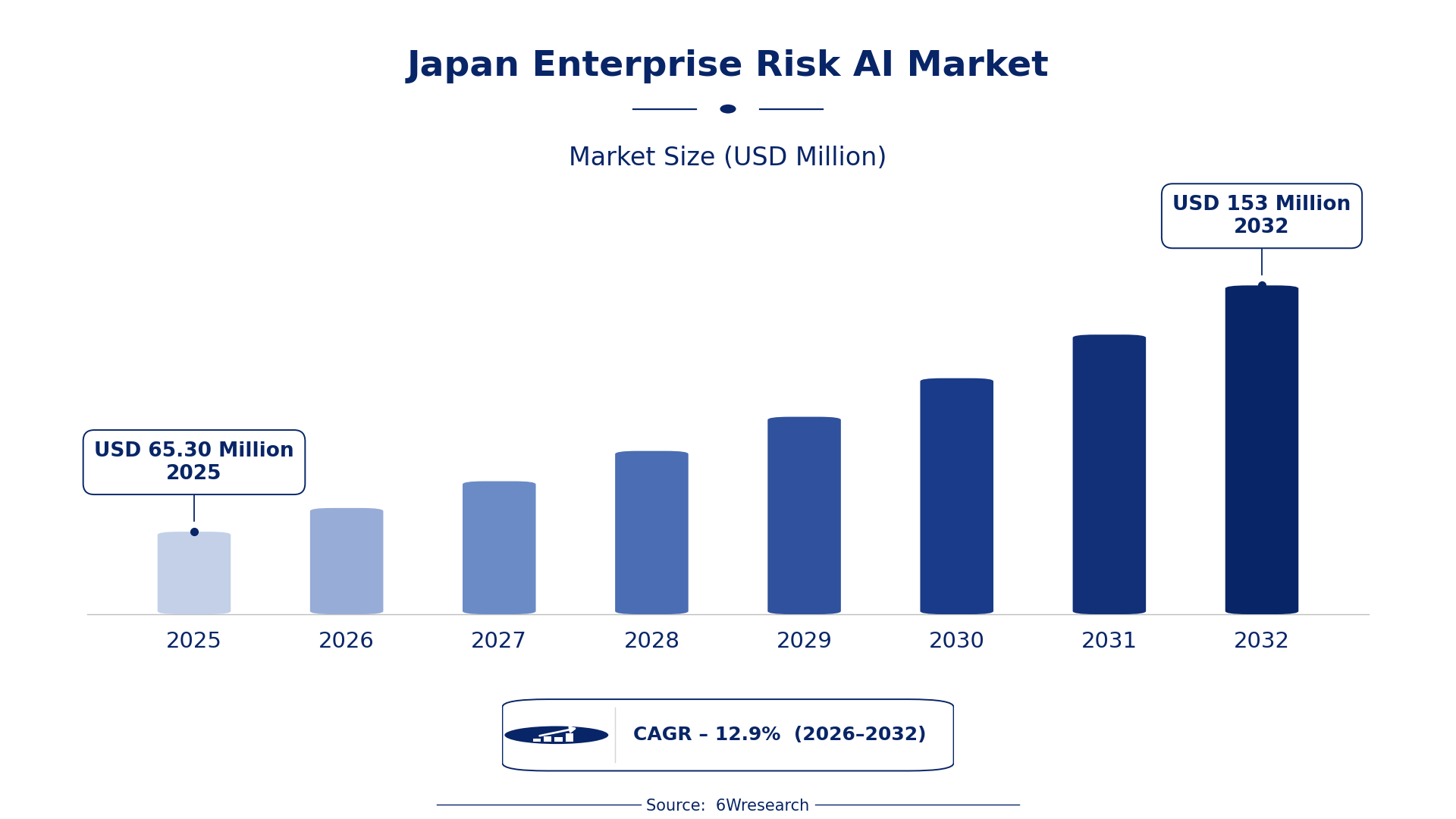
According to 6Wresearch internal database and industry insights, the Japan Enterprise Risk AI Market was valued at USD 65.30 Million in 2025 and is projected to reach USD 153 Million by 2032, growing at a CAGR of approximately 12.9% during 2026–2032.
Japan Enterprise Risk AI Market Highlights
| Report Metric | Details |
| Report Name | Japan Enterprise Risk AI Market (2026-2032) |
| Market Size 2025 | USD 65.30 Million |
| Market Size 2032 | USD 153 Million |
| Absolute Growth 2025–2032 | USD 87.70 Million |
| CAGR 2026–2032 | 12.9% |
| Peak Annual Growth | 20.2% in 2026 |
| Forecast Period | 2026–2032 |
| Historical Data | 2022–2025 |
| Base Year | 2025 |
| Leading Risk Type, 2025 | Credit Risk (45% share) |
| Leading AI Tool Used, 2025 | Predictive AI (36% share) |
| Leading Data Input Type, 2025 | Transaction Logs (39% share) |
| Leading Sector Focus, 2025 | Retail Banking (38% share) |
| Fastest-Growing Risk Type | Fraud Detection (17.3% CAGR) |
| Fastest-Growing Data Input Type | Customer History (17.6% CAGR) |
| Fastest-Growing Sector Focus | Insurance Firms (15.8% CAGR) |
| Growing Sector | Financial Services |
| Key End Users | Banks, Insurance Firms, Compliance Agencies, Retail Banking |
Japan Enterprise Risk AI Market Year-wise Growth Rate and Key Drivers (2022–2032)
This graph illustrates the annual growth rates of the market from 2022 to 2032, highlighting a steady upward trajectory and projected market expansion over the forecast period.
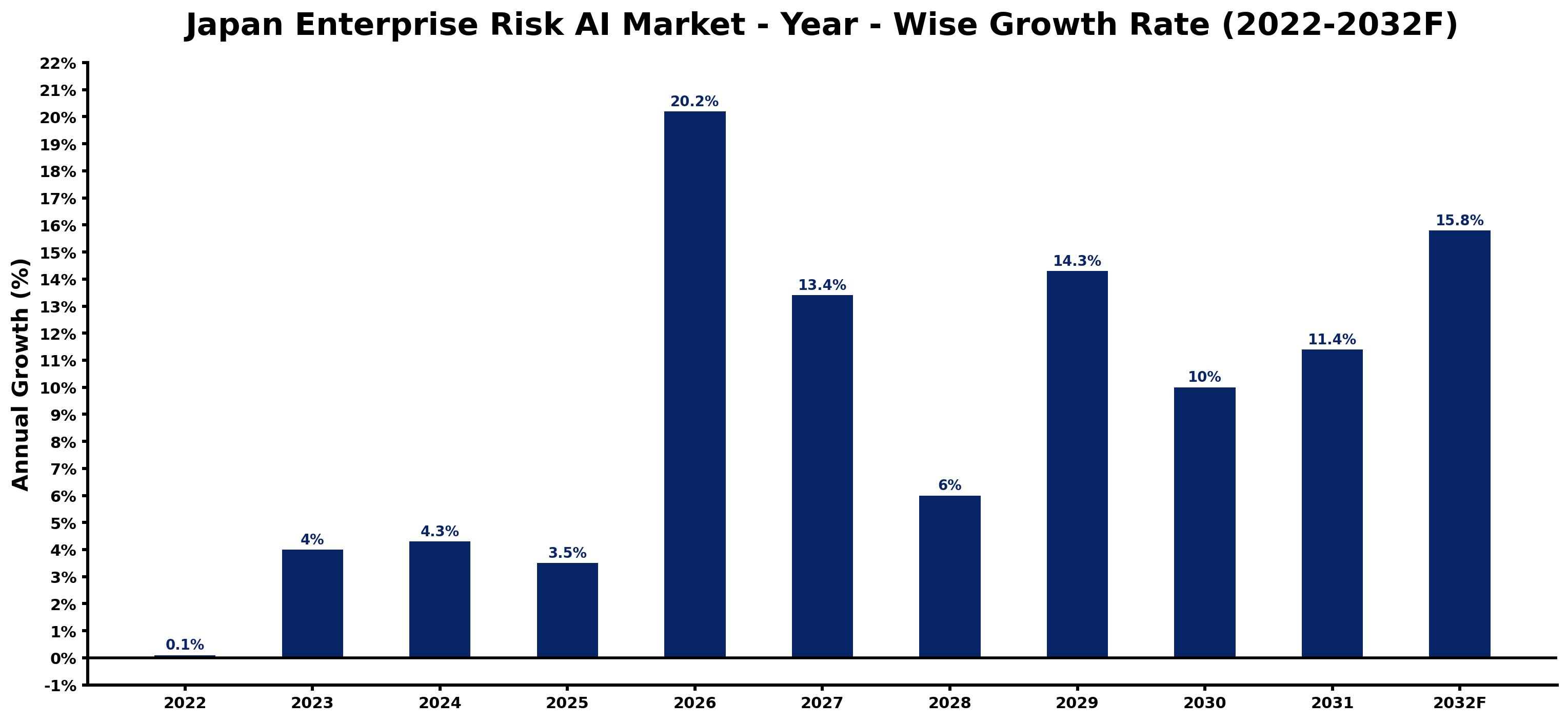
Below, each year's estimated growth is shown next to the factor that most influenced it.
| Year | Estimated Annual Growth (%) | Market Rationale |
| 2022 | 0.1 | The market showed minimal growth as adoption of AI technologies was still emerging. |
| 2023 | 4.0 | Demand increased as financial institutions began integrating AI for risk assessments. |
| 2024 | 4.3 | Growth continued as more firms recognised the importance of risk management. |
| 2025 | 3.5 | Growth slowed due to market saturation in some areas of AI applications. |
| 2026 | 20.2 | The peak growth year will see a surge in AI adoption across financial sectors. |
| 2027 | 13.4 | Growth is expected to decelerate as firms begin consolidating AI investments and optimising usage. |
| 2028 | 6.0 | The market will experience slower growth as early adopters stabilise their systems. |
| 2029 | 14.3 | Demand will rise again as new AI capabilities are introduced to the market. |
| 2030 | 10.0 | Growth is projected to slow as competition intensifies among existing providers. |
| 2031 | 11.4 | The market will see renewed interest as regulatory requirements increase. |
| 2032 | 15.8 | Growth is expected to accelerate again as firms expand their AI capabilities for compliance. |
Note: Market size estimations and growth projections presented in this report are based on 6Wresearch's proprietary forecasting methodology, utilizing the latest available industry data, government publications, and primary research inputs.
Japan Enterprise Risk AI Market Synopsis
This technology finds its primary application in the financial sector, where it aids in creditworthiness evaluations, fraud detection, and regulatory compliance. Recent initiatives aimed at promoting AI adoption further propel market growth, improving operational efficiency and compliance capabilities.
Market Dynamics Impact Analysis (2026–2032)
| Factor | Type | Impact | Primary Segment Affected |
| Increased regulatory requirements for risk assessments | Driver | High | Regulatory Risk |
| Growing need for fraud detection in financial transactions | Driver | High | Fraud Detection |
| Investment in AI technologies by financial institutions | Opportunity | High | Credit Risk |
| Expansion of AI capabilities in risk management | Opportunity | Medium | Operational Risk |
| High initial investment costs for AI implementation | Restraint | High | Credit Risk |
| Limited understanding of AI technologies among smaller firms | Restraint | Medium | Fraud Detection |
| Competition from traditional risk assessment methods | Challenge | High | Regulatory Risk |
| Challenges in data privacy and security compliance | Challenge | Medium | Operational Risk |
Evaluation of Drivers in Japan Enterprise Risk AI Market (2026–2032)
The table below links each growth driver to the segment it affects and the evidence for it.
| Drivers | Primary Segment Affected | Why It Matters (Evidence) |
| Increased regulatory compliance requirements | Regulatory Risk | Regulatory mandates necessitate rigorous risk assessments, driving demand for AI solutions in financial institutions. |
| Rising instances of fraud in financial transactions | Fraud Detection | The need to combat fraud encourages banks to invest in AI technologies for real-time detection. |
| Growth of the financial services sector | Credit Risk | Japan's $6 trillion financial services sector fuels demand for advanced risk assessment technologies. |
| Technological advancements in AI and machine learning | Operational Risk | Innovations in AI improve risk management capabilities, prompting financial firms to adopt these technologies. |
| Increased consumer awareness about data security | Fraud Detection | As consumers demand better protection, financial institutions invest in AI to ensure transaction safety. |
The financial services sector, valued at $6 trillion, is expanding, thereby fuelling the need for sophisticated risk assessment tools. A surge in fraud incidents has led banks to invest in AI for real-time detection. As consumer awareness of data security rises, financial firms are implementing AI solutions to ensure transaction safety.
Evaluation of Restraints in Japan Enterprise Risk AI Market
These restraints slow adoption and weigh on supplier margins.
| Market Restraint | Primary Segment Affected | Why It Matters (Evidence) |
| High initial investment costs for AI implementation | Credit Risk | The upfront costs deter smaller financial institutions from adopting AI solutions. |
| Limited understanding of AI technologies among smaller firms | Fraud Detection | Smaller firms often lack the expertise to implement AI, hindering their competitive edge. |
| Competition from traditional risk assessment methods | Regulatory Risk | Established methods remain preferred by some institutions, slowing AI adoption. |
| Challenges in data privacy and security compliance | Operational Risk | Concerns over data handling and privacy regulations create hesitance in adopting AI. |
| Slow integration into existing systems | Credit Risk | Legacy systems in many banks complicate the adoption of new AI technologies. |
Japan Enterprise Risk AI Market Challenges
A major challenge for buyers in Japan's financial sector is the difficulty in implementing effective risk assessment tools, complicating compliance with regulatory mandates. The Financial Services Agency's stringent requirements demand thorough evaluations, often causing delays in decision-making for banks and reducing their operational efficiency. High personnel costs, with average salaries around $60,000, place budgetary pressure on many firms, restricting their capacity to recruit necessary talent. Disruptions in the technology supply chain can result in delays for AI solution implementation, impacting over 100 banks that depend on timely updates for risk management.
Trends in the Japan Enterprise Risk AI Market
The trends below show where the Japan Enterprise Risk AI Market is heading.
- Shift towards AI-driven Fraud Detection: Financial institutions are increasingly adopting AI-driven solutions for fraud detection, with over 100 banks in Japan implementing these technologies. This shift is due to the need for real-time transaction monitoring to combat rising fraud rates.
- Growing Adoption of Predictive AI Tools: Predictive AI tools are becoming essential for assessing credit risk, with a projected CAGR of 16.5% in this segment. This trend is clear as banks and insurance firms seek to improve their risk assessment capabilities.
- Increased Focus on Regulatory Compliance: The Financial Services Agency's emphasis on compliance has led to a surge in demand for AI solutions that ensure adherence to regulations. This focus is reflected in the allocation of $50 million towards AI innovation in finance.
- Expansion of AI Capabilities in Risk Management: As AI technologies evolve, financial institutions are expanding their capabilities in risk management. The introduction of ISO 31000 as a standard for risk management has accelerated this trend.
Investment Opportunities in the Japan Enterprise Risk AI Market
Investors looking at the Japan Enterprise Risk AI Market should consider the following areas.
- Insurance Firms Seeking Advanced Risk Solutions: Insurance firms are increasingly pursuing AI solutions to refine underwriting processes, with a market gap of $50 million in AI adoption. Collaborating with local tech firms can ease entry into this expanding segment.
- Retail Banking's Demand for Enhanced Fraud Detection: Retail banking is making substantial investments in AI for fraud detection, revealing a significant gap in technology adoption. Forming partnerships with AI developers can enable banks to effectively meet this demand.
- Investment in AI for Regulatory Compliance: With regulatory requirements tightening, financial institutions are actively seeking AI solutions for compliance. Engaging with compliance agencies can streamline the approval process for new technologies.
- Financial Services Sector's Push for Innovation: The financial services sector is emphasising innovation in risk management, creating opportunities for AI suppliers. Focusing on Tokyo as a key investment hub can yield considerable returns.
Government Initiatives in the Japan Enterprise Risk AI Market
The Digital Agency, established in September 2021, leads the government's digital transformation efforts by setting common system standards. This initiative complements existing laws, such as the Industrial Standardization Act, by promoting the adoption of AI technologies in financial services. The agency's efforts support the integration of AI in Enterprise Risk AI applications, ensuring compliance with industry standards and improving operational efficiency.
Compliance agencies, such as the Financial Services Agency, utilise the Digital Agency's framework to ensure that financial institutions adhere to regulatory standards. This oversight supports the implementation of AI solutions, ensuring they meet compliance requirements and facilitating smoother integration into existing systems.
Future Insight of the Japan Enterprise Risk AI Market
Japan's financial sector is set for substantial transformation by 2032, driven by government initiatives that encourage AI integration in financial services. New programmes will incentivise firms to adopt advanced risk management technologies, resulting in improved operational efficiency. Standards like ISO 31000 will gain prominence, ensuring consistency in risk assessments across the industry. As the financial services sector continues to flourish, buyers and suppliers will gain access to sophisticated tools that streamline compliance and improve decision-making processes.
Market Segmentation Analysis
Japan Enterprise Risk AI Market report covers a detailed analysis of the following market segments:
By Risk Type – Credit Risk Leads, Fraud Detection Expected to Grow Fastest
According to Saurav Kr Singh, Senior Research Analyst at 6Wresearch, with 45% of risk type revenue in 2025, Credit Risk was the largest category. The credit risk segment commands the largest share due to its vital function in assessing borrower reliability, essential for financial institutions. With over 100 banks operating in Japan, the demand for effective credit risk evaluation is substantial. The quickest growth will come from Fraud Detection, forecast to expand at a CAGR of 17.3% between 2026 and 2032. Fraud detection is witnessing rapid growth as financial institutions intensify efforts to identify and prevent fraudulent activities. The recent initiative launched in 2023 to enhance AI adoption in financial services further accelerates this segment's expansion. Suppliers should prioritise the development of advanced fraud detection solutions to address the increasing needs of financial institutions.
By AI Tool Used – Predictive AI Leads and Records the Fastest Growth
Predictive AI took 36% of ai tool used revenue in 2025, more than any other category. Predictive AI dominates the market as it is widely employed for forecasting potential risks based on historical data, which is crucial for informed financial decision-making. Its extensive use across various financial services reinforces its leading position. The same category is also set to grow fastest, at a CAGR of 16.5% during 2026–2032. Predictive AI is also the fastest-growing tool due to its essential role in both credit risk evaluation and fraud detection, ensuring its continuous relevance. As the leader in this category, its growth will likely widen the gap with other tools. Buyers should invest in predictive AI technologies to strengthen their risk management capabilities.
By Data Input Type – Transaction Logs Lead, Customer History Expected to Grow Fastest
The largest data input type category in 2025 was Transaction Logs, at 39% of revenue. Transaction logs hold the largest share as they are critical for real-time fraud detection and managing operational risks, making them indispensable for financial institutions. Their direct application in monitoring transactions underlines their importance in risk assessment. Customer History is set to record the highest CAGR in this split, 17.6% over 2026–2032. Customer history is experiencing rapid growth, as it is crucial for assessing credit risk and detecting fraud, reflecting the increasing emphasis on personalised financial services. The rising demand for insights from customer interactions is driving this segment's expansion. Suppliers must create solutions that effectively leverage customer history data to optimise risk management strategies.
By Sector Focus – Retail Banking Leads, Insurance Firms Expected to Grow Fastest
Retail Banking accounted for 38% of the market by sector focus in 2025. Retail banking is the leading sector for enterprise risk AI, as it extensively employs these technologies for credit and fraud assessments, highlighting the sector's reliance on effective risk management. The robust financial services sector in Japan ensures a consistent demand for such solutions. Over 2026–2032, Insurance Firms are expected to post the fastest growth, at a CAGR of 15.8%. Insurance firms represent the fastest-growing segment, utilising risk AI for underwriting and detecting claims fraud, which is becoming increasingly critical in today's market. The growing complexity of risk in insurance will drive further advancements in this area. Buyers in the insurance sector should pursue tailored risk AI solutions to improve their operational efficiency.
Key Attractiveness of the Report
- 10 Years of Market Numbers
- Historical Data Starting from 2022 to 2025
- Base Year 2025
- Forecast Data until 2032
- Key Performance Indicators Impacting the Market
- Major Upcoming Developments and Projects
Key Highlights of the Report:
- Japan Enterprise Risk AI Market Outlook
- Market Size of Japan Enterprise Risk AI Market, 2025
- Forecast of Japan Enterprise Risk AI Market, 2032
- Historical Data and Forecast of Japan Enterprise Risk AI Revenues & Volume for the Period 2022-2032F
- Japan Enterprise Risk AI Market Trend Evolution
- Japan Enterprise Risk AI Market Drivers and Challenges
- Japan Enterprise Risk AI Price Trends
- Japan Enterprise Risk AI Porter's Five Forces
- Japan Enterprise Risk AI Industry Life Cycle
- Historical Data and Forecast of Japan Enterprise Risk AI Market Revenues & Volume By Risk Type for the Period 2022-2032F
- Historical Data and Forecast of Japan Enterprise Risk AI Market Revenues & Volume By Credit Risk for the Period 2022-2032F
- Historical Data and Forecast of Japan Enterprise Risk AI Market Revenues & Volume By Fraud Detection for the Period 2022-2032F
- Historical Data and Forecast of Japan Enterprise Risk AI Market Revenues & Volume By Regulatory Risk for the Period 2022-2032F
- Historical Data and Forecast of Japan Enterprise Risk AI Market Revenues & Volume By Operational Risk for the Period 2022-2032F
- Historical Data and Forecast of Japan Enterprise Risk AI Market Revenues & Volume By AI Tool Used for the Period 2022-2032F
- Historical Data and Forecast of Japan Enterprise Risk AI Market Revenues & Volume By Predictive AI for the Period 2022-2032F
- Historical Data and Forecast of Japan Enterprise Risk AI Market Revenues & Volume By Pattern AI for the Period 2022-2032F
- Historical Data and Forecast of Japan Enterprise Risk AI Market Revenues & Volume By NLP Platform for the Period 2022-2032F
- Historical Data and Forecast of Japan Enterprise Risk AI Market Revenues & Volume By ML Models for the Period 2022-2032F
- Historical Data and Forecast of Japan Enterprise Risk AI Market Revenues & Volume By Data Input Type for the Period 2022-2032F
- Historical Data and Forecast of Japan Enterprise Risk AI Market Revenues & Volume By Customer History for the Period 2022-2032F
- Historical Data and Forecast of Japan Enterprise Risk AI Market Revenues & Volume By Transaction Logs for the Period 2022-2032F
- Historical Data and Forecast of Japan Enterprise Risk AI Market Revenues & Volume By Legal Texts for the Period 2022-2032F
- Historical Data and Forecast of Japan Enterprise Risk AI Market Revenues & Volume By Workflow Records for the Period 2022-2032F
- Historical Data and Forecast of Japan Enterprise Risk AI Market Revenues & Volume By Sector Focus for the Period 2022-2032F
- Historical Data and Forecast of Japan Enterprise Risk AI Market Revenues & Volume By Retail Banking for the Period 2022-2032F
- Historical Data and Forecast of Japan Enterprise Risk AI Market Revenues & Volume By Insurance Firms for the Period 2022-2032F
- Historical Data and Forecast of Japan Enterprise Risk AI Market Revenues & Volume By Compliance Agencies for the Period 2022-2032F
- Historical Data and Forecast of Japan Enterprise Risk AI Market Revenues & Volume By Wealth Managers for the Period 2022-2032F
- Japan Enterprise Risk AI Import Export Trade Statistics
- Market Opportunity Assessment By Risk Type
- Market Opportunity Assessment By AI Tool Used
- Market Opportunity Assessment By Data Input Type
- Market Opportunity Assessment By Sector Focus
- Japan Enterprise Risk AI Top Companies Market Share
- Japan Enterprise Risk AI Competitive Benchmarking By Technical and Operational Parameters
- Japan Enterprise Risk AI Company Profiles
- Japan Enterprise Risk AI Key Strategic Recommendations
Market Covered
Segments analysed in this report are listed below.
By Risk Type
- Credit Risk
- Fraud Detection
- Regulatory Risk
- Operational Risk
By AI Tool Used
- Predictive AI
- Pattern AI
- NLP Platform
- ML Models
By Data Input Type
- Customer History
- Transaction Logs
- Legal Texts
- Workflow Records
By Sector Focus
- Retail Banking
- Insurance Firms
- Compliance Agencies
- Wealth Managers































