Japan Fabricated Metal Products Market Size & Growth Rate
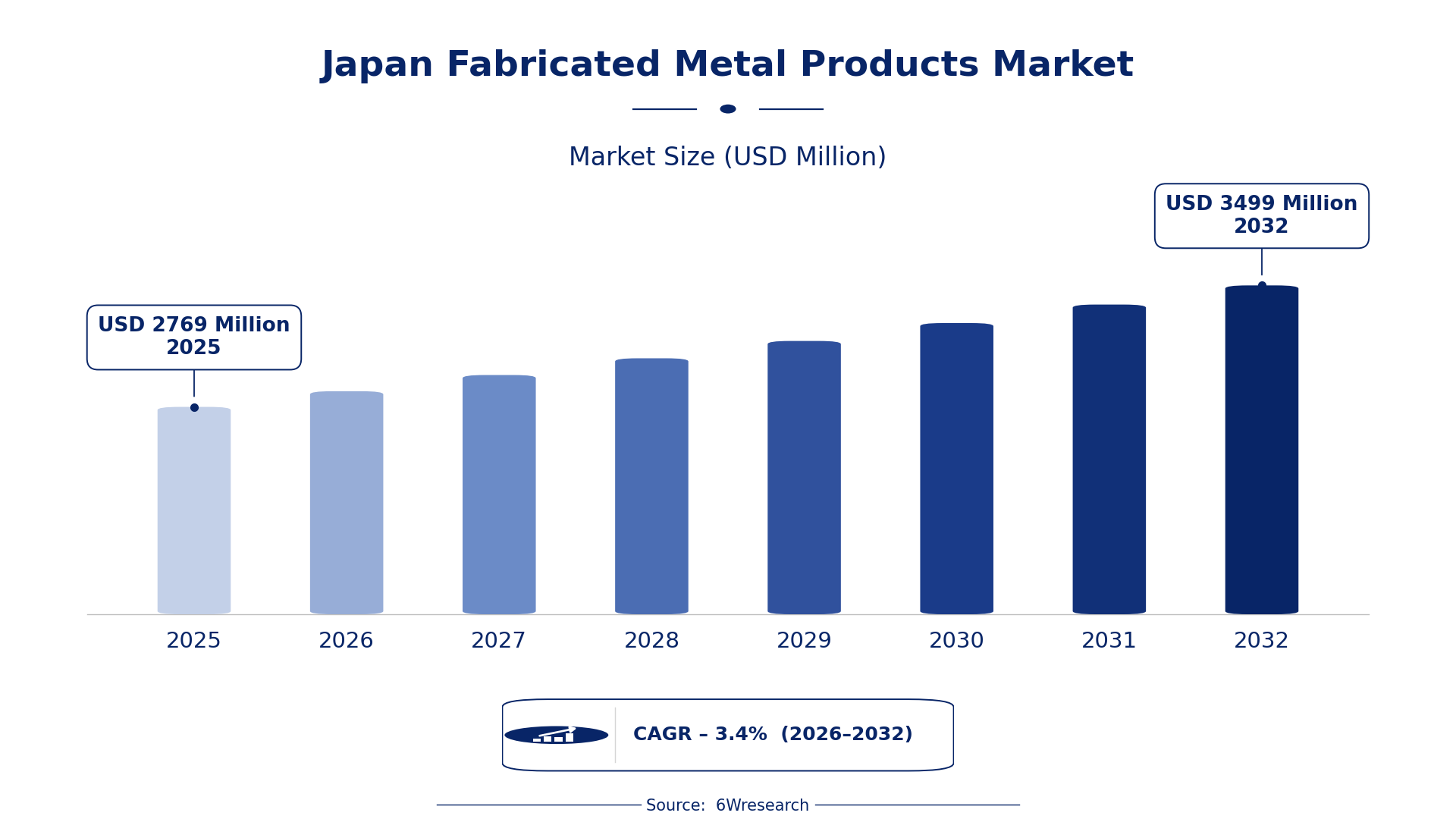
According to 6Wresearch internal database and industry insights, the Japan Fabricated Metal Products Market was valued at USD 2,769 Million in 2025 and is projected to reach USD 3,499 Million by 2032, growing at a CAGR of approximately 3.4% during 2026–2032.
Japan Fabricated Metal Products Market Highlights
| Report Metric | Details |
| Report Name | Japan Fabricated Metal Products Market (2026-2032) |
| Market Size 2025 | USD 2,769 Million |
| Market Size 2032 | USD 3,499 Million |
| Absolute Growth 2025–2032 | USD 730 Million |
| CAGR 2026–2032 | 3.4% |
| Peak Annual Growth | 4.2% in 2028 |
| Forecast Period | 2026–2032 |
| Historical Data | 2022–2025 |
| Base Year | 2025 |
| Leading Types, 2025 | Structural metal products (15% share) |
| Leading End-users Industry, 2025 | Automobile industry (41% share) |
| Leading Channel, 2025 | Direct Sales (56% share) |
| Fastest-Growing Types | machined metals (5.1% CAGR) |
| Fastest-Growing End-users Industry | Machinery Industry (4.5% CAGR) |
| Growing Sector | Automotive industry |
| Key End Users | Automotive manufacturers, machinery producers, construction companies, aerospace sector |
Japan Fabricated Metal Products Market Year-wise Growth Rate and Key Drivers (2022–2032)
This graph illustrates the annual growth rates of the market from 2022 to 2032, highlighting a steady upward trajectory and projected market expansion over the forecast period.
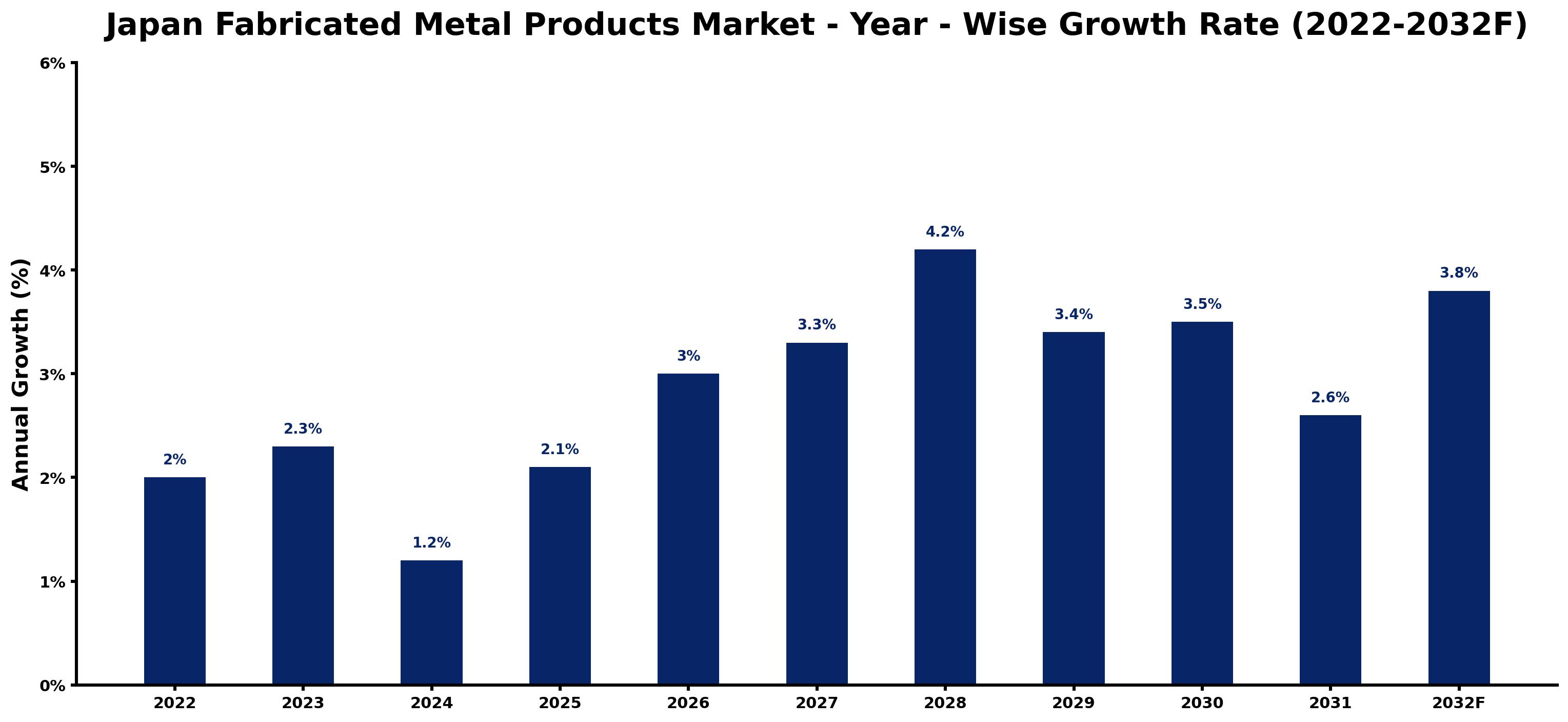
The following figures match every annual growth estimate with the main market development of that year, giving the reasoning behind each rise or slowdown.
| Year | Estimated Annual Growth (%) | Market Rationale |
| 2022 | 2.0 | The market experienced moderate growth due to stable demand from the automotive sector. |
| 2023 | 2.3 | Growth was driven by increased production in the automotive industry and rising exports. |
| 2024 | 1.2 | A slowdown occurred as manufacturers faced supply chain challenges and fluctuating material costs. |
| 2025 | 2.1 | Demand improved with a recovery in automotive production and new investments in machinery. |
| 2026 | 3.0 | Growth is expected to accelerate as investments in advanced manufacturing technologies begin to take effect. |
| 2027 | 3.3 | Higher demand from the machinery sector is projected to contribute to continued growth in the market. |
| 2028 | 4.2 | The peak growth year will see investments in decarbonisation technologies boosting demand. |
| 2029 | 3.4 | A slight slowdown is anticipated as the market stabilises after the peak growth year. |
| 2030 | 3.5 | Demand is expected to rise again due to ongoing investments in infrastructure and manufacturing capabilities. |
| 2031 | 2.6 | Growth is projected to slow as market conditions normalise after several years of expansion. |
| 2032 | 3.8 | The market is expected to grow steadily with continued focus on sustainability and innovation. |
Note: Market size estimations and growth projections presented in this report are based on 6Wresearch's proprietary forecasting methodology, utilizing the latest available industry data, government publications, and primary research inputs.
Japan Fabricated Metal Products Market Synopsis
Fabricated metal products are manufactured through processes such as cutting, welding, and assembling metal components, serving essential roles in industries like automotive and machinery. The Japan Fabricated Metal Products Market is expanding due to strong demand from the automotive sector, which accounts for over 30% of the total market. Japan's commitment to a JPY 150 trillion decarbonisation investment over the next decade is driving technological advancements and increasing production capabilities, further promoting market growth.
Market Dynamics Impact Analysis (2026–2032)
| Factor | Type | Impact | Primary Segment Affected |
| Strong demand from the automotive industry drives the need for fabricated metal products. | Driver | High | Automobile industry |
| Investment in advanced manufacturing technologies enhances production efficiency. | Driver | High | machined metals |
| Rising exports to international markets present new opportunities for manufacturers. | Opportunity | High | general hardware |
| Government funding for research and development in metal processing technologies creates new avenues for growth. | Opportunity | Medium | Structural metal products |
| Fluctuating raw material prices can impact production costs and profitability. | Restraint | High | Treated |
| Supply chain disruptions may hinder timely delivery of products to end-users. | Restraint | Medium | Cutlery |
| Talent shortages in skilled manufacturing roles can limit production capacity. | Challenge | High | tools |
| Competition from low-cost imports may pressure local manufacturers' pricing strategies. | Challenge | Medium | pressed |
Evaluation of Drivers in Japan Fabricated Metal Products Market (2026–2032)
The following drivers explain most of the expected growth.
| Drivers | Primary Segment Affected | Why It Matters (Evidence) |
| Increased automotive production drives demand for fabricated metal components. | Automobile industry | The automobile industry accounts for over 30% of the demand for fabricated metal products in Japan. |
| Investment in advanced manufacturing technologies enhances production capabilities. | machined metals | The government allocated 5 billion yen for research and development in metal processing technologies. |
| Growing exports to international markets expand the customer base for manufacturers. | general hardware | Approximately 25% of fabricated metal products are exported to international markets. |
| Rising infrastructure investments boost demand for structural metal products. | Structural metal products | Japan targets a 46% cut in greenhouse-gas emissions by 2030, stimulating construction projects. |
| Technological advancements in fabrication processes improve product quality and efficiency. | Treated | The JIS G 3101 standard governs the quality of structural steel used in construction. |
What keeps demand rising is the automotive sector, which accounts for over 30% of the market. Exports, constituting approximately 25% of total output, are expanding the customer base for manufacturers. Infrastructure investments targeting a 46% reduction in greenhouse-gas emissions by 2030 are driving demand for structural metal products. Technological advancements governed by the JIS G 3101 standard are improving product quality and efficiency, encouraging more purchases from the automotive and machinery sectors.
Evaluation of Restraints in Japan Fabricated Metal Products Market
Several factors work against faster growth; the main ones are summarised below.
| Market Restraint | Primary Segment Affected | Why It Matters (Evidence) |
| Fluctuating raw material prices can impact production costs. | Treated | Rising costs of raw materials can squeeze margins, affecting profitability for manufacturers. |
| Supply chain disruptions may hinder timely delivery of products. | Cutlery | Delays in supply chains can lead to missed deadlines for construction and manufacturing projects. |
| Regulatory compliance costs can burden manufacturers in the sector. | general hardware | Meeting standards such as ISO 9001 certification requires investment in quality management systems. |
| Limited access to skilled labor can restrict production capacity. | tools | Talent shortages in skilled manufacturing roles can lead to delays in meeting customer demand. |
| Competition from low-cost imports pressures local manufacturers' pricing. | pressed | Imported products can undercut local prices, making it difficult for domestic producers to compete. |
Japan Fabricated Metal Products Market Challenges
Manufacturers face regulatory hurdles under the JIS G 3101 standard, complicating compliance and delaying production timelines for producers. Slow technology adoption persists, resulting in inefficiencies that can reduce competitiveness for many manufacturers. Buyers experience rising costs due to raw material price fluctuations, which can inflate product prices by 15%, straining their financial resources. Limited government funding of 5 billion yen for R&D restricts innovation, affecting the ability of many producers to enhance their product offerings and meet market demands.
Trends in the Japan Fabricated Metal Products Market
These developments are changing demand patterns in the Japan Fabricated Metal Products Market.
- Growing Demand for Precision Engineering: The aerospace sector is increasingly relying on machined metals for precision components. This trend has gained momentum since 2023, with a notable increase in demand for high-quality fabricated parts.
- Transition to Advanced Manufacturing Technologies: In 2023, Japan initiated a program to promote advanced manufacturing technologies in metal fabrication. This change is expected to improve production efficiency and product quality, with manufacturers investing heavily in automation.
- Emergence of Sustainable Practices in Metal Fabrication: Sustainability is becoming a priority in metal fabrication, with producers adopting eco-friendly practices. The government's Green Growth Strategy aims for carbon neutrality by 2050, influencing industry practices.
- Shift in Automotive Manufacturing Techniques: The automotive industry is increasingly adopting lightweight materials in production, improving fuel efficiency. This shift began in 2023, with over 30% of new vehicles incorporating fabricated metal components to reduce weight.
Investment Opportunities in the Japan Fabricated Metal Products Market
The openings below show where demand in the Japan Fabricated Metal Products Market is visible and how suppliers can enter.
- Kanto Region's Manufacturing Facilities: The Kanto region, known for its manufacturing capabilities, presents opportunities for investment in advanced fabrication technologies. The region's strategic location supports access to major markets, with a projected demand increase of 10% by 2025.
- Investment in Sustainable Manufacturing Practices: With Japan targeting a 46% reduction in greenhouse-gas emissions by 2030, there is an opportunity to invest in sustainable manufacturing practices. Companies in the automotive sector can benefit from this shift.
- Supply of High-Quality Machined Metals: The demand for precision components in the aerospace sector is growing, creating opportunities for suppliers of high-quality machined metals. Establishing partnerships with aerospace manufacturers can facilitate market entry.
- Collaboration with Small and Medium-Sized Enterprises: Collaborating with small and medium-sized enterprises in the metalworking industry can improve market reach. The Tokyo Metropolitan Government supports these enterprises, providing funding for innovation.
Government Initiatives in the Japan Fabricated Metal Products Market
The Economic Security Promotion Act, enacted in 2022, strengthens supply-chain resilience for critical products, including fabricated metal products. This law complements existing regulations by ensuring that manufacturers meet stringent quality and safety standards, thereby improving their market competitiveness. In 2023, the government allocated 5 billion yen for research and development initiatives, supporting innovation in metal processing technologies.
The Ministry of Economy, Trade and Industry oversees regulations for the fabricated metal products sector, approving funding for projects that improve production capabilities. In 2023, the agency allocated 5 billion yen for research and development initiatives, supporting innovation in metal processing technologies.
Future Insight of the Japan Fabricated Metal Products Market
Japan's commitment to decarbonisation will drive suppliers to integrate advanced manufacturing technologies, fundamentally changing production processes. The planned investment of approximately 150 trillion yen over the next decade will enhance infrastructure for metal fabrication, benefiting both buyers and suppliers. By 2032, heightened emphasis on ISO 9001 certification will improve quality assurance, building greater trust among buyers. The rise of precision engineering in aerospace will open new avenues for growth in the fabricated metal products sector.
Market Segmentation Analysis
Japan Fabricated Metal Products Market report covers a detailed analysis of the following market segments:
By Types – Structural metal products Lead, machined metals Expected to Grow Fastest
According to Ravi Bhandari, Research Head at 6Wresearch, the largest types category in 2025 was Structural metal products, at 15% of revenue. Structural metal products hold the largest share because they are crucial for construction and manufacturing applications, especially in the Kanto region, which includes major urban centres like Tokyo. Their compliance with the JIS G 3101 standard ensures high quality, making them essential for various infrastructure projects. Over 2026–2032, machined metals are expected to post the fastest growth, at a CAGR of 5.1%. Machined metals are experiencing rapid growth due to their critical role in precision engineering, particularly in the aerospace sector. The government's push for advanced manufacturing technologies is significantly increasing the demand for high-quality machined components, which will further widen the gap with other segments. This means suppliers should focus on enhancing their production capabilities and quality standards to meet the growing demand for structural metal products.
By End-users Industry – Automobile industry Leads, Machinery Industry Expected to Grow Fastest
Automobile industry held 41% of the Japan Fabricated Metal Products Market by end-users industry in 2025. The automobile industry is the leading end-user of fabricated metal products, accounting for over 30% of the total demand in Japan. This substantial share is driven by the industry's need for various structural and functional components in vehicle manufacturing. Machinery Industry is set to record the highest CAGR in this split, 4.5% over 2026–2032. The machinery industry is growing quickly as it increasingly requires fabricated metal products for diverse components used in machinery. The ongoing investments in advanced manufacturing technologies further accelerate this demand. Buyers in the machinery sector should prepare for increased competition and innovation in the supply of fabricated metal products.
By Channel – Direct Sales Leads and Records the Fastest Growth
Direct Sales took 56% of channel revenue in 2025, more than any other category. Direct sales dominate the market as the primary channel for reaching end-users, allowing manufacturers to establish strong relationships and understand customer needs effectively. This approach is particularly beneficial in the fabricated metal products sector, where tailored solutions are often required. Its lead should widen, with a projected CAGR of 4.4% during 2026–2032, the highest in this split. Direct sales are also the fastest-growing channel, as manufacturers are increasingly leveraging digital platforms to connect directly with customers. This trend is likely to continue as technology advances and customers prefer more direct interactions. This indicates that suppliers must improve their digital sales strategies to keep pace with the rising demand for direct sales channels.
Key Attractiveness of the Report
- 10 Years of Market Numbers
- Historical Data Starting from 2022 to 2025
- Base Year 2025
- Forecast Data until 2032
- Key Performance Indicators Impacting the Market
- Major Upcoming Developments and Projects
Key Highlights of the Report:
- Japan Fabricated Metal Products Market Outlook
- Market Size of Japan Fabricated Metal Products Market, 2025
- Forecast of Japan Fabricated Metal Products Market, 2032
- Historical Data and Forecast of Japan Fabricated Metal Products Revenues & Volume for the Period 2022-2032
- Japan Fabricated Metal Products Market Trend Evolution
- Japan Fabricated Metal Products Market Drivers and Challenges
- Japan Fabricated Metal Products Price Trends
- Japan Fabricated Metal Products Porter's Five Forces
- Japan Fabricated Metal Products Industry Life Cycle
- Historical Data and Forecast of Japan Fabricated Metal Products Market Revenues & Volume By Types for the Period 2022-2032
- Historical Data and Forecast of Japan Fabricated Metal Products Market Revenues & Volume By Structural metal products for the Period 2022-2032
- Historical Data and Forecast of Japan Fabricated Metal Products Market Revenues & Volume By Treated, coated, and machined metals for the Period 2022-2032
- Historical Data and Forecast of Japan Fabricated Metal Products Market Revenues & Volume By Cutlery, tools, and general hardware for the Period 2022-2032
- Historical Data and Forecast of Japan Fabricated Metal Products Market Revenues & Volume By Forged, pressed, stamped, and roll-formed metals for the Period 2022-2032
- Historical Data and Forecast of Japan Fabricated Metal Products Market Revenues & Volume By Other for the Period 2022-2032
- Historical Data and Forecast of Japan Fabricated Metal Products Market Revenues & Volume By End-users Industry for the Period 2022-2032
- Historical Data and Forecast of Japan Fabricated Metal Products Market Revenues & Volume By Automobile industry for the Period 2022-2032
- Historical Data and Forecast of Japan Fabricated Metal Products Market Revenues & Volume By Machinery Industry for the Period 2022-2032
- Historical Data and Forecast of Japan Fabricated Metal Products Market Revenues & Volume By Household Items for the Period 2022-2032
- Historical Data and Forecast of Japan Fabricated Metal Products Market Revenues & Volume By Electronics industry for the Period 2022-2032
- Historical Data and Forecast of Japan Fabricated Metal Products Market Revenues & Volume By Others for the Period 2022-2032
- Historical Data and Forecast of Japan Fabricated Metal Products Market Revenues & Volume By Channel for the Period 2022-2032
- Historical Data and Forecast of Japan Fabricated Metal Products Market Revenues & Volume By Direct Sales for the Period 2022-2032
- Historical Data and Forecast of Japan Fabricated Metal Products Market Revenues & Volume By Distributors for the Period 2022-2032
- Japan Fabricated Metal Products Import Export Trade Statistics
- Market Opportunity Assessment By Types
- Market Opportunity Assessment By End-users Industry
- Market Opportunity Assessment By Channel
- Japan Fabricated Metal Products Top Companies Market Share
- Japan Fabricated Metal Products Competitive Benchmarking By Technical and Operational Parameters
- Japan Fabricated Metal Products Company Profiles
- Japan Fabricated Metal Products Key Strategic Recommendations
Market Covered
Segments analysed in this report are listed below.
By Types
- Structural metal products
- Treated
- coated
- machined metals
- Cutlery
- tools
- general hardware
- Forged
- pressed
- stamped
- roll-formed metals
- Other
By End-users Industry
- Automobile industry
- Machinery Industry
- Household Items
- Electronics industry
- Others
By Channel
- Direct Sales
- Distributors































