Japan Facial Treatment Products Market Size & Growth Rate
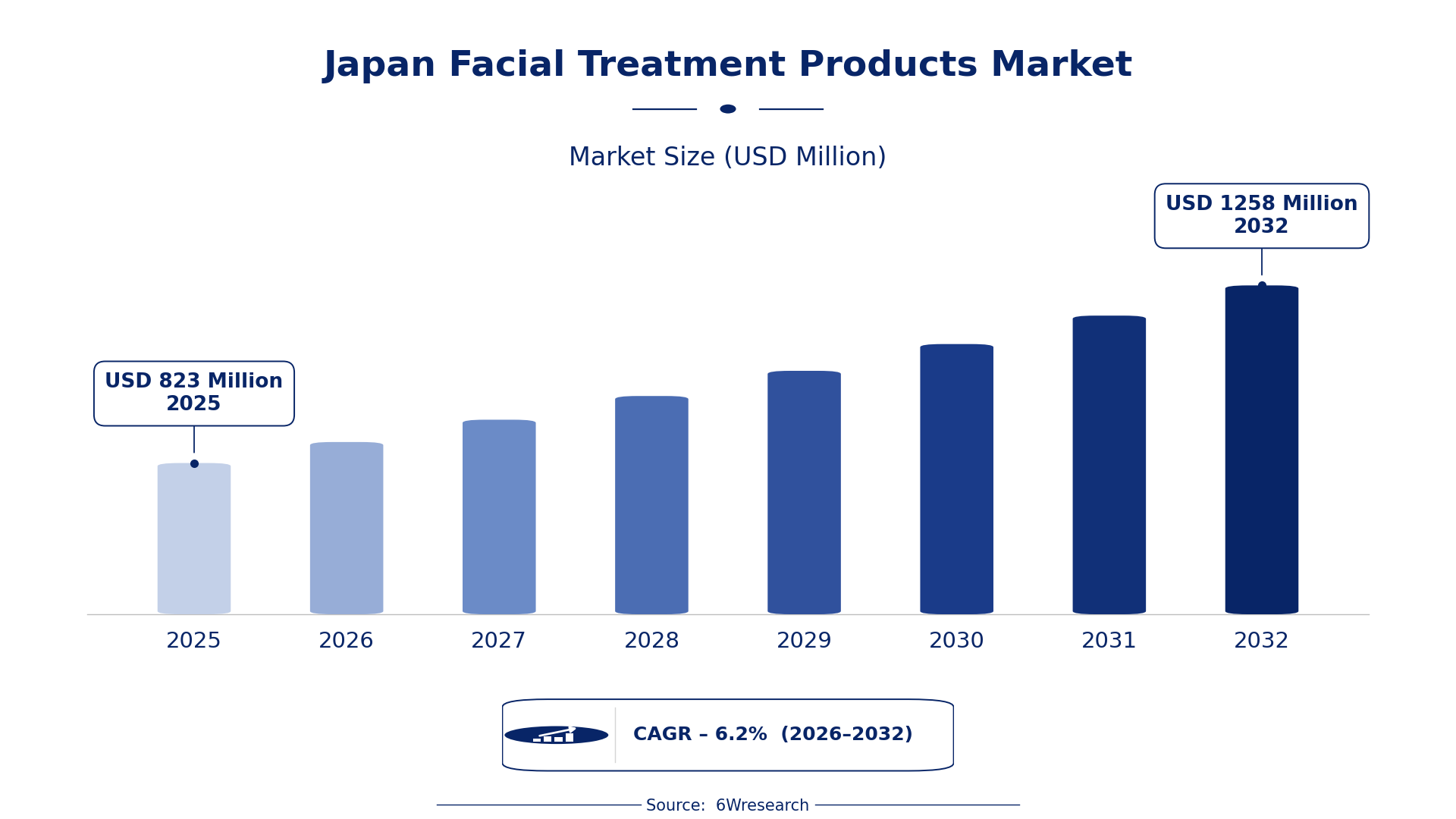
According to 6Wresearch internal database and industry insights, the Japan Facial Treatment Products Market was valued at USD 823 Million in 2025 and is projected to reach USD 1,258 Million by 2032, growing at a CAGR of approximately 6.2% during 2026–2032.
Japan Facial Treatment Products Market Highlights
| Report Metric | Details |
| Report Name | Japan Facial Treatment Products Market (2026-2032) |
| Market Size 2025 | USD 823 Million |
| Market Size 2032 | USD 1,258 Million |
| Absolute Growth 2025–2032 | USD 435 Million |
| CAGR 2026–2032 | 6.2% |
| Peak Annual Growth | 7.1% in 2031 |
| Forecast Period | 2026–2032 |
| Historical Data | 2022–2025 |
| Base Year | 2025 |
| Leading Product Type, 2025 | Cleansers (36% share) |
| Leading Skin Type, 2025 | All Skin Types (45% share) |
| Leading Distribution Channel, 2025 | Drugstores (39% share) |
| Leading End User, 2025 | Mass Market Consumers (45% share) |
| Fastest-Growing Product Type | Exfoliators (8.9% CAGR) |
| Fastest-Growing Skin Type | Oily Skin (8.8% CAGR) |
| Fastest-Growing Distribution Channel | Online Stores (8.1% CAGR) |
| Fastest-Growing End User | Youth Demographic (8.2% CAGR) |
| Growing Sector | Skincare |
| Key End Users | Mass Market Consumers, Youth Demographic, Skincare Clinics, Home Users |
Japan Facial Treatment Products Market Year-wise Growth Rate and Key Drivers (2022–2032)
This graph illustrates the annual growth rates of the market from 2022 to 2032, highlighting a steady upward trajectory and projected market expansion over the forecast period.
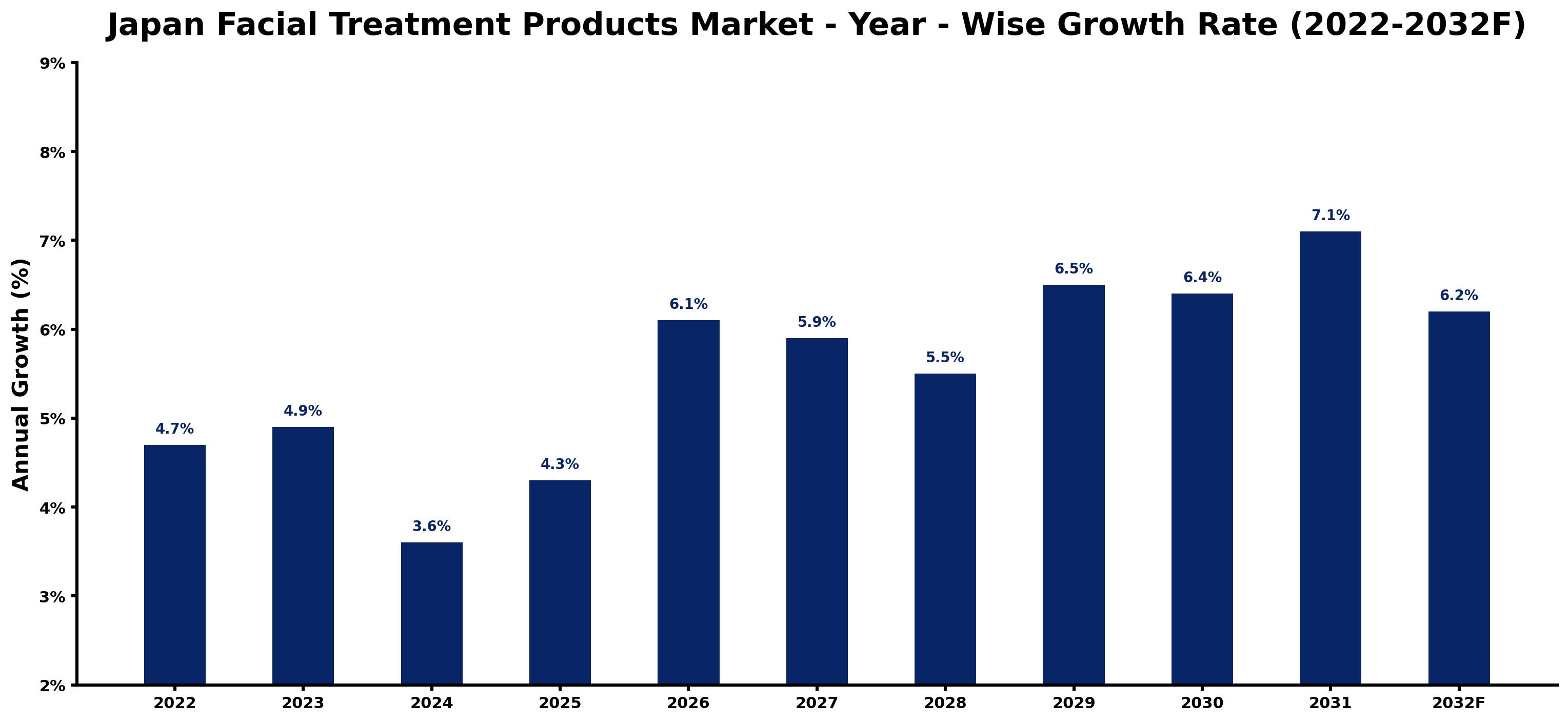
For each year, the table pairs the estimated growth rate with the leading influence on demand, showing how the drivers changed across the period.
| Year | Estimated Annual Growth (%) | Market Rationale |
| 2022 | 4.7 | Consumer spending on skincare was high, reflecting a strong market presence. |
| 2023 | 4.9 | The increase in skincare product interest led to higher growth than in 2022. |
| 2024 | 3.6 | Growth slowed due to market saturation and changing consumer preferences. |
| 2025 | 4.3 | A resurgence in interest in facial treatments boosted market performance. |
| 2026 | 6.1 | Investment in natural skincare products is expected to drive a faster growth rate. |
| 2027 | 5.9 | Market growth is projected to slow slightly as consumers become more selective. |
| 2028 | 5.5 | Continued demand for new products will contribute to slower growth. |
| 2029 | 6.5 | Rising awareness of skincare benefits is expected to spur faster growth again. |
| 2030 | 6.4 | Growth will slow as consumers focus on essential products amid economic factors. |
| 2031 | 7.1 | The peak growth year will see a surge in demand for premium skincare products. |
| 2032 | 6.2 | Market growth is projected to slow but remain strong due to sustained consumer interest. |
Note: Market size estimations and growth projections presented in this report are based on 6Wresearch's proprietary forecasting methodology, utilizing the latest available industry data, government publications, and primary research inputs.
Japan Facial Treatment Products Market Synopsis
Facial treatment products are cosmetic formulations designed to enhance the appearance and health of the skin on the face. The Japan Facial Treatment Products Market was valued at approximately 1.5 trillion yen in 2022, with consumers spending around 10,000 yen monthly on skincare. This growth is driven by high consumer interest in skincare routines, the increasing popularity of natural products, and the rise of online sales, which grew by 15% in 2022, particularly in urban areas.
Market Dynamics Impact Analysis (2026–2032)
| Factor | Type | Impact | Primary Segment Affected |
| Increased consumer interest in skincare routines drives demand for facial treatment products. | Driver | High | Cleansers |
| The rise of e-commerce platforms enhances product accessibility for consumers. | Driver | High | Online Stores |
| Growing demand for natural skincare products presents opportunities for new entrants. | Opportunity | High | Exfoliators |
| Expansion of beauty stores in urban areas creates a need for diverse product offerings. | Opportunity | High | Beauty Stores |
| Market saturation limits growth potential for existing brands. | Restraint | Medium | All Skin Types |
| Economic fluctuations may affect consumer spending on non-essential items. | Restraint | Medium | Mass Market Consumers |
| High competition among brands can lead to price wars, affecting profitability. | Challenge | High | Cleansers |
| Consumer preferences shift rapidly, making it difficult for brands to keep up. | Challenge | High | Exfoliators |
Evaluation of Drivers in Japan Facial Treatment Products Market (2026–2032)
The following drivers explain most of the expected growth.
| Drivers | Primary Segment Affected | Why It Matters (Evidence) |
| Increased consumer spending on skincare products | Cleansers | The average Japanese consumer spends about 10,000 yen monthly on skincare products, driving higher purchases of cleansers. |
| Growth of online retail channels | Online Stores | Online sales of skincare products increased by 15% in 2022, attracting more consumers to purchase facial treatments online. |
| Rising awareness of skincare benefits | Exfoliators | With the youth demographic representing 25% of consumers, there is a growing demand for exfoliating products among younger consumers. |
| Interest in natural ingredients | Masks & Peels | The Japanese government's 2023 program to promote natural skincare products has increased consumer interest in masks and peels. |
| Expansion of beauty stores in urban areas | Beauty Stores | Beauty stores account for over 30% of skincare product sales, reflecting a growing retail presence. |
Orders keep climbing as investment in natural skincare products rises, unlocking new demand for organic formulations. The average Japanese consumer spends about 10,000 yen monthly on skincare, reflecting a strong commitment to personal care. The youth demographic, representing 25% of facial treatment product consumers, drives demand for targeted offerings. Online sales of skincare products have surged, increasing by 15% in 2022, allowing consumers to access a wider range of options. The expansion of beauty stores, which account for over 30% of sales, provides consumers with more choices and supports market growth.
Evaluation of Restraints in Japan Facial Treatment Products Market
The table below lists the restraints and the evidence behind each.
| Market Restraint | Primary Segment Affected | Why It Matters (Evidence) |
| Market saturation limits brand growth potential | All Skin Types | As many brands compete for market share, approximately 30% of products struggle to differentiate themselves. |
| Economic fluctuations may impact discretionary spending | Mass Market Consumers | Economic uncertainties can lead consumers to prioritize essential purchases over skincare products, affecting sales by up to 20%. |
| High competition can lead to price wars | Cleansers | Intense competition among brands may force prices down, impacting profitability for suppliers by approximately 15%. |
| Rapid shifts in consumer preferences complicate product development | Exfoliators | Brands struggle to keep pace with changing consumer tastes, leading to potential inventory issues and losses of around 10%. |
| Regulatory compliance can increase operational costs | Masks & Peels | Adhering to standards like ISO 22716 requires investment in quality control and testing, raising costs by 5-10%. |
Japan Facial Treatment Products Market Challenges
High training costs for staff in skincare clinics can reach 500,000 yen per employee, forcing producers to allocate significant budgets to ensure service quality. Regulatory hurdles from the Ministry of Health, Labour and Welfare can delay product approvals by six months, resulting in lost market opportunities for suppliers. Rising ingredient costs can inflate production expenses by 20%, complicating pricing strategies for producers. Rapid technological advancements require clinics to invest over 1 million yen annually in equipment upgrades, straining their operational budgets and limiting service expansion.
Trends in the Japan Facial Treatment Products Market
These developments are changing demand patterns in the Japan Facial Treatment Products Market.
- Shift towards Natural Ingredients: Since 2023, there has been a notable shift towards natural skincare products in Japan, driven by government initiatives promoting their use. This trend is reflected in the increasing consumer preference for organic ingredients, with a 15% rise in sales of such products.
- Increase in Online Sales Channels: The rise of online shopping for skincare products has accelerated since 2022, with online sales growing by 15%. This shift allows consumers to access a wider range of facial treatment products conveniently, particularly in urban areas.
- Focus on Youth Demographic: The youth demographic, particularly those aged 15-24, has become a key target for facial treatment products since 2022. This group represents 25% of consumers, driving brands to tailor products to their preferences and increasing sales by 10%.
- Expansion of Beauty Stores: Beauty stores have expanded significantly in urban areas, accounting for over 30% of skincare sales. This growth indicates a shift towards specialized retail environments for skincare products, improving customer experience.
Investment Opportunities in the Japan Facial Treatment Products Market
Where to invest in the Japan Facial Treatment Products Market: the main openings are set out below.
- Rising Interest in Natural Products: With the government's 2023 initiative promoting natural skincare, there is an opportunity for brands to develop organic facial treatment products, particularly in urban areas where demand is increasing by 15%.
- Growth in Online Retail: The youth demographic represents a key opportunity for brands to create targeted marketing strategies, with a projected increase in demand for products aimed at this group, especially through online platforms.
- Investment in Beauty Stores: With beauty stores accounting for over 30% of sales, investing in partnerships with these retailers can improve market presence and product visibility, particularly in metropolitan regions.
- Expansion of Skincare Clinics: As skincare clinics grow in urban areas, there is an opportunity to supply advanced treatment products, catering to a more informed consumer base seeking personalised solutions.
Government Initiatives in the Japan Facial Treatment Products Market
The 2023 initiative to promote natural skincare products complements existing regulations like the Water Supply Act (1957) and the Sewerage Act (1958), which set standards for product safety and quality. These measures ensure that producers adhere to high-quality manufacturing practices, building consumer trust in facial treatment products and supporting market integrity.
The Ministry of Health, Labour and Welfare oversees compliance with cosmetic regulations, ensuring that buyers can trust the safety and efficacy of facial treatment products. This agency plays a key role in approving products that meet established standards, with over 500 approvals annually.
Future Insight of the Japan Facial Treatment Products Market
A policy-driven shift towards promoting natural skincare products will reshape consumer preferences by 2032, leading to increased demand for organic formulations. The implementation of standards like ISO 22716 will enhance quality assurance, providing buyers with greater confidence in product safety. Online sales are expected to grow significantly, with a projected increase of 15% annually, reflecting changing shopping behaviours. Clinics will likely expand their service offerings, integrating advanced treatments to cater to a more discerning consumer base seeking personalised skincare solutions.
Market Segmentation Analysis
Japan Facial Treatment Products Market report covers a detailed analysis of the following market segments:
By Product Type – Cleansers Lead, Exfoliators Expected to Grow Fastest
According to Saurav Kr Singh, Senior Research Analyst at 6Wresearch, the largest product type category in 2025 was Cleansers, at 36% of revenue. Cleansers dominate the market due to their essential role in daily skincare routines, appealing to a broad spectrum of consumers. This segment's importance is underscored by the average monthly expenditure of approximately 10,000 yen on skincare products by Japanese consumers. Exfoliators are projected to grow fastest, at a CAGR of 8.9% during 2026–2032. Exfoliators are experiencing rapid growth, primarily driven by increasing consumer awareness about skin health and the importance of dead skin cell removal. The government's recent programme promoting natural skincare products has notably heightened interest in exfoliating solutions among consumers. Suppliers should focus on developing cleanser and exfoliator products to meet the rising consumer demand.
By Skin Type – All Skin Types Lead, Oily Skin Expected to Grow Fastest
All Skin Types held 45% of the Japan Facial Treatment Products Market by skin type in 2025. All Skin Types leads the market as it caters to the diverse skincare needs of consumers, ensuring broad appeal across various demographics. This segment's versatility is particularly crucial in a culture where skincare routines are integral to daily life. The quickest growth will come from Oily Skin, forecast to expand at a CAGR of 8.8% between 2026 and 2032. Oily Skin is the fastest-growing category, propelled by targeted marketing that addresses specific skin concerns among consumers. The heightened focus on skincare from the youth demographic has significantly accelerated growth in this segment. Companies should tailor their marketing strategies to highlight products suitable for all skin types while specifically addressing the needs of oily skin consumers.
By Distribution Channel – Drugstores Lead, Online Stores Expected to Grow Fastest
With 39% of distribution channel revenue in 2025, Drugstores was the largest category. Drugstores are the primary distribution channel due to their extensive availability and convenience for consumers seeking skincare products. This retail format captures a substantial market share, making it vital for brand visibility and accessibility. Over 2026–2032, Online Stores are expected to post the fastest growth, at a CAGR of 8.1%. Online Stores are rapidly expanding as they provide convenience and ease of access, appealing to a digitally savvy consumer base. The 15% rise in online sales of skincare products in 2022 highlights this shift towards e-commerce. Retailers must strengthen their online strategies to effectively engage the growing number of consumers who prefer purchasing skincare products online.
By End User – Mass Market Consumers Lead, Youth Demographic Expected to Grow Fastest
Mass Market Consumers took 45% of end user revenue in 2025, more than any other category. Mass Market Consumers represent the largest segment, reflecting widespread interest in skincare across different age groups and demographics. This extensive consumer base ensures substantial sales volume for products aimed at general skincare needs. Youth Demographic is set to record the highest CAGR in this split, 8.2% over 2026–2032. The Youth Demographic is the fastest-growing group, demonstrating significant interest in skincare routines and products. Their increasing purchasing power and active engagement with beauty trends are key factors propelling this rapid growth. Brands should concentrate on appealing to the youth demographic through targeted marketing and product innovation.
Key Attractiveness of the Report
- 10 Years of Market Numbers
- Historical Data Starting from 2022 to 2025
- Base Year 2025
- Forecast Data until 2032
- Key Performance Indicators Impacting the Market
- Major Upcoming Developments and Projects
Key Highlights of the Report:
- Japan Facial Treatment Products Market Outlook
- Market Size of Japan Facial Treatment Products Market, 2025
- Forecast of Japan Facial Treatment Products Market, 2032
- Historical Data and Forecast of Japan Facial Treatment Products Revenues & Volume for the Period 2022-2032F
- Japan Facial Treatment Products Market Trend Evolution
- Japan Facial Treatment Products Market Drivers and Challenges
- Japan Facial Treatment Products Price Trends
- Japan Facial Treatment Products Porter's Five Forces
- Japan Facial Treatment Products Industry Life Cycle
- Historical Data and Forecast of Japan Facial Treatment Products Market Revenues & Volume By Product Type for the Period 2022-2032F
- Historical Data and Forecast of Japan Facial Treatment Products Market Revenues & Volume By Cleansers for the Period 2022-2032F
- Historical Data and Forecast of Japan Facial Treatment Products Market Revenues & Volume By Exfoliators for the Period 2022-2032F
- Historical Data and Forecast of Japan Facial Treatment Products Market Revenues & Volume By Toners for the Period 2022-2032F
- Historical Data and Forecast of Japan Facial Treatment Products Market Revenues & Volume By Masks & Peels for the Period 2022-2032F
- Historical Data and Forecast of Japan Facial Treatment Products Market Revenues & Volume By Skin Type for the Period 2022-2032F
- Historical Data and Forecast of Japan Facial Treatment Products Market Revenues & Volume By All Skin Types for the Period 2022-2032F
- Historical Data and Forecast of Japan Facial Treatment Products Market Revenues & Volume By Oily Skin for the Period 2022-2032F
- Historical Data and Forecast of Japan Facial Treatment Products Market Revenues & Volume By Sensitive Skin for the Period 2022-2032F
- Historical Data and Forecast of Japan Facial Treatment Products Market Revenues & Volume By Combination Skin for the Period 2022-2032F
- Historical Data and Forecast of Japan Facial Treatment Products Market Revenues & Volume By Distribution Channel for the Period 2022-2032F
- Historical Data and Forecast of Japan Facial Treatment Products Market Revenues & Volume By Drugstores for the Period 2022-2032F
- Historical Data and Forecast of Japan Facial Treatment Products Market Revenues & Volume By Online Stores for the Period 2022-2032F
- Historical Data and Forecast of Japan Facial Treatment Products Market Revenues & Volume By Direct Sales for the Period 2022-2032F
- Historical Data and Forecast of Japan Facial Treatment Products Market Revenues & Volume By Beauty Stores for the Period 2022-2032F
- Historical Data and Forecast of Japan Facial Treatment Products Market Revenues & Volume By End User for the Period 2022-2032F
- Historical Data and Forecast of Japan Facial Treatment Products Market Revenues & Volume By Mass Market Consumers for the Period 2022-2032F
- Historical Data and Forecast of Japan Facial Treatment Products Market Revenues & Volume By Youth Demographic for the Period 2022-2032F
- Historical Data and Forecast of Japan Facial Treatment Products Market Revenues & Volume By Skincare Clinics for the Period 2022-2032F
- Historical Data and Forecast of Japan Facial Treatment Products Market Revenues & Volume By Home Users for the Period 2022-2032F
- Japan Facial Treatment Products Import Export Trade Statistics
- Market Opportunity Assessment By Product Type
- Market Opportunity Assessment By Skin Type
- Market Opportunity Assessment By Distribution Channel
- Market Opportunity Assessment By End User
- Japan Facial Treatment Products Top Companies Market Share
- Japan Facial Treatment Products Competitive Benchmarking By Technical and Operational Parameters
- Japan Facial Treatment Products Company Profiles
- Japan Facial Treatment Products Key Strategic Recommendations
Market Covered
The study includes the following segmentation.
By Product Type
- Cleansers
- Exfoliators
- Toners
- Masks & Peels
By Skin Type
- All Skin Types
- Oily Skin
- Sensitive Skin
- Combination Skin
By Distribution Channel
- Drugstores
- Online Stores
- Direct Sales
- Beauty Stores
By End User
- Mass Market Consumers
- Youth Demographic
- Skincare Clinics
- Home Users































