Japan Fairness & Bias AI Audit Market Size & Growth Rate
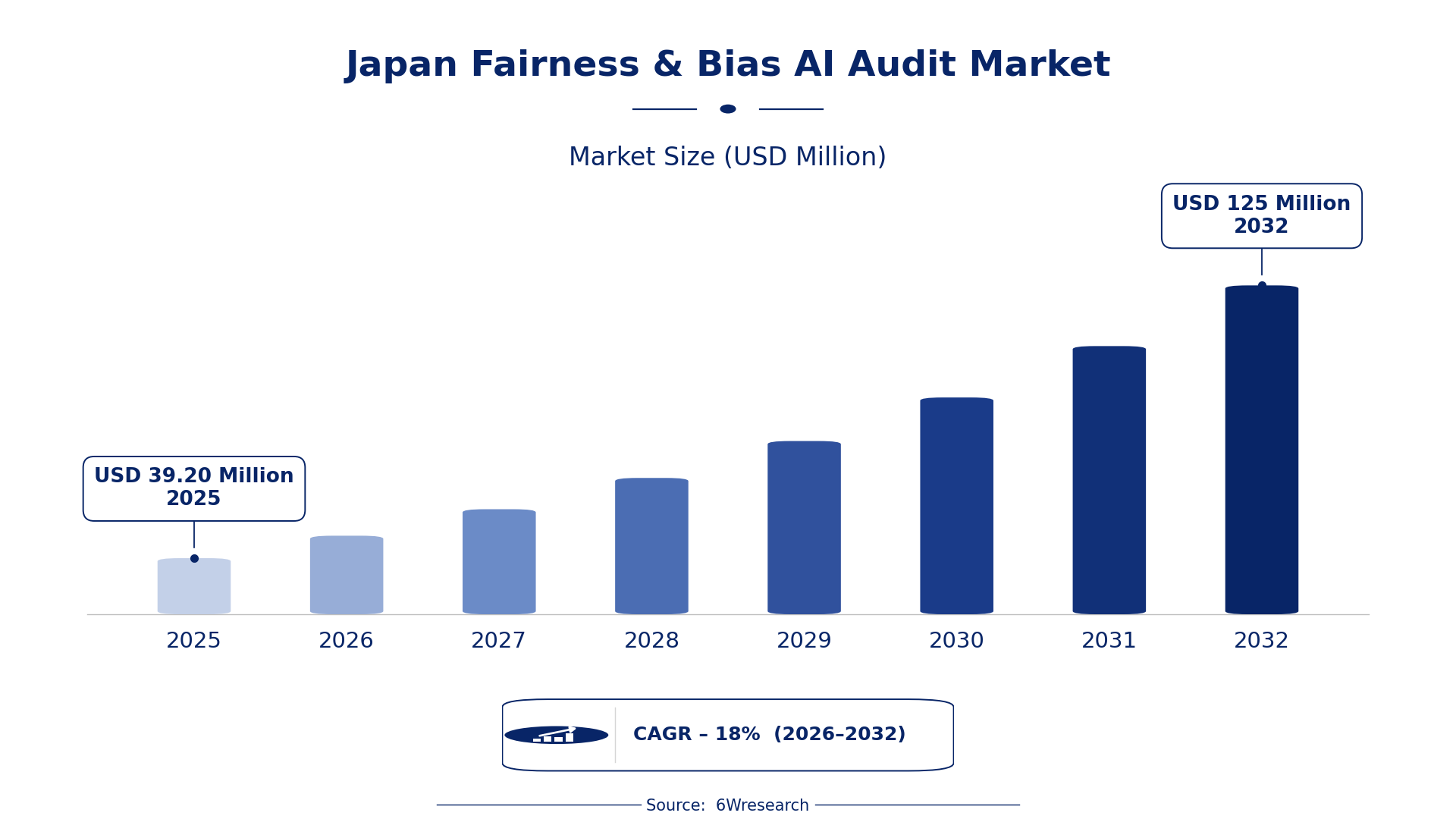
According to 6Wresearch internal database and industry insights, the Japan Fairness & Bias AI Audit Market was valued at USD 39.20 Million in 2025 and is projected to reach USD 125 Million by 2032, growing at a CAGR of approximately 18% during 2026–2032.
Japan Fairness & Bias AI Audit Market Highlights
| Report Metric | Details |
| Report Name | Japan Fairness & Bias AI Audit Market (2026-2032) |
| Market Size 2025 | USD 39.20 Million |
| Market Size 2032 | USD 125 Million |
| Absolute Growth 2025–2032 | USD 85.80 Million |
| CAGR 2026–2032 | 18% |
| Peak Annual Growth | 19.7% in 2032 |
| Forecast Period | 2026–2032 |
| Historical Data | 2022–2025 |
| Base Year | 2025 |
| Leading Service Type, 2025 | Algorithm Audit (42% share) |
| Leading Use Case Area, 2025 | Lending Algorithms (40% share) |
| Leading Distribution Channel, 2025 | Consulting Firms (42% share) |
| Leading End User, 2025 | Financial Institutions (48% share) |
| Fastest-Growing Service Type | Bias Detection (24.0% CAGR) |
| Fastest-Growing Use Case Area | Insurance Models (21.5% CAGR) |
| Fastest-Growing Distribution Channel | SaaS Platforms (23.3% CAGR) |
| Fastest-Growing End User | InsurTech Companies (23.5% CAGR) |
| Growing Sector | Financial Services |
| Key End Users | Financial Institutions, InsurTech Companies, Consulting Firms, HR Tech Providers |
Japan Fairness & Bias AI Audit Market Year-wise Growth Rate and Key Drivers (2022–2032)
This graph illustrates the annual growth rates of the market from 2022 to 2032, highlighting a steady upward trajectory and projected market expansion over the forecast period.
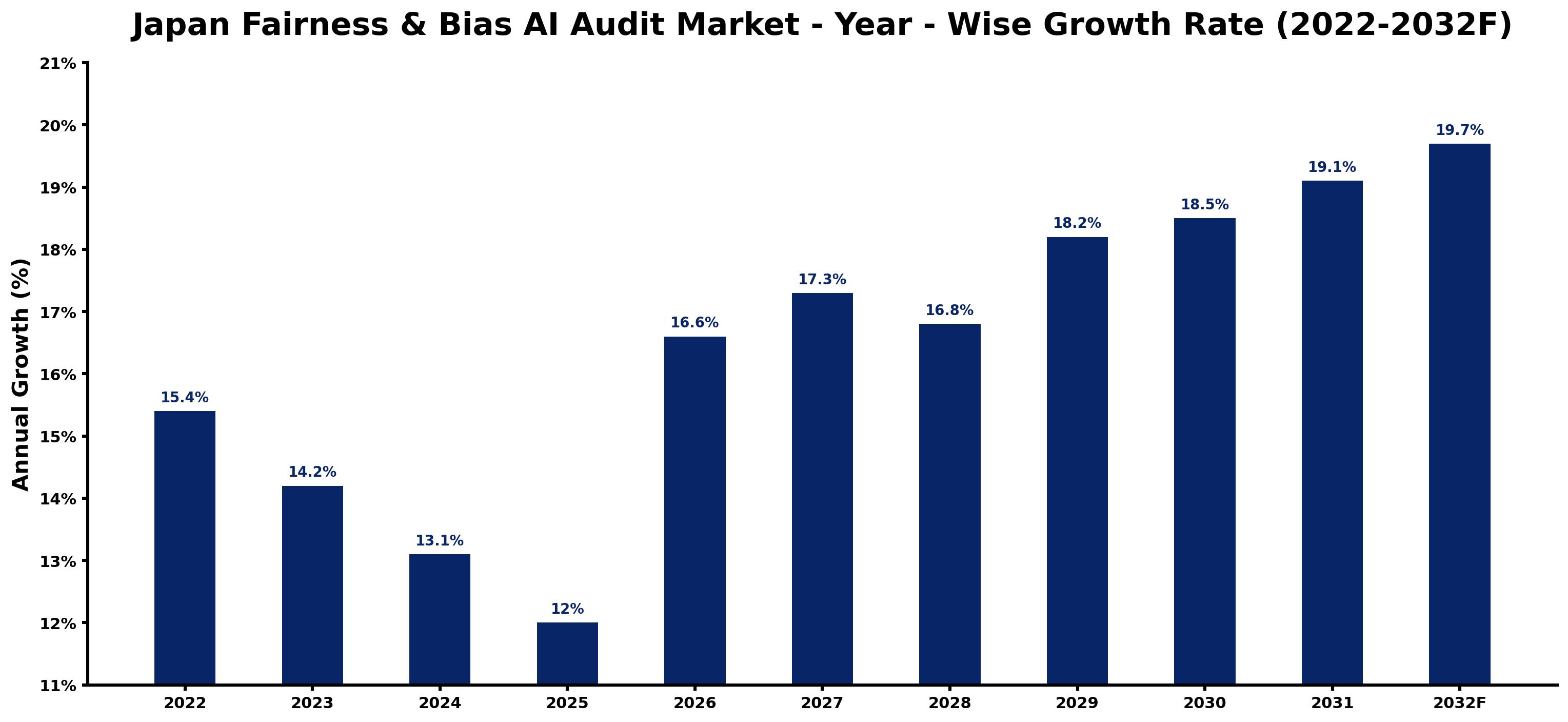
Below, each year's estimated growth is shown next to the factor that most influenced it.
| Year | Estimated Annual Growth (%) | Market Rationale |
| 2022 | 15.4 | The market experienced strong adoption as financial institutions prioritised compliance with ethical standards. |
| 2023 | 14.2 | Demand growth slowed as firms adjusted to the implementation of new auditing processes. |
| 2024 | 13.1 | The market continued to grow, albeit at a slower pace, as more institutions recognised the importance of audits. |
| 2025 | 12.0 | Growth decelerated as the market matured, with firms focusing on refining their audit practices. |
| 2026 | 16.6 | Demand surged as new initiatives emerged to enhance ethical AI use in lending. |
| 2027 | 17.3 | The market expanded further as financial institutions increased their investments in bias detection. |
| 2028 | 16.8 | Growth moderated slightly as the market adjusted to the influx of new auditing technologies. |
| 2029 | 18.2 | Demand accelerated again as more sectors began adopting fairness audits for compliance. |
| 2030 | 18.5 | The market continued to grow robustly, driven by heightened awareness of AI ethics. |
| 2031 | 19.1 | Growth remained strong as firms sought to enhance their compliance frameworks. |
| 2032 | 19.7 | The market peaked as comprehensive audits became standard practice across industries. |
Note: Market size estimations and growth projections presented in this report are based on 6Wresearch's proprietary forecasting methodology, utilizing the latest available industry data, government publications, and primary research inputs.
Japan Fairness & Bias AI Audit Market Synopsis
Fairness & Bias AI Audit involves evaluating algorithms to ensure they operate without discrimination, focusing on data inputs, model outputs, and compliance with ethical standards. In Japan, financial institutions and tech companies drive demand for these audits, particularly as they seek to adhere to JIS Q 15001 standards. The implementation of bias detection in credit scoring systems by over 70% of major banks illustrates the growing commitment to ethical AI use. The expansion of the InsurTech sector is increasing the need for fairness audits, creating opportunities for consulting firms and SaaS platforms.
Market Dynamics Impact Analysis (2026–2032)
| Factor | Type | Impact | Primary Segment Affected |
| Growing regulatory requirements for ethical AI compliance | Driver | High | Compliance Assessment |
| Increased focus on bias detection in lending algorithms | Driver | High | Bias Detection |
| Rising demand for fairness audits in the InsurTech sector | Opportunity | High | Insurance Models |
| Expansion of AI compliance services in the Tokyo metropolitan area | Opportunity | Medium | Consulting Firms |
| Limited awareness of AI audit benefits among smaller firms | Restraint | Medium | Algorithm Audit |
| Challenges in standardising auditing processes across sectors | Restraint | High | Model Validation |
| Competition from emerging audit technologies | Challenge | High | SaaS Platforms |
| Shortage of skilled professionals in AI ethics | Challenge | Medium | Financial Institutions |
Evaluation of Drivers in Japan Fairness & Bias AI Audit Market (2026–2032)
The table below links each growth driver to the segment it affects and the evidence for it.
| Drivers | Primary Segment Affected | Why It Matters (Evidence) |
| Increased regulatory scrutiny | Compliance Assessment | The implementation of JIS Q 15001 standards drives demand for audits, with over 70% of banks adopting these measures. |
| Growing investment in bias detection technologies | Bias Detection | Financial institutions are investing heavily in bias detection, leading to an increase in audit orders. |
| Expansion of the InsurTech sector | Insurance Models | The growth of the InsurTech sector is increasing demand for fairness audits to build consumer trust. |
| Rising awareness of AI ethics among consumers | Recruitment Systems | As consumers demand fairness, companies are implementing audits to ensure compliance with labor regulations. |
| Increased collaboration between consulting firms and tech companies | Consulting Firms | Partnerships are improving the delivery of AI audits, resulting in a surge in demand for consulting services. |
Behind the steady rise in orders sits a marked increase in scrutiny, with over 70% of banks adopting JIS Q 15001 standards. Financial institutions are heavily investing in bias detection technologies, which has led to a notable uptick in audit requests. The growth of the InsurTech sector is also driving demand for fairness audits, as companies seek to build consumer trust. Collaborations between consulting firms and tech companies are further improving the delivery of audits, resulting in increased demand for consulting services.
Evaluation of Restraints in Japan Fairness & Bias AI Audit Market
Several factors work against faster growth; the main ones are summarised below.
| Market Restraint | Primary Segment Affected | Why It Matters (Evidence) |
| Limited understanding of AI audit processes among smaller firms | Algorithm Audit | Many smaller firms lack awareness of the benefits of AI audits, hindering market growth. |
| Difficulty in standardising auditing practices across various sectors | Model Validation | The absence of uniform standards complicates the implementation of effective audits. |
| High costs associated with audits | Bias Detection | The financial burden of audits can deter smaller firms from engaging in the process. |
| Insufficient skilled workforce in AI ethics | Compliance Assessment | The shortage of qualified professionals limits the capacity to conduct thorough audits. |
| Resistance to change within established firms | Recruitment Systems | Some companies are hesitant to adopt new auditing technologies, slowing market adoption. |
Japan Fairness & Bias AI Audit Market Challenges
High costs arise for financial institutions due to the slow adoption of AI auditing technology, delaying compliance with JIS Q 15001 standards by up to six months and reducing operational efficiency. Consulting firms in the Tokyo metropolitan area face intense competition, which erodes profit margins and forces fee reductions, compromising service quality for clients. Implementing bias detection systems in credit scoring can reach millions of yen, straining budgets for over 70% of major banks. Accessing skilled AI auditors is challenging, causing audit delays of weeks and impacting the timely deployment of ethical AI practices.
Trends in the Japan Fairness & Bias AI Audit Market
Four trends stand out in the Japan Fairness & Bias AI Audit Market.
- Shift towards Comprehensive AI Audits: The Japan AI Strategy 2023 emphasises the importance of fairness in AI applications, prompting a shift towards thorough audits. In 2023, approximately 1,000 audits were conducted across various sectors, reflecting this growing trend.
- Transition from Traditional to Automated Auditing: In 2023, many firms began adopting ISO/IEC 27001 standards for data protection in AI audits. This transition to automated auditing tools is improving efficiency and accuracy in compliance processes.
- Emergence of Ethical AI Guidelines: The Japan Association of Corporate Executives established guidelines for ethical AI use in 2023, promoting fairness in AI applications. This development is shaping industry standards and practices.
- Focus on Bias Detection in Financial Services: In 2023, over 70% of major banks implemented bias detection in their credit scoring systems. This emphasis on bias detection is reshaping lending practices and enhancing fairness in financial services.
Investment Opportunities in the Japan Fairness & Bias AI Audit Market
Investors looking at the Japan Fairness & Bias AI Audit Market should consider the following areas.
- Timing aligns with regulatory changes: With the recent push for ethical AI compliance, consulting firms can capitalise on the need for audits. The projected growth of the InsurTech sector is driving the demand for fairness audits.
- Supply of automated auditing tools: There is an opportunity to provide automated bias detection tools to financial institutions. This aligns with the rising adoption of technology in auditing processes.
- Expansion of AI compliance services in Tokyo: The Tokyo metropolitan area is becoming a hub for AI compliance services, creating opportunities for firms to establish operations. Partnering with local consulting firms can facilitate market entry.
- Entry through strategic partnerships: Forming joint ventures with established consulting firms can provide access to the growing demand for fairness audits. This approach can improve credibility and market presence.
Government Initiatives in the Japan Fairness & Bias AI Audit Market
The Industrial Standardization Act governs JIS product and test standards, ensuring that AI audits meet established ethical guidelines. Compliance with these standards is essential for financial institutions to avoid regulatory penalties and maintain consumer trust.
In 2023, the Ministry of Internal Affairs and Communications allocated 500 million yen to support AI ethics initiatives. The Digital Agency oversees the implementation of these initiatives, promoting ethical AI practices across industries.
Future Insight of the Japan Fairness & Bias AI Audit Market
The launch of the ethical AI programme by the Financial Services Agency will drive demand for fairness audits in lending by 2032, prompting financial institutions to enhance compliance. The InsurTech sector's projected growth will significantly increase the need for thorough audits, compelling suppliers to develop advanced services. By 2032, the widespread adoption of ISO/IEC 27001 standards will ensure effective data protection in AI evaluations. The Japan AI Strategy 2023 will enable the implementation of fairness initiatives, leading to a more equitable approach to AI across various sectors.
Market Segmentation Analysis
Japan Fairness & Bias AI Audit Market report covers a detailed analysis of the following market segments:
By Service Type – Algorithm Audit Leads, Bias Detection Expected to Grow Fastest
According to Saurav Kr Singh, Senior Research Analyst at 6Wresearch, Algorithm Audit took 42% of service type revenue in 2025, more than any other category. Algorithm Audits hold the largest share as they are essential for ensuring compliance with ethical standards, particularly in the financial sector. The implementation of these audits by over 70% of major banks in Japan in 2023 underscores their importance. Bias Detection is set to record the highest CAGR in this split, 24.0% over 2026–2032. Bias Detection is experiencing rapid growth due to its critical role in identifying discriminatory patterns, especially in lending practices. The 2023 initiative by the Financial Services Agency to promote ethical practices has significantly increased demand for these audits. Suppliers should focus on enhancing bias detection capabilities to meet the rising compliance needs of financial institutions.
By Use Case Area – Lending Algorithms Lead, Insurance Models Expected to Grow Fastest
Lending Algorithms accounted for 40% of the market by use case area in 2025. Lending Algorithms lead this segment as they are extensively utilised in financial services for loan approvals, necessitating thorough audits. The widespread adoption among major banks underscores the critical importance of fairness in these algorithms. Over 2026–2032, Insurance Models are expected to post the fastest growth, at a CAGR of 21.5%. Insurance Models are experiencing the fastest growth as InsurTech Companies increasingly rely on audits to ensure fair risk assessments and premium settings. This trend is propelled by the sector's expansion and the need for adherence to ethical standards. Buyers in the InsurTech sector should prioritise fairness audits to establish consumer trust and comply with regulatory demands.
By Distribution Channel – Consulting Firms Lead, SaaS Platforms Expected to Grow Fastest
Consulting Firms held 42% of the Japan Fairness & Bias AI Audit Market by distribution channel in 2025. Consulting Firms lead this group by providing essential expertise in AI audits and compliance, particularly in the Tokyo metropolitan area where many firms are located. Their established reputation and experience make them the preferred choice for organisations seeking guidance. The quickest growth will come from SaaS Platforms, forecast to expand at a CAGR of 23.3% between 2026 and 2032. SaaS Platforms are growing rapidly as they offer automated tools for bias detection and audits, catering to the increasing demand for efficiency in compliance processes. This trend is supported by the rising number of AI audits conducted across various sectors. Suppliers should invest in developing SaaS solutions to capture the growing market of automated compliance tools.
By End User – Financial Institutions Lead, InsurTech Companies Expected to Grow Fastest
In 2025, Financial Institutions led the end user split with a 48% share. Financial Institutions dominate the user segment as they require audits for regulatory compliance, particularly in lending scenarios. Their substantial investment in these audits highlights the necessity of maintaining ethical standards in financial services. InsurTech Companies are projected to grow fastest, at a CAGR of 23.5% during 2026–2032. InsurTech Companies are the fastest-growing segment as they utilise audits to build trust in their insurance models, aligning with the sector's projected growth. This trend is driven by the increasing demand for transparency and fairness in risk assessments. Suppliers must tailor their offerings to address the specific needs of InsurTech Companies to capitalise on this growth potential.
Key Attractiveness of the Report
- 10 Years of Market Numbers
- Historical Data Starting from 2022 to 2025
- Base Year 2025
- Forecast Data until 2032
- Key Performance Indicators Impacting the Market
- Major Upcoming Developments and Projects
Key Highlights of the Report:
- Japan Fairness & Bias AI Audit Market Outlook
- Market Size of Japan Fairness & Bias AI Audit Market, 2025
- Forecast of Japan Fairness & Bias AI Audit Market, 2032
- Historical Data and Forecast of Japan Fairness & Bias AI Audit Revenues & Volume for the Period 2022-2032F
- Japan Fairness & Bias AI Audit Market Trend Evolution
- Japan Fairness & Bias AI Audit Market Drivers and Challenges
- Japan Fairness & Bias AI Audit Price Trends
- Japan Fairness & Bias AI Audit Porter's Five Forces
- Japan Fairness & Bias AI Audit Industry Life Cycle
- Historical Data and Forecast of Japan Fairness & Bias AI Audit Market Revenues & Volume By Service Type for the Period 2022-2032F
- Historical Data and Forecast of Japan Fairness & Bias AI Audit Market Revenues & Volume By Algorithm Audit for the Period 2022-2032F
- Historical Data and Forecast of Japan Fairness & Bias AI Audit Market Revenues & Volume By Bias Detection for the Period 2022-2032F
- Historical Data and Forecast of Japan Fairness & Bias AI Audit Market Revenues & Volume By Compliance Assessment for the Period 2022-2032F
- Historical Data and Forecast of Japan Fairness & Bias AI Audit Market Revenues & Volume By Model Validation for the Period 2022-2032F
- Historical Data and Forecast of Japan Fairness & Bias AI Audit Market Revenues & Volume By Use Case Area for the Period 2022-2032F
- Historical Data and Forecast of Japan Fairness & Bias AI Audit Market Revenues & Volume By Lending Algorithms for the Period 2022-2032F
- Historical Data and Forecast of Japan Fairness & Bias AI Audit Market Revenues & Volume By Insurance Models for the Period 2022-2032F
- Historical Data and Forecast of Japan Fairness & Bias AI Audit Market Revenues & Volume By Recruitment Systems for the Period 2022-2032F
- Historical Data and Forecast of Japan Fairness & Bias AI Audit Market Revenues & Volume By Credit Scoring for the Period 2022-2032F
- Historical Data and Forecast of Japan Fairness & Bias AI Audit Market Revenues & Volume By Distribution Channel for the Period 2022-2032F
- Historical Data and Forecast of Japan Fairness & Bias AI Audit Market Revenues & Volume By Consulting Firms for the Period 2022-2032F
- Historical Data and Forecast of Japan Fairness & Bias AI Audit Market Revenues & Volume By SaaS Platforms for the Period 2022-2032F
- Historical Data and Forecast of Japan Fairness & Bias AI Audit Market Revenues & Volume By Direct Engagements for the Period 2022-2032F
- Historical Data and Forecast of Japan Fairness & Bias AI Audit Market Revenues & Volume By Legal Advisory Firms for the Period 2022-2032F
- Historical Data and Forecast of Japan Fairness & Bias AI Audit Market Revenues & Volume By End User for the Period 2022-2032F
- Historical Data and Forecast of Japan Fairness & Bias AI Audit Market Revenues & Volume By Financial Institutions for the Period 2022-2032F
- Historical Data and Forecast of Japan Fairness & Bias AI Audit Market Revenues & Volume By InsurTech Companies for the Period 2022-2032F
- Historical Data and Forecast of Japan Fairness & Bias AI Audit Market Revenues & Volume By HR Tech Providers for the Period 2022-2032F
- Historical Data and Forecast of Japan Fairness & Bias AI Audit Market Revenues & Volume By Banks & Lenders for the Period 2022-2032F
- Japan Fairness & Bias AI Audit Import Export Trade Statistics
- Market Opportunity Assessment By Service Type
- Market Opportunity Assessment By Use Case Area
- Market Opportunity Assessment By Distribution Channel
- Market Opportunity Assessment By End User
- Japan Fairness & Bias AI Audit Top Companies Market Share
- Japan Fairness & Bias AI Audit Competitive Benchmarking By Technical and Operational Parameters
- Japan Fairness & Bias AI Audit Company Profiles
- Japan Fairness & Bias AI Audit Key Strategic Recommendations
Market Covered
Segments analysed in this report are listed below.
By Service Type
- Algorithm Audit
- Bias Detection
- Compliance Assessment
- Model Validation
By Use Case Area
- Lending Algorithms
- Insurance Models
- Recruitment Systems
- Credit Scoring
By Distribution Channel
- Consulting Firms
- SaaS Platforms
- Direct Engagements
- Legal Advisory Firms
By End User
- Financial Institutions
- InsurTech Companies
- HR Tech Providers
- Banks & Lenders































