Japan Fashion 3D Printing Market Size & Growth Rate
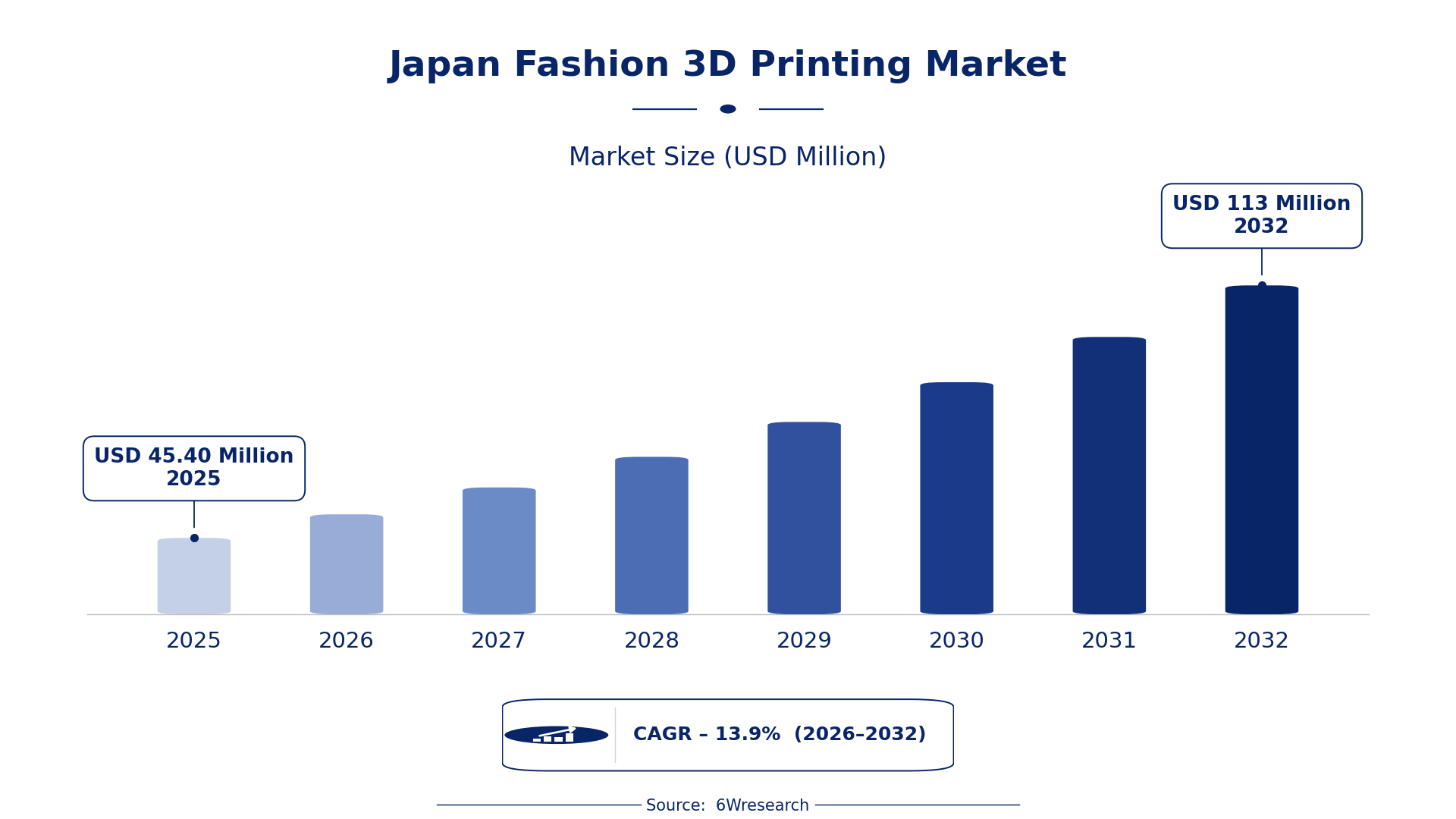
According to 6Wresearch internal database and industry insights, the Japan Fashion 3D Printing Market was valued at USD 45.40 Million in 2025 and is projected to reach USD 113 Million by 2032, growing at a CAGR of approximately 13.9% during 2026–2032.
Japan Fashion 3D Printing Market Highlights
| Report Metric | Details |
| Report Name | Japan Fashion 3D Printing Market (2026-2032) |
| Market Size 2025 | USD 45.40 Million |
| Market Size 2032 | USD 113 Million |
| Absolute Growth 2025–2032 | USD 67.60 Million |
| CAGR 2026–2032 | 13.9% |
| Peak Annual Growth | 14.7% in 2030 |
| Forecast Period | 2026–2032 |
| Historical Data | 2022–2025 |
| Base Year | 2025 |
| Leading Application Type, 2025 | Footwear Prototypes (35% share) |
| Leading Material Used, 2025 | TPU (53% share) |
| Leading Distribution Channel, 2025 | Online Platforms (49% share) |
| Leading End User, 2025 | Designers (45% share) |
| Fastest-Growing Application Type | Jewelry Design (18.2% CAGR) |
| Fastest-Growing Material Used | Resin (19.1% CAGR) |
| Fastest-Growing Distribution Channel | Direct Sales (17.9% CAGR) |
| Fastest-Growing End User | Fashion Studios (17.5% CAGR) |
| Growing Sector | Fashion Design |
| Key End Users | Designers, Fashion Studios, Fashion Schools, End Consumers |
Japan Fashion 3D Printing Market Year-wise Growth Rate and Key Drivers (2022–2032)
This graph illustrates the annual growth rates of the market from 2022 to 2032, highlighting a steady upward trajectory and projected market expansion over the forecast period.
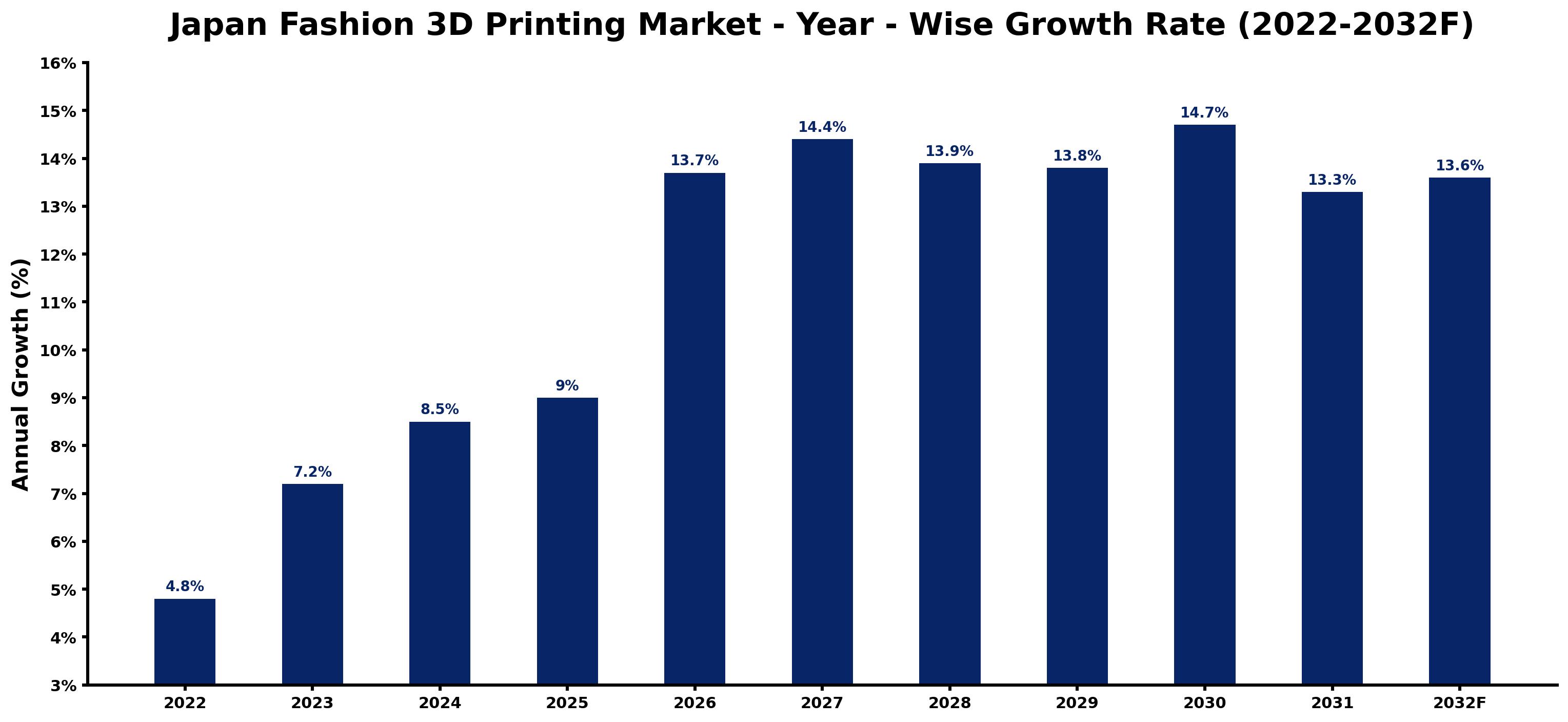
For each year, the table pairs the estimated growth rate with the leading influence on demand, showing how the drivers changed across the period.
| Year | Estimated Annual Growth (%) | Market Rationale |
| 2022 | 4.8 | The market was characterised by steady interest from local designers and fashion studios. |
| 2023 | 7.2 | Growth accelerated due to increased adoption of 3D printing technologies in design processes. |
| 2024 | 8.5 | Demand continued to rise as fashion schools integrated 3D printing into their curricula. |
| 2025 | 9.0 | Unique designs showcased at Tokyo Fashion Week boosted market visibility and interest. |
| 2026 | 13.7 | Investment in 3D printing services is anticipated to surge, leading to improved production capabilities for designers. |
| 2027 | 14.4 | The introduction of new materials will stimulate creative applications in fashion design. |
| 2028 | 13.9 | A slight slowdown is projected as competition intensifies among local studios. |
| 2029 | 13.8 | Demand will remain strong, driven by increasing consumer interest in unique fashion items. |
| 2030 | 14.7 | The peak growth year is expected to feature significant technological advancements in 3D printing. |
| 2031 | 13.3 | A return to steady growth will occur as established practices gain wider acceptance. |
| 2032 | 13.6 | The market is projected to thrive with ongoing innovations in sustainable fashion technologies. |
Note: Market size estimations and growth projections presented in this report are based on 6Wresearch's proprietary forecasting methodology, utilizing the latest available industry data, government publications, and primary research inputs.
Japan Fashion 3D Printing Market Synopsis
Fashion 3D printing employs advanced additive manufacturing technologies to create items such as footwear, jewelry, and apparel. The Japan Fashion 3D Printing Market is expanding due to rising interest from local designers and fashion studios, alongside investments in 3D printing services. Events like Tokyo Fashion Week showcase innovative applications of 3D printing, while the Japan 3D Printing Association promotes technology integration. With a strong urban consumer base and the incorporation of 3D printing in educational institutions, the market is poised for substantial growth.
Market Dynamics Impact Analysis (2026–2032)
| Factor | Type | Impact | Primary Segment Affected |
| Rising interest in custom fashion items | Driver | High | Footwear Prototypes |
| Increased investment in 3D printing services | Driver | High | 3D Printing Services |
| Growing demand for sustainable fashion solutions | Opportunity | High | Custom Accessories |
| Expansion of online sales channels for 3D printed items | Opportunity | High | Online Platforms |
| Limited awareness among traditional manufacturers | Restraint | Medium | Apparel Structures |
| Competition from conventional production methods | Restraint | Medium | Jewelry Design |
| Supply chain challenges in sourcing materials | Challenge | High | TPU |
| Technological limitations in mass production | Challenge | Medium | Resin |
Evaluation of Drivers in Japan Fashion 3D Printing Market (2026–2032)
Key forces behind demand, with the segment each one moves most, are listed below.
| Drivers | Primary Segment Affected | Why It Matters (Evidence) |
| Investment in 3D printing technology | 3D Printing Services | Increased funding has improved access to advanced printing technologies, enabling designers to create unique products. |
| Growing consumer demand for personalised fashion | Jewelry Design | As consumers seek unique items, designers are increasingly using 3D printing to offer bespoke jewelry options. |
| Integration of 3D printing in educational institutions | Fashion Schools | With over 100 schools incorporating 3D printing, students are becoming skilled in modern design techniques, driving future demand. |
| Support from fashion events like Tokyo Fashion Week | Footwear Prototypes | Showcasing unique designs at events has heightened interest in 3D printed footwear, prompting more designers to adopt the technology. |
| Urban consumer base's interest in sustainability | Custom Accessories | As sustainability becomes a priority, consumers are more inclined to purchase eco-friendly 3D printed accessories. |
Much of the new demand traces back to investments in 3D printing services, improving production capabilities for designers. In 2022, over 100 fashion schools incorporated 3D printing into their curricula, creating a skilled workforce. Events like Tokyo Fashion Week showcased unique designs, driving interest in custom footwear prototypes. Consumers increasingly seek sustainable fashion solutions, boosting demand for custom accessories. The Japan 3D Printing Association promotes technology integration, encouraging designers to adopt advanced manufacturing techniques.
Evaluation of Restraints in Japan Fashion 3D Printing Market
Several factors work against faster growth; the main ones are summarised below.
| Market Restraint | Primary Segment Affected | Why It Matters (Evidence) |
| Limited awareness among traditional manufacturers | Apparel Structures | Many traditional manufacturers remain unaware of the benefits of 3D printing, hindering wider adoption in apparel production. |
| Competition from conventional production methods | Jewelry Design | Established jewelry production methods continue to dominate, making it challenging for 3D printing to gain market share. |
| High initial investment costs for equipment | 3D Printing Services | The upfront costs associated with 3D printing technology can deter smaller designers from entering the market. |
| Material sourcing challenges | TPU | Supply chain issues can delay production timelines and increase costs for designers relying on 3D printing. |
| Technological limitations in mass production | Resin | Current 3D printing technologies may not meet the speed and volume demands of large-scale production. |
Japan Fashion 3D Printing Market Challenges
Japan's fashion industry depends on materials like TPU and PLA, which can cause supply chain delays for designers when sourcing these inputs. Compliance with ISO 9001 standards increases operational costs for manufacturers, making it difficult for small studios to compete effectively in a market valued at approximately 3 trillion JPY. The average price of 3D printing equipment can exceed 1 million JPY, restricting access for emerging fashion tech startups. Rapid advancements in 3D printing technology require ongoing investments, straining budgets for fashion schools that aim to keep their curriculum up to date.
Trends in the Japan Fashion 3D Printing Market
Below are the shifts with the largest effect on the Japan Fashion 3D Printing Market.
- Shift to Sustainable Fashion Practices: Tokyo is increasingly adopting sustainable fashion practices, with a government initiative launched in 2023 to support sustainable innovations. This programme encourages designers to use eco-friendly materials, aligning with consumer preferences for sustainability.
- Emergence of Customisation in Fashion: In 2023, 3D printed jewelry gained popularity among young consumers, with an estimated 30% increase in sales. This trend highlights a shift towards personalised fashion items that cater to individual tastes.
- Adoption of Advanced Materials in 3D Printing: The Tokyo Design Lab is focusing on the use of advanced materials in fashion 3D printing, with TPU and resin leading the way. This shift improves product quality and design capabilities, attracting more designers to the technology.
- Growth of Online Sales Channels: Fashion designers are increasingly using online platforms for selling 3D printed items, with online sales accounting for 49% of the market share. This trend allows designers to reach a broader audience and streamline their sales processes.
Investment Opportunities in the Japan Fashion 3D Printing Market
Below are the investment opportunities with the strongest case in the Japan Fashion 3D Printing Market.
- Local Partnerships for Material Sourcing: Establishing local partnerships with material suppliers is crucial for designers seeking to improve production capabilities. With Japan's focus on sustainable practices, collaborating with local suppliers can ensure a steady supply of eco-friendly materials.
- Expansion of 3D Printing Services: Investing in 3D printing services in urban areas like Tokyo presents a valuable opportunity. The increasing demand for custom designs from fashion studios highlights the need for accessible printing services.
- Collaboration with Fashion Schools: Working with fashion schools can provide designers access to fresh talent and innovative ideas. This partnership can help bridge the gap between education and industry, fostering creativity in fashion design.
- Focus on Custom Accessories Market: The current trend towards personalised fashion items creates an opportunity for designers to invest in custom accessories. Engaging with local fashion studios can help meet this growing demand effectively.
Government Initiatives in the Japan Fashion 3D Printing Market
The Chemical Substances Control Law, enacted in 1973, requires manufacturers to evaluate and control chemical substances, ensuring safety in 3D printed fashion items. Additionally, the Plastic Resource Circulation Act promotes the reduction, reuse, and recycling of plastics, encouraging fashion producers to explore alternatives like biodegradable materials. This law supports the integration of sustainable practices in fashion 3D printing, aligning with consumer preferences for eco-friendly products.
In 2023, a government programme was launched to support sustainable fashion innovations, with an investment of 1 billion JPY. The Ministry of Economy, Trade and Industry administers this initiative, providing funding for projects that promote advanced manufacturing technologies in the fashion sector.
Future Insight of the Japan Fashion 3D Printing Market
The Tokyo Fashion Week will showcase new 3D printing facilities by 2032, enabling designers to produce intricate and customised items. Government programmes promoting sustainable fashion will encourage innovation in materials and processes, benefiting both buyers and suppliers. Annual events by the Japan 3D Printing Association will enhance collaboration among industry players. As urban areas attract increased investment in 3D printing technologies, designers will gain improved access to advanced resources, strengthening their competitive edge.
Market Segmentation Analysis
Japan Fashion 3D Printing Market report covers a detailed analysis of the following market segments:
By Application Type – Footwear Prototypes Lead, Jewelry Design Expected to Grow Fastest
According to Saurav Kr Singh, Senior Research Analyst at 6Wresearch, in 2025, Footwear Prototypes led the application type split with a 35% share. Footwear prototypes hold the largest share as they are essential for creating custom shoe designs that appeal to both designers and consumers. Their importance is highlighted by frequent showcases at events such as Tokyo Fashion Week, which emphasises their role in the industry. Jewelry Design is set to record the highest CAGR in this split, 18.2% over 2026–2032. Jewelry design is experiencing rapid growth due to its ability to create intricate and personalised pieces that resonate with younger consumers. The increasing popularity of 3D printed jewelry among this demographic is a key driver of this segment's expansion. Suppliers should focus on enhancing their capabilities in jewelry design to tap into the growing consumer demand.
By Material Used – TPU Leads, Resin Expected to Grow Fastest
TPU took 53% of material used revenue in 2025, more than any other category. TPU is the dominant material as it is extensively used for crafting flexible and durable fashion items that cater to contemporary consumer demands. Its adaptability makes it a preferred choice for various fashion applications, ensuring its leading position in the market. Resin is projected to grow fastest, at a CAGR of 19.1% during 2026–2032. Resin is experiencing the fastest growth because it enables the production of detailed and high-quality prints, which are essential for the fashion industry's aesthetic standards. The heightened emphasis on quality in fashion items is accelerating the adoption of this material. Buyers should prioritise sourcing high-quality resin materials to maintain competitiveness in the fashion market.
By Distribution Channel – Online Platforms Lead, Direct Sales Expected to Grow Fastest
The largest distribution channel category in 2025 was Online Platforms, at 49% of revenue. Online platforms serve as the primary distribution channel, offering a vital means for selling 3D printed fashion items to a wide audience. The convenience and accessibility of online shopping align well with Japan's urban consumer base, driving their dominance. Over 2026–2032, Direct Sales is expected to post the fastest growth, at a CAGR of 17.9%. Direct sales are growing swiftly as they allow for direct customer interaction, facilitating tailored experiences and immediate feedback. This approach is increasingly appealing as brands aim to cultivate closer relationships with their customers. Suppliers should consider refining their direct sales strategies to better engage with consumers.
By End User – Designers Lead, Fashion Studios Expected to Grow Fastest
With 45% of end user revenue in 2025, Designers was the largest category. Designers represent the largest group of end users, as they play a critical role in leveraging 3D printing technology for creative expression in their designs. Their innovative approaches often set trends within the fashion industry, making them vital to market dynamics. The quickest growth will come from Fashion Studios, forecast to expand at a CAGR of 17.5% between 2026 and 2032. Fashion studios are the fastest-growing segment among end users, employing 3D printing for production and prototyping to improve their design workflows. The need for efficiency and modernisation in fashion production is fuelling this growth. Suppliers must tailor their products to address the specific requirements of fashion studios to take advantage of this growth.
Key Attractiveness of the Report
- 10 Years of Market Numbers
- Historical Data Starting from 2022 to 2025
- Base Year 2025
- Forecast Data until 2032
- Key Performance Indicators Impacting the Market
- Major Upcoming Developments and Projects
Key Highlights of the Report:
- Japan Fashion 3D Printing Market Outlook
- Market Size of Japan Fashion 3D Printing Market, 2025
- Forecast of Japan Fashion 3D Printing Market, 2032
- Historical Data and Forecast of Japan Fashion 3D Printing Revenues & Volume for the Period 2022-2032F
- Japan Fashion 3D Printing Market Trend Evolution
- Japan Fashion 3D Printing Market Drivers and Challenges
- Japan Fashion 3D Printing Price Trends
- Japan Fashion 3D Printing Porter's Five Forces
- Japan Fashion 3D Printing Industry Life Cycle
- Historical Data and Forecast of Japan Fashion 3D Printing Market Revenues & Volume By Application Type for the Period 2022-2032F
- Historical Data and Forecast of Japan Fashion 3D Printing Market Revenues & Volume By Footwear Prototypes for the Period 2022-2032F
- Historical Data and Forecast of Japan Fashion 3D Printing Market Revenues & Volume By Jewelry Design for the Period 2022-2032F
- Historical Data and Forecast of Japan Fashion 3D Printing Market Revenues & Volume By Custom Accessories for the Period 2022-2032F
- Historical Data and Forecast of Japan Fashion 3D Printing Market Revenues & Volume By Apparel Structures for the Period 2022-2032F
- Historical Data and Forecast of Japan Fashion 3D Printing Market Revenues & Volume By Material Used for the Period 2022-2032F
- Historical Data and Forecast of Japan Fashion 3D Printing Market Revenues & Volume By TPU for the Period 2022-2032F
- Historical Data and Forecast of Japan Fashion 3D Printing Market Revenues & Volume By Resin for the Period 2022-2032F
- Historical Data and Forecast of Japan Fashion 3D Printing Market Revenues & Volume By PLA for the Period 2022-2032F
- Historical Data and Forecast of Japan Fashion 3D Printing Market Revenues & Volume By Nylon for the Period 2022-2032F
- Historical Data and Forecast of Japan Fashion 3D Printing Market Revenues & Volume By Distribution Channel for the Period 2022-2032F
- Historical Data and Forecast of Japan Fashion 3D Printing Market Revenues & Volume By Online Platforms for the Period 2022-2032F
- Historical Data and Forecast of Japan Fashion 3D Printing Market Revenues & Volume By Direct Sales for the Period 2022-2032F
- Historical Data and Forecast of Japan Fashion 3D Printing Market Revenues & Volume By 3D Printing Services for the Period 2022-2032F
- Historical Data and Forecast of Japan Fashion 3D Printing Market Revenues & Volume By Design Labs for the Period 2022-2032F
- Historical Data and Forecast of Japan Fashion 3D Printing Market Revenues & Volume By End User for the Period 2022-2032F
- Historical Data and Forecast of Japan Fashion 3D Printing Market Revenues & Volume By Designers for the Period 2022-2032F
- Historical Data and Forecast of Japan Fashion 3D Printing Market Revenues & Volume By Fashion Studios for the Period 2022-2032F
- Historical Data and Forecast of Japan Fashion 3D Printing Market Revenues & Volume By End Consumers for the Period 2022-2032F
- Historical Data and Forecast of Japan Fashion 3D Printing Market Revenues & Volume By Fashion Schools for the Period 2022-2032F
- Japan Fashion 3D Printing Import Export Trade Statistics
- Market Opportunity Assessment By Application Type
- Market Opportunity Assessment By Material Used
- Market Opportunity Assessment By Distribution Channel
- Market Opportunity Assessment By End User
- Japan Fashion 3D Printing Top Companies Market Share
- Japan Fashion 3D Printing Competitive Benchmarking By Technical and Operational Parameters
- Japan Fashion 3D Printing Company Profiles
- Japan Fashion 3D Printing Key Strategic Recommendations
Market Covered
Segments analysed in this report are listed below.
By Application Type
- Footwear Prototypes
- Jewelry Design
- Custom Accessories
- Apparel Structures
By Material Used
- TPU
- Resin
- PLA
- Nylon
By Distribution Channel
- Online Platforms
- Direct Sales
- 3D Printing Services
- Design Labs
By End User
- Designers
- Fashion Studios
- End Consumers
- Fashion Schools































