Japan Fashion Basics Market Size & Growth Rate
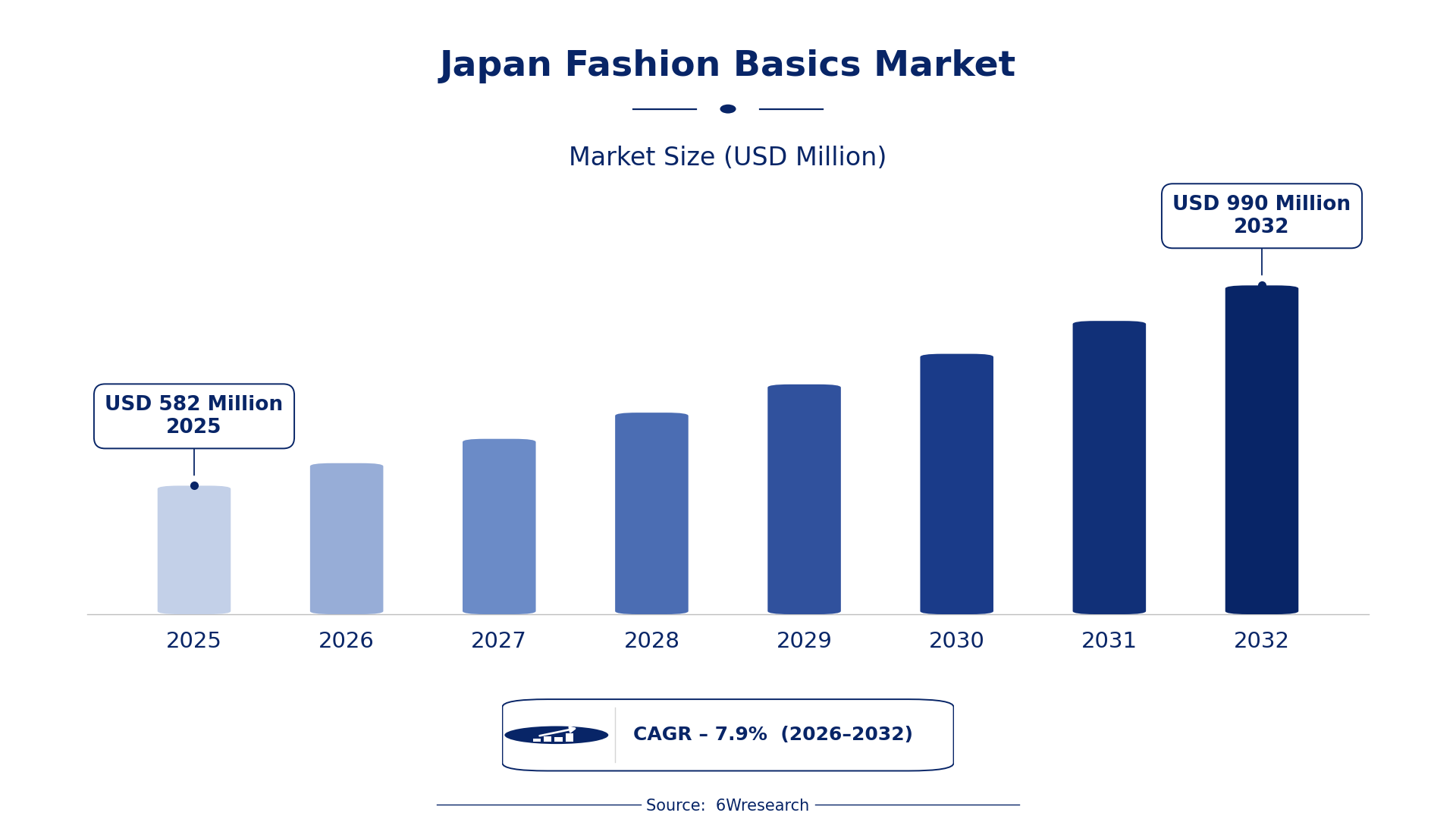
According to 6Wresearch internal database and industry insights, the Japan Fashion Basics Market was valued at USD 582 Million in 2025 and is projected to reach USD 990 Million by 2032, growing at a CAGR of approximately 7.9% during 2026–2032.
Japan Fashion Basics Market Highlights
| Report Metric | Details |
| Report Name | Japan Fashion Basics Market (2026-2032) |
| Market Size 2025 | USD 582 Million |
| Market Size 2032 | USD 990 Million |
| Absolute Growth 2025–2032 | USD 408 Million |
| CAGR 2026–2032 | 7.9% |
| Peak Annual Growth | 9.2% in 2032 |
| Forecast Period | 2026–2032 |
| Historical Data | 2022–2025 |
| Base Year | 2025 |
| Leading Product Type, 2025 | T-Shirts (40% share) |
| Leading Fabric Type, 2025 | Cotton (38% share) |
| Leading Distribution Channel, 2025 | Online Platforms (41% share) |
| Leading End User, 2025 | General Consumers (47% share) |
| Fastest-Growing Product Type | Leggings (11.1% CAGR) |
| Fastest-Growing Fabric Type | Spandex (11.6% CAGR) |
| Fastest-Growing Distribution Channel | Retail Chains (10.4% CAGR) |
| Fastest-Growing End User | Women (10.2% CAGR) |
| Growing Sector | Women |
| Key End Users | General Consumers, Women, Youth, Mass Market |
Japan Fashion Basics Market Year-wise Growth Rate and Key Drivers (2022–2032)
This graph illustrates the annual growth rates of the market from 2022 to 2032, highlighting a steady upward trajectory and projected market expansion over the forecast period.
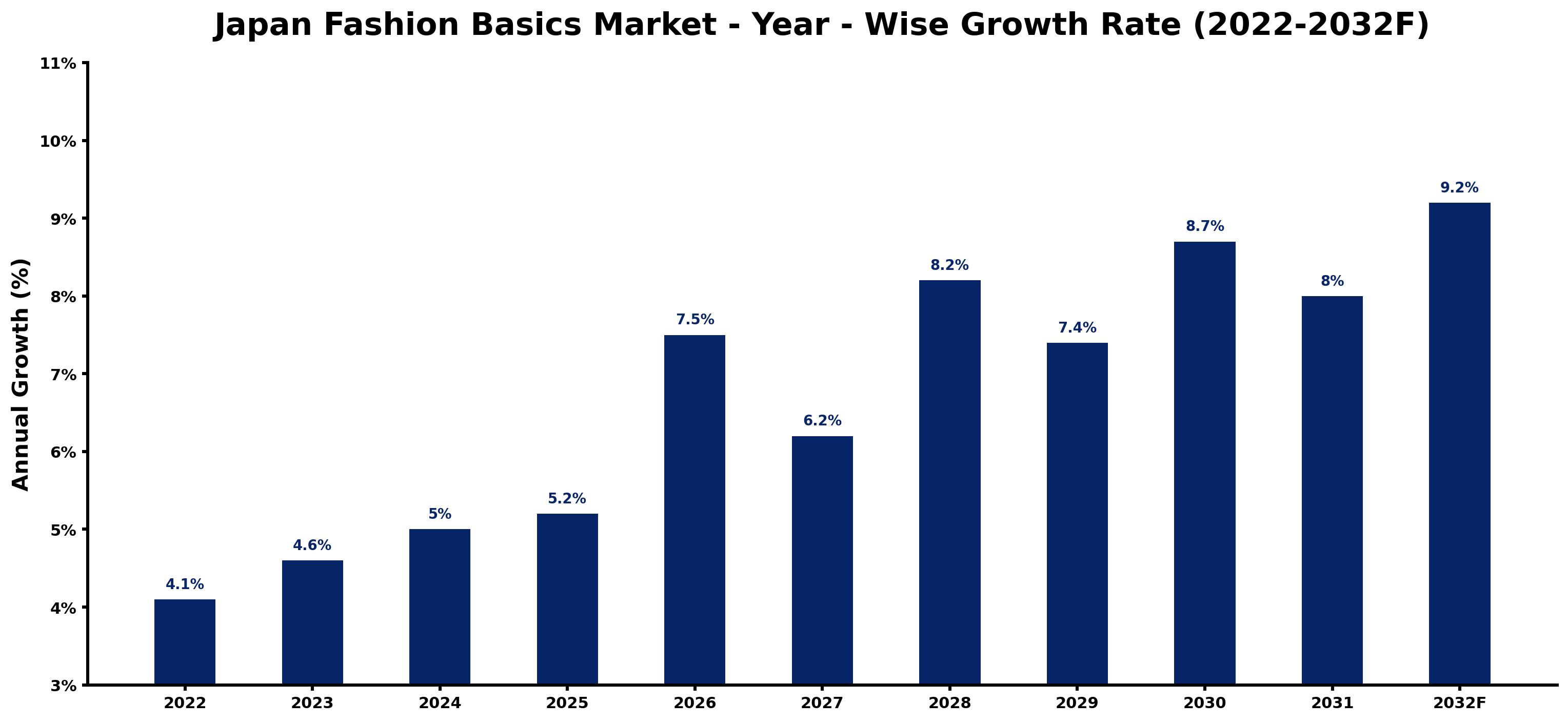
Each row of the following table gives one year's estimated growth and the event or demand shift that explains it.
| Year | Estimated Annual Growth (%) | Market Rationale |
| 2022 | 4.1 | The market experienced steady growth driven by consistent consumer demand for basic clothing. |
| 2023 | 4.6 | Growth accelerated as urban fashion trends influenced purchasing behaviour among young consumers. |
| 2024 | 5.0 | The introduction of new styles and designs contributed to increased sales in fashion basics. |
| 2025 | 5.2 | A peak in growth was achieved as retail chains expanded their offerings across Japan. |
| 2026 | 7.5 | The market is expected to grow faster due to rising disposable incomes and fashion awareness. |
| 2027 | 6.2 | Growth slows as market saturation begins to affect new purchases of fashion basics. |
| 2028 | 8.2 | An increase in online shopping options revitalises demand for fashion basics among consumers. |
| 2029 | 7.4 | Growth slows again as competition intensifies among retailers and online platforms. |
| 2030 | 8.7 | The market sees renewed interest as appealing designs attract younger demographics. |
| 2031 | 8.0 | Demand stabilises as consumer preferences shift towards sustainability and quality. |
| 2032 | 9.2 | The market peaks as sustainable fashion initiatives gain traction, driving higher sales. |
Note: Market size estimations and growth projections presented in this report are based on 6Wresearch's proprietary forecasting methodology, utilizing the latest available industry data, government publications, and primary research inputs.
Japan Fashion Basics Market Synopsis
Fashion basics in Japan include essential clothing items such as T-shirts, leggings, hoodies, and undergarments, primarily crafted from cotton and spandex. These products cater to everyday wear, appealing to a broad consumer base. The Japan Fashion Basics Market is expanding due to rising disposable incomes, a substantial youth demographic, and the growing influence of online platforms, which account for over 30% of sales. Urban fashion trends and sustainability initiatives are driving new demand, positioning the market for ongoing growth.
Market Dynamics Impact Analysis (2026–2032)
| Factor | Type | Impact | Primary Segment Affected |
| Increasing disposable income among consumers | Driver | High | General Consumers |
| Growth of online shopping platforms | Driver | High | Online Platforms |
| Rising interest in sustainable fashion | Opportunity | Medium | Organic Cotton |
| Expansion of retail chains in urban areas | Opportunity | High | Retail Chains |
| Market saturation affecting new purchases | Restraint | High | T-Shirts |
| Intense competition among retailers | Restraint | Medium | Leggings |
| Shifting consumer preferences towards quality | Challenge | High | Hoodies |
| Rising costs of sustainable materials | Challenge | Medium | Undergarments |
Evaluation of Drivers in Japan Fashion Basics Market (2026–2032)
The main growth drivers and the segments they affect most are set out below.
| Drivers | Primary Segment Affected | Why It Matters (Evidence) |
| Rising disposable income | General Consumers | As disposable income increases, consumers are more willing to spend on fashion basics, particularly in urban areas. |
| Growth of online shopping | Online Platforms | Online platforms accounted for over 30% of sales, making it easier for consumers to access a variety of fashion basics. |
| Youth demographic influence | Leggings | The youth demographic, aged 15-24, drives demand for trendy and comfortable fashion basics, boosting sales. |
| Urban fashion trends | Hoodies | Urban fashion trends influence consumer choices, leading to higher purchases of stylish hoodies. |
| Sustainability initiatives | Organic Cotton | Sustainable fashion initiatives promote organic cotton, appealing to eco-conscious consumers and increasing demand. |
Orders continue to rise as the youth demographic increasingly seeks trendy fashion basics, particularly leggings, which are projected to grow by 11.1%. In 2023, online platforms represented over 30% of sales, improving access to a variety of options. Urban fashion trends are spurring higher purchases of hoodies, reflecting evolving consumer preferences. Rising disposable incomes encourage consumers to spend more on quality basics, especially in metropolitan areas like Tokyo, where fashion trends change rapidly. The demand for sustainable materials is also increasing interest in organic cotton, appealing to environmentally conscious buyers.
Evaluation of Restraints in Japan Fashion Basics Market
The table below lists the restraints and the evidence behind each.
| Market Restraint | Primary Segment Affected | Why It Matters (Evidence) |
| Rising costs due to compliance with JIS standards | T-Shirts | Producers face rising costs due to compliance with JIS standards, which can delay product launches by up to six months. |
| Skills shortages in textile production | Leggings | Skills shortages in textile production limit the ability to innovate, forcing buyers to settle for less diverse offerings. |
| Intense competition from international brands | Hoodies | Intense competition from international brands drives down prices, squeezing margins for local suppliers. |
| Increased costs of sustainable materials | Organic Cotton | Increased costs of sustainable materials can raise prices for consumers by as much as 15%. |
| Market saturation affecting new purchases | Undergarments | Market saturation is beginning to affect new purchases of fashion basics, slowing growth. |
Japan Fashion Basics Market Challenges
Retailers encounter high costs due to compliance with JIS standards, which can postpone product launches by up to six months and hinder competitiveness in the market. Regulatory hurdles surrounding sustainable material sourcing complicate supply chains, resulting in production delays that lead to late deliveries for retailers. Skills shortages in textile production limit innovation, forcing buyers to settle for fewer options in fashion basics. Intense competition from international brands pressures local suppliers to reduce prices, diminishing their capacity to invest in quality improvements and ultimately affecting consumer choices.
Trends in the Japan Fashion Basics Market
Buyers and suppliers in the Japan Fashion Basics Market are adjusting to the following trends.
- Shift from Traditional Retail to Online Shopping: In 2023, online platforms accounted for over 30% of fashion basics sales, reflecting a shift in consumer purchasing behaviour. This trend shows that buyers prefer the convenience of online shopping, prompting retailers to adapt their strategies.
- Growing Demand for Sustainable Materials: The adoption of sustainable materials, such as organic cotton, is rising among consumers. In 2023, initiatives promoting sustainable fashion gained traction, appealing to eco-conscious buyers and reshaping purchasing decisions.
- Rise of Casual Wear: The casual wear segment is expanding, with hoodies and leggings becoming staples in everyday fashion. This trend is particularly evident among the youth demographic, which increasingly prioritises comfort and style.
- Increased Focus on Quality: As consumers become more discerning, there is a growing emphasis on quality in fashion basics. This trend began in 2022 as buyers sought durable and sustainable options, influencing purchasing patterns.
Investment Opportunities in the Japan Fashion Basics Market
Investors looking at the Japan Fashion Basics Market should consider the following areas.
- Gap in Sustainable Fashion: With the rising interest in sustainable materials, there is an opportunity to invest in organic cotton production. The youth demographic shows particular interest in eco-friendly options, making this an attractive market for suppliers.
- Expansion of Retail Chains: The growth of retail chains in urban areas presents a prime opportunity for suppliers to partner with these outlets. As of 2023, retail chains play a key role in distributing fashion basics, providing a pathway for market entry.
- Increasing Online Sales: As online platforms account for over 30% of sales, suppliers should focus on improving their digital strategies. This is a timely opportunity, given the rising trend of e-commerce in Japan's fashion market.
- Investment in Trendy Designs: The youth demographic's preference for trendy designs creates an opportunity for investment in appealing fashion basics. Collaborating with designers to create attractive products can capture this key consumer group.
Government Initiatives in the Japan Fashion Basics Market
The Act against Unjustifiable Premiums and Misleading Representations prohibits misleading labelling and advertising of goods, ensuring that buyers receive accurate information about fashion basics. This law protects consumers and encourages transparency in the market. The Industrial Standardization Act governs product and test standards, ensuring quality benchmarks are met in the fashion basics sector, which is essential for maintaining consumer trust.
The Digital Agency oversees government digital transformation and common system standards, approving initiatives that improve online shopping experiences for consumers. This agency plays a vital role in promoting e-commerce growth in the fashion basics market.
Future Insight of the Japan Fashion Basics Market
The launch of textile innovation centres will improve local production capabilities, enabling suppliers to meet the rising interest in sustainable fashion basics. By 2032, online sales are projected to exceed 40% of total transactions, transforming how buyers shop for products. The emphasis on organic materials is anticipated to drive a 20% increase in eco-friendly options, appealing to environmentally conscious consumers. Stricter quality standards will ensure that buyers receive higher-quality products, fostering brand loyalty and encouraging repeat purchases.
Market Segmentation Analysis
Japan Fashion Basics Market report covers a detailed analysis of the following market segments:
By Product Type – T-Shirts Lead, Leggings Expected to Grow Fastest
According to Saurav Kr Singh, Senior Research Analyst at 6Wresearch, T-Shirts took 40% of product type revenue in 2025, more than any other category. T-Shirts hold the largest share in the market because they are essential for everyday wear, appealing to a diverse consumer base. Their widespread use is particularly evident in urban centres like Tokyo, where they remain a fashion staple. Leggings are set to record the highest CAGR in this split, 11.1% over 2026–2032. Leggings are experiencing rapid growth due to their popularity for both casual and athletic wear, particularly among younger consumers. This trend is fuelled by the increasing preference for comfortable clothing that fits various lifestyles. Suppliers should focus on expanding their T-shirt offerings while also increasing production of leggings to meet rising consumer demand.
By Fabric Type – Cotton Leads, Spandex Expected to Grow Fastest
Cotton held 38% of the Japan Fashion Basics Market by fabric type in 2025. Cotton is the predominant fabric in fashion basics, widely favoured for its comfort and versatility across various clothing types. This widespread use is supported by consumer preference for natural materials, particularly in urban settings where fashion choices are diverse. The quickest growth will come from Spandex, forecast to expand at a CAGR of 11.6% between 2026 and 2032. Spandex is experiencing rapid growth due to its ability to provide stretch and comfort, making it increasingly popular in activewear. The rising consumer interest in functional apparel is driving this trend, particularly among fitness enthusiasts. Manufacturers should focus on increasing cotton production while also exploring spandex blends to meet the demand for comfortable clothing.
By Distribution Channel – Online Platforms Lead, Retail Chains Expected to Grow Fastest
Online Platforms accounted for 41% of the market by distribution channel in 2025. Online platforms dominate the distribution channel, accounting for over 30% of fashion basics sales, which highlights the growing preference for digital shopping. This trend is especially prevalent in urban areas where consumers are increasingly engaging with online retail options. Over 2026–2032, Retail Chains are expected to post the fastest growth, at a CAGR of 10.4%. Retail chains are witnessing significant growth as they provide essential access to a wide variety of fashion basics, complementing online sales. Their physical presence is crucial for attracting consumers who prefer the in-store shopping experience. Retailers must enhance their online presence while ensuring that their physical stores remain attractive to capture a wider consumer base.
By End User – General Consumers Lead, Women Expected to Grow Fastest
In 2025, General Consumers led the end user split with a 47% share. General consumers represent a broad target audience for fashion basics, appealing to various demographics and lifestyle preferences. This extensive appeal is reflected in their dominant market share, as these products cater to everyday needs across different age groups. Women is projected to grow fastest, at a CAGR of 10.2% during 2026–2032. Women are the fastest-growing demographic in the fashion basics market, driven by their significant purchasing power and influence on trends. Their preferences are often shaped by social media, leading to increased demand for stylish and comfortable options. Marketers should tailor their strategies to effectively engage women, as they are crucial in shaping the fashion basics market.
Key Attractiveness of the Report
- 10 Years of Market Numbers
- Historical Data Starting from 2022 to 2025
- Base Year 2025
- Forecast Data until 2032
- Key Performance Indicators Impacting the Market
- Major Upcoming Developments and Projects
Key Highlights of the Report:
- Japan Fashion Basics Market Outlook
- Market Size of Japan Fashion Basics Market, 2025
- Forecast of Japan Fashion Basics Market, 2032
- Historical Data and Forecast of Japan Fashion Basics Revenues & Volume for the Period 2022-2032F
- Japan Fashion Basics Market Trend Evolution
- Japan Fashion Basics Market Drivers and Challenges
- Japan Fashion Basics Price Trends
- Japan Fashion Basics Porter's Five Forces
- Japan Fashion Basics Industry Life Cycle
- Historical Data and Forecast of Japan Fashion Basics Market Revenues & Volume By Product Type for the Period 2022-2032F
- Historical Data and Forecast of Japan Fashion Basics Market Revenues & Volume By T-Shirts for the Period 2022-2032F
- Historical Data and Forecast of Japan Fashion Basics Market Revenues & Volume By Leggings for the Period 2022-2032F
- Historical Data and Forecast of Japan Fashion Basics Market Revenues & Volume By Hoodies for the Period 2022-2032F
- Historical Data and Forecast of Japan Fashion Basics Market Revenues & Volume By Undergarments for the Period 2022-2032F
- Historical Data and Forecast of Japan Fashion Basics Market Revenues & Volume By Fabric Type for the Period 2022-2032F
- Historical Data and Forecast of Japan Fashion Basics Market Revenues & Volume By Cotton for the Period 2022-2032F
- Historical Data and Forecast of Japan Fashion Basics Market Revenues & Volume By Spandex for the Period 2022-2032F
- Historical Data and Forecast of Japan Fashion Basics Market Revenues & Volume By Fleece for the Period 2022-2032F
- Historical Data and Forecast of Japan Fashion Basics Market Revenues & Volume By Organic Cotton for the Period 2022-2032F
- Historical Data and Forecast of Japan Fashion Basics Market Revenues & Volume By Distribution Channel for the Period 2022-2032F
- Historical Data and Forecast of Japan Fashion Basics Market Revenues & Volume By Online Platforms for the Period 2022-2032F
- Historical Data and Forecast of Japan Fashion Basics Market Revenues & Volume By Retail Chains for the Period 2022-2032F
- Historical Data and Forecast of Japan Fashion Basics Market Revenues & Volume By Specialty Boutiques for the Period 2022-2032F
- Historical Data and Forecast of Japan Fashion Basics Market Revenues & Volume By Supermarkets for the Period 2022-2032F
- Historical Data and Forecast of Japan Fashion Basics Market Revenues & Volume By End User for the Period 2022-2032F
- Historical Data and Forecast of Japan Fashion Basics Market Revenues & Volume By General Consumers for the Period 2022-2032F
- Historical Data and Forecast of Japan Fashion Basics Market Revenues & Volume By Women for the Period 2022-2032F
- Historical Data and Forecast of Japan Fashion Basics Market Revenues & Volume By Youth for the Period 2022-2032F
- Historical Data and Forecast of Japan Fashion Basics Market Revenues & Volume By Mass Market for the Period 2022-2032F
- Japan Fashion Basics Import Export Trade Statistics
- Market Opportunity Assessment By Product Type
- Market Opportunity Assessment By Fabric Type
- Market Opportunity Assessment By Distribution Channel
- Market Opportunity Assessment By End User
- Japan Fashion Basics Top Companies Market Share
- Japan Fashion Basics Competitive Benchmarking By Technical and Operational Parameters
- Japan Fashion Basics Company Profiles
- Japan Fashion Basics Key Strategic Recommendations
Market Covered
The report covers the following segments.
By Product Type
- T-Shirts
- Leggings
- Hoodies
- Undergarments
By Fabric Type
- Cotton
- Spandex
- Fleece
- Organic Cotton
By Distribution Channel
- Online Platforms
- Retail Chains
- Specialty Boutiques
- Supermarkets
By End User
- General Consumers
- Women
- Youth
- Mass Market































