Japan Ferrosilicon Magnesium Market Size & Growth Rate
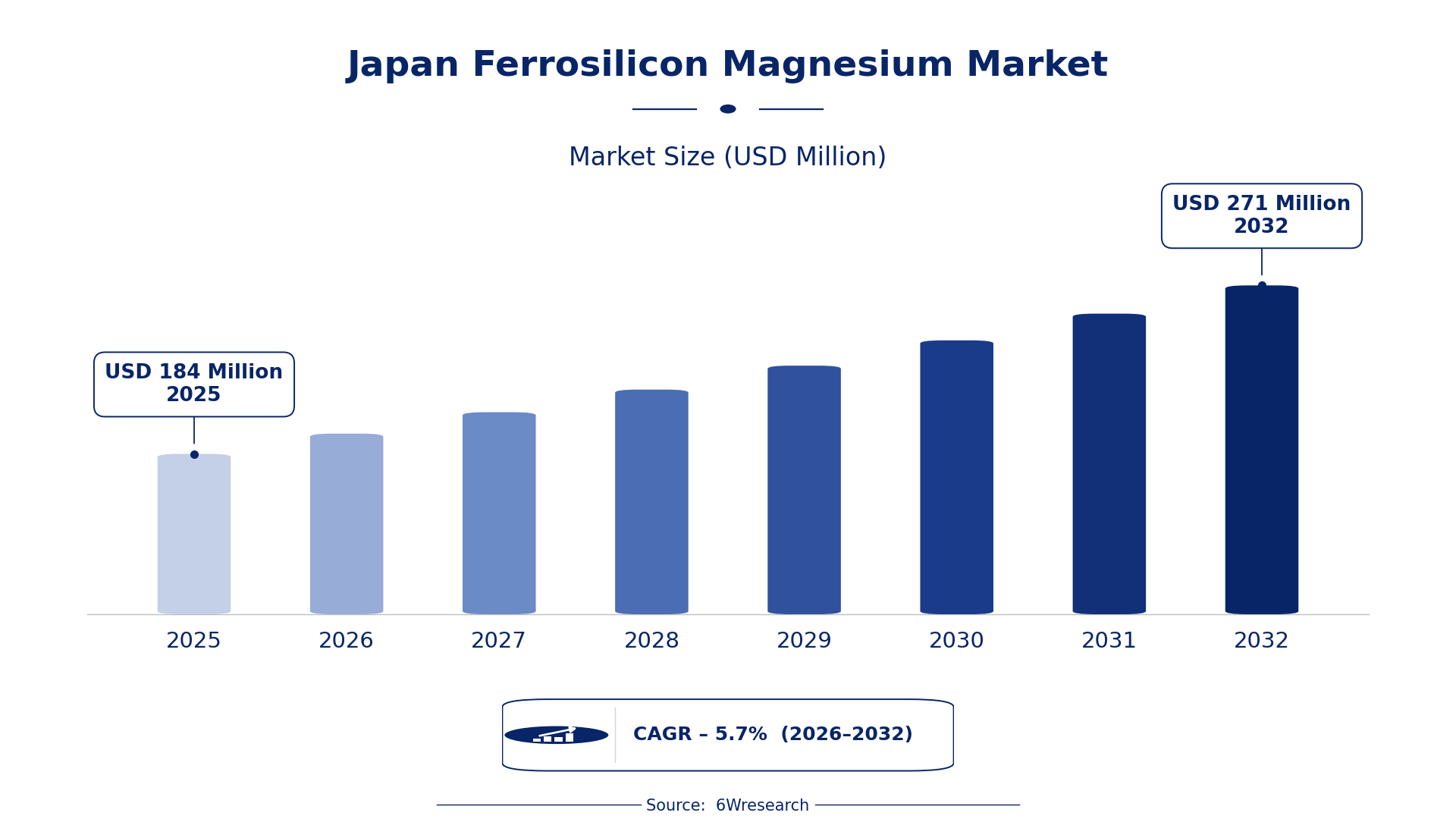
According to 6Wresearch internal database and industry insights, the Japan Ferrosilicon Magnesium Market was valued at USD 184 Million in 2025 and is projected to reach USD 271 Million by 2032, growing at a CAGR of approximately 5.7% during 2026–2032.
Japan Ferrosilicon Magnesium Market Highlights
| Report Metric | Details |
| Report Name | Japan Ferrosilicon Magnesium Market (2026-2032) |
| Market Size 2025 | USD 184 Million |
| Market Size 2032 | USD 271 Million |
| Absolute Growth 2025–2032 | USD 87 Million |
| CAGR 2026–2032 | 5.7% |
| Peak Annual Growth | 6.5% in 2028 |
| Forecast Period | 2026–2032 |
| Historical Data | 2022–2025 |
| Base Year | 2025 |
| Leading Particle Size, 2025 | 5-3 Mm (46% share) |
| Leading Type, 2025 | With Rare Earths (64% share) |
| Leading Application, 2025 | Low Carbon Steel (34% share) |
| Leading End-use, 2025 | Automotive (49% share) |
| Fastest-Growing Particle Size | 3-5 Mm (7.4% CAGR) |
| Fastest-Growing Type | Without Rare Earths (7.6% CAGR) |
| Fastest-Growing Application | Iron (7.5% CAGR) |
| Fastest-Growing End-use | Construction (7.0% CAGR) |
| Growing Sector | Construction |
| Key End Users | Steel manufacturers, automotive sector, construction companies, urban infrastructure developers |
Japan Ferrosilicon Magnesium Market Year-wise Growth Rate and Key Drivers (2022–2032)
This graph illustrates the annual growth rates of the market from 2022 to 2032, highlighting a steady upward trajectory and projected market expansion over the forecast period.
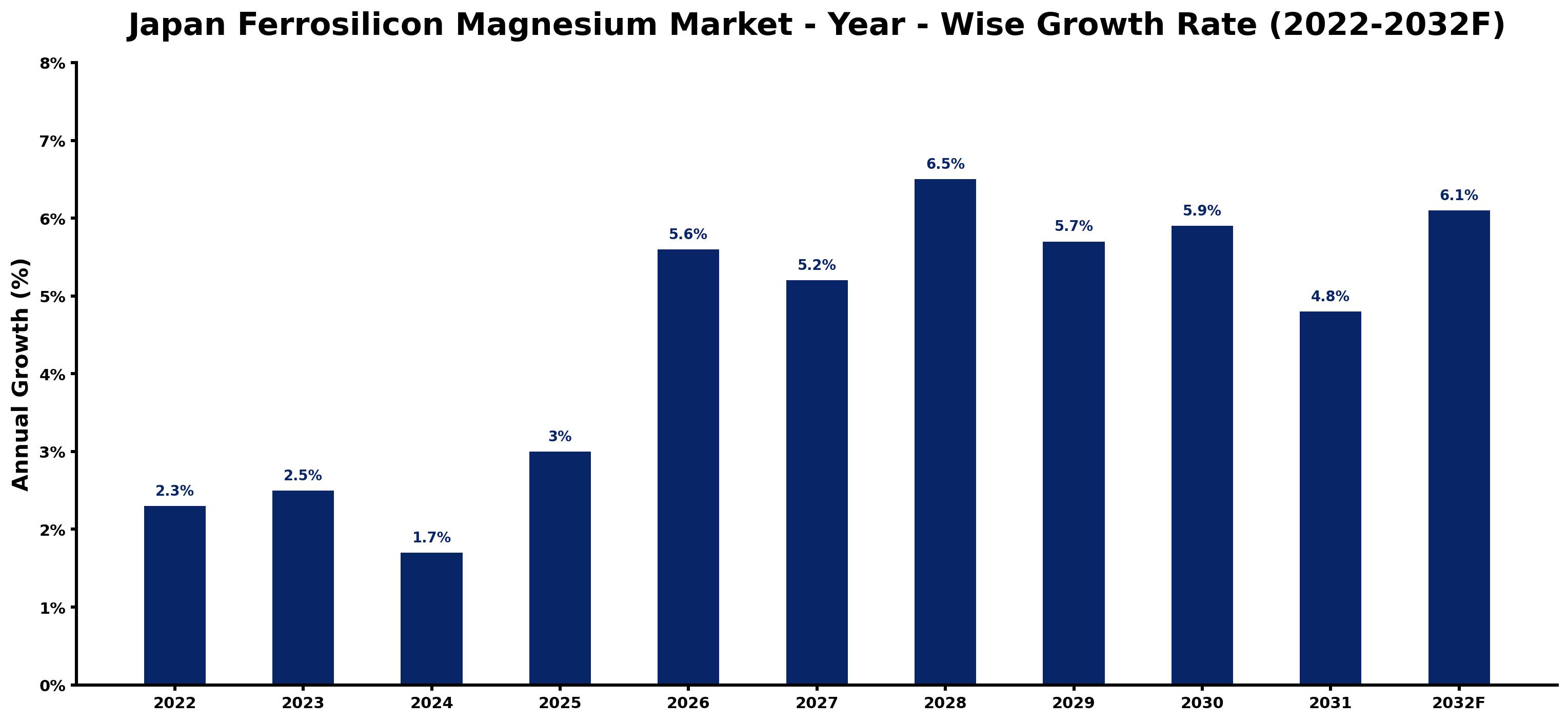
The table below sets out the estimated growth rate for each year and the main factor behind it.
| Year | Estimated Annual Growth (%) | Market Rationale |
| 2022 | 2.3 | The market experienced steady growth due to stable demand from domestic steel producers. |
| 2023 | 2.5 | Demand increased as Japan's total steel production rose, supporting ferrosilicon magnesium usage. |
| 2024 | 1.7 | Growth slowed as manufacturers adjusted to market conditions and production capacities. |
| 2025 | 3.0 | A recovery in steel demand led to faster growth as infrastructure projects resumed. |
| 2026 | 5.6 | Investment in construction projects will drive demand for ferrosilicon magnesium in steel. |
| 2027 | 5.2 | Growth will slow slightly as production stabilises and demand normalises after previous spikes. |
| 2028 | 6.5 | The market will peak with increased demand from low carbon steel production and urbanisation. |
| 2029 | 5.7 | A slight slowdown will occur as growth rates adjust after the previous peak. |
| 2030 | 5.9 | Demand will continue to rise due to ongoing investments in infrastructure and construction. |
| 2031 | 4.8 | Growth will slow as market conditions stabilise, but demand will remain strong overall. |
| 2032 | 6.1 | A resurgence in urban infrastructure projects is expected to boost demand. |
Note: Market size estimations and growth projections presented in this report are based on 6Wresearch's proprietary forecasting methodology, utilizing the latest available industry data, government publications, and primary research inputs.
Japan Ferrosilicon Magnesium Market Synopsis
Ferrosilicon magnesium is an alloy of iron, silicon, and magnesium, primarily used as a deoxidizer and alloying agent in steel production. The Japan Ferrosilicon Magnesium Market will experience robust growth, driven by total steel production of approximately 83 million tons in 2022. Rising demand from the automotive sector and increasing urbanisation, particularly in infrastructure investments, are key contributors to this expansion.
Market Dynamics Impact Analysis (2026–2032)
| Factor | Type | Impact | Primary Segment Affected |
| Rising steel production | Driver | High | Low Carbon Steel |
| Increased urbanisation | Driver | High | Ductile Iron Pipes |
| Growing demand for ductile iron castings | Opportunity | High | Ductile Iron Pipes |
| Investment in advanced materials | Opportunity | Medium | Iron |
| Stringent quality standards | Restraint | High | With Rare Earths |
| Limited domestic production capacity | Restraint | Medium | Without Rare Earths |
| High production costs | Challenge | High | Low Carbon Steel |
| Competition from alternative materials | Challenge | Medium | Ductile Iron Pipes |
Evaluation of Drivers in Japan Ferrosilicon Magnesium Market (2026–2032)
The main growth drivers and the segments they affect most are set out below.
| Drivers | Primary Segment Affected | Why It Matters (Evidence) |
| Increased steel production | Low Carbon Steel | Japan's total steel production reached approximately 83 million tons in 2022, driving demand for ferrosilicon magnesium. |
| Urbanisation trends | Ductile Iron Pipes | Urban population growth is increasing the need for ductile iron pipes in infrastructure projects, expected to rise by 10% annually. |
| Automotive sector growth | Automotive | The automotive industry is expanding due to technological advancements, with production volumes projected to increase by 5% each year. |
| Infrastructure investments | Construction | Investment in infrastructure projects will rise, boosting demand for ferrosilicon magnesium in construction materials by approximately 15%. |
| Quality compliance requirements | Without Rare Earths | Manufacturers pursue ISO 9001 certification to meet stringent quality standards, increasing demand for high-quality ferrosilicon magnesium. |
Spending rises because Japan's total steel production reached approximately 83 million tons in 2022, leading to higher demand for ferrosilicon magnesium in low carbon steel production. Urbanisation trends are increasing the need for ductile iron pipes, essential for urban infrastructure. The automotive sector, as one of the largest consumers, is expanding due to rising production volumes and technological advancements. Investment in infrastructure projects will rise, further boosting demand for ferrosilicon magnesium in construction materials. Manufacturers are pursuing ISO 9001 certification to comply with stringent quality standards, which will increase demand for high-quality products.
Evaluation of Restraints in Japan Ferrosilicon Magnesium Market
These restraints slow adoption and weigh on supplier margins.
| Market Restraint | Primary Segment Affected | Why It Matters (Evidence) |
| High production costs | Low Carbon Steel | Production costs for ferrosilicon magnesium remain elevated, impacting profitability for manufacturers in Japan by approximately 15%. |
| Limited domestic production capacity | Without Rare Earths | Domestic production capacity is insufficient to meet the rising demand, leading to reliance on imports for approximately 20% of needs. |
| Stringent quality standards | With Rare Earths | Compliance with JIS standards increases production costs, affecting pricing strategies for manufacturers by around 10%. |
| Market competition | Ductile Iron Pipes | Competition from alternative materials is increasing, affecting the market share of ferrosilicon magnesium by about 5%. |
| Supply chain disruptions | Iron | Global supply chain issues have led to delays in material availability, impacting production schedules by approximately 30%. |
Japan Ferrosilicon Magnesium Market Challenges
Japan's ferrosilicon magnesium producers face a skills shortage, with an ageing workforce limiting the availability of trained professionals, potentially delaying production timelines by up to six months for steel manufacturers. High production costs arise from stringent JIS standards, necessitating advanced quality control processes that can inflate expenses by 15% for producers, impacting their pricing strategies. Intense competition from alternative alloying agents forces producers to reduce prices, squeezing margins and diminishing profitability. Technology adoption lags, as many producers do not utilise modern electric arc furnaces, resulting in inefficiencies that can reduce output by 20%.
Trends in the Japan Ferrosilicon Magnesium Market
The shifts below are changing how Japan Ferrosilicon Magnesium Market products are bought and supplied.
- Shift towards Advanced Materials in Construction: In 2023, the Japanese government launched a program to promote advanced materials in construction, targeting improved sustainability. This initiative will increase the use of ferrosilicon magnesium in construction materials.
- Increase in Ductile Iron Pipe Usage: The demand for ductile iron pipes is expected to rise due to urbanisation, with urban infrastructure projects increasing by 10% annually. This trend indicates a growing market for ferrosilicon magnesium.
- Focus on Low Carbon Steel Production: Japan's steel industry is increasingly focusing on low carbon steel production, with approximately 60% of total steel production dedicated to this segment. This shift is driving demand for ferrosilicon magnesium as a key alloying agent.
- Rising Automotive Component Manufacturing: The automotive sector is expanding, with production expected to increase by 5% in the next five years. This growth will further boost the demand for ferrosilicon magnesium in automotive components.
Investment Opportunities in the Japan Ferrosilicon Magnesium Market
The following opportunities in the Japan Ferrosilicon Magnesium Market pair current demand with a clear way in.
- Gap in High-Quality Ferrosilicon Magnesium: With a projected increase in demand for high-quality ferrosilicon magnesium, manufacturers can invest in quality improvements. The automotive sector, as a major consumer, presents an opportunity for suppliers.
- Investment in Urban Infrastructure: Investment in urban infrastructure is rising, creating a demand for ferrosilicon magnesium in construction materials. Collaborating with local construction firms can facilitate market entry.
- Growing Need for Ductile Iron Castings: The demand for ductile iron castings is expected to rise due to urbanisation, with a projected increase of 10% annually. Suppliers can target this growing sector to expand their market presence.
- Expansion in Low Carbon Steel Applications: As low carbon steel production grows, there is an opportunity to supply ferrosilicon magnesium tailored for this application. Engaging with steel manufacturers can enhance market penetration.
Government Initiatives in the Japan Ferrosilicon Magnesium Market
The Economic Security Promotion Act of 2022 supports supply-chain resilience for critical materials, including ferrosilicon magnesium. This act encourages local production and reduces dependency on imports, benefiting domestic manufacturers and buyers by ensuring a stable supply.
In 2023, the Japanese government allocated USD 50 million to support the development of advanced materials in construction, administered by the Ministry of Economy, Trade and Industry (METI). This funding aims to improve the quality and availability of materials, benefiting producers and buyers in the construction sector.
Future Insight of the Japan Ferrosilicon Magnesium Market
Steel manufacturers will increasingly seek ferrosilicon magnesium by 2032, as urbanisation drives demand for ductile iron castings. Infrastructure investments are expected to rise, with projections indicating a 10% increase in related projects. The government's programme promoting advanced materials in construction will encourage the adoption of innovative production techniques. Compliance with ISO 9001 certification will become more prevalent, pushing suppliers to enhance quality standards and remain competitive.
Market Segmentation Analysis
Japan Ferrosilicon Magnesium Market report covers a detailed analysis of the following market segments:
By Particle Size – 5-3 Mm Leads, 3-5 Mm Expected to Grow Fastest
According to Shubham Padhi, Research Analyst at 6Wresearch, the largest particle size category in 2025 was 5-3 Mm, at 46% of revenue. The 5-3 Mm particle size segment commands the largest share as it is essential for producing low carbon steel grades, which constitute about 60% of Japan's steel output. This size aligns with the stringent quality standards enforced by the Japanese steel industry, ensuring its continued dominance. The quickest growth will come from 3-5 Mm, forecast to expand at a CAGR of 7.4% between 2026 and 2032. The 3-5 Mm particle size segment is witnessing rapid growth due to its increasing applications in various steel grades and castings, particularly as urbanization drives demand for infrastructure. Its adaptability to a broader range of uses positions it well for future expansion. Suppliers should prioritise the 3-5 Mm segment to meet the rising demand across multiple applications.
By Type – With Rare Earths Lead, Without Rare Earths Expected to Grow Fastest
With Rare Earths held 64% of the Japan Ferrosilicon Magnesium Market by type in 2025. The With Rare Earths type secures the largest share as it enhances the properties of ferrosilicon magnesium, making it suitable for high-performance applications within the steel sector. The adherence to strict quality standards, such as JIS, reinforces the preference for this type among manufacturers. Without Rare Earths are projected to grow fastest, at a CAGR of 7.6% during 2026–2032. The Without Rare Earths type is experiencing the fastest growth due to its widespread use in standard applications, which aligns with the increasing demand for economical solutions in steel production. Its direct applicability in various steel grades accelerates its market penetration. Buyers may find the Without Rare Earths segment appealing for cost-effective solutions that maintain quality.
By Application – Low Carbon Steel Leads, Iron Expected to Grow Fastest
Low Carbon Steel accounted for 34% of the market by application in 2025. Low Carbon Steel is the leading application segment as it constitutes about 60% of Japan's total steel production, making it vital for the industry's stability. The direct application of ferrosilicon magnesium in producing low carbon steel grades underscores its market importance. Iron is set to record the highest CAGR in this split, 7.5% over 2026–2032. Iron is the fastest-growing application segment, driven by rising demand for iron production processes, especially in urban infrastructure projects. The increasing emphasis on construction materials further propels this segment's growth, indicating a shift in application focus. Suppliers should align their strategies to meet the rising demand for ferrosilicon magnesium in iron production to seize emerging opportunities.
By End-use – Automotive Leads, Construction Expected to Grow Fastest
With 49% of end-use revenue in 2025, Automotive was the largest category. The Automotive end-use segment leads the market as it is a major consumer of ferrosilicon magnesium, particularly in the production of automotive components and parts. The automotive industry's strong demand for lightweight and high-strength materials solidifies this segment's position. Over 2026–2032, Construction is expected to post the fastest growth, at a CAGR of 7.0%. The Construction end-use segment is growing the fastest, driven by government initiatives that promote advanced materials and increased investment in infrastructure projects. This focus on urban development underscores the rising need for ferrosilicon magnesium in construction applications. Suppliers should explore opportunities in the construction sector to capitalise on the anticipated growth from infrastructure investments.
Key Attractiveness of the Report
- 10 Years of Market Numbers
- Historical Data Starting from 2022 to 2025
- Base Year 2025
- Forecast Data until 2032
- Key Performance Indicators Impacting the Market
- Major Upcoming Developments and Projects
Key Highlights of the Report:
- Japan Ferrosilicon Magnesium Market Outlook
- Market Size of Japan Ferrosilicon Magnesium Market, 2025
- Forecast of Japan Ferrosilicon Magnesium Market, 2032
- Historical Data and Forecast of Japan Ferrosilicon Magnesium Revenues & Volume for the Period 2022-2032
- Japan Ferrosilicon Magnesium Market Trend Evolution
- Japan Ferrosilicon Magnesium Market Drivers and Challenges
- Japan Ferrosilicon Magnesium Price Trends
- Japan Ferrosilicon Magnesium Porter's Five Forces
- Japan Ferrosilicon Magnesium Industry Life Cycle
- Historical Data and Forecast of Japan Ferrosilicon Magnesium Market Revenues & Volume By Particle Size for the Period 2022-2032
- Historical Data and Forecast of Japan Ferrosilicon Magnesium Market Revenues & Volume By 5-3 Mm for the Period 2022-2032
- Historical Data and Forecast of Japan Ferrosilicon Magnesium Market Revenues & Volume By 3-5 Mm for the Period 2022-2032
- Historical Data and Forecast of Japan Ferrosilicon Magnesium Market Revenues & Volume By 5-15 Mm for the Period 2022-2032
- Historical Data and Forecast of Japan Ferrosilicon Magnesium Market Revenues & Volume By 15-25 Mm for the Period 2022-2032
- Historical Data and Forecast of Japan Ferrosilicon Magnesium Market Revenues & Volume By 25 Mm And Above for the Period 2022-2032
- Historical Data and Forecast of Japan Ferrosilicon Magnesium Market Revenues & Volume By Type for the Period 2022-2032
- Historical Data and Forecast of Japan Ferrosilicon Magnesium Market Revenues & Volume By With Rare Earths for the Period 2022-2032
- Historical Data and Forecast of Japan Ferrosilicon Magnesium Market Revenues & Volume By Without Rare Earths for the Period 2022-2032
- Historical Data and Forecast of Japan Ferrosilicon Magnesium Market Revenues & Volume By Application for the Period 2022-2032
- Historical Data and Forecast of Japan Ferrosilicon Magnesium Market Revenues & Volume By Low Carbon Steel for the Period 2022-2032
- Historical Data and Forecast of Japan Ferrosilicon Magnesium Market Revenues & Volume By Iron for the Period 2022-2032
- Historical Data and Forecast of Japan Ferrosilicon Magnesium Market Revenues & Volume By Ductile Iron Pipes for the Period 2022-2032
- Historical Data and Forecast of Japan Ferrosilicon Magnesium Market Revenues & Volume By Sg Iron Castings for the Period 2022-2032
- Historical Data and Forecast of Japan Ferrosilicon Magnesium Market Revenues & Volume By End-use for the Period 2022-2032
- Historical Data and Forecast of Japan Ferrosilicon Magnesium Market Revenues & Volume By Automotive for the Period 2022-2032
- Historical Data and Forecast of Japan Ferrosilicon Magnesium Market Revenues & Volume By Construction for the Period 2022-2032
- Historical Data and Forecast of Japan Ferrosilicon Magnesium Market Revenues & Volume By Others for the Period 2022-2032
- Japan Ferrosilicon Magnesium Import Export Trade Statistics
- Market Opportunity Assessment By Particle Size
- Market Opportunity Assessment By Type
- Market Opportunity Assessment By Application
- Market Opportunity Assessment By End-use
- Japan Ferrosilicon Magnesium Top Companies Market Share
- Japan Ferrosilicon Magnesium Competitive Benchmarking By Technical and Operational Parameters
- Japan Ferrosilicon Magnesium Company Profiles
- Japan Ferrosilicon Magnesium Key Strategic Recommendations
Market Covered
Segments analysed in this report are listed below.
By Particle Size
- 5-3 Mm
- 3-5 Mm
- 5-15 Mm
- 15-25 Mm
- 25 Mm And Above
By Type
- With Rare Earths
- Without Rare Earths
By Application
- Low Carbon Steel
- Iron
- Ductile Iron Pipes
- Sg Iron Castings
By End-use
- Automotive
- Construction
- Others































