Japan Fiber Optic Communication Market Size & Growth Rate
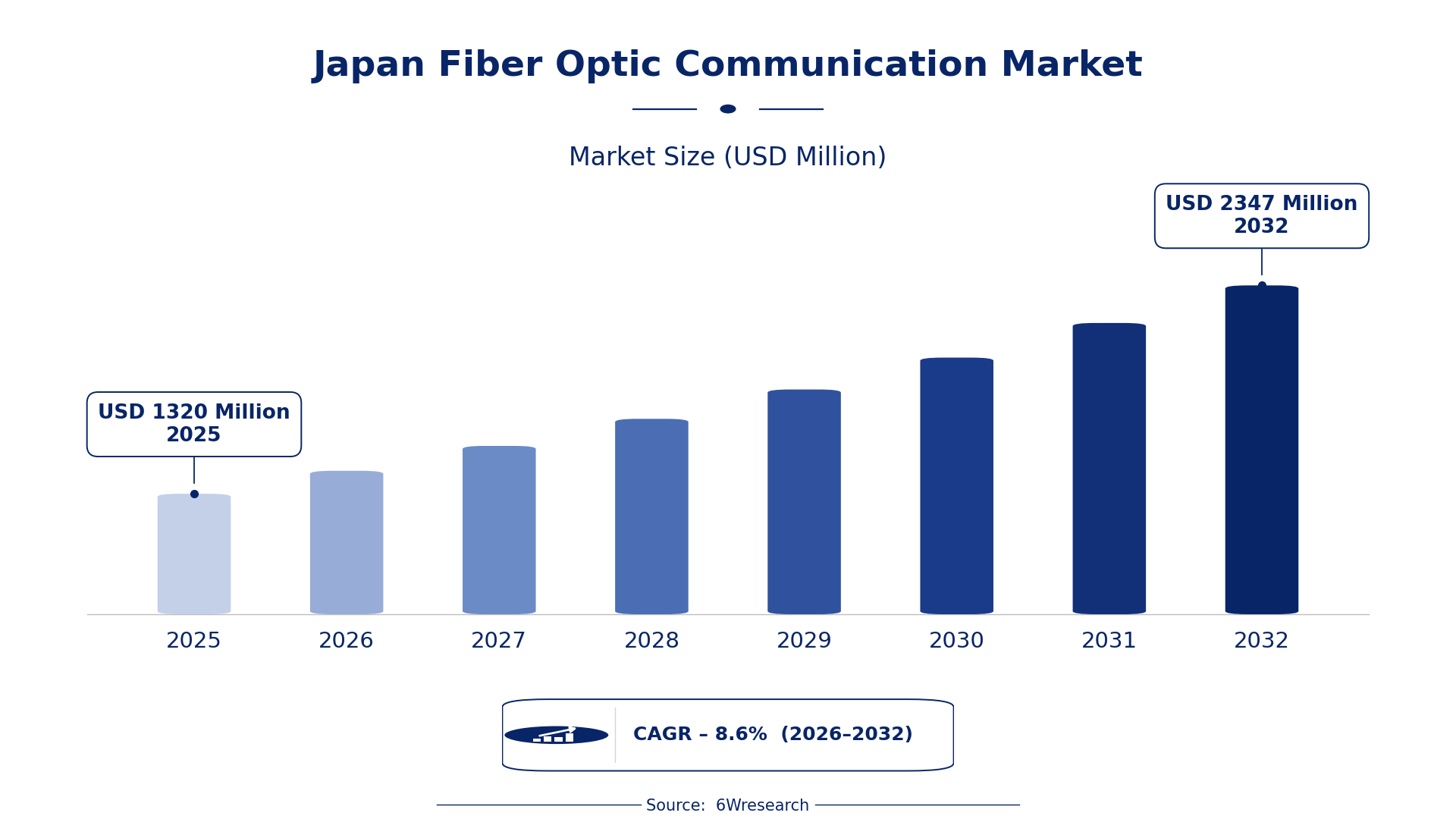
According to 6Wresearch internal database and industry insights, the Japan Fiber Optic Communication Market was valued at USD 1,320 Million in 2025 and is projected to reach USD 2,347 Million by 2032, growing at a CAGR of approximately 8.6% during 2026–2032.
Japan Fiber Optic Communication Market Highlights
| Report Metric | Details |
| Report Name | Japan Fiber Optic Communication Market (2026-2032) |
| Market Size 2025 | USD 1,320 Million |
| Market Size 2032 | USD 2,347 Million |
| Absolute Growth 2025–2032 | USD 1,027 Million |
| CAGR 2026–2032 | 8.6% |
| Peak Annual Growth | 9.4% in 2028 |
| Forecast Period | 2026–2032 |
| Historical Data | 2022–2025 |
| Base Year | 2025 |
| Leading System Type, 2025 | FTTH (42% share) |
| Leading Network Layer, 2025 | Last Mile (34% share) |
| Leading Distribution Channel, 2025 | Internet Providers (35% share) |
| Leading End User, 2025 | Residential Users (38% share) |
| Fastest-Growing System Type | DWDM Systems (11.8% CAGR) |
| Fastest-Growing Network Layer | Backbone Layer (11.4% CAGR) |
| Fastest-Growing Distribution Channel | OEMs (10.6% CAGR) |
| Fastest-Growing End User | Telecom Operators (11.3% CAGR) |
| Growing Sector | Telecom Operators |
| Key End Users | Residential Users, Telecom Operators, Cloud Providers, Internet Exchange Points |
Japan Fiber Optic Communication Market Year-wise Growth Rate and Key Drivers (2022–2032)
This graph illustrates the annual growth rates of the market from 2022 to 2032, highlighting a steady upward trajectory and projected market expansion over the forecast period.
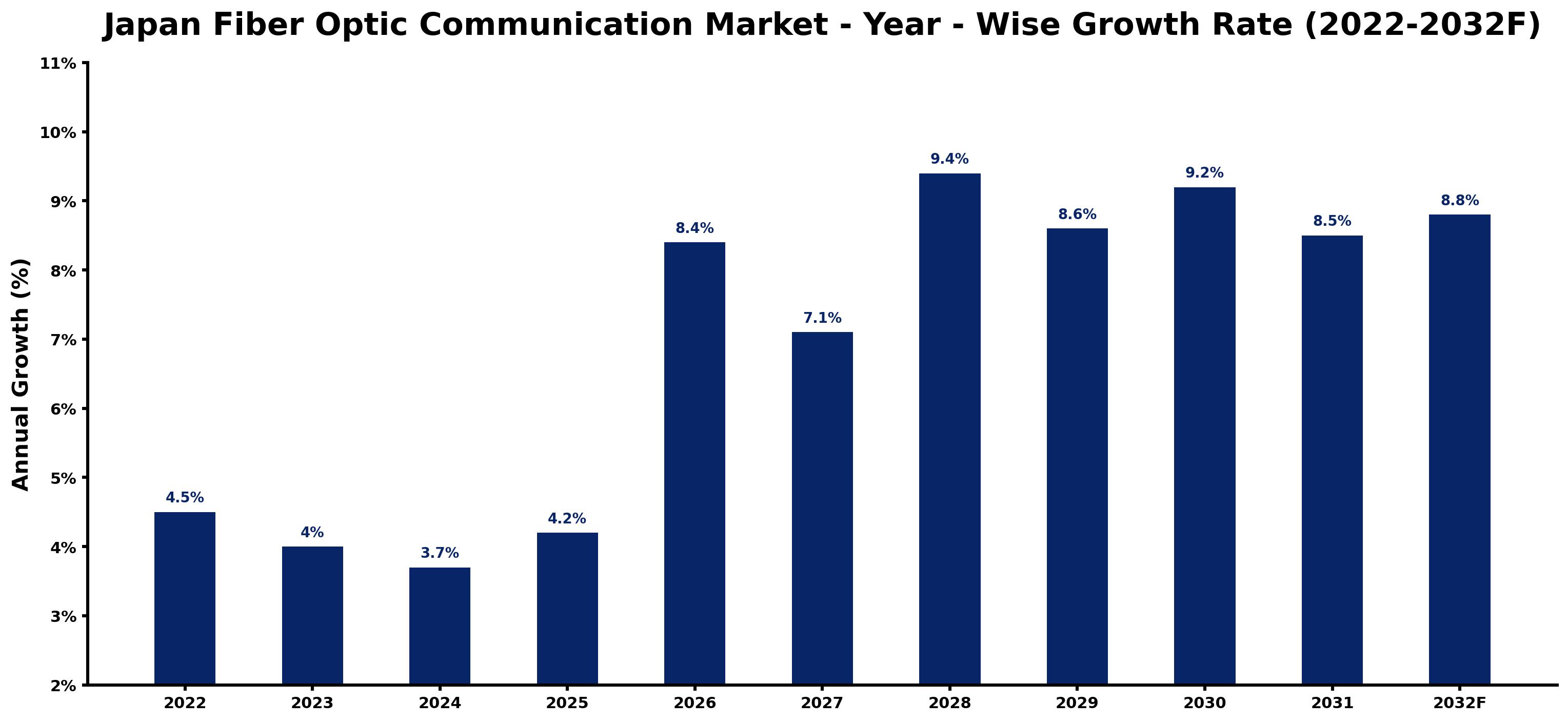
The yearly estimates that follow link every growth rate to its principal driver, so readers can see why the pace changed in each period.
| Year | Estimated Annual Growth (%) | Market Rationale |
| 2022 | 4.5 | The market experienced steady growth due to strong demand from telecom operators. |
| 2023 | 4.0 | Growth slowed as market saturation began to affect new subscriber acquisition. |
| 2024 | 3.7 | Market growth continued to slow as competition intensified among service providers. |
| 2025 | 4.2 | Demand rebounded as investments in infrastructure increased, particularly in urban areas. |
| 2026 | 8.4 | Growth is projected to accelerate due to rising demand for high-speed internet across various sectors. |
| 2027 | 7.1 | Market growth will slow slightly as the focus shifts to improving existing networks. |
| 2028 | 9.4 | A surge in demand for long-haul transmission will lead to peak growth in the market. |
| 2029 | 8.6 | Growth is expected to slow as market maturity begins to set in, stabilising demand. |
| 2030 | 9.2 | The demand for optical transceivers is set to rise, driving market growth. |
| 2031 | 8.5 | The market will continue to grow as telecom operators expand their service offerings. |
| 2032 | 8.8 | Rising demand for high-speed internet services will sustain growth momentum. |
Note: Market size estimations and growth projections presented in this report are based on 6Wresearch's proprietary forecasting methodology, utilizing the latest available industry data, government publications, and primary research inputs.
Japan Fiber Optic Communication Market Synopsis
Fiber optic communication involves the transmission of data as light pulses through optical fibers, essential for high-speed internet and telecommunications. The Japan Fiber Optic Communication Market is projected to grow significantly due to over 40 million FTTH subscribers and increasing demand for high-speed internet. Key drivers include the expansion of fiber optic infrastructure in rural areas and the adoption of DWDM systems in backbone networks, which improve data transmission capabilities.
Market Dynamics Impact Analysis (2026–2032)
| Factor | Type | Impact | Primary Segment Affected |
| Rising demand for high-speed internet services | Driver | High | FTTH |
| Increased investments in fiber optic infrastructure | Driver | High | DWDM Systems |
| Expansion of fiber optic networks in rural areas | Opportunity | High | Last Mile |
| Growing need for high-capacity data transmission | Opportunity | High | Optical Transceivers |
| Intense competition among service providers | Restraint | Medium | Residential Users |
| Market saturation in urban areas | Restraint | Medium | Telecom Operators |
| High installation costs for new infrastructure | Challenge | High | Data Center |
| Technological advancements requiring constant upgrades | Challenge | Medium | Optical Amplifiers |
Evaluation of Drivers in Japan Fiber Optic Communication Market (2026–2032)
These are the developments adding the most demand over the forecast period.
| Drivers | Primary Segment Affected | Why It Matters (Evidence) |
| Growing subscriber base for FTTH services | FTTH | With over 40 million subscribers, demand for high-speed internet drives purchases of fiber optic cables. |
| Increased demand for data centers | Optical Transceivers | Data centers require thousands of optical transceivers to manage high-speed data processing. |
| Rising internet speeds in urban areas | DWDM Systems | The average internet speed of 100 Mbps encourages upgrades to backbone network systems. |
| Expansion of telecommunications infrastructure | Last Mile | Telecom operators are investing in last-mile connections to improve service delivery. |
| Government initiatives to improve connectivity | Optical Amplifiers | The program to expand fiber optic infrastructure in rural areas boosts demand for amplifiers. |
Several shifts outside the market lift sales. The increasing subscriber base for FTTH services drives demand for fiber optic cables, particularly in urban areas. Data centers are adopting optical transceivers in large quantities to meet high-speed data processing needs. The average internet speed in Japan necessitates upgrades to backbone network systems.
Evaluation of Restraints in Japan Fiber Optic Communication Market
The main factors holding the market back are set out below.
| Market Restraint | Primary Segment Affected | Why It Matters (Evidence) |
| High installation costs for new infrastructure | Data Center | High costs associated with installing new fiber optic infrastructure deter some buyers from upgrading. |
| Market saturation in urban areas | Telecom Operators | Market saturation limits the potential for new subscriber growth in urban areas. |
| Intense competition among service providers | Residential Users | Intense competition drives down prices, affecting profitability for service providers in the fiber optic market. |
| Technological advancements requiring constant upgrades | Optical Amplifiers | Rapid advancements in technology necessitate frequent upgrades, increasing costs for buyers. |
| Limited availability of skilled technicians | DWDM Systems | A shortage of skilled technicians hampers the deployment and maintenance of advanced fiber optic systems. |
Japan Fiber Optic Communication Market Challenges
Over 40 million FTTH subscribers in Japan create intense competition among telecom operators, driving down prices and squeezing margins for suppliers. Rapid advancements in fiber optic technology necessitate continuous investment, which can delay deployment timelines for producers, affecting service availability for telecom operators. A shortage of skilled technicians for fiber optic installation results in project delays, hindering telecom operators' ability to meet service demands. Stringent regulations from the Ministry of Internal Affairs and Communications can slow infrastructure expansion, leading to missed opportunities for buyers in rural areas.
Trends in the Japan Fiber Optic Communication Market
The shifts below are changing how Japan Fiber Optic Communication Market products are bought and supplied.
- Transition from Copper to Fiber Optic Technology: The telecommunications sector is transitioning from copper to fiber optic technology, improving data transmission speeds. In 2023, the Tokyo metropolitan area saw a 20% increase in fiber optic installations.
- Growing Adoption of DWDM Systems: DWDM systems are increasingly being adopted in backbone networks across Japan, improving data transmission capacity. As of 2023, these systems account for over 30% of backbone infrastructure.
- Expansion of Rural Fiber Optic Networks: The government initiated a program to expand fiber optic infrastructure in rural areas by 2025, aiming to connect underserved communities. This initiative targets a 50% increase in rural connectivity by 2025.
- Increase in Data Center Connectivity: Data centers are increasingly adopting fiber optic technology for improved performance, with thousands of optical transceivers installed nationwide. By 2023, data centers reported a 25% rise in operational efficiency.
Investment Opportunities in the Japan Fiber Optic Communication Market
Investors looking at the Japan Fiber Optic Communication Market should consider the following areas.
- Forming Partnerships with Local Telecom Operators: Now is an ideal time to form partnerships with local telecom operators to expand fiber optic services. The growing demand for high-speed internet in rural areas presents opportunities for collaboration.
- Investment in Optical Amplifiers: Investing in optical amplifiers is vital as demand for long-haul transmission increases. Telecom operators in rural regions are seeking reliable solutions to improve signal quality.
- Supply of Optical Transceivers: The demand for optical transceivers is rising due to the expansion of data centers. Suppliers can enter the market by collaborating with data center operators to provide tailored solutions.
- Securing Approvals for New Fiber Optic Projects: Securing approvals for new fiber optic projects is essential as the government pushes for improved connectivity. Engaging with local authorities will facilitate smoother project implementation.
Government Initiatives in the Japan Fiber Optic Communication Market
The Digital Agency (established September 2021) leads government digital transformation efforts, improving the capabilities of fiber optic communication systems. This complements existing regulations by ensuring that new technologies can be integrated effectively into the telecommunications infrastructure. The government has allocated USD 500 million towards expanding fiber optic infrastructure in rural areas by 2023, overseen by the Digital Agency. This funding aims to improve connectivity and access to high-speed internet for underserved populations.
The Ministry of Internal Affairs and Communications oversees telecommunications regulations, ensuring compliance with standards such as ISO/IEC 11801. This agency plays a key role in promoting the use of fiber optics, improving the overall quality of telecommunications services in Japan.
Future Insight of the Japan Fiber Optic Communication Market
A government programme to expand fiber optic infrastructure in rural areas will improve connectivity for underserved populations. By 2032, the integration of advanced optical transceivers in data centers is projected to support the increasing need for high-speed internet, with average internet speeds expected to rise above 100 Mbps. Collaboration among telecom operators and industry associations will enhance service delivery. The adoption of ISO/IEC 11801 standards will ensure higher quality and reliability in fiber optic cabling, benefiting both suppliers and buyers.
Market Segmentation Analysis
Japan Fiber Optic Communication Market report covers a detailed analysis of the following market segments:
By System Type – FTTH Leads, DWDM Systems Expected to Grow Fastest
According to Saurav Kr Singh, Senior Research Analyst at 6Wresearch, the largest system type category in 2025 was FTTH, at 42% of revenue. FTTH holds the largest share due to its essential role in providing residential broadband connectivity, with over 40 million subscribers in Japan as of 2023. This extensive subscriber base demonstrates the high demand for reliable internet services among households, particularly in urban areas like Tokyo. DWDM Systems are projected to grow fastest, at a CAGR of 11.8% during 2026–2032. The growth of DWDM systems is fuelled by the increasing need for high-capacity long-distance data transmission, especially within backbone networks. As the telecommunications infrastructure in Japan continues to advance, the demand for these systems is expected to rise significantly. Suppliers should focus on enhancing DWDM systems to meet the growing requirements of network operators.
By Network Layer – Last Mile Leads, Backbone Layer Expected to Grow Fastest
Last Mile took 34% of network layer revenue in 2025, more than any other category. The Last Mile segment leads the market as it is crucial for connecting end users directly to the network, facilitating access to high-speed internet services. Government initiatives to expand fiber optic infrastructure in rural areas by 2025 further highlight the significance of this segment. Over 2026–2032, Backbone Layer is expected to post the fastest growth, at a CAGR of 11.4%. The Backbone Layer is witnessing rapid growth due to its fundamental role in core network infrastructure, which is essential for managing the increasing data traffic. As demand for high-speed internet continues to grow, the Backbone Layer's importance will likely increase. Investors should seek opportunities in Backbone Layer solutions to capitalise on the expanding network infrastructure.
By Distribution Channel – Internet Providers Lead, OEMs Expected to Grow Fastest
In 2025, Internet Providers led the distribution channel split with a 35% share. Internet Providers dominate the market as the primary distributors of fiber optic services, ensuring widespread access to high-speed internet for consumers. Their established relationships with residential users make them critical players in the market. OEMs are set to record the highest CAGR in this split, 10.6% over 2026–2032. OEMs are experiencing the fastest growth as they provide essential equipment that utilises fiber optics, responding to the rising demand for advanced telecommunications technology. This trend indicates a shift towards more integrated solutions within the market. Suppliers must strengthen partnerships with OEMs to enhance market reach and service offerings.
By End User – Residential Users Lead, Telecom Operators Expected to Grow Fastest
Residential Users held 38% of the Japan Fiber Optic Communication Market by end user in 2025. Residential Users constitute the largest end user segment for fiber optic services, driven by the demand for reliable and fast internet connectivity. The substantial number of FTTH subscribers underscores the critical importance of this segment in the overall market. The quickest growth will come from Telecom Operators, forecast to expand at a CAGR of 11.3% between 2026 and 2032. Telecom Operators are the fastest-growing segment as they increasingly implement fiber optic technology to improve their service offerings and satisfy consumer demands. This trend is anticipated to persist as competition in the telecom sector intensifies. Providers should customise their solutions to address the specific needs of telecom operators to capture this expanding market.
Key Attractiveness of the Report
- 10 Years of Market Numbers
- Historical Data Starting from 2022 to 2025
- Base Year 2025
- Forecast Data until 2032
- Key Performance Indicators Impacting the Market
- Major Upcoming Developments and Projects
Key Highlights of the Report:
- Japan Fiber Optic Communication Market Outlook
- Market Size of Japan Fiber Optic Communication Market, 2025
- Forecast of Japan Fiber Optic Communication Market, 2032
- Historical Data and Forecast of Japan Fiber Optic Communication Revenues & Volume for the Period 2022-2032F
- Japan Fiber Optic Communication Market Trend Evolution
- Japan Fiber Optic Communication Market Drivers and Challenges
- Japan Fiber Optic Communication Price Trends
- Japan Fiber Optic Communication Porter's Five Forces
- Japan Fiber Optic Communication Industry Life Cycle
- Historical Data and Forecast of Japan Fiber Optic Communication Market Revenues & Volume By System Type for the Period 2022-2032F
- Historical Data and Forecast of Japan Fiber Optic Communication Market Revenues & Volume By FTTH for the Period 2022-2032F
- Historical Data and Forecast of Japan Fiber Optic Communication Market Revenues & Volume By DWDM Systems for the Period 2022-2032F
- Historical Data and Forecast of Japan Fiber Optic Communication Market Revenues & Volume By Optical Transceivers for the Period 2022-2032F
- Historical Data and Forecast of Japan Fiber Optic Communication Market Revenues & Volume By Optical Amplifiers for the Period 2022-2032F
- Historical Data and Forecast of Japan Fiber Optic Communication Market Revenues & Volume By Network Layer for the Period 2022-2032F
- Historical Data and Forecast of Japan Fiber Optic Communication Market Revenues & Volume By Last Mile for the Period 2022-2032F
- Historical Data and Forecast of Japan Fiber Optic Communication Market Revenues & Volume By Backbone Layer for the Period 2022-2032F
- Historical Data and Forecast of Japan Fiber Optic Communication Market Revenues & Volume By Data Center for the Period 2022-2032F
- Historical Data and Forecast of Japan Fiber Optic Communication Market Revenues & Volume By Long-Haul Transmission for the Period 2022-2032F
- Historical Data and Forecast of Japan Fiber Optic Communication Market Revenues & Volume By Distribution Channel for the Period 2022-2032F
- Historical Data and Forecast of Japan Fiber Optic Communication Market Revenues & Volume By Internet Providers for the Period 2022-2032F
- Historical Data and Forecast of Japan Fiber Optic Communication Market Revenues & Volume By OEMs for the Period 2022-2032F
- Historical Data and Forecast of Japan Fiber Optic Communication Market Revenues & Volume By Distributors for the Period 2022-2032F
- Historical Data and Forecast of Japan Fiber Optic Communication Market Revenues & Volume By Direct Sales for the Period 2022-2032F
- Historical Data and Forecast of Japan Fiber Optic Communication Market Revenues & Volume By End User for the Period 2022-2032F
- Historical Data and Forecast of Japan Fiber Optic Communication Market Revenues & Volume By Residential Users for the Period 2022-2032F
- Historical Data and Forecast of Japan Fiber Optic Communication Market Revenues & Volume By Telecom Operators for the Period 2022-2032F
- Historical Data and Forecast of Japan Fiber Optic Communication Market Revenues & Volume By Cloud Providers for the Period 2022-2032F
- Historical Data and Forecast of Japan Fiber Optic Communication Market Revenues & Volume By Internet Exchange Points for the Period 2022-2032F
- Japan Fiber Optic Communication Import Export Trade Statistics
- Market Opportunity Assessment By System Type
- Market Opportunity Assessment By Network Layer
- Market Opportunity Assessment By Distribution Channel
- Market Opportunity Assessment By End User
- Japan Fiber Optic Communication Top Companies Market Share
- Japan Fiber Optic Communication Competitive Benchmarking By Technical and Operational Parameters
- Japan Fiber Optic Communication Company Profiles
- Japan Fiber Optic Communication Key Strategic Recommendations
Market Covered
Coverage by segment is as follows.
By System Type
- FTTH
- DWDM Systems
- Optical Transceivers
- Optical Amplifiers
By Network Layer
- Last Mile
- Backbone Layer
- Data Center
- Long-Haul Transmission
By Distribution Channel
- Internet Providers
- OEMs
- Distributors
- Direct Sales
By End User
- Residential Users
- Telecom Operators
- Cloud Providers
- Internet Exchange Points































