Japan Fiber Optic Equipment Market Size & Growth Rate
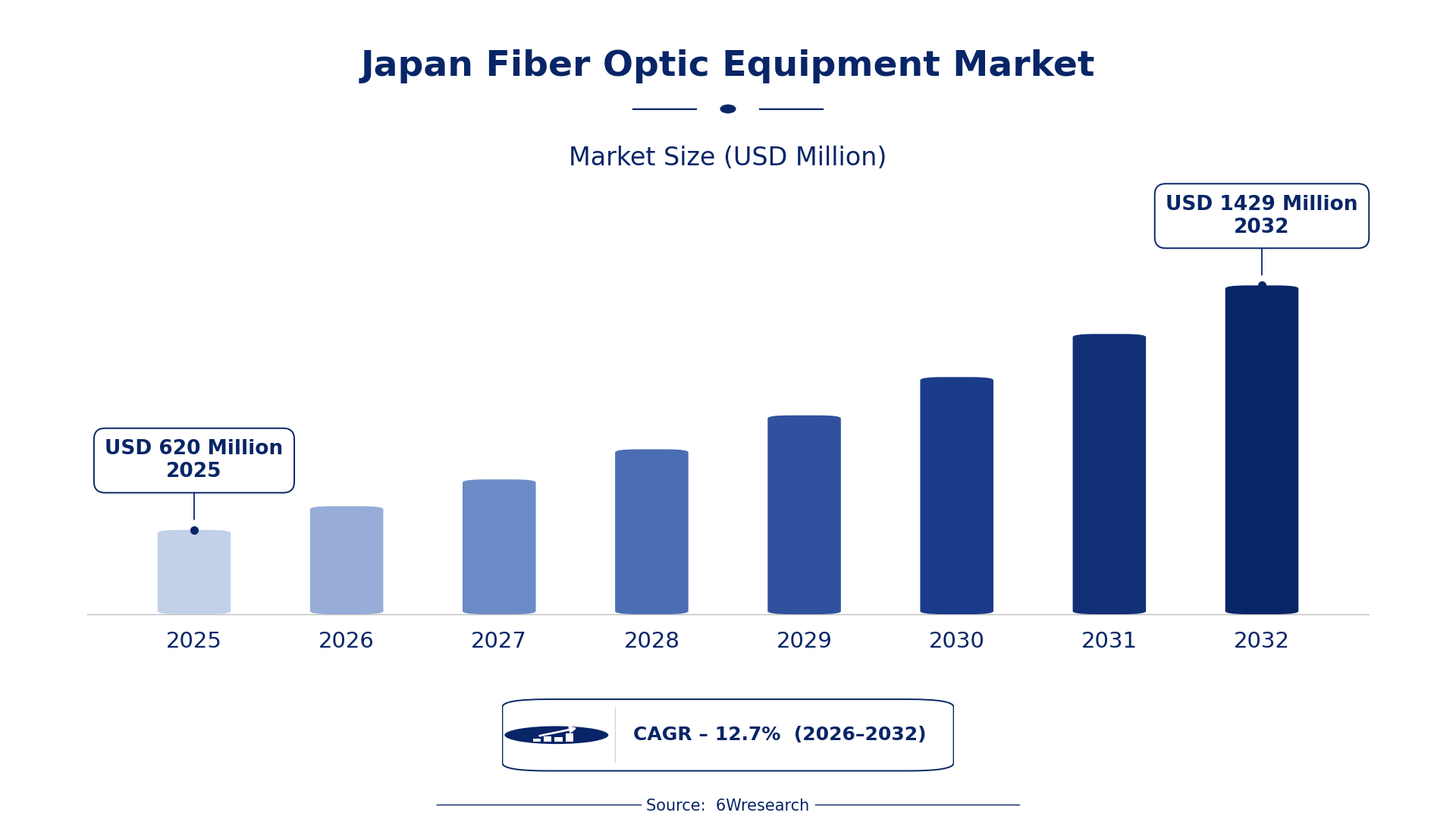
According to 6Wresearch internal database and industry insights, the Japan Fiber Optic Equipment Market was valued at USD 620 Million in 2025 and is projected to reach USD 1,429 Million by 2032, growing at a CAGR of approximately 12.7% during 2026–2032.
Japan Fiber Optic Equipment Market Highlights
| Report Metric | Details |
| Report Name | Japan Fiber Optic Equipment Market (2026-2032) |
| Market Size 2025 | USD 620 Million |
| Market Size 2032 | USD 1,429 Million |
| Absolute Growth 2025–2032 | USD 809 Million |
| CAGR 2026–2032 | 12.7% |
| Peak Annual Growth | 16.1% in 2026 |
| Forecast Period | 2026–2032 |
| Historical Data | 2022–2025 |
| Base Year | 2025 |
| Leading Equipment Type, 2025 | Optical Switches (51% share) |
| Leading Functionality, 2025 | Network Routing (37% share) |
| Leading Distribution Channel, 2025 | Technology Distributors (49% share) |
| Leading End User, 2025 | Telecom Carriers (33% share) |
| Fastest-Growing Equipment Type | Optical Modulators (17.9% CAGR) |
| Fastest-Growing Functionality | Signal Encoding (15.7% CAGR) |
| Fastest-Growing Distribution Channel | OEMs (15.9% CAGR) |
| Fastest-Growing End User | Data Centers (16.1% CAGR) |
| Growing Sector | Telecommunications |
| Key End Users | Telecom Carriers, Data Centers, Field Technicians, Network Engineers |
Japan Fiber Optic Equipment Market Year-wise Growth Rate and Key Drivers (2022–2032)
This graph illustrates the annual growth rates of the market from 2022 to 2032, highlighting a steady upward trajectory and projected market expansion over the forecast period.
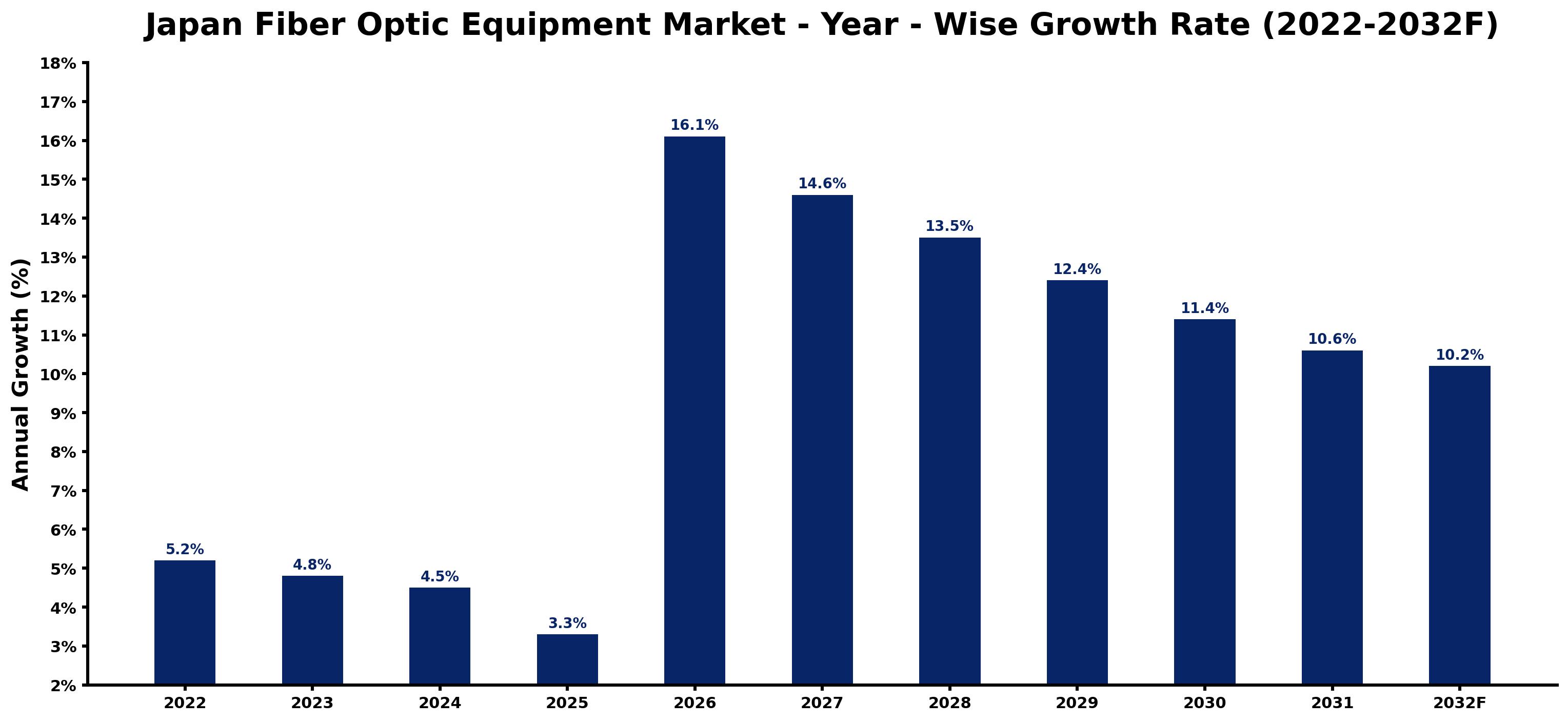
Each row of the following table gives one year's estimated growth and the event or demand shift that explains it.
| Year | Estimated Annual Growth (%) | Market Rationale |
| 2022 | 5.2 | The market experienced steady growth due to ongoing infrastructure investments. |
| 2023 | 4.8 | Demand growth slowed slightly as market adjustments took place in response to previous expansions. |
| 2024 | 4.5 | Continued infrastructure development maintained growth, although at a reduced pace compared to prior years. |
| 2025 | 3.3 | The market faced a slowdown as saturation in certain areas began to affect growth rates. |
| 2026 | 16.1 | A surge in demand for fiber optic technology, particularly for 5G, is expected to drive growth. |
| 2027 | 14.6 | Growth is projected to moderate as the market adjusts to the rapid expansion of the previous year. |
| 2028 | 13.5 | The market will continue to grow, driven by increasing adoption of fiber optics in various sectors. |
| 2029 | 12.4 | Demand growth is expected to slow slightly as competition intensifies among suppliers. |
| 2030 | 11.4 | The market will maintain growth, supported by ongoing investments in digital infrastructure. |
| 2031 | 10.6 | Growth is projected to continue decelerating as the market matures and demand stabilises. |
| 2032 | 10.2 | The market is expected to grow steadily, driven by sustained investments in technology. |
Note: Market size estimations and growth projections presented in this report are based on 6Wresearch's proprietary forecasting methodology, utilizing the latest available industry data, government publications, and primary research inputs.
Japan Fiber Optic Equipment Market Synopsis
Fiber optic equipment enables data transmission through optical fibers, playing a crucial role in telecommunications and networking applications. The Japan Fiber Optic Equipment Market is growing due to strong demand from telecom carriers and ongoing infrastructure investments. The government aims for 100% fiber optic coverage by 2025, with the Tokyo metropolitan area serving as a key deployment hub. With over 100,000 km of fiber optic cables installed nationwide, the market is poised for continued expansion.
Market Dynamics Impact Analysis (2026–2032)
| Factor | Type | Impact | Primary Segment Affected |
| Growing demand for high-speed internet services driven by 5G deployment | Driver | High | Optical Modulators |
| Increasing investments in broadband infrastructure development | Driver | High | Termination Kits |
| Expansion of data centers requiring advanced networking solutions | Opportunity | High | Fiber Testing Tools |
| Rural areas needing improved broadband access | Opportunity | Medium | Cable Installation |
| High costs associated with fiber optic installation and maintenance | Restraint | High | Optical Switches |
| Limited availability of skilled technicians for installation | Restraint | Medium | Quality Assurance |
| Competition from alternative technologies like satellite internet | Challenge | High | Network Routing |
| Regulatory hurdles in rural broadband expansion | Challenge | Medium | Signal Encoding |
Evaluation of Drivers in Japan Fiber Optic Equipment Market (2026–2032)
Key forces behind demand, with the segment each one moves most, are listed below.
| Drivers | Primary Segment Affected | Why It Matters (Evidence) |
| Increased demand for high-speed internet services | Optical Modulators | The average internet speed in Japan is 100 Mbps, prompting telecom carriers to invest in advanced modulation technologies. |
| Expansion of broadband infrastructure | Termination Kits | With over 100,000 km of fiber optic cables installed, the need for effective termination solutions rises. |
| Growth in data centers | Fiber Testing Tools | The presence of more than 3,000 data centers increases the demand for testing tools to ensure network quality. |
| Government initiatives for broadband access | Cable Installation | The Ministry of Internal Affairs and Communications launched a program to enhance broadband access, driving installation needs. |
| Rising adoption of 5G technology | Optical Switches | Fiber optic modulator technology is essential for 5G deployment, leading to higher demand for optical switches. |
The strongest pull on demand comes from the increasing adoption of high-speed internet services, with the average speed in Japan reaching 100 Mbps. This surge in demand compels telecom carriers to invest in optical modulators, improving data transmission capabilities. The expansion of broadband infrastructure has led to a rise in the need for termination kits. The presence of over 3,000 data centers across Japan drives demand for fiber testing tools, as these facilities require reliable network quality. The ongoing rollout of 5G technology necessitates advanced optical switches, creating a favourable market environment.
Evaluation of Restraints in Japan Fiber Optic Equipment Market
The table below lists the restraints and the evidence behind each.
| Market Restraint | Primary Segment Affected | Why It Matters (Evidence) |
| High installation and maintenance costs for fiber optic systems | Optical Switches | The average costs deter some potential buyers, especially in rural areas with limited budgets. |
| Shortage of skilled technicians for installation and maintenance | Quality Assurance | With over 10,000 technicians in the field, the limited workforce restricts service availability. |
| Market saturation in urban areas | Termination Kits | With extensive existing infrastructure, growth potential diminishes in densely populated regions. |
| Regulatory hurdles in expanding broadband access | Signal Encoding | Complex regulations can delay projects, affecting timely deployment of fiber optic solutions. |
| Competition from alternative technologies like satellite internet | Network Routing | Emerging satellite technologies offer lower-cost options, impacting traditional fiber optic demand. |
Japan Fiber Optic Equipment Market Challenges
Producers struggle to source advanced materials like glass and polymers, which delays project timelines for telecommunications companies. Complex regulatory frameworks, particularly around the JIS C 5970 standard, slow down product approvals for manufacturers, causing them to miss key market opportunities. Insufficient technological advancements in fiber optic modulator technology hinder network providers' ability to deploy 5G services, limiting their expansion efforts. Rising operational costs, driven by Japan's minimum wage increase to JPY 1,055 per hour, force suppliers to raise prices, which directly impacts buyers' budgets and purchasing decisions.
Trends in the Japan Fiber Optic Equipment Market
Below are the shifts with the largest effect on the Japan Fiber Optic Equipment Market.
- Shift from Copper to Fiber Optic Solutions: Japan is increasingly replacing copper wiring with fiber optics in telecommunications, particularly in urban areas like Tokyo. The average internet speed of 100 Mbps highlights this transition, pushing suppliers to adapt their offerings.
- Emergence of 5G Infrastructure: The rollout of 5G technology has accelerated fiber optic deployment across Japan, particularly in metropolitan regions. Investments in fiber optics reached 200 million USD in 2023, indicating a strong market shift towards advanced connectivity.
- Growth of Data Centers in Urban Regions: The Kanto region is experiencing a surge in data center establishments, with over 3,000 operational facilities. This growth is driving demand for fiber optic equipment, particularly testing tools and installation services.
- Increasing Focus on Quality Assurance Standards: The Japan Fiber Optics Association promotes best practices in fiber installation, ensuring service quality. The emphasis on quality assurance is vital for maintaining network standards in a competitive market.
Investment Opportunities in the Japan Fiber Optic Equipment Market
The opportunities below stand out in the Japan Fiber Optic Equipment Market for new entrants and existing suppliers.
- Investment in Rural Broadband Infrastructure: With the government targeting 100% fiber optic coverage by 2025, there is a gap in rural areas. Telecom carriers can invest in infrastructure projects to meet this demand, supported by government subsidies.
- Supply of Advanced Fiber Testing Tools: The growing number of data centers necessitates high-quality testing tools. Suppliers can target this market segment by providing solutions that ensure network reliability and performance.
- Expansion of Optical Modulators for 5G: The demand for optical modulators is expected to rise as 5G technology expands. Suppliers can focus on developing advanced modulators to cater to telecom carriers looking to improve their networks.
- Provision of Training for Technicians: The shortage of skilled technicians presents an opportunity for training programs. Organizations can invest in educational initiatives to prepare technicians for the growing fiber optic market.
Government Initiatives in the Japan Fiber Optic Equipment Market
The Act on Japanese Industrial Standards governs product specifications for fiber optic equipment, ensuring quality and safety for producers. Compliance with the JIS C 5970 standard is mandatory, impacting manufacturers and suppliers in the market.
The Ministry of Economy, Trade and Industry initiated a subsidy program in 2023 to support fiber optic infrastructure development in rural areas. This program assists telecom carriers in expanding their services and achieving government targets.
Future Insight of the Japan Fiber Optic Equipment Market
By 2032, buyers will see improved internet connectivity as the government achieves its goal of 100% fiber coverage. Investments in fiber optic technology are projected to reach 500 million USD, enhancing infrastructure capabilities nationwide. The adoption of ISO/IEC 11801 will standardise practices, ensuring consistent quality across the sector. Programmes aimed at improving broadband access will drive demand for advanced equipment, prompting suppliers to innovate and expand their offerings.
Market Segmentation Analysis
Japan Fiber Optic Equipment Market report covers a detailed analysis of the following market segments:
By Equipment Type – Optical Switches Lead, Optical Modulators Expected to Grow Fastest
According to Saurav Kr Singh, Senior Research Analyst at 6Wresearch, Optical Switches held 51% of the Japan Fiber Optic Equipment Market by equipment type in 2025. Optical switches hold the largest share due to their essential role in routing signals within extensive networks, particularly in metropolitan areas like Tokyo. Their importance in maintaining efficient data transmission is evident given Japan's substantial installed base of over 100,000 km of fiber optic cables. Optical Modulators are set to record the highest CAGR in this split, 17.9% over 2026–2032. Optical modulators are experiencing rapid growth as they are crucial for encoding data onto light signals, particularly with the ongoing rollout of 5G technology. The 200 million USD investment in fiber optic technology in 2023 is significantly driving the demand for modulators. Suppliers should focus on developing optical modulators to capitalise on the increasing market demand.
By Functionality – Network Routing Leads, Signal Encoding Expected to Grow Fastest
Network Routing accounted for 37% of the market by functionality in 2025. Network routing is the leading functionality because it is fundamental for directing data traffic across Japan's extensive fiber optic networks. The reliance on effective routing solutions is highlighted by the country's vast infrastructure, which supports seamless data transmission. The quickest growth will come from Signal Encoding, forecast to expand at a CAGR of 15.7% between 2026 and 2032. Signal encoding is the fastest-growing functionality as it is vital for transforming data into optical signals, essential for delivering high-speed internet services. The average internet speed of 100 Mbps in Japan underscores the urgent need for advanced signal encoding technologies. Buyers should invest in state-of-the-art signal encoding solutions to meet the rising demands for internet speed.
By Distribution Channel – Technology Distributors Lead, OEMs Expected to Grow Fastest
With 49% of distribution channel revenue in 2025, Technology Distributors was the largest category. Technology distributors dominate the market by providing essential equipment to end users, ensuring widespread access to fiber optic technology throughout Japan. Their extensive networks are particularly effective in reaching diverse regions, including those targeted for infrastructure enhancements. Over 2026–2032, OEMs are expected to post the fastest growth, at a CAGR of 15.9%. OEMs are the fastest-growing distribution channel as they manufacture equipment for other brands, thereby expanding their market presence. The increasing demand for tailored solutions in fiber optic technology is propelling OEMs to the forefront of the distribution sector. Suppliers should consider forming partnerships with OEMs to enhance their manufacturing capabilities and broaden their market reach.
By End User – Telecom Carriers Lead, Data Centers Expected to Grow Fastest
The largest end user category in 2025 was Telecom Carriers, at 33% of revenue. Telecom carriers represent the largest end user group as they are the primary users of fiber optic technology, essential for providing high-speed internet services. With the government's target of achieving 100% fiber optic coverage by 2025, telecom carriers are at the forefront of this initiative. Data Centers are projected to grow fastest, at a CAGR of 16.1% during 2026–2032. Data centers are the fastest-growing end user segment due to their critical role in data management and storage, driven by the proliferation of digital services. The presence of over 3,000 data centers across Japan underscores the increasing reliance on fiber optics for efficient operations. Suppliers should focus on developing solutions tailored to the specific needs of data centers to capture this growing market segment.
Key Attractiveness of the Report
- 10 Years of Market Numbers
- Historical Data Starting from 2022 to 2025
- Base Year 2025
- Forecast Data until 2032
- Key Performance Indicators Impacting the Market
- Major Upcoming Developments and Projects
Key Highlights of the Report:
- Japan Fiber Optic Equipment Market Outlook
- Market Size of Japan Fiber Optic Equipment Market, 2025
- Forecast of Japan Fiber Optic Equipment Market, 2032
- Historical Data and Forecast of Japan Fiber Optic Equipment Revenues & Volume for the Period 2022-2032F
- Japan Fiber Optic Equipment Market Trend Evolution
- Japan Fiber Optic Equipment Market Drivers and Challenges
- Japan Fiber Optic Equipment Price Trends
- Japan Fiber Optic Equipment Porter's Five Forces
- Japan Fiber Optic Equipment Industry Life Cycle
- Historical Data and Forecast of Japan Fiber Optic Equipment Market Revenues & Volume By Equipment Type for the Period 2022-2032F
- Historical Data and Forecast of Japan Fiber Optic Equipment Market Revenues & Volume By Optical Switches for the Period 2022-2032F
- Historical Data and Forecast of Japan Fiber Optic Equipment Market Revenues & Volume By Optical Modulators for the Period 2022-2032F
- Historical Data and Forecast of Japan Fiber Optic Equipment Market Revenues & Volume By Termination Kits for the Period 2022-2032F
- Historical Data and Forecast of Japan Fiber Optic Equipment Market Revenues & Volume By Fiber Testing Tools for the Period 2022-2032F
- Historical Data and Forecast of Japan Fiber Optic Equipment Market Revenues & Volume By Functionality for the Period 2022-2032F
- Historical Data and Forecast of Japan Fiber Optic Equipment Market Revenues & Volume By Network Routing for the Period 2022-2032F
- Historical Data and Forecast of Japan Fiber Optic Equipment Market Revenues & Volume By Signal Encoding for the Period 2022-2032F
- Historical Data and Forecast of Japan Fiber Optic Equipment Market Revenues & Volume By Cable Installation for the Period 2022-2032F
- Historical Data and Forecast of Japan Fiber Optic Equipment Market Revenues & Volume By Quality Assurance for the Period 2022-2032F
- Historical Data and Forecast of Japan Fiber Optic Equipment Market Revenues & Volume By Distribution Channel for the Period 2022-2032F
- Historical Data and Forecast of Japan Fiber Optic Equipment Market Revenues & Volume By Technology Distributors for the Period 2022-2032F
- Historical Data and Forecast of Japan Fiber Optic Equipment Market Revenues & Volume By OEMs for the Period 2022-2032F
- Historical Data and Forecast of Japan Fiber Optic Equipment Market Revenues & Volume By Online Portals for the Period 2022-2032F
- Historical Data and Forecast of Japan Fiber Optic Equipment Market Revenues & Volume By Specialized Stores for the Period 2022-2032F
- Historical Data and Forecast of Japan Fiber Optic Equipment Market Revenues & Volume By End User for the Period 2022-2032F
- Historical Data and Forecast of Japan Fiber Optic Equipment Market Revenues & Volume By Telecom Carriers for the Period 2022-2032F
- Historical Data and Forecast of Japan Fiber Optic Equipment Market Revenues & Volume By Data Centers for the Period 2022-2032F
- Historical Data and Forecast of Japan Fiber Optic Equipment Market Revenues & Volume By Field Technicians for the Period 2022-2032F
- Historical Data and Forecast of Japan Fiber Optic Equipment Market Revenues & Volume By Network Engineers for the Period 2022-2032F
- Japan Fiber Optic Equipment Import Export Trade Statistics
- Market Opportunity Assessment By Equipment Type
- Market Opportunity Assessment By Functionality
- Market Opportunity Assessment By Distribution Channel
- Market Opportunity Assessment By End User
- Japan Fiber Optic Equipment Top Companies Market Share
- Japan Fiber Optic Equipment Competitive Benchmarking By Technical and Operational Parameters
- Japan Fiber Optic Equipment Company Profiles
- Japan Fiber Optic Equipment Key Strategic Recommendations
Market Covered
The following segment groups are covered in the report.
By Equipment Type
- Optical Switches
- Optical Modulators
- Termination Kits
- Fiber Testing Tools
By Functionality
- Network Routing
- Signal Encoding
- Cable Installation
- Quality Assurance
By Distribution Channel
- Technology Distributors
- OEMs
- Online Portals
- Specialized Stores
By End User
- Telecom Carriers
- Data Centers
- Field Technicians
- Network Engineers































