Japan Financial Analytics Software Market Size & Growth Rate
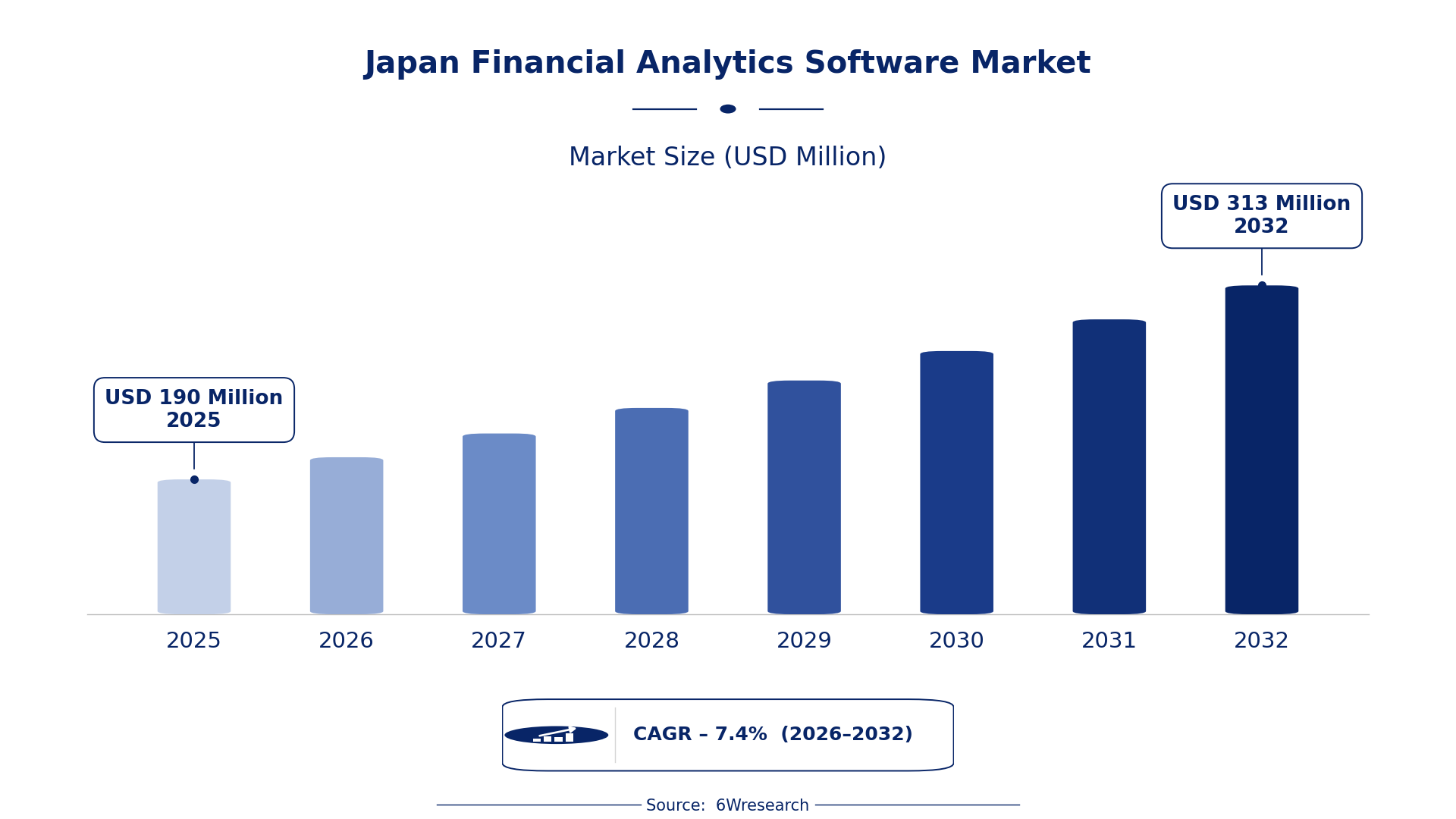
According to 6Wresearch internal database and industry insights, the Japan Financial Analytics Software Market was valued at USD 190 Million in 2025 and is projected to reach USD 313 Million by 2032, growing at a CAGR of approximately 7.4% during 2026–2032.
Japan Financial Analytics Software Market Highlights
| Report Metric | Details |
| Report Name | Japan Financial Analytics Software Market (2026-2032) |
| Market Size 2025 | USD 190 Million |
| Market Size 2032 | USD 313 Million |
| Absolute Growth 2025–2032 | USD 123 Million |
| CAGR 2026–2032 | 7.4% |
| Peak Annual Growth | 8.2% in 2028 |
| Forecast Period | 2026–2032 |
| Historical Data | 2022–2025 |
| Base Year | 2025 |
| Leading Software Type, 2025 | Risk Analytics (48% share) |
| Leading Analytics Type, 2025 | Predictive (45% share) |
| Leading Distribution Channel, 2025 | SaaS Providers (49% share) |
| Leading End User, 2025 | Financial Institutions (46% share) |
| Fastest-Growing Software Type | Cash Flow Forecasting (10.7% CAGR) |
| Fastest-Growing Distribution Channel | Cloud Marketplace (9.5% CAGR) |
| Fastest-Growing End User | Mid-size Companies (9.3% CAGR) |
| Growing Sector | Financial Services |
| Key End Users | Financial Institutions, Enterprises, CFOs, Mid-size Companies |
Japan Financial Analytics Software Market Year-wise Growth Rate and Key Drivers (2022–2032)
This graph illustrates the annual growth rates of the market from 2022 to 2032, highlighting a steady upward trajectory and projected market expansion over the forecast period.
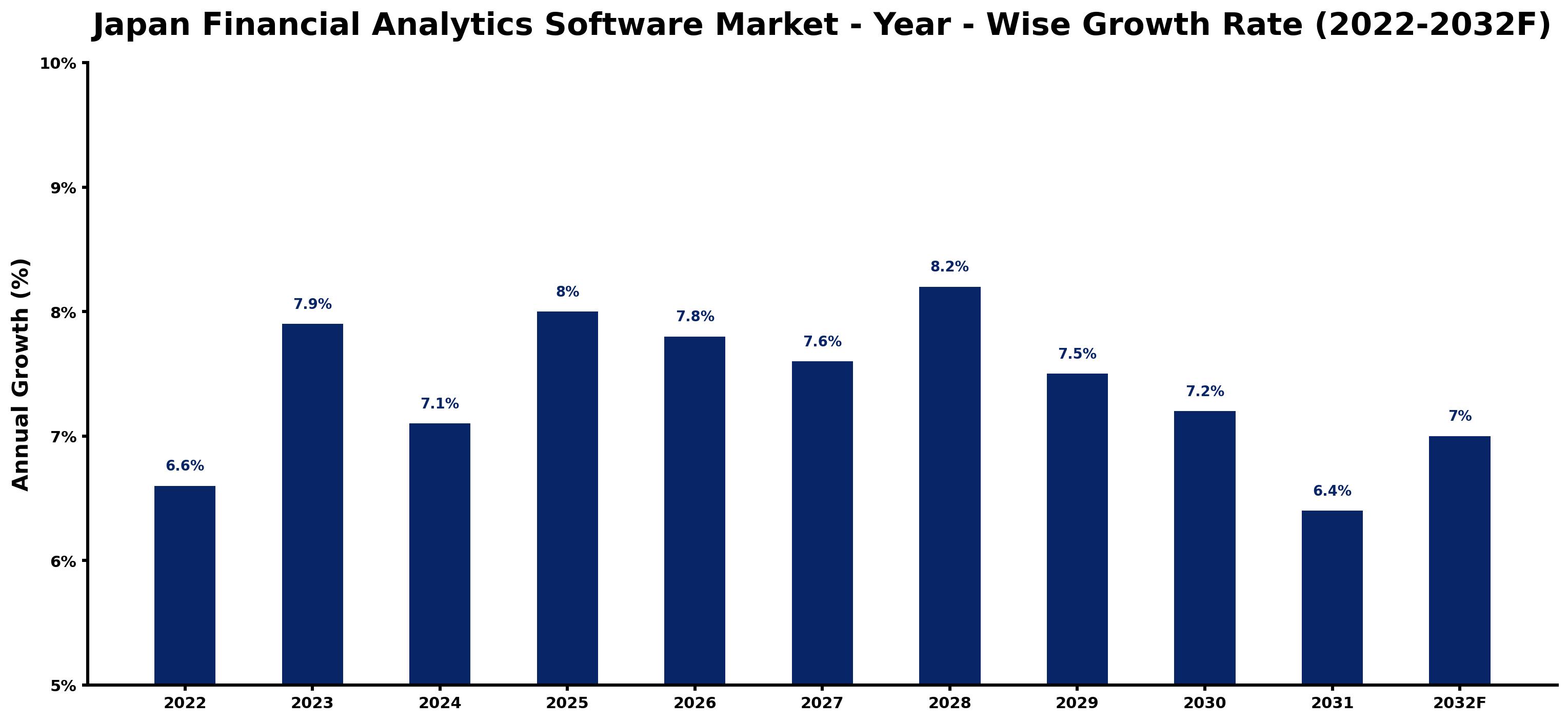
The yearly estimates that follow link every growth rate to its principal driver, so readers can see why the pace changed in each period.
| Year | Estimated Annual Growth (%) | Market Rationale |
| 2022 | 6.6 | The market experienced steady growth, supported by strong demand from financial institutions. |
| 2023 | 7.9 | Growth accelerated as more enterprises adopted financial analytics tools for decision-making. |
| 2024 | 7.1 | The growth rate slowed slightly due to market saturation among larger firms. |
| 2025 | 8.0 | A surge in demand for risk analytics tools led to faster growth than the previous year. |
| 2026 | 7.8 | The market growth rate is expected to slow as competition intensifies among software providers. |
| 2027 | 7.6 | Demand will continue to rise, though at a slower pace due to market maturity. |
| 2028 | 8.2 | The market is projected to peak with new investments in predictive analytics solutions. |
| 2029 | 7.5 | Growth will decelerate as buyers become more selective in software adoption. |
| 2030 | 7.2 | The market is expected to maintain positive growth, driven by ongoing digital transformation efforts. |
| 2031 | 6.4 | A further slowdown will occur as the market stabilises, reflecting mature adoption rates. |
| 2032 | 7.0 | The market is projected to grow as new fintech innovations emerge. |
Note: Market size estimations and growth projections presented in this report are based on 6Wresearch's proprietary forecasting methodology, utilizing the latest available industry data, government publications, and primary research inputs.
Japan Financial Analytics Software Market Synopsis
Financial Analytics Software includes tools that analyse financial data to support decision-making in various sectors. The Japan Financial Analytics Software Market is expanding due to the increasing adoption of cloud-based solutions and rising demand from over 1,200 financial institutions. In 2023, 70% of CFOs in Japan utilised these tools, reflecting a shift towards data-driven decision-making. The Tokyo region remains a key hub for this software's usage, indicating strong growth potential in urban areas.
Market Dynamics Impact Analysis (2026–2032)
| Factor | Type | Impact | Primary Segment Affected |
| Growing adoption of cloud-based solutions | Driver | High | SaaS Providers |
| Increasing regulatory compliance requirements | Driver | High | Risk Analytics |
| Rising demand for predictive analytics tools | Opportunity | High | Predictive |
| Expansion of fintech innovation initiatives | Opportunity | High | Performance Analytics |
| High competition among software providers | Restraint | Medium | Risk Analytics |
| Market saturation among larger enterprises | Restraint | Medium | Enterprises |
| Talent shortages in data analytics | Challenge | High | Risk Analytics |
| High costs of advanced analytics tools | Challenge | Medium | Mid-size Companies |
Evaluation of Drivers in Japan Financial Analytics Software Market (2026–2032)
These are the developments adding the most demand over the forecast period.
| Drivers | Primary Segment Affected | Why It Matters (Evidence) |
| Increased cloud adoption | SaaS Providers | The adoption rate of SaaS financial analytics solutions is around 60% among enterprises, prompting more purchases of cloud-based tools. |
| Regulatory compliance demands | Risk Analytics | Risk analytics is essential for compliance with Japan's Industrial Standardization Act, prompting financial institutions to invest more. |
| Growing investment in predictive analytics | Predictive | The demand for predictive analytics tools is rising, with financial institutions seeking to improve forecasting capabilities. |
| Digital transformation initiatives | Performance Analytics | The promotion of digital transformation in financial services drives enterprises to adopt performance analytics solutions. |
| Increased budgets for financial software | Enterprises | The average budget for financial software in enterprises is approximately ¥5 million annually, encouraging more investments. |
Several shifts outside the market lift sales. The average budget for financial software in enterprises is approximately ¥5 million annually, prompting increased purchases of advanced tools. Cloud-based financial analytics solutions are gaining traction, with a growing number of enterprises investing in these options. Digital transformation in financial services drives demand for performance analytics solutions, while the need for predictive analytics tools is rising as firms seek to improve forecasting accuracy. In 2023, 70% of CFOs in Japan utilised these tools, reflecting a strong trend towards data-driven decision-making.
Evaluation of Restraints in Japan Financial Analytics Software Market
The table below lists the restraints and the evidence behind each.
| Market Restraint | Primary Segment Affected | Why It Matters (Evidence) |
| Intense competition among software providers | Risk Analytics | High competition pressures providers to lower prices, affecting profitability and limiting budget allocations for buyers. |
| Market saturation in larger enterprises | Enterprises | As larger enterprises reach saturation, growth opportunities diminish, making it harder for providers to gain new clients. |
| Limited talent pool in data analytics | Risk Analytics | Shortages in skilled data analysts hinder firms' ability to fully utilise financial analytics tools, impacting adoption rates. |
| High costs of advanced analytics tools | Mid-size Companies | The costs associated with implementing advanced analytics tools can deter mid-size companies from investing, slowing market growth. |
| Regulatory compliance complexities | Risk Analytics | Navigating compliance can be challenging for firms, resulting in hesitance to adopt new analytics solutions. |
Japan Financial Analytics Software Market Challenges
Buyers in Japan's financial analytics software market face regulatory hurdles from the Financial Services Agency, causing compliance delays that can extend project timelines by six months. A lack of skilled developers results in project delays, pushing implementation timelines back by 20% for firms seeking to adopt new systems. Increased competition from global providers raises costs, with software prices climbing by 15% annually, straining budgets for over 1,200 financial institutions. Rapid technological changes necessitate frequent updates, leading to additional costs that can reach ¥1 million per project for firms aiming to stay competitive.
Trends in the Japan Financial Analytics Software Market
Buyers and suppliers in the Japan Financial Analytics Software Market are adjusting to the following trends.
- Shift towards Cloud-Based Solutions: In 2023, the adoption rate of cloud-based financial analytics solutions reached around 60% among enterprises, indicating a shift towards more flexible models. This trend allows for scalable analytics capabilities, benefiting financial institutions and enterprises alike.
- Rise of Predictive Analytics: The demand for predictive analytics tools is increasing, with financial institutions seeking to improve forecasting capabilities. In 2023, 70% of CFOs in Japan utilised these tools, reflecting a growing reliance on data-driven decision-making.
- Focus on Risk Analytics: Risk analytics has become essential for compliance, particularly with Japan's Industrial Standardization Act. This focus is driving financial institutions to invest more in analytics solutions that ensure regulatory adherence.
- Expansion of Fintech Innovations: In 2023, Japan launched a program to promote fintech innovation, encouraging the development of new financial analytics solutions. This initiative is expected to drive further growth in the financial analytics software market.
Investment Opportunities in the Japan Financial Analytics Software Market
Several openings in the Japan Financial Analytics Software Market merit attention from investors.
- Tokyo Region as a Hub: The Tokyo region is a major hub for financial analytics software usage, presenting opportunities for investment in local solutions. With over 1,200 financial institutions, suppliers can tap into this growing market.
- Partnerships with Financial Institutions: Now is the time to establish partnerships with financial institutions, which are primary users of financial analytics software. Collaborating with these entities can improve market entry and product adoption.
- Investment in Predictive Analytics: The demand for predictive analytics tools creates an opportunity for suppliers to invest in developing advanced solutions. Financial institutions are increasingly seeking these tools to improve forecasting accuracy.
- Support for Mid-size Companies: Mid-size companies are showing growing interest in financial analytics solutions, representing a strong opportunity for investment. Suppliers can enter this market by offering tailored solutions that meet their specific needs.
Government Initiatives in the Japan Financial Analytics Software Market
The AI Promotion Act, established in 2025, provides a national framework for AI research and development, impacting financial analytics software producers. This act encourages innovation and investment in AI-driven analytics tools, helping buyers access advanced solutions that improve decision-making capabilities.
The Digital Agency oversees government digital transformation initiatives and approves standards for financial analytics software. This agency funds projects that support the integration of digital technologies in financial services, benefiting both producers and buyers by ensuring compliance with evolving standards.
Future Insight of the Japan Financial Analytics Software Market
The push for digital transformation will reshape the financial analytics market by 2032, driven by the Ministry of Finance's initiatives. The adoption of ISO 20022 will streamline financial data exchange, enhancing transaction speeds for buyers and suppliers. As cloud-based solutions gain traction, urban areas will see SaaS adoption rise to 80%, improving data integration. Companies with over 500 employees will increasingly leverage advanced analytics tools for strategic decision-making, positioning themselves for greater operational efficiency.
Market Segmentation Analysis
Japan Financial Analytics Software Market report covers a detailed analysis of the following market segments:
By Software Type – Risk Analytics Leads, Cash Flow Forecasting Expected to Grow Fastest
According to Saurav Kr Singh, Senior Research Analyst at 6Wresearch, with 48% of software type revenue in 2025, Risk Analytics was the largest category. Risk analytics holds the largest share due to its essential role in assessing financial risks and ensuring compliance with regulations. Financial institutions, which are the primary users, rely heavily on these tools to meet the requirements of the Financial Instruments and Exchange Act. Cash Flow Forecasting is projected to grow fastest, at a CAGR of 10.7% during 2026–2032. Cash flow forecasting is experiencing rapid growth as companies increasingly recognise its importance in managing liquidity and financial planning. The rising demand for accurate forecasting tools among enterprises highlights its critical role in optimising financial strategies. Suppliers should enhance their cash flow forecasting capabilities to align with the growing demand from companies.
By Analytics Type – Predictive Leads and Records the Fastest Growth
In 2025, Predictive led the analytics type split with a 45% share. Predictive analytics leads the market as it is widely utilised for forecasting future financial trends, enabling organisations to make informed decisions. This is particularly important for financial institutions that aim to maintain a competitive edge in a dynamic market. Predictive is also forecast to expand faster than any other category, at a CAGR of 10.1% over 2026–2032. The ongoing adoption of predictive analytics tools ensures sustained growth in this segment, as organisations increasingly rely on data-driven insights for strategic planning. This continuous demand reinforces predictive analytics as a market leader. This trend suggests that suppliers must prioritise predictive analytics solutions to meet the evolving needs of their clients.
By Distribution Channel – SaaS Providers Lead, Cloud Marketplace Expected to Grow Fastest
The largest distribution channel category in 2025 was SaaS Providers, at 49% of revenue. SaaS providers dominate the distribution of financial analytics software, as they offer a flexible and accessible model for users. This model is particularly appealing to financial institutions seeking efficient software delivery methods. The quickest growth will come from Cloud Marketplace, forecast to expand at a CAGR of 9.5% between 2026 and 2032. The cloud marketplace is rapidly growing as a distribution channel, driven by the increasing preference for cloud-based solutions among users. This shift reflects a broader trend towards digital transformation in the financial sector. Suppliers should consider expanding their presence in cloud marketplaces to capture the growing demand for cloud-based financial analytics.
By End User – Financial Institutions Lead, Mid-size Companies Expected to Grow Fastest
Financial Institutions accounted for 46% of the market by end user in 2025. Financial institutions are the primary users of financial analytics software, utilising these tools to enhance decision-making and risk management. Their significant investment in analytics solutions plays a crucial role in driving the overall market share within this segment. Mid-size Companies are set to record the highest CAGR in this split, 9.3% over 2026–2032. Mid-size companies are increasingly recognising the value of financial analytics solutions, indicating a growing awareness of the importance of data-driven insights. This shift in market dynamics reflects their desire to leverage analytics for competitive advantage. Suppliers should tailor their offerings to meet the specific needs of mid-size companies entering the financial analytics market.
Key Attractiveness of the Report
- 10 Years of Market Numbers
- Historical Data Starting from 2022 to 2025
- Base Year 2025
- Forecast Data until 2032
- Key Performance Indicators Impacting the Market
- Major Upcoming Developments and Projects
Key Highlights of the Report:
- Japan Financial Analytics Software Market Outlook
- Market Size of Japan Financial Analytics Software Market, 2025
- Forecast of Japan Financial Analytics Software Market, 2032
- Historical Data and Forecast of Japan Financial Analytics Software Revenues & Volume for the Period 2022-2032F
- Japan Financial Analytics Software Market Trend Evolution
- Japan Financial Analytics Software Market Drivers and Challenges
- Japan Financial Analytics Software Price Trends
- Japan Financial Analytics Software Porter's Five Forces
- Japan Financial Analytics Software Industry Life Cycle
- Historical Data and Forecast of Japan Financial Analytics Software Market Revenues & Volume By Software Type for the Period 2022-2032F
- Historical Data and Forecast of Japan Financial Analytics Software Market Revenues & Volume By Risk Analytics for the Period 2022-2032F
- Historical Data and Forecast of Japan Financial Analytics Software Market Revenues & Volume By Performance Analytics for the Period 2022-2032F
- Historical Data and Forecast of Japan Financial Analytics Software Market Revenues & Volume By Cash Flow Forecasting for the Period 2022-2032F
- Historical Data and Forecast of Japan Financial Analytics Software Market Revenues & Volume By Budgeting Software for the Period 2022-2032F
- Historical Data and Forecast of Japan Financial Analytics Software Market Revenues & Volume By Analytics Type for the Period 2022-2032F
- Historical Data and Forecast of Japan Financial Analytics Software Market Revenues & Volume By Predictive for the Period 2022-2032F
- Historical Data and Forecast of Japan Financial Analytics Software Market Revenues & Volume By Descriptive for the Period 2022-2032F
- Historical Data and Forecast of Japan Financial Analytics Software Market Revenues & Volume By Diagnostic for the Period 2022-2032F
- Historical Data and Forecast of Japan Financial Analytics Software Market Revenues & Volume By Prescriptive for the Period 2022-2032F
- Historical Data and Forecast of Japan Financial Analytics Software Market Revenues & Volume By Distribution Channel for the Period 2022-2032F
- Historical Data and Forecast of Japan Financial Analytics Software Market Revenues & Volume By SaaS Providers for the Period 2022-2032F
- Historical Data and Forecast of Japan Financial Analytics Software Market Revenues & Volume By Direct Sales for the Period 2022-2032F
- Historical Data and Forecast of Japan Financial Analytics Software Market Revenues & Volume By Cloud Marketplace for the Period 2022-2032F
- Historical Data and Forecast of Japan Financial Analytics Software Market Revenues & Volume By VARs for the Period 2022-2032F
- Historical Data and Forecast of Japan Financial Analytics Software Market Revenues & Volume By End User for the Period 2022-2032F
- Historical Data and Forecast of Japan Financial Analytics Software Market Revenues & Volume By Financial Institutions for the Period 2022-2032F
- Historical Data and Forecast of Japan Financial Analytics Software Market Revenues & Volume By Enterprises for the Period 2022-2032F
- Historical Data and Forecast of Japan Financial Analytics Software Market Revenues & Volume By CFOs for the Period 2022-2032F
- Historical Data and Forecast of Japan Financial Analytics Software Market Revenues & Volume By Mid-size Companies for the Period 2022-2032F
- Japan Financial Analytics Software Import Export Trade Statistics
- Market Opportunity Assessment By Software Type
- Market Opportunity Assessment By Analytics Type
- Market Opportunity Assessment By Distribution Channel
- Market Opportunity Assessment By End User
- Japan Financial Analytics Software Top Companies Market Share
- Japan Financial Analytics Software Competitive Benchmarking By Technical and Operational Parameters
- Japan Financial Analytics Software Company Profiles
- Japan Financial Analytics Software Key Strategic Recommendations
Market Covered
The report covers the following segments.
By Software Type
- Risk Analytics
- Performance Analytics
- Cash Flow Forecasting
- Budgeting Software
By Analytics Type
- Predictive
- Descriptive
- Diagnostic
- Prescriptive
By Distribution Channel
- SaaS Providers
- Direct Sales
- Cloud Marketplace
- VARs
By End User
- Financial Institutions
- Enterprises
- CFOs
- Mid-size Companies































