Japan Financial Asset Management Market Size & Growth Rate
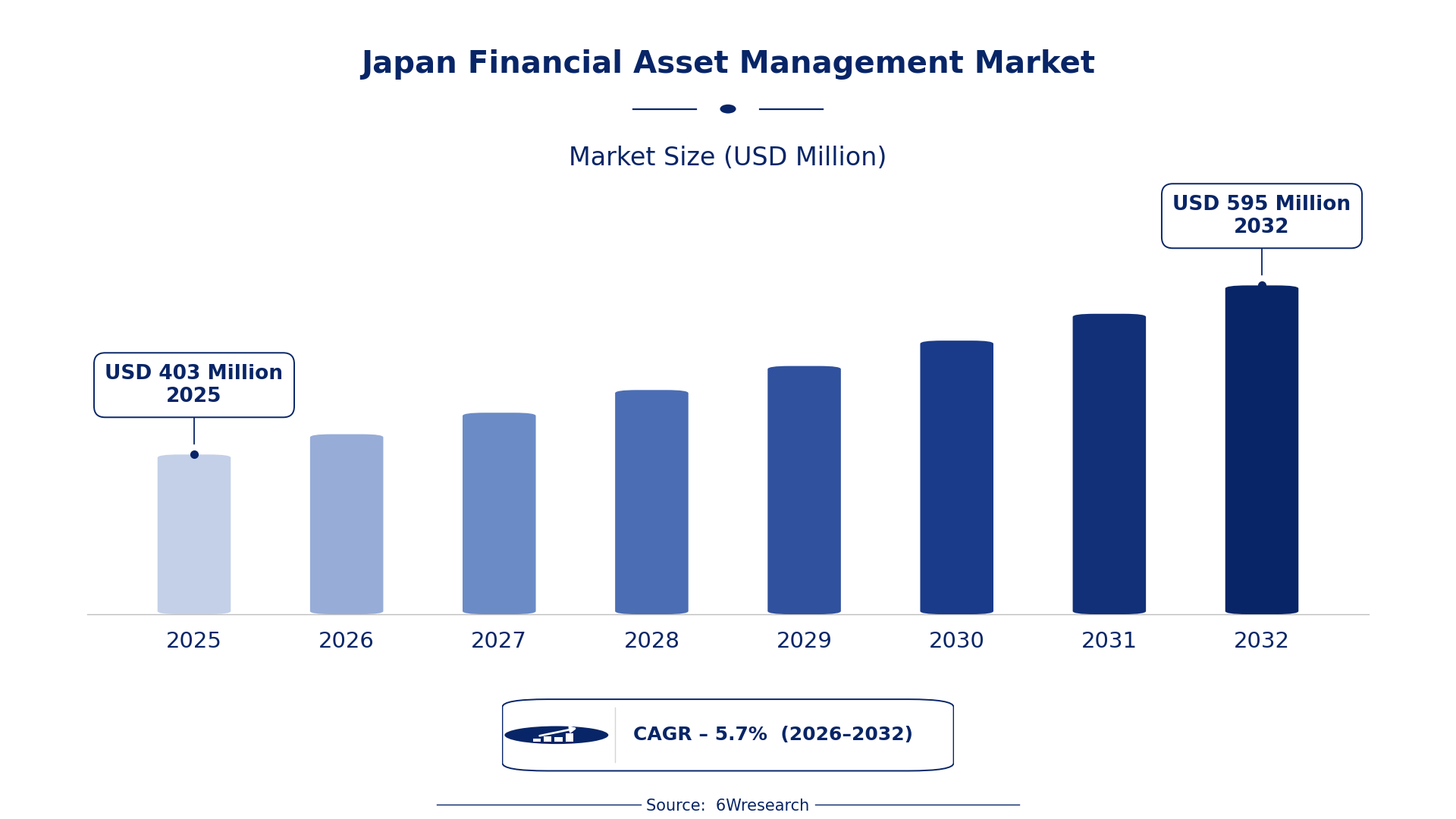
According to 6Wresearch internal database and industry insights, the Japan Financial Asset Management Market was valued at USD 403 Million in 2025 and is projected to reach USD 595 Million by 2032, growing at a CAGR of approximately 5.7% during 2026–2032.
Japan Financial Asset Management Market Highlights
| Report Metric | Details |
| Report Name | Japan Financial Asset Management Market (2026-2032) |
| Market Size 2025 | USD 403 Million |
| Market Size 2032 | USD 595 Million |
| Absolute Growth 2025–2032 | USD 192 Million |
| CAGR 2026–2032 | 5.7% |
| Peak Annual Growth | 6.8% in 2027 |
| Forecast Period | 2026–2032 |
| Historical Data | 2022–2025 |
| Base Year | 2025 |
| Leading Asset Type, 2025 | Mutual Funds (50% share) |
| Leading Management Strategy, 2025 | Active (43% share) |
| Leading Distribution Channel, 2025 | Wealth Advisors (37% share) |
| Leading End User, 2025 | Retail Investors (43% share) |
| Fastest-Growing Asset Type | ETFs (7.7% CAGR) |
| Fastest-Growing Management Strategy | Passive (7.1% CAGR) |
| Fastest-Growing Distribution Channel | Online Brokers (7.5% CAGR) |
| Fastest-Growing End User | Individual Investors (7.2% CAGR) |
| Growing Sector | Financial Services |
| Key End Users | Retail Investors, Individual Investors, Institutional Investors, HNIs |
Japan Financial Asset Management Market Year-wise Growth Rate and Key Drivers (2022–2032)
This graph illustrates the annual growth rates of the market from 2022 to 2032, highlighting a steady upward trajectory and projected market expansion over the forecast period.
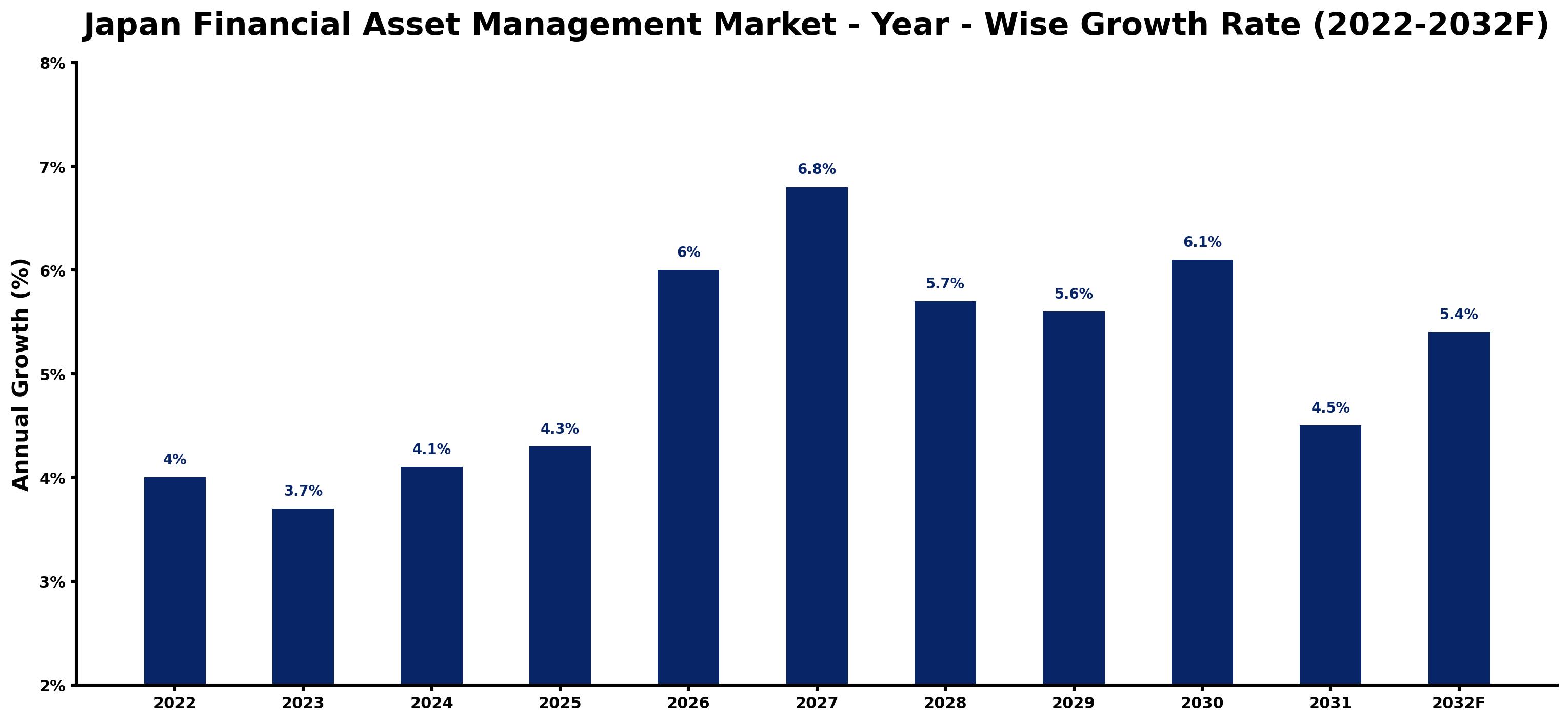
The table below sets out the estimated growth rate for each year and the main factor behind it.
| Year | Estimated Annual Growth (%) | Market Rationale |
| 2022 | 4.0 | The market showed steady growth driven by increased retail investor participation. |
| 2023 | 3.7 | Investor confidence fluctuated due to market volatility, affecting trading activity. |
| 2024 | 4.1 | A rise in individual investor interest boosted demand for asset management services. |
| 2025 | 4.3 | Growth accelerated as the number of registered mutual funds increased significantly. |
| 2026 | 6.0 | The adoption of ETFs is anticipated to contribute to faster growth this year. |
| 2027 | 6.8 | The market is projected to peak with strong demand for actively managed funds. |
| 2028 | 5.7 | Growth is expected to moderate as market conditions stabilise and investor caution returns. |
| 2029 | 5.6 | Interest in passive strategies will lead to a slight slowdown in growth. |
| 2030 | 6.1 | A resurgence in IPOs will revitalise interest in asset management services. |
| 2031 | 4.5 | Growth is projected to slow as market saturation in certain segments begins to impact demand. |
| 2032 | 5.4 | Increased focus on financial literacy among retail investors will enhance market engagement. |
Note: Market size estimations and growth projections presented in this report are based on 6Wresearch's proprietary forecasting methodology, utilizing the latest available industry data, government publications, and primary research inputs.
Japan Financial Asset Management Market Synopsis
Financial Asset Management involves managing investments across various asset classes, primarily through mutual funds, ETFs, and private equity. Demand arises from retail investors and institutional clients seeking effective retirement planning and wealth accumulation. The Japan Financial Asset Management Market is growing due to rising adoption of ETFs and the increasing number of high-net-worth individuals, with the market valued at approximately ¥100 trillion as of 2023.
Market Dynamics Impact Analysis (2026–2032)
| Factor | Type | Impact | Primary Segment Affected |
| Growing interest in ETFs among retail investors | Driver | High | ETFs |
| Increasing number of high-net-worth individuals | Driver | High | HNIs |
| Rise in demand for personalized investment strategies | Opportunity | High | Wealth Advisors |
| Growing market for online trading platforms | Opportunity | High | Online Brokers |
| Market volatility affecting investor confidence | Restraint | Medium | Retail Investors |
| High management fees for mutual funds | Restraint | Medium | Mutual Funds |
| Competition from low-cost passive investment options | Challenge | High | Active |
| Regulatory changes impacting operational costs | Challenge | Medium | Asset Managers |
Evaluation of Drivers in Japan Financial Asset Management Market (2026–2032)
Below are the drivers that matter most for revenue growth, with supporting evidence.
| Drivers | Primary Segment Affected | Why It Matters (Evidence) |
| Increased adoption of ETFs | ETFs | The total assets under management in ETFs reached approximately ¥20 trillion in 2023, driving demand for flexible investment options. |
| Growing number of high-net-worth individuals | HNIs | With an estimated 3 million HNIs in Japan in 2023, demand for tailored investment solutions has surged. |
| Rise in retail investor participation | Retail Investors | Approximately 30% of individual investors utilize online brokers for trading, enhancing market engagement. |
| Demand for diversified investment portfolios | Mutual Funds | Over 3,000 mutual funds registered in Japan as of 2022 indicate strong interest in diversified investments. |
| Increased focus on financial literacy | Retail Investors | The government launched a program in 2023 to promote financial literacy among retail investors, boosting market engagement. |
Spending rises because of the increased adoption of ETFs, with total assets under management reaching approximately ¥20 trillion in 2023. The growing number of high-net-worth individuals, estimated at 3 million in 2023, drives demand for tailored investment solutions. Retail investor participation has surged, with around 30% of individual investors using online brokers for trading. The strong interest in diversified investment portfolios is reflected in the over 3,000 mutual funds registered in Japan.
Evaluation of Restraints in Japan Financial Asset Management Market
Below are the constraints most often cited by buyers and suppliers, with the segment each affects.
| Market Restraint | Primary Segment Affected | Why It Matters (Evidence) |
| Market volatility affecting investor confidence | Retail Investors | Market fluctuations have led to cautious behaviour among retail investors, impacting their investment decisions. |
| High management fees for mutual funds | Mutual Funds | The average management fee for mutual funds in Japan is about 1.5%, which can deter some investors. |
| Competition from low-cost passive investment options | Active | The adoption of passive investment strategies has increased by 15% over the past year, impacting demand for active funds. |
| Regulatory changes impacting operational costs | Asset Managers | Changes in regulations under the Industrial Standardization Act increase compliance costs for asset managers. |
| Limited awareness of financial products among retail investors | Retail Investors | The average age of retail investors in Japan is around 45 years, indicating a potential knowledge gap. |
Japan Financial Asset Management Market Challenges
Supply chain constraints challenge asset management firms, as regulatory fees under the Financial Instruments and Exchange Act can reach ¥1 billion annually, limiting operational budgets. A shortage of skilled professionals is evident, with the industry facing a deficit of 20,000 qualified financial advisors, which delays service delivery for firms. Buyers encounter a limited selection of investment options; with over 3,000 mutual funds registered, individual investors struggle to diversify portfolios effectively. Technology adoption lags, as only 30% of individual investors utilise online brokers, which hampers transaction efficiency and restricts access to market opportunities for clients.
Trends in the Japan Financial Asset Management Market
These developments are changing demand patterns in the Japan Financial Asset Management Market.
- Shift in Retail Investor Preferences: Retail investors are increasingly favouring online brokers for trading, with approximately 30% utilising these platforms. This shift reflects a growing desire for self-directed investing and access to diverse financial products.
- Growth of Passive Investment Strategies: Passive investment strategies have gained traction, with a 15% increase in adoption over the past year. This trend is highlighted by the rising popularity of ETFs, appealing to cost-conscious investors.
- Focus on Financial Literacy Initiatives: The government launched a financial literacy program in 2023 to educate retail investors. This initiative aims to empower individuals to make informed investment decisions, enhancing market participation.
- Increasing Interest in REITs: Investment in REITs has grown by 10% year-on-year as of 2023, driven by the search for income generation and real estate investment opportunities among investors.
Investment Opportunities in the Japan Financial Asset Management Market
Investors looking at the Japan Financial Asset Management Market should consider the following areas.
- Partnerships with Online Trading Platforms: Now is an opportune time to partner with online trading platforms, as approximately 30% of individual investors utilise these services. Collaborating with online brokers can broaden market reach and engagement.
- Investment in Financial Literacy Programs: With the government's focus on financial literacy, investing in educational programs for retail investors can yield returns. Engaging with educational institutions can facilitate entry into this growing market.
- Expansion of ETF Offerings: The increasing assets in ETFs present an opportunity to expand product offerings. Asset managers can target retail investors by developing innovative ETF products tailored to their needs.
- Development of Tailored Investment Solutions: The growing number of high-net-worth individuals creates demand for personalized investment strategies. Asset managers should focus on developing bespoke solutions to capture this lucrative segment.
Government Initiatives in the Japan Financial Asset Management Market
The Digital Agency, established in September 2021, leads government digital transformation efforts, setting common system standards for asset management firms. This initiative complements the Financial Instruments and Exchange Act, which regulates asset management practices, ensuring investor protection and transparency.
The Consumer Affairs Agency oversees regulations prohibiting misleading advertising in financial products. This ensures that asset management firms provide clear and accurate information to investors, fostering trust in the market.
Future Insight of the Japan Financial Asset Management Market
Retail investors will benefit from government-led financial literacy programmes, enabling them to make informed investment choices. By 2032, the average annual return for actively managed funds could rise to around 6%, attracting more clients. The Tokyo Stock Exchange is expected to see increased IPO activity, further stimulating interest in asset management. Advances in technology will streamline trading processes, allowing suppliers to offer a wider array of investment options.
Market Segmentation Analysis
Japan Financial Asset Management Market report covers a detailed analysis of the following market segments:
By Asset Type – Mutual Funds Lead, ETFs Expected to Grow Fastest
According to Saurav Kr Singh, Senior Research Analyst at 6Wresearch, with 50% of asset type revenue in 2025, Mutual Funds was the largest category. Mutual funds lead the market due to their extensive use among investors aiming for diversified portfolios. With over 3,000 mutual funds registered in Japan, they cater effectively to a wide range of investment preferences. ETFs are projected to grow fastest, at a CAGR of 7.7% during 2026–2032. ETFs are experiencing rapid growth thanks to their low-cost and flexible investment options, with total assets under management reaching approximately ¥20 trillion in 2023. This trend indicates a shift towards more accessible investment vehicles, which will likely widen the gap with mutual funds. Suppliers should focus on enhancing ETF offerings to capture the growing interest among investors.
By Management Strategy – Active Leads, Passive Expected to Grow Fastest
Active held 43% of the Japan Financial Asset Management Market by management strategy in 2025. Active management strategies dominate as they appeal to investors seeking potentially higher returns through expert oversight. This preference is rooted in a historical context where performance and expertise are highly valued by investors in Japan. The quickest growth will come from Passive, forecast to expand at a CAGR of 7.1% between 2026 and 2032. The rise of passive strategies is linked to their simplicity and lower fees, making them increasingly attractive to cost-conscious investors. The 15% increase in adoption over the past year highlights a significant shift towards these straightforward investment options. Buyers may benefit from exploring passive options as they become more mainstream and cost-effective.
By Distribution Channel – Wealth Advisors Lead, Online Brokers Expected to Grow Fastest
In 2025, Wealth Advisors led the distribution channel split with a 37% share. Wealth advisors hold the largest market share as they provide essential personalised investment strategies tailored to individual client needs. Their expertise is particularly crucial in navigating the complexities of financial markets in Japan, where tailored advice is highly valued. Over 2026–2032, Online Brokers are expected to post the fastest growth, at a CAGR of 7.5%. Online brokers are rapidly gaining popularity as more individual investors choose self-directed investing, reflecting a shift towards digital platforms. This trend aligns with changing investor preferences for convenience and accessibility in managing their investments. Suppliers must enhance digital offerings to meet the rising demand for online investment solutions.
By End User – Retail Investors Lead, Individual Investors Expected to Grow Fastest
Retail Investors took 43% of end user revenue in 2025, more than any other category. Retail investors are key players in market activity, significantly influencing the financial landscape in Japan. Their engagement across various investment products directly impacts market demand and trends. Individual Investors are set to record the highest CAGR in this split, 7.2% over 2026–2032. Individual investors are becoming increasingly active in financial markets, bolstered by government initiatives promoting financial literacy among retail investors. This trend indicates a shift towards personal investment management and a more engaged investor base. Providers should tailor their services to better address the needs of individual investors as they become increasingly influential in the market.
Key Attractiveness of the Report
- 10 Years of Market Numbers
- Historical Data Starting from 2022 to 2025
- Base Year 2025
- Forecast Data until 2032
- Key Performance Indicators Impacting the Market
- Major Upcoming Developments and Projects
Key Highlights of the Report:
- Japan Financial Asset Management Market Outlook
- Market Size of Japan Financial Asset Management Market, 2025
- Forecast of Japan Financial Asset Management Market, 2032
- Historical Data and Forecast of Japan Financial Asset Management Revenues & Volume for the Period 2022-2032F
- Japan Financial Asset Management Market Trend Evolution
- Japan Financial Asset Management Market Drivers and Challenges
- Japan Financial Asset Management Price Trends
- Japan Financial Asset Management Porter's Five Forces
- Japan Financial Asset Management Industry Life Cycle
- Historical Data and Forecast of Japan Financial Asset Management Market Revenues & Volume By Asset Type for the Period 2022-2032F
- Historical Data and Forecast of Japan Financial Asset Management Market Revenues & Volume By Mutual Funds for the Period 2022-2032F
- Historical Data and Forecast of Japan Financial Asset Management Market Revenues & Volume By ETFs for the Period 2022-2032F
- Historical Data and Forecast of Japan Financial Asset Management Market Revenues & Volume By REITs for the Period 2022-2032F
- Historical Data and Forecast of Japan Financial Asset Management Market Revenues & Volume By Private Equity for the Period 2022-2032F
- Historical Data and Forecast of Japan Financial Asset Management Market Revenues & Volume By Management Strategy for the Period 2022-2032F
- Historical Data and Forecast of Japan Financial Asset Management Market Revenues & Volume By Active for the Period 2022-2032F
- Historical Data and Forecast of Japan Financial Asset Management Market Revenues & Volume By Passive for the Period 2022-2032F
- Historical Data and Forecast of Japan Financial Asset Management Market Revenues & Volume By Income-oriented for the Period 2022-2032F
- Historical Data and Forecast of Japan Financial Asset Management Market Revenues & Volume By Aggressive for the Period 2022-2032F
- Historical Data and Forecast of Japan Financial Asset Management Market Revenues & Volume By Distribution Channel for the Period 2022-2032F
- Historical Data and Forecast of Japan Financial Asset Management Market Revenues & Volume By Wealth Advisors for the Period 2022-2032F
- Historical Data and Forecast of Japan Financial Asset Management Market Revenues & Volume By Online Brokers for the Period 2022-2032F
- Historical Data and Forecast of Japan Financial Asset Management Market Revenues & Volume By Asset Managers for the Period 2022-2032F
- Historical Data and Forecast of Japan Financial Asset Management Market Revenues & Volume By Direct Investment for the Period 2022-2032F
- Historical Data and Forecast of Japan Financial Asset Management Market Revenues & Volume By End User for the Period 2022-2032F
- Historical Data and Forecast of Japan Financial Asset Management Market Revenues & Volume By Retail Investors for the Period 2022-2032F
- Historical Data and Forecast of Japan Financial Asset Management Market Revenues & Volume By Individual Investors for the Period 2022-2032F
- Historical Data and Forecast of Japan Financial Asset Management Market Revenues & Volume By Institutional Investors for the Period 2022-2032F
- Historical Data and Forecast of Japan Financial Asset Management Market Revenues & Volume By HNIs for the Period 2022-2032F
- Japan Financial Asset Management Import Export Trade Statistics
- Market Opportunity Assessment By Asset Type
- Market Opportunity Assessment By Management Strategy
- Market Opportunity Assessment By Distribution Channel
- Market Opportunity Assessment By End User
- Japan Financial Asset Management Top Companies Market Share
- Japan Financial Asset Management Competitive Benchmarking By Technical and Operational Parameters
- Japan Financial Asset Management Company Profiles
- Japan Financial Asset Management Key Strategic Recommendations
Market Covered
Segments analysed in this report are listed below.
By Asset Type
- Mutual Funds
- ETFs
- REITs
- Private Equity
By Management Strategy
- Active
- Passive
- Income-oriented
- Aggressive
By Distribution Channel
- Wealth Advisors
- Online Brokers
- Asset Managers
- Direct Investment
By End User
- Retail Investors
- Individual Investors
- Institutional Investors
- HNIs































