Japan Financial Crime Software Market Size & Growth Rate
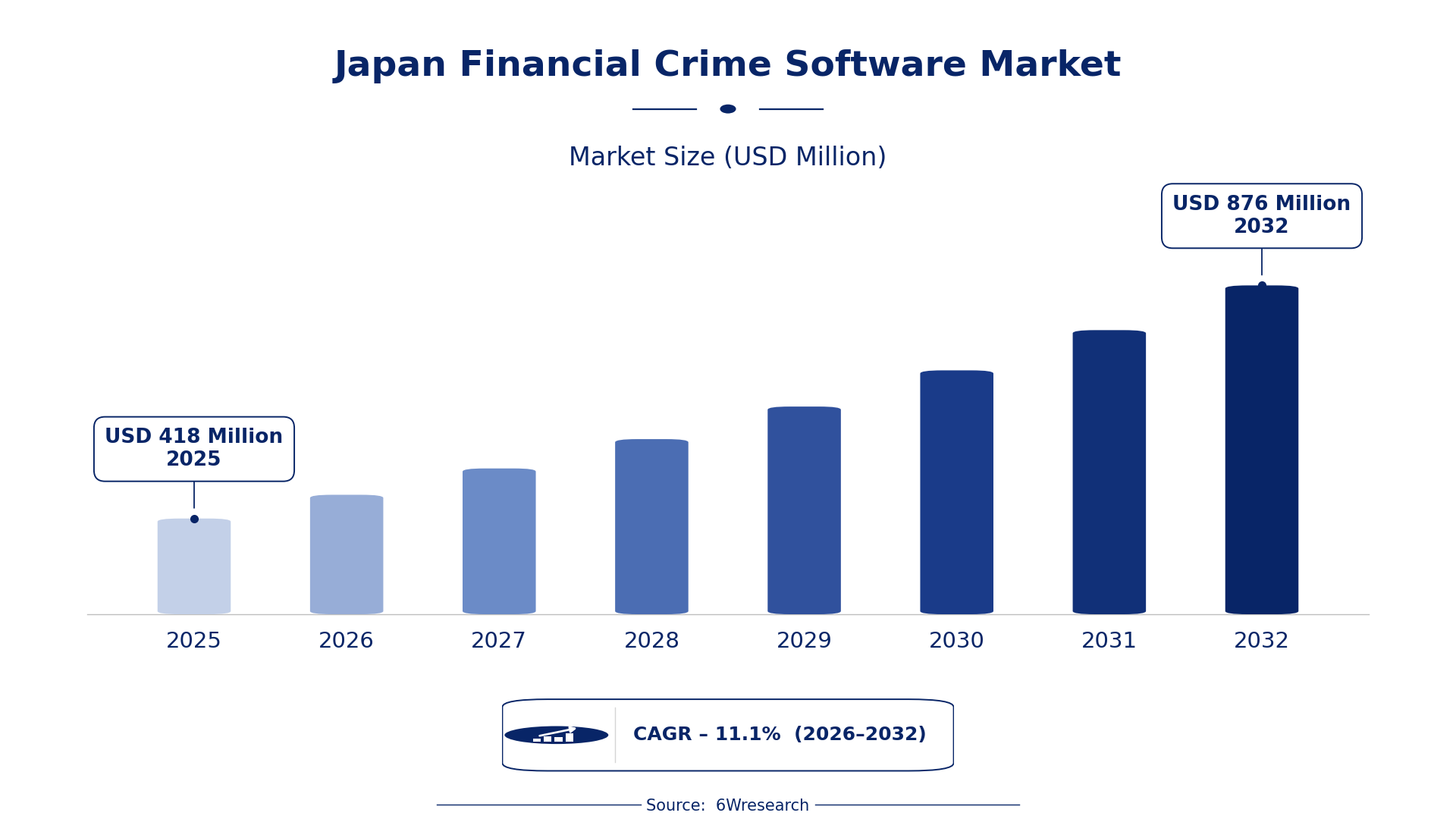
According to 6Wresearch internal database and industry insights, the Japan Financial Crime Software Market was valued at USD 418 Million in 2025 and is projected to reach USD 876 Million by 2032, growing at a CAGR of approximately 11.1% during 2026–2032.
Japan Financial Crime Software Market Highlights
| Report Metric | Details |
| Report Name | Japan Financial Crime Software Market (2026-2032) |
| Market Size 2025 | USD 418 Million |
| Market Size 2032 | USD 876 Million |
| Absolute Growth 2025–2032 | USD 458 Million |
| CAGR 2026–2032 | 11.1% |
| Peak Annual Growth | 11.9% in 2032 |
| Forecast Period | 2026–2032 |
| Historical Data | 2022–2025 |
| Base Year | 2025 |
| Leading Software Type, 2025 | Fraud Detection (54% share) |
| Leading Crime Type, 2025 | Transaction Fraud (46% share) |
| Leading Distribution Channel, 2025 | SaaS (49% share) |
| Leading End User, 2025 | Banks (45% share) |
| Fastest-Growing Software Type | AML Software (15.8% CAGR) |
| Fastest-Growing Crime Type | Money Laundering (15.4% CAGR) |
| Fastest-Growing Distribution Channel | Compliance Providers (16.2% CAGR) |
| Fastest-Growing End User | FinTech Firms (14.2% CAGR) |
| Growing Sector | financial services |
| Key End Users | banks, FinTech firms, investment firms, insurance companies |
Japan Financial Crime Software Market Year-wise Growth Rate and Key Drivers (2022–2032)
This graph illustrates the annual growth rates of the market from 2022 to 2032, highlighting a steady upward trajectory and projected market expansion over the forecast period.
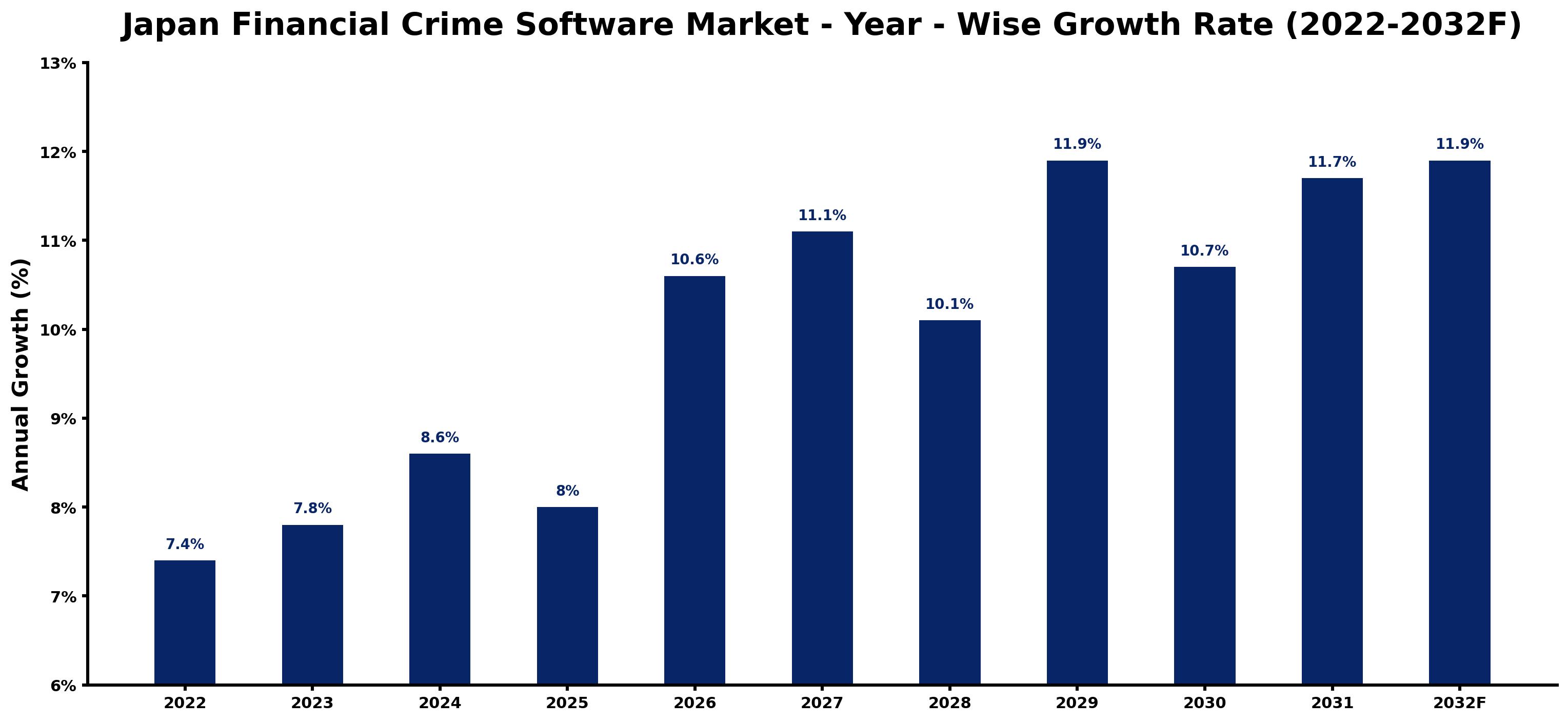
The yearly estimates that follow link every growth rate to its principal driver, so readers can see why the pace changed in each period.
| Year | Estimated Annual Growth (%) | Market Rationale |
| 2022 | 7.4 | The market showed steady demand due to ongoing regulatory requirements for financial institutions. |
| 2023 | 7.8 | Growth accelerated as financial institutions increased investments in compliance technologies. |
| 2024 | 8.6 | Rising cases of money laundering prompted further investments in detection software. |
| 2025 | 8.0 | Growth slowed as some institutions consolidated their software solutions and budgets. |
| 2026 | 10.6 | Demand is projected to surge as new compliance initiatives are introduced by regulatory bodies. |
| 2027 | 11.1 | Increased adoption of AI technologies will drive higher demand for advanced software solutions. |
| 2028 | 10.1 | Growth is anticipated to slow as market saturation begins to affect new software purchases. |
| 2029 | 11.9 | A rise in financial crime cases will spur renewed investment in software. |
| 2030 | 10.7 | Growth is expected to slow as financial institutions focus on optimising existing systems. |
| 2031 | 11.7 | Demand will increase as new regulations are introduced, necessitating software upgrades. |
| 2032 | 11.9 | The market is projected to peak as financial institutions fully embrace advanced compliance technologies. |
Note: Market size estimations and growth projections presented in this report are based on 6Wresearch's proprietary forecasting methodology, utilizing the latest available industry data, government publications, and primary research inputs.
Japan Financial Crime Software Market Synopsis
Financial Crime Software includes tools designed to detect and prevent financial crimes such as fraud and money laundering, utilising advanced algorithms and machine learning techniques. The market is driven by a strong financial services sector with over 1,000 banks and financial institutions. Factors contributing to growth include rising cases of financial crime, stringent compliance requirements, and increased investment in AI technologies, with the average annual budget for cybersecurity in financial institutions around ¥10 billion.
Market Dynamics Impact Analysis (2026–2032)
| Factor | Type | Impact | Primary Segment Affected |
| Ongoing regulatory compliance requirements drive demand for advanced financial crime software. | Driver | High | AML Software |
| The rise in financial crime cases necessitates enhanced fraud detection capabilities. | Driver | High | Fraud Detection |
| The growing need for compliance solutions presents opportunities for software providers. | Opportunity | High | Compliance Providers |
| The increasing adoption of SaaS models creates avenues for flexible software delivery. | Opportunity | Medium | SaaS |
| Budget constraints limit the adoption of new software solutions among smaller institutions. | Restraint | High | Banks |
| The complexity of regulatory requirements can hinder timely software implementation. | Restraint | Medium | FinTech Firms |
| High competition among software providers can lead to pricing pressures. | Challenge | High | Fraud Detection |
| Rapid technological advancements may outpace some institutions' ability to adapt. | Challenge | Medium | AML Software |
Evaluation of Drivers in Japan Financial Crime Software Market (2026–2032)
These are the developments adding the most demand over the forecast period.
| Drivers | Primary Segment Affected | Why It Matters (Evidence) |
| Increased regulatory scrutiny mandates financial institutions to invest in compliance software. | AML Software | The Financial Services Agency enforces strict AML regulations, compelling banks to invest in compliance measures. |
| A surge in reported fraud cases drives demand for effective fraud detection solutions. | Fraud Detection | The number of reported fraud cases in Japan reached 3,000 in 2023, prompting financial institutions to upgrade their systems. |
| The integration of AI technologies improves the capabilities of financial crime software. | AML Software | The adoption rate of AI in financial crime detection is projected to reach 60% by 2025, improving detection accuracy. |
| Growing investment in cybersecurity initiatives boosts demand for financial crime software. | Compliance Providers | In 2023, the government allocated ¥5 billion for cybersecurity initiatives, benefiting compliance software providers. |
| The shift towards SaaS delivery models offers flexibility and scalability for financial institutions. | SaaS | SaaS solutions accounted for 49% of the distribution channel in 2025, appealing to institutions seeking cost-effective options. |
In 2023, Japan reported 1,500 cases of money laundering attempts, prompting financial institutions to invest in advanced fraud detection tools. The average annual budget for cybersecurity in financial institutions is approximately ¥10 billion, driving software purchases. The adoption rate of AI in financial crime detection is projected to reach 60% by 2025, improving detection capabilities.
Evaluation of Restraints in Japan Financial Crime Software Market
These are the pressures that could keep growth below its potential.
| Market Restraint | Primary Segment Affected | Why It Matters (Evidence) |
| Budget constraints limit the ability of smaller institutions to adopt advanced software solutions. | Banks | With an average annual budget of ¥10 billion, many smaller banks struggle to invest in new technologies. |
| Complex regulatory requirements can delay software implementation and upgrades. | FinTech Firms | The Financial Services Agency's stringent regulations often require extensive compliance checks, slowing down adoption. |
| High competition among software providers leads to pricing pressures, affecting profitability. | Fraud Detection | As many firms compete in the market, pricing strategies can limit the profitability of new solutions. |
| Rapid technological advancements may outpace some institutions' ability to adapt to new solutions. | AML Software | Financial institutions often face challenges in integrating new technologies into their existing systems. |
| Limited awareness of advanced software capabilities can hinder market growth. | Compliance Providers | Some financial institutions may not fully understand the benefits of advanced compliance software, delaying purchases. |
Japan Financial Crime Software Market Challenges
Japan's financial crime software sector faces hurdles due to outdated technology, as many institutions still rely on legacy systems that can delay fraud detection for buyers by up to six months. High costs associated with software upgrades present a challenge, with financial institutions needing to allocate an average of ¥10 billion annually for cybersecurity, straining budgets and limiting investments in new solutions. A skills gap exists, with only 40% of the workforce trained in advanced algorithms, preventing producers from fully utilising available technology. Buyers encounter growing regulatory pressure from the Financial Services Agency, leading to compliance costs that can exceed ¥5 billion annually for larger institutions.
Trends in the Japan Financial Crime Software Market
These developments are changing demand patterns in the Japan Financial Crime Software Market.
- Shift towards AI-Driven Fraud Detection: The integration of AI technologies in financial crime software is accelerating, with projections indicating a 60% adoption rate by 2025. This shift allows institutions to identify fraudulent activities more effectively.
- Transition to SaaS Delivery Models: Financial institutions are increasingly favouring SaaS solutions for their flexibility and cost-effectiveness. By 2025, SaaS is expected to account for 49% of the distribution channel, enabling institutions to scale their operations efficiently.
- Increased Focus on Compliance: The Financial Services Agency's 2023 compliance initiative has heightened the focus on anti-money laundering practices. As a result, financial institutions are investing more in compliance solutions to meet regulatory requirements.
- Emergence of Advanced Risk Scoring Systems: Financial institutions are prioritising advanced risk scoring systems to assess transaction risks effectively. This trend is driven by the need to comply with stringent regulations and improve security measures.
Investment Opportunities in the Japan Financial Crime Software Market
The following opportunities in the Japan Financial Crime Software Market pair current demand with a clear way in.
- Partnerships with Compliance Providers: Forming partnerships with compliance providers presents a pathway to strengthen software offerings. The growing number of banks seeking compliance solutions creates a substantial opportunity for software developers.
- Investment in AI-Driven Solutions: Investing in AI-driven financial crime software can address the rising demand for advanced detection capabilities. Banks and FinTech firms are increasingly pursuing cutting-edge solutions to combat financial crime.
- Expansion into Tokyo's Financial Hub: Establishing a presence in Tokyo, the primary hub for financial crime software development, offers access to a large client base. The city's concentration of financial institutions generates opportunities for software suppliers.
- Focus on Cybersecurity Initiatives: Aligning software offerings with government-funded cybersecurity initiatives can facilitate market entry. The government allocated ¥5 billion for cybersecurity in 2023, benefiting compliance software providers.
Government Initiatives in the Japan Financial Crime Software Market
The AI Promotion Act, established in 2025, introduces a national framework for AI research and development, improving compliance capabilities in financial crime software. This builds on existing laws, such as the Financial Services Agency's strict AML regulations, which have been enforced since 2002.
In 2023, the government allocated ¥5 billion for cybersecurity initiatives, overseen by the Digital Agency. This funding supports the development of compliance solutions, ensuring financial institutions can effectively meet regulatory standards.
Future Insight of the Japan Financial Crime Software Market
Financial institutions will undergo a transformation by 2032, driven by technological advancements and increased AI adoption in financial crime detection projected to reach 60%. New compliance initiatives will simplify AML practices, alleviating the burden on institutions to meet regulatory requirements. Stricter regulations from the Tokyo Stock Exchange will drive demand for more effective software solutions, prompting suppliers to improve their offerings. As reported fraud cases increase, the average transaction value monitored by software will rise to ¥1 million, necessitating the development of more sophisticated systems to combat financial crime.
Market Segmentation Analysis
Japan Financial Crime Software Market report covers a detailed analysis of the following market segments:
By Software Type – Fraud Detection Leads, AML Software Expected to Grow Fastest
According to Saurav Kr Singh, Senior Research Analyst at 6Wresearch, the largest software type category in 2025 was Fraud Detection, at 54% of revenue. Fraud detection software holds the largest share due to its critical role in identifying fraudulent activities in financial transactions. The substantial average transaction value monitored by this software, approximately ¥1 million, underscores its importance for financial institutions. The quickest growth will come from AML Software, forecast to expand at a CAGR of 15.8% between 2026 and 2032. AML software is experiencing rapid growth as it becomes increasingly mandatory for compliance with anti-money laundering regulations, especially following the FSA's new compliance initiative launched in 2023. This regulatory emphasis will likely widen the lead of fraud detection software as institutions enhance their compliance measures. Suppliers must focus on developing AML software to meet regulatory demands and capture market opportunities.
By Crime Type – Transaction Fraud Leads, Money Laundering Expected to Grow Fastest
Transaction Fraud took 46% of crime type revenue in 2025, more than any other category. Transaction fraud is the leading segment, representing a major focus for financial institutions, with 3,000 reported fraud cases in Japan in 2023. This high incidence rate necessitates effective detection tools to manage risks associated with fraudulent activities. Money Laundering is set to record the highest CAGR in this split, 15.4% over 2026–2032. Money laundering is the fastest-growing concern, propelled by the 1,500 reported cases of money laundering attempts in 2023, highlighting the urgent need for effective solutions. As regulatory scrutiny increases, the demand for AML solutions will continue to surge, reinforcing the importance of addressing this issue. Buyers should prioritise investments in solutions specifically targeting money laundering to ensure compliance and mitigate risks.
By Distribution Channel – SaaS Lead, Compliance Providers Expected to Grow Fastest
In 2025, SaaS led the distribution channel split with a 49% share. The SaaS model leads the market as the preferred delivery method, providing flexibility and scalability for financial institutions. This approach aligns with the substantial average annual budget for cybersecurity in financial institutions, which is approximately ¥10 billion. Compliance Providers are projected to grow fastest, at a CAGR of 16.2% during 2026–2032. Compliance providers are the fastest-growing channel, essential for ensuring adherence to regulations, particularly with the FSA's enhanced AML practices. Their increasing importance in the regulatory landscape will likely drive further growth in this segment. Suppliers should consider partnerships with compliance providers to strengthen their market position and service offerings.
By End User – Banks Lead, FinTech Firms Expected to Grow Fastest
With 45% of end user revenue in 2025, Banks was the largest category. Banks are the primary users of financial crime software, driven by extensive operational needs and stringent regulatory requirements. With over 1,000 banks and financial institutions in Japan, their demand for such software remains robust and consistent. Over 2026–2032, FinTech Firms are expected to post the fastest growth, at a CAGR of 14.2%. FinTech firms represent the fastest-growing user segment, motivated by their innovative strategies and reliance on technology to combat financial crime. This trend is expected to persist as the FinTech sector continues to expand and adapt to new challenges. Suppliers should tailor their solutions to meet the specific needs of FinTech firms to capitalise on this growing market.
Key Attractiveness of the Report
- 10 Years of Market Numbers
- Historical Data Starting from 2022 to 2025
- Base Year 2025
- Forecast Data until 2032
- Key Performance Indicators Impacting the Market
- Major Upcoming Developments and Projects
Key Highlights of the Report:
- Japan Financial Crime Software Market Outlook
- Market Size of Japan Financial Crime Software Market, 2025
- Forecast of Japan Financial Crime Software Market, 2032
- Historical Data and Forecast of Japan Financial Crime Software Revenues & Volume for the Period 2022-2032F
- Japan Financial Crime Software Market Trend Evolution
- Japan Financial Crime Software Market Drivers and Challenges
- Japan Financial Crime Software Price Trends
- Japan Financial Crime Software Porter's Five Forces
- Japan Financial Crime Software Industry Life Cycle
- Historical Data and Forecast of Japan Financial Crime Software Market Revenues & Volume By Software Type for the Period 2022-2032F
- Historical Data and Forecast of Japan Financial Crime Software Market Revenues & Volume By Fraud Detection for the Period 2022-2032F
- Historical Data and Forecast of Japan Financial Crime Software Market Revenues & Volume By AML Software for the Period 2022-2032F
- Historical Data and Forecast of Japan Financial Crime Software Market Revenues & Volume By Insider Threat Tools for the Period 2022-2032F
- Historical Data and Forecast of Japan Financial Crime Software Market Revenues & Volume By Risk Scoring Systems for the Period 2022-2032F
- Historical Data and Forecast of Japan Financial Crime Software Market Revenues & Volume By Crime Type for the Period 2022-2032F
- Historical Data and Forecast of Japan Financial Crime Software Market Revenues & Volume By Transaction Fraud for the Period 2022-2032F
- Historical Data and Forecast of Japan Financial Crime Software Market Revenues & Volume By Money Laundering for the Period 2022-2032F
- Historical Data and Forecast of Japan Financial Crime Software Market Revenues & Volume By Employee Fraud for the Period 2022-2032F
- Historical Data and Forecast of Japan Financial Crime Software Market Revenues & Volume By Credit Abuse for the Period 2022-2032F
- Historical Data and Forecast of Japan Financial Crime Software Market Revenues & Volume By Distribution Channel for the Period 2022-2032F
- Historical Data and Forecast of Japan Financial Crime Software Market Revenues & Volume By SaaS for the Period 2022-2032F
- Historical Data and Forecast of Japan Financial Crime Software Market Revenues & Volume By Compliance Providers for the Period 2022-2032F
- Historical Data and Forecast of Japan Financial Crime Software Market Revenues & Volume By Cybersecurity Vendors for the Period 2022-2032F
- Historical Data and Forecast of Japan Financial Crime Software Market Revenues & Volume By AI Software Companies for the Period 2022-2032F
- Historical Data and Forecast of Japan Financial Crime Software Market Revenues & Volume By End User for the Period 2022-2032F
- Historical Data and Forecast of Japan Financial Crime Software Market Revenues & Volume By Banks for the Period 2022-2032F
- Historical Data and Forecast of Japan Financial Crime Software Market Revenues & Volume By FinTech Firms for the Period 2022-2032F
- Historical Data and Forecast of Japan Financial Crime Software Market Revenues & Volume By Investment Firms for the Period 2022-2032F
- Historical Data and Forecast of Japan Financial Crime Software Market Revenues & Volume By Insurance Companies for the Period 2022-2032F
- Japan Financial Crime Software Import Export Trade Statistics
- Market Opportunity Assessment By Software Type
- Market Opportunity Assessment By Crime Type
- Market Opportunity Assessment By Distribution Channel
- Market Opportunity Assessment By End User
- Japan Financial Crime Software Top Companies Market Share
- Japan Financial Crime Software Competitive Benchmarking By Technical and Operational Parameters
- Japan Financial Crime Software Company Profiles
- Japan Financial Crime Software Key Strategic Recommendations
Market Covered
The following segment groups are covered in the report.
By Software Type
- Fraud Detection
- AML Software
- Insider Threat Tools
- Risk Scoring Systems
By Crime Type
- Transaction Fraud
- Money Laundering
- Employee Fraud
- Credit Abuse
By Distribution Channel
- SaaS
- Compliance Providers
- Cybersecurity Vendors
- AI Software Companies
By End User
- Banks
- FinTech Firms
- Investment Firms
- Insurance Companies































