Japan Financial Encryption Software Market Size & Growth Rate
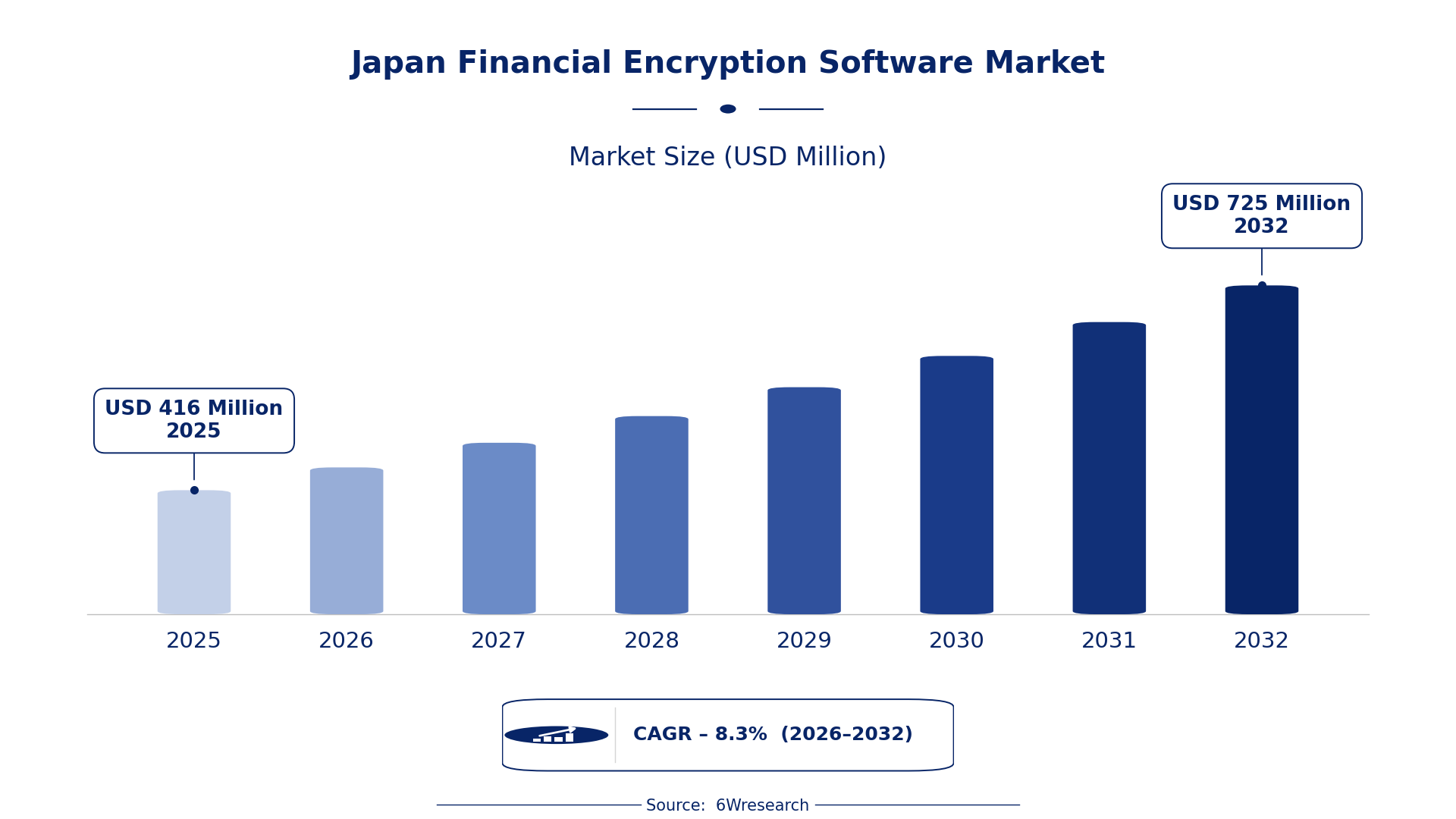
According to 6Wresearch internal database and industry insights, the Japan Financial Encryption Software Market was valued at USD 416 Million in 2025 and is projected to reach USD 725 Million by 2032, growing at a CAGR of approximately 8.3% during 2026–2032.
Japan Financial Encryption Software Market Highlights
| Report Metric | Details |
| Report Name | Japan Financial Encryption Software Market (2026-2032) |
| Market Size 2025 | USD 416 Million |
| Market Size 2032 | USD 725 Million |
| Absolute Growth 2025–2032 | USD 309 Million |
| CAGR 2026–2032 | 8.3% |
| Peak Annual Growth | 9.6% in 2026 |
| Forecast Period | 2026–2032 |
| Historical Data | 2022–2025 |
| Base Year | 2025 |
| Leading Encryption Type, 2025 | End-to-End Encryption (43% share) |
| Leading Application Area, 2025 | Online Transactions (38% share) |
| Leading Distribution Channel, 2025 | SaaS Providers (45% share) |
| Leading End User, 2025 | Financial Institutions (38% share) |
| Fastest-Growing Encryption Type | Tokenization (11.2% CAGR) |
| Fastest-Growing Application Area | Mobile Banking Apps (10.1% CAGR) |
| Fastest-Growing End User | Digital Banks (10.4% CAGR) |
| Growing Sector | Financial Services |
| Key End Users | Financial Institutions, Digital Banks, Payment Gateways, Wealth Management Firms |
Japan Financial Encryption Software Market Year-wise Growth Rate and Key Drivers (2022–2032)
This graph illustrates the annual growth rates of the market from 2022 to 2032, highlighting a steady upward trajectory and projected market expansion over the forecast period.
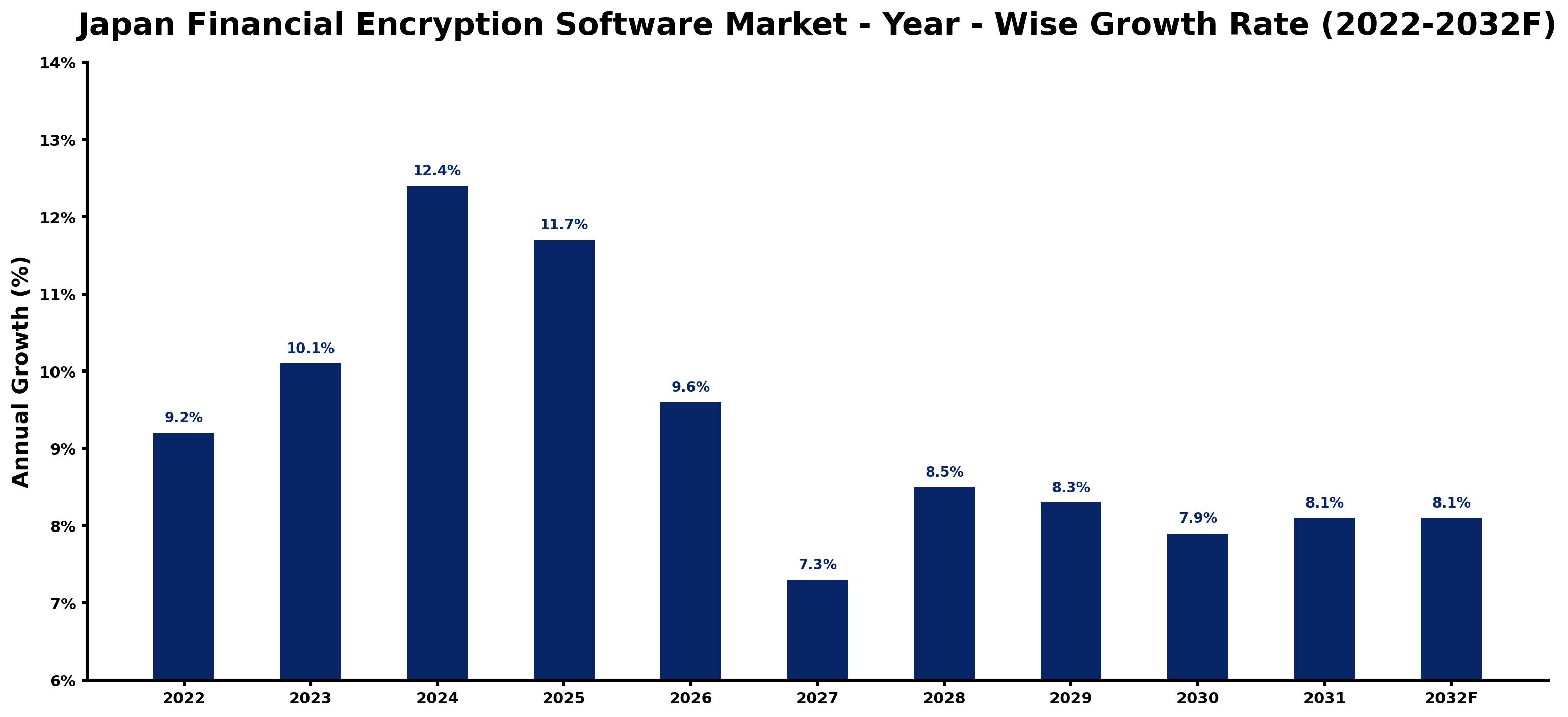
The following figures match every annual growth estimate with the main market development of that year, giving the reasoning behind each rise or slowdown.
| Year | Estimated Annual Growth (%) | Market Rationale |
| 2022 | 9.2 | The market showed solid activity with a notable demand for encryption solutions. |
| 2023 | 10.1 | Demand accelerated as financial institutions increased investments in cybersecurity measures. |
| 2024 | 12.4 | Growth peaked as digital banking surged, driving higher encryption adoption rates. |
| 2025 | 11.7 | Growth slowed slightly due to market maturation and increased competition among providers. |
| 2026 | 9.6 | A slowdown is expected as the market stabilises after previous rapid growth phases. |
| 2027 | 7.3 | Continued growth is projected, albeit at a reduced rate, influenced by market saturation. |
| 2028 | 8.5 | Demand is expected to pick up again as new technologies emerge and user adoption increases. |
| 2029 | 8.3 | Growth is projected to slow as the market adjusts to new regulatory standards and competition. |
| 2030 | 7.9 | The market is expected to maintain a steady growth pace, reflecting ongoing investments in security. |
| 2031 | 8.1 | Growth is projected to accelerate again as financial institutions prioritise encryption for customer trust. |
| 2032 | 8.1 | The market is expected to sustain its growth as digital transformation continues. |
Note: Market size estimations and growth projections presented in this report are based on 6Wresearch's proprietary forecasting methodology, utilizing the latest available industry data, government publications, and primary research inputs.
Japan Financial Encryption Software Market Synopsis
Financial encryption software protects sensitive financial data using advanced cryptographic methods, essential for securing online transactions and mobile banking. The Japan Financial Encryption Software Market is driven by a thriving financial services sector valued at over 200 trillion yen, with a 30% increase in digital banks since 2020 and over 60 million mobile banking app users in 2023, propelling the demand for these solutions. This growth is further supported by rising cybersecurity investments and compliance requirements, leading to increased adoption of encryption technologies across financial institutions.
Market Dynamics Impact Analysis (2026–2032)
| Factor | Type | Impact | Primary Segment Affected |
| Increasing mobile banking transactions drive demand for encryption solutions. | Driver | High | Mobile Banking Apps |
| The rise of digital banks necessitates enhanced security measures. | Driver | High | Digital Banks |
| Growing investment in cybersecurity creates opportunities for encryption providers. | Opportunity | High | Financial Institutions |
| The push for compliance with data protection regulations opens new markets. | Opportunity | High | Financial Institutions |
| High competition among providers may limit pricing power. | Restraint | Medium | End-to-End Encryption |
| Regulatory compliance requirements can increase operational costs. | Restraint | High | End-to-End Encryption |
| Technological integration challenges can delay implementation. | Challenge | Medium | End-to-End Encryption |
| Rapidly changing cybersecurity threats require constant updates. | Challenge | High | End-to-End Encryption |
Evaluation of Drivers in Japan Financial Encryption Software Market (2026–2032)
Demand rests on the following drivers, each shown with the segment it touches most.
| Drivers | Primary Segment Affected | Why It Matters (Evidence) |
| Increased mobile banking transactions drive demand for encryption solutions. | Mobile Banking Apps | The average annual growth rate of mobile banking transactions is 15%, prompting banks to secure user data. |
| The rise of digital banks necessitates security measures. | Digital Banks | With a 30% increase in digital banks since 2020, the need for encryption to protect customer data has surged. |
| Growing investment in cybersecurity creates opportunities for encryption providers. | Financial Institutions | Cybersecurity investment in Japan reached 1.2 trillion yen in 2023, leading to higher demand for encryption technologies. |
| Data storage encryption mandates drive adoption of encryption solutions. | Data Storage | The Financial Services Agency mandates data storage encryption, increasing compliance-driven purchases among institutions. |
| ISO/IEC 27001 adoption supports encryption market growth. | Financial Institutions | Many financial institutions adopt ISO/IEC 27001 for information security, boosting demand for encryption software. |
Purchasing is picking up as mobile banking transactions rise, with users exceeding 60 million in 2023, leading financial institutions to invest in encryption solutions. The number of digital banks has surged, necessitating security measures to protect customer data. Compliance with data storage encryption mandates is prompting institutions to adopt encryption solutions. The adoption of ISO/IEC 27001 standards among financial institutions is increasing the need for encryption software. Rising cybersecurity investments are driving demand for encryption technologies across the sector.
Evaluation of Restraints in Japan Financial Encryption Software Market
These are the pressures that could keep growth below its potential.
| Market Restraint | Primary Segment Affected | Why It Matters (Evidence) |
| High competition among providers may limit pricing power. | End-to-End Encryption | As many providers enter the market, pricing pressure increases, affecting profit margins for encryption solutions. |
| Regulatory compliance requirements can increase operational costs. | Financial Institutions | Compliance with data protection regulations raises costs for financial institutions, impacting their budget for encryption solutions. |
| Integration challenges can delay implementation. | Financial Institutions | Integrating encryption technologies with existing systems can be complex, causing delays in deployment for financial institutions. |
| Rapidly changing cybersecurity threats require constant updates. | End-to-End Encryption | The evolving nature of cybersecurity threats necessitates ongoing updates to encryption solutions, straining resources for providers. |
| Limited awareness among smaller institutions may hinder market growth. | Digital Banks | Smaller digital banks may lack awareness of encryption benefits, slowing their adoption of necessary security measures. |
Japan Financial Encryption Software Market Challenges
Financial institutions face supply chain disruptions for encryption software, which delays transaction security. This issue arises from reliance on a limited number of domestic developers, potentially extending implementation timelines by up to six months for banks. Technology integration challenges emerge as many firms lack the expertise to implement advanced encryption methods, risking exposure to data breaches that could incur fines in the millions. Regulatory pressures elevate compliance costs, with the Financial Services Agency mandating data storage encryption, raising operational expenses by 20% for smaller banks. Buyers also contend with rising costs due to cybersecurity investments, which reached 1.2 trillion yen in 2023, compelling them to allocate more budget for essential upgrades.
Trends in the Japan Financial Encryption Software Market
The trends below show where the Japan Financial Encryption Software Market is heading.
- Tokyo Metropolitan Area Leading Fintech Innovation: The Tokyo Metropolitan Area is emerging as a hub for fintech innovation, with over 60 million mobile banking app users as of 2023. This trend drives demand for advanced financial encryption solutions to secure transactions.
- Financial Institutions Prioritising Cybersecurity: Financial institutions are increasingly prioritising cybersecurity, with over 80% employing end-to-end encryption for transactions. This shift reflects a growing awareness of data protection needs in the digital banking sector.
- Shift Towards Cloud-Based Encryption Solutions: There is a marked shift towards cloud-based encryption solutions among financial institutions, as SaaS providers now serve 45% of the market. This trend facilitates easier access to encryption technologies.
- Rising Adoption of ISO/IEC 27001 Standards: The adoption of ISO/IEC 27001 standards is on the rise among financial institutions, strengthening their information security frameworks. This trend is apparent as more institutions pursue certification to improve data protection.
Investment Opportunities in the Japan Financial Encryption Software Market
Below are the investment opportunities with the strongest case in the Japan Financial Encryption Software Market.
- Partner with Local Fintech Innovators: Now is an opportune time to collaborate with local fintech innovators in the Tokyo Metropolitan Area, where demand for encryption solutions is increasing. Partnering with these firms can enhance market entry strategies.
- Supply Advanced Encryption Technologies: There is a growing demand for advanced encryption technologies among financial institutions, particularly in mobile banking. Suppliers can capitalise on this by offering tailored solutions to address specific security needs.
- Focus on Compliance Solutions for Financial Institutions: With the rising regulatory requirements, concentrating on compliance solutions for financial institutions presents a valuable opportunity. Engaging with the Financial Industry Association of Japan can facilitate market entry.
- Capitalize on Cybersecurity Investments: The surge in cybersecurity investments, reaching 1.2 trillion yen in 2023, presents opportunities for encryption providers. Entering the market through joint ventures with local firms can strengthen competitive positioning.
Government Initiatives in the Japan Financial Encryption Software Market
The Industrial Standardization Act of 1949, amended in 2019, establishes JIS product and test standards for encryption technologies. Compliance with these standards is mandatory for producers, ensuring that financial encryption software meets national security requirements. The Act against Unjustifiable Premiums and Misleading Representations protects consumers by prohibiting misleading claims about encryption products, ensuring market integrity.
The Digital Agency, established in September 2021, leads the government's digital transformation efforts, approving initiatives that promote cybersecurity measures. This agency oversees funding for projects aimed at improving encryption technologies, ensuring that financial institutions can access the necessary resources to implement effective security solutions.
Future Insight of the Japan Financial Encryption Software Market
A policy-driven shift will prompt stronger cybersecurity standards, leading to wider adoption of new protocols among financial institutions. This standardisation will streamline compliance processes and reduce costs for buyers. The rise of digital banking will drive further innovation in encryption technologies, improving user trust and security. As mobile banking app users exceed 60 million, suppliers will need to develop more sophisticated solutions to meet this growing demand. The Tokyo Metropolitan Area will solidify its position as a fintech hub, attracting investments in encryption software development.
Market Segmentation Analysis
Japan Financial Encryption Software Market report covers a detailed analysis of the following market segments:
By Encryption Type – End-to-End Encryption Leads, Tokenization Expected to Grow Fastest
According to Saurav Kr Singh, Senior Research Analyst at 6Wresearch, End-to-End Encryption held 43% of the Japan Financial Encryption Software Market by encryption type in 2025. End-to-End Encryption commands the largest share as it is widely adopted among financial institutions for safeguarding sensitive data during transmission. For instance, over 80% of financial institutions implement this method to ensure secure transactions. Tokenization is projected to grow fastest, at a CAGR of 11.2% during 2026–2032. Tokenization is experiencing rapid growth due to its ability to replace sensitive data with non-sensitive equivalents, appealing to organisations that prioritise data security. The 30% increase in digital banks since 2020 significantly contributes to the rising demand for tokenization solutions. Suppliers should prioritise the development of advanced tokenization technologies to meet the growing needs of digital banks.
By Application Area – Online Transactions Lead, Mobile Banking Apps Expected to Grow Fastest
The largest application area category in 2025 was Online Transactions, at 38% of revenue. Online Transactions hold the leading position as they are vital for securing e-commerce activities, with countless transactions occurring daily. This is highlighted by the financial services sector's valuation exceeding 200 trillion yen, indicating a strong reliance on secure transaction methods. Mobile Banking Apps are set to record the highest CAGR in this split, 10.1% over 2026–2032. Mobile Banking Apps are the fastest-growing segment, driven by a 15% average annual growth rate of mobile banking transactions. With more than 60 million users, the demand for secure solutions in this area is rapidly escalating. Buyers must prioritise the implementation of robust encryption measures for mobile banking to protect user data and maintain consumer trust.
By Distribution Channel – SaaS Providers Lead and Record the Fastest Growth
SaaS Providers took 45% of distribution channel revenue in 2025, more than any other category. SaaS Providers lead the distribution channel as they incorporate financial encryption within broader service offerings, making solutions widely accessible to financial institutions. This model is particularly successful in Japan's fintech hub, the Tokyo Metropolitan Area. The same category are also set to grow fastest, at a CAGR of 10.6% during 2026–2032. SaaS Providers are also the fastest-growing channel, coinciding with a surge in cybersecurity investment in Japan, which reached 1.2 trillion yen in 2023. Their ability to rapidly scale solutions supports swift market expansion. Suppliers should focus on enhancing their SaaS solutions to address the increasing demand for comprehensive encryption services.
By End User – Financial Institutions Lead, Digital Banks Expected to Grow Fastest
With 38% of end user revenue in 2025, Financial Institutions was the largest category. Financial Institutions represent the largest user group of encryption technologies, as they are the primary entities responsible for securing sensitive financial data. Their reliance on encryption is underscored by the Financial Services Agency's mandate for data storage encryption. Over 2026–2032, Digital Banks are expected to post the fastest growth, at a CAGR of 10.4%. Digital Banks are the fastest-growing end-user segment, heavily relying on encryption to build customer trust and secure transactions. The rise of digital banking in Japan, with a 30% increase since 2020, fuels this trend. Suppliers must tailor their encryption solutions to meet the specific needs of digital banks to remain competitive.
Key Attractiveness of the Report
- 10 Years of Market Numbers
- Historical Data Starting from 2022 to 2025
- Base Year 2025
- Forecast Data until 2032
- Key Performance Indicators Impacting the Market
- Major Upcoming Developments and Projects
Key Highlights of the Report:
- Japan Financial Encryption Software Market Outlook
- Market Size of Japan Financial Encryption Software Market, 2025
- Forecast of Japan Financial Encryption Software Market, 2032
- Historical Data and Forecast of Japan Financial Encryption Software Revenues & Volume for the Period 2022-2032F
- Japan Financial Encryption Software Market Trend Evolution
- Japan Financial Encryption Software Market Drivers and Challenges
- Japan Financial Encryption Software Price Trends
- Japan Financial Encryption Software Porter's Five Forces
- Japan Financial Encryption Software Industry Life Cycle
- Historical Data and Forecast of Japan Financial Encryption Software Market Revenues & Volume By Encryption Type for the Period 2022-2032F
- Historical Data and Forecast of Japan Financial Encryption Software Market Revenues & Volume By End-to-End Encryption for the Period 2022-2032F
- Historical Data and Forecast of Japan Financial Encryption Software Market Revenues & Volume By Tokenization for the Period 2022-2032F
- Historical Data and Forecast of Japan Financial Encryption Software Market Revenues & Volume By PKI (Public Key Infra) for the Period 2022-2032F
- Historical Data and Forecast of Japan Financial Encryption Software Market Revenues & Volume By AES Encryption for the Period 2022-2032F
- Historical Data and Forecast of Japan Financial Encryption Software Market Revenues & Volume By Application Area for the Period 2022-2032F
- Historical Data and Forecast of Japan Financial Encryption Software Market Revenues & Volume By Mobile Banking Apps for the Period 2022-2032F
- Historical Data and Forecast of Japan Financial Encryption Software Market Revenues & Volume By Credit Card Processing for the Period 2022-2032F
- Historical Data and Forecast of Japan Financial Encryption Software Market Revenues & Volume By Online Transactions for the Period 2022-2032F
- Historical Data and Forecast of Japan Financial Encryption Software Market Revenues & Volume By Data Storage for the Period 2022-2032F
- Historical Data and Forecast of Japan Financial Encryption Software Market Revenues & Volume By Distribution Channel for the Period 2022-2032F
- Historical Data and Forecast of Japan Financial Encryption Software Market Revenues & Volume By SaaS Providers for the Period 2022-2032F
- Historical Data and Forecast of Japan Financial Encryption Software Market Revenues & Volume By Cybersecurity Vendors for the Period 2022-2032F
- Historical Data and Forecast of Japan Financial Encryption Software Market Revenues & Volume By Direct Sales for the Period 2022-2032F
- Historical Data and Forecast of Japan Financial Encryption Software Market Revenues & Volume By Cloud Platforms for the Period 2022-2032F
- Historical Data and Forecast of Japan Financial Encryption Software Market Revenues & Volume By End User for the Period 2022-2032F
- Historical Data and Forecast of Japan Financial Encryption Software Market Revenues & Volume By Digital Banks for the Period 2022-2032F
- Historical Data and Forecast of Japan Financial Encryption Software Market Revenues & Volume By Payment Gateways for the Period 2022-2032F
- Historical Data and Forecast of Japan Financial Encryption Software Market Revenues & Volume By Financial Institutions for the Period 2022-2032F
- Historical Data and Forecast of Japan Financial Encryption Software Market Revenues & Volume By Wealth Management Firms for the Period 2022-2032F
- Japan Financial Encryption Software Import Export Trade Statistics
- Market Opportunity Assessment By Encryption Type
- Market Opportunity Assessment By Application Area
- Market Opportunity Assessment By Distribution Channel
- Market Opportunity Assessment By End User
- Japan Financial Encryption Software Top Companies Market Share
- Japan Financial Encryption Software Competitive Benchmarking By Technical and Operational Parameters
- Japan Financial Encryption Software Company Profiles
- Japan Financial Encryption Software Key Strategic Recommendations
Market Covered
The report covers the following segments.
By Encryption Type
- End-to-End Encryption
- Tokenization
- PKI (Public Key Infra)
- AES Encryption
By Application Area
- Mobile Banking Apps
- Credit Card Processing
- Online Transactions
- Data Storage
By Distribution Channel
- SaaS Providers
- Cybersecurity Vendors
- Direct Sales
- Cloud Platforms
By End User
- Digital Banks
- Payment Gateways
- Financial Institutions
- Wealth Management Firms































