Japan Financial Fraud Detection Market Size & Growth Rate
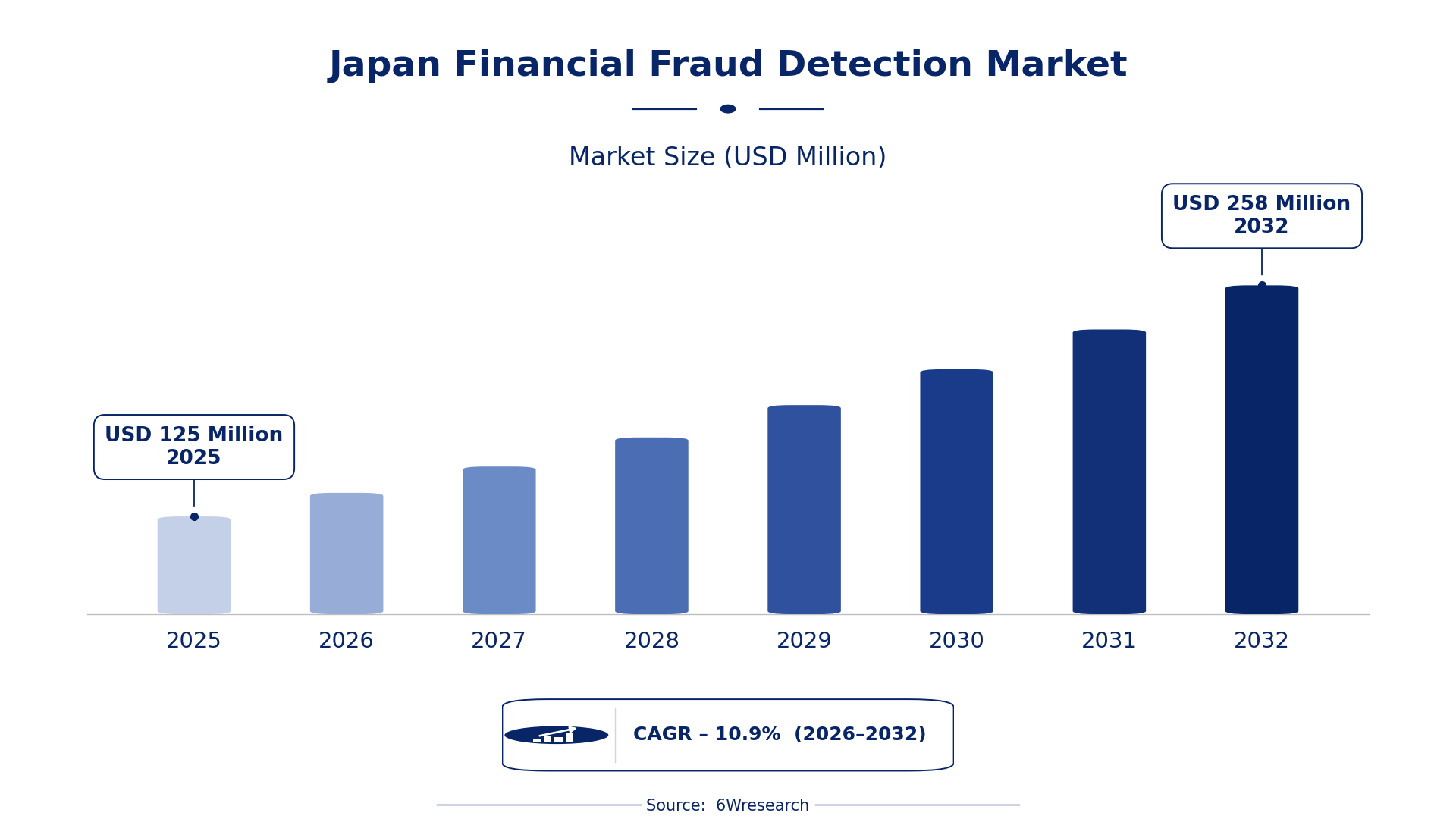
According to 6Wresearch internal database and industry insights, the Japan Financial Fraud Detection Market was valued at USD 125 Million in 2025 and is projected to reach USD 258 Million by 2032, growing at a CAGR of approximately 10.9% during 2026–2032.
Japan Financial Fraud Detection Market Highlights
| Report Metric | Details |
| Report Name | Japan Financial Fraud Detection Market (2026-2032) |
| Market Size 2025 | USD 125 Million |
| Market Size 2032 | USD 258 Million |
| Absolute Growth 2025–2032 | USD 133 Million |
| CAGR 2026–2032 | 10.9% |
| Peak Annual Growth | 13.1% in 2027 |
| Forecast Period | 2026–2032 |
| Historical Data | 2022–2025 |
| Base Year | 2025 |
| Leading Detection Method, 2025 | Rule-Based (35% share) |
| Leading Deployment Type, 2025 | On-Premise (48% share) |
| Leading Distribution Channel, 2025 | Fraud Management Vendors (38% share) |
| Leading End User, 2025 | Commercial Banks (43% share) |
| Fastest-Growing Detection Method | AI-Based (15.2% CAGR) |
| Fastest-Growing Deployment Type | Cloud (15.4% CAGR) |
| Fastest-Growing Distribution Channel | SaaS Platforms (13.7% CAGR) |
| Fastest-Growing End User | Credit Card Companies (13.6% CAGR) |
| Growing Sector | Financial Services |
| Key End Users | Commercial Banks, Credit Card Companies, FinTech Startups, Insurance Providers |
Japan Financial Fraud Detection Market Year-wise Growth Rate and Key Drivers (2022–2032)
This graph illustrates the annual growth rates of the market from 2022 to 2032, highlighting a steady upward trajectory and projected market expansion over the forecast period.
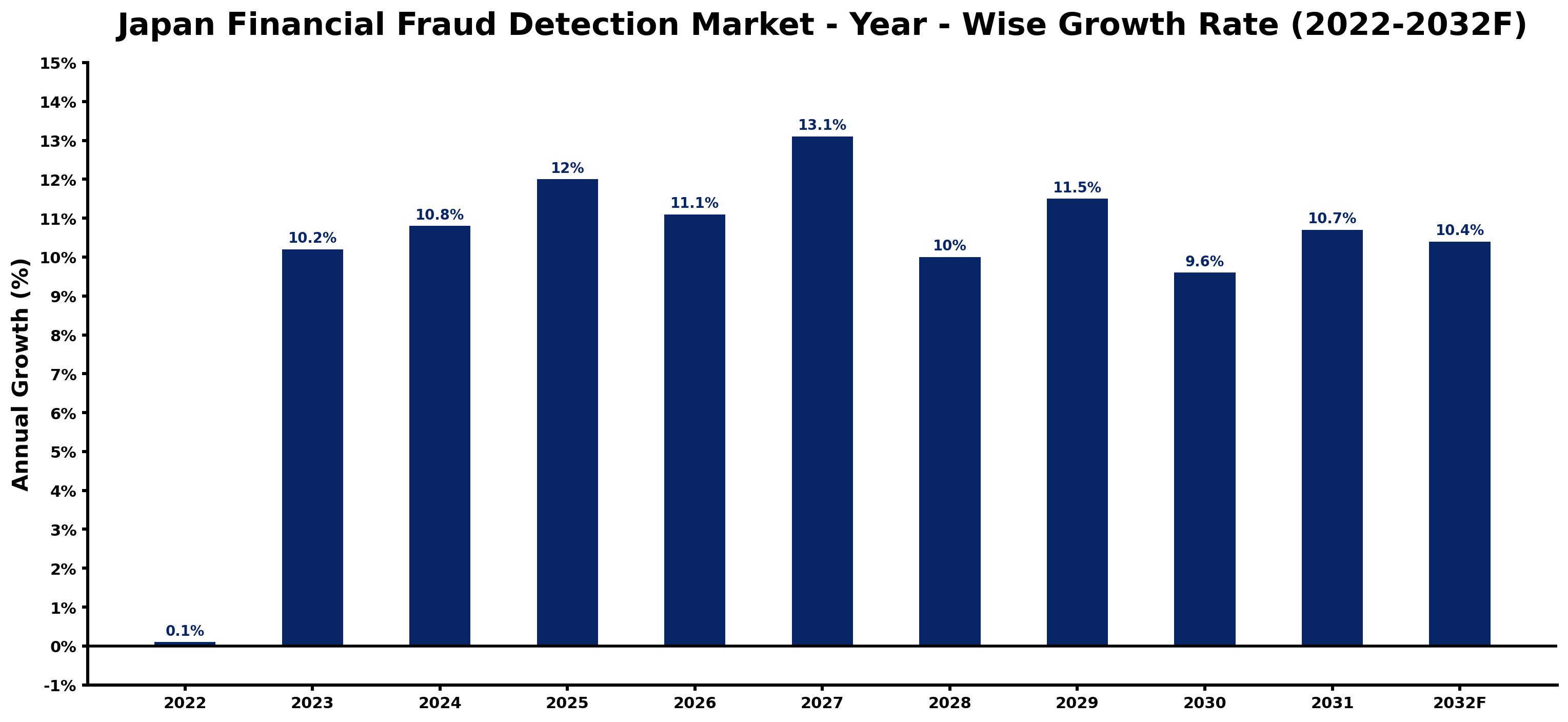
For each year, the table pairs the estimated growth rate with the leading influence on demand, showing how the drivers changed across the period.
| Year | Estimated Annual Growth (%) | Market Rationale |
| 2022 | 0.1 | The market experienced minimal growth due to initial adoption challenges. |
| 2023 | 10.2 | Growth accelerated as financial institutions began implementing advanced detection technologies. |
| 2024 | 10.8 | Continued investment in fraud detection technologies spurred further growth in the market. |
| 2025 | 12.0 | The peak growth year saw widespread adoption of AI-based solutions among banks. |
| 2026 | 11.1 | Growth is expected to slow slightly as the market begins to stabilise after rapid expansion. |
| 2027 | 13.1 | Demand is projected to surge again with the introduction of new regulatory requirements for fraud detection. |
| 2028 | 10.0 | A slowdown is anticipated as market saturation begins to impact growth rates. |
| 2029 | 11.5 | Growth is expected to pick up as more financial institutions adopt cloud-based solutions. |
| 2030 | 9.6 | The market is projected to experience a slowdown as competition intensifies among providers. |
| 2031 | 10.7 | Increased investment in cybersecurity measures is expected to drive growth once more. |
| 2032 | 10.4 | A slight slowdown is anticipated as the market reaches a more mature stage. |
Note: Market size estimations and growth projections presented in this report are based on 6Wresearch's proprietary forecasting methodology, utilizing the latest available industry data, government publications, and primary research inputs.
Japan Financial Fraud Detection Market Synopsis
Financial Fraud Detection encompasses technologies and methodologies aimed at identifying and preventing fraudulent activities in financial transactions. The market is growing due to the increasing adoption of AI-based systems, which currently stands at a 30% adoption rate among banks. The surge in FinTech startups, now exceeding 1,000 in Japan, further drives demand. Regulatory requirements and the need for compliance, particularly among commercial banks and credit card companies, create a secure financial environment.
Market Dynamics Impact Analysis (2026–2032)
| Factor | Type | Impact | Primary Segment Affected |
| Growing adoption of AI-based fraud detection systems | Driver | High | AI-Based |
| Increasing number of FinTech startups | Driver | High | FinTech Startups |
| Rising demand for compliance with cybersecurity regulations | Opportunity | High | Commercial Banks |
| Expansion of cloud deployment for scalability | Opportunity | High | Cloud |
| Challenges in integrating new technologies into legacy systems | Restraint | Medium | On-Premise |
| Limited awareness of advanced fraud detection technologies | Restraint | Medium | Behavioral Analytics |
| High competition among fraud detection vendors | Challenge | Medium | Fraud Management Vendors |
| Need for continuous updates to combat evolving fraud tactics | Challenge | Medium | Machine Learning Models |
Evaluation of Drivers in Japan Financial Fraud Detection Market (2026–2032)
Key forces behind demand, with the segment each one moves most, are listed below.
| Drivers | Primary Segment Affected | Why It Matters (Evidence) |
| Increased investment in AI technologies | AI-Based | AI-based fraud detection systems have a 30% adoption rate among banks, improving their detection capabilities. |
| Rise in digital transactions | Cloud | The projected 25% growth in cloud deployment reflects the need for scalable fraud detection solutions. |
| Regulatory compliance requirements | Commercial Banks | Regulations necessitate advanced fraud detection measures to comply with industry standards. |
| Growing cybersecurity concerns | FinTech Startups | The increase in FinTech startups drives demand for effective fraud detection solutions. |
| Technological advancements in fraud detection | Machine Learning Models | Advanced detection capabilities from machine learning models are essential for real-time fraud prevention. |
Volumes grow on the back of increased investment in AI technologies, with a 30% adoption rate among banks improving their detection capabilities. The rise in digital transactions necessitates scalable solutions, leading to a projected 25% growth in cloud deployment. Compliance requirements drive banks to adopt advanced fraud detection measures. Cybersecurity concerns among financial institutions fuel demand for effective solutions. Technological advancements in detection capabilities encourage more financial institutions to invest in these technologies, enhancing their fraud prevention strategies.
Evaluation of Restraints in Japan Financial Fraud Detection Market
Below are the constraints most often cited by buyers and suppliers, with the segment each affects.
| Market Restraint | Primary Segment Affected | Why It Matters (Evidence) |
| Integration challenges with legacy systems | On-Premise | Many financial institutions struggle to integrate new technologies into existing systems, delaying implementation. |
| Limited awareness of advanced technologies | Behavioral Analytics | A lack of understanding about behavioral analytics hampers adoption among smaller firms. |
| High competition among vendors | Fraud Management Vendors | Intense competition can lead to price wars, affecting profitability for providers. |
| Need for continuous updates | Machine Learning Models | To combat evolving fraud tactics, constant updates are necessary, increasing operational costs. |
| Regulatory compliance costs | Commercial Banks | The costs associated with meeting regulatory requirements can strain budgets for smaller banks. |
Japan Financial Fraud Detection Market Challenges
In Japan, outdated fraud detection systems inflate operational costs, costing financial institutions potential losses exceeding ¥50 billion annually. A shortage of skilled professionals in advanced analytics restricts banks' ability to implement effective fraud prevention measures, delaying solutions for over 30% of them. Intense competition from more than 1,000 FinTech startups pressures traditional banks to invest heavily in technology upgrades, diverting funds from critical areas like customer service. Rapid advancements in fraud detection technology often outpace regulatory updates, resulting in compliance challenges that can incur substantial fines for institutions unable to meet required standards.
Trends in the Japan Financial Fraud Detection Market
The shifts below are changing how Japan Financial Fraud Detection Market products are bought and supplied.
- Shift from On-Premise to Cloud Solutions: Financial institutions are increasingly adopting cloud-based fraud detection solutions for improved scalability and cost efficiency. The projected 25% growth in cloud deployment by 2025 supports this trend.
- Emergence of AI in Fraud Detection: The adoption of AI technologies in fraud detection has accelerated, with a 30% adoption rate among banks. This shift enhances detection capabilities and reduces false positives.
- Focus on Real-Time Monitoring: The trend towards real-time monitoring is gaining momentum, driven by the need for immediate fraud detection. The use of behavioural analytics is becoming more common among financial institutions.
- Growth of FinTech Startups: The number of FinTech startups in Japan has surpassed 1,000, indicating a growing market for effective fraud detection solutions. This surge is reshaping the financial sector.
Investment Opportunities in the Japan Financial Fraud Detection Market
The opportunities below stand out in the Japan Financial Fraud Detection Market for new entrants and existing suppliers.
- Increasing demand for cloud-based solutions: With cloud deployment projected to grow by 25% by 2025, there is an opportunity for suppliers to offer scalable fraud detection solutions to financial institutions.
- Investment in AI technologies: Now is an opportune moment to invest in AI-based fraud detection solutions, as banks increasingly adopt these technologies to strengthen their security measures.
- Support for technology startups: The Tokyo Metropolitan Government's funding programs for technology startups create opportunities for partnerships in developing effective fraud detection solutions.
- Focus on regulatory compliance: With rising regulatory requirements, there is a growing need for compliance-focused fraud detection solutions, particularly among commercial banks.
Government Initiatives in the Japan Financial Fraud Detection Market
In 2023, the government initiated a cybersecurity initiative with a budget of ¥10 billion, enhancing the existing regulatory framework established by the Financial Instruments and Exchange Act. This initiative aims to improve the overall security posture of financial institutions, ensuring they are better equipped to handle fraud detection and prevention.
The Digital Agency oversees regulations for fraud detection technologies, ensuring compliance across the financial sector. The agency's efforts include promoting best practices through the Japan Bankers Association, which supports financial institutions in implementing effective fraud prevention measures.
Future Insight of the Japan Financial Fraud Detection Market
By 2032, a policy-driven shift will propel Japan's financial sector towards AI-driven fraud detection technologies, spurred by a government-backed cybersecurity initiative with a budget of ¥10 billion. Cloud deployment of these solutions is projected to grow by 25%, enabling banks to enhance operational efficiency. The adoption of the JIS Q 15001 standard will improve data protection practices across the industry. As the Tokyo Metropolitan Government continues to support technology startups, collaboration between established banks and new entrants will drive innovation in fraud detection methodologies.
Market Segmentation Analysis
Japan Financial Fraud Detection Market report covers a detailed analysis of the following market segments:
By Detection Method – Rule-Based Leads, AI-Based Expected to Grow Fastest
According to Saurav Kr Singh, Senior Research Analyst at 6Wresearch, Rule-Based took 35% of detection method revenue in 2025, more than any other category. Rule-Based systems maintain a strong presence in traditional financial institutions, which depend on these methods for effective transaction monitoring. The Financial Services Agency's regulations often favour these conventional approaches, ensuring their ongoing relevance in the market. AI-Based is set to record the highest CAGR in this split, 15.2% over 2026–2032. AI-Based detection methods are experiencing rapid growth as financial institutions aim for improved efficiency and accuracy in identifying fraudulent activities. The notable 30% adoption rate among banks highlights a shift towards more advanced techniques that can handle complex fraud scenarios. Suppliers must prioritise the development of advanced detection methods to align with the evolving preferences of financial institutions.
By Deployment Type – On-Premise Leads, Cloud Expected to Grow Fastest
The largest deployment type category in 2025 was On-Premise, at 48% of revenue. On-Premise solutions dominate the market as financial institutions prioritise control and security, particularly in Tokyo where regulatory compliance is crucial. The traditional nature of these systems aligns with the needs of established banks managing sensitive data. The quickest growth will come from Cloud, forecast to expand at a CAGR of 15.4% between 2026 and 2032. Cloud deployment is set to experience substantial growth, with a projected rise of 25% by 2025, as financial institutions seek scalable and cost-effective alternatives. This shift indicates a broader acceptance of modern technological solutions in Japan's financial landscape. Suppliers must focus on developing cloud-based solutions to meet the increasing demand for flexibility and efficiency in financial fraud detection.
By Distribution Channel – Fraud Management Vendors Lead, SaaS Platforms Expected to Grow Fastest
Fraud Management Vendors accounted for 38% of the market by distribution channel in 2025. Fraud Management Vendors are the primary source for financial fraud detection solutions, providing tailored services to meet regulatory requirements. Their established relationships with financial institutions ensure a steady demand for their offerings. Over 2026–2032, SaaS Platforms are expected to post the fastest growth, at a CAGR of 13.7%. SaaS Platforms are becoming increasingly popular due to their flexibility and ease of integration, catering to the diverse needs of financial institutions. This trend reflects a broader move towards more adaptable and user-friendly solutions in the market. Suppliers must adapt their strategies to include SaaS offerings to capture the growing interest from clients seeking flexible solutions.
By End User – Commercial Banks Lead, Credit Card Companies Expected to Grow Fastest
With 43% of end user revenue in 2025, Commercial Banks was the largest category. Commercial Banks are the largest users of financial fraud detection technologies, driven by the need to secure transactions and protect customer assets. Their substantial investment in fraud prevention measures underscores their critical role in the market. Credit Card Companies are projected to grow fastest, at a CAGR of 13.6% during 2026–2032. Credit Card Companies are experiencing rapid growth in their use of fraud detection technologies, as they face increasing pressure to prevent fraudulent transactions. This urgency is pushing them to adopt advanced solutions more quickly than other sectors. Suppliers should tailor their offerings to meet the specific needs of credit card companies to capitalise on this fast-growing segment.
Key Attractiveness of the Report
- 10 Years of Market Numbers
- Historical Data Starting from 2022 to 2025
- Base Year 2025
- Forecast Data until 2032
- Key Performance Indicators Impacting the Market
- Major Upcoming Developments and Projects
Key Highlights of the Report:
- Japan Financial Fraud Detection Market Outlook
- Market Size of Japan Financial Fraud Detection Market, 2025
- Forecast of Japan Financial Fraud Detection Market, 2032
- Historical Data and Forecast of Japan Financial Fraud Detection Revenues & Volume for the Period 2022-2032F
- Japan Financial Fraud Detection Market Trend Evolution
- Japan Financial Fraud Detection Market Drivers and Challenges
- Japan Financial Fraud Detection Price Trends
- Japan Financial Fraud Detection Porter's Five Forces
- Japan Financial Fraud Detection Industry Life Cycle
- Historical Data and Forecast of Japan Financial Fraud Detection Market Revenues & Volume By Detection Method for the Period 2022-2032F
- Historical Data and Forecast of Japan Financial Fraud Detection Market Revenues & Volume By Rule-Based for the Period 2022-2032F
- Historical Data and Forecast of Japan Financial Fraud Detection Market Revenues & Volume By AI-Based for the Period 2022-2032F
- Historical Data and Forecast of Japan Financial Fraud Detection Market Revenues & Volume By Behavioral Analytics for the Period 2022-2032F
- Historical Data and Forecast of Japan Financial Fraud Detection Market Revenues & Volume By Machine Learning Models for the Period 2022-2032F
- Historical Data and Forecast of Japan Financial Fraud Detection Market Revenues & Volume By Deployment Type for the Period 2022-2032F
- Historical Data and Forecast of Japan Financial Fraud Detection Market Revenues & Volume By On-Premise for the Period 2022-2032F
- Historical Data and Forecast of Japan Financial Fraud Detection Market Revenues & Volume By Cloud for the Period 2022-2032F
- Historical Data and Forecast of Japan Financial Fraud Detection Market Revenues & Volume By Hybrid for the Period 2022-2032F
- Historical Data and Forecast of Japan Financial Fraud Detection Market Revenues & Volume By Hosted Services for the Period 2022-2032F
- Historical Data and Forecast of Japan Financial Fraud Detection Market Revenues & Volume By Distribution Channel for the Period 2022-2032F
- Historical Data and Forecast of Japan Financial Fraud Detection Market Revenues & Volume By Fraud Management Vendors for the Period 2022-2032F
- Historical Data and Forecast of Japan Financial Fraud Detection Market Revenues & Volume By SaaS Platforms for the Period 2022-2032F
- Historical Data and Forecast of Japan Financial Fraud Detection Market Revenues & Volume By Direct Sales for the Period 2022-2032F
- Historical Data and Forecast of Japan Financial Fraud Detection Market Revenues & Volume By Cybersecurity Integrators for the Period 2022-2032F
- Historical Data and Forecast of Japan Financial Fraud Detection Market Revenues & Volume By End User for the Period 2022-2032F
- Historical Data and Forecast of Japan Financial Fraud Detection Market Revenues & Volume By Commercial Banks for the Period 2022-2032F
- Historical Data and Forecast of Japan Financial Fraud Detection Market Revenues & Volume By Credit Card Companies for the Period 2022-2032F
- Historical Data and Forecast of Japan Financial Fraud Detection Market Revenues & Volume By FinTech Startups for the Period 2022-2032F
- Historical Data and Forecast of Japan Financial Fraud Detection Market Revenues & Volume By Insurance Providers for the Period 2022-2032F
- Japan Financial Fraud Detection Import Export Trade Statistics
- Market Opportunity Assessment By Detection Method
- Market Opportunity Assessment By Deployment Type
- Market Opportunity Assessment By Distribution Channel
- Market Opportunity Assessment By End User
- Japan Financial Fraud Detection Top Companies Market Share
- Japan Financial Fraud Detection Competitive Benchmarking By Technical and Operational Parameters
- Japan Financial Fraud Detection Company Profiles
- Japan Financial Fraud Detection Key Strategic Recommendations
Market Covered
This report examines the market across the segments below.
By Detection Method
- Rule-Based
- AI-Based
- Behavioral Analytics
- Machine Learning Models
By Deployment Type
- On-Premise
- Cloud
- Hybrid
- Hosted Services
By Distribution Channel
- Fraud Management Vendors
- SaaS Platforms
- Direct Sales
- Cybersecurity Integrators
By End User
- Commercial Banks
- Credit Card Companies
- FinTech Startups
- Insurance Providers































