Japan Financial Services Analytics Market Size & Growth Rate
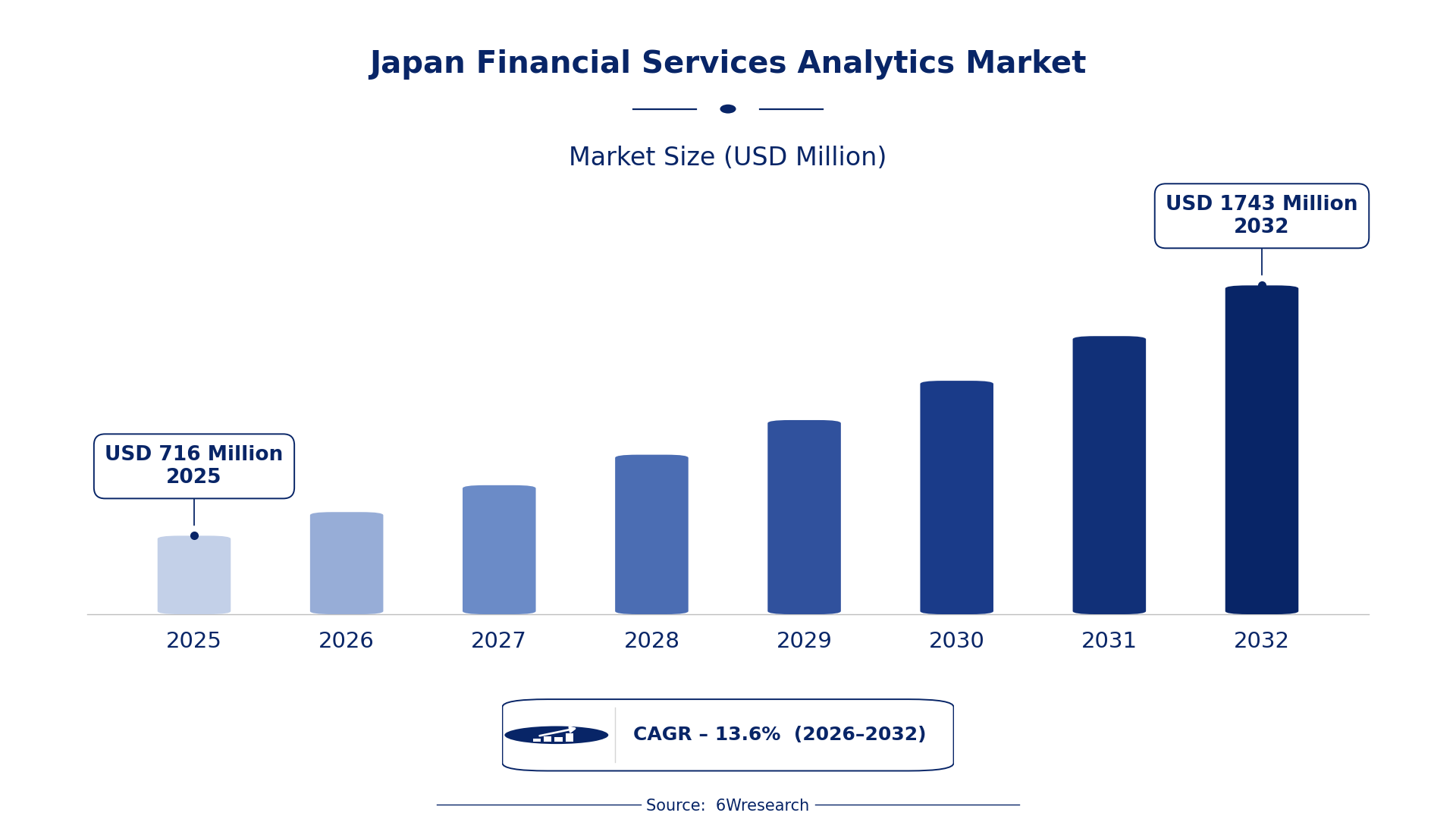
According to 6Wresearch internal database and industry insights, the Japan Financial Services Analytics Market was valued at USD 716 Million in 2025 and is projected to reach USD 1,743 Million by 2032, growing at a CAGR of approximately 13.6% during 2026–2032.
Japan Financial Services Analytics Market Highlights
| Report Metric | Details |
| Report Name | Japan Financial Services Analytics Market (2026-2032) |
| Market Size 2025 | USD 716 Million |
| Market Size 2032 | USD 1,743 Million |
| Absolute Growth 2025–2032 | USD 1,027 Million |
| CAGR 2026–2032 | 13.6% |
| Peak Annual Growth | 14.8% in 2026 |
| Forecast Period | 2026–2032 |
| Historical Data | 2022–2025 |
| Base Year | 2025 |
| Leading Analytics Type, 2025 | Descriptive Analytics (41% share) |
| Leading Application Area, 2025 | Customer Behavior (45% share) |
| Leading Distribution Channel, 2025 | Cloud Platforms (38% share) |
| Leading End User, 2025 | Banks (44% share) |
| Fastest-Growing Analytics Type | Predictive Analytics (18.5% CAGR) |
| Fastest-Growing Application Area | Risk Management (15.7% CAGR) |
| Fastest-Growing Distribution Channel | SaaS Providers (17.5% CAGR) |
| Fastest-Growing End User | Wealth Managers (17.0% CAGR) |
| Growing Sector | Financial Services |
| Key End Users | Banks, FinTech Companies, Wealth Managers, Hedge Funds |
Japan Financial Services Analytics Market Year-wise Growth Rate and Key Drivers (2022–2032)
This graph illustrates the annual growth rates of the market from 2022 to 2032, highlighting a steady upward trajectory and projected market expansion over the forecast period.
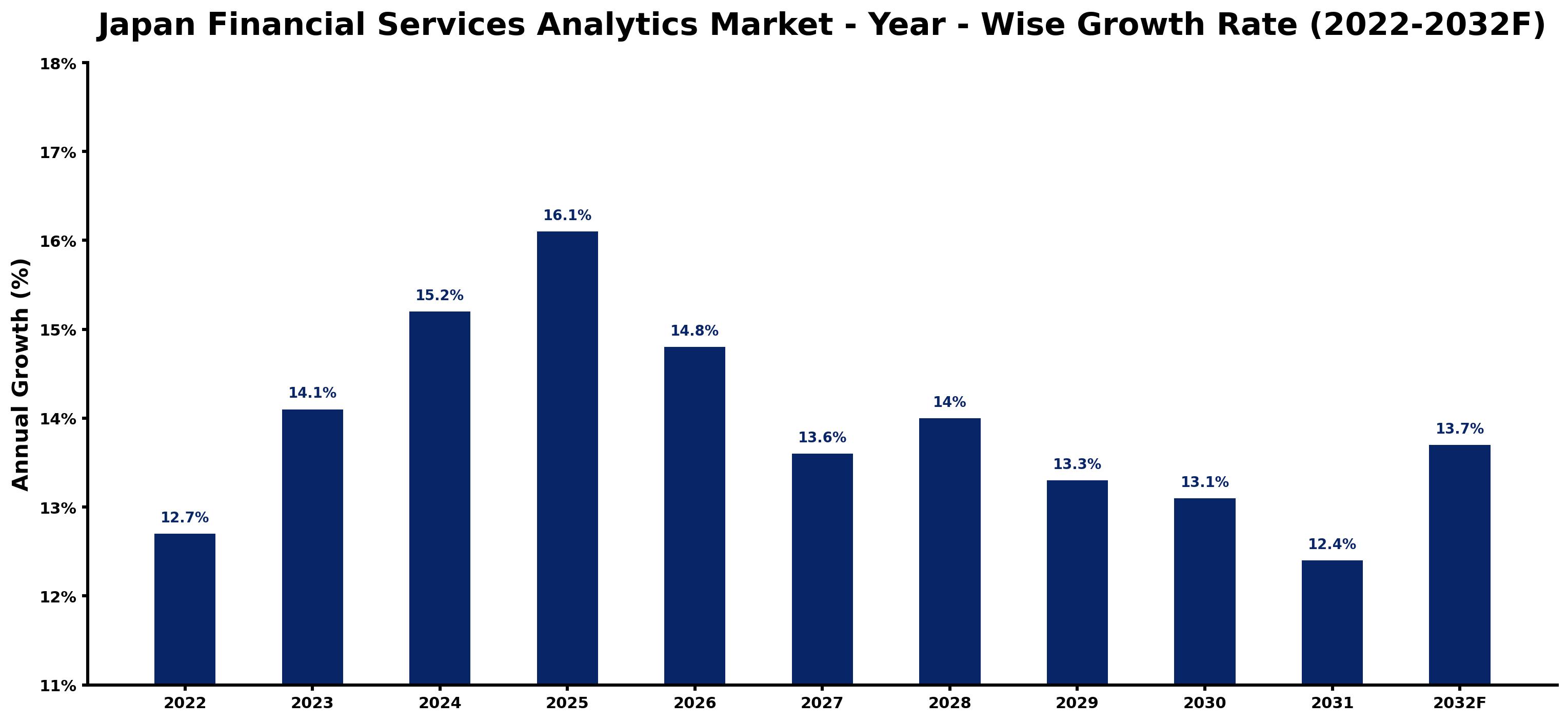
Annual growth estimates for each year appear below with the principal reason behind them, explaining the shifts that set the pace of the market.
| Year | Estimated Annual Growth (%) | Market Rationale |
| 2022 | 12.7 | The market saw steady growth due to increasing analytics adoption in financial institutions. |
| 2023 | 14.1 | Demand rose as more banks integrated advanced analytics into their operations. |
| 2024 | 15.2 | Investment in predictive analytics surged, driven by the need for better forecasting. |
| 2025 | 16.1 | The peak growth year was marked by widespread implementation of analytics across sectors. |
| 2026 | 14.8 | Growth slowed slightly as the market matured and competition intensified. |
| 2027 | 13.6 | Demand continued to grow, although at a moderated pace compared to previous years. |
| 2028 | 14.0 | The market rebounded with renewed interest in real-time analytics solutions. |
| 2029 | 13.3 | Growth decelerated as market saturation began to impact new investments. |
| 2030 | 13.1 | The trend towards cloud-based analytics solutions continued to shape the market. |
| 2031 | 12.4 | Growth slowed further as the focus shifted to optimizing existing analytics capabilities. |
| 2032 | 13.7 | A resurgence in investment is expected as new technologies emerge. |
Note: Market size estimations and growth projections presented in this report are based on 6Wresearch's proprietary forecasting methodology, utilizing the latest available industry data, government publications, and primary research inputs.
Japan Financial Services Analytics Market Synopsis
Financial Services Analytics involves using data analysis tools to improve decision-making in the financial sector. The Japan Financial Services Analytics Market is growing, driven by over 1.5 million employees in the financial sector. Investment in financial technology reached approximately 500 billion yen in 2023, further energising the market.
Market Dynamics Impact Analysis (2026–2032)
| Factor | Type | Impact | Primary Segment Affected |
| Increasing adoption of predictive analytics among banks | Driver | High | Predictive Analytics |
| Growth in FinTech companies integrating analytics into services | Driver | High | FinTech Companies |
| Rising demand for real-time analytics in major banks | Opportunity | High | Real-Time Analytics |
| Expansion of cloud-based analytics solutions among financial firms | Opportunity | Medium | Cloud Platforms |
| Shortage of skilled data analysts in the financial sector | Restraint | High | Descriptive Analytics |
| Regulatory compliance costs impacting analytics investments | Restraint | Medium | Descriptive Analytics |
| High costs of implementing advanced analytics systems | Challenge | High | Descriptive Analytics |
| Rapid technological changes requiring constant upgrades | Challenge | Medium | Descriptive Analytics |
Evaluation of Drivers in Japan Financial Services Analytics Market (2026–2032)
The main growth drivers and the segments they affect most are set out below.
| Drivers | Primary Segment Affected | Why It Matters (Evidence) |
| Increased investment in predictive analytics | Predictive Analytics | Over 70% of banks are adopting predictive analytics to improve decision-making. |
| Growing number of FinTech companies | FinTech Companies | With over 200 FinTech firms, competition drives demand for advanced analytics solutions. |
| Demand for real-time analytics solutions | Real-Time Analytics | Real-time analytics is essential for over 60% of transactions in major banks. |
| Shift towards cloud-based analytics | Cloud Platforms | 50% of financial firms are adopting cloud-based solutions for better scalability. |
| Focus on risk management frameworks | Risk Management | Advanced analytics are incorporated into risk management as per JIS standards. |
Purchasing is picking up as financial institutions increasingly invest in predictive analytics to improve decision-making. Over 70% of banks have adopted these tools, enhancing their forecasting capabilities. The presence of numerous FinTech companies in Japan intensifies competition, leading to greater demand for advanced analytics solutions. Real-time analytics is essential for over 60% of transactions in major banks, driving further investment. Many financial firms are transitioning to cloud-based analytics solutions for improved scalability and efficiency.
Evaluation of Restraints in Japan Financial Services Analytics Market
Several factors work against faster growth; the main ones are summarised below.
| Market Restraint | Primary Segment Affected | Why It Matters (Evidence) |
| Shortage of skilled data analysts | Descriptive Analytics | The financial sector faces a talent gap, with a growing need for skilled analysts to interpret complex data. |
| High regulatory compliance costs | Descriptive Analytics | Compliance with regulations from the Financial Services Agency increases operational costs for analytics. |
| Investment costs for advanced analytics systems | Descriptive Analytics | The high initial costs of implementing advanced analytics deter some financial institutions from investing. |
| Rapid technological changes | Descriptive Analytics | The need for constant upgrades to keep pace with technology can strain budgets and resources. |
| Market saturation affecting new investments | Descriptive Analytics | As the market matures, many firms are focusing on optimising existing analytics rather than new investments. |
Japan Financial Services Analytics Market Challenges
Fraud detection systems in over 80% of major financial institutions face strict regulations from the Financial Services Agency, which can delay compliance efforts by up to six months for affected firms. Many analytics providers contend with outdated technology, resulting in inefficiencies that inflate operational costs by approximately 20% for financial service providers. A shortage of skilled data analysts restricts firms' ability to implement advanced analytics, leading to missed opportunities for optimising investments. Buyers frequently experience delays in obtaining actionable insights, which can impede decision-making processes and diminish their competitive edge in the market.
Trends in the Japan Financial Services Analytics Market
The trends below show where the Japan Financial Services Analytics Market is heading.
- Shift from Traditional to Predictive Analytics: Since 2023, financial institutions have increasingly adopted predictive analytics to forecast trends. This shift is illustrated by over 70% of banks now utilising these tools, improving decision-making capabilities.
- Transition to Cloud-Based Solutions: Beginning in 2023, many financial firms have moved towards cloud-based analytics solutions. Approximately 50% of these firms have adopted cloud platforms, allowing for greater flexibility and scalability.
- Emergence of Real-Time Analytics: In 2023, real-time analytics gained prominence, becoming vital for over 60% of transactions in major banks. This trend highlights the need for immediate decision-making in financial operations.
- Investment in Fraud Detection Technologies: Since 2023, there has been a rise in investment in fraud detection systems, with over 80% of major financial institutions implementing these technologies to safeguard against fraudulent activities.
Investment Opportunities in the Japan Financial Services Analytics Market
Several openings in the Japan Financial Services Analytics Market merit attention from investors.
- Banks seeking advanced analytics solutions: With over 1.5 million employed in Japan's financial sector, banks are increasingly looking for sophisticated analytics tools to improve decision-making and risk management.
- Investment in predictive analytics: Predictive analytics is projected to grow, with strong demand for advanced forecasting tools among financial institutions, reflecting a market need for better insights.
- Growing need for real-time analytics: As over 60% of transactions require immediate insights, financial firms are investing in real-time analytics solutions to improve operational efficiency and customer satisfaction.
- Cloud platforms for analytics hosting: With 38% of the market share in 2025, cloud platforms are increasingly favoured by financial firms, creating opportunities for suppliers of cloud-based analytics solutions.
Government Initiatives in the Japan Financial Services Analytics Market
The Financial Services Agency oversees regulations impacting financial services analytics, ensuring compliance with standards such as ISO 27001 for data security. The AI Promotion Act, established in 2025, supports the integration of AI technologies in analytics, improving the sector's capabilities.
In 2023, the Financial Services Agency initiated a programme to enhance data analytics capabilities, with funding of approximately 10 billion yen. The Digital Agency, established in September 2021, spearheads government digital transformation initiatives, promoting common system standards for analytics.
Future Insight of the Japan Financial Services Analytics Market
A policy-driven shift towards advanced data analytics capabilities will transform the financial services sector by 2032. Suppliers will increasingly adopt cloud-based solutions, currently favoured by 50% of firms, to enhance service delivery. Investment in financial technology reached approximately 500 billion yen in 2023, indicating a growing emphasis on innovation. The implementation of new standards, such as ISO 27001, will improve data security, enabling buyers to make more informed decisions and building greater trust in financial transactions.
Market Segmentation Analysis
Japan Financial Services Analytics Market report covers a detailed analysis of the following market segments:
By Analytics Type – Descriptive Analytics Leads, Predictive Analytics Expected to Grow Fastest
According to Saurav Kr Singh, Senior Research Analyst at 6Wresearch, Descriptive Analytics took 41% of analytics type revenue in 2025, more than any other category. Descriptive analytics holds the largest share as it is used by over 70% of banks in Japan to summarise past data, which is crucial for informed decision-making. This widespread application underscores its role in enhancing operational efficiency within the financial sector. Predictive Analytics is set to record the highest CAGR in this split, 18.5% over 2026–2032. Predictive analytics is expected to grow rapidly as financial institutions increasingly focus on forecasting future trends based on historical data, with significant adoption anticipated by 2025. This trend is driven by the need for enhanced risk management and strategic foresight in a competitive market. Suppliers should prioritise the development of predictive analytics solutions to meet the rising demand from financial institutions.
By Application Area – Customer Behavior Leads, Risk Management Expected to Grow Fastest
Customer Behavior held 45% of the Japan Financial Services Analytics Market by application area in 2025. Customer behaviour analysis is the leading application area, vital for enhancing service offerings and customer satisfaction in the financial sector. This focus on understanding client needs drives substantial investment in analytics to effectively tailor services. Risk Management is projected to grow fastest, at a CAGR of 15.7% during 2026–2032. Risk management is the fastest-growing application area, as institutions concentrate on analytics to identify and mitigate financial risks. The increasing complexity of financial products and regulatory requirements heightens the demand for effective risk management solutions. Buyers must invest in advanced risk management analytics to ensure compliance and maintain competitiveness in the evolving financial environment.
By Distribution Channel – Cloud Platforms Lead, SaaS Providers Expected to Grow Fastest
With 38% of distribution channel revenue in 2025, Cloud Platforms was the largest category. Cloud platforms dominate the distribution channel, serving as the primary hosting solution for analytics tools and data storage in the financial sector. Their scalability and flexibility make them the preferred choice for many financial firms seeking efficient data management. The quickest growth will come from SaaS Providers, forecast to expand at a CAGR of 17.5% between 2026 and 2032. SaaS providers are the fastest-growing distribution channel, offering subscription-based analytics solutions that appeal to financial service providers looking for cost-effective and scalable options. This trend aligns with the industry's shift towards more agile and accessible technology solutions. Suppliers should consider expanding their SaaS offerings to capture the growing interest from financial service providers.
By End User – Banks Lead, Wealth Managers Expected to Grow Fastest
The largest end user category in 2025 was Banks, at 44% of revenue. Banks are the primary end users of financial services analytics, employing these tools across various functions such as risk management and customer insights. The substantial workforce of over 1.5 million in Japan's financial sector highlights the crucial role banks play in driving analytics adoption. Over 2026–2032, Wealth Managers are expected to post the fastest growth, at a CAGR of 17.0%. Wealth managers are the fastest-growing end user group, increasingly using analytics for portfolio management to refine investment strategies. This growth indicates a rising demand for data-driven insights within wealth management practices. Suppliers should tailor their offerings to meet the specific needs of wealth managers as they adopt analytics more rapidly.
Key Attractiveness of the Report
- 10 Years of Market Numbers
- Historical Data Starting from 2022 to 2025
- Base Year 2025
- Forecast Data until 2032
- Key Performance Indicators Impacting the Market
- Major Upcoming Developments and Projects
Key Highlights of the Report:
- Japan Financial Services Analytics Market Outlook
- Market Size of Japan Financial Services Analytics Market, 2025
- Forecast of Japan Financial Services Analytics Market, 2032
- Historical Data and Forecast of Japan Financial Services Analytics Revenues & Volume for the Period 2022-2032F
- Japan Financial Services Analytics Market Trend Evolution
- Japan Financial Services Analytics Market Drivers and Challenges
- Japan Financial Services Analytics Price Trends
- Japan Financial Services Analytics Porter's Five Forces
- Japan Financial Services Analytics Industry Life Cycle
- Historical Data and Forecast of Japan Financial Services Analytics Market Revenues & Volume By Analytics Type for the Period 2022-2032F
- Historical Data and Forecast of Japan Financial Services Analytics Market Revenues & Volume By Descriptive Analytics for the Period 2022-2032F
- Historical Data and Forecast of Japan Financial Services Analytics Market Revenues & Volume By Predictive Analytics for the Period 2022-2032F
- Historical Data and Forecast of Japan Financial Services Analytics Market Revenues & Volume By Prescriptive Analytics for the Period 2022-2032F
- Historical Data and Forecast of Japan Financial Services Analytics Market Revenues & Volume By Real-Time Analytics for the Period 2022-2032F
- Historical Data and Forecast of Japan Financial Services Analytics Market Revenues & Volume By Application Area for the Period 2022-2032F
- Historical Data and Forecast of Japan Financial Services Analytics Market Revenues & Volume By Customer Behavior for the Period 2022-2032F
- Historical Data and Forecast of Japan Financial Services Analytics Market Revenues & Volume By Risk Management for the Period 2022-2032F
- Historical Data and Forecast of Japan Financial Services Analytics Market Revenues & Volume By Investment Insights for the Period 2022-2032F
- Historical Data and Forecast of Japan Financial Services Analytics Market Revenues & Volume By Fraud Detection for the Period 2022-2032F
- Historical Data and Forecast of Japan Financial Services Analytics Market Revenues & Volume By Distribution Channel for the Period 2022-2032F
- Historical Data and Forecast of Japan Financial Services Analytics Market Revenues & Volume By Cloud Platforms for the Period 2022-2032F
- Historical Data and Forecast of Japan Financial Services Analytics Market Revenues & Volume By SaaS Providers for the Period 2022-2032F
- Historical Data and Forecast of Japan Financial Services Analytics Market Revenues & Volume By Data Vendors for the Period 2022-2032F
- Historical Data and Forecast of Japan Financial Services Analytics Market Revenues & Volume By Software Providers for the Period 2022-2032F
- Historical Data and Forecast of Japan Financial Services Analytics Market Revenues & Volume By End User for the Period 2022-2032F
- Historical Data and Forecast of Japan Financial Services Analytics Market Revenues & Volume By Banks for the Period 2022-2032F
- Historical Data and Forecast of Japan Financial Services Analytics Market Revenues & Volume By Wealth Managers for the Period 2022-2032F
- Historical Data and Forecast of Japan Financial Services Analytics Market Revenues & Volume By Hedge Funds for the Period 2022-2032F
- Historical Data and Forecast of Japan Financial Services Analytics Market Revenues & Volume By FinTech Companies for the Period 2022-2032F
- Japan Financial Services Analytics Import Export Trade Statistics
- Market Opportunity Assessment By Analytics Type
- Market Opportunity Assessment By Application Area
- Market Opportunity Assessment By Distribution Channel
- Market Opportunity Assessment By End User
- Japan Financial Services Analytics Top Companies Market Share
- Japan Financial Services Analytics Competitive Benchmarking By Technical and Operational Parameters
- Japan Financial Services Analytics Company Profiles
- Japan Financial Services Analytics Key Strategic Recommendations
Market Covered
The report covers the following segments.
By Analytics Type
- Descriptive Analytics
- Predictive Analytics
- Prescriptive Analytics
- Real-Time Analytics
By Application Area
- Customer Behavior
- Risk Management
- Investment Insights
- Fraud Detection
By Distribution Channel
- Cloud Platforms
- SaaS Providers
- Data Vendors
- Software Providers
By End User
- Banks
- Wealth Managers
- Hedge Funds
- FinTech Companies































