Japan Financial Transaction Software Market Size & Growth Rate
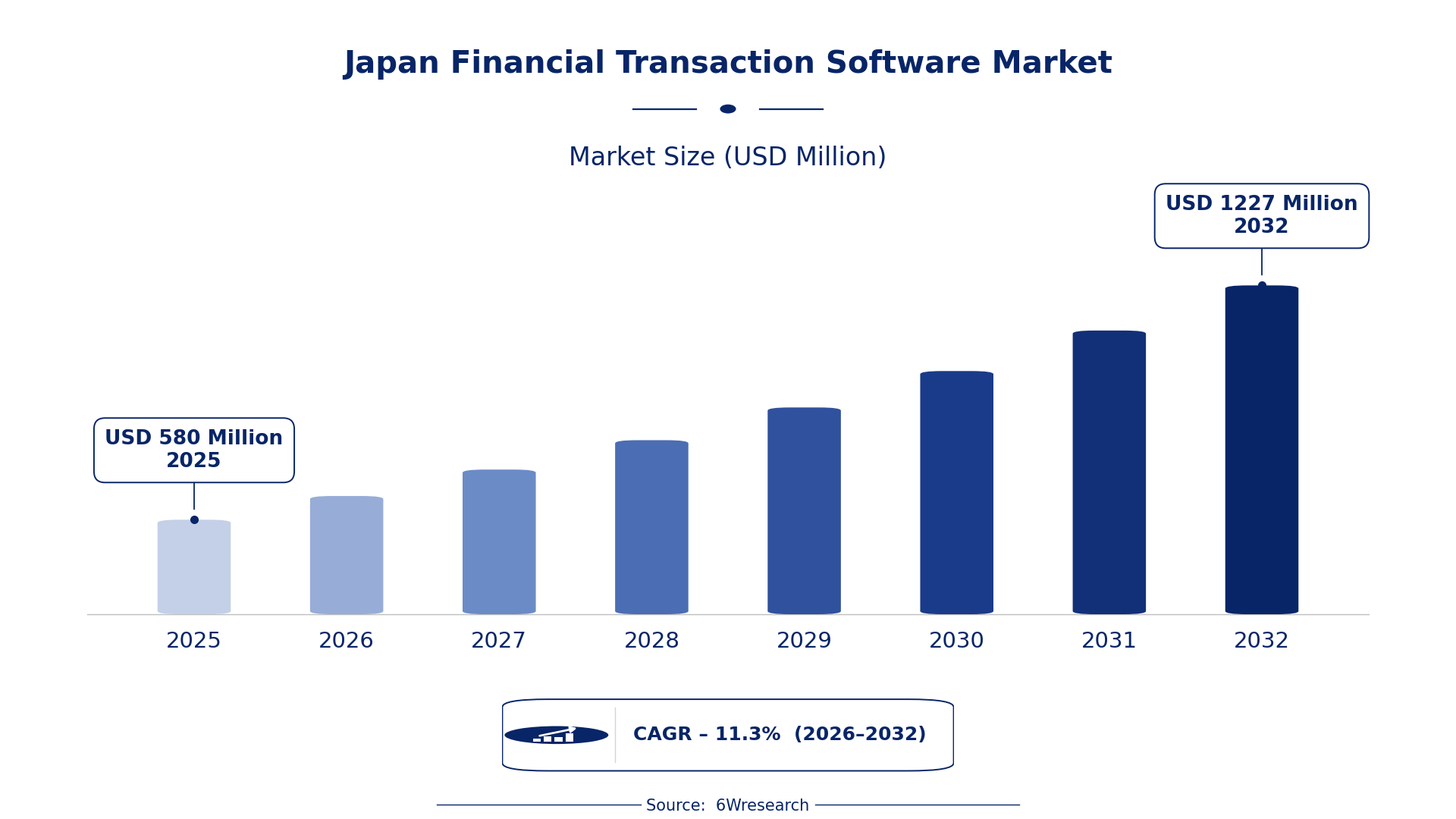
According to 6Wresearch internal database and industry insights, the Japan Financial Transaction Software Market was valued at USD 580 Million in 2025 and is projected to reach USD 1,227 Million by 2032, growing at a CAGR of approximately 11.3% during 2026–2032.
Japan Financial Transaction Software Market Highlights
| Report Metric | Details |
| Report Name | Japan Financial Transaction Software Market (2026-2032) |
| Market Size 2025 | USD 580 Million |
| Market Size 2032 | USD 1,227 Million |
| Absolute Growth 2025–2032 | USD 647 Million |
| CAGR 2026–2032 | 11.3% |
| Peak Annual Growth | 15.1% in 2026 |
| Forecast Period | 2026–2032 |
| Historical Data | 2022–2025 |
| Base Year | 2025 |
| Leading Software Type, 2025 | Core Banking Software (46% share) |
| Leading Transaction Type, 2025 | Account Transfers (45% share) |
| Leading Distribution Channel, 2025 | Financial IT Vendors (41% share) |
| Leading End User, 2025 | Commercial Banks (44% share) |
| Fastest-Growing Software Type | Payment Gateway (16.2% CAGR) |
| Fastest-Growing Transaction Type | eCommerce Transactions (15.5% CAGR) |
| Fastest-Growing Distribution Channel | API Providers (14.3% CAGR) |
| Fastest-Growing End User | Online Retailers (14.4% CAGR) |
| Growing Sector | Financial services |
| Key End Users | Commercial Banks, Online Retailers, FinTech Platforms, Central Banks |
Japan Financial Transaction Software Market Year-wise Growth Rate and Key Drivers (2022–2032)
This graph illustrates the annual growth rates of the market from 2022 to 2032, highlighting a steady upward trajectory and projected market expansion over the forecast period.
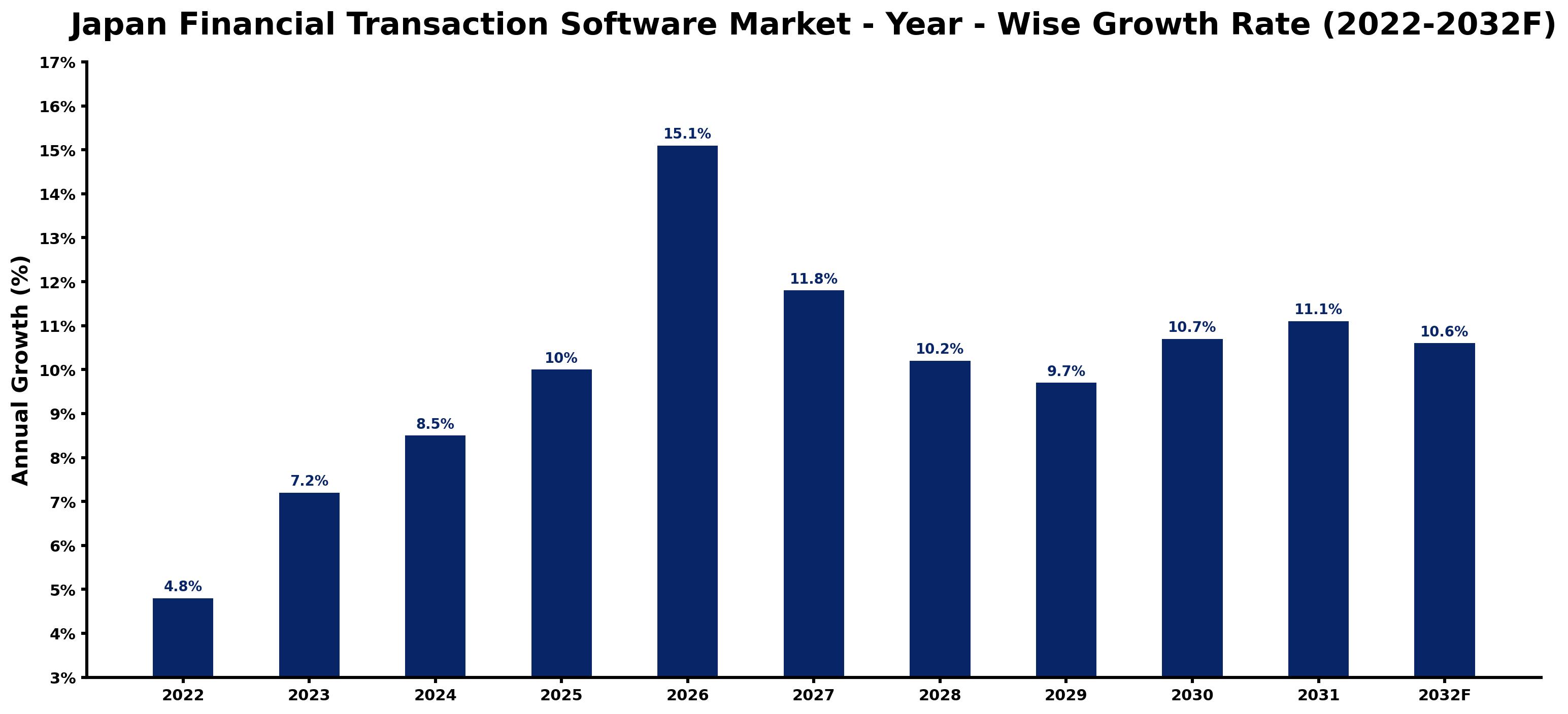
Each row of the following table gives one year's estimated growth and the event or demand shift that explains it.
| Year | Estimated Annual Growth (%) | Market Rationale |
| 2022 | 4.8 | The market showed steady growth due to increasing digital transactions. |
| 2023 | 7.2 | Growth accelerated as more users adopted mobile payment solutions. |
| 2024 | 8.5 | The rise in eCommerce transactions boosted software demand. |
| 2025 | 10.0 | Regulatory changes prompted the adoption of digital payment systems. |
| 2026 | 15.1 | The market peaked as FinTech innovations surged, driving demand. |
| 2027 | 11.8 | Growth slowed slightly as the market began to stabilise. |
| 2028 | 10.2 | Demand remained strong, but growth rates normalised. |
| 2029 | 9.7 | A further slowdown occurred as market saturation approached. |
| 2030 | 10.7 | Growth picked up again with new technological advancements. |
| 2031 | 11.1 | Continued investment in FinTech solutions supported market expansion. |
| 2032 | 10.6 | The market stabilised as growth rates returned to normal levels. |
Note: Market size estimations and growth projections presented in this report are based on 6Wresearch's proprietary forecasting methodology, utilizing the latest available industry data, government publications, and primary research inputs.
Japan Financial Transaction Software Market Synopsis
Financial Transaction Software includes applications that facilitate electronic transactions, such as core banking systems and payment gateways. In Japan, the financial services industry is thriving, supported by over 100 million active bank accounts. The FinTech sector has seen a 30% increase in new startups in 2023, driving demand for advanced solutions. Regulations like the AI Promotion Act and the Industrial Standardization Act have created a conducive environment for digital transactions, further propelling the Japan Financial Transaction Software Market's growth.
Market Dynamics Impact Analysis (2026–2032)
| Factor | Type | Impact | Primary Segment Affected |
| Increasing adoption of mobile payments | Driver | High | Payment Gateway |
| Growth in the eCommerce sector | Driver | High | eCommerce Transactions |
| Expansion of FinTech startups | Opportunity | High | Financial IT Vendors |
| Rising demand for API integration | Opportunity | Medium | API Providers |
| High transaction fees for eCommerce payments | Restraint | Medium | Payment Gateway |
| Regulatory compliance burdens | Restraint | High | Core Banking Software |
| Limited talent pool in software development | Challenge | High | Core Banking Software |
| Competition from international software providers | Challenge | Medium | Financial IT Vendors |
Evaluation of Drivers in Japan Financial Transaction Software Market (2026–2032)
The factors lifting demand, and the evidence behind each, are summarised below.
| Drivers | Primary Segment Affected | Why It Matters (Evidence) |
| Rising mobile payment adoption | Payment Gateway | Mobile payment transactions increased by 25% in 2023, leading to higher demand for payment gateways. |
| Growth of eCommerce | eCommerce Transactions | Japan's eCommerce market is projected to reach ¥20 trillion by 2025, boosting transaction software needs. |
| Increase in FinTech startups | Financial IT Vendors | Over 1,000 registered FinTech companies as of 2023 are driving demand for innovative software solutions. |
| Demand for API integration | API Providers | API integration is a growing trend among 70% of financial institutions, increasing software purchases. |
| Regulatory changes | Core Banking Software | New regulations by the Bank of Japan in 2023 have necessitated updates in banking software. |
Buyers are adding capacity as mobile payment adoption rises, with transactions increasing by 25% in 2023. In 2023, over 1,000 FinTech companies are pushing for advanced solutions, resulting in increased purchases. About 70% of financial institutions are adopting API integration, which improves service offerings.
Evaluation of Restraints in Japan Financial Transaction Software Market
The table below lists the restraints and the evidence behind each.
| Market Restraint | Primary Segment Affected | Why It Matters (Evidence) |
| High transaction fees for eCommerce payments | Payment Gateway | The average transaction fee for eCommerce payments is 3%, which can deter smaller retailers. |
| Regulatory compliance burdens | Core Banking Software | Compliance with the Industrial Standardization Act increases operational costs for banks. |
| Limited talent pool in software development | Core Banking Software | A shortage of skilled developers can delay software implementation, impacting service delivery. |
| Competition from international software providers | Financial IT Vendors | Local vendors face pressure from established global firms, affecting market share. |
| Slow adoption of new technologies | API Providers | Some financial institutions are hesitant to adopt new integration technologies, limiting growth. |
Japan Financial Transaction Software Market Challenges
Buyers in the financial transaction software market face rising costs due to Japan's national minimum wage increase to JPY 1,055 per hour, which pressures pricing strategies for software providers. Compliance costs arise from the 2023 Bank of Japan's new digital payment regulations, leading to delays in software updates for financial institutions. Technology integration issues stem from the adoption of ISO 20022 standards, causing inefficiencies in transaction processing for banks. Users encounter challenges from the surge in mobile payment transactions, which increased by 25% in 2023, creating urgent demands for software adaptations that many providers struggle to fulfil.
Trends in the Japan Financial Transaction Software Market
Several trends are reshaping the Japan Financial Transaction Software Market; the most important are set out below.
- Shift towards Mobile Payment Solutions: The Tokyo Metropolitan Government supports innovation in financial technology, resulting in a 25% increase in mobile payment transactions in 2023. This shift encourages suppliers to improve their software offerings.
- Rise of API Integration: API integration is becoming essential, with 70% of financial institutions adopting it to streamline services. This trend is prompting software providers to focus on integration capabilities.
- Growth in eCommerce Transactions: Japan's eCommerce market is projected to reach ¥20 trillion by 2025, driving demand for payment gateways. This growth is motivating software developers to create tailored solutions.
- Emergence of FinTech Startups: The FinTech sector has seen a 30% increase in new startups in 2023, indicating a vibrant market for financial transaction software. This trend presents opportunities for advanced solutions.
Investment Opportunities in the Japan Financial Transaction Software Market
Below are the investment opportunities with the strongest case in the Japan Financial Transaction Software Market.
- Investment in API Development: With 70% of institutions adopting APIs, there is a substantial opportunity to invest in API development services. Financial IT vendors can capitalise on this trend to improve their offerings.
- Expansion of Mobile Payment Solutions: As mobile payment transactions rise, there is a gap in the market for advanced mobile wallet solutions. Online retailers are key buyers, and partnerships with local developers can facilitate entry.
- Focus on eCommerce Software Solutions: The projected growth of the eCommerce market to ¥20 trillion by 2025 creates a demand for tailored payment solutions. Investing in software for online retailers can yield high returns.
- Support for FinTech Innovations: The increase in FinTech startups presents an opportunity to provide advanced software solutions. Collaborating with incubators in Tokyo can help establish a foothold in this growing sector.
Government Initiatives in the Japan Financial Transaction Software Market
The Financial Services Agency oversees regulations that impact financial transaction software, ensuring compliance with standards such as the Payment Services Act, which governs payment service providers. In 2023, the agency implemented new regulations for digital payment systems, requiring software producers to adapt their solutions to meet updated compliance criteria. This regulation aims to enhance security and efficiency in electronic transactions, benefiting both producers and buyers in the market.
The Digital Agency, established in September 2021, leads government digital transformation efforts and approves initiatives that enhance the financial technology landscape. It funds projects aimed at improving payment infrastructure, with a focus on integrating advanced technologies. By 2025, the agency is expected to support initiatives that streamline operations for over 100 million active bank accounts, further driving the demand for financial transaction software.
Future Insight of the Japan Financial Transaction Software Market
Investment in Japan's financial transaction software will rise by 2032, driven by a focus on upgrading payment infrastructure. The growing trend of API integration among financial institutions will streamline operations and improve user experiences. As the FinTech sector expands, with a notable increase in new startups, buyers will gain access to a broader array of tailored software options.
Market Segmentation Analysis
Japan Financial Transaction Software Market report covers a detailed analysis of the following market segments:
By Software Type – Core Banking Software Leads, Payment Gateway Expected to Grow Fastest
According to Saurav Kr Singh, Senior Research Analyst at 6Wresearch, in 2025, Core Banking Software led the software type split with a 46% share. Core Banking Software holds the largest share due to its essential function in managing banking operations across Japan's extensive financial services sector. Its prevalence in Tokyo, a major financial hub, underscores its critical role in facilitating efficient banking activities. The quickest growth will come from Payment Gateway, forecast to expand at a CAGR of 16.2% between 2026 and 2032. The Payment Gateway segment is experiencing rapid growth as online payments gain traction, illustrated by a 25% increase in mobile payment transactions in 2023. This upward trend indicates a shift towards digital transactions, which will likely further strengthen the position of core banking software. Suppliers should focus on enhancing their payment gateway solutions to cater to the increasing demand from online retailers.
By Transaction Type – Account Transfers Lead, eCommerce Transactions Expected to Grow Fastest
With 45% of transaction type revenue in 2025, Account Transfers was the largest category. Account Transfers dominate the market as they are a prevalent transaction type in banking, reflecting the extensive reliance on financial transaction software in Japan. The substantial number of active bank accounts, exceeding 100 million, reinforces this trend. eCommerce Transactions are projected to grow fastest, at a CAGR of 15.5% during 2026–2032. eCommerce Transactions are the fastest-growing segment, propelled by the online retail market in Japan projected to reach ¥20 trillion by 2025. This growth indicates a shift towards digital payments, which will further strengthen the position of account transfers. Buyers must adapt their payment solutions to handle the increasing volume of eCommerce transactions.
By Distribution Channel – Financial IT Vendors Lead, API Providers Expected to Grow Fastest
Financial IT Vendors took 41% of distribution channel revenue in 2025, more than any other category. Financial IT Vendors dominate the market as they provide essential software solutions specifically designed for financial institutions. Their established expertise and strong market presence ensure a consistent demand for their offerings. API Providers are set to record the highest CAGR in this split, 14.3% over 2026–2032. API Providers are growing the fastest, with 70% of financial institutions adopting API integration to enhance service delivery. This trend towards flexible software solutions will likely create additional opportunities for financial IT vendors. Suppliers should consider forming partnerships with API providers to expand their market reach and improve service offerings.
By End User – Commercial Banks Lead, Online Retailers Expected to Grow Fastest
Commercial Banks accounted for 44% of the market by end user in 2025. Commercial Banks are the primary users of banking software, reflecting their crucial role in Japan's financial ecosystem. Their extensive operations necessitate robust financial transaction software to ensure efficiency and compliance with regulations. Over 2026–2032, Online Retailers are expected to post the fastest growth, at a CAGR of 14.4%. Online Retailers represent the fastest-growing user segment, driven by the increasing adoption of payment gateways to facilitate eCommerce transactions. As this sector continues to expand, the demand for banking software is expected to rise, benefiting commercial banks. Suppliers must adapt their solutions to meet the specific needs of online retailers as they become significant users of financial transaction software.
Key Attractiveness of the Report
- 10 Years of Market Numbers
- Historical Data Starting from 2022 to 2025
- Base Year 2025
- Forecast Data until 2032
- Key Performance Indicators Impacting the Market
- Major Upcoming Developments and Projects
Key Highlights of the Report:
- Japan Financial Transaction Software Market Outlook
- Market Size of Japan Financial Transaction Software Market, 2025
- Forecast of Japan Financial Transaction Software Market, 2032
- Historical Data and Forecast of Japan Financial Transaction Software Revenues & Volume for the Period 2022-2032F
- Japan Financial Transaction Software Market Trend Evolution
- Japan Financial Transaction Software Market Drivers and Challenges
- Japan Financial Transaction Software Price Trends
- Japan Financial Transaction Software Porter's Five Forces
- Japan Financial Transaction Software Industry Life Cycle
- Historical Data and Forecast of Japan Financial Transaction Software Market Revenues & Volume By Software Type for the Period 2022-2032F
- Historical Data and Forecast of Japan Financial Transaction Software Market Revenues & Volume By Core Banking Software for the Period 2022-2032F
- Historical Data and Forecast of Japan Financial Transaction Software Market Revenues & Volume By Payment Gateway for the Period 2022-2032F
- Historical Data and Forecast of Japan Financial Transaction Software Market Revenues & Volume By Clearing & Settlement for the Period 2022-2032F
- Historical Data and Forecast of Japan Financial Transaction Software Market Revenues & Volume By Mobile Wallet Engine for the Period 2022-2032F
- Historical Data and Forecast of Japan Financial Transaction Software Market Revenues & Volume By Transaction Type for the Period 2022-2032F
- Historical Data and Forecast of Japan Financial Transaction Software Market Revenues & Volume By Account Transfers for the Period 2022-2032F
- Historical Data and Forecast of Japan Financial Transaction Software Market Revenues & Volume By eCommerce Transactions for the Period 2022-2032F
- Historical Data and Forecast of Japan Financial Transaction Software Market Revenues & Volume By Interbank Transfers for the Period 2022-2032F
- Historical Data and Forecast of Japan Financial Transaction Software Market Revenues & Volume By P2P Payments for the Period 2022-2032F
- Historical Data and Forecast of Japan Financial Transaction Software Market Revenues & Volume By Distribution Channel for the Period 2022-2032F
- Historical Data and Forecast of Japan Financial Transaction Software Market Revenues & Volume By Financial IT Vendors for the Period 2022-2032F
- Historical Data and Forecast of Japan Financial Transaction Software Market Revenues & Volume By API Providers for the Period 2022-2032F
- Historical Data and Forecast of Japan Financial Transaction Software Market Revenues & Volume By Direct Sales for the Period 2022-2032F
- Historical Data and Forecast of Japan Financial Transaction Software Market Revenues & Volume By SaaS Providers for the Period 2022-2032F
- Historical Data and Forecast of Japan Financial Transaction Software Market Revenues & Volume By End User for the Period 2022-2032F
- Historical Data and Forecast of Japan Financial Transaction Software Market Revenues & Volume By Commercial Banks for the Period 2022-2032F
- Historical Data and Forecast of Japan Financial Transaction Software Market Revenues & Volume By Online Retailers for the Period 2022-2032F
- Historical Data and Forecast of Japan Financial Transaction Software Market Revenues & Volume By Central Banks for the Period 2022-2032F
- Historical Data and Forecast of Japan Financial Transaction Software Market Revenues & Volume By FinTech Platforms for the Period 2022-2032F
- Japan Financial Transaction Software Import Export Trade Statistics
- Market Opportunity Assessment By Software Type
- Market Opportunity Assessment By Transaction Type
- Market Opportunity Assessment By Distribution Channel
- Market Opportunity Assessment By End User
- Japan Financial Transaction Software Top Companies Market Share
- Japan Financial Transaction Software Competitive Benchmarking By Technical and Operational Parameters
- Japan Financial Transaction Software Company Profiles
- Japan Financial Transaction Software Key Strategic Recommendations
Market Covered
The study includes the following segmentation.
By Software Type
- Core Banking Software
- Payment Gateway
- Clearing & Settlement
- Mobile Wallet Engine
By Transaction Type
- Account Transfers
- eCommerce Transactions
- Interbank Transfers
- P2P Payments
By Distribution Channel
- Financial IT Vendors
- API Providers
- Direct Sales
- SaaS Providers
By End User
- Commercial Banks
- Online Retailers
- Central Banks
- FinTech Platforms































