Japan Gastronomy/Food Tourism Market Size & Growth Rate
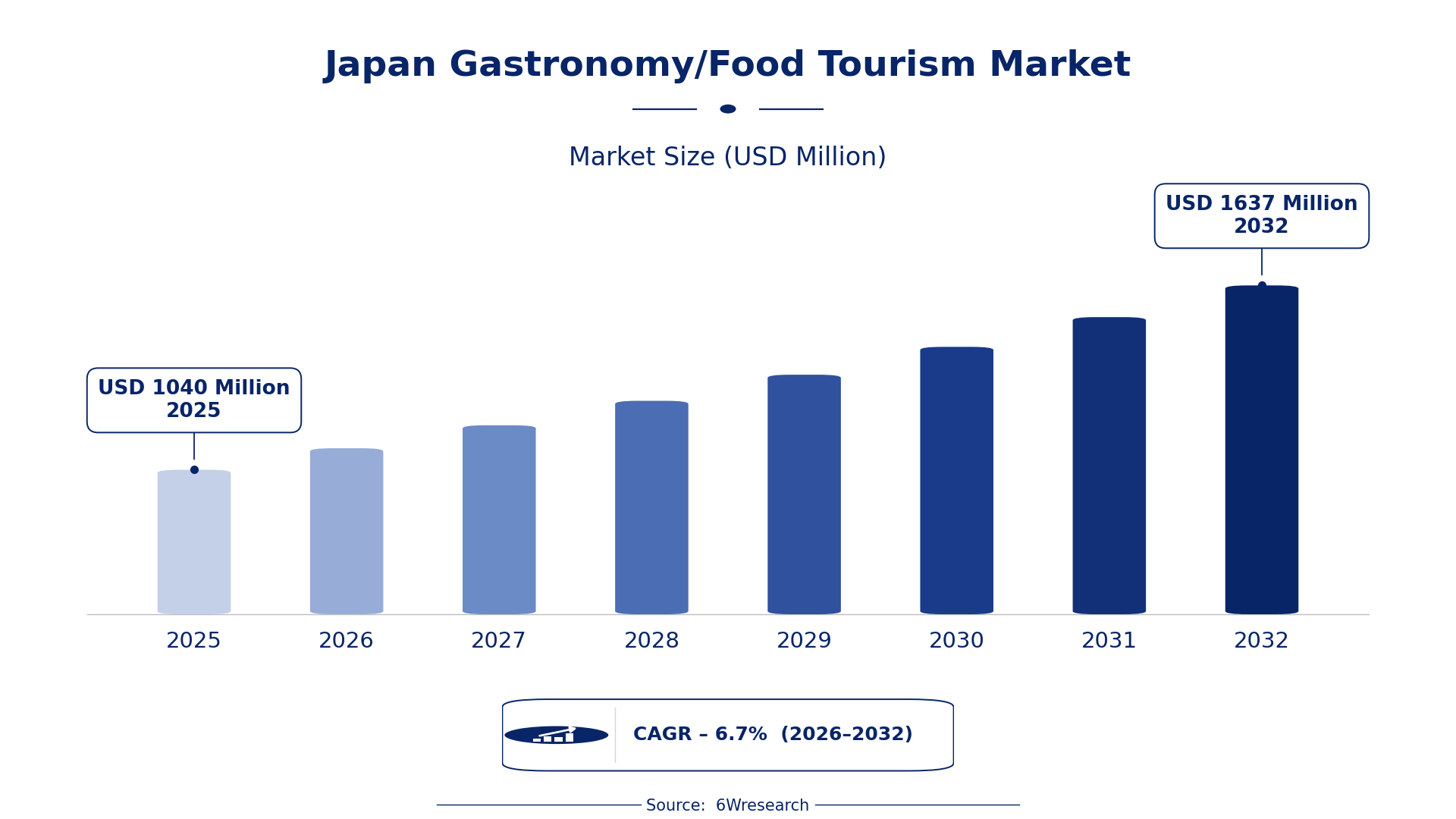
According to 6Wresearch internal database and industry insights, the Japan Gastronomy/Food Tourism Market was valued at USD 1,040 Million in 2025 and is projected to reach USD 1,637 Million by 2032, growing at a CAGR of approximately 6.7% during 2026–2032.
Japan Gastronomy/Food Tourism Market Highlights
| Report Metric | Details |
| Report Name | Japan Gastronomy/Food Tourism Market (2026-2032) |
| Market Size 2025 | USD 1,040 Million |
| Market Size 2032 | USD 1,637 Million |
| Absolute Growth 2025–2032 | USD 597 Million |
| CAGR 2026–2032 | 6.7% |
| Peak Annual Growth | 7.2% in 2026 |
| Forecast Period | 2026–2032 |
| Historical Data | 2022–2025 |
| Base Year | 2025 |
| Leading Product Type, 2025 | Culinary Tours (52% share) |
| Leading Experience Type, 2025 | Guided Tours (41% share) |
| Leading Application Area, 2025 | Regional Cuisine (37% share) |
| Leading Distribution Channel, 2025 | Online Platforms (42% share) |
| Leading End User, 2025 | Tourists (50% share) |
| Fastest-Growing Product Type | Cooking Classes (9.3% CAGR) |
| Fastest-Growing Experience Type | Hands-On Experience (9.5% CAGR) |
| Fastest-Growing Application Area | Gourmet Tourism (7.9% CAGR) |
| Fastest-Growing End User | Food Enthusiasts (8.5% CAGR) |
| Growing Sector | Gourmet Tourism |
| Key End Users | Regional Cuisine, Cultural Experience, Local Dishes, Gourmet Tourism |
Japan Gastronomy/Food Tourism Market Year-wise Growth Rate and Key Drivers (2022–2032)
This graph illustrates the annual growth rates of the market from 2022 to 2032, highlighting a steady upward trajectory and projected market expansion over the forecast period.
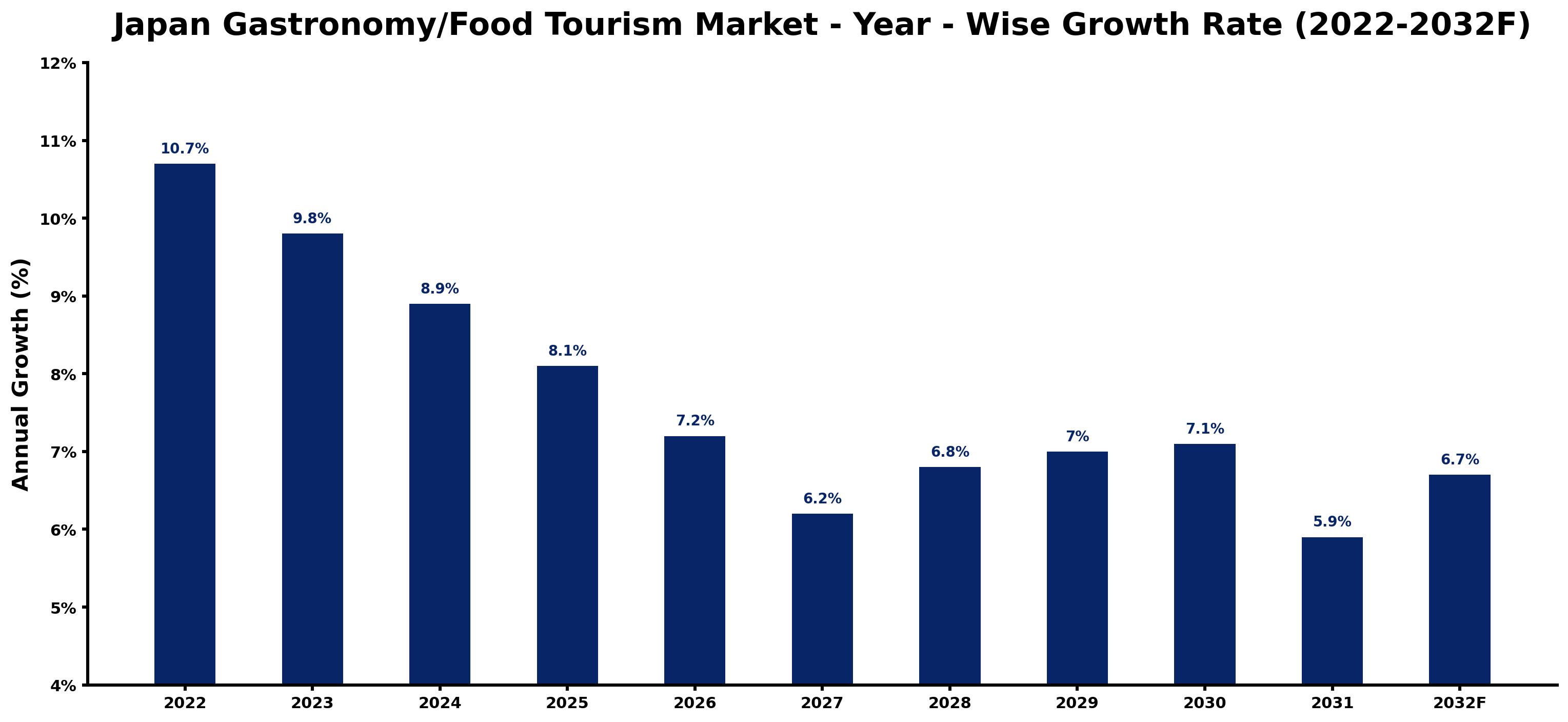
The yearly estimates that follow link every growth rate to its principal driver, so readers can see why the pace changed in each period.
| Year | Estimated Annual Growth (%) | Market Rationale |
| 2022 | 10.7 | The market experienced strong demand from international tourists seeking culinary experiences. |
| 2023 | 9.8 | Growth slowed as tourism levels stabilised following the recovery from previous disruptions. |
| 2024 | 8.9 | Demand remained high, driven by ongoing interest in Japan's diverse food culture. |
| 2025 | 8.1 | The market showed a further slowdown as competition increased among culinary experiences. |
| 2026 | 7.2 | Growth is expected to slow as the market adjusts to a more mature phase. |
| 2027 | 6.2 | Demand is projected to remain steady, supported by a growing number of culinary tours available. |
| 2028 | 6.8 | Interest in cooking classes is expected to surge, attracting more food enthusiasts to participate. |
| 2029 | 7.0 | The market will see a rise in bookings for food festivals, reflecting increased tourist interest. |
| 2030 | 7.1 | Culinary experiences will continue to gain traction, driven by effective marketing campaigns. |
| 2031 | 5.9 | Growth is projected to slow again as market saturation begins to impact new customer acquisition. |
| 2032 | 6.7 | Interest in gourmet tourism is expected to rise, driven by international promotional efforts. |
Note: Market size estimations and growth projections presented in this report are based on 6Wresearch's proprietary forecasting methodology, utilizing the latest available industry data, government publications, and primary research inputs.
Japan Gastronomy/Food Tourism Market Synopsis
Gastronomy/Food Tourism in Japan showcases the country's rich culinary heritage through immersive experiences like culinary tours, cooking classes, and food festivals. In 2022, Japan welcomed over 30 million international tourists, many eager to explore its diverse regional cuisines. The Japan Gastronomy/Food Tourism Market is expanding due to increased domestic and international tourism, with the Ministry of Agriculture promoting local food products and the Tokyo Metropolitan area hosting numerous festivals that attract thousands of visitors annually.
Market Dynamics Impact Analysis (2026–2032)
| Factor | Type | Impact | Primary Segment Affected |
| Growing interest in culinary experiences among international tourists | Driver | High | Culinary Tours |
| Increase in cooking classes available in major cities | Driver | High | Cooking Classes |
| Expanding culinary tours in regions like Hokkaido and Okinawa | Opportunity | High | Regional Cuisine |
| Rising popularity of food festivals showcasing local dishes | Opportunity | Medium | Food Festivals |
| High competition among culinary experience providers | Restraint | Medium | Culinary Tours |
| Limited awareness of regional cuisines among tourists | Restraint | High | Regional Cuisine |
| Rising operational costs for food tourism businesses | Challenge | High | Cooking Classes |
| Compliance with food safety regulations can be burdensome | Challenge | Medium | Food Festivals |
Evaluation of Drivers in Japan Gastronomy/Food Tourism Market (2026–2032)
Key forces behind demand, with the segment each one moves most, are listed below.
| Drivers | Primary Segment Affected | Why It Matters (Evidence) |
| Increased international tourist arrivals seeking culinary experiences | Culinary Tours | In 2022, Japan welcomed over 30 million international tourists eager to explore local cuisine. |
| Growing number of cooking classes in cities like Osaka and Tokyo | Cooking Classes | With hundreds of options available, more food enthusiasts are participating in hands-on learning. |
| Government initiatives promoting local food products | Regional Cuisine | The 'Japan Food Culture Promotion Project' aims to raise awareness of Japanese cuisine among tourists. |
| Popularity of food festivals attracting large crowds | Food Festivals | The Tokyo Food Festival attracts over 500,000 visitors each year, showcasing local dishes. |
| Expansion of online platforms for booking culinary experiences | Online Platforms | With a 42% share in 2025, online platforms facilitate easier access to gastronomy tourism. |
Behind the steady rise in orders is the influx of over 30 million international tourists in 2022, many seeking unique culinary experiences that highlight Japan's diverse food culture. The growing number of cooking classes across major cities has led to increased participation from food enthusiasts eager to learn. The popularity of food festivals is clear, with major events attracting large crowds and showcasing regional specialties. The expansion of online platforms is making culinary experiences more accessible, encouraging greater tourist engagement.
Evaluation of Restraints in Japan Gastronomy/Food Tourism Market
These are the pressures that could keep growth below its potential.
| Market Restraint | Primary Segment Affected | Why It Matters (Evidence) |
| High competition among culinary experience providers | Culinary Tours | With many options available, providers struggle to differentiate themselves, impacting profitability. |
| Limited awareness of regional cuisines among tourists | Regional Cuisine | Many tourists are unfamiliar with local dishes, resulting in lower participation in culinary experiences. |
| Rising operational costs for food tourism businesses | Cooking Classes | Increasing costs limit the ability of providers to offer competitive pricing and quality. |
| Compliance with food safety regulations can be burdensome | Food Festivals | Adhering to regulations increases operational complexity and costs for event organizers. |
| Seasonal fluctuations in tourist arrivals | Culinary Tours | Tourism peaks during certain seasons, creating inconsistent demand for culinary experiences. |
Japan Gastronomy/Food Tourism Market Challenges
In 2023, travel agencies reported a 25% increase in bookings for culinary experiences, but high costs deter some buyers from participating. Rising operational costs, driven by a national minimum wage of JPY 1,055 per hour, strain suppliers, forcing them to increase prices. A shortage of qualified instructors limits the quality of cooking classes in cities like Osaka and Tokyo, where hundreds of options exist but often lack skilled personnel. Strict food safety regulations, such as ISO 22000, complicate operations for many producers, causing delays in launching new culinary offerings.
Trends in the Japan Gastronomy/Food Tourism Market
Buyers and suppliers in the Japan Gastronomy/Food Tourism Market are adjusting to the following trends.
- Shift from Traditional to Interactive Culinary Experiences: Since 2022, there has been a notable shift towards interactive culinary experiences, such as cooking classes and hands-on workshops. In cities like Osaka, over 150 cooking classes are now available, catering to the growing demand for immersive food experiences.
- Rise of Regional Cuisine Promotion: In 2023, initiatives like the 'Taste of Japan' campaign gained traction, highlighting local dishes. This effort aims to attract more tourists to regional areas, with prefectures like Hokkaido seeing increased interest in their culinary offerings.
- Growth of Online Booking Platforms: The trend towards online platforms for booking culinary experiences has accelerated, with these channels expected to grow by 8.8% from 2026 to 2032. This shift is clear as more tourists prefer to book experiences digitally, increasing convenience.
- Increased Focus on Sustainable Gastronomy: Since 2024, sustainability has become a priority in food tourism, with many festivals highlighting eco-friendly practices. The Tokyo Food Festival, for instance, features over 100 local vendors committed to sustainable food practices.
Investment Opportunities in the Japan Gastronomy/Food Tourism Market
The following areas offer the clearest openings for investors and suppliers in the Japan Gastronomy/Food Tourism Market.
- Timing for Culinary Experiences: With over 30 million international tourists visiting in 2022, there is a prime opportunity to invest in culinary tours that highlight local specialties. Regions like Hokkaido can attract more visitors by showcasing their unique culinary heritage.
- Gap in Cooking Classes: Food festivals are gaining popularity, providing an opportunity to invest in event organization. The Tokyo Food Festival, attracting a significant number of visitors, offers a platform for culinary businesses to showcase their products.
- Regional Cuisine Tours: The increasing focus on regional cuisine creates opportunities for investment in guided tours. Collaborating with local travel agencies can facilitate market entry and enhance the visitor experience.
- Expansion of Culinary Experiences: With rising interest in gourmet tourism, there is a chance to develop high-end culinary experiences. Targeting affluent food enthusiasts in urban centres can lead to increased bookings.
Government Initiatives in the Japan Gastronomy/Food Tourism Market
The Food Sanitation Act amendment (2018) introduced a positive list system for materials used in food utensils and packaging, which is crucial for producers to comply with safety standards. This regulation ensures that food tourism businesses meet hygiene requirements, impacting their operational practices. Compliance with these standards is important for maintaining consumer trust and ensuring safety in culinary experiences.
The Japan Tourism Agency actively promotes food-related travel experiences, funding initiatives that support culinary tourism. This support includes marketing campaigns and resources for local businesses, helping them attract more tourists interested in gastronomy. By providing financial assistance and promotional materials, the agency increases the visibility of local culinary offerings, benefiting both producers and consumers.
Future Insight of the Japan Gastronomy/Food Tourism Market
The 'Japan Food Culture Promotion Project' will enhance international awareness of Japanese cuisine by 2032, encouraging more visitors to explore local culinary experiences. As the government promotes local food products, buyers will benefit from a wider variety of authentic offerings. Culinary tourism will thrive, with over 30 million international visitors expected to seek unique dining experiences annually. With ongoing support for gastronomy tourism, suppliers can anticipate increased investment in culinary infrastructure, improving the overall experience for both domestic and international visitors.
Market Segmentation Analysis
Japan Gastronomy/Food Tourism Market report covers a detailed analysis of the following market segments:
By Product Type – Culinary Tours Lead, Cooking Classes Expected to Grow Fastest
According to Vasu Joshi, Associate Consultant at 6Wresearch, Culinary Tours held 52% of the Japan Gastronomy/Food Tourism Market by product type in 2025. Culinary Tours dominate the market as they provide immersive experiences for tourists eager to explore local cuisine. The availability of over 200 culinary tours across Japan caters to the rising demand for authentic gastronomic adventures. Cooking Classes are set to record the highest CAGR in this split, 9.3% over 2026–2032. Cooking Classes are experiencing rapid growth due to their engaging, hands-on approach that appeals to food enthusiasts. The notable 25% increase in bookings for culinary experiences in 2023 highlights the rising interest in these educational opportunities. Suppliers must consider expanding their offerings of cooking classes to meet the increasing demand for culinary education.
By Experience Type – Guided Tours Lead, Hands-On Experience Expected to Grow Fastest
In 2025, Guided Tours led the experience type split with a 41% share. Guided Tours dominate the segment as they facilitate exploration of culinary hotspots, offering structured experiences for tourists. These tours are particularly vital in regions with rich food cultures, such as the Tokyo Metropolitan area, renowned for its diverse food festivals. Hands-On Experience is projected to grow fastest, at a CAGR of 9.5% during 2026–2032. Hands-On Experience is expanding quickly as it actively engages participants in cooking and food preparation, making the culinary journey more interactive. This trend is reflected in the increasing number of tourists seeking immersive activities that connect them with local cuisines. Suppliers should integrate hands-on experiences into their offerings to address the rising demand for interactive culinary activities.
By Application Area – Regional Cuisine Leads, Gourmet Tourism Expected to Grow Fastest
With 37% of application area revenue in 2025, Regional Cuisine was the largest category. Regional Cuisine holds the largest share as it focuses on local specialties that define Japanese food culture. This emphasis on regional dishes attracts both domestic and international tourists eager to experience authentic flavours. The quickest growth will come from Gourmet Tourism, forecast to expand at a CAGR of 7.9% between 2026 and 2032. Gourmet Tourism is the fastest-growing area, targeting high-end food experiences for discerning travelers. The increase in international tourists seeking unique culinary experiences has contributed to the rapid growth of this segment. Suppliers should tailor their offerings to highlight gourmet experiences to attract affluent tourists looking for premium culinary adventures.
By Distribution Channel – Online Platforms Lead and Record the Fastest Growth
Online Platforms took 42% of distribution channel revenue in 2025, more than any other category. Online Platforms dominate as they serve as essential booking tools for gastronomy experiences, providing convenience for users. The rise of digital solutions has made it easier for tourists to discover and book culinary activities. Its lead should widen, with a projected CAGR of 8.8% during 2026–2032, the highest in this split. Online Platforms are also the fastest-growing channel, reflecting the shift towards digitalisation in travel planning. The increasing reliance on online resources for booking gastronomy experiences indicates a trend that will likely continue to expand. Suppliers must optimise their online presence and booking systems to capture the growing market of digital-savvy consumers.
By End User – Tourists Lead, Food Enthusiasts Expected to Grow Fastest
The largest end user category in 2025 was Tourists, at 50% of revenue. Tourists represent the largest consumer group for gastronomy experiences, driving demand across various culinary offerings. With over 30 million international tourists visiting Japan in 2022, their interest in local cuisine fuels the market. Food Enthusiasts are set to record the highest CAGR in this split, 8.5% over 2026–2032. Food Enthusiasts are the fastest-growing segment, actively seeking culinary experiences that deepen their understanding of food culture. This growing demographic is indicative of a broader trend towards experiential travel focused on gastronomy. Suppliers should develop targeted marketing strategies to attract food enthusiasts who are increasingly influential in the gastronomy tourism market.
Key Attractiveness of the Report
- 10 Years of Market Numbers
- Historical Data Starting from 2022 to 2025
- Base Year 2025
- Forecast Data until 2032
- Key Performance Indicators Impacting the Market
- Major Upcoming Developments and Projects
Key Highlights of the Report:
- Japan Gastronomy/Food Tourism Market Outlook
- Market Size of Japan Gastronomy/Food Tourism Market, 2025
- Forecast of Japan Gastronomy/Food Tourism Market, 2032
- Historical Data and Forecast of Japan Gastronomy/Food Tourism Market Revenues & Volume for the Period 2022-2032F
- Japan Gastronomy/Food Tourism Market Trend Evolution
- Japan Gastronomy/Food Tourism Market Drivers and Challenges
- Japan Gastronomy/Food Tourism Market Price Trends
- Japan Gastronomy/Food Tourism Market Porter's Five Forces
- Japan Gastronomy/Food Tourism Market Industry Life Cycle
- Historical Data and Forecast of Japan Gastronomy/Food Tourism Market Revenues & Volume By Product Type for the Period 2022-2032F
- Historical Data and Forecast of Japan Gastronomy/Food Tourism Market Revenues & Volume By Culinary Tours for the Period 2022-2032F
- Historical Data and Forecast of Japan Gastronomy/Food Tourism Market Revenues & Volume By Cooking Classes for the Period 2022-2032F
- Historical Data and Forecast of Japan Gastronomy/Food Tourism Market Revenues & Volume By Food Festivals for the Period 2022-2032F
- Historical Data and Forecast of Japan Gastronomy/Food Tourism Market Revenues & Volume By Restaurant Experiences for the Period 2022-2032F
- Historical Data and Forecast of Japan Gastronomy/Food Tourism Market Revenues & Volume By Experience Type for the Period 2022-2032F
- Historical Data and Forecast of Japan Gastronomy/Food Tourism Market Revenues & Volume By Guided Tours for the Period 2022-2032F
- Historical Data and Forecast of Japan Gastronomy/Food Tourism Market Revenues & Volume By Hands-On Experience for the Period 2022-2032F
- Historical Data and Forecast of Japan Gastronomy/Food Tourism Market Revenues & Volume By Event-Based for the Period 2022-2032F
- Historical Data and Forecast of Japan Gastronomy/Food Tourism Market Revenues & Volume By Curated Dining for the Period 2022-2032F
- Historical Data and Forecast of Japan Gastronomy/Food Tourism Market Revenues & Volume By Application Area for the Period 2022-2032F
- Historical Data and Forecast of Japan Gastronomy/Food Tourism Market Revenues & Volume By Regional Cuisine for the Period 2022-2032F
- Historical Data and Forecast of Japan Gastronomy/Food Tourism Market Revenues & Volume By Local Dishes for the Period 2022-2032F
- Historical Data and Forecast of Japan Gastronomy/Food Tourism Market Revenues & Volume By Cultural Experience for the Period 2022-2032F
- Historical Data and Forecast of Japan Gastronomy/Food Tourism Market Revenues & Volume By Gourmet Tourism for the Period 2022-2032F
- Historical Data and Forecast of Japan Gastronomy/Food Tourism Market Revenues & Volume By Distribution Channel for the Period 2022-2032F
- Historical Data and Forecast of Japan Gastronomy/Food Tourism Market Revenues & Volume By Travel Agencies for the Period 2022-2032F
- Historical Data and Forecast of Japan Gastronomy/Food Tourism Market Revenues & Volume By Online Platforms for the Period 2022-2032F
- Historical Data and Forecast of Japan Gastronomy/Food Tourism Market Revenues & Volume By Event Organizers for the Period 2022-2032F
- Historical Data and Forecast of Japan Gastronomy/Food Tourism Market Revenues & Volume By Specialty Platforms for the Period 2022-2032F
- Historical Data and Forecast of Japan Gastronomy/Food Tourism Market Revenues & Volume By End User for the Period 2022-2032F
- Historical Data and Forecast of Japan Gastronomy/Food Tourism Market Revenues & Volume By Tourists for the Period 2022-2032F
- Historical Data and Forecast of Japan Gastronomy/Food Tourism Market Revenues & Volume By Food Enthusiasts for the Period 2022-2032F
- Historical Data and Forecast of Japan Gastronomy/Food Tourism Market Revenues & Volume By Travelers for the Period 2022-2032F
- Historical Data and Forecast of Japan Gastronomy/Food Tourism Market Revenues & Volume By Hospitality Visitors for the Period 2022-2032F
- Japan Gastronomy/Food Tourism Market Import Export Trade Statistics
- Market Opportunity Assessment By Product Type
- Market Opportunity Assessment By Experience Type
- Market Opportunity Assessment By Application Area
- Market Opportunity Assessment By Distribution Channel
- Market Opportunity Assessment By End User
- Japan Gastronomy/Food Tourism Market Top Companies Market Share
- Japan Gastronomy/Food Tourism Market Competitive Benchmarking By Technical and Operational Parameters
- Japan Gastronomy/Food Tourism Market Company Profiles
- Japan Gastronomy/Food Tourism Market Key Strategic Recommendations
Market Covered
Segments analysed in this report are listed below.
By Product Type
- Culinary Tours
- Cooking Classes
- Food Festivals
- Restaurant Experiences
By Experience Type
- Guided Tours
- Hands-On Experience
- Event-Based
- Curated Dining
By Application Area
- Regional Cuisine
- Local Dishes
- Cultural Experience
- Gourmet Tourism
By Distribution Channel
- Travel Agencies
- Online Platforms
- Event Organizers
- Specialty Platforms
By End User
- Tourists
- Food Enthusiasts
- Travelers
- Hospitality Visitors































