Japan Healthcare Extended Reality Market Size & Growth Rate
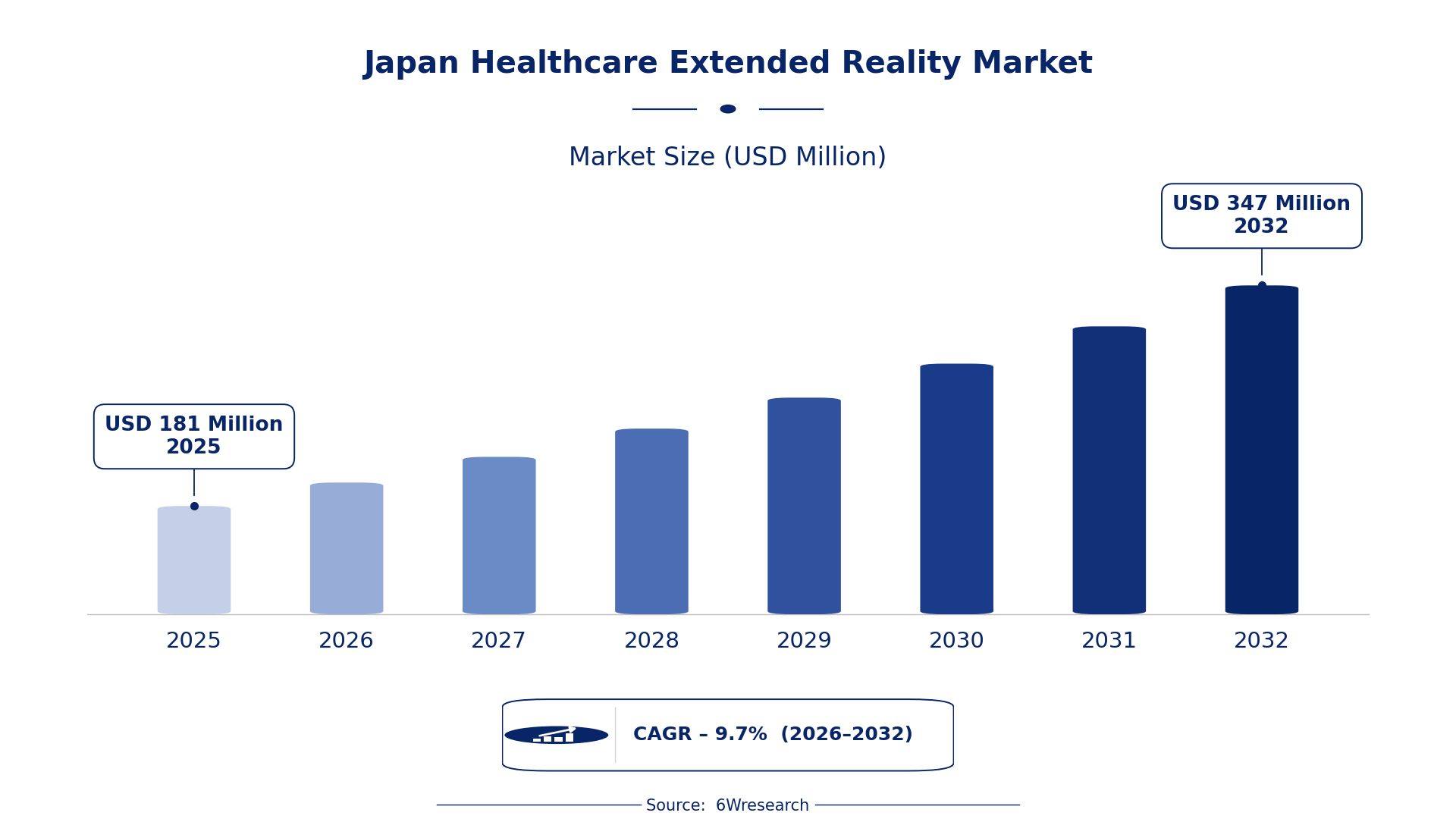
According to 6Wresearch internal database and industry insights, the Japan Healthcare Extended Reality Market was valued at USD 181 Million in 2025 and is projected to reach USD 347 Million by 2032, growing at a CAGR of approximately 9.7% during 2026–2032.
Japan Healthcare Extended Reality Market Highlights
| Report Metric | Details |
| Report Name | Japan Healthcare Extended Reality Market (2026-2032) |
| Market Size 2025 | USD 181 Million |
| Market Size 2032 | USD 347 Million |
| Absolute Growth 2025–2032 | USD 166 Million |
| CAGR 2026–2032 | 9.7% |
| Peak Annual Growth | 14.4% in 2027 |
| Forecast Period | 2026–2032 |
| Historical Data | 2022–2025 |
| Base Year | 2025 |
| Leading Component, 2025 | Software (55% share) |
| Leading Technology, 2025 | Virtual Reality (53% share) |
| Leading Application, 2025 | Surgery (45% share) |
| Fastest-Growing Technology | Augmented Reality (13.5% CAGR) |
| Fastest-Growing Application | Therapy (13.6% CAGR) |
| Growing Sector | Therapy |
| Key End Users | Surgery, Education and Training, Therapy, Rehabilitation |
Japan Healthcare Extended Reality Market Year-wise Growth Rate and Key Drivers (2022–2032)
This graph illustrates the annual growth rates of the market from 2022 to 2032, highlighting a steady upward trajectory and projected market expansion over the forecast period.
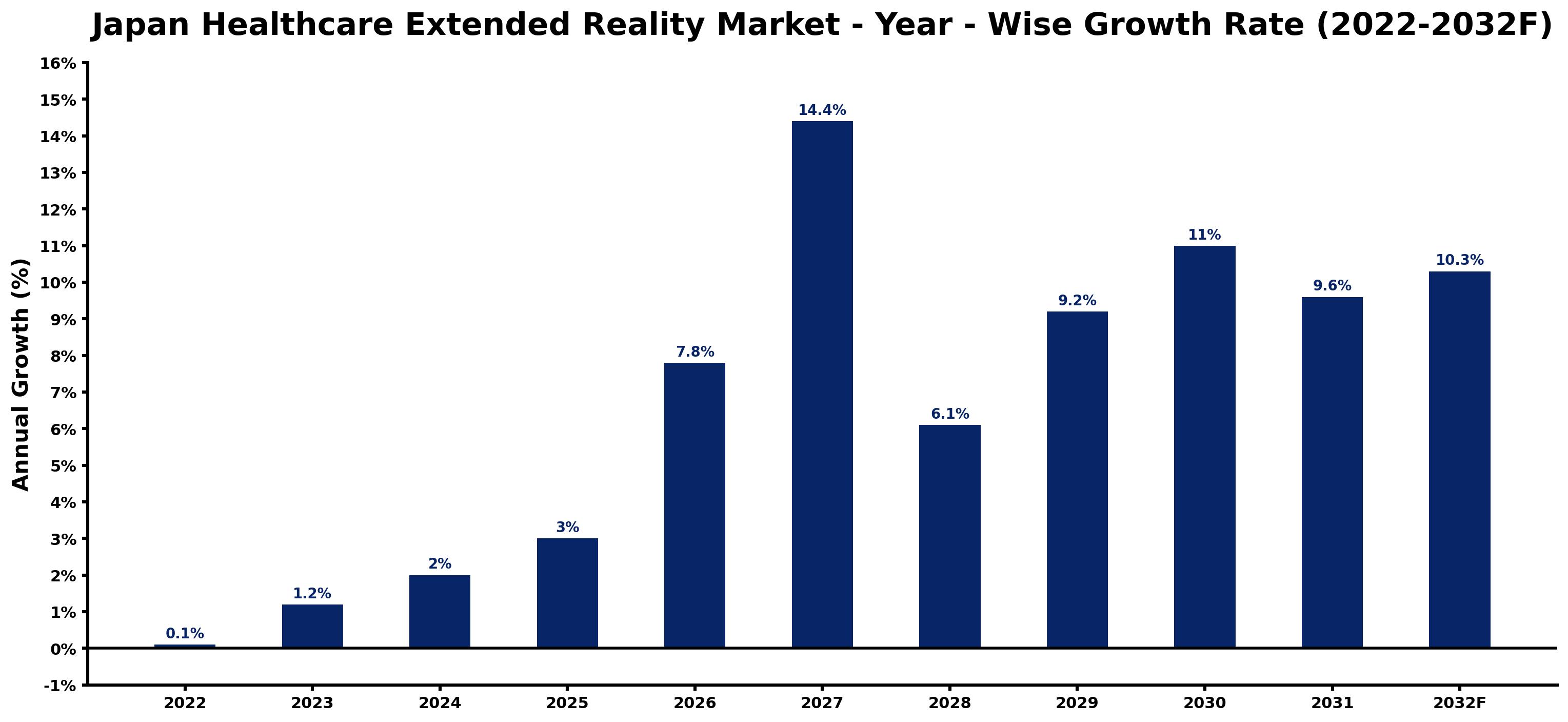
For each year, the table pairs the estimated growth rate with the leading influence on demand, showing how the drivers changed across the period.
| Year | Estimated Annual Growth (%) | Market Rationale |
| 2022 | 0.1 | The market showed minimal growth as initial adoption of XR technologies began. |
| 2023 | 1.2 | Growth accelerated due to increased awareness of XR benefits in medical training. |
| 2024 | 2.0 | Demand continued rising as hospitals expanded digital transformation initiatives. |
| 2025 | 3.0 | Growth peaked as more medical schools integrated XR into their curricula. |
| 2026 | 7.8 | The market is expected to see growth as private investments in XR surge. |
| 2027 | 14.4 | Demand peaked with XR applications in surgical settings driving purchases. |
| 2028 | 6.1 | Growth is projected to slow as the market begins to stabilise after rapid expansion. |
| 2029 | 9.2 | Demand is expected to increase again as hospitals seek to upgrade existing XR systems. |
| 2030 | 11.0 | Growth will continue as the ageing population increases the need for new solutions. |
| 2031 | 9.6 | The market is projected to grow at a slower pace as saturation begins in some segments. |
| 2032 | 10.3 | Demand is expected to rise as new XR technologies emerge for healthcare. |
Note: Market size estimations and growth projections presented in this report are based on 6Wresearch's proprietary forecasting methodology, utilizing the latest available industry data, government publications, and primary research inputs.
Japan Healthcare Extended Reality Market Synopsis
Healthcare Extended Reality (XR) includes augmented and virtual reality technologies utilised in medical training, patient therapy, and surgical assistance. The Japan Healthcare Extended Reality Market is growing due to substantial investments in digital transformation, with ¥1.2 trillion allocated in 2023. Key drivers are the integration of XR in medical education, with over 60% of medical schools adopting these technologies, and increasing demand from hospitals for enhanced surgical precision and improved patient outcomes.
Market Dynamics Impact Analysis (2026–2032)
| Factor | Type | Impact | Primary Segment Affected |
| Increased integration of XR in medical training | Driver | High | Education and Training |
| Growing demand for surgical precision | Driver | High | Surgery |
| Expansion of XR applications in therapy | Opportunity | High | Therapy |
| Investment in telemedicine capabilities | Opportunity | Medium | Services |
| High costs of XR technology implementation | Restraint | High | Hardware |
| Limited awareness among healthcare providers | Restraint | Medium | Software |
| Competition from traditional training methods | Challenge | High | Education and Training |
| Slow adoption rates in rural areas | Challenge | Medium | Services |
Evaluation of Drivers in Japan Healthcare Extended Reality Market (2026–2032)
These are the developments adding the most demand over the forecast period.
| Drivers | Primary Segment Affected | Why It Matters (Evidence) |
| Increased healthcare expenditure | Surgery | Japan's national medical care expenditure was about JPY 46.7 trillion in fiscal 2022, driving demand for advanced surgical technologies. |
| Growing elderly population | Therapy | As of 2023, Japan's population over 65 reached 36 million, increasing the need for innovative therapy solutions. |
| Support from educational institutions | Education and Training | Over 60% of medical schools in Japan incorporated XR into their curriculum, enhancing training quality. |
| Rising public and private sector investment | Services | In 2023, Japan allocated ¥1.2 trillion for digital transformation initiatives, boosting XR integration. |
| Technological advancements in XR | Hardware | The establishment of the Japan XR Association in 2022 promotes XR technology, leading to increased hardware demand. |
Several shifts outside the market lift sales. The growing elderly population, which reached 36 million in 2023, drives demand for therapy solutions. Japan's national medical care expenditure was about JPY 46.7 trillion in fiscal 2022, supporting investments in advanced surgical technologies. Over 60% of medical schools have integrated XR into their curriculum, improving training quality for future professionals.
Evaluation of Restraints in Japan Healthcare Extended Reality Market
The following restraints limit how fast demand can grow.
| Market Restraint | Primary Segment Affected | Why It Matters (Evidence) |
| High costs of implementing XR technology | Hardware | The initial investment for XR systems remains prohibitive for many healthcare providers, limiting adoption. |
| Limited awareness of XR benefits among providers | Software | Many healthcare professionals are not fully aware of the advantages XR can bring to their practices. |
| Competition from established training methods | Education and Training | Traditional training methods continue to dominate, making it challenging for XR to gain traction. |
| Slow adoption rates in rural areas | Services | Healthcare facilities in rural regions often lack the resources to implement XR technologies. |
| Regulatory hurdles for XR applications | Surgery | Compliance with ISO 13485 standards can delay the introduction of new XR surgical tools. |
Japan Healthcare Extended Reality Market Challenges
Hospitals encounter rising costs due to outdated technology, restricting access to advanced XR solutions and delaying patient treatment. Competition among healthcare providers intensifies as they strive to adopt XR, resulting in increased operational expenses and potential service gaps. Compliance with ISO 13485 standards necessitates considerable investment in software development, causing delays in product launches for suppliers. A shortage of skilled XR professionals limits the workforce available to hospitals, leading to a 25% rise in training costs since 2020 as facilities work to upskill existing staff.
Trends in the Japan Healthcare Extended Reality Market
Four trends stand out in the Japan Healthcare Extended Reality Market.
- Shift from Traditional Training to XR: Medical training is increasingly incorporating XR technologies, with over 60% of medical schools adopting these tools by 2023. This shift improves the quality of education and prepares students for modern healthcare challenges.
- Growing Use of XR in Surgical Procedures: Tokyo and Osaka are leading regions in adopting XR for surgery, with a 25% increase in hospitals using this technology since 2020. This trend improves surgical precision and patient outcomes.
- Increased Focus on Telemedicine Integration: The Health, Labour and Welfare Ministry launched a program in 2022 to improve telemedicine capabilities using XR. This initiative supports remote patient care and expands access to healthcare services.
- Emergence of Mixed Reality Applications: Mixed Reality is gaining traction in specialized healthcare applications, with increasing interest from educational institutions. This trend is expected to grow as technology advances and becomes more accessible.
Investment Opportunities in the Japan Healthcare Extended Reality Market
Several openings in the Japan Healthcare Extended Reality Market merit attention from investors.
- Hospitals seeking advanced solutions: With Japan's healthcare expenditure reaching ¥46.7 trillion, hospitals are looking to invest in XR technologies. Partnering with local tech startups in Tokyo can facilitate entry into this growing market.
- Tokyo as a hub for XR development: Tokyo's healthcare sector is rapidly adopting XR, with a 25% increase in hospitals using this technology since 2020. Suppliers can enter this market by collaborating with local hospitals.
- Growing demand for immersive training: As over 60% of medical schools incorporate XR, educational institutions are seeking advanced training tools. Suppliers can enter through partnerships with these institutions to meet this demand.
- Investment in telemedicine solutions: The Health, Labour and Welfare Ministry's program to improve telemedicine capabilities presents an opportunity for suppliers. Engaging with hospitals to develop XR solutions can lead to successful market entry.
Government Initiatives in the Japan Healthcare Extended Reality Market
The Next-Generation Medical Infrastructure Act (2017) allows certified bodies to anonymise medical data for research and product development, strengthening the framework for XR applications. This measure builds on the Medical Care Act (1948), which sets standards for hospitals and clinics, ensuring that XR technologies meet necessary regulations.
The Pharmaceuticals and Medical Devices Agency (PMDA) approves medical devices, including XR applications, ensuring compliance with safety and efficacy standards. This agency plays an important role in facilitating the introduction of XR technologies into healthcare settings.
Future Insight of the Japan Healthcare Extended Reality Market
By 2032, healthcare facilities will increasingly adopt XR technologies, propelled by a dedicated programme from the Ministry of Health, Labour and Welfare aimed at improving telemedicine capabilities. The healthcare sector's investment of ¥1.2 trillion in digital transformation will support advancements in patient care. As medical schools integrate XR into their curriculum, a new generation of skilled professionals will enter the workforce, benefiting both buyers and suppliers. The Japan XR Association will promote collaboration and innovation across the healthcare sector.
Market Segmentation Analysis
Japan Healthcare Extended Reality Market report covers a detailed analysis of the following market segments:
By Component – Software Leads and Records the Fastest Growth
According to Vasudha, AM at 6Wresearch, with 55% of component revenue in 2025, Software was the largest category. Software holds the largest share due to its crucial role in creating immersive experiences and simulations essential for medical applications. The healthcare sector's allocation of ¥1.2 trillion for digital transformation initiatives in 2023 highlights the strong demand for advanced software solutions. The same category is also set to grow fastest, at a CAGR of 11.3% during 2026–2032. The software segment is expected to maintain rapid growth as more healthcare facilities adopt XR technologies for enhanced training and patient care. With over 60% of medical schools incorporating XR into their curriculum, the need for sophisticated software will continue to rise. Suppliers must focus on software advancements to meet the increasing demand from healthcare providers.
By Technology – Virtual Reality Leads, Augmented Reality Expected to Grow Fastest
The largest technology category in 2025 was Virtual Reality, at 53% of revenue. Virtual Reality leads the market as it is extensively applied in therapy and training scenarios, providing immersive experiences that enhance learning outcomes. Its widespread use in therapeutic settings has become increasingly vital in Japan's healthcare landscape. Over 2026–2032, Augmented Reality is expected to post the fastest growth, at a CAGR of 13.5%. Augmented Reality is experiencing the fastest growth due to its practical applications in surgical overlays and patient education, which are becoming more prevalent in hospitals. The integration of AR into surgical procedures is driving its adoption among healthcare professionals. This trend indicates that suppliers should prioritise AR solutions to capitalise on the growing interest from healthcare practitioners.
By Application – Surgery Leads, Therapy Expected to Grow Fastest
Surgery held 45% of the Japan Healthcare Extended Reality Market by application in 2025. Surgery dominates the application segment as XR technologies significantly enhance precision and visualisation during complex procedures. The increase in hospitals using XR for surgery by 25% since 2020 underscores its critical role in improving surgical outcomes. Therapy is set to record the highest CAGR in this split, 13.6% over 2026–2032. Therapy is the fastest-growing application as XR is increasingly utilised for psychological therapies, reflecting a shift towards innovative treatment methods. This growth is supported by the rising demand for effective therapeutic solutions among an ageing population. Suppliers should consider expanding their offerings in therapy applications to address the evolving needs of healthcare providers.
Key Attractiveness of the Report
- 10 Years of Market Numbers
- Historical Data Starting from 2022 to 2025
- Base Year 2025
- Forecast Data until 2032
- Key Performance Indicators Impacting the Market
- Major Upcoming Developments and Projects
Key Highlights of the Report:
- Japan Healthcare Extended Reality Market Outlook
- Market Size of Japan Healthcare Extended Reality Market, 2025
- Forecast of Japan Healthcare Extended Reality Market, 2032
- Historical Data and Forecast of Japan Healthcare Extended Reality Revenues & Volume for the Period 2022-2032
- Japan Healthcare Extended Reality Market Trend Evolution
- Japan Healthcare Extended Reality Market Drivers and Challenges
- Japan Healthcare Extended Reality Price Trends
- Japan Healthcare Extended Reality Porter's Five Forces
- Japan Healthcare Extended Reality Industry Life Cycle
- Historical Data and Forecast of Japan Healthcare Extended Reality Market Revenues & Volume By Component for the Period 2022-2032
- Historical Data and Forecast of Japan Healthcare Extended Reality Market Revenues & Volume By Hardware for the Period 2022-2032
- Historical Data and Forecast of Japan Healthcare Extended Reality Market Revenues & Volume By Software for the Period 2022-2032
- Historical Data and Forecast of Japan Healthcare Extended Reality Market Revenues & Volume By Services for the Period 2022-2032
- Historical Data and Forecast of Japan Healthcare Extended Reality Market Revenues & Volume By Technology for the Period 2022-2032
- Historical Data and Forecast of Japan Healthcare Extended Reality Market Revenues & Volume By Augmented Reality for the Period 2022-2032
- Historical Data and Forecast of Japan Healthcare Extended Reality Market Revenues & Volume By Virtual Reality for the Period 2022-2032
- Historical Data and Forecast of Japan Healthcare Extended Reality Market Revenues & Volume By Mixed Reality for the Period 2022-2032
- Historical Data and Forecast of Japan Healthcare Extended Reality Market Revenues & Volume By Application for the Period 2022-2032
- Historical Data and Forecast of Japan Healthcare Extended Reality Market Revenues & Volume By Surgery for the Period 2022-2032
- Historical Data and Forecast of Japan Healthcare Extended Reality Market Revenues & Volume By Therapy for the Period 2022-2032
- Historical Data and Forecast of Japan Healthcare Extended Reality Market Revenues & Volume By Education and Training for the Period 2022-2032
- Historical Data and Forecast of Japan Healthcare Extended Reality Market Revenues & Volume By Rehabilitation for the Period 2022-2032
- Historical Data and Forecast of Japan Healthcare Extended Reality Market Revenues & Volume By Pain Management for the Period 2022-2032
- Historical Data and Forecast of Japan Healthcare Extended Reality Market Revenues & Volume By Others for the Period 2022-2032
- Japan Healthcare Extended Reality Import Export Trade Statistics
- Market Opportunity Assessment By Component
- Market Opportunity Assessment By Technology
- Market Opportunity Assessment By Application
- Japan Healthcare Extended Reality Top Companies Market Share
- Japan Healthcare Extended Reality Competitive Benchmarking By Technical and Operational Parameters
- Japan Healthcare Extended Reality Company Profiles
- Japan Healthcare Extended Reality Key Strategic Recommendations
Market Covered
The report covers the following segments.
By Component
- Hardware
- Software
- Services
By Technology
- Augmented Reality
- Virtual Reality
- Mixed Reality
By Application
- Surgery
- Therapy
- Education and Training
- Rehabilitation
- Pain Management
- Others































