Japan Home IV Therapy Market Size & Growth Rate
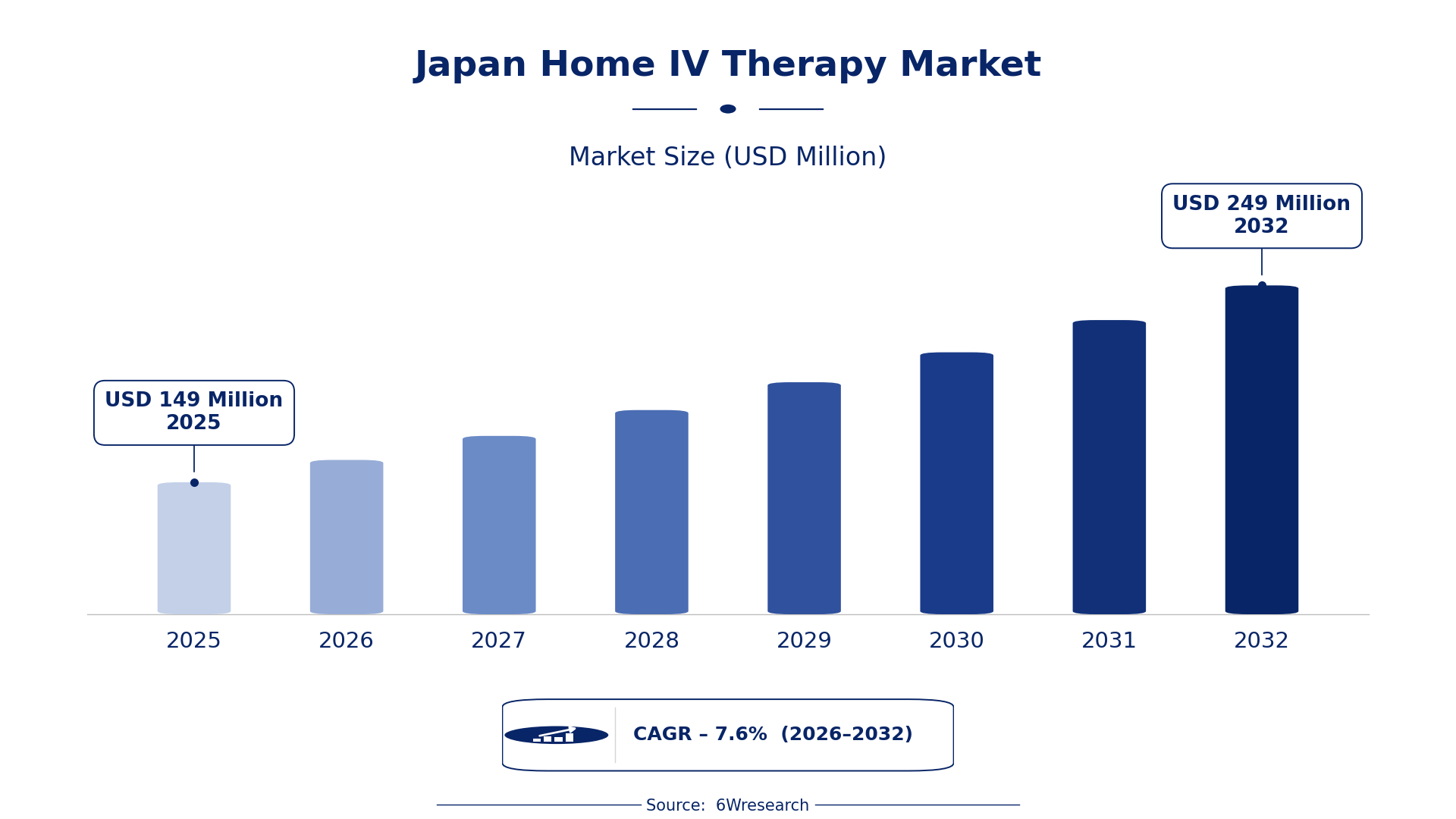
According to 6Wresearch internal database and industry insights, the Japan Home IV Therapy Market was valued at USD 149 Million in 2025 and is projected to reach USD 249 Million by 2032, growing at a CAGR of approximately 7.6% during 2026–2032.
Japan Home IV Therapy Market Highlights
| Report Metric | Details |
| Report Name | Japan Home IV Therapy Market (2026-2032) |
| Market Size 2025 | USD 149 Million |
| Market Size 2032 | USD 249 Million |
| Absolute Growth 2025–2032 | USD 100 Million |
| CAGR 2026–2032 | 7.6% |
| Peak Annual Growth | 8.3% in 2030 |
| Forecast Period | 2026–2032 |
| Historical Data | 2022–2025 |
| Base Year | 2025 |
| Leading Therapy Type, 2025 | Hydration Therapy (52% share) |
| Leading Delivery Method, 2025 | Saline Drips (44% share) |
| Leading Distribution Channel, 2025 | Home Medical Providers (43% share) |
| Leading End User, 2025 | Dehydrated Patients (43% share) |
| Fastest-Growing Therapy Type | Antibiotic Therapy (10.3% CAGR) |
| Fastest-Growing Delivery Method | IV Infusion Bags (10.5% CAGR) |
| Fastest-Growing Distribution Channel | Pharmacies (9.9% CAGR) |
| Fastest-Growing End User | Infection Recovery Patients (9.6% CAGR) |
| Growing Sector | Home Healthcare |
| Key End Users | Elderly Patients, Cancer Homecare Users, Infection Recovery Patients, Malnourished Patients |
Japan Home IV Therapy Market Year-wise Growth Rate and Key Drivers (2022–2032)
This graph illustrates the annual growth rates of the market from 2022 to 2032, highlighting a steady upward trajectory and projected market expansion over the forecast period.
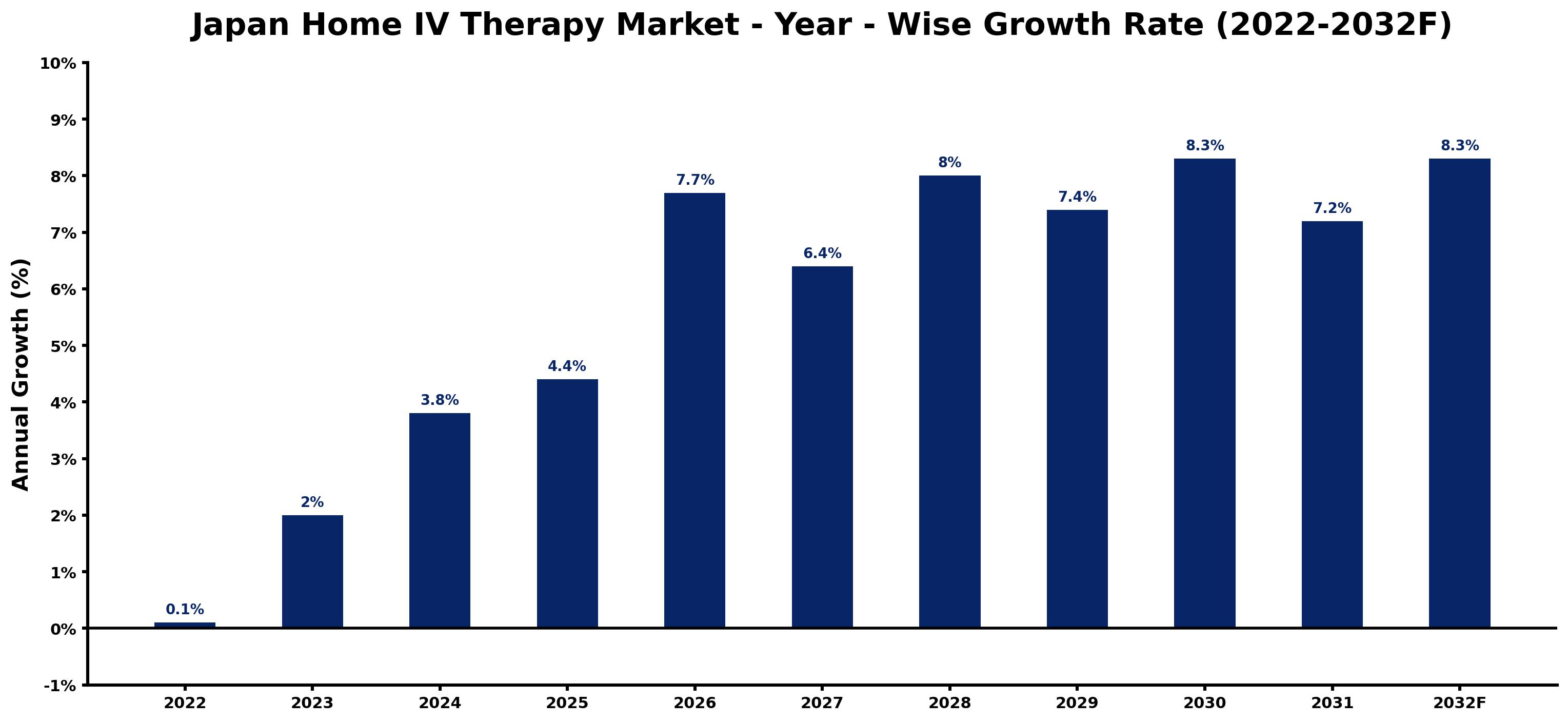
The table below sets out the estimated growth rate for each year and the main factor behind it.
| Year | Estimated Annual Growth (%) | Market Rationale |
| 2022 | 0.1 | The market showed minimal growth as it adjusted to evolving healthcare demands. |
| 2023 | 2.0 | Growth accelerated due to increased awareness of home healthcare options among patients. |
| 2024 | 3.8 | The rise in elderly patients needing care contributed to faster growth this year. |
| 2025 | 4.4 | Growth continued as more patients opted for home IV therapy for convenience. |
| 2026 | 7.7 | Demand surged as healthcare providers expanded services to accommodate home treatments. |
| 2027 | 6.4 | Growth slowed slightly as market saturation began to impact new patient acquisitions. |
| 2028 | 8.0 | The market rebounded with increased adoption of advanced IV therapy technologies. |
| 2029 | 7.4 | Growth decelerated as competition intensified among home healthcare providers. |
| 2030 | 8.3 | Demand peaked as the healthcare sector recognised the benefits of home IV therapy. |
| 2031 | 7.2 | Growth moderated slightly as the market stabilised at a higher demand level. |
| 2032 | 8.3 | The market is expected to maintain strong growth as technology further improves service delivery. |
Note: Market size estimations and growth projections presented in this report are based on 6Wresearch's proprietary forecasting methodology, utilizing the latest available industry data, government publications, and primary research inputs.
Japan Home IV Therapy Market Synopsis
Home IV Therapy involves administering intravenous fluids and medications at home, primarily for hydration, nutrition, and recovery. This therapy is vital for elderly patients and those with chronic illnesses, with hydration therapy being the most common use. The Japan Home IV Therapy Market is expanding due to an ageing population, rising healthcare needs, and advancements in home healthcare services, particularly in urban areas like Tokyo, which accounts for 40% of demand.
Market Dynamics Impact Analysis (2026–2032)
| Factor | Type | Impact | Primary Segment Affected |
| An ageing population drives demand for home IV therapy services. | Driver | High | Hydration Therapy |
| Increased prevalence of chronic illnesses necessitates home healthcare solutions. | Driver | High | Antibiotic Therapy |
| The growing elderly population presents a significant opportunity for service expansion. | Opportunity | High | Nutritional IVs |
| Rising awareness of home healthcare options opens new market avenues. | Opportunity | High | Chemotherapy Support |
| High costs of equipment and supplies can limit provider capacity. | Restraint | Medium | IV Infusion Bags |
| Regulatory compliance may slow down the entry of new providers. | Restraint | Medium | Home Medical Providers |
| Rising operational costs challenge the sustainability of existing services. | Challenge | High | Home Medical Providers |
| Limited access to advanced training for providers affects service quality. | Challenge | Medium | Chemotherapy Support |
Evaluation of Drivers in Japan Home IV Therapy Market (2026–2032)
The table below links each growth driver to the segment it affects and the evidence for it.
| Drivers | Primary Segment Affected | Why It Matters (Evidence) |
| An increasing number of elderly patients requiring hydration therapy. | Hydration Therapy | In 2023, approximately 30% of home IV therapy users are elderly patients over 65 years old. |
| The rise in chronic illnesses necessitates antibiotic treatments at home. | Antibiotic Therapy | Antibiotic therapy is crucial for 70% of patients recovering from infections at home. |
| Growing malnutrition rates among the elderly boost demand for nutritional IVs. | Nutritional IVs | Malnutrition affects 15% of the elderly population in Japan, increasing demand. |
| The Tokyo region's high demand drives service expansion for home IV therapy. | Chemotherapy Support | The Tokyo region accounts for 40% of home IV therapy demand in Japan. |
| Regulatory support for home healthcare services enhances provider capabilities. | Home Medical Providers | The government allocated 500 million yen for home healthcare initiatives in 2023. |
Purchasing is picking up as the elderly population increasingly opts for home IV therapy solutions. Approximately 30% of users are over 65, driving demand for hydration and nutritional support. In 2023, malnutrition affected 15% of the elderly, prompting a rise in nutritional IVs. The Tokyo region, accounting for 40% of demand, showcases the potential for service expansion. The increase in chronic illnesses necessitates antibiotic treatments at home, as antibiotic therapy is essential for 70% of patients recovering from infections.
Evaluation of Restraints in Japan Home IV Therapy Market
Below are the constraints most often cited by buyers and suppliers, with the segment each affects.
| Market Restraint | Primary Segment Affected | Why It Matters (Evidence) |
| High costs of IV therapy supplies limit access for some patients. | IV Infusion Bags | The average treatment duration for home IV therapy is 2-3 weeks, increasing overall costs. |
| Regulatory compliance can slow the expansion of new service providers. | Home Medical Providers | Providers must adhere to standards established by the Ministry of Health, Labour and Welfare. |
| Limited availability of trained professionals may affect service quality. | Chemotherapy Support | Training for home IV therapy providers is supported by the Tokyo Medical Association. |
| Market saturation in urban areas may hinder new patient acquisition. | Hydration Therapy | The Tokyo region already accounts for 40% of home IV therapy demand. |
| Competition among providers may lead to price wars, affecting profitability. | Antibiotic Therapy | Increased demand has attracted multiple providers, intensifying competition. |
Japan Home IV Therapy Market Challenges
Providers face intense competition, as many offer similar home IV therapy services, which drives down prices and reduces margins. Buyers encounter increased expenses due to limited availability of specialised IV equipment, resulting in treatment delays for elderly patients who require immediate care. A shortage of qualified professionals hampers service delivery, with the average age of home IV therapy patients at 72 years, leading to a critical need for trained staff that remains unfulfilled. Supply chain disruptions arise from adherence to the JIS T 0325 standard, causing delays in equipment delivery that hinder timely patient treatments.
Trends in the Japan Home IV Therapy Market
The shifts below are changing how Japan Home IV Therapy Market products are bought and supplied.
- Shift Towards Home Healthcare Services: Dehydrated patients are increasingly opting for home IV therapy, reflecting a broader trend towards home healthcare. In 2023, approximately 30% of home IV therapy users are elderly patients over 65 years old, indicating a shift in patient preferences.
- Emergence of Nutritional IVs: Growing awareness of malnutrition among the elderly has led to an increase in the use of nutritional IVs. Approximately 15% of the elderly population is affected by malnutrition, driving demand for these therapies.
- Growth of Antibiotic Therapy at Home: Since 2023, there has been a notable rise in antibiotic therapy for patients recovering at home. This is critical for 70% of patients, reflecting a shift in treatment approaches.
- Increase in Home Medical Providers: The number of home medical providers has surged, particularly in urban areas like Tokyo. The market is projected to grow by 15% in the next five years, highlighting the demand for home healthcare services.
Investment Opportunities in the Japan Home IV Therapy Market
The openings below show where demand in the Japan Home IV Therapy Market is visible and how suppliers can enter.
- Partnerships with Local Healthcare Providers: Local partnerships can facilitate entry into the home IV therapy market, especially in urban areas. The Tokyo region, which accounts for 40% of demand, presents a prime opportunity for collaboration.
- Expansion in Urban Areas: With 40% of demand concentrated in Tokyo, investing in urban home healthcare facilities can yield high returns. The increasing elderly population further supports this investment opportunity.
- Growing Demand for Nutritional IVs: The rising malnutrition rates among the elderly present a substantial investment opportunity. Targeting malnourished patients in urban areas can lead to significant market gains.
- Collaboration with Home Medical Providers: Working with home medical providers can improve market entry and service delivery. These providers are regulated by the Ministry of Health, Labour and Welfare, ensuring compliance with standards.
Government Initiatives in the Japan Home IV Therapy Market
The NHI drug price standard establishes reimbursement prices for drugs used in home IV therapy, impacting both providers and patients. This measure ensures that home IV therapy remains accessible and affordable, promoting wider adoption among patients.
In 2023, the government allocated 500 million yen for home healthcare initiatives, administered by the Ministry of Health, Labour and Welfare. This funding supports the development and expansion of home IV therapy services, improving access for patients.
Future Insight of the Japan Home IV Therapy Market
Innovations in telehealth technology will reshape demand for home IV therapy by 2032, enabling better patient monitoring and management. The government has committed 500 million yen to enhance home healthcare services, which will expand access for elderly patients. Improved training initiatives for providers will develop a more skilled workforce, addressing existing expertise shortages. Increased recognition of malnutrition among the elderly will elevate the need for nutritional IVs, as 15% of this population struggles with related health challenges, leading to a shift towards tailored home care solutions.
Market Segmentation Analysis
Japan Home IV Therapy Market report covers a detailed analysis of the following market segments:
By Therapy Type – Hydration Therapy Leads, Antibiotic Therapy Expected to Grow Fastest
According to Saurav Kr Singh, Senior Research Analyst at 6Wresearch, in 2025, Hydration Therapy led the therapy type split with a 52% share. Hydration therapy is the leading sub-segment due to its essential function in rehydrating patients at home, particularly among the elderly demographic. In 2023, 60% of home IV patients relied on hydration therapy, highlighting its critical importance in the market. Antibiotic Therapy is set to record the highest CAGR in this split, 10.3% over 2026–2032. Antibiotic therapy is experiencing rapid growth as it is crucial for 70% of patients recovering from infections at home. This increasing focus on infection recovery will likely drive further demand for antibiotic IV treatments, ensuring the leader's position remains strong. Suppliers should prioritise the development and availability of hydration and antibiotic therapies to meet the growing needs of home healthcare.
By Delivery Method – Saline Drips Lead, IV Infusion Bags Expected to Grow Fastest
Saline Drips accounted for 44% of the market by delivery method in 2025. Saline drips lead the market as they are the most commonly used method for hydration purposes, making them essential for many patients. Their widespread adoption reflects their importance in the administration of home IV therapy. The quickest growth will come from IV Infusion Bags, forecast to expand at a CAGR of 10.5% between 2026 and 2032. IV infusion bags are gaining traction as a standard method for delivering IV fluids, indicating a shift towards more efficient delivery systems. This trend will likely continue as healthcare providers aim to improve patient care and outcomes. Manufacturers must adapt to the rising preference for IV infusion bags to maintain competitiveness in the home IV therapy market.
By Distribution Channel – Home Medical Providers Lead, Pharmacies Expected to Grow Fastest
Home Medical Providers held 43% of the Japan Home IV Therapy Market by distribution channel in 2025. Home medical providers are the primary distribution channel, as they play a crucial role in delivering home IV services to patients. Their established networks and expertise in home healthcare make them indispensable in this market. Over 2026–2032, Pharmacies are expected to post the fastest growth, at a CAGR of 9.9%. Pharmacies are emerging as the fastest-growing channel, providing a supportive role in supplying IV products to patients. Their accessibility and convenience are driving increased sales in this segment, particularly as more patients seek home care solutions. Suppliers should consider strengthening partnerships with pharmacies to enhance product distribution and reach more patients effectively.
By End User – Dehydrated Patients Lead, Infection Recovery Patients Expected to Grow Fastest
Dehydrated Patients took 43% of end user revenue in 2025, more than any other category. Dehydrated patients represent the largest user group for home IV therapy, primarily utilising hydration treatments. This demographic is particularly significant given the high prevalence of dehydration among the elderly population, which is a key factor in market demand. Infection Recovery Patients are projected to grow fastest, at a CAGR of 9.6% during 2026–2032. Infection recovery patients are the fastest-growing user group, as antibiotic therapy becomes increasingly vital for those recovering at home. This trend reflects a broader shift towards managing infections outside of hospital settings, which is likely to continue. Providers should focus on tailoring services and products to meet the specific needs of infection recovery patients to capitalise on this growth opportunity.
Key Attractiveness of the Report
- 10 Years of Market Numbers
- Historical Data Starting from 2022 to 2025
- Base Year 2025
- Forecast Data until 2032
- Key Performance Indicators Impacting the Market
- Major Upcoming Developments and Projects
Key Highlights of the Report:
- Japan Home IV Therapy Market Outlook
- Market Size of Japan Home IV Therapy Market, 2025
- Forecast of Japan Home IV Therapy Market, 2032
- Historical Data and Forecast of Japan Home IV Therapy Revenues & Volume for the Period 2022-2032F
- Japan Home IV Therapy Market Trend Evolution
- Japan Home IV Therapy Market Drivers and Challenges
- Japan Home IV Therapy Price Trends
- Japan Home IV Therapy Porter's Five Forces
- Japan Home IV Therapy Industry Life Cycle
- Historical Data and Forecast of Japan Home IV Therapy Market Revenues & Volume By Therapy Type for the Period 2022-2032F
- Historical Data and Forecast of Japan Home IV Therapy Market Revenues & Volume By Hydration Therapy for the Period 2022-2032F
- Historical Data and Forecast of Japan Home IV Therapy Market Revenues & Volume By Antibiotic Therapy for the Period 2022-2032F
- Historical Data and Forecast of Japan Home IV Therapy Market Revenues & Volume By Chemotherapy Support for the Period 2022-2032F
- Historical Data and Forecast of Japan Home IV Therapy Market Revenues & Volume By Nutritional IVs for the Period 2022-2032F
- Historical Data and Forecast of Japan Home IV Therapy Market Revenues & Volume By Delivery Method for the Period 2022-2032F
- Historical Data and Forecast of Japan Home IV Therapy Market Revenues & Volume By Saline Drips for the Period 2022-2032F
- Historical Data and Forecast of Japan Home IV Therapy Market Revenues & Volume By IV Infusion Bags for the Period 2022-2032F
- Historical Data and Forecast of Japan Home IV Therapy Market Revenues & Volume By Injectable Ports for the Period 2022-2032F
- Historical Data and Forecast of Japan Home IV Therapy Market Revenues & Volume By Vitamin Drips for the Period 2022-2032F
- Historical Data and Forecast of Japan Home IV Therapy Market Revenues & Volume By Distribution Channel for the Period 2022-2032F
- Historical Data and Forecast of Japan Home IV Therapy Market Revenues & Volume By Home Medical Providers for the Period 2022-2032F
- Historical Data and Forecast of Japan Home IV Therapy Market Revenues & Volume By Pharmacies for the Period 2022-2032F
- Historical Data and Forecast of Japan Home IV Therapy Market Revenues & Volume By Hospital Distributors for the Period 2022-2032F
- Historical Data and Forecast of Japan Home IV Therapy Market Revenues & Volume By Online Medical Stores for the Period 2022-2032F
- Historical Data and Forecast of Japan Home IV Therapy Market Revenues & Volume By End User for the Period 2022-2032F
- Historical Data and Forecast of Japan Home IV Therapy Market Revenues & Volume By Dehydrated Patients for the Period 2022-2032F
- Historical Data and Forecast of Japan Home IV Therapy Market Revenues & Volume By Infection Recovery Patients for the Period 2022-2032F
- Historical Data and Forecast of Japan Home IV Therapy Market Revenues & Volume By Cancer Homecare Users for the Period 2022-2032F
- Historical Data and Forecast of Japan Home IV Therapy Market Revenues & Volume By Malnourished Patients for the Period 2022-2032F
- Japan Home IV Therapy Import Export Trade Statistics
- Market Opportunity Assessment By Therapy Type
- Market Opportunity Assessment By Delivery Method
- Market Opportunity Assessment By Distribution Channel
- Market Opportunity Assessment By End User
- Japan Home IV Therapy Top Companies Market Share
- Japan Home IV Therapy Competitive Benchmarking By Technical and Operational Parameters
- Japan Home IV Therapy Company Profiles
- Japan Home IV Therapy Key Strategic Recommendations
Market Covered
This report examines the market across the segments below.
By Therapy Type
- Hydration Therapy
- Antibiotic Therapy
- Chemotherapy Support
- Nutritional IVs
By Delivery Method
- Saline Drips
- IV Infusion Bags
- Injectable Ports
- Vitamin Drips
By Distribution Channel
- Home Medical Providers
- Pharmacies
- Hospital Distributors
- Online Medical Stores
By End User
- Dehydrated Patients
- Infection Recovery Patients
- Cancer Homecare Users
- Malnourished Patients































