Japan Home Urine Testing Market Size & Growth Rate
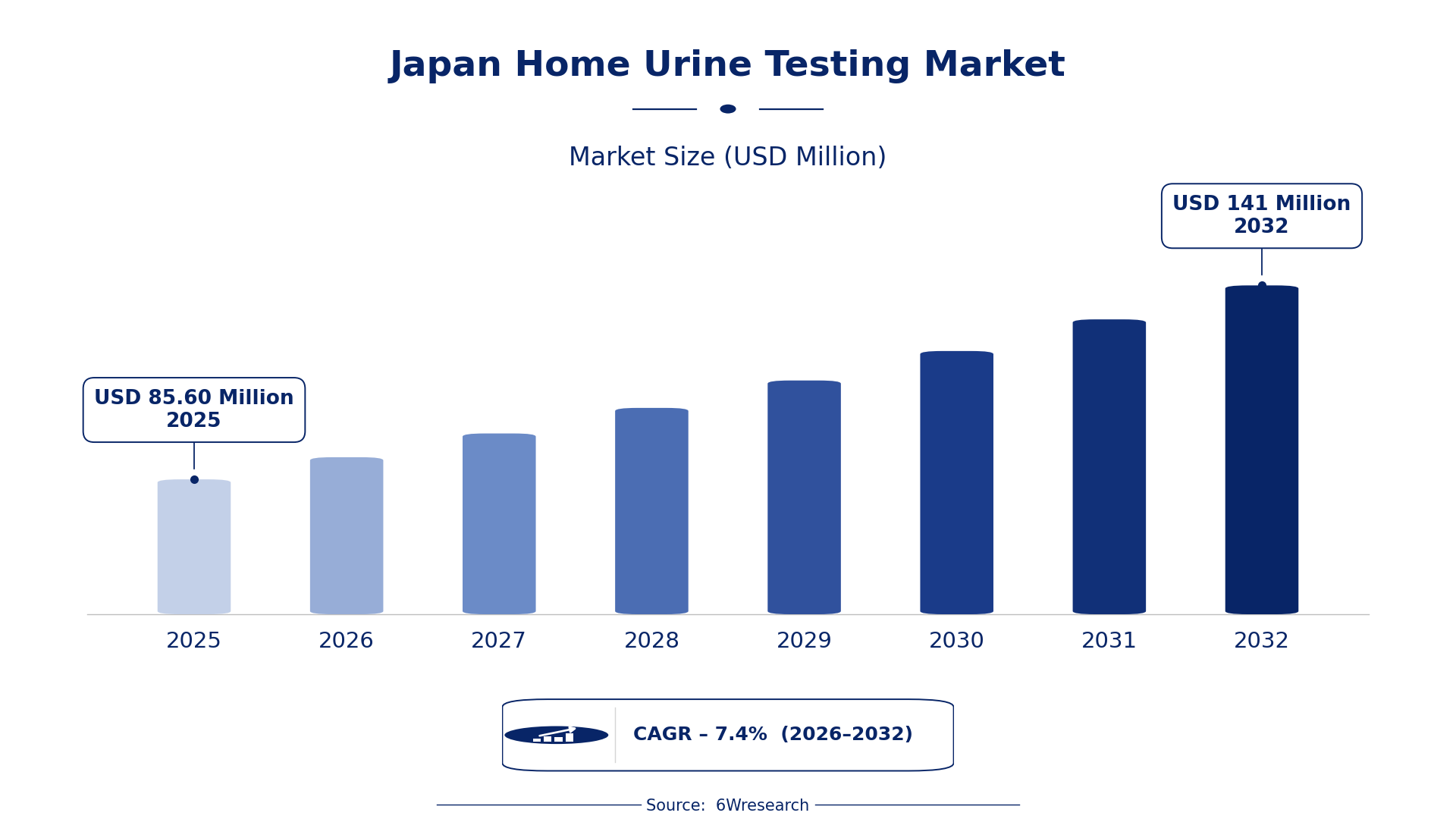
According to 6Wresearch internal database and industry insights, the Japan Home Urine Testing Market was valued at USD 85.60 Million in 2025 and is projected to reach USD 141 Million by 2032, growing at a CAGR of approximately 7.4% during 2026–2032.
Japan Home Urine Testing Market Highlights
| Report Metric | Details |
| Report Name | Japan Home Urine Testing Market (2026-2032) |
| Market Size 2025 | USD 85.60 Million |
| Market Size 2032 | USD 141 Million |
| Absolute Growth 2025–2032 | USD 55.40 Million |
| CAGR 2026–2032 | 7.4% |
| Peak Annual Growth | 8.4% in 2028 |
| Forecast Period | 2026–2032 |
| Historical Data | 2022–2025 |
| Base Year | 2025 |
| Leading Test Type, 2025 | Pregnancy Test Kits (44% share) |
| Leading Sample Method, 2025 | Dip Strip (36% share) |
| Leading Distribution Channel, 2025 | Pharmacies (42% share) |
| Leading End User, 2025 | Women Consumers (52% share) |
| Fastest-Growing Test Type | UTI Test Kits (10.0% CAGR) |
| Fastest-Growing Sample Method | Self-Test Strips (10.4% CAGR) |
| Fastest-Growing Distribution Channel | Online Pharmacies (9.4% CAGR) |
| Fastest-Growing End User | Elderly/Female Users (9.6% CAGR) |
| Growing Sector | home health monitoring |
| Key End Users | women consumers, elderly users, diabetic patients, general households |
Japan Home Urine Testing Market Year-wise Growth Rate and Key Drivers (2022–2032)
This graph illustrates the annual growth rates of the market from 2022 to 2032, highlighting a steady upward trajectory and projected market expansion over the forecast period.
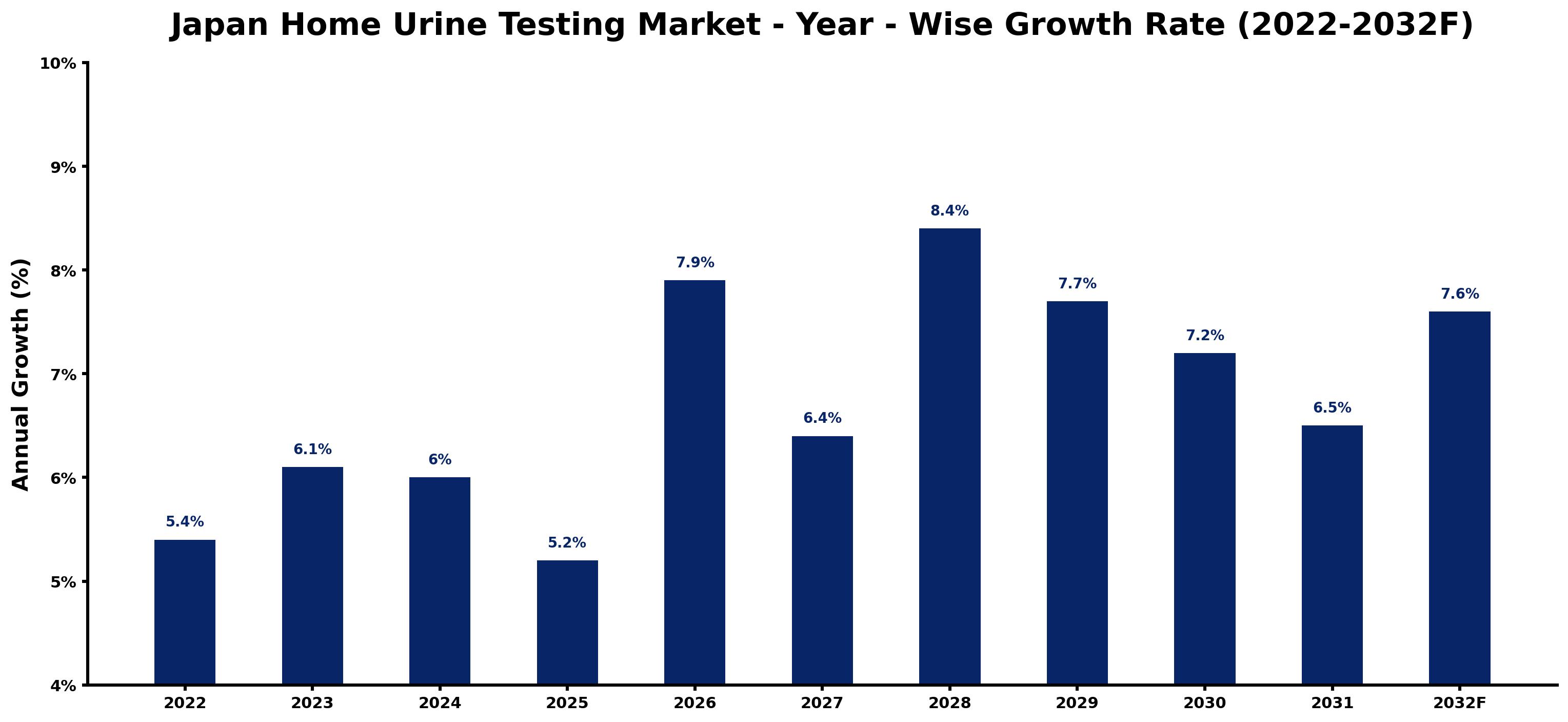
The yearly estimates that follow link every growth rate to its principal driver, so readers can see why the pace changed in each period.
| Year | Estimated Annual Growth (%) | Market Rationale |
| 2022 | 5.4 | The market experienced steady growth due to increased awareness of home health monitoring. |
| 2023 | 6.1 | Demand surged as healthcare facilities promoted home testing for convenience. |
| 2024 | 6.0 | Growth slowed as competition intensified among various testing products. |
| 2025 | 5.2 | The market continued to grow, though at a reduced rate compared to previous years. |
| 2026 | 7.9 | Demand is projected to rise as more households adopt home testing kits for health management. |
| 2027 | 6.4 | Growth is anticipated to slow as market saturation begins to affect new customer acquisition. |
| 2028 | 8.4 | The market will see a peak in growth driven by rising health concerns among the elderly. |
| 2029 | 7.7 | Growth is expected to slow as the market stabilises after reaching peak demand levels. |
| 2030 | 7.2 | The market will continue to expand, albeit at a slower pace as consumer habits evolve. |
| 2031 | 6.5 | Demand growth is expected to slow as the market matures and competition increases. |
| 2032 | 7.6 | The market is projected to grow faster again as new products enter the market. |
Note: Market size estimations and growth projections presented in this report are based on 6Wresearch's proprietary forecasting methodology, utilizing the latest available industry data, government publications, and primary research inputs.
Japan Home Urine Testing Market Synopsis
Home urine testing products are diagnostic tools that analyse urine samples for various health indicators, including pregnancy monitoring and diabetes management. In Japan, these products are widely available, with over 90% of pharmacies stocking pregnancy test kits. The Japan Home Urine Testing Market is growing due to an aging population, rising health consciousness, and increased convenience from online sales, which have risen by 15%. With around 7 million diabetic patients, the demand for home urine testing is set to increase substantially in the coming years.
Market Dynamics Impact Analysis (2026–2032)
| Factor | Type | Impact | Primary Segment Affected |
| Aging population increases demand for regular health monitoring, particularly for diabetic patients and elderly users. | Driver | High | Ketone Test Strips |
| Health campaigns promote preventive healthcare, boosting interest in multi-parameter kits for comprehensive health assessments. | Driver | High | Multi-Parameter Kits |
| Growing online pharmacy sales create opportunities for suppliers to reach a broader customer base. | Opportunity | High | Self-Test Strips |
| The increasing number of diabetic patients presents a significant market opportunity for home urine testing products. | Opportunity | High | Ketone Test Strips |
| Supply chain disruptions inflate production costs, impacting pricing and availability of testing kits. | Restraint | High | Multi-Parameter Kits |
| Regulatory compliance issues can extend approval times, delaying product launches and market entry. | Restraint | High | Pregnancy Test Kits |
| Recruitment challenges due to a skilled labor shortage can delay product development timelines significantly. | Challenge | High | Self-Test Strips |
| Technology adoption lags among households, limiting the penetration of home urine testing kits in the market. | Challenge | Medium | Pregnancy Test Kits |
Evaluation of Drivers in Japan Home Urine Testing Market (2026–2032)
The main growth drivers and the segments they affect most are set out below.
| Drivers | Primary Segment Affected | Why It Matters (Evidence) |
| Increased health awareness among consumers boosts demand for home urine testing kits. | Pregnancy Test Kits | With over 90% availability in pharmacies, these kits are easily accessible to consumers. |
| The rise in diabetic patients necessitates regular health monitoring. | Ketone Test Strips | Around 7 million diabetic patients in Japan require daily monitoring of ketone levels. |
| The trend towards preventive healthcare is encouraging home testing. | Multi-Parameter Kits | Health campaigns promote regular health assessments, increasing demand for these products. |
| The growth of online pharmacies increases product availability. | Online Pharmacies | Online pharmacy sales have increased by 15%, making home testing kits more accessible. |
| The convenience of home testing appeals to busy households. | Self-Test Strips | The adoption rate of home testing kits among households is around 25%. |
Orders keep climbing as the aging population drives demand for home urine testing products. Approximately 29.3% of Japan's population was aged 65 or older in September 2024, which increases the need for regular health monitoring. With around 7 million diabetic patients, the necessity for regular health checks is pressing, pushing demand for ketone test strips. Health campaigns promote preventive healthcare, boosting interest in multi-parameter kits. The rise of online pharmacies, with a 15% increase in sales, also improves accessibility for consumers, resulting in higher adoption rates of self-test strips.
Evaluation of Restraints in Japan Home Urine Testing Market
The table below lists the restraints and the evidence behind each.
| Market Restraint | Primary Segment Affected | Why It Matters (Evidence) |
| High competition among various testing products limits market share. | Multi-Parameter Kits | Many brands compete for consumer attention, making it harder for new entrants. |
| Limited awareness of home testing benefits can hinder adoption. | Pregnancy Test Kits | Consumers may not fully understand the advantages of home testing, affecting sales. |
| Regulatory compliance can delay product launches in the market. | UTI Test Kits | Strict regulations can slow down approvals, impacting time-to-market for new products. |
| High costs associated with product development can restrict market entry. | Ketone Test Strips | Developing reliable and effective testing kits requires substantial investment, limiting new entrants. |
| Consumer preferences may shift towards alternative health monitoring solutions. | Self-Test Strips | As technology evolves, new testing methods may emerge, affecting demand. |
Japan Home Urine Testing Market Challenges
Producers face recruitment challenges due to a shortage of skilled workers, as Japan's declining population reduces the available talent pool, which can delay product development timelines by up to three months. Supply chain disruptions occur because of reliance on specific regions for raw materials, inflating production costs by 15% and causing delivery delays to healthcare facilities. Regulatory compliance issues arise from stringent quality standards set by the Ministry of Health, Labour and Welfare, extending approval times and potentially postponing product launches by six months. Technology adoption lags, with only 25% of households using home urine testing kits, limiting market penetration and revenue growth for suppliers.
Trends in the Japan Home Urine Testing Market
The following changes are redrawing the Japan Home Urine Testing Market.
- Shift towards Online Pharmacies: The trend towards online pharmacies is reshaping the distribution of home urine testing kits. In 2023, online pharmacy sales increased by 15%, reflecting consumer preference for convenience. This shift allows consumers to access a wider range of products without visiting physical stores.
- Transition to Multi-Parameter Kits: Since 2022, there has been a notable transition towards multi-parameter kits for health assessments. These kits are now used in over 60% of home testing cases, indicating a growing preference for holistic health monitoring solutions among consumers.
- Emergence of Self-Test Strips: Self-test strips have gained popularity, especially among busy households. With an adoption rate of around 25%, these products offer convenience and ease of use, catering to the needs of modern consumers seeking quick health assessments.
- Focus on Preventive Healthcare Initiatives: The 'Healthy Japan 21' initiative, launched in 2000, prioritises preventive healthcare measures. This programme has led to increased awareness and usage of home urine testing products, driving demand for early health issue detection.
Investment Opportunities in the Japan Home Urine Testing Market
The following areas offer the clearest openings for investors and suppliers in the Japan Home Urine Testing Market.
- Home Urine Testing Kits: The demand for home urine testing kits is rising, with a projected market size of USD 141 million by 2032. Investing in testing solutions can attract health-conscious consumers, particularly in urban areas like Tokyo.
- Healthcare Facilities: The Tokyo region is a major hub for healthcare product distribution, with over 50,000 medical stores. Establishing partnerships with local pharmacies can improve market reach and product visibility.
- Growth in Online Sales Channels: With online pharmacy sales increasing by 15%, there is a gap in the market for convenient home testing solutions. Collaborating with e-commerce platforms can facilitate access to a broader consumer base.
- Elderly Health Monitoring Solutions: The elderly population represents a growing segment in home testing markets. Developing targeted products for this demographic can meet their specific health monitoring needs and preferences.
Government Initiatives in the Japan Home Urine Testing Market
Several laws shape the regulatory framework for home urine testing products, including the Medical Care Act of 1948 and the Pharmaceuticals and Medical Devices Act. These laws set standards for product safety and efficacy, ensuring that manufacturers comply with quality regulations. The Long-Term Care Insurance Act, revised in 2000, supports healthcare services for the aging population, indirectly promoting the use of home testing products.
The Ministry of Health, Labour and Welfare oversees regulations and approves medical devices, including home urine testing kits. This agency ensures that products meet safety and quality standards, facilitating their entry into the market. Additionally, the Digital Agency, established in 2021, supports the digital transformation of healthcare, improving access to health monitoring solutions.
Future Insight of the Japan Home Urine Testing Market
Investment in health innovation programs will drive demand for home urine testing products, creating opportunities for suppliers to expand their offerings. By 2032, advancements in technology will enhance the accuracy and user-friendliness of testing kits, attracting a broader customer base. The 'Healthy Japan 21' initiative will continue to advocate for preventive healthcare measures, increasing the adoption rate of home testing solutions. With the aging population, the number of diabetic patients is projected to rise to around 8 million by 2032, underscoring the need for effective monitoring solutions.
Market Segmentation Analysis
Japan Home Urine Testing Market report covers a detailed analysis of the following market segments:
By Test Type – Pregnancy Test Kits Lead, UTI Test Kits Expected to Grow Fastest
According to Saurav Kr Singh, Senior Research Analyst at 6Wresearch, Pregnancy Test Kits took 44% of test type revenue in 2025, more than any other category. Pregnancy test kits hold the largest market share as they are widely used for early pregnancy detection among women, particularly in urban areas. Their presence in over 90% of pharmacies across Japan ensures high accessibility and convenience for consumers. The quickest growth will come from UTI Test Kits, forecast to expand at a CAGR of 10.0% between 2026 and 2032. The UTI test kits are experiencing rapid growth due to their prevalent use in diagnosing urinary tract infections, which affect a significant portion of the population. Increased awareness of urinary health issues is driving up the demand for these testing solutions. This trend indicates that suppliers should focus on enhancing the availability and marketing of UTI test kits to meet the rising consumer demand.
By Sample Method – Dip Strip Leads, Self-Test Strips Expected to Grow Fastest
The largest sample method category in 2025 was Dip Strip, at 36% of revenue. Dip strips are the leading sample method, recognised as the standard for urine analysis in both home and clinical environments. Their established reliability and ease of use contribute to their widespread adoption among users. Self-Test Strips are projected to grow fastest, at a CAGR of 10.4% during 2026–2032. Self-test strips are rapidly gaining popularity as they facilitate convenient home health monitoring, enabling users to perform tests independently. This ease of use is driving their swift uptake in households throughout Japan. Manufacturers should focus on increasing the availability of self-test strips to cater to the rising demand for convenient at-home health testing.
By Distribution Channel – Pharmacies Lead, Online Pharmacies Expected to Grow Fastest
Pharmacies accounted for 42% of the market by distribution channel in 2025. Pharmacies dominate the distribution channel as they serve as the primary access point for consumers seeking home urine testing products. Their extensive presence across Japan ensures that these products are readily available to the public. Online Pharmacies are set to record the highest CAGR in this split, 9.4% over 2026–2032. Online pharmacies are emerging as the fastest-growing channel, driven by a 15% increase in online sales over the past year. This trend reflects a shift towards convenience and accessibility for consumers. Suppliers must invest in online distribution strategies to capitalise on the growing preference for purchasing health products through digital platforms.
By End User – Women Consumers Lead, Elderly/Female Users Expected to Grow Fastest
In 2025, Women Consumers led the end user split with a 52% share. Women consumers represent the largest segment as they are the primary demographic for pregnancy tests, which are essential for early detection. This focus on women's health drives a substantial portion of the market. Over 2026–2032, Elderly/Female Users are expected to post the fastest growth, at a CAGR of 9.6%. Elderly and female users are the fastest-growing segment, as they increasingly utilise health monitoring kits to manage their health proactively. The ageing population in Japan is contributing to this trend. Targeting marketing efforts towards elderly and female users can help suppliers tap into this expanding segment effectively.
Key Attractiveness of the Report
- 10 Years of Market Numbers
- Historical Data Starting from 2022 to 2025
- Base Year 2025
- Forecast Data until 2032
- Key Performance Indicators Impacting the Market
- Major Upcoming Developments and Projects
Key Highlights of the Report:
- Japan Home Urine Testing Market Outlook
- Market Size of Japan Home Urine Testing Market, 2025
- Forecast of Japan Home Urine Testing Market, 2032
- Historical Data and Forecast of Japan Home Urine Testing Revenues & Volume for the Period 2022-2032F
- Japan Home Urine Testing Market Trend Evolution
- Japan Home Urine Testing Market Drivers and Challenges
- Japan Home Urine Testing Price Trends
- Japan Home Urine Testing Porter's Five Forces
- Japan Home Urine Testing Industry Life Cycle
- Historical Data and Forecast of Japan Home Urine Testing Market Revenues & Volume By Test Type for the Period 2022-2032F
- Historical Data and Forecast of Japan Home Urine Testing Market Revenues & Volume By Pregnancy Test Kits for the Period 2022-2032F
- Historical Data and Forecast of Japan Home Urine Testing Market Revenues & Volume By UTI Test Kits for the Period 2022-2032F
- Historical Data and Forecast of Japan Home Urine Testing Market Revenues & Volume By Ketone Test Strips for the Period 2022-2032F
- Historical Data and Forecast of Japan Home Urine Testing Market Revenues & Volume By Multi-Parameter Kits for the Period 2022-2032F
- Historical Data and Forecast of Japan Home Urine Testing Market Revenues & Volume By Sample Method for the Period 2022-2032F
- Historical Data and Forecast of Japan Home Urine Testing Market Revenues & Volume By Dip Strip for the Period 2022-2032F
- Historical Data and Forecast of Japan Home Urine Testing Market Revenues & Volume By Self-Test Strips for the Period 2022-2032F
- Historical Data and Forecast of Japan Home Urine Testing Market Revenues & Volume By Color-Coded for the Period 2022-2032F
- Historical Data and Forecast of Japan Home Urine Testing Market Revenues & Volume By Glucose/Protein/Nitrite for the Period 2022-2032F
- Historical Data and Forecast of Japan Home Urine Testing Market Revenues & Volume By Distribution Channel for the Period 2022-2032F
- Historical Data and Forecast of Japan Home Urine Testing Market Revenues & Volume By Pharmacies for the Period 2022-2032F
- Historical Data and Forecast of Japan Home Urine Testing Market Revenues & Volume By Online Pharmacies for the Period 2022-2032F
- Historical Data and Forecast of Japan Home Urine Testing Market Revenues & Volume By E-commerce Platforms for the Period 2022-2032F
- Historical Data and Forecast of Japan Home Urine Testing Market Revenues & Volume By Medical Stores for the Period 2022-2032F
- Historical Data and Forecast of Japan Home Urine Testing Market Revenues & Volume By End User for the Period 2022-2032F
- Historical Data and Forecast of Japan Home Urine Testing Market Revenues & Volume By Women Consumers for the Period 2022-2032F
- Historical Data and Forecast of Japan Home Urine Testing Market Revenues & Volume By Elderly/Female Users for the Period 2022-2032F
- Historical Data and Forecast of Japan Home Urine Testing Market Revenues & Volume By Diabetic Patients for the Period 2022-2032F
- Historical Data and Forecast of Japan Home Urine Testing Market Revenues & Volume By General Households for the Period 2022-2032F
- Japan Home Urine Testing Import Export Trade Statistics
- Market Opportunity Assessment By Test Type
- Market Opportunity Assessment By Sample Method
- Market Opportunity Assessment By Distribution Channel
- Market Opportunity Assessment By End User
- Japan Home Urine Testing Top Companies Market Share
- Japan Home Urine Testing Competitive Benchmarking By Technical and Operational Parameters
- Japan Home Urine Testing Company Profiles
- Japan Home Urine Testing Key Strategic Recommendations
Market Covered
Coverage by segment is as follows.
By Test Type
- Pregnancy Test Kits
- UTI Test Kits
- Ketone Test Strips
- Multi-Parameter Kits
By Sample Method
- Dip Strip
- Self-Test Strips
- Color-Coded
- Glucose/Protein/Nitrite
By Distribution Channel
- Pharmacies
- Online Pharmacies
- E-commerce Platforms
- Medical Stores
By End User
- Women Consumers
- Elderly/Female Users
- Diabetic Patients
- General Households































