Japan Homecare Beds Market Size & Growth Rate
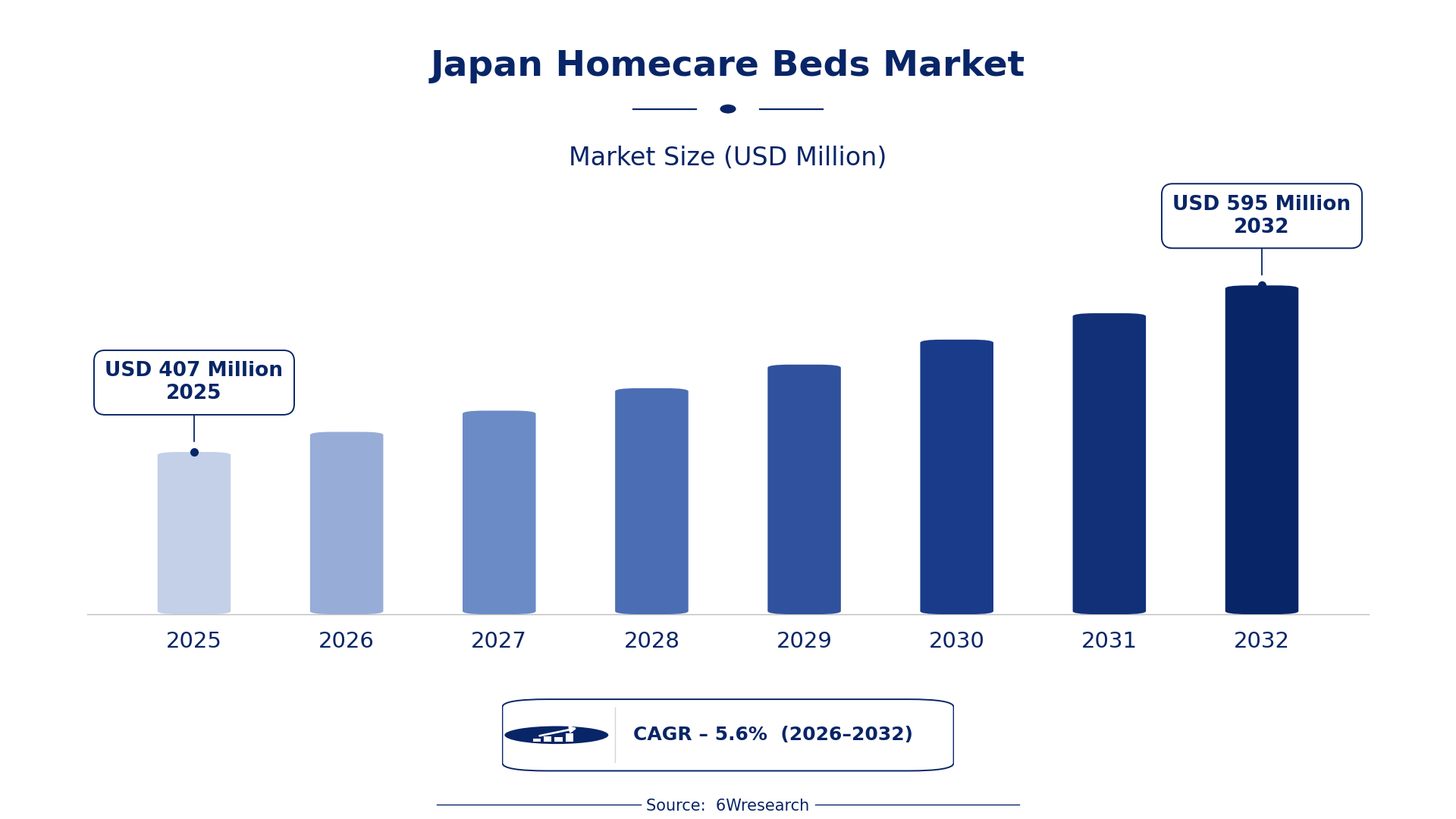
According to 6Wresearch internal database and industry insights, the Japan Homecare Beds Market was valued at USD 407 Million in 2025 and is projected to reach USD 595 Million by 2032, growing at a CAGR of approximately 5.6% during 2026–2032.
Japan Homecare Beds Market Highlights
| Report Metric | Details |
| Report Name | Japan Homecare Beds Market (2026-2032) |
| Market Size 2025 | USD 407 Million |
| Market Size 2032 | USD 595 Million |
| Absolute Growth 2025–2032 | USD 188 Million |
| CAGR 2026–2032 | 5.6% |
| Peak Annual Growth | 6.3% in 2032 |
| Forecast Period | 2026–2032 |
| Historical Data | 2022–2025 |
| Base Year | 2025 |
| Leading Bed Type, 2025 | Electric Beds (44% share) |
| Leading Functionality, 2025 | Motorized (49% share) |
| Leading Distribution Channel, 2025 | Medical Equipment Retailers (52% share) |
| Leading End User, 2025 | Elderly Users (47% share) |
| Fastest-Growing Bed Type | Bariatric Beds (8.0% CAGR) |
| Fastest-Growing Distribution Channel | Online Platforms (7.2% CAGR) |
| Fastest-Growing End User | Assisted Living Homes (7.1% CAGR) |
| Growing Sector | Homecare solutions for the elderly |
| Key End Users | Elderly Users, Assisted Living Homes, Homecare Suppliers, Medical Equipment Retailers |
Japan Homecare Beds Market Year-wise Growth Rate and Key Drivers (2022–2032)
This graph illustrates the annual growth rates of the market from 2022 to 2032, highlighting a steady upward trajectory and projected market expansion over the forecast period.
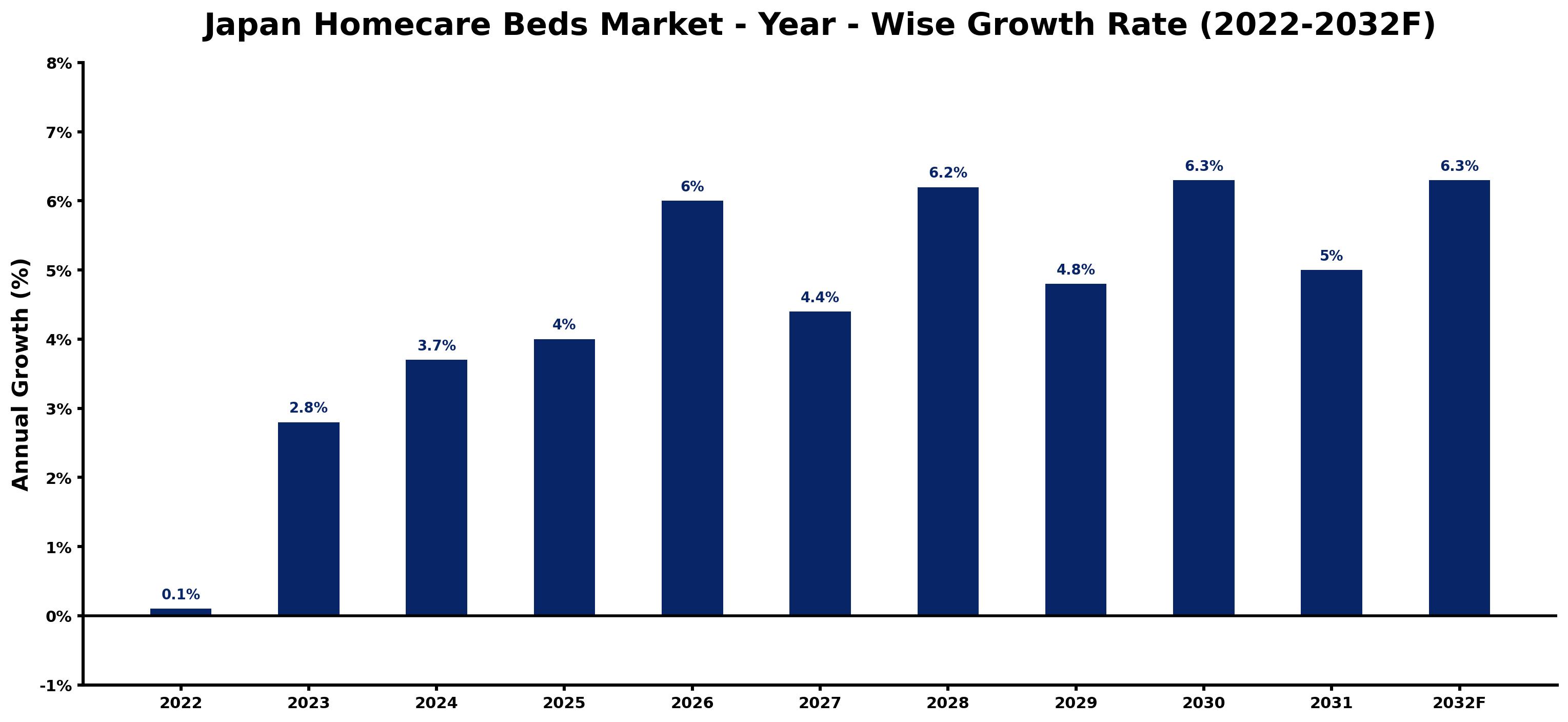
Annual growth estimates for each year appear below with the principal reason behind them, explaining the shifts that set the pace of the market.
| Year | Estimated Annual Growth (%) | Market Rationale |
| 2022 | 0.1 | The market experienced minimal growth as demand began to stabilise amid ongoing healthcare needs. |
| 2023 | 2.8 | Growth accelerated as healthcare providers increased investments in homecare solutions for the elderly. |
| 2024 | 3.7 | Demand continued to rise, driven by a growing number of assisted living facilities requiring homecare beds. |
| 2025 | 4.0 | The market peaked historically as healthcare expenditure surged, reflecting increased consumer spending on homecare solutions. |
| 2026 | 6.0 | Growth is expected to remain strong as the elderly population continues to expand, driving demand for specialized beds. |
| 2027 | 4.4 | A slowdown in growth is anticipated as market conditions normalise after the previous peak in 2025. |
| 2028 | 6.2 | Demand is projected to rise again as innovations in bed technology attract more buyers seeking comfort and safety. |
| 2029 | 4.8 | Growth is expected to slow as the market adjusts to previous expansions, yet demand remains positive. |
| 2030 | 6.3 | The market is likely to experience renewed growth as government initiatives stimulate home healthcare services. |
| 2031 | 5.0 | A slowdown is expected as the market stabilises, reflecting the maturity of homecare bed solutions. |
| 2032 | 6.3 | The market is projected to peak again, driven by sustained demand from the elderly population and healthcare facilities. |
Note: Market size estimations and growth projections presented in this report are based on 6Wresearch's proprietary forecasting methodology, utilizing the latest available industry data, government publications, and primary research inputs.
Japan Homecare Beds Market Synopsis
Homecare beds are specialized medical beds designed for patient care in home settings, ensuring comfort and safety. In Japan, the demand is driven by over 36 million elderly individuals and a growing number of assisted living homes. The Japan Homecare Beds Market is expanding due to increased healthcare expenditure, projected to exceed JPY 10 trillion by 2025, and a rising preference for homecare solutions among healthcare providers and consumers alike. This trend reflects a shift towards at-home patient care, with investments flowing into new bed technologies and improved healthcare services.
Market Dynamics Impact Analysis (2026–2032)
| Factor | Type | Impact | Primary Segment Affected |
| Growing elderly population | Driver | High | Elderly Users |
| Increased healthcare expenditure | Driver | High | Homecare Suppliers |
| Expansion of assisted living facilities | Opportunity | High | Assisted Living Homes |
| Rising demand for bariatric beds | Opportunity | Medium | Bariatric Beds |
| High costs of homecare bed replacements | Restraint | High | Manual Beds |
| Limited awareness of advanced bed features | Restraint | Medium | Electric Beds |
| Competition from alternative healthcare solutions | Challenge | High | Medical Equipment Retailers |
| Supply chain disruptions affecting availability | Challenge | Medium | Hospital Distributors |
Evaluation of Drivers in Japan Homecare Beds Market (2026–2032)
The main growth drivers and the segments they affect most are set out below.
| Drivers | Primary Segment Affected | Why It Matters (Evidence) |
| Increased elderly population | Elderly Users | 29.3% of Japan's population was aged 65 or older, driving demand for homecare beds. |
| Rising healthcare expenditure | Homecare Suppliers | Japan's national medical care expenditure was about JPY 46.7 trillion, increasing investment in homecare solutions. |
| Growth in assisted living facilities | Assisted Living Homes | The number of assisted living facilities is projected to reach 10,000 by 2025, boosting demand for homecare beds. |
| Preference for electric beds | Electric Beds | Electric beds are preferred in 70% of homecare settings, leading to higher sales. |
| Focus on bariatric care | Bariatric Beds | Bariatric beds are designed for patients over 300 kg, addressing specific healthcare needs. |
Purchasing is picking up as the elderly population in Japan grows, with over 36 million individuals aged 65 or older. In 2023, healthcare expenditure reached approximately JPY 46.7 trillion, prompting healthcare providers to invest in homecare solutions. The number of assisted living facilities is projected to increase significantly, boosting the demand for specialized beds. Electric beds, preferred in many homecare settings, are driving sales growth due to their convenience. The focus on bariatric care is rising, with beds designed for patients over 300 kg becoming essential in many healthcare facilities.
Evaluation of Restraints in Japan Homecare Beds Market
The key brakes on demand, and where they bite hardest, are shown below.
| Market Restraint | Primary Segment Affected | Why It Matters (Evidence) |
| High replacement costs for homecare beds | Manual Beds | The average lifespan of homecare beds is about 10 years, necessitating frequent replacements. |
| Limited consumer awareness of advanced features | Electric Beds | Many consumers remain unaware of the benefits of electric beds, hindering market growth. |
| Competition from alternative healthcare solutions | Medical Equipment Retailers | Alternative solutions are increasingly popular, affecting sales of homecare beds. |
| Supply chain disruptions | Hospital Distributors | Supply chain issues have delayed the availability of essential homecare beds. |
| Regulatory compliance costs | Bariatric Beds | Manufacturers face high costs to meet JIS product standards for bariatric beds. |
Japan Homecare Beds Market Challenges
Japan's rising elderly population, with over 36 million individuals aged 65 and older, drives up demand for homecare beds, straining family budgets and limiting access for buyers. Production costs escalate as suppliers face challenges in sourcing durable materials, which delays the delivery of essential equipment to healthcare facilities. Buyers encounter difficulties as the average hospital bed occupancy rate hovers around 80%, pushing them to seek homecare solutions urgently. Skills shortages in the workforce hinder producers from meeting the increasing standards set by the Japanese Association of Homecare Equipment Suppliers, resulting in longer lead times for product availability.
Trends in the Japan Homecare Beds Market
Four trends stand out in the Japan Homecare Beds Market.
- Shift from Manual to Electric Beds: Japan is experiencing a shift from manual to electric homecare beds, reflecting changing consumer preferences. In 2023, electric beds accounted for 70% of homecare settings, highlighting the demand for ease of use.
- Rising Popularity of Bariatric Beds: Bariatric beds are gaining traction due to increasing obesity rates in Japan. With a projected CAGR of 8.0%, these beds are becoming essential in healthcare facilities.
- Growth of Online Sales Channels: Online platforms are becoming a significant sales channel for homecare beds. In 2023, medical equipment retailers reported a 30% increase in online sales, indicating a shift in consumer buying behaviour.
- Expansion of Assisted Living Facilities: The number of assisted living facilities in Japan is projected to reach 10,000 by 2025. This expansion is driving demand for homecare beds tailored to resident needs.
Investment Opportunities in the Japan Homecare Beds Market
The opportunities below stand out in the Japan Homecare Beds Market for new entrants and existing suppliers.
- Timing for Investment in Bariatric Beds: With rising obesity rates, there is an urgent need for bariatric beds. The healthcare sector is investing heavily in these beds, particularly in urban areas, where demand is growing rapidly.
- Demand for Electric Beds: As consumer preferences shift towards convenience, investing in electric beds presents a promising opportunity. Medical equipment retailers are increasingly focusing on this segment, anticipating sales growth in the coming years.
- Growth in Homecare Solutions: The increasing elderly population necessitates more homecare solutions. Suppliers can target assisted living homes to meet this rising demand for specialized equipment.
- Expansion in Online Sales: The shift towards online shopping for medical equipment is accelerating. Suppliers should consider partnerships with online platforms to reach a broader audience and improve distribution.
Government Initiatives in the Japan Homecare Beds Market
The Long-Term Care Insurance Act, enacted in 1997, provides funding for essential homecare services, improving access to homecare beds by subsidising costs for consumers. This measure ensures that individuals can afford necessary equipment for home healthcare, improving the overall quality of care.
The Medical Care Act, administered by the Ministry of Health, Labour and Welfare, establishes standards for healthcare facilities. This act ensures that homecare beds meet quality and safety standards, benefiting both producers and consumers by promoting reliable products.
Future Insight of the Japan Homecare Beds Market
By 2032, buyers will see improved access to homecare beds due to government initiatives that improve home healthcare services. The Ministry of Health, Labour and Welfare's programme launched in 2023 will stimulate demand and encourage innovation in product offerings. Healthcare expenditure is expected to exceed 10 trillion yen by 2025, prompting suppliers to adopt advanced technologies for production efficiency. The anticipated increase in assisted living facilities will create new avenues for suppliers to meet the growing needs of the elderly population.
Market Segmentation Analysis
Japan Homecare Beds Market report covers a detailed analysis of the following market segments:
By Bed Type – Electric Beds Lead, Bariatric Beds Expected to Grow Fastest
According to Saurav Kr Singh, Senior Research Analyst at 6Wresearch, in 2025, Electric Beds led the bed type split with a 44% share. Electric beds hold the largest share due to their ease of adjustment, making them ideal for patients requiring frequent repositioning. For instance, in homecare settings, these beds are preferred in 70% of cases, reflecting their widespread acceptance among users. Bariatric Beds are projected to grow fastest, at a CAGR of 8.0% during 2026–2032. Bariatric beds are experiencing rapid growth driven by rising obesity rates, with increasing demand for beds that support patients weighing over 300 kg. This segment's growth is likely to continue as the population's health needs evolve. Suppliers should focus on expanding their bariatric bed offerings to meet the growing demand.
By Functionality – Motorized Leads and Records the Fastest Growth
Motorized held 49% of the Japan Homecare Beds Market by functionality in 2025. Motorized beds command the largest market share because they provide automated adjustments that enhance patient comfort and care efficiency. This feature is particularly important in homecare settings, where user satisfaction is crucial for recovery and overall quality of life. Motorized is also forecast to expand faster than any other category, at a CAGR of 7.5% over 2026–2032. The motorized segment is also witnessing the highest growth rate due to continuous technological improvements that enhance usability and patient satisfaction. This trend indicates that the lead of motorized beds will likely expand as more users appreciate the benefits of automation. Suppliers should prioritise advancements in motorized bed technology to maintain competitiveness in a growing market.
By Distribution Channel – Medical Equipment Retailers Lead, Online Platforms Expected to Grow Fastest
The largest distribution channel category in 2025 was Medical Equipment Retailers, at 52% of revenue. Medical equipment retailers are the leading distribution channel, offering direct access to consumers in search of homecare beds. Their established presence and reputation in the market build trust, which is vital for consumer purchasing decisions. Over 2026–2032, Online Platforms are expected to post the fastest growth, at a CAGR of 7.2%. Online platforms are rapidly becoming the fastest-growing distribution channel, reflecting a shift in consumer preferences towards more convenient purchasing options. This trend suggests that suppliers must adapt to an increasing demand for online sales opportunities. Suppliers need to enhance their online sales strategies to effectively engage the expanding consumer base that prefers digital purchasing.
By End User – Elderly Users Lead, Assisted Living Homes Expected to Grow Fastest
Elderly Users accounted for 47% of the market by end user in 2025. Elderly users represent the largest segment of the market, as they constitute a significant portion of the population requiring homecare solutions. With over 36 million elderly individuals in Japan, their need for comfort and safety in homecare beds drives substantial market share. The quickest growth will come from Assisted Living Homes, forecast to expand at a CAGR of 7.1% between 2026 and 2032. Assisted living homes are the fastest-growing end user segment, as they are essential for providing care to residents. The projected increase in the number of such facilities underscores the rising demand for specialised homecare bed solutions. Suppliers should concentrate on developing products specifically designed for assisted living homes to address the growing need for specialised care equipment.
Key Attractiveness of the Report
- 10 Years of Market Numbers
- Historical Data Starting from 2022 to 2025
- Base Year 2025
- Forecast Data until 2032
- Key Performance Indicators Impacting the Market
- Major Upcoming Developments and Projects
Key Highlights of the Report:
- Japan Homecare Beds Market Outlook
- Market Size of Japan Homecare Beds Market, 2025
- Forecast of Japan Homecare Beds Market, 2032
- Historical Data and Forecast of Japan Homecare Beds Revenues & Volume for the Period 2022-2032F
- Japan Homecare Beds Market Trend Evolution
- Japan Homecare Beds Market Drivers and Challenges
- Japan Homecare Beds Price Trends
- Japan Homecare Beds Porter's Five Forces
- Japan Homecare Beds Industry Life Cycle
- Historical Data and Forecast of Japan Homecare Beds Market Revenues & Volume By Bed Type for the Period 2022-2032F
- Historical Data and Forecast of Japan Homecare Beds Market Revenues & Volume By Manual Beds for the Period 2022-2032F
- Historical Data and Forecast of Japan Homecare Beds Market Revenues & Volume By Electric Beds for the Period 2022-2032F
- Historical Data and Forecast of Japan Homecare Beds Market Revenues & Volume By Semi-Electric Beds for the Period 2022-2032F
- Historical Data and Forecast of Japan Homecare Beds Market Revenues & Volume By Bariatric Beds for the Period 2022-2032F
- Historical Data and Forecast of Japan Homecare Beds Market Revenues & Volume By Functionality for the Period 2022-2032F
- Historical Data and Forecast of Japan Homecare Beds Market Revenues & Volume By Foldable Frames for the Period 2022-2032F
- Historical Data and Forecast of Japan Homecare Beds Market Revenues & Volume By Motorized for the Period 2022-2032F
- Historical Data and Forecast of Japan Homecare Beds Market Revenues & Volume By Hybrid Control for the Period 2022-2032F
- Historical Data and Forecast of Japan Homecare Beds Market Revenues & Volume By Heavy-Duty for the Period 2022-2032F
- Historical Data and Forecast of Japan Homecare Beds Market Revenues & Volume By Distribution Channel for the Period 2022-2032F
- Historical Data and Forecast of Japan Homecare Beds Market Revenues & Volume By Medical Equipment Retailers for the Period 2022-2032F
- Historical Data and Forecast of Japan Homecare Beds Market Revenues & Volume By Homecare Suppliers for the Period 2022-2032F
- Historical Data and Forecast of Japan Homecare Beds Market Revenues & Volume By Online Platforms for the Period 2022-2032F
- Historical Data and Forecast of Japan Homecare Beds Market Revenues & Volume By Hospital Distributors for the Period 2022-2032F
- Historical Data and Forecast of Japan Homecare Beds Market Revenues & Volume By End User for the Period 2022-2032F
- Historical Data and Forecast of Japan Homecare Beds Market Revenues & Volume By Post-Surgery Patients for the Period 2022-2032F
- Historical Data and Forecast of Japan Homecare Beds Market Revenues & Volume By Elderly Users for the Period 2022-2032F
- Historical Data and Forecast of Japan Homecare Beds Market Revenues & Volume By Assisted Living Homes for the Period 2022-2032F
- Historical Data and Forecast of Japan Homecare Beds Market Revenues & Volume By Obese Patients for the Period 2022-2032F
- Japan Homecare Beds Import Export Trade Statistics
- Market Opportunity Assessment By Bed Type
- Market Opportunity Assessment By Functionality
- Market Opportunity Assessment By Distribution Channel
- Market Opportunity Assessment By End User
- Japan Homecare Beds Top Companies Market Share
- Japan Homecare Beds Competitive Benchmarking By Technical and Operational Parameters
- Japan Homecare Beds Company Profiles
- Japan Homecare Beds Key Strategic Recommendations
Market Covered
The following segment groups are covered in the report.
By Bed Type
- Manual Beds
- Electric Beds
- Semi-Electric Beds
- Bariatric Beds
By Functionality
- Foldable Frames
- Motorized
- Hybrid Control
- Heavy-Duty
By Distribution Channel
- Medical Equipment Retailers
- Homecare Suppliers
- Online Platforms
- Hospital Distributors
By End User
- Post-Surgery Patients
- Elderly Users
- Assisted Living Homes
- Obese Patients































