Japan Hospital Acquired Condition Treatment Market Size & Growth Rate
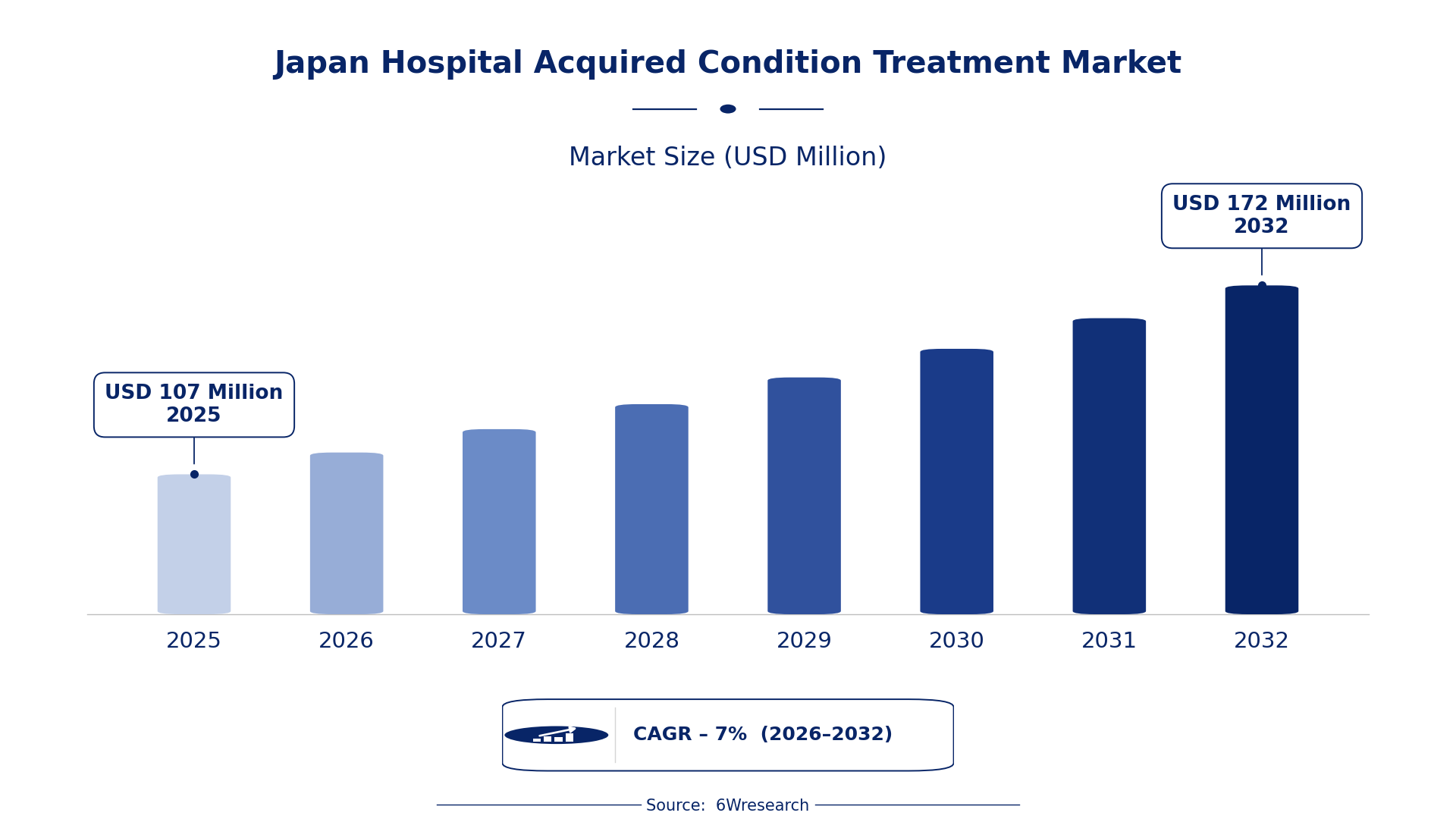
According to 6Wresearch internal database and industry insights, the Japan Hospital Acquired Condition Treatment Market was valued at USD 107 Million in 2025 and is projected to reach USD 172 Million by 2032, growing at a CAGR of approximately 7% during 2026–2032.
Japan Hospital Acquired Condition Treatment Market Highlights
| Report Metric | Details |
| Report Name | Japan Hospital Acquired Condition Treatment Market (2026-2032) |
| Market Size 2025 | USD 107 Million |
| Market Size 2032 | USD 172 Million |
| Absolute Growth 2025–2032 | USD 65 Million |
| CAGR 2026–2032 | 7% |
| Peak Annual Growth | 7.5% in 2027 |
| Forecast Period | 2026–2032 |
| Historical Data | 2022–2025 |
| Base Year | 2025 |
| Leading Condition Type, 2025 | Pressure Ulcers (46% share) |
| Leading Treatment Method, 2025 | Antibiotic Therapy (39% share) |
| Leading Distribution Channel, 2025 | Hospital Suppliers (44% share) |
| Leading End User, 2025 | ICU Departments (46% share) |
| Fastest-Growing Condition Type | DVT (Clot Prevention) (9.6% CAGR) |
| Fastest-Growing Treatment Method | Rehab Devices (10.0% CAGR) |
| Fastest-Growing Distribution Channel | Clinics (9.0% CAGR) |
| Fastest-Growing End User | Urology Departments (8.8% CAGR) |
| Growing Sector | Urology Departments |
| Key End Users | ICU Departments, Surgery Units, Urology Departments, Geriatric Units |
Japan Hospital Acquired Condition Treatment Market Year-wise Growth Rate and Key Drivers (2022–2032)
This graph illustrates the annual growth rates of the market from 2022 to 2032, highlighting a steady upward trajectory and projected market expansion over the forecast period.
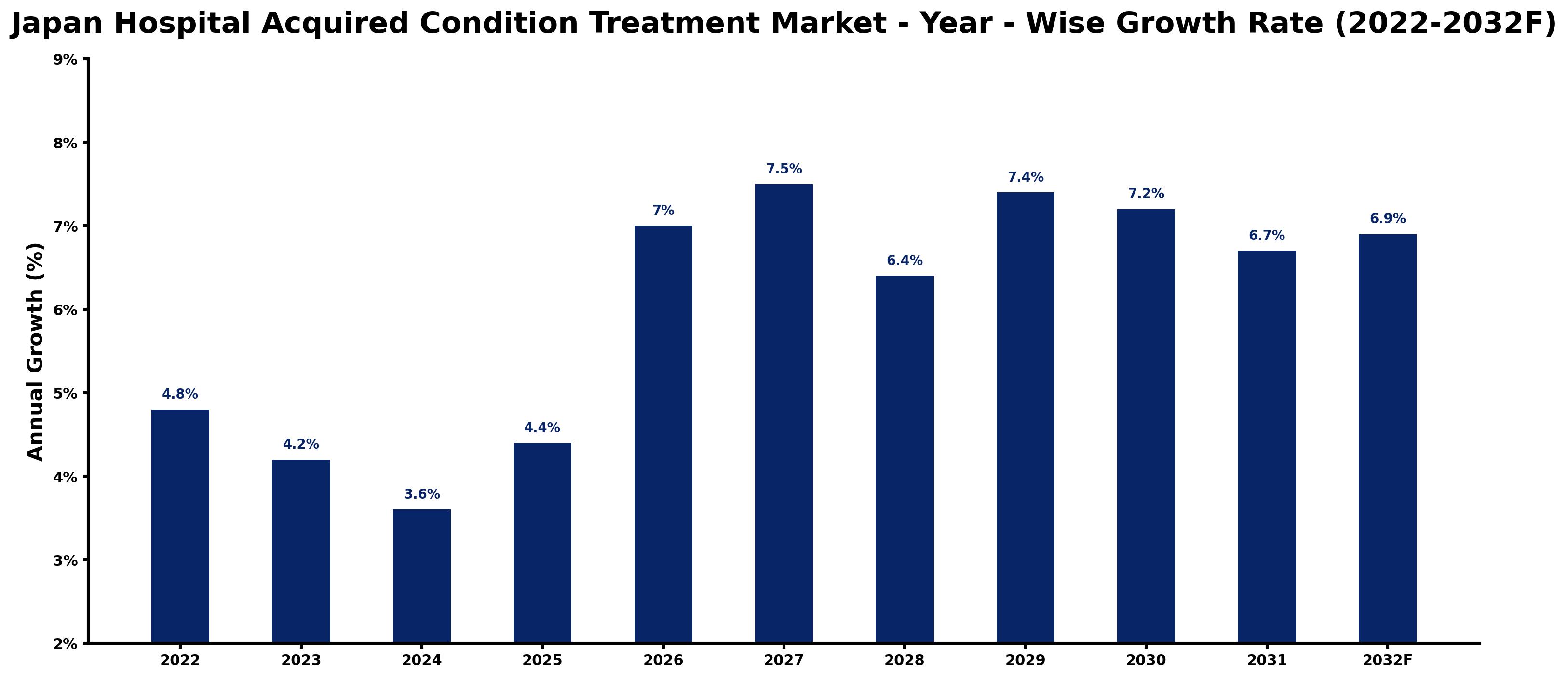
Annual growth estimates for each year appear below with the principal reason behind them, explaining the shifts that set the pace of the market.
| Year | Estimated Annual Growth (%) | Market Rationale |
| 2022 | 4.8 | The market experienced solid demand due to high hospitalisation rates and increased awareness of hospital-acquired conditions. |
| 2023 | 4.2 | Growth slowed as hospitals focused on reducing costs amid rising healthcare expenditures. |
| 2024 | 3.6 | The market continued to slow as hospitals adjusted to new treatment protocols and standards. |
| 2025 | 4.4 | Demand increased as hospitals invested in advanced treatment solutions to improve patient outcomes. |
| 2026 | 7.0 | Growth is expected to accelerate as healthcare providers adopt new technologies and treatment methods. |
| 2027 | 7.5 | The market is projected to peak with strong investments in infection control and patient care technologies. |
| 2028 | 6.4 | Growth will slow as hospitals face challenges in managing costs while maintaining quality care. |
| 2029 | 7.4 | Demand is expected to rise as hospitals implement improved protocols for managing hospital-acquired conditions. |
| 2030 | 7.2 | Growth will moderate as healthcare providers focus on efficiency and cost containment strategies. |
| 2031 | 6.7 | The market is projected to continue growing as patient demographics shift towards older populations requiring more care. |
| 2032 | 6.9 | Demand is expected to increase with advancements in treatment technologies and a growing focus on patient safety. |
Note: Market size estimations and growth projections presented in this report are based on 6Wresearch's proprietary forecasting methodology, utilizing the latest available industry data, government publications, and primary research inputs.
Japan Hospital Acquired Condition Treatment Market Synopsis
Hospital Acquired Condition Treatment involves medical interventions for conditions acquired during hospital stays, such as infections and injuries. The Japan Hospital Acquired Condition Treatment Market is expanding due to rising healthcare expenditures, with national medical care expenditure reaching approximately JPY 46.7 trillion in fiscal 2022.
Market Dynamics Impact Analysis (2026–2032)
| Factor | Type | Impact | Primary Segment Affected |
| Increasing prevalence of hospital-acquired infections | Driver | High | Antibiotic Therapy |
| Growing elderly population requiring hospital care | Driver | High | Pressure Ulcers |
| Expansion of infection control programs | Opportunity | High | DVT (Clot Prevention) |
| Rising demand for advanced treatment solutions | Opportunity | High | Catheter Infections |
| High costs associated with hospital-acquired conditions | Restraint | High | Fall Injuries |
| Limited awareness of treatment options among healthcare providers | Restraint | Medium | Anticoagulants |
| Inadequate training for healthcare professionals | Challenge | High | Rehab Devices |
| Regulatory compliance costs for hospitals | Challenge | Medium | Dressings |
Evaluation of Drivers in Japan Hospital Acquired Condition Treatment Market (2026–2032)
These are the developments adding the most demand over the forecast period.
| Drivers | Primary Segment Affected | Why It Matters (Evidence) |
| Increased healthcare expenditure | Antibiotic Therapy | Japan's national medical care expenditure was about JPY 46.7 trillion in fiscal 2022, driving demand for effective treatments. |
| High prevalence of hospital-acquired conditions | Pressure Ulcers | The prevalence of pressure ulcers in hospitals is estimated at 15% of patients, necessitating improved treatment options. |
| Government funding for infection control | DVT (Clot Prevention) | The Ministry of Health, Labour and Welfare allocated ¥5 billion for infection control initiatives in 2023, boosting demand. |
| Aging population increasing hospital stays | Catheter Infections | 29.3% of Japan's population was aged 65 or older in September 2024, leading to higher rates of hospital-acquired conditions. |
| Clinical guidelines promoting best practices | Fall Injuries | The Japanese Society of Wound Care Management provides guidelines for treatment, influencing hospital purchasing decisions. |
Much of the new demand traces back to increased healthcare expenditure, with Japan's national medical care expenditure reaching about JPY 46.7 trillion in fiscal 2022. The growing prevalence of hospital-acquired conditions drives hospitals to seek effective treatment solutions. The aging population, with a significant portion aged 65 or older, increases hospital stays, resulting in a higher incidence of hospital-acquired conditions. Clinical guidelines from the Japanese Society of Wound Care Management encourage hospitals to adopt best practices in treatment, further boosting demand.
Evaluation of Restraints in Japan Hospital Acquired Condition Treatment Market
The table below lists the restraints and the evidence behind each.
| Market Restraint | Primary Segment Affected | Why It Matters (Evidence) |
| Inadequate training for healthcare professionals | Antibiotic Therapy | Inconsistent treatment of hospital-acquired conditions results in longer recovery times for patients. |
| Supply chain disruptions for essential medical supplies | DVT (Clot Prevention) | Delays in treatment can increase hospital costs and extend patient stays. |
| Regulatory changes creating administrative burdens | Catheter Infections | New laws mandating reporting of hospital-acquired infections divert resources away from patient care. |
| Technological adoption lagging in some facilities | Fall Injuries | Limited access to advanced treatment methods compromises patient outcomes in hospitals. |
| High competition among treatment providers | Pressure Ulcers | Intense competition can lead to price wars, affecting profitability for suppliers. |
Japan Hospital Acquired Condition Treatment Market Challenges
Inadequate training for healthcare professionals results in inconsistent management of hospital-acquired conditions, causing increased recovery times and higher costs for hospitals. Supply chain disruptions for essential medical supplies can delay treatments, contributing to an average hospital stay of 17.5 days, which escalates expenses for healthcare facilities. New regulations, such as mandatory reporting of hospital-acquired infections, create additional administrative burdens on hospitals, diverting resources from patient care. Slow adoption of advanced technologies limits access to effective treatment methods, ultimately compromising patient outcomes in hospitals.
Trends in the Japan Hospital Acquired Condition Treatment Market
Four trends stand out in the Japan Hospital Acquired Condition Treatment Market.
- Shift towards Advanced Treatment Technologies: Japan is increasingly adopting advanced treatment technologies for hospital-acquired conditions, focusing on improving patient outcomes. In 2023, the government allocated ¥5 billion for infection control initiatives, driving innovation in treatment protocols.
- Increase in Infection Control Programs: The number of infection control programs in hospitals has risen, with a 30% reduction target for hospital-acquired infections set by the government in 2023. This shift is enhancing patient safety and care quality.
- Growing Demand for Specialized Training: There is a heightened focus on specialized training for healthcare professionals to manage hospital-acquired conditions effectively. In 2023, over 8,000 hospitals participated in training programs to improve treatment standards.
- Expansion of Rehabilitation Services: The use of rehabilitation services is growing, particularly in post-operative care. The Japanese Association of Rehabilitation Medicine reported an increase in the adoption of rehab devices, focusing on improving recovery outcomes.
Investment Opportunities in the Japan Hospital Acquired Condition Treatment Market
Below are the investment opportunities with the strongest case in the Japan Hospital Acquired Condition Treatment Market.
- Partnerships with Healthcare Providers: Investing in partnerships with hospitals can bridge the gap in treatment solutions. With over 8,100 hospitals in Japan, collaboration can improve service delivery and patient outcomes.
- Market for Infection Control Products: The infection control product market is projected to grow, with a significant funding boost of ¥5 billion in 2023. Suppliers can target hospitals focusing on infection prevention strategies.
- Development of Advanced Treatment Devices: There is an opportunity to develop advanced treatment devices for hospital-acquired conditions, especially in ICU Departments, which accounted for 46% of treatment use in 2025.
- Expansion into Geriatric Care: As the aging population grows, investing in solutions for geriatric units is critical. The average age of patients in these units is over 75, increasing the demand for specialized treatments.
Government Initiatives in the Japan Hospital Acquired Condition Treatment Market
The Medical Care Act (1948; MHLW) establishes standards for hospitals and clinics, ensuring quality care for patients. Compliance with this act is essential for hospitals to provide effective treatments for hospital-acquired conditions, as it mandates adequate staffing and facility requirements.
The PMD Act regulates the approval and quality of pharmaceuticals and medical devices. This ensures that hospitals can access safe and effective treatments for managing hospital-acquired conditions, facilitating better patient outcomes.
Future Insight of the Japan Hospital Acquired Condition Treatment Market
Hospitals will increasingly implement advanced technologies, such as telemedicine and AI diagnostics, to improve treatment efficiency by 2032. The government’s investment in infection control initiatives will lead to improved protocols that enhance patient safety and care quality. Training programmes will equip healthcare professionals with the skills needed to effectively manage hospital-acquired conditions. As a result, buyers will see better patient outcomes, while suppliers will face growing demand for innovative treatment solutions.
Market Segmentation Analysis
Japan Hospital Acquired Condition Treatment Market report covers a detailed analysis of the following market segments:
By Condition Type – Pressure Ulcers Lead, DVT (Clot Prevention) Expected to Grow Fastest
According to Saurav Kr Singh, Senior Research Analyst at 6Wresearch, with 46% of condition type revenue in 2025, Pressure Ulcers was the largest category. Pressure ulcers represent a critical challenge in hospitals, particularly among patients with limited mobility, leading to their dominant share. With an estimated prevalence of 15% among hospitalised patients, this condition necessitates extensive treatment resources and protocols. Over 2026–2032, DVT (Clot Prevention) is expected to post the fastest growth, at a CAGR of 9.6%. The rapid growth of DVT prevention is propelled by strict protocols mandated in major surgical units across Japan, ensuring that over 80% of surgical patients receive anticoagulant therapy. This focus on prevention is expected to drive further advancements in treatment methods. Suppliers should prioritise developing targeted solutions for DVT prevention to capitalise on this growing demand.
By Treatment Method – Antibiotic Therapy Leads, Rehab Devices Expected to Grow Fastest
Antibiotic Therapy took 39% of treatment method revenue in 2025, more than any other category. Antibiotic therapy is essential for managing infections acquired during hospital stays, making it a primary choice among healthcare providers. Its extensive use in treating hospital-acquired infections ensures a steady demand across numerous healthcare facilities in Japan. The quickest growth will come from Rehab Devices, forecast to expand at a CAGR of 10.0% between 2026 and 2032. The increasing emphasis on rehabilitation devices stems from their acknowledged role in supporting recovery after surgical procedures. This trend is highlighted by healthcare providers integrating these devices into their post-operative care protocols more frequently. Suppliers should consider expanding their product offerings to include rehabilitation solutions to address the rising demand in the market.
By Distribution Channel – Hospital Suppliers Lead, Clinics Expected to Grow Fastest
The largest distribution channel category in 2025 was Hospital Suppliers, at 44% of revenue. Hospital suppliers are the primary channel for distributing medical supplies, ensuring that hospitals have the necessary resources to manage hospital-acquired conditions effectively. Their established relationships with healthcare facilities solidify their leading position in the market. Clinics are set to record the highest CAGR in this split, 9.0% over 2026–2032. Clinics are experiencing growth as they play a supportive role in outpatient management of conditions, reflecting a shift towards decentralised care. This trend is likely to continue as healthcare systems adapt to changing patient needs. Suppliers must consider expanding their distribution strategies to include clinics to reach a broader patient base.
By End User – ICU Departments Lead, Urology Departments Expected to Grow Fastest
ICU Departments accounted for 46% of the market by end user in 2025. ICU departments are the main users of treatments for severe hospital-acquired conditions, establishing their dominant position in the market. The critical care setting requires advanced treatment options to effectively manage complex patient needs. Urology Departments are projected to grow fastest, at a CAGR of 8.8% during 2026–2032. Urology departments are witnessing rapid growth due to the heightened awareness of the necessity for effective treatments for catheter-related infections. This increasing focus on specialised care is poised to significantly boost their market share. Suppliers must tailor their strategies to meet the specific needs of urology departments to take advantage of this growth opportunity.
Key Attractiveness of the Report
- 10 Years of Market Numbers
- Historical Data Starting from 2022 to 2025
- Base Year 2025
- Forecast Data until 2032
- Key Performance Indicators Impacting the Market
- Major Upcoming Developments and Projects
Key Highlights of the Report:
- Japan Hospital Acquired Condition Treatment Market Outlook
- Market Size of Japan Hospital Acquired Condition Treatment Market, 2025
- Forecast of Japan Hospital Acquired Condition Treatment Market, 2032
- Historical Data and Forecast of Japan Hospital Acquired Condition Treatment Revenues & Volume for the Period 2022-2032F
- Japan Hospital Acquired Condition Treatment Market Trend Evolution
- Japan Hospital Acquired Condition Treatment Market Drivers and Challenges
- Japan Hospital Acquired Condition Treatment Price Trends
- Japan Hospital Acquired Condition Treatment Porter's Five Forces
- Japan Hospital Acquired Condition Treatment Industry Life Cycle
- Historical Data and Forecast of Japan Hospital Acquired Condition Treatment Market Revenues & Volume By Condition Type for the Period 2022-2032F
- Historical Data and Forecast of Japan Hospital Acquired Condition Treatment Market Revenues & Volume By Pressure Ulcers for the Period 2022-2032F
- Historical Data and Forecast of Japan Hospital Acquired Condition Treatment Market Revenues & Volume By DVT (Clot Prevention) for the Period 2022-2032F
- Historical Data and Forecast of Japan Hospital Acquired Condition Treatment Market Revenues & Volume By Catheter Infections for the Period 2022-2032F
- Historical Data and Forecast of Japan Hospital Acquired Condition Treatment Market Revenues & Volume By Fall Injuries for the Period 2022-2032F
- Historical Data and Forecast of Japan Hospital Acquired Condition Treatment Market Revenues & Volume By Treatment Method for the Period 2022-2032F
- Historical Data and Forecast of Japan Hospital Acquired Condition Treatment Market Revenues & Volume By Dressings for the Period 2022-2032F
- Historical Data and Forecast of Japan Hospital Acquired Condition Treatment Market Revenues & Volume By Anticoagulants for the Period 2022-2032F
- Historical Data and Forecast of Japan Hospital Acquired Condition Treatment Market Revenues & Volume By Antibiotic Therapy for the Period 2022-2032F
- Historical Data and Forecast of Japan Hospital Acquired Condition Treatment Market Revenues & Volume By Rehab Devices for the Period 2022-2032F
- Historical Data and Forecast of Japan Hospital Acquired Condition Treatment Market Revenues & Volume By Distribution Channel for the Period 2022-2032F
- Historical Data and Forecast of Japan Hospital Acquired Condition Treatment Market Revenues & Volume By Hospital Suppliers for the Period 2022-2032F
- Historical Data and Forecast of Japan Hospital Acquired Condition Treatment Market Revenues & Volume By Clinics for the Period 2022-2032F
- Historical Data and Forecast of Japan Hospital Acquired Condition Treatment Market Revenues & Volume By Specialty Pharmacies for the Period 2022-2032F
- Historical Data and Forecast of Japan Hospital Acquired Condition Treatment Market Revenues & Volume By Medical Stores for the Period 2022-2032F
- Historical Data and Forecast of Japan Hospital Acquired Condition Treatment Market Revenues & Volume By End User for the Period 2022-2032F
- Historical Data and Forecast of Japan Hospital Acquired Condition Treatment Market Revenues & Volume By ICU Departments for the Period 2022-2032F
- Historical Data and Forecast of Japan Hospital Acquired Condition Treatment Market Revenues & Volume By Surgery Units for the Period 2022-2032F
- Historical Data and Forecast of Japan Hospital Acquired Condition Treatment Market Revenues & Volume By Urology Departments for the Period 2022-2032F
- Historical Data and Forecast of Japan Hospital Acquired Condition Treatment Market Revenues & Volume By Geriatric Units for the Period 2022-2032F
- Japan Hospital Acquired Condition Treatment Import Export Trade Statistics
- Market Opportunity Assessment By Condition Type
- Market Opportunity Assessment By Treatment Method
- Market Opportunity Assessment By Distribution Channel
- Market Opportunity Assessment By End User
- Japan Hospital Acquired Condition Treatment Top Companies Market Share
- Japan Hospital Acquired Condition Treatment Competitive Benchmarking By Technical and Operational Parameters
- Japan Hospital Acquired Condition Treatment Company Profiles
- Japan Hospital Acquired Condition Treatment Key Strategic Recommendations
Market Covered
The following segment groups are covered in the report.
By Condition Type
- Pressure Ulcers
- DVT (Clot Prevention)
- Catheter Infections
- Fall Injuries
By Treatment Method
- Dressings
- Anticoagulants
- Antibiotic Therapy
- Rehab Devices
By Distribution Channel
- Hospital Suppliers
- Clinics
- Specialty Pharmacies
- Medical Stores
By End User
- ICU Departments
- Surgery Units
- Urology Departments
- Geriatric Units































