Japan Hospital Acquired Infection Testing Market Size & Growth Rate
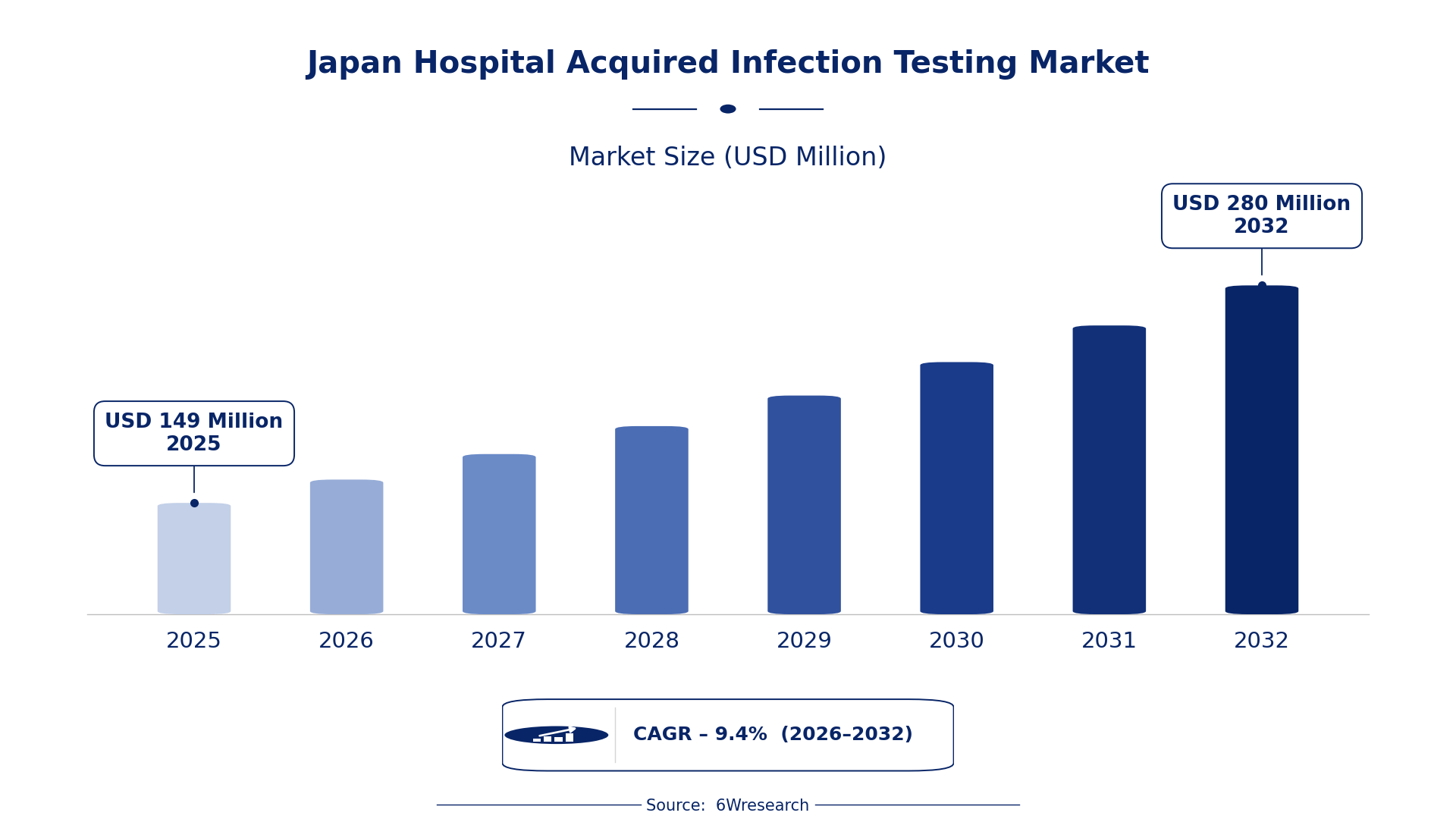
According to 6Wresearch internal database and industry insights, the Japan Hospital Acquired Infection Testing Market was valued at USD 149 Million in 2025 and is projected to reach USD 280 Million by 2032, growing at a CAGR of approximately 9.4% during 2026–2032.
Japan Hospital Acquired Infection Testing Market Highlights
| Report Metric | Details |
| Report Name | Japan Hospital Acquired Infection Testing Market (2026-2032) |
| Market Size 2025 | USD 149 Million |
| Market Size 2032 | USD 280 Million |
| Absolute Growth 2025–2032 | USD 131 Million |
| CAGR 2026–2032 | 9.4% |
| Peak Annual Growth | 10.1% in 2028 |
| Forecast Period | 2026–2032 |
| Historical Data | 2022–2025 |
| Base Year | 2025 |
| Leading Test Type, 2025 | MRSA Testing (43% share) |
| Leading Pathogen Targeted, 2025 | Bacteria (41% share) |
| Leading Distribution Channel, 2025 | Diagnostic Labs (39% share) |
| Leading End User, 2025 | Hospitals (39% share) |
| Fastest-Growing Test Type | VRE Testing (12.8% CAGR) |
| Fastest-Growing Pathogen Targeted | Resistant Strains (11.8% CAGR) |
| Fastest-Growing Distribution Channel | Online Distributors (12.2% CAGR) |
| Fastest-Growing End User | ICU Units (11.7% CAGR) |
| Growing Sector | Healthcare |
| Key End Users | Hospitals, Diagnostic Labs, Medical Test Providers, ICU Units |
Japan Hospital Acquired Infection Testing Market Year-wise Growth Rate and Key Drivers (2022–2032)
This graph illustrates the annual growth rates of the market from 2022 to 2032, highlighting a steady upward trajectory and projected market expansion over the forecast period.
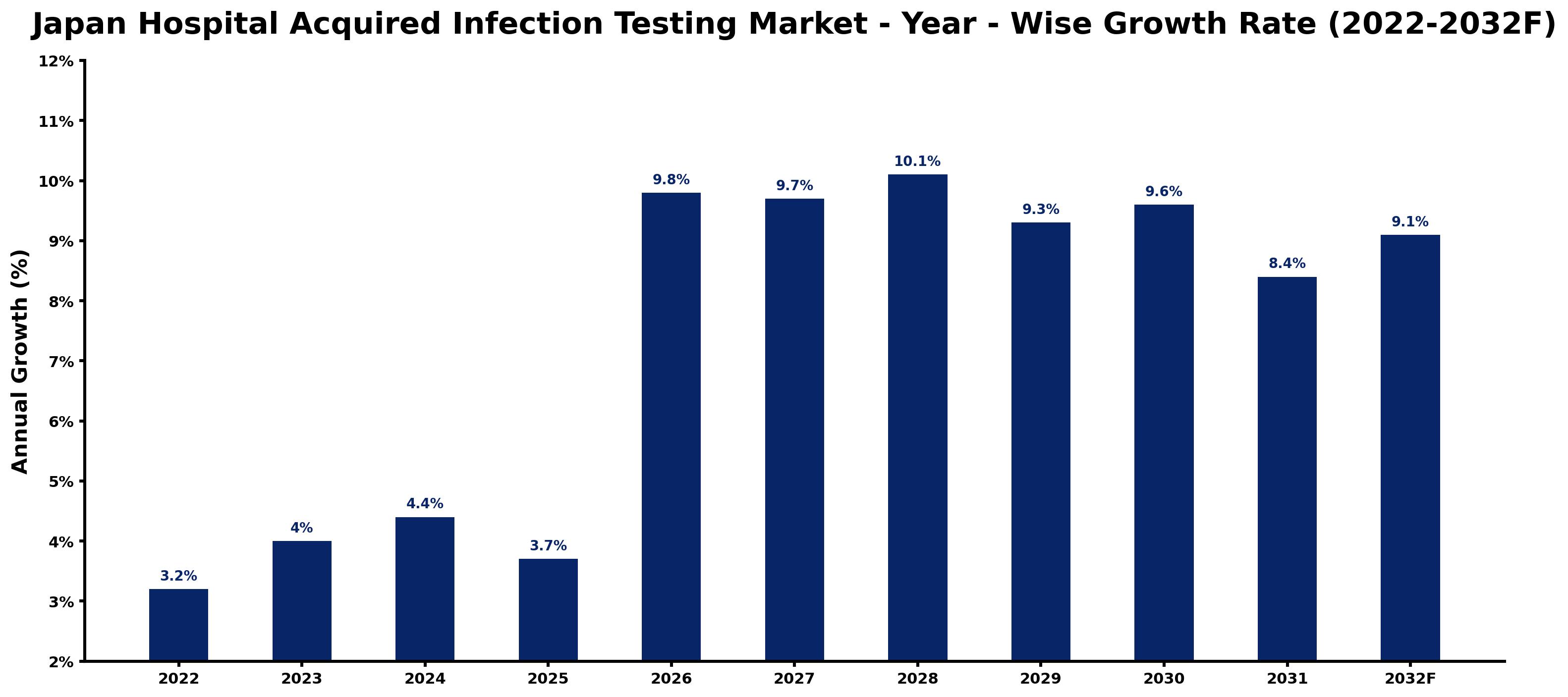
The table below sets out the estimated growth rate for each year and the main factor behind it.
| Year | Estimated Annual Growth (%) | Market Rationale |
| 2022 | 3.2 | The market showed steady growth, reflecting ongoing healthcare demands. |
| 2023 | 4.0 | Growth accelerated as hospitals increased investments in infection control measures. |
| 2024 | 4.4 | Demand continued to rise, driven by heightened awareness of infection risks. |
| 2025 | 3.7 | Growth slowed slightly as hospitals adjusted to new guidelines and standards. |
| 2026 | 9.8 | A surge in testing demand emerged as hospitals expanded their infection control programs. |
| 2027 | 9.7 | Growth remained strong, supported by ongoing investments in healthcare infrastructure. |
| 2028 | 10.1 | The market peaked with substantial investments in advanced diagnostic technologies. |
| 2029 | 9.3 | Growth moderated as hospitals focused on consolidating gains from previous years. |
| 2030 | 9.6 | Demand increased again as hospitals implemented new infection prevention protocols. |
| 2031 | 8.4 | Growth slowed as the market stabilised after rapid expansions in testing. |
| 2032 | 9.1 | The market is projected to grow steadily, driven by ongoing healthcare needs. |
Note: Market size estimations and growth projections presented in this report are based on 6Wresearch's proprietary forecasting methodology, utilizing the latest available industry data, government publications, and primary research inputs.
Japan Hospital Acquired Infection Testing Market Synopsis
Hospital Acquired Infection Testing refers to diagnostic tests that identify infections acquired in healthcare settings, utilising advanced microbiological techniques and molecular diagnostics. The Japan Hospital Acquired Infection Testing Market is expanding due to a strong healthcare system, with over 8,000 hospitals prioritising infection control. Factors such as an aging population, projected to reach 29.3% by 2024, and the introduction of new infection control guidelines in 2023 are driving demand for these testing services.
Market Dynamics Impact Analysis (2026–2032)
| Factor | Type | Impact | Primary Segment Affected |
| Aging population increasing the prevalence of infections | Driver | High | Bacteria |
| Increased healthcare expenditure for infection control measures | Driver | High | MRSA Testing |
| Growing focus on infection prevention in hospitals | Opportunity | High | VRE Testing |
| Emerging technologies in diagnostic testing | Opportunity | Medium | Bloodstream Infection |
| Limited availability of testing resources in rural areas | Restraint | High | Diagnostic Labs |
| High operational costs for maintaining testing standards | Restraint | Medium | Hospital Labs |
| Compliance with stringent regulations on testing procedures | Challenge | High | Medical Test Providers |
| Capacity constraints in hospital laboratories | Challenge | Medium | ICU Units |
Evaluation of Drivers in Japan Hospital Acquired Infection Testing Market (2026–2032)
The following drivers explain most of the expected growth.
| Drivers | Primary Segment Affected | Why It Matters (Evidence) |
| Increase in elderly population | Bacteria | 29.3% of Japan's population was aged 65 or older in September 2024, leading to higher infection rates. |
| Rising healthcare expenditure | MRSA Testing | Japan's national medical care expenditure was about JPY 46.7 trillion in fiscal 2022, supporting infection control investments. |
| Implementation of new infection control guidelines | VRE Testing | In 2023, the Ministry of Health introduced guidelines that mandate routine testing for resistant strains. |
| Technological advancements in diagnostics | Bloodstream Infection | ISO 15189 adoption in Japan enhances laboratory testing standards, improving diagnostic accuracy. |
| Increased awareness of hospital-acquired infections | Clostridium difficile | Clostridium difficile testing is essential in over 1,000 hospitals, driving demand for effective diagnostics. |
Behind the steady rise in orders sits an increasing elderly population, with 29.3% aged 65 or older by September 2024, resulting in higher infection rates. Japan's healthcare expenditure, approximately JPY 46.7 trillion in fiscal 2022, supports investments in infection control measures. New guidelines introduced in 2023 mandate routine testing for resistant strains, boosting demand for various testing methods. Technological advancements, including improved laboratory testing standards, enhance diagnostic accuracy. Awareness of hospital-acquired infections has surged, with testing essential in numerous hospitals, further driving market growth.
Evaluation of Restraints in Japan Hospital Acquired Infection Testing Market
The main factors holding the market back are set out below.
| Market Restraint | Primary Segment Affected | Why It Matters (Evidence) |
| Limited availability of testing resources in rural areas | Diagnostic Labs | Approximately 8,100 hospitals exist, but rural areas often lack sufficient testing facilities. |
| High operational costs for maintaining testing standards | Hospital Labs | Maintaining compliance with standards incurs substantial costs for hospitals. |
| Challenges in staffing qualified laboratory personnel | Medical Test Providers | The demand for skilled technicians exceeds supply, impacting testing capacity. |
| Regulatory compliance burdens on laboratories | ICU Units | Strict regulations increase operational complexity and costs for ICU testing. |
| Limited funding for infection control initiatives | Bacteria | Healthcare expenditure is substantial, yet funding for specific infection control programs is often constrained. |
Japan Hospital Acquired Infection Testing Market Challenges
Buyers in hospitals face intense competition for infection testing services, which can reduce profit margins by 15% due to aggressive pricing. Supply chain challenges arise from reliance on a limited number of domestic suppliers for testing kits, causing delays of up to three weeks for hospitals needing quick results. Technological gaps persist, as many facilities have not adopted the latest diagnostic methods, resulting in a 20% increase in turnaround times for those that lag behind. Regulatory changes, including new infection control guidelines, impose compliance costs that can exceed ¥50 million annually for larger hospitals.
Trends in the Japan Hospital Acquired Infection Testing Market
Four trends stand out in the Japan Hospital Acquired Infection Testing Market.
- Shift towards Advanced Molecular Diagnostics: In 2023, hospitals started embracing advanced molecular diagnostics to enhance infection detection accuracy. This shift is particularly evident in the Tokyo region, where diagnostic labs have markedly improved their capabilities.
- Increased Focus on Infection Prevention: Hospitals are emphasising infection prevention strategies, with many facilities implementing new protocols since 2023. This change reflects a broader trend towards improved healthcare management.
- Growth of Diagnostic Labs in Urban Areas: The concentration of diagnostic labs in urban areas like Tokyo has risen, with 39% of testing services provided by these facilities. This trend supports quicker testing turnaround times and better patient outcomes.
- Emergence of Online Distribution Channels: Online distributors are gaining momentum, with a projected growth rate of 12.2% by 2032. This shift enables broader access to testing services, particularly in underserved regions.
Investment Opportunities in the Japan Hospital Acquired Infection Testing Market
Investors looking at the Japan Hospital Acquired Infection Testing Market should consider the following areas.
- Timing for Investment in Diagnostic Technologies: With the government allocating ¥1 billion for infection prevention programs in 2023, now presents an ideal opportunity to invest in advanced diagnostic technologies for hospitals.
- Partnerships with Diagnostic Labs: Establishing partnerships with diagnostic labs can ease market entry, especially as these facilities expand their testing capabilities to address rising demand.
- Expansion in Urban Healthcare Facilities: Urban healthcare facilities are broadening their infection control measures, creating opportunities for suppliers of diagnostic testing services to satisfy growing needs.
- Focus on Infection Control Products: There is an urgent demand for infection control products in hospitals, particularly as the government aims to reduce hospital-acquired infections by 20% by 2025.
Government Initiatives in the Japan Hospital Acquired Infection Testing Market
The Medical Care Act of 1948 establishes essential standards for hospitals and clinics, including staffing and facility requirements. This law has shaped healthcare in Japan, ensuring that hospitals maintain adequate measures for infection control. The PMD Act, renamed in 2014, regulates the approval and quality of medical devices, impacting testing protocols and equipment standards.
In 2023, the government allocated ¥1 billion for infection prevention programs, administered by the Ministry of Health, Labour and Welfare. This funding supports hospitals in implementing new technologies and practices, improving patient safety and reducing infection rates.
Future Insight of the Japan Hospital Acquired Infection Testing Market
Investment in infection prevention programmes will rise, driven by government funding of ¥1 billion and hospital initiatives, creating a demand for advanced diagnostic capabilities. By 2032, the government’s target to reduce hospital-acquired infections by 20% will push hospitals to implement more effective testing solutions. The introduction of ISO 15189 standards will improve laboratory practices, ensuring reliable results for buyers. As the elderly population expands, the demand for efficient infection testing will increase, particularly in urban areas with high patient volumes.
Market Segmentation Analysis
Japan Hospital Acquired Infection Testing Market report covers a detailed analysis of the following market segments:
By Test Type – MRSA Testing Leads, VRE Testing Expected to Grow Fastest
According to Saurav Kr Singh, Senior Research Analyst at 6Wresearch, the largest test type category in 2025 was MRSA Testing, at 43% of revenue. MRSA Testing holds the largest share as it is critical for identifying resistant infections in healthcare settings. The extensive network of over 8,100 hospitals in Japan highlights the strong demand for effective MRSA testing to ensure patient safety. VRE Testing is projected to grow fastest, at a CAGR of 12.8% during 2026–2032. VRE Testing is witnessing rapid growth due to the increasing incidence of vancomycin-resistant infections in healthcare environments. The government's target to reduce hospital-acquired infections by 20% by 2025 further intensifies the need for effective VRE testing solutions. Suppliers should enhance their VRE testing capabilities to align with rising demand and regulatory initiatives.
By Pathogen Targeted – Bacteria Leads, Resistant Strains Expected to Grow Fastest
With 41% of pathogen targeted revenue in 2025, Bacteria was the largest category. Bacteria is the leading category as it is essential for accurate pathogen identification in healthcare facilities. The robust healthcare system in Japan, with a strong focus on infection control, necessitates widespread bacterial testing. Over 2026–2032, Resistant Strains are expected to post the fastest growth, at a CAGR of 11.8%. Resistant Strains are experiencing rapid growth due to the urgent need to effectively manage antibiotic resistance. The alarming rise in resistant infections reported in hospitals underscores the critical need for testing these strains. Buyers must prioritise testing for resistant strains to ensure effective treatment and compliance with infection control protocols.
By Distribution Channel – Diagnostic Labs Lead, Online Distributors Expected to Grow Fastest
Diagnostic Labs held 39% of the Japan Hospital Acquired Infection Testing Market by distribution channel in 2025. Diagnostic Labs dominate the market as they are the main providers of testing services across Japan's extensive hospital network. Their established infrastructure and expertise make them essential for accurate infection testing. The quickest growth will come from Online Distributors, forecast to expand at a CAGR of 12.2% between 2026 and 2032. Online Distributors are growing quickly, albeit from a smaller base, as healthcare facilities seek more convenient procurement options. The shift towards digital solutions in healthcare is driving this segment's expansion. Suppliers should consider strengthening their online distribution channels to capture the growing demand for convenient testing solutions.
By End User – Hospitals Lead, ICU Units Expected to Grow Fastest
In 2025, Hospitals led the end user split with a 39% share. Hospitals are the largest end users of testing services, given their crucial role in patient care and infection management. With approximately 8,100 hospitals in Japan, the demand for testing remains consistently high to effectively control infections. ICU Units are set to record the highest CAGR in this split, 11.7% over 2026–2032. ICU Units are growing the fastest as they are vital for monitoring high-risk patients who are more susceptible to infections. The increasing number of ICU units in Japan highlights the necessity for specialised testing in these critical environments. Suppliers need to tailor their products to meet the specific requirements of ICU units, ensuring they have the necessary testing capabilities.
Key Attractiveness of the Report
- 10 Years of Market Numbers
- Historical Data Starting from 2022 to 2025
- Base Year 2025
- Forecast Data until 2032
- Key Performance Indicators Impacting the Market
- Major Upcoming Developments and Projects
Key Highlights of the Report:
- Japan Hospital Acquired Infection Testing Market Outlook
- Market Size of Japan Hospital Acquired Infection Testing Market, 2025
- Forecast of Japan Hospital Acquired Infection Testing Market, 2032
- Historical Data and Forecast of Japan Hospital Acquired Infection Testing Revenues & Volume for the Period 2022-2032F
- Japan Hospital Acquired Infection Testing Market Trend Evolution
- Japan Hospital Acquired Infection Testing Market Drivers and Challenges
- Japan Hospital Acquired Infection Testing Price Trends
- Japan Hospital Acquired Infection Testing Porter's Five Forces
- Japan Hospital Acquired Infection Testing Industry Life Cycle
- Historical Data and Forecast of Japan Hospital Acquired Infection Testing Market Revenues & Volume By Test Type for the Period 2022-2032F
- Historical Data and Forecast of Japan Hospital Acquired Infection Testing Market Revenues & Volume By MRSA Testing for the Period 2022-2032F
- Historical Data and Forecast of Japan Hospital Acquired Infection Testing Market Revenues & Volume By VRE Testing for the Period 2022-2032F
- Historical Data and Forecast of Japan Hospital Acquired Infection Testing Market Revenues & Volume By Clostridium difficile for the Period 2022-2032F
- Historical Data and Forecast of Japan Hospital Acquired Infection Testing Market Revenues & Volume By Bloodstream Infection for the Period 2022-2032F
- Historical Data and Forecast of Japan Hospital Acquired Infection Testing Market Revenues & Volume By Pathogen Targeted for the Period 2022-2032F
- Historical Data and Forecast of Japan Hospital Acquired Infection Testing Market Revenues & Volume By Bacteria for the Period 2022-2032F
- Historical Data and Forecast of Japan Hospital Acquired Infection Testing Market Revenues & Volume By Resistant Strains for the Period 2022-2032F
- Historical Data and Forecast of Japan Hospital Acquired Infection Testing Market Revenues & Volume By Stool Analysis for the Period 2022-2032F
- Historical Data and Forecast of Japan Hospital Acquired Infection Testing Market Revenues & Volume By Blood Culture for the Period 2022-2032F
- Historical Data and Forecast of Japan Hospital Acquired Infection Testing Market Revenues & Volume By Distribution Channel for the Period 2022-2032F
- Historical Data and Forecast of Japan Hospital Acquired Infection Testing Market Revenues & Volume By Diagnostic Labs for the Period 2022-2032F
- Historical Data and Forecast of Japan Hospital Acquired Infection Testing Market Revenues & Volume By Online Distributors for the Period 2022-2032F
- Historical Data and Forecast of Japan Hospital Acquired Infection Testing Market Revenues & Volume By Hospital Labs for the Period 2022-2032F
- Historical Data and Forecast of Japan Hospital Acquired Infection Testing Market Revenues & Volume By Medical Test Providers for the Period 2022-2032F
- Historical Data and Forecast of Japan Hospital Acquired Infection Testing Market Revenues & Volume By End User for the Period 2022-2032F
- Historical Data and Forecast of Japan Hospital Acquired Infection Testing Market Revenues & Volume By Hospitals for the Period 2022-2032F
- Historical Data and Forecast of Japan Hospital Acquired Infection Testing Market Revenues & Volume By ICU Units for the Period 2022-2032F
- Historical Data and Forecast of Japan Hospital Acquired Infection Testing Market Revenues & Volume By Gastroenterology Wards for the Period 2022-2032F
- Historical Data and Forecast of Japan Hospital Acquired Infection Testing Market Revenues & Volume By Hematology Clinics for the Period 2022-2032F
- Japan Hospital Acquired Infection Testing Import Export Trade Statistics
- Market Opportunity Assessment By Test Type
- Market Opportunity Assessment By Pathogen Targeted
- Market Opportunity Assessment By Distribution Channel
- Market Opportunity Assessment By End User
- Japan Hospital Acquired Infection Testing Top Companies Market Share
- Japan Hospital Acquired Infection Testing Competitive Benchmarking By Technical and Operational Parameters
- Japan Hospital Acquired Infection Testing Company Profiles
- Japan Hospital Acquired Infection Testing Key Strategic Recommendations
Market Covered
Coverage by segment is as follows.
By Test Type
- MRSA Testing
- VRE Testing
- Clostridium difficile
- Bloodstream Infection
By Pathogen Targeted
- Bacteria
- Resistant Strains
- Stool Analysis
- Blood Culture
By Distribution Channel
- Diagnostic Labs
- Online Distributors
- Hospital Labs
- Medical Test Providers
By End User
- Hospitals
- ICU Units
- Gastroenterology Wards
- Hematology Clinics































