Japan Hospital Admission Software Market Size & Growth Rate
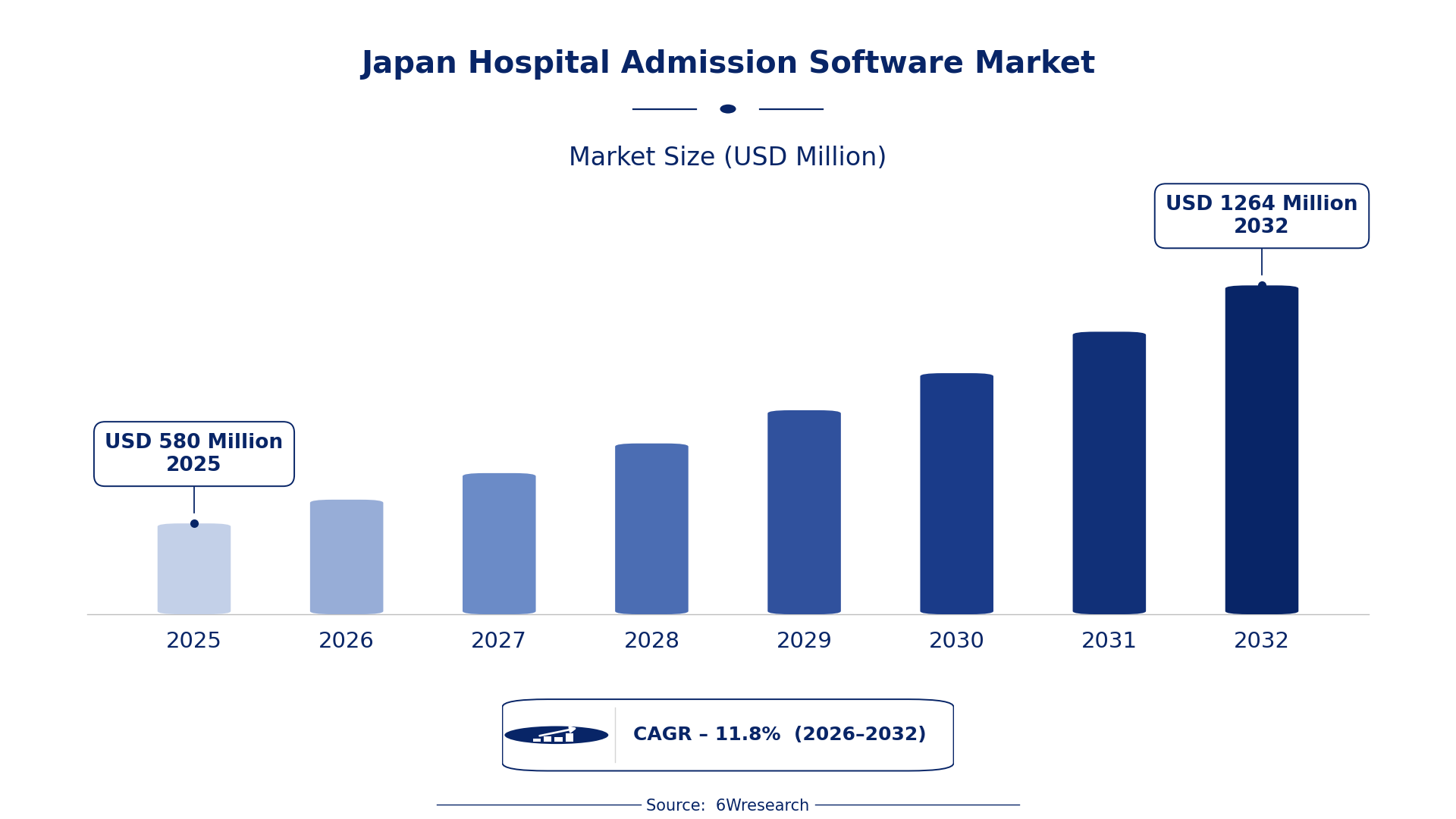
According to 6Wresearch internal database and industry insights, the Japan Hospital Admission Software Market was valued at USD 580 Million in 2025 and is projected to reach USD 1,264 Million by 2032, growing at a CAGR of approximately 11.8% during 2026–2032.
Japan Hospital Admission Software Market Highlights
| Report Metric | Details |
| Report Name | Japan Hospital Admission Software Market (2026-2032) |
| Market Size 2025 | USD 580 Million |
| Market Size 2032 | USD 1,264 Million |
| Absolute Growth 2025–2032 | USD 684 Million |
| CAGR 2026–2032 | 11.8% |
| Peak Annual Growth | 12.8% in 2028 |
| Forecast Period | 2026–2032 |
| Historical Data | 2022–2025 |
| Base Year | 2025 |
| Leading Software Type, 2025 | EHR Integration (40% share) |
| Leading Functionality, 2025 | Claims Processing (51% share) |
| Leading Distribution Channel, 2025 | SaaS Providers (36% share) |
| Leading End User, 2025 | Hospital IT Systems (43% share) |
| Fastest-Growing Software Type | Admission Scheduling (16.2% CAGR) |
| Fastest-Growing Functionality | Real-Time Booking (15.4% CAGR) |
| Fastest-Growing End User | Reception Desks (14.9% CAGR) |
| Growing Sector | hospital management systems |
| Key End Users | hospitals, healthcare providers, IT departments, administrative staff |
Japan Hospital Admission Software Market Year-wise Growth Rate and Key Drivers (2022–2032)
This graph illustrates the annual growth rates of the market from 2022 to 2032, highlighting a steady upward trajectory and projected market expansion over the forecast period.
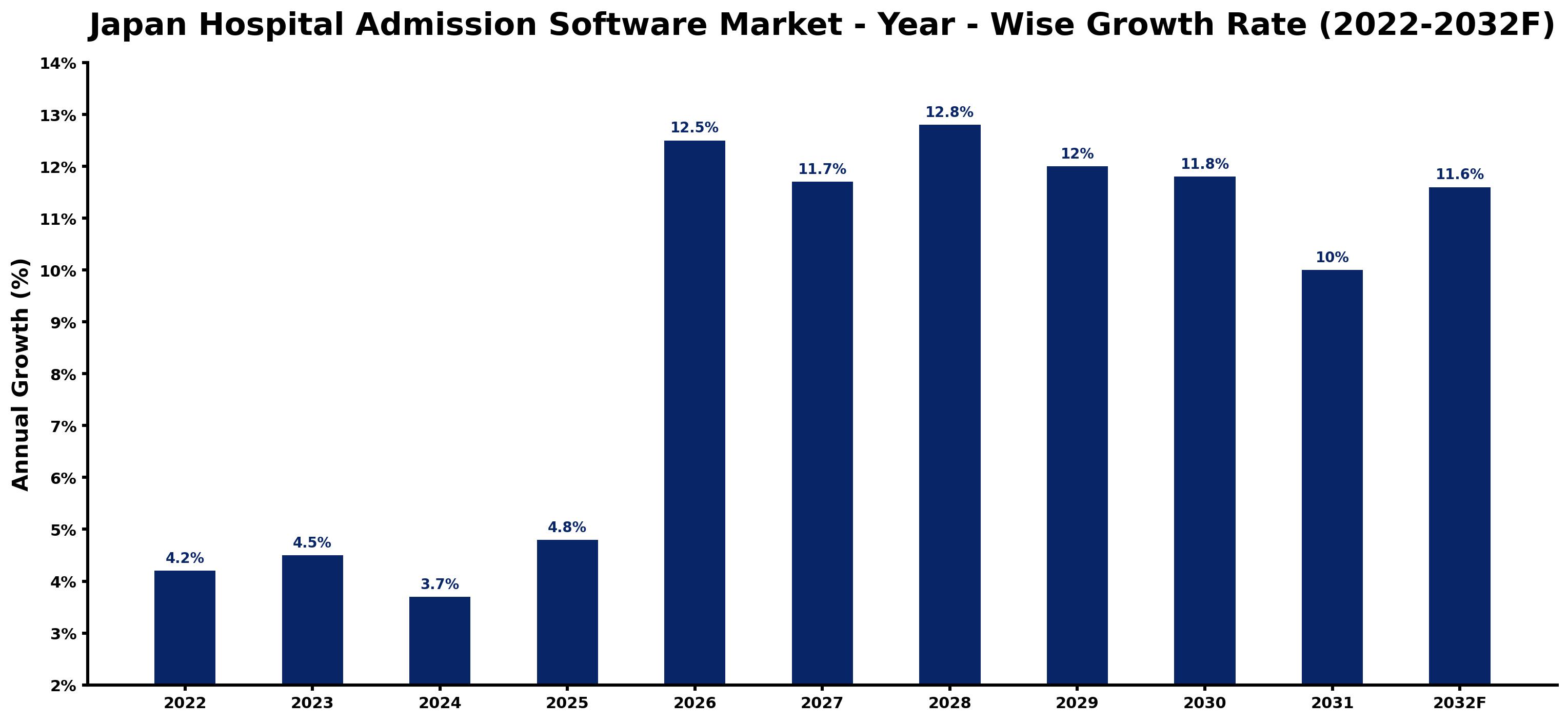
Below, each year's estimated growth is shown next to the factor that most influenced it.
| Year | Estimated Annual Growth (%) | Market Rationale |
| 2022 | 4.2 | The market experienced steady growth as healthcare facilities began upgrading their systems. |
| 2023 | 4.5 | Demand continued to rise due to increased hospital IT spending and digital transformation efforts. |
| 2024 | 3.7 | Growth slowed slightly as hospitals faced challenges in integrating new technologies. |
| 2025 | 4.8 | Investment in hospital IT surged, driven by the need for improved operational efficiency. |
| 2026 | 12.5 | The market saw a significant boost from the implementation of advanced admission solutions. |
| 2027 | 11.7 | Growth moderated as hospitals adjusted to new software systems and processes. |
| 2028 | 12.8 | A peak in growth occurred as hospitals fully embraced digital transformation initiatives. |
| 2029 | 12.0 | The market continued to grow, albeit at a slower pace as saturation approached. |
| 2030 | 11.8 | Growth slowed as hospitals focused on optimising existing software solutions. |
| 2031 | 10.0 | A further slowdown occurred as the market stabilised with mature technologies. |
| 2032 | 11.6 | Demand is expected to rise again as new technologies and standards emerge. |
Note: Market size estimations and growth projections presented in this report are based on 6Wresearch's proprietary forecasting methodology, utilizing the latest available industry data, government publications, and primary research inputs.
Japan Hospital Admission Software Market Synopsis
Hospital Admission Software streamlines the patient admission process in healthcare facilities, managing demographics, scheduling, and insurance claims. In Japan, the market is expanding due to the increasing number of hospitals, which exceeded 8,500 in 2023, and a national push for digital health strategies. Rising healthcare expenditure, projected to reach JPY 46.7 trillion, along with a growing elderly population, with 29.3% aged 65 or older by September 2024, are driving demand for efficient hospital management solutions.
Market Dynamics Impact Analysis (2026–2032)
| Factor | Type | Impact | Primary Segment Affected |
| Increasing hospital IT spending | Driver | High | EHR Integration |
| Growing elderly population | Driver | High | Admission Scheduling |
| Rising demand for digital health solutions | Opportunity | High | Insurance Integration |
| Government subsidies for digital transformation | Opportunity | High | Real-Time Booking |
| Integration challenges with existing systems | Restraint | High | Data Syncing |
| High costs of implementation and maintenance | Restraint | Medium | Claims Processing |
| Shortage of skilled IT professionals | Challenge | High | Hospital IT Systems |
| Resistance to change among hospital staff | Challenge | Medium | Reception Desks |
Evaluation of Drivers in Japan Hospital Admission Software Market (2026–2032)
The factors lifting demand, and the evidence behind each, are summarised below.
| Drivers | Primary Segment Affected | Why It Matters (Evidence) |
| Increased healthcare expenditure | EHR Integration | Japan's national medical care expenditure reached approximately JPY 46.7 trillion in 2022, driving demand for integrated systems. |
| Growing elderly population | Admission Scheduling | With 29.3% of the population aged 65 or older, hospitals are investing in scheduling solutions to manage patient flow. |
| Government initiatives for digital health | Insurance Integration | The 2023 digital health strategy aims for 90% EHR adoption by 2025, enhancing insurance claim processing. |
| Demand for real-time patient management | Real-Time Booking | The average patient wait time is targeted to be reduced by 20%, prompting hospitals to adopt real-time booking systems. |
| Focus on operational efficiency | Claims Processing | The average cost of hospital admission software ranges from ¥5 million to ¥30 million, pushing hospitals to streamline claims. |
Volumes grow on the back of Japan's increasing healthcare expenditure, which reached approximately JPY 46.7 trillion in 2022, prompting hospitals to invest in EHR systems. The elderly population, accounting for 29.3% of residents by September 2024, drives demand for efficient admission scheduling solutions. Hospitals are focusing on reducing patient wait times by 20%, leading to a rise in real-time booking systems. The average cost of hospital admission software, ranging from ¥5 million to ¥30 million, highlights the need for efficient claims processing solutions.
Evaluation of Restraints in Japan Hospital Admission Software Market
Below are the constraints most often cited by buyers and suppliers, with the segment each affects.
| Market Restraint | Primary Segment Affected | Why It Matters (Evidence) |
| Integration challenges with existing hospital systems | Data Syncing | Many hospitals struggle to integrate new software with legacy systems, affecting data accuracy and operational efficiency. |
| High costs of implementation and maintenance | Claims Processing | The average cost of admission software can reach up to ¥30 million, limiting adoption among smaller facilities. |
| Limited availability of skilled IT professionals | Hospital IT Systems | A shortage of qualified personnel hampers the effective implementation of advanced systems, delaying upgrades. |
| Resistance to change among hospital staff | Reception Desks | Staff may be hesitant to adopt new technologies, which slows down the transition to updated systems and processes. |
| Complex regulatory compliance requirements | Insurance Integration | Navigating the regulatory framework can delay the implementation of new software solutions, impacting operational timelines. |
Japan Hospital Admission Software Market Challenges
The average cost of hospital admission software, ranging from ¥5 million to ¥30 million, pressures producers to limit technology investments, which can restrict their ability to innovate. Over 8,500 hospitals in Japan face intense competition, as they strive to attract patients while needing to improve operational efficiency, leading to delays in software upgrades. Regulatory requirements from the Ministry of Health, Labour and Welfare compel hospitals to allocate resources for compliance, extending project timelines and raising costs. Disruptions in the supply chain for software components can postpone implementation, negatively impacting service delivery and increasing patient wait times by up to 20%.
Trends in the Japan Hospital Admission Software Market
Buyers and suppliers in the Japan Hospital Admission Software Market are adjusting to the following trends.
- Shift towards Real-Time Patient Management: Hospitals are increasingly adopting real-time booking systems to improve patient experience, with a focus on reducing wait times by 20%. This trend is particularly visible in Tokyo, where many facilities are implementing these solutions.
- Transition from On-Premise to Cloud-Based Solutions: Since 2023, there has been a marked shift towards cloud-based hospital admission software, allowing for greater flexibility and scalability. This change is driven by the need for efficient data management across multiple facilities.
- Emergence of AI-Driven Admission Solutions: AI-driven technologies are becoming prevalent in hospital admissions, with facilities in Osaka adopting these solutions to streamline processes and improve patient outcomes. This trend is supported by the AI Promotion Act of 2025.
- Increased Focus on Data Security and Compliance: With rising cyber threats, hospitals are prioritising data security in their admission software. The implementation of ISO 9001 certification among software vendors is a response to these growing concerns.
Investment Opportunities in the Japan Hospital Admission Software Market
The opportunities below stand out in the Japan Hospital Admission Software Market for new entrants and existing suppliers.
- Investment in Digital Transformation: Now is an opportune time for investment in hospital admission software, as the government has launched a subsidy program in 2023 to support digital transformation efforts, targeting JPY 10 billion for hospital IT upgrades.
- Supply of Real-Time Booking Systems: The demand for real-time booking solutions is rising, particularly in urban areas like Tokyo, where hospitals are striving to enhance patient flow. Suppliers can enter this market by partnering with local healthcare providers.
- Expansion of EHR Integration Solutions: With the goal of 90% EHR adoption by 2025, there is a significant opportunity for software vendors to supply integration solutions. Collaborating with hospital IT departments will facilitate market entry.
- Development of AI-Enhanced Admission Software: The increasing focus on AI technologies presents a chance to develop advanced admission solutions. Engaging with hospitals in Osaka can provide insights into specific needs and preferences.
Government Initiatives in the Japan Hospital Admission Software Market
The Medical Care Act of 1948 established standards for hospitals and clinics, regulating facilities and staffing requirements. This foundational legislation has influenced the development of hospital admission software, ensuring compliance with operational standards and quality care. Japan had about 8,100 hospitals in 2023, reflecting the ongoing investment in healthcare infrastructure.
In 2023, the Digital Agency initiated a funding program to support digital transformation in healthcare, targeting JPY 10 billion for hospital IT upgrades. This agency oversees the implementation of common system standards, facilitating smoother integration of new technologies into hospital admission software.
Future Insight of the Japan Hospital Admission Software Market
A new subsidy program will support hospitals in adopting electronic health record systems, streamlining patient admission processes. By 2032, the JIS X 25001 standard will improve software quality, benefiting both buyers and suppliers. Enhanced IT infrastructure will emerge from the government's digital health strategy, facilitating better integration of hospital systems. With a targeted 5% increase in hospital IT spending, facilities will improve operational capabilities and patient satisfaction through advanced management systems.
Market Segmentation Analysis
Japan Hospital Admission Software Market report covers a detailed analysis of the following market segments:
By Software Type – EHR Integration Leads, Admission Scheduling Expected to Grow Fastest
According to Saurav Kr Singh, Senior Research Analyst at 6Wresearch, EHR Integration accounted for 40% of the market by software type in 2025. EHR Integration holds the largest share due to its critical role in ensuring seamless patient data management across Japan's healthcare facilities. With over 8,500 hospitals employing various admission software solutions, the reliance on EHR Integration is essential for maintaining operational efficiency. Admission Scheduling is projected to grow fastest, at a CAGR of 16.2% during 2026–2032. The Admission Scheduling segment is experiencing rapid growth as hospitals strive to optimise patient flow and minimise wait times. The government's digital health strategy, which aims for a 20% reduction in average patient wait times, significantly propels this segment's expansion. Suppliers should focus on enhancing EHR Integration features to meet the high demand from hospitals.
By Functionality – Claims Processing Leads, Real-Time Booking Expected to Grow Fastest
Claims Processing took 51% of functionality revenue in 2025, more than any other category. Claims Processing leads the functionality segment as it is vital for financial operations within hospitals, ensuring timely reimbursement for services provided. This critical aspect of hospital management drives the adoption of software solutions that feature robust claims processing capabilities. Over 2026–2032, Real-Time Booking is expected to post the fastest growth, at a CAGR of 15.4%. Real-Time Booking is witnessing accelerated growth as hospitals seek to enhance patient experience through immediate appointment scheduling. The focus on operational efficiency and patient satisfaction is significantly boosting this functionality's demand. Buyers will gain from solutions that streamline claims processing while improving real-time booking functionalities.
By Distribution Channel – SaaS Providers Lead and Record the Fastest Growth
In 2025, SaaS Providers led the distribution channel split with a 36% share. SaaS Providers dominate the distribution channel as they represent a primary delivery model for hospital software solutions, offering easy access and scalability. The increasing adoption of digital solutions by hospitals reinforces the strong position of SaaS Providers in this market. The same category are also set to grow fastest, at a CAGR of 15.8% during 2026–2032. SaaS Providers are also the fastest-growing channel, as hospitals increasingly favour cloud-based solutions for their flexibility and cost-effectiveness. The ongoing digital transformation in healthcare is expected to further accelerate this trend. Suppliers must prioritise the development of SaaS offerings to align with market preferences.
By End User – Hospital IT Systems Lead, Reception Desks Expected to Grow Fastest
Hospital IT Systems held 43% of the Japan Hospital Admission Software Market by end user in 2025. Hospital IT Systems constitute the largest end user segment as they are essential for the effective functioning of hospital admissions, managing critical processes and data. The robust infrastructure of over 8,100 hospitals in Japan necessitates advanced IT systems for efficient operations and patient management. Reception Desks are set to record the highest CAGR in this split, 14.9% over 2026–2032. Reception Desks are the fastest-growing end user segment, serving as the frontline for patient check-in and requiring efficient software solutions to manage increasing patient volumes. The emphasis on enhancing patient experiences is driving this segment's growth. Suppliers should tailor their solutions to address the specific needs of reception desks to capture this expanding segment.
Key Attractiveness of the Report
- 10 Years of Market Numbers
- Historical Data Starting from 2022 to 2025
- Base Year 2025
- Forecast Data until 2032
- Key Performance Indicators Impacting the Market
- Major Upcoming Developments and Projects
Key Highlights of the Report:
- Japan Hospital Admission Software Market Outlook
- Market Size of Japan Hospital Admission Software Market, 2025
- Forecast of Japan Hospital Admission Software Market, 2032
- Historical Data and Forecast of Japan Hospital Admission Software Revenues & Volume for the Period 2022-2032F
- Japan Hospital Admission Software Market Trend Evolution
- Japan Hospital Admission Software Market Drivers and Challenges
- Japan Hospital Admission Software Price Trends
- Japan Hospital Admission Software Porter's Five Forces
- Japan Hospital Admission Software Industry Life Cycle
- Historical Data and Forecast of Japan Hospital Admission Software Market Revenues & Volume By Software Type for the Period 2022-2032F
- Historical Data and Forecast of Japan Hospital Admission Software Market Revenues & Volume By EHR Integration for the Period 2022-2032F
- Historical Data and Forecast of Japan Hospital Admission Software Market Revenues & Volume By Admission Scheduling for the Period 2022-2032F
- Historical Data and Forecast of Japan Hospital Admission Software Market Revenues & Volume By Patient Demographics for the Period 2022-2032F
- Historical Data and Forecast of Japan Hospital Admission Software Market Revenues & Volume By Insurance Integration for the Period 2022-2032F
- Historical Data and Forecast of Japan Hospital Admission Software Market Revenues & Volume By Functionality for the Period 2022-2032F
- Historical Data and Forecast of Japan Hospital Admission Software Market Revenues & Volume By Data Syncing for the Period 2022-2032F
- Historical Data and Forecast of Japan Hospital Admission Software Market Revenues & Volume By Real-Time Booking for the Period 2022-2032F
- Historical Data and Forecast of Japan Hospital Admission Software Market Revenues & Volume By Reporting/Analysis for the Period 2022-2032F
- Historical Data and Forecast of Japan Hospital Admission Software Market Revenues & Volume By Claims Processing for the Period 2022-2032F
- Historical Data and Forecast of Japan Hospital Admission Software Market Revenues & Volume By Distribution Channel for the Period 2022-2032F
- Historical Data and Forecast of Japan Hospital Admission Software Market Revenues & Volume By SaaS Providers for the Period 2022-2032F
- Historical Data and Forecast of Japan Hospital Admission Software Market Revenues & Volume By Online Subscription for the Period 2022-2032F
- Historical Data and Forecast of Japan Hospital Admission Software Market Revenues & Volume By Direct Sales for the Period 2022-2032F
- Historical Data and Forecast of Japan Hospital Admission Software Market Revenues & Volume By Software Vendors for the Period 2022-2032F
- Historical Data and Forecast of Japan Hospital Admission Software Market Revenues & Volume By End User for the Period 2022-2032F
- Historical Data and Forecast of Japan Hospital Admission Software Market Revenues & Volume By Hospital IT Systems for the Period 2022-2032F
- Historical Data and Forecast of Japan Hospital Admission Software Market Revenues & Volume By Reception Desks for the Period 2022-2032F
- Historical Data and Forecast of Japan Hospital Admission Software Market Revenues & Volume By Admin Departments for the Period 2022-2032F
- Historical Data and Forecast of Japan Hospital Admission Software Market Revenues & Volume By Billing Departments for the Period 2022-2032F
- Japan Hospital Admission Software Import Export Trade Statistics
- Market Opportunity Assessment By Software Type
- Market Opportunity Assessment By Functionality
- Market Opportunity Assessment By Distribution Channel
- Market Opportunity Assessment By End User
- Japan Hospital Admission Software Top Companies Market Share
- Japan Hospital Admission Software Competitive Benchmarking By Technical and Operational Parameters
- Japan Hospital Admission Software Company Profiles
- Japan Hospital Admission Software Key Strategic Recommendations
Market Covered
The following segment groups are covered in the report.
By Software Type
- EHR Integration
- Admission Scheduling
- Patient Demographics
- Insurance Integration
By Functionality
- Data Syncing
- Real-Time Booking
- Reporting/Analysis
- Claims Processing
By Distribution Channel
- SaaS Providers
- Online Subscription
- Direct Sales
- Software Vendors
By End User
- Hospital IT Systems
- Reception Desks
- Admin Departments
- Billing Departments































