Japan Immersive Entertainment Market Size & Growth Rate
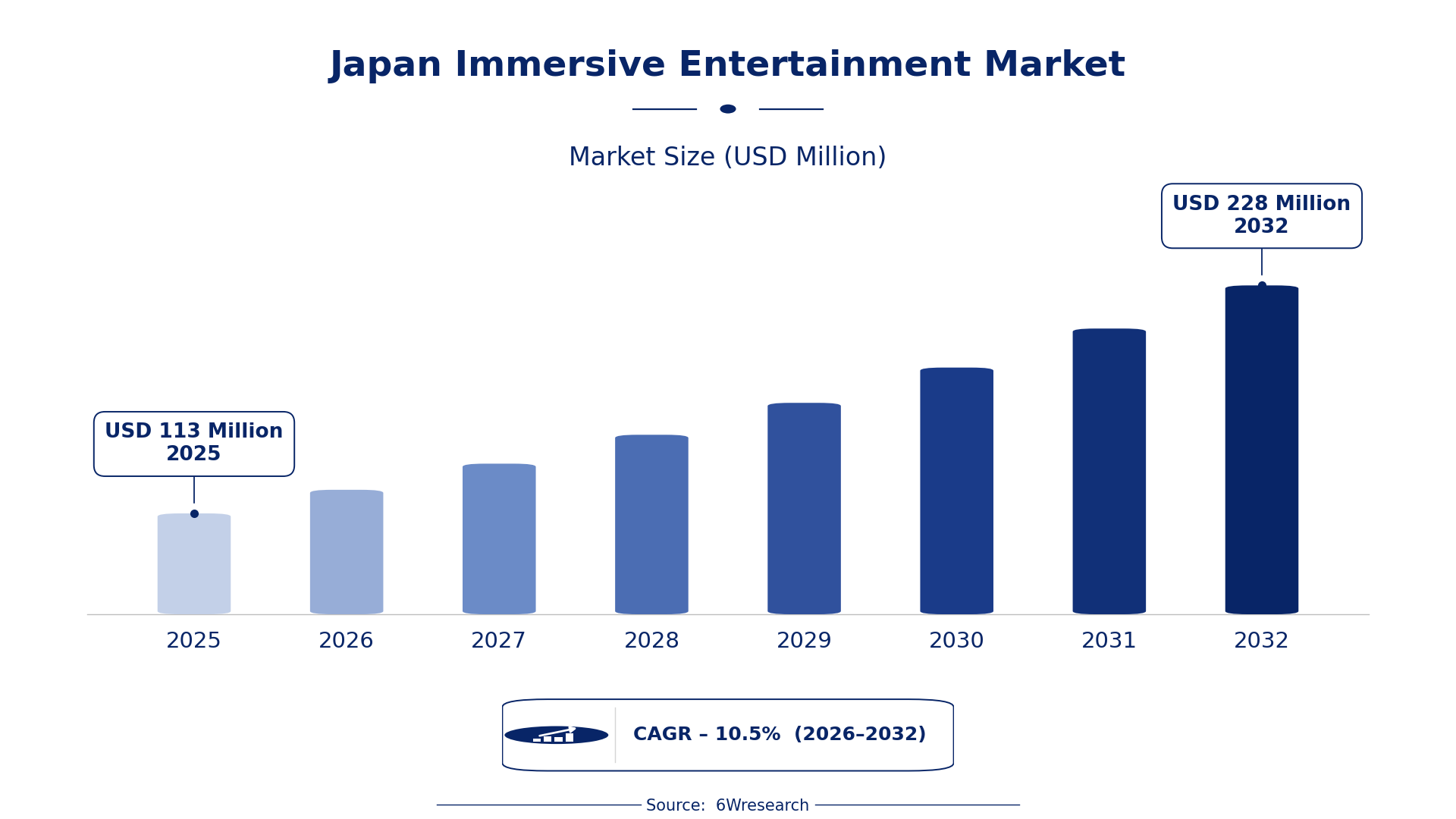
According to 6Wresearch internal database and industry insights, the Japan Immersive Entertainment Market was valued at USD 113 Million in 2025 and is projected to reach USD 228 Million by 2032, growing at a CAGR of approximately 10.5% during 2026–2032.
Japan Immersive Entertainment Market Highlights
| Report Metric | Details |
| Report Name | Japan Immersive Entertainment Market (2026-2032) |
| Market Size 2025 | USD 113 Million |
| Market Size 2032 | USD 228 Million |
| Absolute Growth 2025–2032 | USD 115 Million |
| CAGR 2026–2032 | 10.5% |
| Peak Annual Growth | 12.6% in 2032 |
| Forecast Period | 2026–2032 |
| Historical Data | 2022–2025 |
| Base Year | 2025 |
| Leading Product Type, 2025 | Virtual Reality Experiences (52% share) |
| Leading Technology Type, 2025 | VR Platforms (44% share) |
| Leading Application Area, 2025 | Gaming & Leisure (40% share) |
| Leading Distribution Channel, 2025 | Online Platforms (50% share) |
| Leading End User, 2025 | Gamers (42% share) |
| Fastest-Growing Product Type | Augmented Reality Shows (14.6% CAGR) |
| Fastest-Growing Technology Type | AR Technology (14.8% CAGR) |
| Fastest-Growing Application Area | Live Entertainment (12.7% CAGR) |
| Fastest-Growing End User | Event Organizers (13.6% CAGR) |
| Growing Sector | Live Entertainment |
| Key End Users | Gaming & Leisure, Live Entertainment, Theme Attractions |
Japan Immersive Entertainment Market Year-wise Growth Rate and Key Drivers (2022–2032)
This graph illustrates the annual growth rates of the market from 2022 to 2032, highlighting a steady upward trajectory and projected market expansion over the forecast period.
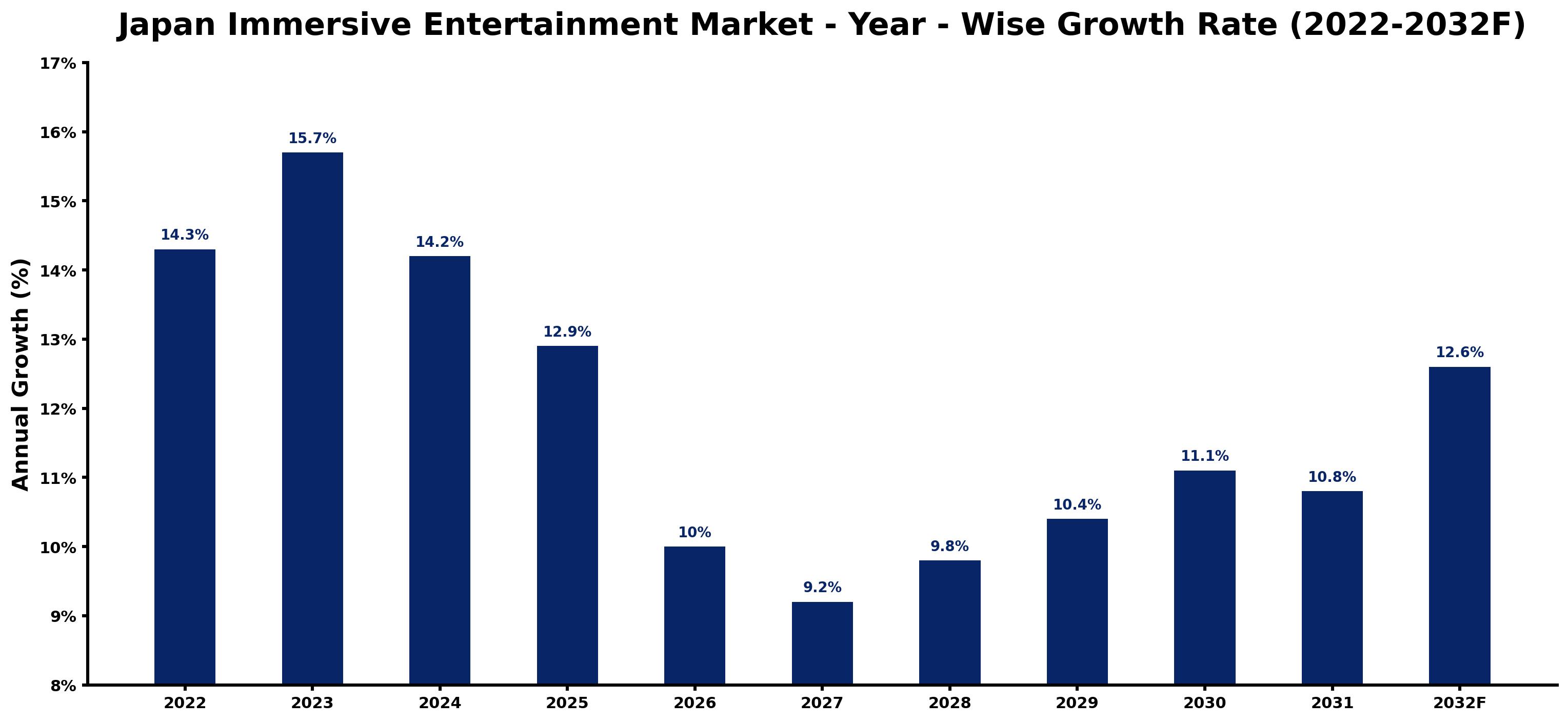
The table below sets out the estimated growth rate for each year and the main factor behind it.
| Year | Estimated Annual Growth (%) | Market Rationale |
| 2022 | 14.3 | The market experienced strong engagement from domestic users in immersive entertainment. |
| 2023 | 15.7 | Demand surged as Japan hosted the Tokyo Game Show, showcasing innovations. |
| 2024 | 14.2 | Growth slowed due to market saturation in certain segments, yet remained positive. |
| 2025 | 12.9 | The market continued to grow, driven by ongoing interest in immersive experiences. |
| 2026 | 10.0 | Growth is expected to slow as competition intensifies among immersive technology providers. |
| 2027 | 9.2 | The market growth rate will decrease as users become more selective in purchasing. |
| 2028 | 9.8 | Demand is projected to increase with the introduction of new immersive technologies and applications. |
| 2029 | 10.4 | Market growth will accelerate as more venues adopt immersive entertainment solutions. |
| 2030 | 11.1 | The market is expected to expand further as consumer interest in immersive experiences rises. |
| 2031 | 10.8 | Growth will slow slightly as the market begins to stabilise with established players. |
| 2032 | 12.6 | Demand is expected to peak as new technologies redefine immersive entertainment. |
Note: Market size estimations and growth projections presented in this report are based on 6Wresearch's proprietary forecasting methodology, utilizing the latest available industry data, government publications, and primary research inputs.
Japan Immersive Entertainment Market Synopsis
Immersive entertainment utilises technologies like virtual reality and augmented reality to create engaging experiences across gaming, live events, and theme parks. The Japan Immersive Entertainment Market is expanding due to strong domestic demand, particularly from gamers, and increasing international collaborations. The Creative Industry Strategy launched in 2021 aims to boost immersive tech development, while events like the Tokyo Game Show in 2023 showcased innovations, driving further interest and investment in this sector.
Market Dynamics Impact Analysis (2026–2032)
| Factor | Type | Impact | Primary Segment Affected |
| Growing interest in immersive experiences among domestic users | Driver | High | Gaming & Leisure |
| Expansion of VR arcades in Tokyo and other major cities | Driver | High | Virtual Reality Experiences |
| Increasing demand for immersive entertainment in live events | Opportunity | High | Live Entertainment |
| Investment in immersive technology by entertainment venues | Opportunity | Medium | Theme Attractions |
| Market saturation in certain segments limiting growth potential | Restraint | Medium | Augmented Reality Shows |
| High competition among technology providers affecting pricing strategies | Restraint | High | VR Platforms |
| Limited supply of advanced immersive technology solutions | Challenge | High | Immersive Installations |
| Consumer hesitance towards new technology adoption | Challenge | Medium | AR Technology |
Evaluation of Drivers in Japan Immersive Entertainment Market (2026–2032)
These are the developments adding the most demand over the forecast period.
| Drivers | Primary Segment Affected | Why It Matters (Evidence) |
| Rising number of VR users in Japan | Virtual Reality Experiences | In 2022, over 5 million active VR users in Japan increased demand for immersive experiences. |
| Tokyo's status as a hub for immersive entertainment | Gaming & Leisure | Tokyo hosts numerous VR arcades, attracting gamers and boosting market growth. |
| Government initiatives supporting immersive technology | Live Entertainment | The Creative Industry Strategy aims to enhance immersive tech development, driving innovation in the sector. |
| Increasing interest in international collaborations | Theme Attractions | Collaborations broaden technology access, driving demand for immersive attractions. |
| Growth of online platforms for content distribution | Online Platforms | Online Platforms accounted for 50% of distribution channels, facilitating wider access to content. |
Behind the steady rise in orders sits the growing number of VR users, with over 5 million active participants in 2022, leading to increased demand for immersive experiences. Tokyo's prominence as a hub for entertainment attracts a vibrant gaming culture, drawing more users to VR arcades. International collaborations are broadening technology access, increasing the appeal of immersive attractions. The growth of online platforms facilitates wider access to immersive content, encouraging more consumers to engage with these technologies.
Evaluation of Restraints in Japan Immersive Entertainment Market
Below are the constraints most often cited by buyers and suppliers, with the segment each affects.
| Market Restraint | Primary Segment Affected | Why It Matters (Evidence) |
| Market saturation in VR experiences limiting growth | Virtual Reality Experiences | As the market matures, fewer new users are entering, resulting in saturation in VR experiences. |
| High competition among technology providers affecting pricing | VR Platforms | Intense competition drives down prices, impacting profitability for providers in the market. |
| Limited availability of advanced immersive technologies | Immersive Installations | A shortage of advanced technology restricts the development of new immersive installations. |
| Consumer hesitance towards adopting new technologies | AR Technology | Some consumers remain cautious about investing in AR, which slows market growth. |
| Regulatory challenges in content distribution | Online Platforms | Strict regulations complicate the distribution of immersive content, hindering market expansion. |
Japan Immersive Entertainment Market Challenges
In 2022, over 5 million active VR users in Japan highlighted a technology gap, as local developers struggle with high development costs stemming from limited access to advanced hardware. Competition from international firms intensifies this issue, resulting in delays for local producers who cannot match the speed of foreign innovations. Suppliers face sourcing difficulties for critical components, which increases lead times for clinics and entertainment venues. Regulatory uncertainty from the ongoing development of JIS standards complicates project approvals, hindering progress for developers in the immersive sector.
Trends in the Japan Immersive Entertainment Market
The shifts below are changing how Japan Immersive Entertainment Market products are bought and supplied.
- Shift towards Enhanced Live Entertainment Experiences: The integration of immersive technology in live events is increasing, as seen in the Tokyo Game Show, which featured numerous innovations in 2023, attracting thousands of visitors.
- Transition from Traditional Gaming to Immersive Experiences: Consumers are increasingly favouring immersive experiences over traditional gaming, with 40% of the market share held by Gaming & Leisure in 2025, reflecting changing preferences.
- Augmented Reality Gaining Traction in Education: The Digital Agency's push for AR in education is reshaping learning environments, with investments expected to improve educational experiences in the coming years.
- Emergence of Collaborative Immersive Installations: The establishment of the Immersive Technology Forum in 2023 is encouraging collaboration in the sector, resulting in innovative immersive installations in public spaces.
Investment Opportunities in the Japan Immersive Entertainment Market
Investors looking at the Japan Immersive Entertainment Market should consider the following areas.
- Gap in Advanced Immersive Technologies: With over 5 million active VR users in 2022, there is a gap in advanced immersive technologies. Event organizers in Tokyo are looking to invest in new solutions to enhance experiences.
- Investment in VR Arcades: Tokyo is a major hub for immersive entertainment, with a growing number of VR arcades. Investors can enter this market by partnering with local operators to establish new facilities.
- Focus on Education and Training: The push for AR in education presents an opportunity for suppliers to develop educational tools. Collaborating with educational institutions can facilitate entry into this growing market.
- Expansion of Online Distribution Channels: Online Platforms accounted for 50% of content distribution, indicating a strong opportunity for suppliers. Establishing partnerships with online platforms can enhance market reach.
Government Initiatives in the Japan Immersive Entertainment Market
The Digital Agency, established in September 2021, leads government digital transformation and sets common system standards for immersive technology. This agency's initiatives aim to improve infrastructure and support the development of immersive applications across various sectors, including education and entertainment.
The Industrial Standardization Act, amended in 2019, governs JIS product and test standards. This law ensures that immersive technologies meet safety and quality benchmarks, facilitating smoother market entry for producers and enhancing consumer trust.
Future Insight of the Japan Immersive Entertainment Market
The rise of immersive graphics technology will transform demand for experiences by 2032, as users increasingly seek realistic interactions. By 2032, immersive technologies will be integrated into educational frameworks, broadening their application beyond traditional entertainment. Enhanced venues in Tokyo will showcase these advancements, driving further interest and investment. The government's Creative Industry Strategy will support the growth of immersive tech, leading to increased collaboration and innovation within the sector.
Market Segmentation Analysis
Japan Immersive Entertainment Market report covers a detailed analysis of the following market segments:
By Product Type – Virtual Reality Experiences Lead, Augmented Reality Shows Expected to Grow Fastest
According to Vasu Joshi, Associate Consultant at 6Wresearch, in 2025, Virtual Reality Experiences led the product type split with a 52% share. Virtual Reality Experiences hold the largest share as they are extensively utilised by gamers, with over 5 million active VR users in Japan. The prevalence of VR arcades in metropolitan areas like Tokyo significantly bolsters this segment's dominance. Augmented Reality Shows are projected to grow fastest, at a CAGR of 14.6% during 2026–2032. Augmented Reality Shows are rapidly gaining popularity as they enhance live performances, attracting audiences who seek interactive elements. The Tokyo Game Show serves as a prime example of the increasing integration of AR into entertainment, propelling growth in this segment. Suppliers should focus on creating content that meets the rising demand for AR in live events.
By Technology Type – VR Platforms Lead, AR Technology Expected to Grow Fastest
VR Platforms accounted for 44% of the market by technology type in 2025. VR Platforms are the leading segment, providing essential access to a diverse range of VR content and applications that are vital for immersive experiences. The establishment of standards by the Japan VR Association further solidifies the appeal and reliability of VR technologies. The quickest growth will come from AR Technology, forecast to expand at a CAGR of 14.8% between 2026 and 2032. AR Technology is experiencing swift growth due to its capability to create engaging AR applications, particularly in education and training. Initiatives from the Digital Agency are promoting the adoption of AR across various sectors, driving its expansion. Buyers should invest in AR technologies to remain competitive in the immersive entertainment market.
By Application Area – Gaming & Leisure Leads, Live Entertainment Expected to Grow Fastest
Gaming & Leisure held 40% of the Japan Immersive Entertainment Market by application area in 2025. Gaming & Leisure is the dominant application area, attracting the largest audience for immersive entertainment experiences. Japan's strong gaming culture, supported by a substantial user base, ensures a continuous demand for advanced gaming solutions. Over 2026–2032, Live Entertainment is expected to post the fastest growth, at a CAGR of 12.7%. Live Entertainment is the fastest-growing application area, increasingly integrating immersive technologies into events to engage audiences seeking unique experiences. The success of immersive showcases at events like the Tokyo Game Show highlights this trend. Suppliers must adapt their offerings to meet the growing interest in immersive experiences within live entertainment.
By Distribution Channel – Online Platforms Lead and Record the Fastest Growth
With 50% of distribution channel revenue in 2025, Online Platforms was the largest category. Online Platforms are the primary distribution method for immersive content, capitalising on the digital consumption trends among users. The convenience of accessing VR and AR experiences online has made this channel indispensable for reaching audiences. Its lead should widen, with a projected CAGR of 12.6% during 2026–2032, the highest in this split. Online Platforms are also the fastest-growing channel, as they facilitate the rapid distribution of new immersive content to a broad audience. The increasing reliance on digital platforms for entertainment ensures sustained growth in this area. Suppliers should prioritise online distribution strategies to maximise reach and engagement with users.
By End User – Gamers Lead, Event Organizers Expected to Grow Fastest
Gamers took 42% of end user revenue in 2025, more than any other category. Gamers represent the largest user group for immersive experiences, driven by high engagement levels in Japan's gaming culture. The significant number of active VR users indicates a robust market for immersive gaming solutions. Event Organizers are projected to grow fastest, at a CAGR of 13.6% during 2026–2032. Event Organizers are quickly adopting immersive technologies to enhance their events, responding to audience demands for more engaging experiences. The emphasis on integrating AR into live events is becoming essential for many organisers, accelerating this segment's growth. Suppliers should tailor their offerings to address the specific needs of event organisers looking to incorporate immersive technologies.
Key Attractiveness of the Report
- 10 Years of Market Numbers
- Historical Data Starting from 2022 to 2025
- Base Year 2025
- Forecast Data until 2032
- Key Performance Indicators Impacting the Market
- Major Upcoming Developments and Projects
Key Highlights of the Report:
- Japan Immersive Entertainment Market Outlook
- Market Size of Japan Immersive Entertainment Market, 2025
- Forecast of Japan Immersive Entertainment Market, 2032
- Historical Data and Forecast of Japan Immersive Entertainment Market Revenues & Volume for the Period 2022-2032F
- Japan Immersive Entertainment Market Trend Evolution
- Japan Immersive Entertainment Market Drivers and Challenges
- Japan Immersive Entertainment Market Price Trends
- Japan Immersive Entertainment Market Porter's Five Forces
- Japan Immersive Entertainment Market Industry Life Cycle
- Historical Data and Forecast of Japan Immersive Entertainment Market Revenues & Volume By Product Type for the Period 2022-2032F
- Historical Data and Forecast of Japan Immersive Entertainment Market Revenues & Volume By Virtual Reality Experiences for the Period 2022-2032F
- Historical Data and Forecast of Japan Immersive Entertainment Market Revenues & Volume By Augmented Reality Shows for the Period 2022-2032F
- Historical Data and Forecast of Japan Immersive Entertainment Market Revenues & Volume By Immersive Installations for the Period 2022-2032F
- Historical Data and Forecast of Japan Immersive Entertainment Market Revenues & Volume By Technology Type for the Period 2022-2032F
- Historical Data and Forecast of Japan Immersive Entertainment Market Revenues & Volume By VR Platforms for the Period 2022-2032F
- Historical Data and Forecast of Japan Immersive Entertainment Market Revenues & Volume By AR Technology for the Period 2022-2032F
- Historical Data and Forecast of Japan Immersive Entertainment Market Revenues & Volume By Mixed Reality for the Period 2022-2032F
- Historical Data and Forecast of Japan Immersive Entertainment Market Revenues & Volume By Application Area for the Period 2022-2032F
- Historical Data and Forecast of Japan Immersive Entertainment Market Revenues & Volume By Gaming & Leisure for the Period 2022-2032F
- Historical Data and Forecast of Japan Immersive Entertainment Market Revenues & Volume By Live Entertainment for the Period 2022-2032F
- Historical Data and Forecast of Japan Immersive Entertainment Market Revenues & Volume By Theme Attractions for the Period 2022-2032F
- Historical Data and Forecast of Japan Immersive Entertainment Market Revenues & Volume By Distribution Channel for the Period 2022-2032F
- Historical Data and Forecast of Japan Immersive Entertainment Market Revenues & Volume By Online Platforms for the Period 2022-2032F
- Historical Data and Forecast of Japan Immersive Entertainment Market Revenues & Volume By Direct Licensing for the Period 2022-2032F
- Historical Data and Forecast of Japan Immersive Entertainment Market Revenues & Volume By System Integrators for the Period 2022-2032F
- Historical Data and Forecast of Japan Immersive Entertainment Market Revenues & Volume By End User for the Period 2022-2032F
- Historical Data and Forecast of Japan Immersive Entertainment Market Revenues & Volume By Gamers for the Period 2022-2032F
- Historical Data and Forecast of Japan Immersive Entertainment Market Revenues & Volume By Event Organizers for the Period 2022-2032F
- Historical Data and Forecast of Japan Immersive Entertainment Market Revenues & Volume By Entertainment Venues for the Period 2022-2032F
- Japan Immersive Entertainment Market Import Export Trade Statistics
- Market Opportunity Assessment By Product Type
- Market Opportunity Assessment By Technology Type
- Market Opportunity Assessment By Application Area
- Market Opportunity Assessment By Distribution Channel
- Market Opportunity Assessment By End User
- Japan Immersive Entertainment Market Top Companies Market Share
- Japan Immersive Entertainment Market Competitive Benchmarking By Technical and Operational Parameters
- Japan Immersive Entertainment Market Company Profiles
- Japan Immersive Entertainment Market Key Strategic Recommendations
Market Covered
Coverage by segment is as follows.
By Product Type
- Virtual Reality Experiences
- Augmented Reality Shows
- Immersive Installations
By Technology Type
- VR Platforms
- AR Technology
- Mixed Reality
By Application Area
- Gaming & Leisure
- Live Entertainment
- Theme Attractions
By Distribution Channel
- Online Platforms
- Direct Licensing
- System Integrators
By End User
- Gamers
- Event Organizers
- Entertainment Venues































