Japan Immersive Virtual Reality Market Size & Growth Rate
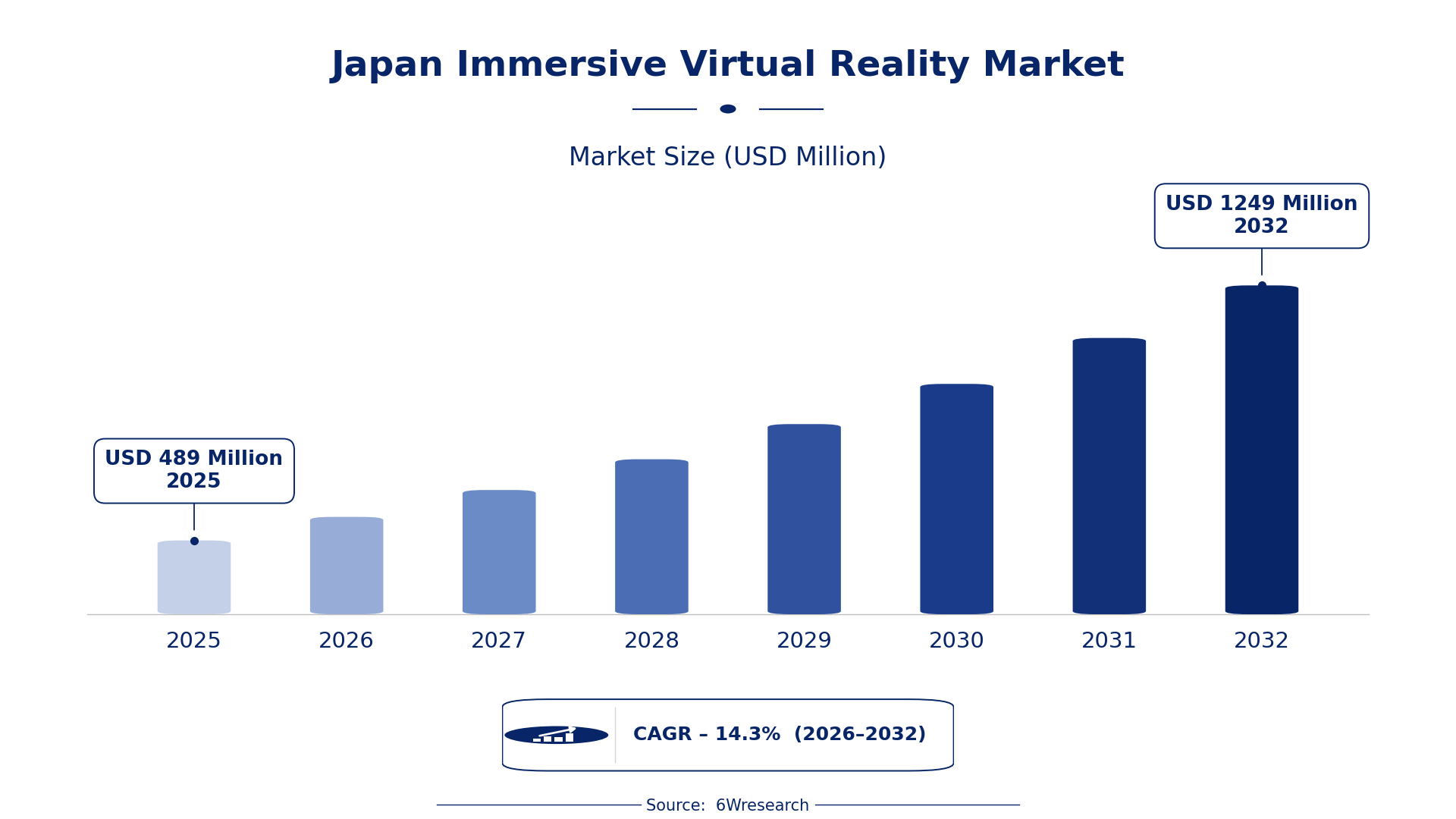
According to 6Wresearch internal database and industry insights, the Japan Immersive Virtual Reality Market was valued at USD 489 Million in 2025 and is projected to reach USD 1,249 Million by 2032, growing at a CAGR of approximately 14.3% during 2026–2032.
Japan Immersive Virtual Reality Market Highlights
| Report Metric | Details |
| Report Name | Japan Immersive Virtual Reality Market (2026-2032) |
| Market Size 2025 | USD 489 Million |
| Market Size 2032 | USD 1,249 Million |
| Absolute Growth 2025–2032 | USD 760 Million |
| CAGR 2026–2032 | 14.3% |
| Peak Annual Growth | 16.3% in 2026 |
| Forecast Period | 2026–2032 |
| Historical Data | 2022–2025 |
| Base Year | 2025 |
| Leading Technology Type, 2025 | VR Headsets (48% share) |
| Leading Device Type, 2025 | Wearable (39% share) |
| Leading Application Area, 2025 | Gaming (33% share) |
| Leading Distribution Channel, 2025 | Online Retail (50% share) |
| Leading End User, 2025 | Consumers (41% share) |
| Fastest-Growing Technology Type | VR Software (20.1% CAGR) |
| Fastest-Growing Device Type | Integrated Systems (19.7% CAGR) |
| Fastest-Growing Application Area | Training (16.3% CAGR) |
| Fastest-Growing End User | Enterprises (17.6% CAGR) |
| Growing Sector | Training |
| Key End Users | Consumers, Enterprises, Developers, Educational Institutions |
Japan Immersive Virtual Reality Market Year-wise Growth Rate and Key Drivers (2022–2032)
This graph illustrates the annual growth rates of the market from 2022 to 2032, highlighting a steady upward trajectory and projected market expansion over the forecast period.
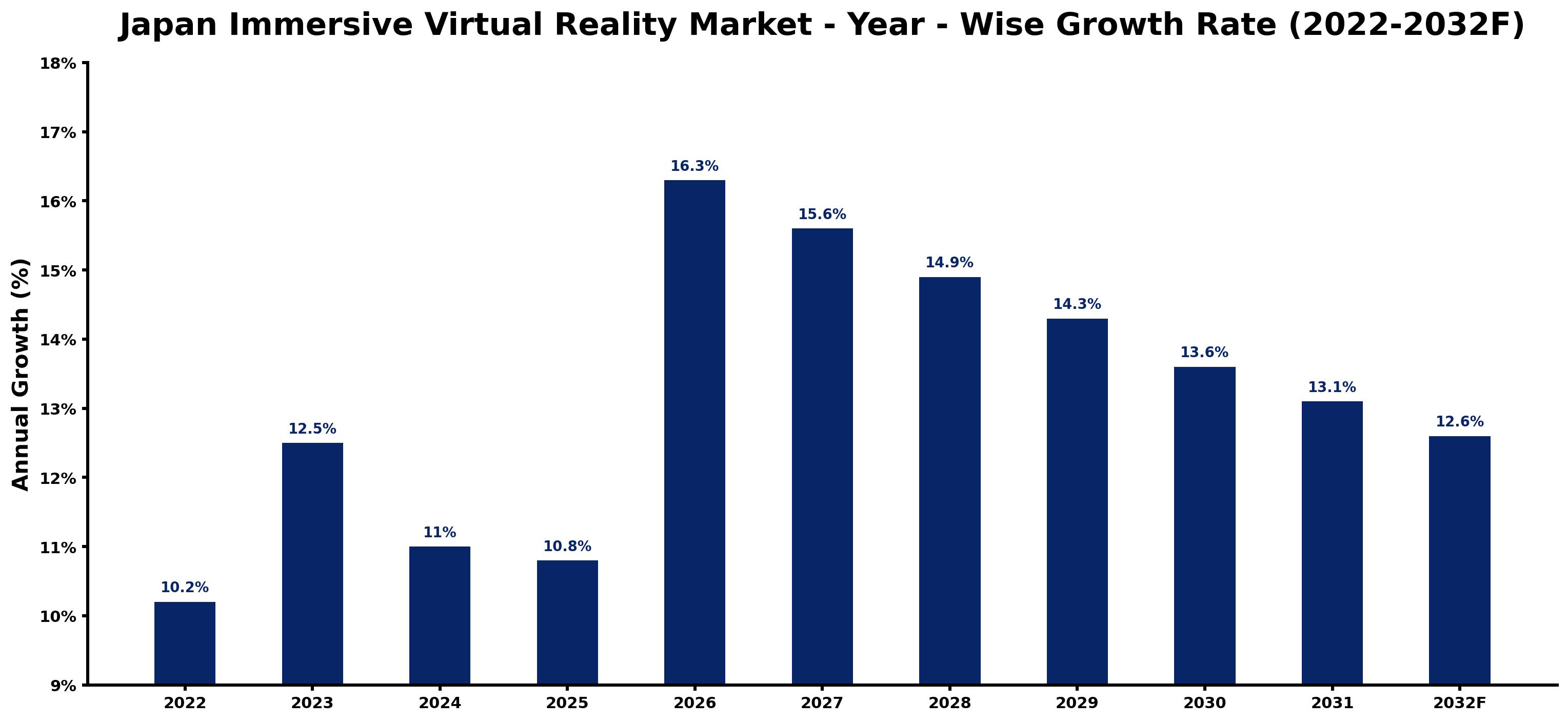
Each row of the following table gives one year's estimated growth and the event or demand shift that explains it.
| Year | Estimated Annual Growth (%) | Market Rationale |
| 2022 | 10.2 | The market showed steady growth due to increasing interest in immersive experiences. |
| 2023 | 12.5 | Growth accelerated as more consumers adopted VR technologies for gaming and training. |
| 2024 | 11.0 | A slowdown in growth occurred as market saturation began in certain segments. |
| 2025 | 10.8 | Market growth continued to slow as competition intensified among VR providers. |
| 2026 | 16.3 | The peak growth year is driven by investments in new VR content. |
| 2027 | 15.6 | Growth slowed slightly as the market matured and consumer expectations rose. |
| 2028 | 14.9 | A further slowdown in growth reflects the need for innovation in VR applications. |
| 2029 | 14.3 | Growth continues to decelerate as the market stabilises and competition remains high. |
| 2030 | 13.6 | The market experiences a continued slowdown as new entrants increase competition. |
| 2031 | 13.1 | Growth slows further as established players focus on improving customer experiences. |
| 2032 | 12.6 | The market stabilises with modest growth driven by consistent user engagement. |
Note: Market size estimations and growth projections presented in this report are based on 6Wresearch's proprietary forecasting methodology, utilizing the latest available industry data, government publications, and primary research inputs.
Japan Immersive Virtual Reality Market Synopsis
Immersive Virtual Reality is a technology that creates simulated environments through computer-generated graphics and sensory feedback. This technology is primarily used in gaming, training simulations, and content creation. The Japan Immersive Virtual Reality Market is expanding, driven by a user base projected to reach 1.5 million by 2025 and increasing investments in VR content creation, which saw a rise of 30% in 2023. The Tokyo region leads in VR development, supported by innovation programs from the Ministry of Economy, Trade and Industry.
Market Dynamics Impact Analysis (2026–2032)
| Factor | Type | Impact | Primary Segment Affected |
| High demand for immersive gaming experiences drives VR headset sales. | Driver | High | VR Headsets |
| Growing interest in training solutions across various sectors boosts VR software adoption. | Driver | High | VR Software |
| The increasing number of educational institutions adopting VR creates new market opportunities. | Opportunity | High | Training |
| Significant investments in VR content creation present avenues for growth. | Opportunity | High | Content Creation |
| Competition among VR providers may lead to pricing pressures. | Restraint | Medium | VR Headsets |
| Market saturation in certain segments can limit growth potential. | Restraint | Medium | VR Software |
| High development costs for VR content can deter new entrants. | Challenge | High | Content Creation |
| Technological limitations in hardware may hinder user experience. | Challenge | Medium | VR Headsets |
Evaluation of Drivers in Japan Immersive Virtual Reality Market (2026–2032)
Key forces behind demand, with the segment each one moves most, are listed below.
| Drivers | Primary Segment Affected | Why It Matters (Evidence) |
| Increased consumer interest in gaming experiences drives demand for VR headsets. | VR Headsets | Japan's VR headset market is projected to capture a 60% share by 2025. |
| Growing adoption of VR training solutions in healthcare boosts software sales. | VR Software | VR training solutions are increasingly adopted in healthcare and education sectors. |
| Investment in VR content creation has surged, boosting market growth. | Content Creation | Investment in VR content creation has increased by 30% in 2023. |
| The expansion of VR applications in educational institutions fuels market growth. | Training | AR and VR systems are used in over 200 educational institutions across Japan. |
| The popularity of VR gaming drives technological advancements and user engagement. | Gaming | The VR gaming market is expected to grow with new releases in 2024. |
What keeps demand rising is the increasing consumer interest in immersive gaming experiences, with the VR headset market projected to capture a 60% share by 2025. Adoption of VR training solutions in healthcare is boosting software sales, as evidenced by the growing use of VR training solutions in educational sectors. Investment in VR content creation surged by 30% in 2023, driving market growth. The expansion of VR applications in educational institutions fuels demand, with many institutions adopting AR and VR systems. The popularity of VR gaming is driving technological advancements, with growth expected in the gaming market due to new releases in 2024.
Evaluation of Restraints in Japan Immersive Virtual Reality Market
These restraints slow adoption and weigh on supplier margins.
| Market Restraint | Primary Segment Affected | Why It Matters (Evidence) |
| Competition among VR providers may lead to pricing pressures. | VR Headsets | Intense competition can reduce profit margins, affecting overall market health. |
| Market saturation in certain segments can limit growth potential. | VR Software | As more players enter the market, differentiation becomes challenging. |
| High development costs for VR content can deter new entrants. | Content Creation | The investment required can restrict smaller companies from entering. |
| Technological limitations in hardware may hinder user experience. | VR Headsets | Inadequate hardware can lead to user dissatisfaction and reduced adoption rates. |
| Consumer hesitance to adopt new technologies can slow market growth. | Training | Concerns about the effectiveness of VR training solutions may limit uptake. |
Japan Immersive Virtual Reality Market Challenges
A lack of established standards creates regulatory confusion for producers, leading to inconsistent product quality that discourages buyers from making investments. This hesitation can result in a potential loss of ¥10 billion in market opportunities. Skills shortages in the workforce hinder the development of advanced VR technologies, delaying project timelines for producers by up to six months. Cost pressures from high-quality hardware requirements force buyers to allocate larger budgets, which can restrict adoption among smaller enterprises, limiting their competitive edge in the market.
Trends in the Japan Immersive Virtual Reality Market
Several trends are reshaping the Japan Immersive Virtual Reality Market; the most important are set out below.
- Shift Towards VR in Education: Tokyo is experiencing a transition towards the adoption of VR technologies in education, with many institutions integrating AR and VR systems for improved learning experiences. In 2023, over 200 educational institutions have adopted these technologies.
- Emergence of VR Content Creation: The Japan Virtual Reality Association is promoting VR content creation, leading to a rise in investment in 2023, reflecting a growing demand for immersive experiences. Investment in this sector increased by 30%.
- Increased Focus on Training Solutions: Training solutions are increasingly prioritised in corporate settings, as evidenced by the adoption of VR training in healthcare and education sectors, improving skill development. This trend is supported by the use of VR in over 200 institutions.
- Expansion of VR Gaming Market: The VR gaming market is expanding significantly, with new releases expected in 2024, driving user engagement and increasing the number of VR applications available, which now exceeds 5,000.
Investment Opportunities in the Japan Immersive Virtual Reality Market
Investors looking at the Japan Immersive Virtual Reality Market should consider the following areas.
- Gap in VR Training Solutions: With many companies in the automotive sector using simulation training, there is a gap for suppliers to provide advanced VR training solutions. This sector is supported by over 100 companies utilizing simulation training.
- Timing for Investment in VR Content: As investment in VR content creation surged by 30% in 2023, now is an opportune time for developers to enter this growing market, particularly in entertainment and education sectors.
- Potential in Tokyo's VR Startups: The Tokyo Metropolitan Government supports startups in the VR space through funding, creating opportunities for investors to partner with emerging companies in this vibrant environment.
- Supply of Integrated VR Systems: The demand for integrated VR systems is rising, especially in training applications, presenting a chance for suppliers to meet this need as more enterprises adopt VR solutions.
Government Initiatives in the Japan Immersive Virtual Reality Market
The Act against Unjustifiable Premiums and Misleading Representations (1962) prohibits misleading advertising in VR products, ensuring consumer protection and trust in immersive technologies. More recently, the AI Promotion Act (2025) establishes a framework for AI research and development, which includes applications in VR technology, supporting innovation in the sector and benefiting users and producers alike.
The Digital Agency, established in September 2021, leads the government’s digital transformation efforts and approves standards for VR technologies. In 2023, the government allocated ¥10 billion for technology innovation, including VR, to support growth and development in this emerging market.
Future Insight of the Japan Immersive Virtual Reality Market
Government initiatives will prioritise VR technology, driving advancements in hardware and software integration. The introduction of JIS standards will ensure consistent quality, providing buyers with reliable products and building trust. Investment in VR training solutions will grow, particularly in healthcare and education, facilitating broader adoption across sectors. By 2025, VR applications available in Japan will exceed 5,000, stimulating further content creation and user engagement.
Market Segmentation Analysis
Japan Immersive Virtual Reality Market report covers a detailed analysis of the following market segments:
By Technology Type – VR Headsets Lead, VR Software Expected to Grow Fastest
According to Prakhar Dixit, Senior Research Analyst at 6Wresearch, in 2025, VR Headsets led the technology type split with a 48% share. VR headsets dominate the market as they are essential for delivering immersive experiences, particularly in gaming and training scenarios. The Tokyo Game Show exemplifies the high demand for headsets among users eager for advanced VR technology. The quickest growth will come from VR Software, forecast to expand at a CAGR of 20.1% between 2026 and 2032. The rapid growth of VR software is fuelled by a 30% increase in investment for content creation in 2023. This surge indicates a bright future for software as developers strive to create engaging VR experiences. Suppliers must focus on enhancing software offerings to meet the rising demand from developers.
By Device Type – Wearable Leads, Integrated Systems Expected to Grow Fastest
Wearable held 39% of the Japan Immersive Virtual Reality Market by device type in 2025. Wearable devices lead the market due to their unique integration with VR experiences, attracting users who seek immersive interactions. Their application across various sectors supports their notable market presence despite not being the primary focus. Over 2026–2032, Integrated Systems are expected to post the fastest growth, at a CAGR of 19.7%. Integrated systems are witnessing rapid growth as they become crucial for enterprise solutions, especially in training applications. This trend reflects the increasing necessity for comprehensive systems to facilitate effective VR implementation. Buyers should consider integrated systems to enhance training outcomes and operational efficiency.
By Application Area – Gaming Leads, Training Expected to Grow Fastest
Gaming took 33% of application area revenue in 2025, more than any other category. Gaming is the foremost application area for VR, significantly propelling adoption and innovation within the sector. Anticipated growth in the VR gaming market, particularly with new releases in 2024, solidifies its leading position. Training is projected to grow fastest, at a CAGR of 16.3% during 2026–2032. Training is swiftly expanding as more organisations adopt VR for corporate and educational purposes. This trend underscores the growing recognition of VR's effectiveness in enhancing learning and skill development. Suppliers must tailor their offerings to address the needs of the burgeoning training market.
By Distribution Channel – Online Retail Leads and Records the Fastest Growth
The largest distribution channel category in 2025 was Online Retail, at 50% of revenue. Online retail serves as the primary distribution channel for VR products, providing consumers with convenient access to a wide array of options. The ease of purchasing through online platforms greatly contributes to its dominant market share. Online Retail is also forecast to expand faster than any other category, at a CAGR of 15.5% over 2026–2032. Online retail is also the fastest-growing channel as consumer preferences increasingly shift towards digital shopping experiences. This trend is expected to continue as users seek the convenience of online purchases for VR products. Suppliers should prioritise online retail strategies to maximise their market reach.
By End User – Consumers Lead, Enterprises Expected to Grow Fastest
Consumers accounted for 41% of the market by end user in 2025. Consumers represent the largest end-user segment, driving demand for immersive VR experiences in gaming and entertainment. Their active participation is crucial for sustaining market growth and encouraging innovation in the sector. The quickest growth will come from Enterprises, forecast to expand at a CAGR of 17.6% between 2026 and 2032. Enterprises are increasingly adopting VR solutions for training and simulation, signalling a shift towards leveraging technology for operational improvements. This trend reflects a broader acceptance of VR's benefits in professional environments. Suppliers should develop targeted solutions for enterprises to effectively capture this expanding segment.
Key Attractiveness of the Report
- 10 Years of Market Numbers
- Historical Data Starting from 2022 to 2025
- Base Year 2025
- Forecast Data until 2032
- Key Performance Indicators Impacting the Market
- Major Upcoming Developments and Projects
Key Highlights of the Report:
- Japan Immersive Virtual Reality Market Outlook
- Market Size of Japan Immersive Virtual Reality Market, 2025
- Forecast of Japan Immersive Virtual Reality Market, 2032
- Historical Data and Forecast of Japan Immersive Virtual Reality Market Revenues & Volume for the Period 2022-2032F
- Japan Immersive Virtual Reality Market Trend Evolution
- Japan Immersive Virtual Reality Market Drivers and Challenges
- Japan Immersive Virtual Reality Market Price Trends
- Japan Immersive Virtual Reality Market Porter's Five Forces
- Japan Immersive Virtual Reality Market Industry Life Cycle
- Historical Data and Forecast of Japan Immersive Virtual Reality Market Revenues & Volume By Technology Type for the Period 2022-2032F
- Historical Data and Forecast of Japan Immersive Virtual Reality Market Revenues & Volume By VR Headsets for the Period 2022-2032F
- Historical Data and Forecast of Japan Immersive Virtual Reality Market Revenues & Volume By AR Systems for the Period 2022-2032F
- Historical Data and Forecast of Japan Immersive Virtual Reality Market Revenues & Volume By Mixed Reality for the Period 2022-2032F
- Historical Data and Forecast of Japan Immersive Virtual Reality Market Revenues & Volume By VR Software for the Period 2022-2032F
- Historical Data and Forecast of Japan Immersive Virtual Reality Market Revenues & Volume By Device Type for the Period 2022-2032F
- Historical Data and Forecast of Japan Immersive Virtual Reality Market Revenues & Volume By Wearable for the Period 2022-2032F
- Historical Data and Forecast of Japan Immersive Virtual Reality Market Revenues & Volume By Smart Glasses for the Period 2022-2032F
- Historical Data and Forecast of Japan Immersive Virtual Reality Market Revenues & Volume By Integrated Systems for the Period 2022-2032F
- Historical Data and Forecast of Japan Immersive Virtual Reality Market Revenues & Volume By Platforms for the Period 2022-2032F
- Historical Data and Forecast of Japan Immersive Virtual Reality Market Revenues & Volume By Application Area for the Period 2022-2032F
- Historical Data and Forecast of Japan Immersive Virtual Reality Market Revenues & Volume By Gaming for the Period 2022-2032F
- Historical Data and Forecast of Japan Immersive Virtual Reality Market Revenues & Volume By Training for the Period 2022-2032F
- Historical Data and Forecast of Japan Immersive Virtual Reality Market Revenues & Volume By Simulation for the Period 2022-2032F
- Historical Data and Forecast of Japan Immersive Virtual Reality Market Revenues & Volume By Content Creation for the Period 2022-2032F
- Historical Data and Forecast of Japan Immersive Virtual Reality Market Revenues & Volume By Distribution Channel for the Period 2022-2032F
- Historical Data and Forecast of Japan Immersive Virtual Reality Market Revenues & Volume By Online Retail for the Period 2022-2032F
- Historical Data and Forecast of Japan Immersive Virtual Reality Market Revenues & Volume By Direct Sales for the Period 2022-2032F
- Historical Data and Forecast of Japan Immersive Virtual Reality Market Revenues & Volume By Tech Vendors for the Period 2022-2032F
- Historical Data and Forecast of Japan Immersive Virtual Reality Market Revenues & Volume By App Stores for the Period 2022-2032F
- Historical Data and Forecast of Japan Immersive Virtual Reality Market Revenues & Volume By End User for the Period 2022-2032F
- Historical Data and Forecast of Japan Immersive Virtual Reality Market Revenues & Volume By Consumers for the Period 2022-2032F
- Historical Data and Forecast of Japan Immersive Virtual Reality Market Revenues & Volume By Enterprises for the Period 2022-2032F
- Historical Data and Forecast of Japan Immersive Virtual Reality Market Revenues & Volume By Defense for the Period 2022-2032F
- Historical Data and Forecast of Japan Immersive Virtual Reality Market Revenues & Volume By Developers for the Period 2022-2032F
- Japan Immersive Virtual Reality Market Import Export Trade Statistics
- Market Opportunity Assessment By Technology Type
- Market Opportunity Assessment By Device Type
- Market Opportunity Assessment By Application Area
- Market Opportunity Assessment By Distribution Channel
- Market Opportunity Assessment By End User
- Japan Immersive Virtual Reality Market Top Companies Market Share
- Japan Immersive Virtual Reality Market Competitive Benchmarking By Technical and Operational Parameters
- Japan Immersive Virtual Reality Market Company Profiles
- Japan Immersive Virtual Reality Market Key Strategic Recommendations
Market Covered
Segments analysed in this report are listed below.
By Technology Type
- VR Headsets
- AR Systems
- Mixed Reality
- VR Software
By Device Type
- Wearable
- Smart Glasses
- Integrated Systems
- Platforms
By Application Area
- Gaming
- Training
- Simulation
- Content Creation
By Distribution Channel
- Online Retail
- Direct Sales
- Tech Vendors
- App Stores
By End User
- Consumers
- Enterprises
- Defense
- Developers































