Japan In-Flight Connectivity C-Band Market Size & Growth Rate
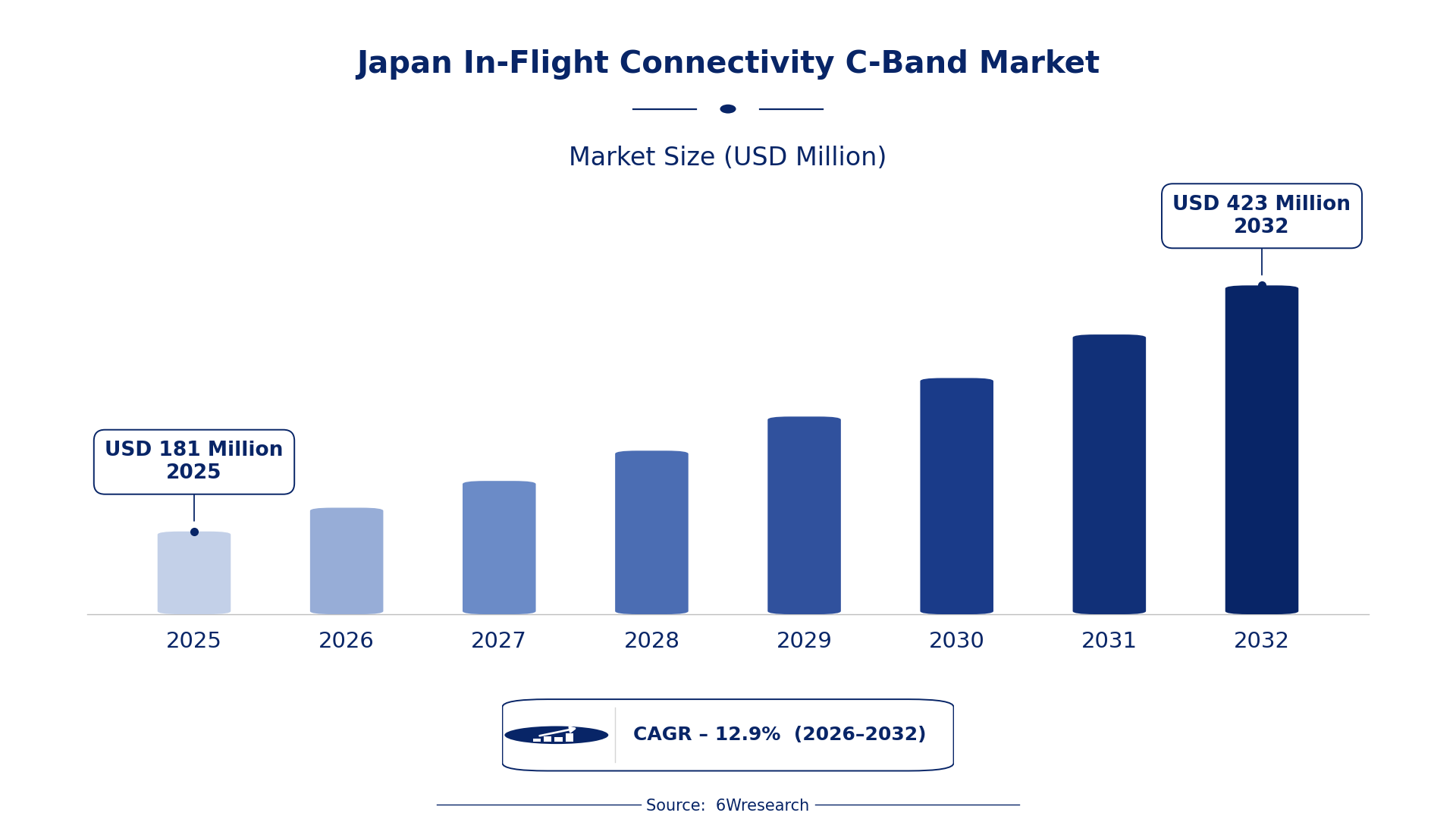
According to 6Wresearch internal database and industry insights, the Japan In-Flight Connectivity C-Band Market was valued at USD 181 Million in 2025 and is projected to reach USD 423 Million by 2032, growing at a CAGR of approximately 12.9% during 2026–2032.
Japan In-Flight Connectivity C-Band Market Highlights
| Report Metric | Details |
| Report Name | Japan In-Flight Connectivity C-Band Market (2026-2032) |
| Market Size 2025 | USD 181 Million |
| Market Size 2032 | USD 423 Million |
| Absolute Growth 2025–2032 | USD 242 Million |
| CAGR 2026–2032 | 12.9% |
| Peak Annual Growth | 15.7% in 2026 |
| Forecast Period | 2026–2032 |
| Historical Data | 2022–2025 |
| Base Year | 2025 |
| Leading Connectivity Type, 2025 | Satellite-Based (43% share) |
| Leading Application, 2025 | Broadband Internet (48% share) |
| Leading Aircraft Type, 2025 | Commercial Aircraft (45% share) |
| Leading Distribution Channel, 2025 | Satcom Providers (35% share) |
| Fastest-Growing Connectivity Type | Ground-to-Air (17.3% CAGR) |
| Fastest-Growing Application | Voice + Data Link (17.0% CAGR) |
| Fastest-Growing Aircraft Type | Business Jets (17.5% CAGR) |
| Fastest-Growing Distribution Channel | Telecom Integrators (15.5% CAGR) |
| Growing Sector | Aviation |
| Key End Users | Airlines, Aircraft Manufacturers, Satellite Service Providers, Telecom Integrators |
Japan In-Flight Connectivity C-Band Market Year-wise Growth Rate and Key Drivers (2022–2032)
This graph illustrates the annual growth rates of the market from 2022 to 2032, highlighting a steady upward trajectory and projected market expansion over the forecast period.
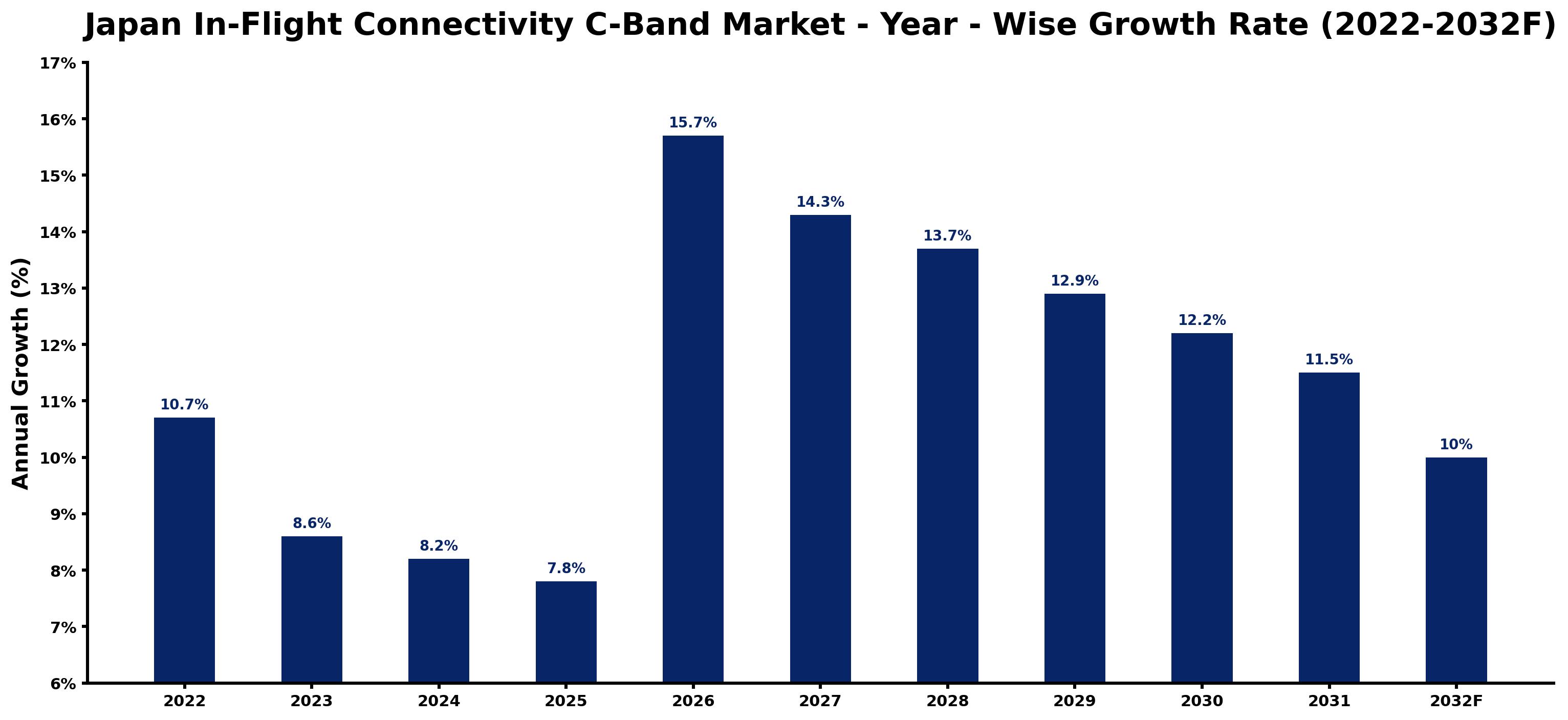
Below, each year's estimated growth is shown next to the factor that most influenced it.
| Year | Estimated Annual Growth (%) | Market Rationale |
| 2022 | 10.7 | Demand for in-flight connectivity services was strong, particularly from domestic airlines. |
| 2023 | 8.6 | Growth slowed as competition intensified among service providers, impacting expansion plans. |
| 2024 | 8.2 | Investment in satellite technology continued but at a reduced pace, affecting growth rates. |
| 2025 | 7.8 | Airlines focused on enhancing existing services rather than expanding new offerings, moderating growth. |
| 2026 | 15.7 | Investment in satellite infrastructure is expected to surge, driving increased demand for connectivity solutions. |
| 2027 | 14.3 | The market will continue to expand as airlines modernise fleets with advanced connectivity systems. |
| 2028 | 13.7 | Adoption of in-flight Wi-Fi is projected to increase, maintaining steady demand for connectivity services. |
| 2029 | 12.9 | Demand will remain strong as passenger expectations for connectivity continue to rise. |
| 2030 | 12.2 | A focus on enhancing passenger experience will support ongoing growth in connectivity services. |
| 2031 | 11.5 | The market will grow as airlines broaden their service offerings to include more connectivity options. |
| 2032 | 10.0 | Demand is expected to stabilise as the market matures and competition intensifies among providers. |
Note: Market size estimations and growth projections presented in this report are based on 6Wresearch's proprietary forecasting methodology, utilizing the latest available industry data, government publications, and primary research inputs.
Japan In-Flight Connectivity C-Band Market Synopsis
In-Flight Connectivity C-Band utilises satellite communication technology with C-Band frequencies to deliver internet and voice services on aircraft. This technology is essential for providing broadband internet and voice communication during flights. The Japan In-Flight Connectivity C-Band Market is expanding due to rising passenger expectations for connectivity, substantial investments in satellite infrastructure, and the increasing number of commercial aircraft equipped with in-flight connectivity solutions. Approximately 100 million passengers travel annually in Japan, driving demand for improved in-flight services.
Market Dynamics Impact Analysis (2026–2032)
| Factor | Type | Impact | Primary Segment Affected |
| Growing passenger demand for in-flight connectivity services | Driver | High | Broadband Internet |
| Investment in satellite technology and infrastructure | Driver | High | C-Band Transceivers |
| Increasing number of commercial aircraft equipped with connectivity solutions | Opportunity | High | Commercial Aircraft |
| Expansion of in-flight Wi-Fi services among airlines | Opportunity | Medium | Inflight Wi-Fi |
| Regulatory constraints on satellite communication frequencies | Restraint | High | Satellite-Based |
| High costs associated with upgrading aircraft systems | Restraint | Medium | C-Band Radomes |
| Limited availability of skilled technicians for installation and maintenance | Challenge | High | Equipment Vendors |
| Competition among service providers leading to price wars | Challenge | Medium | Satcom Providers |
Evaluation of Drivers in Japan In-Flight Connectivity C-Band Market (2026–2032)
Key forces behind demand, with the segment each one moves most, are listed below.
| Drivers | Primary Segment Affected | Why It Matters (Evidence) |
| Increasing passenger expectations for reliable in-flight connectivity | Broadband Internet | Japan's commercial aviation sector serves approximately 100 million passengers annually, driving demand for better connectivity. |
| Expansion of satellite infrastructure investment | C-Band Transceivers | Annual investment in aviation technology in Japan exceeds 200 billion yen, promoting connectivity upgrades across airlines. |
| Regulatory support for satellite communication development | Satellite-Based | The Japan Telecommunications Agency oversees satellite communications, creating a conducive environment for connectivity services. |
| Growing adoption of in-flight Wi-Fi by airlines | Inflight Wi-Fi | In-flight Wi-Fi adoption in Japan has reached approximately 40% among airlines, indicating rising demand for improved services. |
| Technological advancements in satellite communication | C-Band Radomes | Support for satellite technology development improves connectivity capabilities. |
Behind the steady rise in orders sits increasing passenger expectations for reliable in-flight connectivity, with Japan's commercial aviation sector serving approximately 100 million passengers annually. Investment in satellite infrastructure exceeds 200 billion yen annually, promoting connectivity upgrades across airlines. Adoption of in-flight Wi-Fi has reached around 40% among airlines, highlighting the growing need for enhanced services. Advancements in satellite technology are improving connectivity capabilities, leading to increased purchases by airlines.
Evaluation of Restraints in Japan In-Flight Connectivity C-Band Market
These are the pressures that could keep growth below its potential.
| Market Restraint | Primary Segment Affected | Why It Matters (Evidence) |
| Regulatory constraints limiting frequency allocation for satellite communications | Satellite-Based | C-Band frequencies are regulated under the Ministry of Internal Affairs and Communications, restricting service expansion. |
| High costs associated with upgrading aircraft connectivity systems | C-Band Radomes | Many airlines face considerable expenses when retrofitting older aircraft with modern connectivity solutions. |
| Limited availability of skilled technicians for installation and maintenance | Equipment Vendors | The demand for qualified technicians exceeds supply, which delays connectivity upgrades for airlines. |
| Intense competition among service providers leading to price wars | Satcom Providers | Fierce competition results in reduced profit margins, impacting service quality and technology investment. |
| Slow regulatory approval processes for new technologies | C-Band Transceivers | Regulatory delays hinder timely deployment of advanced connectivity solutions in the aviation sector. |
Japan In-Flight Connectivity C-Band Market Challenges
Regulatory constraints hinder the deployment of advanced in-flight connectivity technology, as C-Band frequencies are strictly controlled by the Ministry of Internal Affairs and Communications. This limitation delays the introduction of new services for airlines, which can affect passenger satisfaction and retention. Supply chain issues arise from dependence on specific components, notably C-Band transceivers, found in over 60% of commercial aircraft, leading to increased costs and implementation delays for airlines. Skills shortages in satellite communication technology restrict the ability of service providers to meet rising demand, resulting in slower service rollouts and missed opportunities for airlines.
Trends in the Japan In-Flight Connectivity C-Band Market
Below are the shifts with the largest effect on the Japan In-Flight Connectivity C-Band Market.
- Shift from Traditional to Enhanced In-Flight Connectivity: Japan's aviation sector is evolving towards improved in-flight connectivity solutions, spurred by passenger demand for better services. In 2023, the Ministry of Land, Infrastructure, Transport and Tourism initiated a program to improve connectivity, reflecting this shift.
- Increase in In-Flight Wi-Fi Adoption: In-flight Wi-Fi adoption has surged, reaching approximately 40% among airlines in Japan. This trend reflects changing passenger expectations for connectivity during flights, prompting airlines to invest in better solutions.
- Growing Demand for Voice + Data Link Services: Voice + Data Link services are gaining traction, with a projected CAGR of 17.0% from 2026 to 2032. This growth is driven by the increasing need for reliable communication during flights.
- Expansion of Satellite-Based Connectivity Solutions: The market is seeing a shift towards Satellite-Based connectivity solutions, which accounted for 43% of the market share in 2025. This trend is supported by advancements in satellite technology and infrastructure.
Investment Opportunities in the Japan In-Flight Connectivity C-Band Market
Below are the investment opportunities with the strongest case in the Japan In-Flight Connectivity C-Band Market.
- Collaborations with Satellite Technology Providers: Now is an ideal time for partnerships with satellite technology providers, as Japan invests heavily in connectivity solutions. Collaborating with Satcom Providers can improve service offerings and market reach.
- Investment in In-Flight Wi-Fi Infrastructure: With in-flight Wi-Fi adoption reaching 40%, there is a notable opportunity to invest in Wi-Fi infrastructure. Airlines in Tokyo and Osaka are particularly keen to improve their connectivity services.
- Expansion into Business Jet Connectivity Solutions: The growing demand for connectivity in business jets, estimated at 300 in Japan, presents an opportunity for specialised service providers. Targeting this niche market can yield high returns.
- Development of Advanced C-Band Equipment: Investing in advanced C-Band equipment is timely, given the increasing focus on satellite communication. Collaborating with Equipment Vendors can facilitate entry into this expanding market.
Government Initiatives in the Japan In-Flight Connectivity C-Band Market
The In-Flight Connectivity C-Band Market is influenced by several key regulations. The Industrial Safety and Health Act (1972) mandates safety standards for telecommunications equipment, ensuring that in-flight connectivity devices meet necessary safety requirements. Additionally, the JIS X 6008 standard governs telecommunications equipment, including in-flight connectivity devices, promoting interoperability and reliability. The Digital Agency, established in September 2021, leads initiatives to enhance digital transformation in aviation, including connectivity improvements, with a focus on ensuring that the technology meets modern standards.
Airlines benefit from government initiatives aimed at enhancing satellite communication infrastructure. The Japan Aerospace Exploration Agency (JAXA) supports satellite technology development, providing funding for projects that improve in-flight connectivity. The Civil Aviation Bureau oversees regulations for in-flight connectivity services, ensuring compliance with safety and performance standards. In 2023, the government allocated funds specifically for enhancing satellite communication infrastructure, further supporting the needs of airlines and improving passenger services.
Future Insight of the Japan In-Flight Connectivity C-Band Market
A shift towards improved satellite communication infrastructure will reshape the market by 2032, prompting airlines to invest in modern connectivity solutions. With approximately 100 million passengers served annually, suppliers will likely introduce systems that enhance service quality and reliability. New regulations will emerge, ensuring compliance and safety for in-flight connectivity. The growing demand for connectivity solutions in cargo planes will further influence market dynamics, creating opportunities for both buyers and suppliers.
Market Segmentation Analysis
Japan In-Flight Connectivity C-Band Market report covers a detailed analysis of the following market segments:
By Connectivity Type – Satellite-Based Leads, Ground-to-Air Expected to Grow Fastest
According to Saurav Kr Singh, Senior Research Analyst at 6Wresearch, with 43% of connectivity type revenue in 2025, Satellite-Based was the largest category. Satellite-Based connectivity is the leading sub-segment due to its critical role in delivering internet and voice services on aircraft. With a significant number of commercial aircraft in Japan relying on this technology, it effectively meets the connectivity needs of both domestic and international airlines. Ground-to-Air is projected to grow fastest, at a CAGR of 17.3% during 2026–2032. Ground-to-Air connectivity is witnessing rapid growth, primarily due to the average flight duration of 1.5 hours, which increases the demand for reliable communication solutions. The Japanese government's recent investments in satellite communication infrastructure further support this upward trend. Suppliers should focus on enhancing satellite-based solutions to cater to the rising demand for in-flight connectivity.
By Application – Broadband Internet Leads, Voice + Data Link Expected to Grow Fastest
In 2025, Broadband Internet led the application split with a 48% share. Broadband Internet is the dominant application as it serves as the primary service offered to passengers during flights. The approximately 40% adoption rate of in-flight Wi-Fi among airlines highlights the strong demand for internet access in the aviation sector. The quickest growth will come from Voice + Data Link, forecast to expand at a CAGR of 17.0% between 2026 and 2032. Voice + Data Link is the fastest-growing application, driven by the heightened need for communication during flights, especially emphasised during events such as the Tokyo 2020 Olympics. As airlines strive to improve passenger experiences, this segment is expected to expand further. Buyers will benefit from enhanced voice and data services as airlines invest in improving in-flight connectivity.
By Aircraft Type – Commercial Aircraft Leads, Business Jets Expected to Grow Fastest
The largest aircraft type category in 2025 was Commercial Aircraft, at 45% of revenue. Commercial Aircraft represent the largest segment utilising in-flight connectivity technology, catering to around 100 million passengers annually. The extensive installed base of over 1,300 commercial aircraft equipped with connectivity solutions solidifies its leading position in the market. Business Jets are set to record the highest CAGR in this split, 17.5% over 2026–2032. Business Jets are experiencing the fastest growth in connectivity demand, fuelled by an increasing number of affluent travellers seeking luxury travel options. This segment's expansion is further underscored by the estimated 300 business jets in Japan that require enhanced connectivity. Suppliers should tailor their offerings to address the specific needs of business jet operators as demand for connectivity rises.
By Distribution Channel – Satcom Providers Lead, Telecom Integrators Expected to Grow Fastest
Satcom Providers accounted for 35% of the market by distribution channel in 2025. Satcom Providers lead the distribution channel segment as they are essential for delivering satellite connectivity services to airlines. Their critical role is underscored by the extensive network of over 100 airports in Japan equipped with in-flight connectivity services. Over 2026–2032, Telecom Integrators are expected to post the fastest growth, at a CAGR of 15.5%. Telecom Integrators are rapidly growing as they play a key role in integrating various connectivity solutions for airlines. Their importance is increasing as the aviation sector aims to streamline connectivity services and enhance passenger experiences. Suppliers must collaborate with telecom integrators to improve service delivery and adapt to the evolving demands of airlines.
Key Attractiveness of the Report
- 10 Years of Market Numbers
- Historical Data Starting from 2022 to 2025
- Base Year 2025
- Forecast Data until 2032
- Key Performance Indicators Impacting the Market
- Major Upcoming Developments and Projects
Key Highlights of the Report:
- Japan In-Flight Connectivity C-Band Market Outlook
- Market Size of Japan In-Flight Connectivity C-Band Market, 2025
- Forecast of Japan In-Flight Connectivity C-Band Market, 2032
- Historical Data and Forecast of Japan In-Flight Connectivity C-Band Revenues & Volume for the Period 2022-2032F
- Japan In-Flight Connectivity C-Band Market Trend Evolution
- Japan In-Flight Connectivity C-Band Market Drivers and Challenges
- Japan In-Flight Connectivity C-Band Price Trends
- Japan In-Flight Connectivity C-Band Porter's Five Forces
- Japan In-Flight Connectivity C-Band Industry Life Cycle
- Historical Data and Forecast of Japan In-Flight Connectivity C-Band Market Revenues & Volume By Connectivity Type for the Period 2022-2032F
- Historical Data and Forecast of Japan In-Flight Connectivity C-Band Market Revenues & Volume By Satellite-Based for the Period 2022-2032F
- Historical Data and Forecast of Japan In-Flight Connectivity C-Band Market Revenues & Volume By Ground-to-Air for the Period 2022-2032F
- Historical Data and Forecast of Japan In-Flight Connectivity C-Band Market Revenues & Volume By C-Band Transceivers for the Period 2022-2032F
- Historical Data and Forecast of Japan In-Flight Connectivity C-Band Market Revenues & Volume By C-Band Radomes for the Period 2022-2032F
- Historical Data and Forecast of Japan In-Flight Connectivity C-Band Market Revenues & Volume By Application for the Period 2022-2032F
- Historical Data and Forecast of Japan In-Flight Connectivity C-Band Market Revenues & Volume By Broadband Internet for the Period 2022-2032F
- Historical Data and Forecast of Japan In-Flight Connectivity C-Band Market Revenues & Volume By Voice + Data Link for the Period 2022-2032F
- Historical Data and Forecast of Japan In-Flight Connectivity C-Band Market Revenues & Volume By Inflight Wi-Fi for the Period 2022-2032F
- Historical Data and Forecast of Japan In-Flight Connectivity C-Band Market Revenues & Volume By Signal Shielding for the Period 2022-2032F
- Historical Data and Forecast of Japan In-Flight Connectivity C-Band Market Revenues & Volume By Aircraft Type for the Period 2022-2032F
- Historical Data and Forecast of Japan In-Flight Connectivity C-Band Market Revenues & Volume By Commercial Aircraft for the Period 2022-2032F
- Historical Data and Forecast of Japan In-Flight Connectivity C-Band Market Revenues & Volume By Business Jets for the Period 2022-2032F
- Historical Data and Forecast of Japan In-Flight Connectivity C-Band Market Revenues & Volume By Cargo Planes for the Period 2022-2032F
- Historical Data and Forecast of Japan In-Flight Connectivity C-Band Market Revenues & Volume By Military Aircraft for the Period 2022-2032F
- Historical Data and Forecast of Japan In-Flight Connectivity C-Band Market Revenues & Volume By Distribution Channel for the Period 2022-2032F
- Historical Data and Forecast of Japan In-Flight Connectivity C-Band Market Revenues & Volume By Satcom Providers for the Period 2022-2032F
- Historical Data and Forecast of Japan In-Flight Connectivity C-Band Market Revenues & Volume By Telecom Integrators for the Period 2022-2032F
- Historical Data and Forecast of Japan In-Flight Connectivity C-Band Market Revenues & Volume By Equipment Vendors for the Period 2022-2032F
- Historical Data and Forecast of Japan In-Flight Connectivity C-Band Market Revenues & Volume By OEMs for the Period 2022-2032F
- Japan In-Flight Connectivity C-Band Import Export Trade Statistics
- Market Opportunity Assessment By Connectivity Type
- Market Opportunity Assessment By Application
- Market Opportunity Assessment By Aircraft Type
- Market Opportunity Assessment By Distribution Channel
- Japan In-Flight Connectivity C-Band Top Companies Market Share
- Japan In-Flight Connectivity C-Band Competitive Benchmarking By Technical and Operational Parameters
- Japan In-Flight Connectivity C-Band Company Profiles
- Japan In-Flight Connectivity C-Band Key Strategic Recommendations
Market Covered
The following segment groups are covered in the report.
By Connectivity Type
- Satellite-Based
- Ground-to-Air
- C-Band Transceivers
- C-Band Radomes
By Application
- Broadband Internet
- Voice + Data Link
- Inflight Wi-Fi
- Signal Shielding
By Aircraft Type
- Commercial Aircraft
- Business Jets
- Cargo Planes
- Military Aircraft
By Distribution Channel
- Satcom Providers
- Telecom Integrators
- Equipment Vendors
- OEMs































