Japan In-Flight Connectivity Market Size & Growth Rate
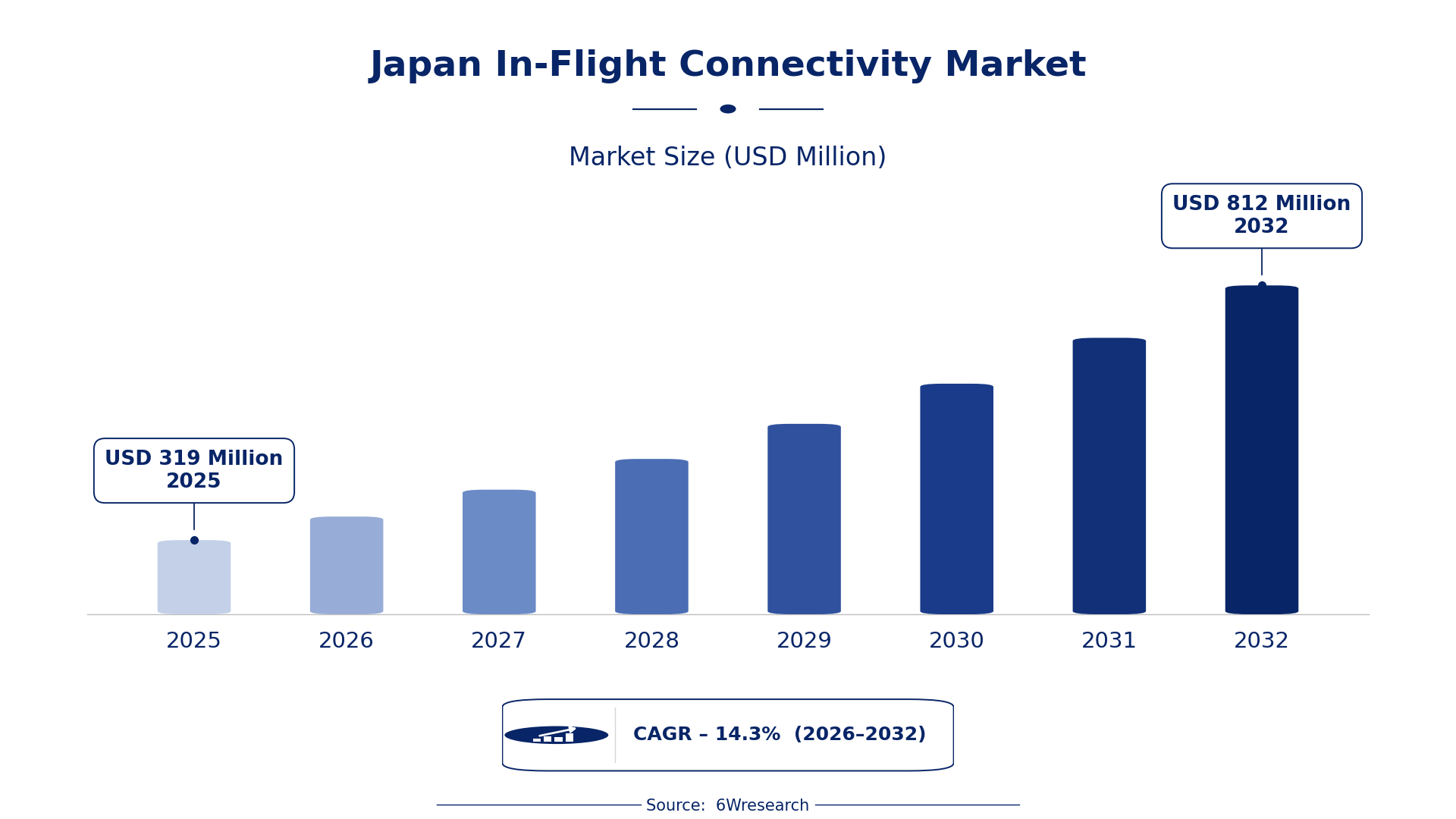
According to 6Wresearch internal database and industry insights, the Japan In-Flight Connectivity Market was valued at USD 319 Million in 2025 and is projected to reach USD 812 Million by 2032, growing at a CAGR of approximately 14.3% during 2026–2032.
Japan In-Flight Connectivity Market Highlights
| Report Metric | Details |
| Report Name | Japan In-Flight Connectivity Market (2026-2032) |
| Market Size 2025 | USD 319 Million |
| Market Size 2032 | USD 812 Million |
| Absolute Growth 2025–2032 | USD 493 Million |
| CAGR 2026–2032 | 14.3% |
| Peak Annual Growth | 17.0% in 2029 |
| Forecast Period | 2026–2032 |
| Historical Data | 2022–2025 |
| Base Year | 2025 |
| Leading Connectivity Type, 2025 | Satellite-Based (39% share) |
| Leading Frequency Band, 2025 | Ku / Ka / L Band (39% share) |
| Leading Service Type, 2025 | Wi-Fi / VPN (37% share) |
| Leading Distribution Channel, 2025 | Satellite Network Vendors (46% share) |
| Fastest-Growing Connectivity Type | Hybrid Systems (20.5% CAGR) |
| Fastest-Growing Frequency Band | ATG / LTE (15.9% CAGR) |
| Fastest-Growing Service Type | Streaming / Messaging (19.5% CAGR) |
| Fastest-Growing Distribution Channel | Telecom Operators (18.7% CAGR) |
| Growing Sector | Aviation |
| Key End Users | Airlines, telecom operators, aviation authorities, content providers |
Japan In-Flight Connectivity Market Year-wise Growth Rate and Key Drivers (2022–2032)
This graph illustrates the annual growth rates of the market from 2022 to 2032, highlighting a steady upward trajectory and projected market expansion over the forecast period.
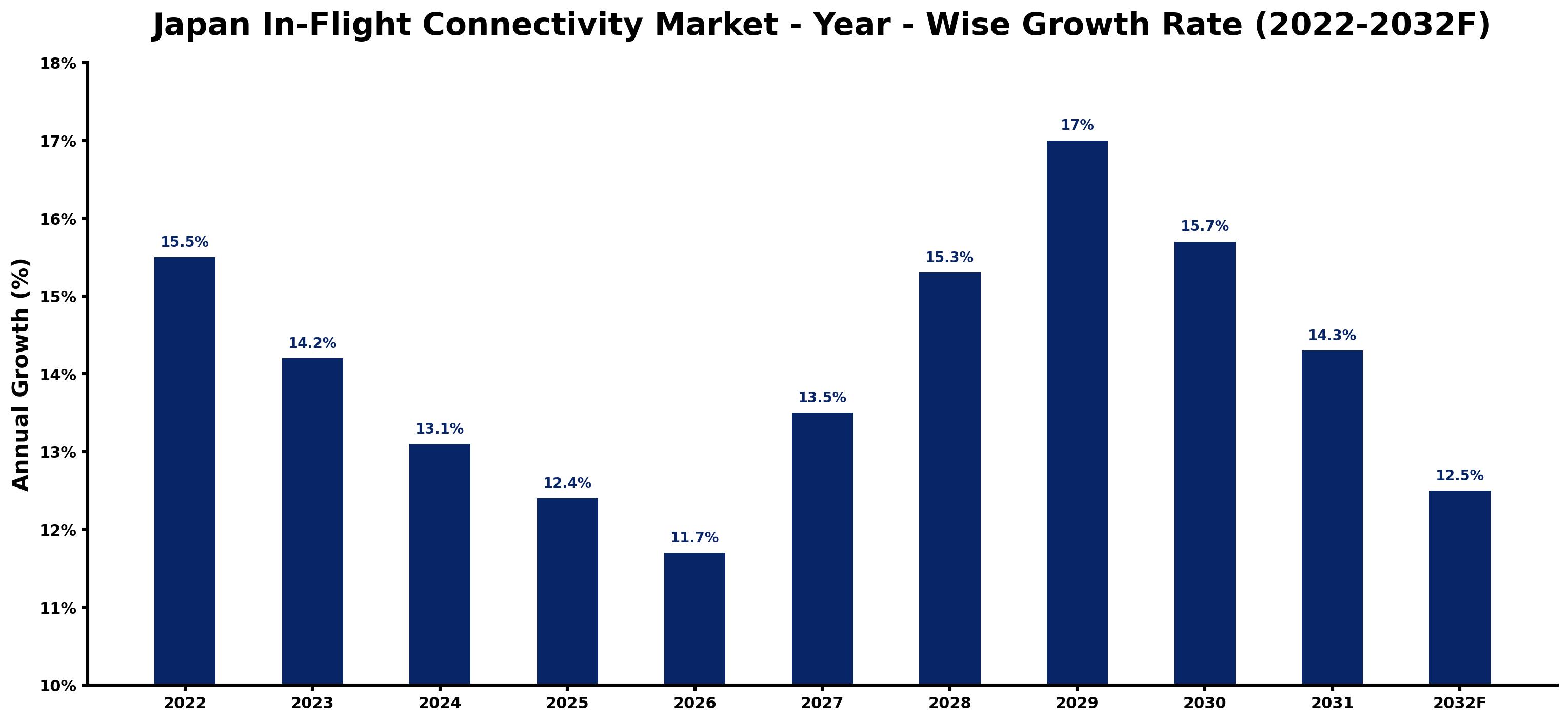
Each row of the following table gives one year's estimated growth and the event or demand shift that explains it.
| Year | Estimated Annual Growth (%) | Market Rationale |
| 2022 | 15.5 | The market experienced strong demand as air travel rebounded following restrictions. |
| 2023 | 14.2 | Growth slowed due to market saturation and increased competition among service providers. |
| 2024 | 13.1 | Demand continued to rise, but at a reduced rate as airlines adjusted to new standards. |
| 2025 | 12.4 | The market saw a further slowdown as airlines focused on operational efficiency. |
| 2026 | 11.7 | Growth is expected to slow as airlines face challenges in upgrading existing systems. |
| 2027 | 13.5 | Demand is projected to increase as airlines adopt hybrid systems for better connectivity. |
| 2028 | 15.3 | Growth is anticipated to pick up with rising passenger expectations for in-flight services. |
| 2029 | 17.0 | The market is expected to peak as new standards and technologies improve connectivity options. |
| 2030 | 15.7 | Growth will slow as the market stabilises following rapid technological advancements. |
| 2031 | 14.3 | Demand is projected to continue growing, albeit at a slower pace as competition intensifies. |
| 2032 | 12.5 | The market is expected to maintain steady growth as airlines innovate services. |
Note: Market size estimations and growth projections presented in this report are based on 6Wresearch's proprietary forecasting methodology, utilizing the latest available industry data, government publications, and primary research inputs.
Japan In-Flight Connectivity Market Synopsis
In-Flight Connectivity (IFC) enables internet access and communication services aboard aircraft, primarily through satellite or air-to-ground systems. The Japan In-Flight Connectivity Market is growing, driven by over 100 million air passengers annually, with domestic airlines and international carriers increasingly adopting hybrid systems. The introduction of new standards in 2023 and the government's programme to improve digital services in aviation are propelling demand, as airlines strive to meet passenger expectations for connectivity and improve their service offerings.
Market Dynamics Impact Analysis (2026–2032)
| Factor | Type | Impact | Primary Segment Affected |
| Rising passenger numbers are increasing demand for in-flight connectivity services. | Driver | High | Satellite-Based |
| The adoption of hybrid systems allows airlines to offer better connectivity. | Driver | High | Hybrid Systems |
| The increasing demand for streaming services among passengers presents a significant opportunity. | Opportunity | High | Streaming / Messaging |
| Airlines are looking to enhance operational efficiency, creating a need for managed connectivity solutions. | Opportunity | High | Managed Connectivity |
| Intense competition among service providers is limiting profit margins for airlines. | Restraint | High | Air-to-Ground |
| Regulatory compliance costs are rising, impacting service providers' pricing strategies. | Restraint | Medium | Satellite-Based |
| Technological integration challenges can delay service upgrades for airlines. | Challenge | High | Hybrid Systems |
| High infrastructure costs can deter new entrants into the market. | Challenge | Medium | Satellite-Based |
Evaluation of Drivers in Japan In-Flight Connectivity Market (2026–2032)
Demand rests on the following drivers, each shown with the segment it touches most.
| Drivers | Primary Segment Affected | Why It Matters (Evidence) |
| Increasing air passenger traffic drives demand for connectivity services. | Satellite-Based | Japan has over 100 million air passengers annually, leading to higher demand for in-flight connectivity. |
| Adoption of hybrid systems improves connectivity options for airlines. | Hybrid Systems | Recent trends show a significant rise in airlines adopting hybrid systems for enhanced service quality. |
| Rising demand for streaming services boosts in-flight service offerings. | Streaming / Messaging | The popularity of streaming services among air travelers is driving airlines to expand their in-flight options. |
| Managed connectivity solutions improve operational efficiency for airlines. | Managed Connectivity | The average revenue per passenger for in-flight services in Japan is steadily increasing, prompting airlines to invest in management solutions. |
| Regulatory standards drive improvements in service quality and offerings. | Satellite-Based | In 2023, the Japanese government launched a program to improve digital services in aviation, enhancing connectivity standards. |
Orders keep climbing as the aviation sector in Japan continues to thrive, with over 100 million air passengers annually driving demand for in-flight connectivity services. The average flight duration of approximately 1.5 hours increases the need for in-flight services, while the introduction of new standards in 2023 improves service quality. Airlines are adopting hybrid systems that combine satellite and air-to-ground technologies to provide better connectivity options. The increasing popularity of streaming services among passengers is pushing airlines to invest in their in-flight offerings, resulting in greater demand for advanced connectivity solutions.
Evaluation of Restraints in Japan In-Flight Connectivity Market
Below are the constraints most often cited by buyers and suppliers, with the segment each affects.
| Market Restraint | Primary Segment Affected | Why It Matters (Evidence) |
| Intense competition among service providers is driving down prices. | Air-to-Ground | As multiple providers enter the market, profit margins for airlines are being squeezed. |
| Rising regulatory compliance costs can impact service pricing. | Satellite-Based | Japan has specific regulations regarding data privacy for in-flight internet services. |
| Technological integration challenges can delay service upgrades. | Hybrid Systems | Airlines may struggle to implement new technologies due to existing infrastructure limitations. |
| High infrastructure costs deter new entrants into the market. | Satellite-Based | Setting up satellite communication systems requires substantial investment. |
| Limited availability of skilled workforce affects service quality. | Managed Connectivity | The aviation sector faces challenges in hiring qualified personnel for advanced technologies. |
Japan In-Flight Connectivity Market Challenges
Japanese airlines face supply challenges due to the limited availability of advanced in-flight connectivity systems, which hampers their ability to meet the needs of over 100 million annual air passengers. This issue arises from stringent regulations set by the Ministry of Land, Infrastructure, Transport and Tourism, causing delays in service implementation for airlines. Consequently, passengers experience longer wait times for reliable internet access during flights, particularly with an average flight duration of 1.5 hours. Compliance with new JIS standards in 2023 is raising operational costs, forcing airlines to increase ticket prices, which can deter budget-conscious travellers from opting for premium connectivity services.
Trends in the Japan In-Flight Connectivity Market
The trends below show where the Japan In-Flight Connectivity Market is heading.
- Shift towards Hybrid Connectivity Solutions: Airlines are increasingly adopting hybrid connectivity solutions, combining satellite and air-to-ground systems. In 2023, approximately 70% of Japanese airlines offered in-flight Wi-Fi services, reflecting this trend.
- Increase in Streaming Services Usage: The average revenue per passenger for in-flight services in Japan is steadily increasing, supported by a high adoption rate of streaming services among air travelers. This trend enhances the overall passenger experience.
- Growing Demand for Real-Time Communication: Passengers are increasingly seeking real-time communication options during flights. The Tokyo metropolitan area is a major hub for airlines offering these services, contributing to rising demand for in-flight connectivity.
- Emergence of Managed Connectivity Solutions: Managed connectivity solutions are becoming essential for airlines to efficiently manage their in-flight services. The Japan Airlines Association promotes the use of advanced connectivity solutions to improve operational efficiency.
Investment Opportunities in the Japan In-Flight Connectivity Market
The opportunities below stand out in the Japan In-Flight Connectivity Market for new entrants and existing suppliers.
- Investment in Hybrid Connectivity Systems: The increasing demand for hybrid connectivity systems presents an opportunity for suppliers. In 2023, approximately 70% of Japanese airlines offered in-flight Wi-Fi services, indicating a market gap for improved solutions.
- Expansion of Streaming Services: With a high adoption rate of streaming services among air travellers, there is a notable opportunity for content providers. Collaborating with airlines to offer exclusive streaming options can significantly enhance passenger experience.
- Development of Managed Connectivity Solutions: The need for managed connectivity solutions is rising as airlines focus on operational efficiency. Partnering with telecom operators can provide a pathway to enter this growing market.
- Enhancement of Regional Connectivity Programs: The Japanese government's initiative to improve regional connectivity for air travel highlights an investment opportunity. Suppliers can engage with local authorities to provide necessary infrastructure and services.
Government Initiatives in the Japan In-Flight Connectivity Market
The Long-Term Care Insurance Act (1997, in force 2000; MHLW) established a framework for care services, influencing regulations across various sectors, including aviation. The Digital Agency, established in September 2021, is leading government digital transformation efforts, promoting common system standards that benefit in-flight connectivity services.
The Digital Agency's framework is utilised by the Japan Airlines Association to improve digital services in aviation. This includes funding for projects aimed at enhancing in-flight connectivity, focusing on meeting the evolving demands of passengers. The government has allocated resources to ensure that airlines comply with new standards, creating a more connected travel experience.
Future Insight of the Japan In-Flight Connectivity Market
The introduction of new digital service programmes in aviation will transform in-flight connectivity by 2032. Enhanced regional connectivity initiatives will ensure that even remote areas benefit from reliable internet access. As airlines adopt advanced systems, passengers will experience improved internet services during flights. With the average revenue per passenger for in-flight services steadily increasing, suppliers will invest more in technologies, raising service quality. Collaborations between telecom providers and airlines will further elevate the standard of in-flight offerings.
Market Segmentation Analysis
Japan In-Flight Connectivity Market report covers a detailed analysis of the following market segments:
By Connectivity Type – Satellite-Based Leads, Hybrid Systems Expected to Grow Fastest
According to Saurav Kr Singh, Senior Research Analyst at 6Wresearch, Satellite-Based took 39% of connectivity type revenue in 2025, more than any other category. Satellite-based connectivity maintains a strong position due to its essential role in providing coverage over remote areas, which is crucial for long-haul flights. The reliance on satellite systems is particularly evident in the Tokyo metropolitan area, where numerous airlines operate. Hybrid Systems are projected to grow fastest, at a CAGR of 20.5% during 2026–2032. Hybrid systems are experiencing rapid growth as they combine the strengths of both satellite and ground technologies, making them appealing to airlines seeking to improve service quality. The recent introduction of new standards in 2023 is likely to further boost their adoption in the market. Suppliers should focus on developing hybrid solutions to meet the rising demand from airlines for improved connectivity.
By Frequency Band – Ku / Ka / L Band Leads, ATG / LTE Expected to Grow Fastest
Ku / Ka / L Band accounted for 39% of the market by frequency band in 2025. The Ku, Ka, and L bands are the predominant frequency bands in the market, widely utilised for satellite communication, ensuring reliable connectivity for Japan's extensive air traffic. This is particularly significant given the country’s annual passenger volume exceeding 100 million. Over 2026–2032, ATG / LTE is expected to post the fastest growth, at a CAGR of 15.9%. ATG and LTE frequency bands are rapidly gaining traction as they provide cost-effective solutions tailored for specific regions, appealing to airlines aiming to optimise operational costs. Their growing adoption is expected to significantly influence connectivity strategies in the aviation sector. Buyers should consider the benefits of ATG and LTE solutions to enhance their service offerings.
By Service Type – Wi-Fi / VPN Leads, Streaming / Messaging Expected to Grow Fastest
In 2025, Wi-Fi / VPN led the service type split with a 37% share. Wi-Fi and VPN services are the primary offerings for passengers, making up the largest share of in-flight connectivity services. With approximately 70% of Japanese airlines providing Wi-Fi, it is a critical component of the passenger experience. The quickest growth will come from Streaming / Messaging, forecast to expand at a CAGR of 19.5% between 2026 and 2032. Streaming and messaging services are rapidly growing in popularity, driven by the high adoption rate of streaming among air travelers. This shift indicates a changing preference towards more interactive in-flight experiences. Suppliers must innovate in streaming and messaging services to align with passenger expectations.
By Distribution Channel – Satellite Network Vendors Lead, Telecom Operators Expected to Grow Fastest
The largest distribution channel category in 2025 was Satellite Network Vendors, at 46% of revenue. Satellite network vendors hold a substantial market share as they provide critical infrastructure for connectivity, even though they are not directly accessed by passengers. Their role is vital in supporting the overall connectivity framework within Japan's aviation industry. Telecom Operators are set to record the highest CAGR in this split, 18.7% over 2026–2032. Telecom operators are emerging as the fastest-growing distribution channel, offering tailored connectivity solutions that address the specific needs of airlines. Their partnerships with airlines are essential for enhancing in-flight services and meeting passenger expectations effectively. Suppliers should strengthen collaborations with telecom operators to leverage their increasing importance in the market.
Key Attractiveness of the Report
- 10 Years of Market Numbers
- Historical Data Starting from 2022 to 2025
- Base Year 2025
- Forecast Data until 2032
- Key Performance Indicators Impacting the Market
- Major Upcoming Developments and Projects
Key Highlights of the Report:
- Japan In-Flight Connectivity Market Outlook
- Market Size of Japan In-Flight Connectivity Market, 2025
- Forecast of Japan In-Flight Connectivity Market, 2032
- Historical Data and Forecast of Japan In-Flight Connectivity Revenues & Volume for the Period 2022-2032F
- Japan In-Flight Connectivity Market Trend Evolution
- Japan In-Flight Connectivity Market Drivers and Challenges
- Japan In-Flight Connectivity Price Trends
- Japan In-Flight Connectivity Porter's Five Forces
- Japan In-Flight Connectivity Industry Life Cycle
- Historical Data and Forecast of Japan In-Flight Connectivity Market Revenues & Volume By Connectivity Type for the Period 2022-2032F
- Historical Data and Forecast of Japan In-Flight Connectivity Market Revenues & Volume By Satellite-Based for the Period 2022-2032F
- Historical Data and Forecast of Japan In-Flight Connectivity Market Revenues & Volume By Air-to-Ground for the Period 2022-2032F
- Historical Data and Forecast of Japan In-Flight Connectivity Market Revenues & Volume By Hybrid Systems for the Period 2022-2032F
- Historical Data and Forecast of Japan In-Flight Connectivity Market Revenues & Volume By Managed Connectivity for the Period 2022-2032F
- Historical Data and Forecast of Japan In-Flight Connectivity Market Revenues & Volume By Frequency Band for the Period 2022-2032F
- Historical Data and Forecast of Japan In-Flight Connectivity Market Revenues & Volume By Ku / Ka / L Band for the Period 2022-2032F
- Historical Data and Forecast of Japan In-Flight Connectivity Market Revenues & Volume By ATG / LTE for the Period 2022-2032F
- Historical Data and Forecast of Japan In-Flight Connectivity Market Revenues & Volume By Satellite + ATG for the Period 2022-2032F
- Historical Data and Forecast of Japan In-Flight Connectivity Market Revenues & Volume By Subscription Model for the Period 2022-2032F
- Historical Data and Forecast of Japan In-Flight Connectivity Market Revenues & Volume By Service Type for the Period 2022-2032F
- Historical Data and Forecast of Japan In-Flight Connectivity Market Revenues & Volume By Wi-Fi / VPN for the Period 2022-2032F
- Historical Data and Forecast of Japan In-Flight Connectivity Market Revenues & Volume By Streaming / Messaging for the Period 2022-2032F
- Historical Data and Forecast of Japan In-Flight Connectivity Market Revenues & Volume By Real-Time Browsing for the Period 2022-2032F
- Historical Data and Forecast of Japan In-Flight Connectivity Market Revenues & Volume By B2B Airline Services for the Period 2022-2032F
- Historical Data and Forecast of Japan In-Flight Connectivity Market Revenues & Volume By Distribution Channel for the Period 2022-2032F
- Historical Data and Forecast of Japan In-Flight Connectivity Market Revenues & Volume By Satellite Network Vendors for the Period 2022-2032F
- Historical Data and Forecast of Japan In-Flight Connectivity Market Revenues & Volume By Telecom Operators for the Period 2022-2032F
- Historical Data and Forecast of Japan In-Flight Connectivity Market Revenues & Volume By Aircraft OEM Integration for the Period 2022-2032F
- Historical Data and Forecast of Japan In-Flight Connectivity Market Revenues & Volume By SaaS Platforms for the Period 2022-2032F
- Japan In-Flight Connectivity Import Export Trade Statistics
- Market Opportunity Assessment By Connectivity Type
- Market Opportunity Assessment By Frequency Band
- Market Opportunity Assessment By Service Type
- Market Opportunity Assessment By Distribution Channel
- Japan In-Flight Connectivity Top Companies Market Share
- Japan In-Flight Connectivity Competitive Benchmarking By Technical and Operational Parameters
- Japan In-Flight Connectivity Company Profiles
- Japan In-Flight Connectivity Key Strategic Recommendations
Market Covered
Coverage by segment is as follows.
By Connectivity Type
- Satellite-Based
- Air-to-Ground
- Hybrid Systems
- Managed Connectivity
By Frequency Band
- Ku / Ka / L Band
- ATG / LTE
- Satellite + ATG
- Subscription Model
By Service Type
- Wi-Fi / VPN
- Streaming / Messaging
- Real-Time Browsing
- B2B Airline Services
By Distribution Channel
- Satellite Network Vendors
- Telecom Operators
- Aircraft OEM Integration
- SaaS Platforms































