Japan In-Flight Data Link Market Size & Growth Rate
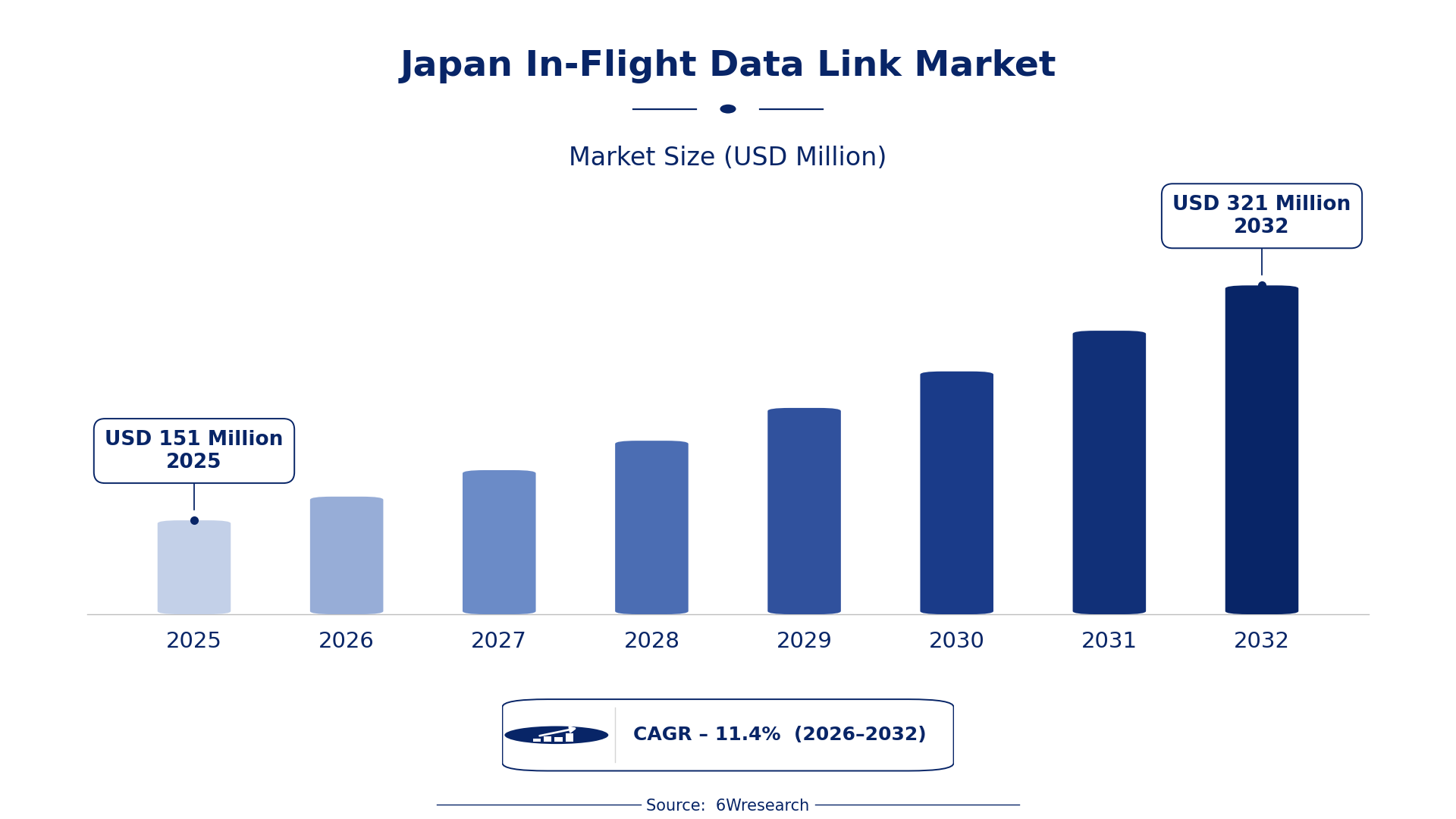
According to 6Wresearch internal database and industry insights, the Japan In-Flight Data Link Market was valued at USD 151 Million in 2025 and is projected to reach USD 321 Million by 2032, growing at a CAGR of approximately 11.4% during 2026–2032.
Japan In-Flight Data Link Market Highlights
| Report Metric | Details |
| Report Name | Japan In-Flight Data Link Market (2026-2032) |
| Market Size 2025 | USD 151 Million |
| Market Size 2032 | USD 321 Million |
| Absolute Growth 2025–2032 | USD 170 Million |
| CAGR 2026–2032 | 11.4% |
| Peak Annual Growth | 14.3% in 2032 |
| Forecast Period | 2026–2032 |
| Historical Data | 2022–2025 |
| Base Year | 2025 |
| Leading Link Type, 2025 | ACARS (33% share) |
| Leading Technology Used, 2025 | VHF / SATCOM (42% share) |
| Leading Use Case, 2025 | Aircraft Communication (39% share) |
| Leading Distribution Channel, 2025 | Avionics Suppliers (36% share) |
| Fastest-Growing Link Type | CPDLC (16.1% CAGR) |
| Fastest-Growing Technology Used | Data Link Messaging (17.1% CAGR) |
| Fastest-Growing Use Case | ATC Interaction (15.7% CAGR) |
| Fastest-Growing Distribution Channel | OEM Integrators (14.5% CAGR) |
| Growing Sector | aviation |
| Key End Users | domestic airlines, international airlines, avionics suppliers, air traffic control agencies |
Japan In-Flight Data Link Market Year-wise Growth Rate and Key Drivers (2022–2032)
This graph illustrates the annual growth rates of the market from 2022 to 2032, highlighting a steady upward trajectory and projected market expansion over the forecast period.
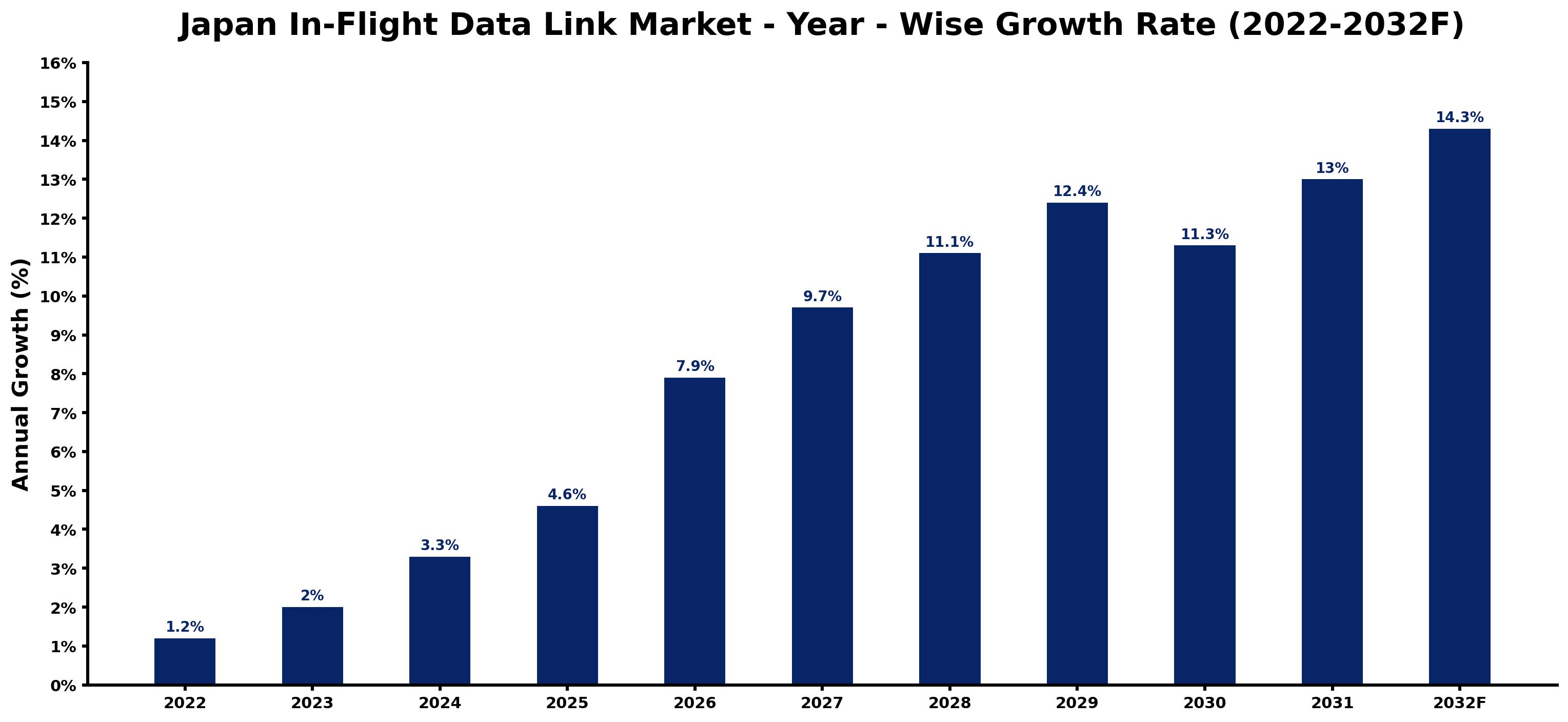
The following figures match every annual growth estimate with the main market development of that year, giving the reasoning behind each rise or slowdown.
| Year | Estimated Annual Growth (%) | Market Rationale |
| 2022 | 1.2 | The market experienced steady operations, with demand primarily from domestic airlines. |
| 2023 | 2.0 | Growth accelerated as the aviation sector began recovering from previous challenges. |
| 2024 | 3.3 | Increased air traffic led to higher demand for data link systems. |
| 2025 | 4.6 | The upgrade of air traffic management systems spurred further growth in data link technology. |
| 2026 | 7.9 | Demand is expected to rise as more airlines adopt advanced communication systems. |
| 2027 | 9.7 | The implementation of new technologies will improve operational efficiency for airlines. |
| 2028 | 11.1 | Increased passenger numbers will drive further investments in data link capabilities. |
| 2029 | 12.4 | The growing focus on safety and efficiency will boost demand for data links. |
| 2030 | 11.3 | A slowdown in growth is anticipated as the market stabilises after rapid expansion. |
| 2031 | 13.0 | Demand is projected to rise as international flights increase in frequency. |
| 2032 | 14.3 | The market will peak as advanced technologies become standard in aviation. |
Note: Market size estimations and growth projections presented in this report are based on 6Wresearch's proprietary forecasting methodology, utilizing the latest available industry data, government publications, and primary research inputs.
Japan In-Flight Data Link Market Synopsis
In-Flight Data Link technology facilitates communication between aircraft and ground stations through satellite and radio technologies. This technology is essential for aircraft communication, air traffic control interaction, and real-time flight data transmission. The Japan In-Flight Data Link Market is expanding due to rising air traffic, with over 300 airports in operation and a strong push from domestic airlines. The Japanese government supports advanced data link systems through various initiatives, encouraging investment and improving operational efficiency across the aviation sector.
Market Dynamics Impact Analysis (2026–2032)
| Factor | Type | Impact | Primary Segment Affected |
| The upgrade of air traffic management systems enhances data link capabilities, driving demand for ACARS. | Driver | High | ACARS |
| The increasing number of commercial flights necessitates reliable communication systems, boosting VHF / SATCOM usage. | Driver | High | VHF / SATCOM |
| Growing demand for real-time data transmission creates opportunities for Aircraft Communication systems. | Opportunity | High | Aircraft Communication |
| The need for efficient air traffic management presents a chance for CPDLC adoption. | Opportunity | High | CPDLC |
| High costs of implementing advanced data link systems can limit adoption among smaller airlines. | Restraint | Medium | Data Link Messaging |
| Limited infrastructure in remote areas may hinder the deployment of satellite communication systems. | Restraint | Medium | Satellite Providers |
| Competition among avionics suppliers can lead to pricing pressures affecting profitability. | Challenge | High | Avionics Suppliers |
| Technological advancements require continuous investment, posing a challenge for smaller firms. | Challenge | High | OEM Integrators |
Evaluation of Drivers in Japan In-Flight Data Link Market (2026–2032)
The factors lifting demand, and the evidence behind each, are summarised below.
| Drivers | Primary Segment Affected | Why It Matters (Evidence) |
| Increasing air traffic volumes drive demand for ACARS systems. | ACARS | Over 80% of commercial flights in Japan utilise ACARS for efficient data transmission. |
| The need for reliable voice and data communication boosts VHF / SATCOM systems. | VHF / SATCOM | Mandated for all commercial aircraft, ensuring compliance and operational efficiency. |
| The push for real-time data sharing increases demand for Data Link Messaging solutions. | Data Link Messaging | Supports efficient communication and data sharing across borders. |
| The growing focus on safety regulations increases the need for CPDLC systems. | CPDLC | Used for communication between pilots and air traffic controllers, improving safety. |
| The rise in international flights necessitates advanced data link technologies. | Aircraft Communication | Essential for operational safety, especially in high-density air traffic areas. |
A wider customer base explains much of the growth, as increasing air traffic volumes in the Tokyo metropolitan area drive demand for data link technologies. In 2022, the Japanese aviation industry upgraded its air traffic management systems, significantly improving communication efficiency. Over 80% of commercial flights in Japan utilise ACARS, which supports effective data transmission. The need for reliable voice and data communication boosts VHF / SATCOM systems, which are mandated for all commercial aircraft. The rise in international flights also necessitates advanced data link technologies, contributing to overall market growth.
Evaluation of Restraints in Japan In-Flight Data Link Market
These restraints slow adoption and weigh on supplier margins.
| Market Restraint | Primary Segment Affected | Why It Matters (Evidence) |
| High implementation costs for advanced data link systems limit adoption among smaller airlines. | Data Link Messaging | Smaller carriers may struggle to invest in necessary technologies, affecting their competitiveness. |
| Limited infrastructure in remote areas hinders satellite communication deployment. | Satellite Providers | This restricts service availability, impacting airlines operating in less accessible regions. |
| Regulatory compliance costs can deter investment in new data link technologies. | VHF / SATCOM | Airlines must allocate budgets to meet stringent aviation regulations. |
| Market competition among avionics suppliers can lead to pricing pressures. | Avionics Suppliers | This affects profitability, especially for smaller firms trying to gain market share. |
| Technological advancements require ongoing investment, posing challenges for smaller firms. | OEM Integrators | Continuous upgrades are necessary to stay competitive, straining financial resources. |
Japan In-Flight Data Link Market Challenges
Producers struggle with a lack of skilled technicians trained in advanced data link systems, which delays aircraft maintenance and increases operational costs by around 20%. New regulations from the Ministry of Land, Infrastructure, Transport and Tourism create compliance hurdles, leading to aircraft upgrade delays that can extend timelines by six months for airlines. Rising demand for advanced data link technology results in price increases of up to 15% for new systems, straining budgets for buyers. Technological limitations in existing data link infrastructure impede the rollout of satellite communication initiatives, affecting operational efficiency for airlines.
Trends in the Japan In-Flight Data Link Market
Four trends stand out in the Japan In-Flight Data Link Market.
- Shift towards Advanced Data Link Technologies: The aviation sector is increasingly adopting advanced data link technologies, with the Japanese government promoting these systems through various initiatives. In 2022, upgrades to air traffic management systems were implemented, improving operational efficiency.
- Transition from Traditional Communication to Data-Driven Solutions: Japan's aviation industry is moving from traditional communication methods to data-driven solutions. The introduction of CPDLC systems is gaining traction, with a projected CAGR of 16.1% from 2026 to 2032, improving safety and efficiency.
- Emergence of Real-Time Data Sharing: Real-time data sharing is becoming essential in aviation, with ACARS systems leading this trend. Over 80% of commercial flights in Japan now utilise ACARS for efficient data transmission, reflecting a growing demand for connectivity.
- Focus on Safety and Efficiency in Air Traffic Management: Air traffic management in Japan is prioritising safety and efficiency through advanced data link systems. The Tokyo metropolitan area, with the highest air traffic density, is a key region for implementing these technologies.
Investment Opportunities in the Japan In-Flight Data Link Market
Where to invest in the Japan In-Flight Data Link Market: the main openings are set out below.
- Investment in Satellite Communication Infrastructure: The Japanese government is investing in satellite communication infrastructure to improve connectivity in remote areas. This initiative, launched in 2023, aims to enhance communication capabilities, creating opportunities for satellite providers.
- Partnerships with Avionics Suppliers: Now is the time for OEM Integrators to form partnerships with avionics suppliers to strengthen their offerings. The increasing need for advanced data link systems presents a promising opportunity for collaboration.
- Expansion of CPDLC Systems: The need for efficient air traffic management creates an opportunity for CPDLC system providers. With a projected CAGR of 16.1%, this segment is ripe for investment and development.
- Development of Real-Time Flight Data Solutions: As airlines seek to improve operational efficiency, there is a demand for real-time flight data solutions. This presents opportunities for technology providers to supply advanced systems.
Government Initiatives in the Japan In-Flight Data Link Market
The Japanese government promotes the adoption of advanced data link systems through various initiatives, which aim to improve safety and operational efficiency. The program encourages airlines to invest in technologies such as ACARS and CPDLC, focusing on improving communication between aircraft and ground stations. In 2022, upgrades to the air traffic management system were implemented, further supporting these initiatives.
The Digital Agency oversees the implementation of aviation regulations and standards. This agency leads government digital transformation efforts, ensuring that aviation technology aligns with common system standards. It plays a key role in facilitating the adoption of advanced data link systems among airlines.
Future Insight of the Japan In-Flight Data Link Market
By 2032, airlines will adopt advanced satellite data link systems, driven by government initiatives to enhance connectivity in remote regions. Upgrades to air traffic management systems will streamline operations, reducing delays significantly. As the aviation industry focuses on emission reductions, suppliers will develop more efficient data link technologies to meet regulatory standards. The expected rise in passenger traffic at airports will require effective data link solutions to manage air traffic efficiently.
Market Segmentation Analysis
Japan In-Flight Data Link Market report covers a detailed analysis of the following market segments:
By Link Type – ACARS Leads, CPDLC Expected to Grow Fastest
According to Saurav Kr Singh, Senior Research Analyst at 6Wresearch, ACARS accounted for 33% of the market by link type in 2025. ACARS holds the largest share due to its extensive use in over 80% of commercial flights in Japan. This widespread adoption ensures reliable communication for flight data transmission between aircraft and ground stations, making it essential for operational efficiency. CPDLC is projected to grow fastest, at a CAGR of 16.1% during 2026–2032. The CPDLC sub-segment is growing quickly as it enhances communication between pilots and air traffic controllers, which is crucial for air traffic management. The recent upgrade of Japan's air traffic management system in 2022 is driving further adoption of CPDLC. Suppliers should enhance their CPDLC offerings to capitalise on its increasing significance in the aviation sector.
By Technology Used – VHF / SATCOM Leads, Data Link Messaging Expected to Grow Fastest
The largest technology used category in 2025 was VHF / SATCOM, at 42% of revenue. VHF / SATCOM technology leads the market as it is vital for both voice and data communication in aviation, ensuring operational safety. Its established presence in the industry makes it the preferred choice for many aviation stakeholders. Over 2026–2032, Data Link Messaging is expected to post the fastest growth, at a CAGR of 17.1%. Data Link Messaging is experiencing rapid growth as it serves as the core function for sending and receiving critical flight information. The rising demand for real-time data exchange in aviation operations is propelling this segment forward. Buyers should invest in advanced Data Link Messaging solutions to enhance operational capabilities and safety.
By Use Case – Aircraft Communication Leads, ATC Interaction Expected to Grow Fastest
Aircraft Communication took 39% of use case revenue in 2025, more than any other category. Aircraft Communication is the leading use case, fundamental for ensuring operational efficiency and safety in flight operations. Its critical role in maintaining effective communication between aircraft and ground services solidifies its dominant position. ATC Interaction is set to record the highest CAGR in this split, 15.7% over 2026–2032. ATC Interaction is growing swiftly due to its essential role in maintaining safe air traffic management, particularly in high-density regions like Tokyo. The emphasis on enhanced safety protocols in aviation is driving this segment's growth. Suppliers must focus on solutions that improve ATC Interaction to meet the demands of air traffic management.
By Distribution Channel – Avionics Suppliers Lead, OEM Integrators Expected to Grow Fastest
Avionics Suppliers held 36% of the Japan In-Flight Data Link Market by distribution channel in 2025. Avionics Suppliers dominate the distribution channel as they provide essential components for data link systems, ensuring airlines access the latest technologies. Their established relationships with airlines and regulatory bodies further reinforce their market position. The quickest growth will come from OEM Integrators, forecast to expand at a CAGR of 14.5% between 2026 and 2032. OEM Integrators are experiencing the fastest growth as they play a pivotal role in integrating systems for aircraft manufacturers, crucial for modernising fleets. Ongoing initiatives to enhance aviation technology in Japan are increasing demand for these integrators. Buyers should collaborate with OEM Integrators to ensure they receive the most advanced and compatible data link systems.
Key Attractiveness of the Report
- 10 Years of Market Numbers
- Historical Data Starting from 2022 to 2025
- Base Year 2025
- Forecast Data until 2032
- Key Performance Indicators Impacting the Market
- Major Upcoming Developments and Projects
Key Highlights of the Report:
- Japan In-Flight Data Link Market Outlook
- Market Size of Japan In-Flight Data Link Market, 2025
- Forecast of Japan In-Flight Data Link Market, 2032
- Historical Data and Forecast of Japan In-Flight Data Link Revenues & Volume for the Period 2022-2032F
- Japan In-Flight Data Link Market Trend Evolution
- Japan In-Flight Data Link Market Drivers and Challenges
- Japan In-Flight Data Link Price Trends
- Japan In-Flight Data Link Porter's Five Forces
- Japan In-Flight Data Link Industry Life Cycle
- Historical Data and Forecast of Japan In-Flight Data Link Market Revenues & Volume By Link Type for the Period 2022-2032F
- Historical Data and Forecast of Japan In-Flight Data Link Market Revenues & Volume By ACARS for the Period 2022-2032F
- Historical Data and Forecast of Japan In-Flight Data Link Market Revenues & Volume By CPDLC for the Period 2022-2032F
- Historical Data and Forecast of Japan In-Flight Data Link Market Revenues & Volume By VDL Mode 2 for the Period 2022-2032F
- Historical Data and Forecast of Japan In-Flight Data Link Market Revenues & Volume By ADS-C for the Period 2022-2032F
- Historical Data and Forecast of Japan In-Flight Data Link Market Revenues & Volume By Technology Used for the Period 2022-2032F
- Historical Data and Forecast of Japan In-Flight Data Link Market Revenues & Volume By VHF / SATCOM for the Period 2022-2032F
- Historical Data and Forecast of Japan In-Flight Data Link Market Revenues & Volume By Data Link Messaging for the Period 2022-2032F
- Historical Data and Forecast of Japan In-Flight Data Link Market Revenues & Volume By Digital Radio for the Period 2022-2032F
- Historical Data and Forecast of Japan In-Flight Data Link Market Revenues & Volume By GPS / SAT for the Period 2022-2032F
- Historical Data and Forecast of Japan In-Flight Data Link Market Revenues & Volume By Use Case for the Period 2022-2032F
- Historical Data and Forecast of Japan In-Flight Data Link Market Revenues & Volume By Aircraft Communication for the Period 2022-2032F
- Historical Data and Forecast of Japan In-Flight Data Link Market Revenues & Volume By ATC Interaction for the Period 2022-2032F
- Historical Data and Forecast of Japan In-Flight Data Link Market Revenues & Volume By Crew/Flight Info Relay for the Period 2022-2032F
- Historical Data and Forecast of Japan In-Flight Data Link Market Revenues & Volume By Remote Tracking for the Period 2022-2032F
- Historical Data and Forecast of Japan In-Flight Data Link Market Revenues & Volume By Distribution Channel for the Period 2022-2032F
- Historical Data and Forecast of Japan In-Flight Data Link Market Revenues & Volume By Avionics Suppliers for the Period 2022-2032F
- Historical Data and Forecast of Japan In-Flight Data Link Market Revenues & Volume By OEM Integrators for the Period 2022-2032F
- Historical Data and Forecast of Japan In-Flight Data Link Market Revenues & Volume By Satellite Providers for the Period 2022-2032F
- Historical Data and Forecast of Japan In-Flight Data Link Market Revenues & Volume By Navigation Vendors for the Period 2022-2032F
- Japan In-Flight Data Link Import Export Trade Statistics
- Market Opportunity Assessment By Link Type
- Market Opportunity Assessment By Technology Used
- Market Opportunity Assessment By Use Case
- Market Opportunity Assessment By Distribution Channel
- Japan In-Flight Data Link Top Companies Market Share
- Japan In-Flight Data Link Competitive Benchmarking By Technical and Operational Parameters
- Japan In-Flight Data Link Company Profiles
- Japan In-Flight Data Link Key Strategic Recommendations
Market Covered
Segments analysed in this report are listed below.
By Link Type
- ACARS
- CPDLC
- VDL Mode 2
- ADS-C
By Technology Used
- VHF / SATCOM
- Data Link Messaging
- Digital Radio
- GPS / SAT
By Use Case
- Aircraft Communication
- ATC Interaction
- Crew/Flight Info Relay
- Remote Tracking
By Distribution Channel
- Avionics Suppliers
- OEM Integrators
- Satellite Providers
- Navigation Vendors































